


Erhalten Sie Zugang zu diesem und mehr als 300000 Büchern ab EUR 5,99 monatlich.
- Herausgeber: New Island
- Kategorie: Sachliteratur, Reportagen, Biografien
- Sprache: Englisch
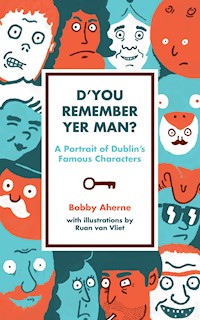
From lovable oddballs and quirky miscreants to out-and-out chancers and the certifiably insane, the streets of Dublin have been filled with an eclectic cast of characters down through the years. D'You Remember Yer Man? is aided by comic illustrations from Ruan van Vliet asBobby Aherne relates the stories of over 100 of the city's most eccentric inhabitants - the likes of Bang Bang and Hairy Yank, Shellshock Joe and Endymion. The resulting anecdotes are often hilarious and other times tragic, but always fascinating, providing an insight into the people who have passed into Dublin Folklore.
Sie lesen das E-Book in den Legimi-Apps auf:
Seitenzahl: 159
Veröffentlichungsjahr: 2014
Das E-Book (TTS) können Sie hören im Abo „Legimi Premium” in Legimi-Apps auf:
Ähnliche


















D’YouRememberYer Man?
D’YouRememberYer Man?
A Portrait of Dublin’sFamous Characters
BOBBY AHERNE
D’YOU REMEMBER YER MAN?
First published in 2014
by New Island Books
16 Priory Hall Office Park
Stillorgan
County Dublin
Republic of Ireland
www.newisland.ie
Text Copyright © Bobby Aherne, 2014
Images Copyright © Ruan van Vliet, 2014
Bobby Aherne and Ruan van Vliet have asserted their moral rights.
PRINT ISBN: 978-1-84840-377-2
EPUB ISBN: 978-1-84840-378-9
MOBI ISBN: 978-1-84840-379-6
All rights reserved. The material in this publication is protected by copyright law. Except as may be permitted by law, no part of the material may be reproduced (including by storage in a retrieval system) or transmitted in any form or by any means; adapted; rented or lent without the written permission of the copyright owner.
British Library Cataloguing Data. A CIP catalogue record for this book is available from the British Library
Contents
Foreword: C’mere Till I Tell Ya
Aidan Walsh
All Parcels
Annie Fruitcake
The Bah Man
Bang Bang
Billy in the Bowl
Billy Storey
The Bird Flanagan
Boo Paw
Bridie
The Bugler Dunne
Butty Sugrue
Cantering Jack
Captain Dempsey
Corrigan
Corny Neill
Crazy Crow
Daddy Egan
Damn the Weather
Dan Donnelly
Dancing Mary
The Dead Man
Decco the Caveman
The Diceman
Dingers
Doggypond
Elvis
Endymion
The Female Oddity
Flower
Fluther Good
The Gatekeeper
Granny Dolan
Hairy Lemon
Hairy Yank
Hamlet, Dunbar and Uncle
Harry Lipman the Ragman
The Haymarket Players
Hector Grey
Hoyer Kelly
Jack Plant
Jack the Tumbler
Jembo No-Toes
Jenny with the Dogs
Joe Edelstein
Joe Sadler
Johnny Fortycoats
Johnny Rea
Jonny Farthing
Lilian McEvoy
Lino
Liverpool Annie
Love, Joy and Peace
Lugs Branigan
Mad Moses
The Man on the Bridge
Mary Anne Night-and-Day
Mary Ockey
Mary Wallpaper
Matt Talbot
Matt the Jap
Mick McGilligan’s daughter, Mary Ann
Mickey Joe
Miler
Molly Malone
Mullinahack
Ned Get Up
Nittiney Wah Wah
One Eyeball
Owny the Fool
Paddy Carwash
Paddy Sugarstick
Paddy the Liar
Pat Ingoldsby
Peggy Leg
Plush Maggie
Pound Note
President Keely
Razorblades
Red Fitz
Shellshock Joe
Sikey
Slep’ with the Nuns
Slim
Soodlum
Stack of Rags
Stoney Pockets
Swing
Tiddle the Stars
Tie-Me-Up
Tom the Doll Man
Tom the Moon
Tom Tutty
Tommy Atkins
The Toucher Doyle
Ubi Dwyer
The Window Pest
Zozimus
184B
Epilogue
Dedicated to anybody who has ever madetheir city a more interesting place to be.
Foreword: C’mere TillI Tell Ya
To most people in this world, a ‘character’ is – by definition – a fictional being who appears in a novel, movie, cartoon, play or video game. But in a windswept little town on the east coast of a small island on the third rock from the sun, that noun has been used for years to refer to walking, talking, real-life citizens who are often even more fantastical and far-fetched than those made up by creative writers. In the arts, a character is a device designed to lead the reader or viewer through a story, helping them to understand the plot, decipher the themes and empathise with different perspectives. This is no different in the real world, where a study of the eccentric and renowned characters of Dublin allows us to trace the real history of the city. In this book, through a hundred or so individual portraits, we can observe the mindset of Dubliners over the past 400 years, through their personalities, their attitudes and – perhaps most importantly – their sense of humour and irreverence.
The art critic William Hazlitt once said that ‘a nickname is the heaviest stone that the devil can throw at a man,’ but we can safely assume that he had never been to Dublin, where – in most cases – a nickname can be worn like a badge of honour – an affectionate stone, perhaps, thrown at certain people by their neighbours and cohabitants. In fact, many of the new friends that you are about to meet possess ludicrous pseudonyms. Just look at the likes of Bang Bang, Fortycoats, or even Mad Mary – all of whom are local legends remembered with great fondness. That said, I once heard about a man who mentioned to his friends that he’d love to have a cool nickname – but expressing this desire was such a social faux pas that from that day forth, he was simply known as ‘Duckshite’. So I suppose that some nicknames are indeed better than others. Some other people who might agree with Mr Hazlitt’s theory include Hot Potato (a man with a head like a red hot potato, who would chase anyone who shouted ‘Hot Potato’ at him), Clappy (he’d chase you if you clapped at him), Wagon Wheels (he’d chase anyone who shouted ‘Wagon Wheels’ at him) and Rusty Razors (you‘re probably getting the hang of this by now). It seems like in the olden days, before the arrival of technology, there was nothing more enjoyable for a young Dubliner to do than provoking a good chase from a furious grown-up.
Some of our characters were so-called ‘knights of the road’ with no fixed abode, whose way of life might inspire pity. But they usually seemed so content in their ways that they bring to mind the meeting of Alexander the Great and Diogenes, when the king approached the resting beggar and asked him if there were anything that he could do for him. The poor man simply replied ‘Yes… stand out of my light.’ Like Diogenes, most of our motley crew seemed to have had it all sussed – although there are also a few poor unfortunates from the twentieth century who went off to war as fit young men and returned home, shell-shocked, to a place where they no longer fitted in.
As is the nature of folklore, stories change rapidly as they are passed from one person to another – a lesson that we learned early on in life through schoolyard games like ‘Chinese Whispers’ or ‘Telephone’. In modern-day Dublin, there’s a middle-aged fellow who seems to spend every day sitting outside coffee shops jotting in a notepad, dressed in a Hawaiian shirt, a garish gilet and a big fur-lined trapper hat. I once mentioned his existence to a friend and was told – very matter-of-factly – that this man had made enough money from the stock markets to afford this coffee-guzzling, people-watching, poetry-writing, flâneur lifestyle. Then somebody else told me that he had actually inherited lots of properties and was living off the rent from them. Another in-the-know observer claimed that he had made enough money as an architect to enable an early retirement. Finally, my uncle had heard that this fellow had authored a hugely successful children’s book and now lives off his royalty cheques. At least my uncle’s preposterous theory can be eliminated from the equation, as everybody knows that there’s no money in publishing. Regardless of the truth, by living an unusual lifestyle and by dressing in an unorthodox fashion, this fellow has essentially placed himself within the public domain, where his mysterious life story is up for debate and subject to gossip and rumour. Make no bones about it – this book is the product of some extreme people-watching down through the years. The fact is that people are nosey, Dublin is tiny, and its people tend to talk a whole load of shite.
Shades of primitive celebrity culture surround all of our local characters – some more so than others. One eccentric gentleman by the name of Brendan Kilkenny is always certain to turn heads around town for his waist-length, peroxide blonde mullet and dazzling array of sports jackets, shirts and ties. My brother and I have very fond memories of listening to his bizarre pirate radio show The Loveline in the 1990s, where he signed off each episode with the immortal catchphrase ‘keep on smoochin.’ In 2002, he entered the major leagues when he briefly decamped to London and auditioned for every talent competition on television – much to the chagrin of the judges. His claim that he was ‘Ireland’s number one entertainer’ was backed up by some truly astonishing scissor kicks and a tone-deaf karaoke-style rendition of 1976 Eurovision winner ‘Save All Your Kisses For Me’. He’s also famed for running singles nights, offering escort services, and for receiving a truly revolting pedicure on the British reality TV show The Salon. It’s always a delight to spot the irrepressible Mr Kilkenny in the city, still kicking – in every sense of the word.
Another character of my time was a Blanchardstown native who was never spotted without a flagon of cider in his hands, which led to him being known as ‘Two Litre Peter’. Since his passing, Two Litre Peter has been immortalised with a plaque outside of the local barbershop. Unfortunately, not all of our characters are lucky enough to be remembered in such a way – although one fittingly peculiar monument can be seen in The Coombe, where the names of a few random characters (including Johnny Wet Bread, The Lady Hogan and The Magic Soap Man) are engraved onto the steps of the portico to the old maternity hospital; the rest of the building was demolished in 1967. Fortycoats, Hairy Lemon and Bang Bang also get a mention in ‘The Mero’ by folk balladeer Pete St. John, a fellow better known for songs like ‘The Fields of Athenry’ and ‘Rare Oul Times’. ‘The Sick Bed Of Cuchulainn’ by The Pogues even gives a little nod to Billy in the Bowl – although it’s arguable whether Billy is deserving of any tributes, based on what is known about him. Apart from these few allusions, our street characters have largely been remembered in the oral tradition.
Several years ago, I decided that I wanted to read something about all of these Dubliners – the renegades, the dreamers, the outsiders, the entertainers and the madmen… the people who do whatever they feel like and don’t give a damn about what anybody else thinks. ‘That would make for a great book,’ I thought to myself, possibly aloud. Alas, no library, bookshop or website stocked such a volume, and so I took it upon myself to bring one into existence. According to Dublin oracle Éamonn Mac Thomáis, you’d often see the likes of Bang Bang, Shellshock Joe, All Parcels, Houdini and Hairy Yank cosying up next to each other along the hot wall of Thompson’s Bakery on Bridgefoot Street. But apart from that bakery wall, this ‘buke’ represents the first time that such a crowd of them have been brought together at once. Their stories are often hilarious, sometimes tragic, but always fascinating. These are the wonderful people who Dubliners remember best – the ones who elicit nostalgia, the ones who spark up conversation, the ones who induce smiles and laughs, and the ones responsible for a countless number of individuals turning to each other, smiling and saying ‘Ah, d’you remember yer man?’
Aidan Walsh
Aidan Walsh, the self-proclaimed ‘Master of the Universe,’ was born in 1954 and attended Cork’s Lota School for Boys, which he ultimately ran away from to follow his dream of becoming – in his words – ‘the head guy over the army.’ Walsh never received his promotion. After marching in a few military parades, he complained of sore feet and was discharged in 1972.
He arrived in Dublin not long before the entirety of Temple Bar was due to be razed in order to make way for a new bus terminal. In the meantime, the decrepit buildings were being rented out for next to nothing, encouraging an influx of artists and musicians to the area. Aidan and his pal Paddy Dunning took advantage of the cheap rates being offered and founded Temple Lane Recording Studios and Rehearsal Rooms. While Dunning was the more level-headed of the pair, Walsh saw the project as an opportunity to try to net himself £100,000, which he claimed was the going rate for a German inventor’s groundbreaking latest invention – a metal suit that would enable to wearer to live for a million years. According to its creator, the allocated time would start ticking as soon as the user had activated the costume’s elixir-like properties… by filling it up with their own urine. As the music studio transpired to be a great success, we can only assume that Aidan got his suit and will be around to celebrate the coming of another thousand millennia. Interestingly, the activities of Dunning, Walsh and their contemporaries actually inspired Dublin City Council; as a result of all the young, creative types infesting the area, the planned bus station was scrapped and Temple Bar was officially designated ‘Dublin’s Cultural Quarter.’
Walsh later set up a video production company. Callers to the advertised phone number got through to a busy Temple Bar pub, which Aidan used as his headquarters. Despite this slightly unprofessional touch, he managed to get hired to document a high society wedding – the union of a barrister and a solicitor. But his film-making career came to an abrupt end after he recorded the entire day’s proceedings and then realised that he’d forgotten to insert the tape.
In 1987, he signed Ireland’s fastest ever record deal, thanks to his truly unique rendition of ‘The Hokey Cokey’. His debut album A Life Story of My Life was a minor hit, with songs such as ‘Kissin’ and Eatin’ with Women’, ‘I’m the World’s Greatest Bankrobber’ and ‘Laughing My Way Out of the Army’. Around this time, it became common to see Walsh dressed in a gold suit with a cape wrapped around him and a turban on his head, riding a white horse around town.
He drew up plans to have a building on Aston Quay turned into a ‘Rock ‘n’ Roll Hotel’, with a direct underground link to Dublin Airport to grant A-list celebrities a paparazzi-free journey to and from the city. For the safety of his clientele, he also proposed a nuclear shelter to be built in front of the hotel, under the River Liffey. His ludicrous, impossible bid of £3,000,000 for the premises led to an actual bidding war with one of the world’s richest and most powerful men. Richard Branson, however, had no idea that he was competing against Aidan Walsh, so he kept offering more money. As you can imagine, it wasn’t long before the latest branch of Virgin Megastore was opening on Walsh’s dream site. On the first day of business, a disgusted Walsh, on horseback, led a procession of his fans, wearing luminous buckets on their heads, along the quays and into the shop. His stallion then emptied its bowels all over the freshly-carpeted music store. Branson’s shop went out of business in 2002; ‘The Rock ‘n’ Roll Hotel’ remains to be built.
In 1997, Walsh ran for election to the Dáil. Alas, he came in with just 0.12% of the public vote, losing out to one Bertie Ahern. Although he may not have been democratically elected as leader of Ireland, he is still universally recognised as the Master of the Universe.
Aidan Walsh
All Parcels
B ack in the day, waste paper had a value around Dublin that today’s unemployed recyclers could only dream about. A decent sackful of expired newspapers was worth a few coppers down at the lumberyard, which would help keep you in tea and bread for another day. At a time when jobs and money were as scarce as each other, collecting paper proved to be the only source of income for some of the city’s poorest citizens. Things got even more competitive when youngsters joined in, trying to cobble together enough money for a Saturday afternoon double bill down at one of the local picture-houses.
Unable to imagine a luxury such as the cinema was one old beggar woman, whose reliance on this way of life meant that people referred to her as ‘All Parcels’. In the 1930s, it was a familiar sight to see her traipsing around Thomas Street and James’s Street all day every day, gathering up every last scrap of paper she spotted. What was even more unique about her was the fact that, rather than carelessly tossing everything into a big bag, she’d delicately fold her harvest into neat little parcels, which she tucked under her arms to facilitate their transportation.
A lot of the locals felt great pity for All Parcels, but this pity was always accompanied by a pang of admiration for the fact that a desperate soul like her could fulfil her tedious daily duties with such panache.
All Parcels
Annie Fruitcake
I wish I were able to tell you that Annie Fruitcake earned her pseudonym because she was a fantastic baker who loved to give free samples of her wares to all of her neighbours. Alas, there is no evidence to suggest that she was a confectioner of any sort. Her name derived from the dual facts that she was christened ‘Annie’ by her parents and that she was as nutty as a fruitcake.
She used to sit on a rock all day, asking passers-by where they lived and threatening to slit the throats of those privileged enough to live in a private house. The children who lived in the tenements could pass by her outpost without fearing for their lives, but the posh kids would make sure that they steered well clear of Annie Fruitcake and her curious ideals.
The Bah Man
The Bah Man was a sickly looking man in his thirties who sat on O’Connell Street sketching his surroundings all day, with his shiny red nose sticking out from beneath his peaked cap. In the evening, with all of his self-imposed artistic duties fulfilled for the day, he’d stroll up and down our main street hunting for prey.
As soon as he spotted a few girls walking along together, he leapt out in front of them, flung his hands in the air and screamed the word ‘BAH!’ into their faces with terrifying volume. Usually a word lifelessly uttered in a blasé fashion to denote boredom or disinterest, The Bah Man can certainly be credited with breathing a new lease of life into the expression.
Not that this vocabular reinvention ever impressed the girls whose paths he had crossed – they’d have to take a moment to post-traumatically collect themselves before continuing along their way. Laughing away delightedly, The Bah Man continued on his quest to scope out his next unwitting victims.
Bang Bang
During the 1950s and 1960s, a bedraggled man by the name of Thomas Dudley would regularly jump on-board the back of a bus, point his weapon at the driver’s head, bark at him to ‘keep driving’, and then open fire at fellow passengers and passing pedestrians. He sometimes spiced things up for his own amusement, playing a macabre little game where the goal was to shoot everyone on the lower deck before the conductor even had a chance to call for fares.




