


13,99 €
Mehr erfahren.
- Herausgeber: The History Press
- Kategorie: Sachliteratur, Reportagen, Biografien
- Sprache: Englisch
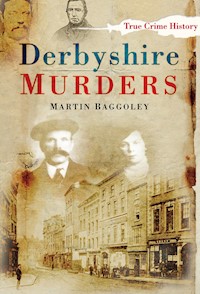
Derbyshire Murders brings together fifteen of the county's most extraordinary and shocking cases. The crimes covered made not just local but in some cases national headlines. For this fascinating, illustrated collection, Martin Baggoley has returned to original sources - including police interviews, trial transcripts and contemporary newspaper reports - to rebuild each story from scratch. Cases include a murder and robbery committed in 1842 in Stanley, and the murder of a police constable in Derby in 1879. Although the killer was sentenced to death, he was reprieved after it was revealed how the jury had reached their decision: they drew lots and tossed a coin. Also included are cases from Belper, Chesterfield, Bonsall, Glossop and Ilkeston. This unique re-examination of the darker side of Derbyshire's past is sure to appeal to all those interested in the shady side of the county's history.
Das E-Book können Sie in Legimi-Apps oder einer beliebigen App lesen, die das folgende Format unterstützen:
Veröffentlichungsjahr: 2012
Ähnliche



















Derbyshire
MURDERS
Derbyshire
MURDERS
MARTIN BAGGOLEY
This book is dedicated to my old friend, David Stubbings.
First published 2008
The History Press
The Mill, Brimscombe Port
Stroud, Gloucestershire, GL5 2QG
www.thehistorypress.co.uk
This ebook edition first published in 2012
All rights reserved
© Martin Baggoley, 2008, 2012
The right of Martin Baggoley, to be identified as the Author of this work has been asserted in accordance with the Copyrights, Designs and Patents Act 1988.
This ebook is copyright material and must not be copied, reproduced, transferred, distributed, leased, licensed or publicly performed or used in any way except as specifically permitted in writing by the publishers, as allowed under the terms and conditions under which it was purchased or as strictly permitted by applicable copyright law. Any unauthorised distribution or use of this text may be a direct infringement of the author’s and publisher’s rights, and those responsible may be liable in law accordingly.
EPUB ISBN 978 0 7524 8405 1
MOBI ISBN 978 0 7524 8404 4
Original typesetting by The History Press
CONTENTS
Acknowledgements
1. A Crime of Common Purpose
Stanley, 1842
2. A Cuckold’s Bloody Revenge
Belper, 1844
3. The Body in the Cesspit
chesterfield, 1845
4. Murdered for an Inheritance
Ilkeston, 1861
5. Murder in the Street
Chesterfield, 1862
6. The Great Jury Scandal
Derby, 1879
7. A Murder of Singular Atrocity
Derby, 1880
8. The Drowning of a Loved One
Bonsall, 1880
9. The Chamber Pot Killing
Matlock Bridge, 1883
10. Murdered for the Insurance Money
Swanwick, 1889
11. The Abortionist
Osmaston, 1898
12. The Brute
Bugsworth, 1898
13. A Matricide
Chesterfield, 1905
14. The Disappearances
Glossop, 1923
15. A Seventy-Five-Year-Old Mystery
Ilkeston, 1927
Bibliography
ACKNOWLEDGEMENTS
I would like to thank the staff at the British Newspaper Library at Colindale and at Derby Local Studies Library. I am grateful to Amy Goodwin at Buxton Museum, and to Jackie Ledder and Geoff Parker for their help with the illustrations. The support given to me by the staff at the Ramsbottom branch of The Royal Bank of Scotland has been invaluable. Thanks also to my editor, Matilda Richards, at The History Press.
1
A CRIME OF COMMON PURPOSE
Stanley, 1842
Seventy-year-old Martha Goddard lived with her sister Sarah, who was four years her junior, at the secluded Stanley Hall, six miles from Derby. It was a large residence, 100 yards from their closest neighbours, surrounded by orchards and fields, and which was approached by a private road.
The daughters of a former vicar of Tideswell, the Misses Goddard, as they were affectionately known throughout the district, had never married. They were members of one of the county’s most respectable and wealthiest families. They were noted for being charitable, kind and humane, but they also had a reputation for being rather eccentric. Fiercely independent, they lived alone and had no permanent servants. If any work needed to be done to the Hall or in the garden, the sisters hired local people from the village of Stanley. By the autumn of 1842, they had lived under the same roof for more than forty years.
Their isolated location and independent nature meant that they were vulnerable, and they had been the victims of two burglaries already that year. In April, two men had broken into their home, and, after threatening Martha, the culprits escaped with several articles of silver and a number of sovereigns.
In early September, a second burglary had occurred and several pieces of linen were taken. However, the sisters had not been disturbed, and had only become aware of the crime when they awoke the next morning. Following this, their friends attempted to persuade them to employ two live-in servants, to offer at least some protection. However, Martha and Sarah would not agree to such a suggestion, and continued to live on their own as they had for many years previously.
However, the concern for their well being, which had been shown by their friends, proved to have been well founded. At 5 a.m. on Friday, 30 September 1842, their neighbours, Mr and Mrs Scattergood, woke to the sound of Sarah hammering at their door. She was in great distress and her nightdress was covered in blood, for she had been the victim of a vicious assault. She told the Scattergoods that another burglary had occurred, that both she and her sister had been attacked, and she believed Martha to have been murdered.
The Scattergoods alerted other neighbours Mr and Mrs Hartson, and together they all made their way to the Hall, which they discovered to have been ransacked. They found Martha in her bedroom, lying on her back on the bed, her legs protruding over the side and resting on a chair. Her eyes were closed, but she was still breathing, albeit with great difficulty. Unable to speak, she was covered in blood and there was a great quantity on the bed and on the floor.
Dr Robert Boden of Smalley arrived at 7 a.m. and found Martha insensible but clinging to life. Tragically, however, she died thirty minutes later. The doctor found four severe wounds to her head, each of which was 1¾in long, and three of these had resulted in fractures to the skull, and these had been the cause of death. All had probably been caused by the same weapon, which he thought was a type of iron bar. He also confirmed that it had been used with considerable force against the elderly victim.
Other injuries included considerable bruising to the right side of her neck, a wound to her left wrist and left forefinger, bruising to the back of her left hand, and the ring finger of her right hand was fractured.
Dr Boden treated Sarah’s injuries at the scene, which, although serious, were not life threatening. There was bruising to her face, neck and hands; he found two wounds on the left side of her head, and the middle finger of her left hand was fractured. He concluded that Sarah’s injuries had been caused by a similar weapon to that which had been used against her sister.
The police discovered a ladder leaning against the wall of the coalhouse, which was about 7ft high. Several tiles had been removed from the coalhouse roof, creating a hole large enough for a man to lower himself through. Once inside the coalhouse the intruders had passed through a door into the kitchen, from which another door led into the main living area of the Hall.
Sarah told the police that the intruders demanded to be shown where their cash and valuables were kept. They took two sovereigns and a few shillings, together with several shawls, a yellow handkerchief, a brown apron and several pieces of cloth, but missed two £5 notes.
The inquest into Martha’s death was held at the White Hart in Stanley before the coroner, Henry Mozley. The jury heard evidence from the neighbours who responded to Sarah’s pleas for help, and medical evidence given by Dr Boden. Additionally, they heard Sarah’s own account of what had occurred. She told the court:
On Thursday night last, my sister went to bed about ten o’ clock. I sat up a great deal later. About half past twelve o’clock on Friday morning, I was sitting by the fire in the house place, and heard a noise like mortar falling. The sound came from the coalhouse, the door of which was open. Just as I got to it there came out of it two men who knocked me down, and afterwards went up to my sister’s room. When I was able to get up again, I went upstairs to my room, and the men came into it, and knocked me down again with heavy iron bars they had in their hands. They were very stern savage men. They stayed in the house about ninety minutes, and they then left it. Soon after they had gone I went into my sister’s room and found her lying, bleeding, on her back across the bed. I put her legs on a chair and alarmed the neighbours. When I first went in my sister said to me, ‘Sally! Sally! A man! A man!’ and she moaned. I cannot describe the men.
The inquest jury returned a verdict of wilful murder, and a reward of £100 was offered immediately by Martha’s friends for information leading to the arrest of those responsible for the crime. A few days later the Home Secretary agreed to an additional reward of £100, which included an offer to pardon any participant in the crime, if not the actual murderer, who would identify those responsible and give evidence against them on behalf of the Crown. Within twenty-four hours of the murder being committed, two local villains named Keeling and Green had fallen under suspicion and were arrested. However, it was soon established that they had not been responsible. They were released after the police received information implicating three other men in the crime, all of whom were known criminals.
News of the murder had broken during the early hours of Friday – market day in Derby – and the crime at Stanley Hall was the day’s major topic of conversation. One of those who returned home at the end of the day’s business was Joseph Simpson, a needle maker from the village of Heage. That evening he discussed the case with his neighbour, John Hulme. During their conversation, Hulme blurted out that he had been one of the burglars, and telling Simpson, ‘I’ll go and tell Bonsall, and he must tell Bland. Nobody can swear to us as nobody was there.’
The following night Hulme met a friend, known as Domino, for a drink. Domino knew that Hulme had taken part in the two earlier burglaries of Stanley Hall, and raised the matter of the murder with him. Hulme admitted that he had been present when Martha was beaten, but insisted that he had not been responsible for her death. He again named his accomplices as Samuel Bonsall and William Bland, adding that Bonsall had committed the murder.
With a reward of £200 on offer, Hulme was clearly being naïve in believing that his admitting to having taken part in the crime would not be reported to the authorities. Domino contacted Constable John Hawkins, who immediately arranged for the houses of the three men to be searched. At Bonsall’s home, a quantity of items including a flannel shirt were found; at Bland’s home, a brown apron was discovered hidden away. It was later established that all of these items had been taken from Stanley Hall on the night of the crime. At this stage, nothing was found in Hulme’s house, but Joseph Simpson, with the assistance of Richard Dronsfield, a youngster apprenticed to Hulme, would later uncover a large quantity of the items stolen from Stanley Hall, which had been buried by Hulme.
Bonsall and Bland were arrested and brought before Sarah. She did not recognise Bland, but she identified Bonsall, saying, ‘He was the man who looked stern and savage at me, and shook his fist. He also knocked me down and afterwards beat me with an iron bar.’
Hulme meanwhile had fled the area, and a reward of £50 was offered for his capture. He travelled to his hometown of Leek in Staffordshire, where his parents still lived. After a few days, during which he had remained hidden, he contacted them through an intermediary, and his mother and father assured him that it was safe to come to the house. However, they had contacted their local constable, and he was arrested as soon as he entered the family home. All three suspects were now in custody.
Twenty-four-year-old John Hulme, also known as Holme, Starbuck and Jack the Sweep, had left his parents’ home when he was eleven years old. He was apprenticed to a chimneysweep and travelled the countryside using this employment as a cover for finding houses to break into. Two of his brothers had already been transported for crimes they had committed. Samuel Bonsall, also known as Bonser, was twenty-six years old, and William Bland was aged thirty-nine. Both men were colliers, originally natives of Belper, and were known burglars.
Their trial took place on Monday, 20 March 1843, and at 7 a.m. the courtroom was already packed. Many were locked out and some of these climbed on to the roof of the court building to watch the proceedings through the rooftop windows. At 9 a.m. the trial judge, Mr Justice Gurney, took his seat and the hearing began.
The prosecution was conducted by Mr Clarke, Mr Whitehurst and Mr Fowler. Bonsall was represented by Mr Miller, but Hulme and Bland had no legal representation. The statements made by Hulme and Bland contained admissions that they had taken part in the crime, but each man attempted to distance himself from the actual murder. Unlike his coaccused, Bonsall denied any involvement and insisted he was not at the scene when the crime was committed. Each of the accused was hoping that if his version of events was accepted by the jury, he would perhaps avoid the noose.
Sarah Goddard was too distressed to attend the trial, and her identification evidence of Bonsall was therefore not presented to the jury. Nevertheless, the Crown was convinced it had a strong case against him and proceeded without her testimony.
William Bland’s account, which formed the basis of his defence at the trial, had been taken down by the police following his arrest. It had been read out in the presence of his two co-accused on 21 October, and in it he stated that:
I am innocent of the charge of wilful [sic] murder; I am innocent of that crime. I was there but on the outside. I mean on the outside of the buildings where the lady lived. Samuel Bonsall began to take the slates off and gave them me. This John Sweep as they call him, he goes by the name of John Starbuck, said, ‘Damn you, stand on one side and let me take the slates off’. There was a bit of a ladder to get up to them. John Starbuck said, ‘They have nailed a piece of wood on here since we were here before.’ Samuel Bonsall goes up the ladder and pulled it off. And Samuel came down and the Sweep went up the ladder and went through. As soon as he got through, the maiden lady I think was nigh at hand. We went in the door. The Sweep unbolted it and said, ‘Damn her eyes, I had to knock her over before I could unbolt the door’. He unbolted it – that is John Starbuck did, in the inside, and I and Bonsall went in. This was through the outer kitchen door. Samuel Bonsall and John Starbuck drove the lady upstairs. I did not offer to go up. John Starbuck said if I did not come up he would come and knock my brains out. They damned and buggered me several times, and I was forced to go up or else I was afraid for my life. Samuel Bonsall and John Starbuck were plundering – that is throwing things on to the landing. John Starbuck got this iron crow and said if I did not put the things into the bag he would knock my brains out. They broke several chests open. They broke the door open where this lady was. They got both their crowbars and sprung the door open. The old lady, her as they killed, screamed out several times, ‘Sally, come Sally!’ Samuel Bonsall struck this old lady several times over the ribs on the side. She kept screaming out like, and he struck her over the head at last. He says, ‘Damn you, I think I have cranked you at last’. I don’t know as I have anything more to say. The other old woman they said was coming out, ‘Damn her, stop her.’ We were going back towards Heage and met a man near some houses in a lane, which I understood Joseph Roe to say this morning was Woodhouse Lane. I don’t know justly the words he said. He said, ‘I think you have got something that is not your own’. Us three, Samuel Bonsall, John Starbuck and me met this man. John Starbuck says, ‘You must be thankful you are against these houses or else we should have cranked you.’ And Samuel Bonsall said, ‘Never mind him, come on.’ We went right home. They said there was 19s 6d, which they found on the premises, and they gave me 6s 6d of it. I have rather overrun my tale; John Starbuck says the old lady soon delivered up 6s 6d. That was all she had she said, and 13s Samuel Bonsall found, that made 19s 6d, they told me.
John Hulme’s defence was given in the account which had been taken down in written form when he appeared before Leek Magistrates’ Court, shortly after his arrest. It read as follows:
On Thursday, the night of the murder of Miss Goddard, Samuel Bonsall of Heage, a collier, came to see me at my house at Heage, in John Roger’s Row, about 8 o’clock at night, where I was getting my supper. My wife and her mother were present. He asked me if I would go with him to Stanley about nine miles off Heage. I asked him what for and he answered to get some money. He said there was plenty there, and I then said I would go with him. My wife and her mother were present and heard what passed. He then left my house and said he was going to William Bland’s house near the barracks, and about five minutes after he came back with Bland to my house. We all set off directly. When we got to Miss Goddard’s house, Samuel Bonsall took the slates off the low part of the building, a place where lumber and coal are kept. Samuel Bonsall then entered the place through the roof. I followed Bonsall through the hole. We let Bland in at the back door. It was bolted at top and bottom with wooden bolts. One of the ladies was gone to bed, the other was sitting up. Samuel Bonsall ill-used the lady that was sitting up, by striking her. This was in the kitchen. I could see what was passing by the light from the house place. She made her escape from him, and ran up the stairs. He followed her. She had locked the door; he prised the door open and demanded her money. I was then at the top of the stairs, and Bland was at the bottom. She gave Bonsall two sovereigns and some silver. Bonsall struck a light with a lucifer match and I saw the sovereigns and silver in his hand. Bonsall asked her if that was all the money she had, and said if she did not find more he would cut her throat, and at the same time drew a knife out of his pocket, one with a narrow pointed blade. I told Bonsall not to do any murder, but to come out of the room. He then came out and shut the door with the lady in. Bonsall then entered a room by bursting it open with a crowbar, opposite the one he had left. There was a lady in bed. I heard her shriek and Bonsall then ran towards her and knocked her brains out with a crowbar. I saw Bonsall give her the blow, he had the crowbar in one hand, and a candle in the other. The lady was just putting her feet on the floor at the time she was struck, and she fell on the floor. We then quitted the house all together. Bonsall took some calico and linen and put them in a sack, which he brought from his own house. We saw no more of the other lady. Bland was about three yards from me and I was at a distance not so far again from Bonsall when he struck the blow. We did not meet anybody either going or returning. The murder was committed between twelve and one o’clock at night. Bonsall, when he heard of the murder being made public on the Saturday night, told me that he should bury the calico and linen. I went home with Bonsall after the murder. We got there between four and five o’clock in the morning. Bonsall’s wife was sitting up. I stopped at Bonsall’s about ten minutes and then went home. I had 14s for my share of the money.
Despite the absence of a formal statement by Bonsall, the Crown had evidence provided by two prisoners who had shared a cell with him following his arrival at Derby Gaol in early October. These were William Salt, who at the time was imprisoned for not complying with a bastardy order, and John Brown, who was awaiting trial for the theft of a cow.
According to his two fellow prisoners, Bonsall told them that Hulme had called at his house on the night of the crime, and asked if he was interested in committing a burglary at Stanley. Bonsall’s wife protested at the idea and told him, ‘No my lad, go thee to bed’. Bonsall suggested that they rob a local tanner’s yard instead, as he knew a shoemaker in Belper who would buy any leather they could get hold of. Hulme, however, was not interested in this idea, and finally Bonsall agreed to go with him to Stanley.
At Hulme’s suggestion they called on Bland to ask if he wished to accompany them, and he readily agreed. The three men set off at 7 p.m. and arrived at Stanley Hall three hours later. Hulme was said to have removed the roof slates, and, on entering the house, he was confronted by Sarah, holding a poker in one hand and a candle in the other. Hulme knocked her down, and did so for a second time when she attempted to stand up.
Bonsall continued by insisting that Hulme and Bland forced Sarah upstairs, where they ransacked her bedroom, finding 12s 6d in one of the drawers. Bonsall later followed them and found Sarah screaming at Hulme, ‘Man, man, what a man you are! I’ve given you my money. Tell me what you want and I will give it to you.’ Hulme shouted back, ‘You damned old woman. I want one of those £5 notes!’, and he knocked her to the floor once again.
Meanwhile, Bland had burst into Martha’s bedroom, with Bonsall supposedly exhorting him not to harm her in any way. At this point, Bonsall claimed he went downstairs to eat some cheese he had seen in the kitchen, leaving his two accomplices with the sisters. He returned upstairs some time later, having finished his meal, and on reaching Martha’s room he heard Hulme say, ‘I think we have nearly finished her, and now we’ll go’.
Bonsall described his own weapon as a poker with a turned up tip; Hulme’s was a strong piece of iron; and Bland’s was a piece of wood lined with lead. He told Salt and Brown that all three weapons had been buried and would never be found.
Joseph Roe, a farmer who lived at Smalley Mill, was in Woodhouse Lane at 2.30 a.m. on the morning of the murder. He testified that he met the three accused, travelling from the direction of Stanley, heading towards Heage, which was about three miles from the spot where they met. Each of the men was carrying a bundle over his shoulder. Suspicious, Joseph said, ‘Hullo my lads, have you got fighting cocks in your bags?’ Bonsall, who Joseph knew, replied, ‘What do you say?’ Joseph suggested that they had been up to no good, as he was convinced they had stolen goods in their bundles.
Bonsall said to his two companions, ‘Let’s kill the bastard!’ A defiant Joseph retorted, ‘Come on, come on then!’ Bonsall took a few paces towards him, but Bland called out, ‘Oh come away, we have done enough for tonight’.
Another prosecution witness, Elizabeth Wainwright, who lived in Heage, also provided important evidence. She lived only a few yards from Bland’s house, and could see if his door was open. On the night of 29 September she saw Bonsall arrive, and later noticed the three accused leave the house and make their way out of the village in the direction of Stanley. Importantly, having risen from her bed early in the morning to see her son off to work, she also saw the three men arrive back at the house several hours later, at about four o’clock.
Seventeen-year-old Richard Dronsfield was employed as an apprentice chimneysweep by Hulme, and lived in his employer’s house. He testified that on that same evening, Bonsall called at the house and he heard him ask Hulme, ‘Are you ready?’ Hulme finished his supper after which the two men left. He saw Hulme put a bag and two short staves in his pockets, together with a knife he had made out of a razor. The youngster could also see that Bonsall had brought an iron crowbar with him.
Richard slept on the floor downstairs, and was woken by the two men when they returned in the early hours of the following morning. The fire was still lit and the youngster could see that Hulme’s bag was full of various items. He and Bonsall examined their clothes for blood, and having found some they wiped it off. Richard could also see that Bonsall had blood on his left hand.
Richard saw Hulme empty his bag, which contained two shawls, some stockings and other items of clothing. There were several pieces of material, and he heard Hulme say, ‘This will make thee and me some waistcoats’. He also heard him say that he thought one of the shawls might be worth as much as 30s. Having thrown the staves into the fire, Bonsall left the house.
At six o’clock that morning, Richard left to sweep a chimney, and when he returned a few hours later, he found the three accused at the house. Hulme led the other two to the door, saying, ‘Its all clear, you may go now’. Bonsall returned the following day, and he and Hulme decided to bury the proceeds of the crime in the garden of a neighbour, John Rogers.
Upon hearing of the arrest of his two accomplices, Hulme took Richard to the garden where the booty was buried, and moved it, apparently worried lest Bonsall tell the police where it was, thus incriminating him in the crime. The pair then travelled to Leek and on the journey Hulme admitted to his apprentice that he had taken part in the burglary, but insisted that Bonsall and Bland had killed Martha.
After hearing of Hulme’s arrest, Richard wandered the countryside, worried lest he be considered a suspect. He eventually returned to Heage several weeks later, where he contacted Joseph Simpson. The two of them retrieved the proceeds of the crime that had been reburied by Hulme and took them to Constable Hawkins. These proved to be valuable items of prosecution evidence, as neighbours and friends identified them as having belonged to the Goddard sisters. Importantly, they also confirmed that they had seen them in the sisters’ possession after the two earlier burglaries that year, so the items could only have been taken on the night of the murder. Far from being considered a suspect, Richard was viewed as a crucial Crown witness, and so he proved to be at the trial.
Although it did not link Bonsall directly to the crime, further damning evidence was provided by a fellow prisoner, Benjamin Potter, who was in Derby Gaol awaiting trial for police assault. Given his status as a prisoner facing trial for a capital offence, Bonsall was not permitted to send any uncensored mail out of the gaol. He therefore attempted to gain Potter’s assistance in smuggling a letter out to his father, written on a page torn from a Bible, obviously in the hope of establishing an alibi; it read:
You must get Varges in come and sware he saw me stand in the yard in my short pising as I was going to call Abraham Jackson to go to work and I asked him what o clock it was, and he said it was about two, and olievar was in the little house and he asked me if I was going to work and I said I was not. It was about half past one I was doing a job for myself in the garding before the door. I was in my shirt. You must let me know if they will come.




