


8,39 €
Mehr erfahren.
- Herausgeber: Luath Press
- Kategorie: Sachliteratur, Reportagen, Biografien
- Sprache: Englisch
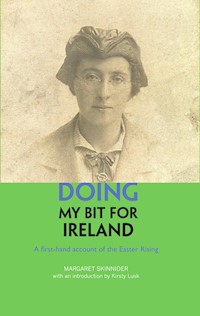
Whether by gun or words, Margaret was committed to an Ireland in which everyone was valued for their contribution, and were not discriminated against for gender or class. (from the Introduction by Kirsty Lusk). Published in the UK for the first time in this landmark Easter Rising centenary edition, with introduction and footnotes by Kirsty Lusk, Doing My Bit For Ireland is Margaret Skinnider's eyewitness account of Dublin's 1916 Easter Rising. The Easter Rising was a key event not just for socialists and nationalists in Ireland, but also for women and supporters of women's suffrage. Coatbridge-born to Irish parents, schoolteacher Margaret Skinnider risked her life in armed combat for a nation that she claimed in her heart as hers despite her early life in Scotland. Despite serious gunshot wounds during battle, Margaret was later refused an army pension on the grounds that they were only to be awarded 'to soldiers as generally understood in the masculine sense'. Providing an unusual and much needed female perspective on rebellion and battle, Doing My Bit was written in the USA in the two years following the Rising, and was published only in the States before going out of print. With this edition, Skinnider's lively and informative voice is made audible again, 100 years after she took part in the rising which led eventually to the partition of Ireland.
Das E-Book können Sie in Legimi-Apps oder einer beliebigen App lesen, die das folgende Format unterstützen:
Veröffentlichungsjahr: 2017
Ähnliche

















MARGARET SKINNIDER (1893–1971) was born to immigrant Irish parents in Coatbridge, North Lanarkshire. A mathematics teacher, she joined the Glasgow branch of Cumann na mBan in 1915 and became involved in smuggling detonators and bomb-making equipment into Ireland. During the Easter Rising she was a sniper and despatch rider attached to James Connolly’s Irish Citizen Army and stayed in Dublin at the home of her mentor, Countess Markievicz, the unofficial headquarters of the rebellion. Shot while setting fire to houses in Harcourt Street, she was taken to hospital where she was interrogated before being released. Doing My Bit For Ireland was published in 1917 in New York, where she stayed for some years before returning to Dublin where she resumed teaching and became a leading member of the Irish National School Teachers’ Association.
KIRSTY LUSK is a doctoral candidate at the University of Glasgow. She received her mPhil in Irish Writing from Trinity College Dublin and holds an MA (Hons) in English Literature from the University of Glasgow. She is currently researching Scottish-Irish connections in the late 19th and early 20th centuries from a literary perspective in order to explore the legacy of independence, equality and commemoration within a comparative Irish-Scottish framework. She was the co-editor of Scotland and theEaster Rising and is currently editing a new edition of Nora Connolly’s book, The Unbroken Tradition.
Doing My Bit For Ireland
A first-hand account of the Easter Rising
MARGARET SKINNIDER
First published by The Century Co., New York, 1917
New edition 2016
eISBN: 978-1-910324-86-8
Typographical arrangement, foreword and timeline © Luath Press Ltd
Contents
Foreword by Kirsty Lusk
Timeline
Introduction by Margaret Skinnider
Chapter 1
Chapter 2
Chapter 3
Chapter 4
Chapter 5
Chapter 6
Chapter 7
Chapter 8
Chapter 9
Chapter 10
Chapter 11
Chapter 12
Chapter 13
Chapter 14
Suggested Further Reading
Foreword
Kirsty Lusk
THE NAME OFMARGARET SKINNIDER (1892–1971) should be more widely known, and her vital contribution to the struggle for Irish independence more fully acknowledged, both in the centenary year of the Easter Rising and beyond. A 23-year-old schoolteacher from Coatbridge in Scotland, Margaret joined the Irish Citizen Army and fought as a dispatch rider and sniper during Easter Week. She was commended three times for bravery in dispatches to the General Post Office. Her participation was cut short when she was shot three times in the back on Wednesday 26 April 1916. Margaret was the only female combatant to be severely wounded. Her contribution to the events of 1916 did not stop at arming herself and risking her life.
In 1917 Margaret’s memoir, Doing My Bit For Ireland, was published in New York by Century Company. It was one of the first personal accounts published by a participant and did much to share the rebels’ story and encourage American support for the Irish cause. Doing My Bit For Ireland is an important perspective on Easter Week and one that provides a fascinating insight into the role of women in 1916. Margaret’s writing focuses on the importance and bravery of these female participants, regardless of their role in the conflict, and outlines their professionalism in the face of great risk. Yet she also explains the reasons that they took those risks, and why she did. For Margaret, nationalism, feminism and equal rights for social classes intersected naturally. Margaret saw national self-determination as the method by which to improve social conditions, to do away with the slums of Dublin and improve the lives of children, to bring about equal suffrage and allow women their say in politics. Whether by gun or words, Margaret was committed to an Ireland in which everyone was valued for their contribution, and no one was discriminated against for gender or class. In this respect, it is clear to see why her story is still so relevant today. Inequality was Margaret’s most hated enemy, and the one she would fight against her entire life.
Margaret Skinnider was born on 28 May 1892 at 116 Main Street, Coatbridge, to James Skinnider, a stonemason from Tydavnet, County Monaghan, Ireland, and Jane Doud from Barrhead, Renfrewshire. Her parents married on 20 November 1880 in Bothwell and Margaret was brought up with five older siblings Thomas, James, Isabelle, Joseph and Mary, and one younger sister Catherine, who often went by her middle name Georgina. The family travelled to Monaghan every summer for their holidays, Margaret’s first introduction to Ireland. By 1901, the Skinniders had moved to 64 St John Street in Maryhill, Glasgow, now known as Barron Street. Margaret followed in her older sister Isabelle’s footsteps and trained as a teacher before working at St Agnes’ School in Lambhill, Glasgow. She lived at 14 Kersland Street, Hillhead, in Glasgow’s West End with the rest of her family, although her older brothers regularly travelled and were often away, including visits to Quebec and New York.
In 1914, Margaret became involved in the suffrage movement in Scotland and described herself as known to the police as a militant suffragette, of which there were estimated to be around 100 in Scotland. The suffragettes’ actions included burning down buildings and pouring acid into letterboxes to destroy the mail. It is a point often raised that 1916 was a violent uprising, but it did not arise out of a vacuum. A culture of arms, violence and war existed across Britain and Ireland in their entirety by 1914 and Margaret’s introduction to this came through physical force suffragism in Scotland, not nationalism. On 10 June 1914, Margaret was present at the protests outside Perth Prison against the violent force-feeding of the imprisoned suffragettes who had been on hunger strike. Margaret joined the picket line outside to allow Helen Crawfurd, a Scottish suffragette and communist who supported home rule, to attend the Royal Visit to Perth. Suffragettes would interrupt the visit but according to Helen, Margaret ‘had no time for Kings and Queens’.1
In 1914 Margaret also joined the Irish Volunteers in Glasgow. The military organisation had been formed in Ireland in 1913 in response to the signing of the Ulster Covenant and the formation of the Ulster Volunteers in 1912. The Ulster Volunteers were organised to stop the implementation of Home Rule for Ireland at any cost; the Irish Volunteers emerged to safeguard Home Rule. A civil war seemed likely. The Home Rule bill was agreed by the House of Commons in 1914 – at the same time as a Home Rule bill for Scotland – but political change was put on hold by the outbreak of the First World War in August 1914. Members of the Irish Volunteers and Ulster Volunteers alike signed up to fight for the British Army. The Irish Volunteers split in September 1914. The majority followed parliamentarian John Redmond, who believed that by proving their loyalty, they would ensure the implementation of Home Rule when the war drew to an end. The reorganisation after the split placed the secretive Irish Republican Brotherhood (IRB), committed to Irish independence, in a stronger position amongst the remaining Irish Volunteers.
In April 1914, Cumann na mBan (The Women’s Council) was formed. The female paramilitary organisation stated in its constitution that its purpose was to ‘advance the cause of Irish liberty and to organise Irishwomen in the furtherance of this object’. The majority of the organisation supported the Irish Volunteers who rejected the call to sign up to the British Army in 1914. When the Anne Devlin branch of Cumann na mBan was set up in Glasgow in mid-1915, Margaret Skinnider joined the organisation. In October 1915, Margaret assisted in a raid on Henderson Admiralty Shipyard in Partick, Glasgow, for weapons to send over to Ireland. According to her colleague, Seamus Reader, it was a failed attempt. What they had believed would be a 12-pounder ship’s gun turned out to be a fire extinguisher beneath a tarpaulin. Along with other Cumann na mBan members, Margaret had been tasked with observing the wall and footpath whilst the Volunteers searched the shipyard.
Skinnider’s preparations for the Rising extended beyond acting as a lookout. Margaret learned to shoot in one of the rifle practice clubs in Glasgow, which had been formed to enable women to help in defence of the British Empire in case of invasion. She became an expert shot.
There were tensions over the activities of Cumann na mBan however, and the relationship with the men’s organisation, the Irish Volunteers. In October 1915, Constance Georgine Markievicz, Countess Markievicz (1868–1927), a suffragette, Irish nationalist, socialist and trade unionist complained that ‘[t]oday the women attached to the national movements are there chiefly to collect funds for the men to spend’.2 Markievicz would soon become a powerful role model for Margaret, who shared her strong beliefs and also her wish for active participation in the struggle for Irish independence. At Christmas 1915, Margaret travelled to Dublin to meet with Countess Markievicz for the first time. Margaret crossed the Irish Sea at night, with bomb detonators hidden under her hat, the wires wrapped around her body beneath her coat.
It was an eventful trip. Whilst in Ireland Margaret would test explosives in the Wicklow Hills, practise shooting while disguised as a male member of the boy scout organisation Na Fianna Éireann, draw up plans of the Barracks for dynamiting and meet both Thomas MacDonagh and James Connolly.
In January, however, Margaret was forced to return to Glasgow to resume her teaching work in the city. It was a difficult time for her with little information about plans for the Rising reaching Glasgow. Conscription came into force in Scotland in February 1916.
Irish Volunteers called up for the British Army would slip across the Irish Sea and join the garrison at Kimmage, to fight for Ireland when the Rising began. Not all of the West of Scotland Volunteers received as much information however. John Mulholland, Scotland’s Representative on the Irish Republican Brotherhood Supreme Council in 1914, and president of the organisation, had voted against staging an uprising before the end of the war, likely for constitutional reasons. Mulholland resigned and left the organisation immediately after explaining his decision to the circles in Glasgow. His replacement as Scottish Representative, Charles Carrigan, would become a member of the Kimmage Garrison after being conscripted and was killed in the Moore Street charge alongside The O’Rahilly. Mulholland’s influence would have its effect however. When news of the planned Rising was communicated to Mulholland, he did not inform the executive in Glasgow until Saturday 22 April, stopping the Scottish forces from mobilising in time. Around 56 Scots were members of the Kimmage Garrison during the Rising, but many Irish Volunteers in the West of Scotland would know nothing of the events of Easter Week until they were reported in the Scottish newspapers, by which time it was too late.
For many of the Irish organisations in Ireland, anti-recruitment efforts constituted a major element in their plans. Two hundred thousand Irishmen fought in the First World War and between 30,000 and 49,000 Irishmen were killed.3 There was a realistic threat of conscription, and economic conscription had already been put into practice. Men were being released from jobs or turned away from work with the intent that they would take up paid employment in the army – known as the ‘King’s Shilling’. It was a highly effective method in encouraging the lower classes to enlist. It was not the only method at the disposal of the British Government however.
Irish recruitment agents appealed to Irishmen to protect the rights of small nations, a move seen as deeply ironic by many Irish nationalists. James Connolly wrote that:
In India, in Egypt, in Flanders, in Gallipoli, the green flag is used by our rulers to encourage Irish soldiers of England to give up their lives for the power that denies their country the right of nationhood.4
The anti-war movement was not just about nationalism. For Connolly, whom Skinnider deeply admired, the First World War was an imperialist and capitalist venture that set the working classes against each other. It had been Connolly’s hope that socialists across Europe would come together in rejection of the war, but he was sorely disappointed. Connolly wrote that:
[there were those of] us who believe that the signal of war ought also to have been the signal for rebellion, that when the bugles sounded the first note for actual war, their notes should have been taken as the tocsin for social revolution.5
There would not be the Europe-wide rejection of war that Connolly had hoped for, but he made his opinion clear. From Liberty Hall there hung a sign just prior to the Rising:
WE SERVE NEITHER KING NOR KAISER, BUT IRELAND
It was as much a rejection of the ongoing war as it was a statement of national self-determination.
The Irish fighting in the British army in this period have remained largely unseen and undiscussed until recent years. These Irish soldiers who fought for the British army would return home to an Ireland ‘changed utterly’, to a Dublin that had been shelled by the British army they had been fighting for. Two hundred and sixty civilians were killed during Easter Week; many more were injured. In the trenches on the front, the German soldiers held up a sign to the Irish soldiers that stated ‘The military are shooting down your wives and children in Dublin.’ Those Irish soldiers who had gone out to fight for Ireland – as rebels or members of the British army – would find themselves remembered very differently. In the initial aftermath of Easter Week, however, responses to the actions of the rebels were overwhelmingly negative, likely because so many Irishmen were fighting abroad at the time. It was with the executions of the leaders of 1916, amongst others, and the stories about those who had participated in the Rising, that opinion began to change.
It was for this reason that Margaret would tell her story.
Easter Week 1916
On Holy Thursday, 1916, Margaret Skinnider returned to Dublin and joined the Irish Citizen Army (ica) in Liberty Hall at the invitation of Countess Markievicz. The ICA was formed of workingmen and women and had been set up in 1913 by James Connolly and Jim Larkin after the atrocities visited on strikers and crowds during the Dublin Lockout. A smaller organisation than the Irish Volunteers, they numbered around 250 and would drill openly in Dublin. The ICA was unique amongst the Irish military organisations of the time in that it allowed women to join and participate to the same extent as men. Countess Markievicz claimed that ‘[t]here were a considerable number of ICA women. These were absolutely on the same footing as men’, and that ‘Connolly made it clear to us that unless we women took our share in the drudgery of training and preparing, we should not be allowed to take any share at all in the fight’.66 It was not the same in other organisations: ‘At first, members of Cumann na mBan were turned away from many posts, including the GPO. When this news filtered back to the leaders a directive was sent to accept any of the women who wished to take part’.7 This did not mean that all were in agreement however:
De Valera refused to have women participate at his outpost. He did not want women who were untrained for soldiering. Afterwards he admitted that he was sorry that he had not used their help, as some of his best men were engaged in cooking rather than fighting.8
According to Sinead McCoole, ‘Edward Daly was another who only accepted women into his garrison upon receipt of the directive from the GPO’.9 Even in the GPO there continued to be bias against women: Catherine Rooney (née Byrne) relates in her witness statement how she had to enter the GPO through a window with the aid of two Volunteers after having been refused at the main entrance. Connolly’s Irish Citizen Army, however, continued to treat male and female participants equally. For Connolly as for Skinnider, nationalism, feminism and socialism were bound together. It was for this reason that many female participants in Easter Week were members of, or became attached to, the Irish Citizen Army. Amongst their number were Dr Kathleen Clarke, Helena Molony, Elizabeth Farrell and Julia Grenan.
As an ica member, Skinnider was immediately put to work. Preparations were well under way in Liberty Hall for the Rising, and Citizen Army members surrounded the hall as it had barely avoided a raid thanks to the quick thinking of Connolly and Markievicz. The sense of urgency was heightened by the secret order for the arrest of members of all Irish organisations in Dublin, including the Irish Citizen Army and Irish Volunteers which Connolly showed to Skinnider. After being sent to work making cartridges, Skinnider was given a dispatch to take to Connolly’s house in Belfast in the evening. It was here that she met Connolly’s daughter, Nora. The two women were of a similar age, both around 23, and went on to become lifelong friends. Mrs Connolly and her daughters returned to Dublin with Skinnider after the dispatch had been delivered. The following days were spent in continued preparation.
The intended date for the start of the Rising was Easter Sunday, 23 April 1916. This was delayed, however, thanks to a demobilisation order for the Irish Volunteers. The order was given by Eoin MacNeill, triggered by the sinking of the Aud and the loss of a great number of arms. Though Patrick Pearse challenged the order it had a lasting effect, and the number of combatants was greatly reduced, bringing an end to any potential for an uprising across the whole of Ireland. The Irish Citizen Army in its entirety (219 men and women) alongside the four battalions of Irish Volunteers in Dublin combined to form the first Irish Republican Army. The Rising began on Monday 24 April.
During the Rising, Margaret was attached to the St Stephen’s Green garrison, under the command of Michael Mallin and Countess Markievicz. St Stephen’s Green is a public park of 20 acres on the south side of Dublin, roughly a mile from the General Post Office. A major transport hub, it had symbolic as well as militaristic importance. At the north entrance to the park is Fusilier’s Arch, erected in 1907 to the war dead, known locally to nationalists in 1916 as ‘Traitor’s Arch’. Mallin successfully seized Harcourt Street Station, cutting off transport links. Unfortunately, lacking the numbers to take the surrounding buildings as well as the park itself, it was impossible to hold the Green for any length of time, particularly once the army erected a machine gun on the roof of the Shelbourne Hotel.
Margaret worked as a scout and dispatch rider, a dangerous role that took her across Dublin and regularly saw her face machine gun fire. Whilst carrying dispatches, Margaret saw the charge of the 5th Lancers on O’Connell Street and the raising of the Irish flag over the General Post Office. In the early hours of Tuesday, Margaret was sent with a dispatch to the gpo when those encamped in St Stephen’s Green were forced to evacuate and retreat to the Royal College of Surgeons by the machine gun fire from the Shelbourne. Margaret had barely returned when she was sent out again to bring in the 16 men guarding the Leeson Street Bridge. Margaret was successful but had to brave the gunfire several times in her continued dispatch work.




