


Erhalten Sie Zugang zu diesem und mehr als 300000 Büchern ab EUR 5,99 monatlich.
- Herausgeber: THP Ireland
- Kategorie: Sachliteratur, Reportagen, Biografien
- Sprache: Englisch
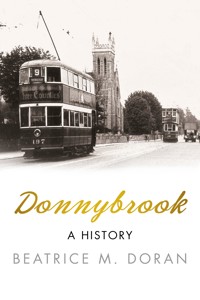
Donnybrook is one of the most iconic areas of South Dublin, a prosperous and peaceful suburb that is well-known as the being the heartland of Leinster Rugby. It derived its name, however, from the violence and carousing that were a regular feature of the area in the 1800s, and this book tells the story of the development and the journey from these inauspicious beginnings to its current form through a series of rare and beautifully produced photographs.
Sie lesen das E-Book in den Legimi-Apps auf:
Seitenzahl: 251
Veröffentlichungsjahr: 2013
Das E-Book (TTS) können Sie hören im Abo „Legimi Premium” in Legimi-Apps auf:
Ähnliche


















In memory of
Sr Vincenzo O.P. (Sr Meabh Ni Cleirigh),
an inspirational history teacher
And
Claire Baylis (née) Dowling, MA, DLIS,
lecturer in librarianship and historian
The disadvantage of men not knowing the past is that they do not know the present. History is a hill or high point of vantage, from which alone men see the town in which they live or the age in which they are living.
G.K. Chesterton, All I Survey (1933)
Leaving town by what was formerly known as the Donnybrook Road, but which, since its accession to respectability, has become the Morehampton Road, we enter Donnybrook, now almost merged in the populous district around it, though still retaining its distinctive character as a village. Few of its old features, however, now remain, its quaint inns are gone, its thatched cottages have vanished, and the whole place has assumed a less rural appearance than it possessed in the days when the ‘glories’ of its Fair shed around it their halo of renown.
W. St Joyce, The Neighbourhood of Dublin (1912)
ACKNOWLEDGEMENTS
So many people and institutions helped me in writing this book. I am grateful in particular to the staff of the following institutions:
Ballsbridge, Donnybrook & Sandymount Historical Society, Chester Beatty Library, Dublin City Libraries – the Gilbert Library Pearse Street, Pembroke Library, Irish Architectural Archive, Irish Music Archive, National Library of Ireland, National Photographic Archive, Representative Church Body Library, Royal Dublin Society Library, RTÉ Library, Ordnance Survey of Ireland – UCD Libraries, Belfield, Blackrock, Richview, and the Department of Archives, Society of Friends, G. & T. Crampton, Fugimerrion, (Conor McCarthy) and Scott Tallon Walker.
Thank you too to the following people who provided me with information and images of Donnybrook:
Reverend Ted Ardis, Richard Ashen, Sr Barnabas OP, Julia Barrett, Ann Barry, Nick Bradshaw, Rosemary Brady, Sean Brennan, Dr Cliona Buckley, Dr Eileen Campbell, Valerie Clancy, Dr Mary Clark, Andrew Clinch, Enda Cogan, Dr Lisa Cogan, Anne Coleman, Con Collins, Mary Coolahan, Valerie Clancy, Elaine Bastable Cogavin, Nieves Roche Collins, Glenda Cimino, David Crampton, Peggy Hickey Curran, Joe Curtis, Maurice Curtis, Yvonne Davis, Anton Daltun, Professor Fergus D’Arcy, Mary Smyth Dee, Desmond Delany, Joanne Donnelly, Glynn Douglas, Elizabeth Dunne, Honora Faul, Penelope FitzGerald, Eithne Frost, Pascal & Mary Fuller, Fr Seamus Galvin, Maire and Lisa Godfrey, David Griffin, Dr Stephen Harrison, Elizabeth Hartford, Anne Henderson, Seamus Helferty, John and Jacqueline Holohan, Dr Vivien Igoe, Frances Kavanagh, Tony Kearney, Ben Kealy, Joan and Mary Keenan, Kevin Kelleher, Mary Kelleher, Dr Donal Kelly, William Kelly, Dr Maire Kennedy, Susan Kennedy, Frances Kiely, Deirdre Ellis King, Elizabeth Kirwan, Dr Ita Kirwan, Dermot Lacey, Jean Lane, Sheila Larchet, Denis and Gillian Leonard, Alan Little, Lorna Madigan, Conor McCarthy, Kathleen McCloskey, Stephen McCormack, Patricia McKenna, Madeleine McKeown, Deirdre Mac Mahuna, Dr Ruth McManus, Prof. Ged Martin, Eithne Massey, Veronica Meenan, Christopher Moriarity, Paul Murphy, Honor O’Brolochain, Anne O’Byrne, Angela O’Connell, Tim & Ann O’Driscoll, Maeve O’Leary, Nora O’Leary, Patricia O’Loan, Hugh Oram, Dr Dagmar O Riain, Professor Padraig O Riain, Sister Patrice, Sheila O’Shea, Danny Parkinson, Madeleine Parkinson, Dr Michael Pegum, Margaret Pettigrew, Annette Sorahan Quigley, George and Jane Reddan, Dr Raymond Refusee, Sarah Jane Roe, Anne Sheppard, Brian Siggins, Joan Soraghan, Eileen Spelman, Marguerite Stapleton, John Steele, Annette Sweeney, Sean Tobin, Grace Toland, Liz Turley, Dr Elizabeth Twohig, Sally Walker, Margaret Walsh, Gerard Whelan, Gail Wolf, and the Woods family.
Many thanks are also due to Ronan Colgan, who commissioned this book, and to my editor Beth Amphlett and the staff of The History Press.
Every effort has been made to identify, trace and contact the copyright owners of all the images used in this book.
CONTENTS
Title
Dedication
Epigraph
Acknowledgements
Foreword
Introduction
1.
Early History and Institutions
2.
The Donnybrook Fair
3.
Schools and Colleges
4.
Sports and Leisure
5.
Trams and Buses
6.
Donnybrook Shops
7.
Familiar Roads and Historic Houses
8.
Well-Known Residents
Conclusion
Select Bibliography
About the Author
Copyright
FOREWORD
From pre-Celtic times Donnybrook has featured in the annals of history, firstly as a place of hospitality on one of the four roads south from Tara of the High Kings, then as a place of worship, close to the River Dodder, not far from the sea, where a holy woman, Broc, one of the seven daughters of Dalbronach, is reputed to have had a place by a well for pilgrims – hence we have the name Domnach Broc. Later, with the coming of the Normans, we have the Charter of King John 1204, granting the City of Dublin the right to hold a fair, which, as the Donnybrook Fair, continued to 1855.
Up to the eighteenth and into the nineteenth century, Donnybrook was a tranquil village by the River Dodder to which people came to enjoy peaceful sojourns south of the city. In the eighteenth and nineteenth centuries industries developed in the area, such as the cotton and calico mills, a hat factory, and quarries. In the nineteenth century landowners like the Fitzwilliams, later the Herberts, Earls of Pembroke, the Scotts, Earls of Clonmel, Riall of Old Conna and Branston-Smith, all saw the potential to develop a suburb south of the city. They laid out roads and leased plots for house-building from the 1830s, and so we saw the transformation of a rural village into a suburban arcadia.
Accounts of the history of the area from earlier writers on Donnybrook – authors like Revd Beaver Blacker and Francis Elrington Ball, to later works by Deirdre Kelly and Dr Seamus Ó Maitiú – have opened the way for further research and so additional research on Donnybrook resulting in the present book by Dr Beatrice Doran is most welcome!
The initiative of Liz Turley, librarian at Pembroke Library, in inviting a group in the area to form a Historical Society bore fruit in 2006 when the Ballsbridge, Donnybrook & Sandymount Society was formed. The society’s inaugural lecture on ‘The Humours of Donnybrook, being the story of The Donnybrook Fair’, was given by Dr Seamus Ó Maitiú and held at Ballsbridge College of Further Education in January 2007. The first major project undertaken by the society was the staging of a display to celebrate the centenary of the Irish International Exhibition of 1907, held on the ground now Herbert Park. The support and collaboration of the Royal Dublin Society in funding and hosting this project was of much value to the area, and greatly appreciated by the society.
Donnybrook has the unique distinction of having representation of institutions ecclesiastical, educational, social and commercial, in its midst, in the churches, schools, businesses, shops and in the many sports and leisure facilities which support the community and the leisure of its citizens. This book, encompassing the origins of Donnybrook and the development of all these facilities to the present day, is a most welcome addition to Dublin’s local history.
John R. Holohan, BCL, BL
Chairman
Ballsbridge, Donnybrook & Sandymount Historical Society
April 2013
INTRODUCTION
I was born and reared in Donnybrook, educated there (Muckross Park and University College Dublin) and still live there. This book is not a comprehensive history of Donnybrook, but rather an overview and contribution to the history of my native place.
The book begins with the early history of Donnybrook and a number of sources must be acknowledged, such as Mrs Moyra Gorevan’s article on Donnybrook in the Dublin Historical Record that provided an excellent introduction to the history of Donnybrook. The Revd H. Beaver Blacker’s Brief Sketches of the Parishes of Booterstown and Donnybrook (1861) was another important resource, as was the Revd N. Donnelly’s History of Donnybrook Parish (1912). Father C.P. Crean’s Parish of the Sacred Heart proved invaluable, as did Danny Parkinson’s book Donnybrook Graveyard. Richard Lattimore’s The Real Donnybrook was also consulted. L.J. Lennan’s ‘Growing Up in Donnybrook 1910-1930’, transcribed by his son, was another useful source and is available online at www.rootsweb.ancestry.com/~lennan/len003.htm. A comprehensive local history of interest is Martin Holland’s book on Clonskeagh and Mary Daly’s Dublin: The Deposed Capital was a wonderful resource for nineteenth- and twentieth-century Dublin. The national broadcasting centre of RTÉ is also included in this chapter and Richard Pine’s comprehensive book 2RN and the Origins of Irish Radio was a delight to read regarding RTÉ radio. John Bowman’s Window and Mirror: RTÉ Television 1961-2011 was also extremely helpful.
Chapter 2 tells the story of Donnybrook Fair. As well as descriptions of the fair in the Freeman’s Journal and the Dublin Penny Journal, Seamus Ó Maitiú’s book The Humours of Donnybrook and Professor Fergus D’Arcy’s article ‘The Decline and Fall of Donnybrook Fair’ were excellent sources of information on the fair. Schools and colleges in Donnybrook are discussed in Chapter 3. Some of the schools very kindly provided me with histories and accounts of their schools; some were individual publications, while others had been published in school magazines over the years.
Sports and leisure facilities and activities in Donnybrook are discussed in Chapter 4. Here the local sports clubs were a valuable source of information on their history and activities. The Record of the Irish International Exhibition of 1907, held in Herbert Park and published two years after the event, was a detailed account of the exhibition. The Great White Fair by Brian Siggins together with Ken Finlay’s book The Biggest Show on Earth were most informative. Dermot Lacy, the local Labour councillor, very kindly provided me with a transcript of the ‘History of the Donnybrook Boy Scouts’ that he is currently writing.
Local transport is the topic for Chapter 5 and it covers the early history of transport together with details of the trams and buses that served Donnybrook over the years. Michael Corcoran’s Through Streets Broad and Narrow was a most interesting account of the Dublin trams, while Dublin Tram Workers by Bill McCamley provided an insight into the lives of the tram workers during the period 1872 to 1945.
Shops and businesses in the 1950s and 1960s are the topic of Chapter 6. Members of several of the families who had shops or businesses in Donnybrook provided me with additional information on them. Thom’s Directories dating from the nineteenth century were another major source of information.
Historic roads and houses are discussed in Chapter 7. Again, Mary Daly’s book Dublin: The Deposed Capital was invaluable. The history of the Pembroke Township was covered in detail by Seamus Ó Maitiú in his book Dublin’s Suburban Towns. Constantia Maxwell’s Dublin under the Georges is still one of the standard books on the topic as is Maurice Craig’s Dublin 1660-1860: A Social and Architectural History. Ruth McManus has written a comprehensive account – Dublin 1910-1940: Shaping the City and Suburbs – and Dr McManus is also the author of Crampton Built: A History of G & T Crampton, about the well-known Dublin builders.
Chapter 8, the final chapter, provides an account of some of the more well-known people who have lived in Donnybrook over the years, including politicians, local councillors, writers, poets, actors, composers and artists.
The aim of this book is to provide residents and friends of Donnybrook with an overview of the history and facilities of the area.
Dr Beatrice M. Doran
April 2013
Ordnance Survey Map of 1837. (Ordnance Survey Ireland/Government of Ireland, Copyright Permit No. MP003513)
Ordnance Survey Map of 1837. (Ordnance Survey/Ireland/Government of Ireland, Copyright Permit No. MP003513)
1
EARLY HISTORY AND INSTITUTIONS
Donnybrook is one of Dublin’s many suburban villages. It is situated on the southeast side of the city, two and a half miles from the General Post Office in O’Connell Street. There is historical evidence from the Annals of the Four Masters (1632-1636) that there were five principal highways (slighes) which led to and from Tara, the headquarters of the High Kings of Ireland, in early medieval Ireland. One of these roads went through Donnybrook on its way south.1 Tradition tells us that near Donnybrook, on the Slighe Cualann, was a hostel owned by the Da Derga, where travellers along the road could obtain refreshments and a place to rest. However, not all historians agree that this was the site of the hostel as it has also been suggested that it was closer to the source of the River Dodder. The earliest archaeological evidence from Donnybrook is a Viking burial found when builders were digging the foundations for the German Ambassador’s residence (Danesfield) on Seaview Terrace, off Ailesbury Road in 1877.2
Origin of the Name Donnybrook
There are two possible explanations for the meaning of Donnybrook in the Irish version, Domhnach Broc. The word Domhnach means Sunday, possibly a church founded by St Patrick on a Sunday. Broc is the Irish for a badger so Domhnach Broc could mean either the church of the badger, or, as according to tradition, the Church of St Broc, who was one of the seven daughters of Dallbronach, from Deece, County Meath. She is mentioned by Aengus the Culdee (who was a monk in the monastery at Tallaght) in two manuscripts in the Book of Leacan. History suggests that she founded a convent on the banks of the River Dodder in the first half of the eighth century. A well in the grounds of Eglinton Square, formerly the site of a house called Ballinguile, is associated with St Broc. In the Martyrology of Donegal (which dates from the seventeenth century), Mobhi, a nun of Donnybrook, is mentioned.3 The site of St Broc’s convent is reputed to be where the old graveyard is located, in the centre of the present village of Donnybrook. When the graveyard was being restored in the 1970s, a granite base for a wooden cross dating from the eighth or ninth century was found, which may indicate that it was the site of St Broc’s convent.
Viking Invasion
The Viking invasion of Ireland commenced about ad 950 and St Broc’s convent (if it existed at all) probably did not survive the Viking raids.
Between 1125 and 1134 Donnybrook was part of the kingdom of Mac Gillamocholmog, who were a powerful Irish clan from County Wicklow. A member of this clan, Donell Mac Gillamocholmog, supported Dermot McMurrough in his negotiations with Henry II of England at the time of the Norman invasion. The territory of Mac Gillamocholmog appears to have been divided up at the time of this invasion and the largest part of it went, in 1174, to one of Strongbow’s men, Walter de Ridelesford, Lord of Bray.4 Included in this territory was Donnybrook, which probably covered a much larger area than the present Donnybrook. To protect his new lands from the marauding Irish of County Wicklow, de Ridelesford built a fort.
Among the knights who accompanied Henry II to Ireland in 1171 was Hugh de Lacy, and for his services he was awarded all the lands of County Meath. Among the knights of Hugh de Lacy was one William Messet, who was granted the area of Donnybrook by de Lacy. Dr Arlene Hogan, in her recent book The Priory of Llanthony Prima and Secunda in Ireland, 1172 to 1541, has pointed out that this Welsh monastery (which had been founded by Hugh de Lacy) benefited from a charter of William Messet c. 1177-91 concerning the benefices and tithes of his land of Donnybrook and others:
Let all men present and future know that I William Messet have given and et cetera and by my present charter have confirmed to God and to St Mary and St John of Llanthony and to the canons there serving God all of the tithes and ecclesiastical benefices of Donnybrook and all its appurtenances in pure and perpetual alms, moreover I have given to them one measure of land in Donnybrook right up to the water of the Dodder to have and to hold freely, quietly and honourably, free and quit from all secular exactions and services, in churches, fishing rights, pastures, meadows waters, windmills, in woods and plains and in all things concerning which the tithe is accustomed to be exchanged and given. Moreover I order that the flocks and animals of the same canons can go, and have pasture and common issue of my pasture with my men.
William Messet also augmented the above with a house on the banks of the Dodder. These references to the River Dodder must be some of the earliest references to the Dodder in the medieval period. Arlene Hogan has pointed out that Maizet, from where this family take their name, is just over a mile from Amaye-sur-Orne, where the de Lacy’s also held land.
In 1185, John, the eighteen-year-old youngest son of Henry II, was given the territory of Ireland by his father with the title Dominus Hiberniae (Lord of Ireland). When John succeeded his brother Richard as King of England in 1199 the Lordship of Ireland reverted to the English Crown.
In 1204, a Royal Charter of King John initiated the Donnybrook Fair, which continued for some 600 years. It began as a fair for cattle and horse-trading but it had expanded by the seventeenth century into a recreational and holiday event lasting fifteen days.5
During the twelfth century King John sent:
A Grant to his citizens of Dublin as perambulated on oath by good men of the City under precept of his father King Henry – namely from the eastern part of Dublin and the southern part of the pasture which extends so far as the gate of the Church of St Kevin, and then along the way as far as Kilerecaregan, and so by the mere of the land of Duuenolbroc as far as the Dother and from the Dother to the sea.
This was the beginning of the municipal tradition in Dublin of riding the city boundaries, known as Riding the Franchise. During his reign, King John became aware that the Anglo-Norman families were becoming too powerful so, in 1210, he came to Ireland and stayed here for about sixty days, during which time he reduced the powers of the Anglo-Norman families.
The Donnybrook Fair received its charter from King John in 1204 and it is discussed in more detail in Chapter 2.
With the death of Walter de Ridelesford, his infant granddaughter, Christiana de Marisco, inherited his property. She became a ward of the Crown and at some stage was married to Ebulo de Geneve. This marriage was not a success and she was taken under the protection of Eleanor, widow of King Henry III. Christiana de Marisco moved to Provence with the dowager Queen Eleanor, and it is said she followed her into a convent. Her lands then went to the English Crown.6 During the mid-thirteenth century, the lands of Donnybrook passed to the Fitzwilliam family. In the fifteenth century Richard Fitzwilliam is mentioned as living in Donnybrook and through his marriage he received some of the lands of the de Ridelford family. By the sixteenth century the Fitzwilliam family were now known as the Lords of Merrion.7 They built a chapel beside the Church of St Mary’s in Donnybrook Graveyard, and a number of the Fitzwilliam family were interred here.
In 1524, the ownership of the lands of Donnybrook fell to Alison Ussher, sister of Richard Fitzwilliam, as part of her marriage settlement. Two years after her marriage she became a widow and her son John inherited the Donnybrook Estate. John Ussher (1529-1590) was Mayor of Dublin, like his father, and he was the first person to publish a book in the Irish language, Aibidil Gaoidheilge Caiticiosma (Irish Alphabet and Catechism of the Church of Ireland), printed in 1571 by John Kearney. Sir William Ussher was John Ussher’s only surviving son. Tragically, William Ussher’s eldest son Arthur drowned while crossing the Dodder at Donnybrook. Many noble and distinguished people can trace their descent from the Ussher family, including the Dukes of Wellington and Leinster, and the Earls of Rosse, Egmont, Lanesborough, Enniskillen and Milltown.8
The Ussher family, who now owned substantial lands in Donnybrook, built an Elizabethan-style mansion in the sixteenth century in Donnybrook, known as Donnybrook Castle. In 1649 Oliver Cromwell selected Donnybrook as the rendezvous for his army after he had taken Drogheda. At the beginning of the eighteenth century, Donnybrook Castle was vested in trustees for the purpose of sale. One of the trustees was Sir Francis Stoyte, Lord Mayor of Dublin in 1705, and for a while Donnybrook Castle was occupied by some of Stoyte’s relatives, including Jonathan Swift’s Stella. The demesne and lands of Donnybrook were sold in 1726 to Robert Jocelyn, who subsequently became Lord Chancellor of Ireland.
In 1816 Donnybrook Castle became a boys’ school known as the Castle School and it was then purchased, in 1837, by Mother Mary Aikenhead, as a home for the Irish Sisters of Charity and the Magdalene Home. Mother Mary Aikenhead died on 22 July 1858 and she is interred in the nuns’ cemetery located in the gardens of Donnybrook Castle.
There are few records for Donnybrook during the seventeenth and eighteenth centuries in existence. Until the middle of the seventeenth century the City of Dublin was a small walled town. By 1603 the circuit of the municipal boundaries – called Riding of the Franchises made on horseback once every three years – had become quite an elaborate occasion.9 Three hundred horses and a large group of the citizens of Dublin often accompanied the mayor, sheriffs and aldermen. The group rode along the shoreline of Dublin Bay as far as Blackrock. From there they turned inland and passed Merrion and went on to the southeast side of the green of Smothe’s Court, to the millpond of Donnybrook on the Dodder. From there it proceeded to Clonskeagh and back to the city of Dublin.
Between 1691 and 1801 Ireland was ruled by a Protestant Ascendancy who were the descendants of the English who had settled in Ireland during the various plantations. Ireland had its own parliament but the vast majority of the population were excluded from holding power or the ownership of property under the Penal Laws because they were Catholic. Dublin City thrived in the eighteenth century under the Protestant Ascendancy until the outbreak of the Rebellion in 1798. The Act of Union of 1800 was a great blow to the country, which saw many of the Ascendency leave the city of Dublin for London. This, of course, had a great impact on the growth and development of Dublin and its suburban towns and villages.
Catholic and Protestant Churches in Donnybrook
With the Norman invasion, the English proceeded to impose Roman methods and doctrine on the native Irish Church. During the twelfth century, under the Archbishopric of St Laurence O’Toole, the parish of Donnybrook was affiliated with Dundrum. Between 1181 and 1212 Archbishop Comyn (1181-1212), Archbishop of Dublin, dedicated St Mary’s Church at Donnybrook. Under Archbishop Luke (1230-1255) St Mary’s had an independent existence with a parish priest called William de Romney, who was the Archbishop’s chaplain. Queen Elizabeth I suppressed Catholic worship in 1559, and the old Catholic Church of St Mary was handed over to the Church of Ireland. The church appears to have been rebuilt by Archbishop William King (1703-1729) in 1720.
St Mary’s Church of Ireland continued in use until the 1820s, when a new church was built at the junction of Anglesea Road and Simmonscourt Road on land that belonged to Christ Church Cathedral.10 It opened for worship in 1830, and was built in the Gothic revival style. The architect for this church was John Semple, a distinguished Dublin architect, and the building was completed at a cost of £4,500. The church contains a window by Edward Burne-Jones (1833-1898), the distinguished British stained-glass artist. It is a memorial to Minnie, wife of Mr Justice Madden of Nutley.
There are very few records from 1630 until the eighteenth century in relation to the development of a Catholic parish at Donnybrook. In 1615 the Catholic Church held a provincial Synod in Kilkenny where it was decided, among other things, to re-constitute the parishes in Dublin. From 1617 to 1787 Booterstown, Blackrock, Stillorgan, Kilmacud and Dundrum were all pre-Reformation sub-parishes of Donnybrook. In the eighteenth century the Archbishop of Dublin, John Troy, created a parish consisting of Booterstown-Blackrock, Stillorgan and Dundrum.11 Donnybrook retained Ballsbridge, Ringsend and Irishtown, and a Fr Nicholson was appointed parish priest. Shortly afterwards Archbishop Troy decided a new chapel was needed in Donnybrook and he appointed Fr Peter Clinch to the parish. A new chapel for Catholics was built in 1787 beside the Protestant Church of St Mary in Donnybrook Graveyard, and it too was called St Mary’s.12 The wall of this church is the wall dividing the graveyard from the Garda Station in the village. This church remained in use until the Church of the Sacred Heart, the present Catholic Church, opened in 1866 on the site of the Donnybrook Fair, now the home of Bective and Old Wesley Rugby Football Clubs.
Interior of St Mary’s Church at the junction of Simmonscourt and Anglesea Roads. (Courtesy Representative Church Body Library)
During the years when there was no Catholic Church in Donnybrook, the Old Catholic families like the Fitzwilliams, the Archbolds and the Wolverstons, provided sanctuary for priests who celebrated Mass in the chapels attached to their homes.
The boundaries of Donnybrook parish have changed dramatically over the centuries. It once included not only Sandymount and Ringsend, but also Haddington Road, Dundrum, Booterstown and Blackrock. According to the Census of 1831, the Catholic population of Donnybrook was about 8,000 people, most of them living in great poverty.
In the 1840s it was decided that the Catholic church in the graveyard was not sufficiently large for the growing Catholic population of Donnybrook. Monsignor Andrew O’Connell, appointed by the Archbishop of Dublin to the combined parishes of Donnybrook, Irishtown, Ringsend and Sandymount in 1849, began a building campaign to replace the old churches with new ones. Dr O’Connell acquired a new site on the right bank of the River Dodder, facing the old Fair Green, as a location for the new Catholic church for Donnybrook.
Work on the new church, which was to be dedicated to the Sacred Heart, began in 1860. The foundation stone was blessed and laid on 12 June 1863 by Archbishop Paul Cullen. (It has been said that it was built in reparation for the sins of intemperance, and the violent and righteous behaviour which was common at the Donnybrook Fair over the centuries.) The new Catholic church cost approximately £7,000 to build. The original architect was Patrick Byrne (1783-1864), but he had to resign due to ill health in 1863.13 Pugin and Ashlin, a well-known firm of Dublin architects who were in partnership from 1860 to 1868, then took over. Edward Welby Pugin (1834-1875) was the son of Augustus Welby Pugin (1812-1852), the well-known church architect. George Coppinger Ashlin (1837-1921) had married Edward Pugin’s sister, Mary Pugin (1844-1933), so there was a family connection between the two. The builder of Donnybrook church was Michael Meade, a well-known Dublin builder, who constructed a number of important buildings around Dublin, together with many houses at the Merrion Road end of Ailesbury Road.
The Church of the Sacred Heart was built of granite with Bath Stone dressings. It was highly ornamental in character and the internal dimensions are 148ft in length by 58ft in width. The aisles of the church are separated from the nave by an arcade of six arches that rest on polished Cork marble shafts, with carved Caen stone capitals. The opening ceremony took place on 26 August 1866, which was the same date that the Donnybrook Fair normally started.14 The church contains a beautiful rose window in the west gable and there are some lovely stained-glass windows (St Malachi and St Bernard) by Harry Clarke and Michael Healy (St Patrick, St Eithne and St Feidhlim).15 A Mrs Jury of Greenfield presented the Stations of the Cross to the church in 1887 and Mrs Catherine Dignam presented the High Altar, in memory of her husband. The Altar of Our Lady was a gift from William McDermott Fitzgibbon while John R. Corballis of Roebuck presented the windows over the Sacred Heart statue. Other benefactors were the Egan and Martin families, who presented the windows of St Rita and St Bernard.
At a meeting held in 1912 to raise funds for the completion of the Church of the Sacred Heart, it was decided to erect a tower instead of the spire that was in the original design of the church. Many might have preferred a steeple for the top of the church, but a tower was considered a much safer proposition. The tower was completed at the cost of £1,200. In 1915, Monsignor Dunne took over the parish building debt of £3,000. Through the generosity of parishioners, and with the proceeds of a bazaar, the debt was cleared. There was also money left over to be used for improvements to the church and, as a memorial to his predecessor, Cannon Gossan, Monsignor Dunne used a portion of this money to install electric light in the church. It is interesting that the Church of the Sacred Heart was not consecrated until 1923, the year when the parish debt was cleared!
Original architectural drawing for the Church of the Sacred Heart, 1866. (Courtesy John Holohan)
Consecration and blessing by Dr Edward J. Byrne, Archbishop of Dublin of a stone cross found in the old Donnybrook Graveyard, 1923. (Author’s image)
On 19 July 1923, Revd Dr Edward J. Byrne, Archbishop of Dublin, consecrated a stone cross which had been found in the old Donnybrook Graveyard when the road was widened. This probably belonged to the earlier church, which was located in the old graveyard in the centre of the village. In 1936 the old stone cross was incorporated into a wall of the new extension to the church. The architect for the extension was W.H. Byrne & Sons and it was built by W. & J. Bolger, the well-known Dublin builders, whose family continues to live on Eglinton Road to this very day. The extension consists of two transepts, which have a capacity of 700, together with a baptistery and a mortuary chapel.
The present-day parish of the Sacred Heart extends from the south side of Ranelagh Road to the RDS Ballsbridge and from Belfield to Leeson Street Bridge.




