


Erhalten Sie Zugang zu diesem und mehr als 300000 Büchern ab EUR 5,99 monatlich.
- Herausgeber: Muswell Press
- Kategorie: Sachliteratur, Reportagen, Biografien
- Sprache: Englisch
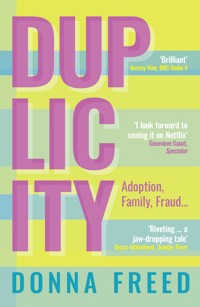
A powerful, poignant and pacey adoption memoir which reads like a thriller' New York Times. Donna's birth parents were infamous con artists at the heart one of the US's biggest crime investigations of the 1960s. Adoption, Family and Fraud… When her adoptive mother died in 2009 Donna Freed set out to track down her birth mother. What she discovered was truly shocking - she was the daughter of a pair of infamous con artists, at the heart of one of the biggest true crime stories to grip the USA in the 1960s. Previously redacted records from the infamous *Louise Wise Services in New York revealed that Donna's mother (27, Jewish and single), her father (40, Catholic, married with 4 children), had hatched a plan to defraud an insurance company and run off to Spain to raise Donna. Further investigation revealed that in 1967, Donna's mother, Mira Lindenmaier, faked her own death in a drowning accident off City Island in the Bronx for the double indemnity insurance money. Donna loved her tricky, unconventional adoptive mother, but was now keen to meet her birth mother and find out how and why her parents abandoned her. How would she feel towards Mira, her 'real' Mum. How has becoming a mother herself impacted on her feelings towards her two mothers? Gripping and fast-paced, this extraordinary memoir is also incredibly moving tackling fundamental questions about motherhood and identity, nature vs nurture.
Sie lesen das E-Book in den Legimi-Apps auf:
Seitenzahl: 365
Veröffentlichungsjahr: 2022
Das E-Book (TTS) können Sie hören im Abo „Legimi Premium” in Legimi-Apps auf:
Ähnliche


















iii
DUPLICITY: MY MOTHERS’ SECRETS
Donna Freed
v
To Ruth and Mira
vi
Contents
The thin white envelope contained a single page with a total of three facts:
Age of Mother: 27 years
Nationality of Mother: Swiss
Health History of Birth Mother: There were no children born to your mother prior to you.
About my birth father it merely stated: Not reported.
Swiss? A yodeller? A chocolate-loving banker or watchmaker? How was it possible that I, perennially late, sloppy, disorganised, somewhat wild, was derived from Swiss stock? Hackneyed stereotypes aside, Swiss didn’t seem to fit, but Swiss was all I had.
‘Not reported’ is repeated twenty-six times for ethnic background, height, weight, hair and eye colour, race, skin colour, religion, education, occupation, talents, hobbies and interests. As to the Health History of the Birth Father, ‘no information was reported.’
‘But Swiss? Really? Me?’ I pestered Simon, incredulous.
‘It’s not so very different from what you thought might be the case: Polish or German, possibly Russian,’ my husband pointed out. These were the combined nationalities of my adopted families and my looks echoed that profile in a loose way.
‘Is Swiss a bit too dull for you? Doesn’t quite fit your fantasy?’ he asked, utterly nailing it. I had indeed fantasised 2about my birth mother, a woman with frizzy hair and an ashtray slung around her neck who lounged about on slip-covered furniture out on Long Island. She didn’t seem very Swiss to me.
By the time the social worker from Spence-Chapin got back to me, the school year had begun. My patience was further tested with an exasperating, week’s long game of phone tag. Finally, we connected and she apologised for taking so much time to prepare the report. She explained that it had taken her longer than usual, there was a slew of material to sift through in the much larger than expected file.
‘Before I take you through it, Donna’ she cautioned, ‘I need to prepare you for a very dramatic story.’
PART I
4My mother Ruth
1
IF YOU DON’T BELIEVE ME (1973)
‘You know, we were all adopted.’ My sister Leah stands framed in her bedroom doorway, her dark braids covering the fists of her crossed arms. Her tone is matter of fact, blasé even, a simple statement of the obvious. There is no sneering singsong of ‘I know something you don’t know’; this is a more assured superiority, a bit detached, delivered without preamble, head tilted as she looks down on me. This is Claudius casually pouring poison into the ear of Hamlet’s father and then standing back, waiting for the caustic to work its corrosive way through to my heart.
‘You were adopted’ is one of the classic taunts of childhood; one of the first ways we say, ‘you don’t belong.’ But this was no idle threat.
My tongue sticks to the roof of my mouth with my first intake of breath and I almost choke. Heart slamming, I fix my bulging eyes on the floral, ceramic name-plate glued to my sister’s door, determinedly avoiding her gaze. 6
‘If you don’t believe me, ask Paul, he’s six years older than you and he would remember when they brought you home,’ she says, calmly killing off all possible doubt.
‘They’ were our parents. In one searing cut, I was severed from them. I was no longer theirs and they were no longer mine. I was six years old and the one thing that defined me – that was the most important aspect of my life – was a lie. I was not my parents’ child, Mom and Dad were not my parents, so we were not a real family; and ‘they’ hadn’t even bothered to tell me.
I didn’t doubt my sister, not for one second. I had no need and no desire to doublecheck with my brother and to ask my parents was unthinkable. The panic flooded in because it felt true, it answered every unformed question and realised every unnamed fear. Unacknowledged suspicions were confirmed and the blow I had secretly expected fell, a tiny kernel of knowledge now unfurling inside me that this had all been too good to be true.
It was 1973 and we lived in White Plains, New York where we had moved from Queens three years earlier. My parents chose the suburban neighbourhood for the schools and paid for the house in cash. Mom and Dad were Ruth and Sy (short for Seymour). He was a civil engineer and she was a home-maker with a doctorate in Psychology. My brother, the eldest, was born in 1961, my sister came along three years later and finally I arrived after another three years in March 1967, seemingly inevitable links in a chain.
My family was my world, my religion, and I exalted the people in it to the status of gods. Granted they were like the gods of ancient Greece: capricious, vengeful and vain, prone to petty rivalries – like teenagers with superpowers – but gods nonetheless and awesome in every aspect, displaying every shade of light and dark. My mother, I revered above all the others; she was Zeus, Athena and The Furies combined. 7
When I sat snuggled on the bed between my parents, with my siblings on the floor in front, our black and white television flickering before us, I, a mere mortal, was granted a glimpse of the view from Mount Olympus. That status and the safety of being cocooned by my people had now been shattered by Leah’s thunderbolt and I was cast out.
Years later, my mother would claim that our adoption was never a secret but it was clear to me that my parents – they – didn’t want me to have this vital bit of information. And what is a secret? A secret is something hidden, not meant to be heard, or seen, or known and above all, not to be spoken of. And I was not then in the habit of questioning the gods.
The subject of our adoption had never been uttered, let alone discussed before this moment and it was not raised by me or indeed anyone else in my family for another eight years. By the time I turned twenty-one it had been mentioned on only two occasions.
As well as being secret, it was also clearly shameful in an unnameable way. Adopted, in the way that Leah had said it, sounded bad. She did not whisper it in the way that implied we had some special powers but couldn’t tell anyone; it was not joyful and it was certainly not cause for celebration. It changed something fundamental about us so that we were now tarnished and dirty.
If it wasn’t shameful, why had no one mentioned it? This was not something inconsequential, beneath consideration or discussion; this was a secret with power, the power to disown and to shame. Once exposed, it branded me with the knowledge, conferring the shame of itself, its deficiency and failure, onto me. The shroud of shame seemed to fit and belong to me in a way I no longer did within my family.
I didn’t question this shame. I didn’t question where it 8came from or whose humiliation I was ingesting. Like so much else, I swallowed it whole.
Shame is my first memory. I was no more than three and slept in the crib in my brother’s room in the three-bedroom house, or junior three as it was known, in Queens. There were two small bedrooms, the third, a sliver of a room, was my sister’s. I lie on my back in the early morning and my father comes in smiling. He reaches underneath me, ‘Wet’, he says. I can feel his disappointment. Shame, with a little flare of fear, settles on me like a fine mist. And he walks out.
Memories are tricky and fickle but my mother was surprised at the accuracy and clarity of my memory of that room in the house we left when I was three. I have another early memory from that house which feels so genuine I could lick it. It is my third birthday, and my mother and Nana, my maternal grandmother, are there, sitting at the dining table. Nana is smoking. I am in my highchair. In front of me is a bowl of ice cream with a candle in it, the ice cream is melting, my mother is smiling. I am happy. But this memory comes from a photograph, static and flat in black and white. There are no photographs of my brother’s room with my crib in the middle of the floor.
The evidence of our adoption was clear from the moment Leah told me and a certain ambivalence on my mother’s part suddenly made sense. A kindergarten homework assignment, a good thirty years before the likes of Heather Has Two Mommies penetrated the curriculum, tasked us with determining which of our two parents we most resembled.
‘I look more like Daddy because we both have blue eyes and blond hair,’ I asserted.
‘Okay,’ my mother replied with a shrug, in a ‘have it your way’ dismissal. There was no, ‘you have my eyes, but my mother’s nose and your dad’s ears but my fingers’ or ‘you’re 9the very image of your grandmother.’ Just a shrug. Of course, I didn’t know anything was missing, until I did and then the glaring and compounded lies sprang from all sides.
The collusion was so complete that no one else in our family seemed bothered by the knowledge of our adoption or even gave any outward sign of it. In my shock, it didn’t occur to me to ask my sister how she knew, when and how she found out. She pointed out that my brother knew and my parents had to know. It was clear to me that Leah wasn’t too happy about it but prior to telling me, she had betrayed no sign of it. So they had all known, except me, the youngest, the family dupe.
I didn’t look at her in the car later that weekend when my father started singing a family favourite, I just joined in.
This is the day they give babies away
With a half a pound of tea.
You just open the lid, and out pops the kid
With a twelve month guarantee.
This is the day they give babies away
With a half a pound of tea
If you know any ladies who need any babies
Just send them round to me …
My parents had given me a record player and with it, two second-hand records. One was Pete Seeger and The Weavers singing ‘Wimoweh’ and the other was a compilation of folk songs from around the world. It had a deep scratch across all but this song by singer-songwriter Rosalie Sorrels (June 24, 1933 – June 11, 2017).
Sorrels terminated her first, out-of-wedlock pregnancy, then gave her next child up for adoption when she became pregnant after a rape. She had five more children with her 10husband. She introduced the song, ‘Baby Rocking Medley,’ like so:
‘All right, it’s 5:30 in the morning. That kid has not quit howling now for six hours. You’re getting sort of desperate, breaking out into a cold sweat because you know that all those other kids are going to get up in about another half hour and they’re going to demand cereal and peanut sandwiches and milk. And you forgot to get milk. Oh, God. All the paregoric is gone. It’s gone because you drank it. Things are getting awful bad and you need something else. Every culture’s got one: it’s the hostile baby-rocking song. You just can’t keep all that stuff bottled up inside yourself. You need to let it out some way, or you’d get strange … punch the baby in the mouth … and you can’t do that. You’d get an awful big ticket for it, and it makes you feel lousy. So you take that baby and you rock it firmly, smile sweetly … and you sing the hostile baby-rocking song.’
2
BIRTHDAY PRESENCE (1973–79)
It is impossible to judge the past by the norms and mores of today, but even by the standards of the 1960s and ’70s, my parents made mistakes. Were there mitigating circumstances? Aren’t there always? However, different choices could have been made. My mother did not always do ‘the best she could’, and neither did my father. But I can’t know which parts of their parenting felt like choices to them. I didn’t question the decisions, I only lived with their consequences.
I was in awe of my family; these giants who surrounded me were both protective and oppressive. They were the boundary that defined the parameters of my world, demarcating outside and inside. I knew to be wary of outsiders, but inside the perimeter I was defenceless. When I opened my eyes in my life, my parents and siblings were already there, unquestionable in their prior arrival and authority.
I walked into an established hierarchy of rules, an insidious game with escalating challenges and repercussions, a 12snakes-and-ladders landscape littered with invisible obstacles. I struggled to navigate the Byzantine complexities.
I don’t know whether I accepted these rules and my parents’ utter authority because I was the youngest or just because I was a kid. Later on, I would wonder about the nature and origin of this acquiescence. I don’t know if this passivity was sewn into me or onto me. I do know that I was predisposed to be amenable to my family’s wishes above my own. The love and attention I craved were directly delivered, or so I believed, by slavishly complying to the letter of their laws.
My parents were scythed away from me in one slice that day in front of my sister’s door. My parents standing as deities in my life only grew as they became more distant. That they held the power to add or subtract me and that this information was withheld from me only proved their omniscience. Knowing I was adopted didn’t mean I didn’t belong to these people, and I tried in earnest to belong.
Rule number one was: obey my mother in all things regardless of whether they were nonsensical and counter-intuitive. Whether instructions made sense was secondary, compliance was paramount. Don’t think, do!
By age six, I had accumulated a small collection of beloved stuffed animals. There was Lovey Bear, a long-legged ‘bear’ whose canvas limbs were printed with bubbly ’60s slogans of love and peace. There was Ducky Donna, a lemony-yellow knitted, squashy bundle with yarn hair, felt beak and feet and ‘Donna’ sewn onto a heart-shaped badge on her breast; there was Raggedy Ann and Raggedy Andy and Bunny, a faded pastel hand-me-down that I loved for being small and portable. There was a blue walrus that I had inexpertly stitched together and embroidered. Holly was also there, but she sat on my bedside table. She was a replica of Ling-Ling, one of the Smithsonian’s National Zoo’s giant pandas. Although I 13adored her, she was made of faux velvet-covered plastic, hard and not bed-friendly.
Each night, I would carefully arrange Ducky Donna, the Raggedys, Walrus and Bunny around my pillow on the corner of my bed that was against the walls. I tucked Lovey in alongside me and then the tea party could begin. Tea was served by the baker who lived on my ceiling. Tea and cakes would be lowered down via a dumbwaiter by the baker and shared out to each guest in turn. I would take mine last and thank the baker. It was with this imaginary artisan baker that I shared my first kiss.
My after-school routine was to go into the kitchen for ‘snack’ directly upon coming home. Snack was almost invariably apple juice and graham crackers which sometimes had spider eggs on them. I instinctively brushed away the webbed crumbs. A clear rule was to never call attention to my mother’s housekeeping in any way. You ate what you were given without complaint, ignoring any added ingredients, whether it was Mom’s hair, mould or spider eggs. Don’t think, choke it down!
On this day, I skipped home through fallen leaves to find the Formica kitchen table hidden under piled-up packages of rice and pasta. Penne and elbow macaroni cascaded down, slipping on rills of rice, valleys of bow-ties, pasta cushions all leaking their stuffing. Beneath them, snaked a river of blue-and-white-wrapped Ivory soap.
My ‘New England thrifty’ mother bought in bulk when things were on sale. She was a ‘prepper’ long before preparing for the apocalypse was a thing, even before it was called hoarding.
‘What do you have to say about all this?’ Her arms took in the scope of the display.
Eager as ever to please, I tried to glean what was required 14of me. Was this a game? Which one doesn’t belong? That’s too easy, it’s obviously the soap. I stood there blank, waiting for a hint.
She reached into the pile and pulled out a bar of the soap which looked as if it had been raked by claws, furrows made in the waxy wrapping, the white soap curled into crusty waves.
‘Doesn’t it look like little teeth did that?’ she asked, her voice almost reasonable.
‘Yes! Yes it does look like little teeth did that,’ I answered with relief. The mystery was solved and I looked with fresh eyes at the pile of rice and pasta and it became clear, all the bags had been nibbled by little teeth. Aha! We have mice!
However true, it was still the wrong answer. The injunction against noticing the deficiencies in my mother’s housekeeping extended to herself. To solve a problem like mice would require outside intervention – the buying of mouse traps at the very least which, as she didn’t drive, would involve my father and a hardware store – and therefore acknowledgement of the mice. A better solution to the evidence of mice was to find a different cause.
So, my mother concluded that it was my little teeth that had done the nibbling and scraping of soap and my agreement was a clear and irrefutable admission of guilt. As punishment – do not eat food, whether raw, cooked or indeed soap, that was not specifically allotted to you was a hard and fast rule – all my stuffed animals were taken away and put in the attic the following morning after a final, prolonged tea party and one last lingering kiss from the baker – the end of our brief affair.
When my son Dexter’s own collection of cuddly toys threatens to overtake our apartment, I start flailing around with them, ‘Why do you want to keep them? You don’t even play with them!’ I yell. 15
‘Sorry,’ I say to Dexter when we’re having dinner that evening, ‘We’ll find a place for all your toys, don’t worry, we don’t have to give them away. It’s just, I used to really play with my stuffed animals …’
‘I know,’ he interrupts, rolling his eyes, ‘you used to kiss the baker on the ceiling.’
‘I have told you that story. Well, then they all got taken away,’ I blurt, my eyes on my plate.
His head whips to mine, ‘what did you do?’ he asks after a long moment of staring at me.
‘We had mice, but my mom blamed me instead and that was my punishment,’ I explain in the same even voice I use to explain why he has to go to school or eat fruit or put on his shoes or countless other unwelcome but immutable truths.
‘I’m sorry, sweetie, I know that’s a bit heavy but I’m telling you because I don’t always know the right thing to do. I didn’t always have the best example.’
Without a sound, he gently picks up my fork and starts feeding me from my plate. I swallow his spooned up love past the tears that choke my throat.
I don’t tell him that my mother took them from the attic and moved them to North Carolina, where my parents retired in 1999 and dotted them around their bedroom. Mementos of my childhood passed up a generation, instead of down. The internal heirlooms that were passed down are larger, less tangible and far less cuddly.
With the word ‘adopted,’ my identity as my parents’ child tilted away from me like a rock detaching from a cliff; but in the vacuum left by my parents, a new alliance and affiliation with my siblings was born. We were tarred with that same brush of ‘adopted’, lumped together as the us against the parental them. I immediately grasped that we were not biological siblings, but we were all in the same boat and we 16were bonded with stronger stuff than mere biology: secrecy and collusion.
My sister, while still one of the exalted, was closest to me in both age and inclination. It wasn’t exactly an alliance of equals, more like handler and agent. And while it did feel disloyal to turn my allegiance from my mother to my sister, had my mother not betrayed me first?
In John le Carré novels, George Smiley is a masterful handler; the spies in his webs are unwittingly entrapped into betraying their country, their loyalty in turn then welded to him. And how does Smiley do this? Why does it work? Because he too has been betrayed, the same crime perpetrated against him, and he has contorted his hurt into the same shape, love and loyalty inverted. My sister was a master handler and I, a natural born spy.
My free will was subsumed by the dictates of my mother’s but submitting to the will of others was also against the rules. Listen to me: think for yourself!
My mother decried my willingness to let other people hold sway over my actions and personality. In particular, my slavish adoration of my sister was problematic. If my big sister Leah did it, I did it. If Leah told me to do it, I did it. If Leah dared me to say it, I said it. My mother started calling me ‘Little “Me Too.”’ ‘If your sister jumped off the Brooklyn Bridge would you jump too?’
Thinking for myself was an endless game of chance, trying to land on what won approval and not punishment. I had to weigh my mother’s erratic attentions against the conspiratorial camaraderie with my sister. My mother and sister were at either end of the tightrope I trod through childhood.
All this hyper-vigilance was nerve-wracking stuff and I started biting my nails. The sight of my chewed fingers disgusted my mother on an aesthetic level but also the physical 17evidence of my nervous state unnerved her. ‘You have such pretty hands,’ she tried cajoling.
When flattery failed, she decreed that I should wear plasters on all ten fingers to school. A girl in my class who also bit her nails applied a foul-tasting solution to repel the biting – Antabuse for nail-biters – but needless to say, my mother didn’t entertain that kind of expensive gimmickry. I baulked at the insufferable embarrassment and indignity of the plasters.
It was enough that I wore my brother’s hand-me-down Y-front underwear with the hole sewn shut; it was enough that I took my lunch to school in the plastic lining of a cereal box (and when I got an actual brown paper bag, I folded it up and reused it until it disintegrated); it was enough that those lunches consisted of scrambled egg sandwiches that congealed into a cold, eggy sponge-blob by lunch time; it was enough that I looked like a plucked chicken from the home haircuts; it was enough that I wore the same clothes in the class photo for three years running which we got on sale at the thrift store in the first place; it was enough that our house still sported the decals, years later, from the one time we had Halloween decorations because they came free with the newspaper; it was enough that my white tights were discoloured, lumpen with varicose-veins of black, Frankenstein-sutures where they had run and my mother had sewn them. But it was a step too far to expect me to parade through the third grade with plasters on my fingers!
Leah came to the rescue. At the last minute before going to school, she advised, I should run up to ‘the children’s bathroom’ to use the toilet, peel the plasters off and tuck them under a facecloth placed casually on the radiator for this purpose, and then run out to school. At that time Mom was working, so Paul had the key to the basement to let us 18in the house after school. I should again pretend I had to go to the bathroom, clutching myself and hopping up and down with urgency so he couldn’t see my hands and scoot up to the bathroom and jam the plasters back on. This scheme was abandoned when my hands were still bitten raw after a week.
In the escalating stakes, my mother upped the ante, she saw my bandage avoidance and raised me the celebration of my upcoming birthday. It was a shocking and demoralising threat. Each night, as I caught a nail in my teeth, I would tell myself it would be the last one, but I was back at it the next day.
As my birthday approached, it seemed impossible that my nails could grow in time and so, finger in mouth, I resigned myself to not having a birthday. On our birthdays, we got to pick where we got take-out from and there was cake and ice cream. I invariably picked pizza, the thick and pillowy Sicilian style we favoured from the lovely Italian man in Hartsdale who gave me cheese (not soap or rice) to nibble on while we waited for our order. I meekly accepted birthday defeat, chewing my cuticles and comforting myself with remembrances of pizzas past. My brother and sister, however, were outraged and mutinous on my behalf.
They weren’t going to capitulate so easily, because if my birthday could be cancelled, any birthday could be cancelled. So my sister propped me up against the wall behind my brother’s bed and while she sat twisting the skin of my upper arm on one side, my brother dug under my nails to reveal some white on the other. The searing pain from the pinch was supposed to distract me from the gouging of my nails. ‘This is what Indians do,’ she explained. The outcome be damned, being wedged between Leah and Paul as they worked to earn me a birthday celebration was better than any pizza. 19
‘Don’t bother,’ my mother said when she saw us, ‘she’s not having a birthday.’
When Paul left for college, we still had the key to the basement but we were no longer entrusted with the run of the house after school. My father installed a chain lock across the door that led from the basement to the ground floor. What they failed to appreciate was that along with the laundry room, ping pong table, my father’s treadmill and my mother’s old psychology textbooks – and no, there was not a bathroom in the place where we were locked for several hours each day – were all of my father’s tools. The same key that opened the basement door from the garage, also unlocked the door from the basement to the upstairs. We unlocked the door, unscrewed the bolt and screwed ourselves back in again around the time Mom was due home. We listened to the radio, stole food – or snacked, if you were other people – and watched the fish or the black and white TV that had now moved to a corner of the dining room. There were a couple of heart-poundingly close calls when we were rethreading the screws and locking the door as Mom was opening the front door. One of those days was December 8, 1980 when we heard on the radio that John Lennon had been shot and killed. By the time the soap operas I was watching were interrupted to announce the attempted assassination of Ronald Reagan, on March 30, 1981, my sister had been shipped off to boarding school and I was on my own.
Who had time to fantasise about who my ‘real’ parents might be when every day was a minefield? But finding out about our adoption seemed to be the catalyst for a type of identity crisis within me. I couldn’t see myself. The foundations of my personality, like a cloth whipped away from a table leaving strewn and broken crockery, were obliterated in that one blow. 20
There is a scene in Duck Soup, Chico pretends to be Groucho, who has just exited the room. Mrs. Teasdale protests, ‘but I saw you with my own eyes!’
Chico says, ‘who you gonna believe: me or your own eyes?’
To me, my mother was Chico. She was the last word on everything in our house and clearly knew more about me than I did.
‘Am I a happy person?’ I asked in the car one day. ‘It’s hard to tell,’ she replied, ‘you’re like a tropical storm, sunny one minute and dark the next.’ Which while it sounded exotic, didn’t sound that great.
Another night we were playing checkers on her bed. Checkers was a high-stakes game. When we had gerbils visit our first-grade classroom, Miss Pettymare held up the female and pointed out the nipples running down her belly, ‘these are the mammary glands,’ she informed us. During checkers with my mother that night, I lifted up my shirt and pointed to my own nipples and said proudly, ‘these are my mammary glands!’ I was promptly sent to bed.
But this night, I was in sixth grade, around eleven years old. Mom sat cross-legged, pouring over the checkers board in concentration; I knelt on the floor at the end of the bed. My brother was making a racket practising his violin in the full-length mirror in the hallway. ‘I have a question to ask you,’ I said. She nodded her acquiescence. ‘It’s important, can I close the door?’
She spread her hands with a big sigh but the roll of her eyes signified a sudden wariness. Her arms said, ‘be my guest’, the sigh and her eyes added the unsaid ‘if you must.’ As I crossed to close the door, a flash of inspiration and instantaneous, heady power flooded through me as I understood that she was afraid I was going to ask about our adoption. I savoured her discomfort but, I already knew the answer to that question and I had 21far more important matters weighing on my mind. I shut the door and turned to square myself off in front of my mother.
‘Am I mature enough for my age?’ I asked.
Her hands, which had been gripped at her elbows, started waving around. Relief and wonder mixed in her voice, ‘Well, Donna,’ she said, ‘yes and no.’
In P.D. Eastman’s 1960 book, Are You My Mother, a little bird looks for his mother, never having seen her, he doesn’t know what she looks like. He asks a kitten, hen, dog, cow, car, boat, plane and backhoe the same question: ‘Are you my mother?’ Instead, I seemed to be asking, ‘Can you see me?’ ‘Are you my mirror?’
One of our family myths was that my mother was a child psychologist but in truth she merely studied child psychology; she didn’t practise it. When later on she became overwhelmed and subsumed by doubts and anger, her depression gaining traction, I think her knowledge hindered her parenting more than it helped.
I think she hoped I’d notice only the positive aspects of her mothering and ignore what she preferred not to examine herself. The fact that I’m scary shouldn’t cow you. Don’t dare defy me but stand up to other people. This was a parenting technique that I squirrelled away for later use and could be summarised by my father’s oft repeated: ‘do as I say, not as I do.’
My mother would have been familiar with Anna Freud’s pioneering work in child psychoanalysis and Kanner’s theory of ‘refrigerator mothers’. ‘Trust yourself. You know more than you think you do,’ advised paediatrician of the day, Dr. Spock. She would have read about the importance of attachment and play. It must have filled her with dread when she slipped. How do you trust yourself then?
With knowledge comes power but also tremendous guilt. ‘No medical intervention!’ was drilled into Simon and me at 22the natural childbirth classes we attended each week of my pregnancy. If you were weak and allowed the doctors near you, the bond with your child would be interrupted and your child’s life chances ruined. My mother was spared that form of guilt but she had a taste of it even earlier when pregnancy didn’t come along at all.
As well as the added pressure of knowledge there must have been some in-creep of imposter syndrome. Your right to bear children is unimpeded until it doesn’t come naturally. If you persist in your desire for children, you enter the public domain. You open the door to medical experts and social workers to measure and weigh your fitness, examine and chart your progress. Adoption as some version of FILTH in British banking circles: Failed In London, Try Hong Kong. Failed in natural childbearing, try adoption, the latter always thought of as the lesser option and achievement.
These though, were the dark times, made darker still because of the light. And there was light. Perhaps it is the light that helps to normalise and rationalise the dark. I still don’t know.
Our house was a place of rituals. Sunday mornings started with blaring classical music and bagels and lox, followed by a family outing. On rainy days we would venture into the city to the Natural History Museum or the Metropolitan Museum of Art, where my mother, ignoring the suggested donation for entry, would hand over a quarter for the five of us. In good weather we walked the nature trails at Cranberry Lake or the Mianus River Gorge, looking for mica and rose quartz. In the autumn there was apple picking or just a visit to the orchard to collect bushels of crisp Macoun apples. We stood at the end of the conveyor belt where the freshly fried doughnuts bobbed along, licking the hot sugar off our fingers and guzzling the thick cider. 23
We started going to the opera once a year when I was in the fourth grade. The Marriage of Figaro was our first. Dad got the tickets from work and the seats were in rows M and N in the orchestra. My father checked out the recording from the library and we listened to a little each night, following along with the libretto. On the day of the opera, I went to work with my mother whose office was in the World Trade Center, Tower One at the time. She took me for lunch at the staff cafeteria near the top and we shared fries. At her prompting, I read my mother the synopsis before each act although we knew it inside and out. We gasped in unison as the star-like chandeliers ascended to the ceiling in the darkening hall.
Middle-class Jewish families in the 1960s and ’70s lived as if it were the 1950s and mothers had an evening of rest on Sunday. And yes, we were actually middle-class, not that we knew it with all my mother’s obsessive scrimping and saving. My father was in charge of dinner those nights and his culinary repertoire was limited to what he could char in the fireplace. He grilled steaks, which we were allowed to flavour with exactly three drops of Lea & Perrins, and buried potatoes and onions wrapped in foil in the coals. Dessert was either chestnuts or popcorn shaken over the flames. My sister and I saved the Sunday comics to read in front of the fire while my mother languished in a long bath.
My father was smart and silly and fair, fair-haired and fair-minded and he still talked to you when you were in trouble. He marked the Winter Solstice by donning his long johns and an orange ski mask, careering down the hall singing the baseline of the Batman theme, ‘duh, nuh, nuh, nuh, nuh, nuh nuh, nuh’ and landing in front of you in a spindly-legged cat leap: ‘Thermal Man!’
During the working week, I didn’t see much of him but I milked my time at bedtime when he tucked me in. Just as 24he was about to kiss me goodnight, I would ask ‘Can I have a glass of water?’ I had to sit up to drink the water and so I had to be re-tucked. Of course, then I had to use the toilet earning me a third and final tuck.
I craved and savoured time alone with my mother. I used to do my homework at the kitchen table, both of us toiling away to All Things Considered on the radio. Everyone else in the family called me Peach Fuzz due to my lack of hair until I was two, except Mom because she knew I didn’t like it. She taught me the song flute and recorder and made me French flash cards. She would play my favourite song on the recorder, the ‘Habanera’ from Carmen while I pranced and cavorted through the upstairs hallway. One afternoon I rushed home to tell my mother that this huge surge of joy had started in my belly and suffused my chest and was beaming up my throat. I felt that same bursting warmth when she would take both my cheeks in her hands and say ‘Shnookums!’ into my face, squeezing so hard it ached.
And life was always lighter when Uncle Lew, Mom’s brother, flew in from his far-flung adventures in Cairo and Paris. My mother’s emotional storm-clouds were temporarily dispersed, replaced by the plumes of Lew’s cigarette smoke billowing out over the sofa. He brought glamour and exoticism but most importantly of all, he brought laughter.
Once when it was the hour of his departure, my sister and I spontaneously jumped either side of him and tugged him back away from the door. ‘Don’t go,’ we pleaded. Egged on by Lew’s giggles, we pressed on. Mom started laughing and in the ensuing contagion, we all abandoned ourselves to the hilarity, the four of us doubled over, sister and brother and sister and sister, in silent, gut-wrenching laughter.
3
THE CAT IS OUT OF THE BAG (1981–90)
My brother and I are sitting on the kerb outside our house. It’s a humid summer night; I’m fourteen, he’s twenty and home from university.
‘So, were we adopted?’ I asked. ‘Leah always told me I should ask you, that you would remember because you were six.’
‘Of course we were adopted,’ he says, with some of that same scornful superiority that Leah had when she told me. ‘I remember when you were brought home. Mom had to go somewhere each evening for a week and Dad took Leah and me out for Flying Saucers at Carvel every night. We were so disappointed when they brought you home.’ He grins, his face open and lovely and I know he’s kidding, as I’m also aware that tucked inside his violin case there is a picture of what must be our first meeting. My mother, looking both bemused and exhausted – standard for all pictures from our youth – is proffering a bald and squalling me while my brother and sister look on, nonplussed. 26
I don’t know what prompted me to ask him at that moment. At fourteen I had been the only child in the house for six months and would be starting high school in the autumn. I had asserted my independence as far as my hair was concerned and finally grown it beyond the crew cut my mother reduced my curly hair to with regular mowings. But because of the singular quality of my now full head of springy, corkscrew curls, I was frequently asked if anyone else in my family had curly hair. Perhaps I had a feeling that it was time to get corroboration of our adoption. Maybe it was a step towards claiming my own identity. It also seemed like grown-up knowledge, and asking about it was a way to appear more mature to my sophisticated, older brother.
When our parents told him he was adopted, Paul said that night, he heard ‘chosen’ and therefore special and had swanned all over school bragging about it until he was asked to tone down his enthusiastic ‘chosen one’ rhetoric.
And so, I confirmed my sister’s story from eight years before and that seemed to suffice for the next four years.
My earliest memories are characterised by complete thoughts and observations of the world around me, but the advent of puberty and high school spelled a time when I purely felt. I did not reflect, I did not think through other people’s perspectives, I did not see that other vantage points existed. This was the first time I felt driven by desire. I was a purely carnal, borderline feral, teenage being.
My sister’s abrupt removal to boarding school the year before disturbed the uneasy balance of household power. I was now the sole focus of my parents’ attention and control, something I had previously craved but now bitterly resented. Not only was it unwelcome to my now more secretive nature, but it had come at the cost of my sister’s banishment. Leah had been my ally, compatriot and in part protectress – she 27was a lightning rod for Mom’s anger and I could always rely on her to be in deeper hot water than me.
If I had been an open book to my mother up to that point, I was more opaque now, obscured by a cloud of hormones and surly attitude. While there remained the excellent student, there was now also the embryonic libertine, the cigarette smoker and imbiber of beer.
My mother responded to these natural developments as she did any other ordinary inconvenience that comes with child-rearing – like getting sick or injured, losing things, breaking things, forgetting things – with Draconian measures. She threatened to send me to a special needs school because of what she perceived as my ‘social problems’. She didn’t like my friends, ‘I don’t think she’s a good influence on you,’ was a frequent refrain. I found this continuation of the theme that I was a follower – ‘Little Me-Too’ all over again – insulting, infuriating and alienating.




