


Erhalten Sie Zugang zu diesem und mehr als 300000 Büchern ab EUR 5,99 monatlich.
- Herausgeber: The History Press
- Kategorie: Sachliteratur, Reportagen, Biografien
- Sprache: Englisch
Enid Blyton is known throughout the world for her imaginative childrens books and her enduring characters such as Noddy and the Famous Five. She is one of the most borrowed authors from British libraries and she holds a fascination for readers old and young alike. Yet until 1974, when Barbara Stoney first published her official biography, little was known about this most private author, even members of her own family. The woman who emerged from Barbara Stoney's remarkable research was hardworking, complex, often difficult and, in many ways. childlike. Now this widely praised classic biography has been fully updated for the twenty-first century and, with the addition of new colour illustration and an extended bibliography of Enid Blyton's books, it documents the growing appeal of this extraordinary woman and her writing. The fascinating story of one of the world's most famous authors will once again intrigue and delight all those with an interest in her timeless books.
Sie lesen das E-Book in den Legimi-Apps auf:
Seitenzahl: 476
Veröffentlichungsjahr: 2011
Das E-Book (TTS) können Sie hören im Abo „Legimi Premium” in Legimi-Apps auf:
Ähnliche



















THE BIOGRAPHY
THE BIOGRAPHY
BARBARA STONEY
To my husband and family
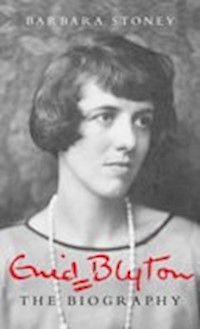
Cover Illustration: Enid Blyton in 1923.
First published in 1974
This edition first published 2006
The History Press
The Mill, Brimscombe Port
stroud, Gloucestershire, GL5 2QG
www.thehistorypress.co.uk
This ebook edition first published in 2011
All rights reserved
© Gillian Baverstock 2006, 2011
The right of Barbara Stoney, to be identified as the Author of this work has been asserted in accordance with the Copyrights, Designs and Patents Act 1988.
This ebook is copyright material and must not be copied, reproduced, transferred, distributed, leased, licensed or publicly performed or used in any way except as specifically permitted in writing by the publishers, as allowed under the terms and conditions under which it was purchased or as strictly permitted by applicable copyright law. Any unauthorised distribution or use of this text may be a direct infringement of the author’s and publisher’s rights, and those responsible may be liable in law accordingly.
EPUB ISBN 978 0 7524 6957 7
MOBI ISBN 978 0 7524 6958 4
Original typesetting by The History Press
CONTENTS
FOREWORD
ACKNOWLEDGEMENTS
CHAPTER 1
CHAPTER 2
CHAPTER 3
CHAPTER 4
CHAPTER 5
CHAPTER 6
CHAPTER 7
CHAPTER 8
CHAPTER 9
CHAPTER 10
CHAPTER 11
CHAPTER 12
THE ‘PHENOMENON’ LIVES ON INTO THE TWENTY-FIRST CENTURY
APPENDICES
APPENDIX 1
APPENDIX 2
APPENDIX 3
APPENDIX 4
APPENDIX 5
APPENDIX 6
APPENDIX 7
APPENDIX 8
APPENDIX 9
APPENDIX 10
AFTERWORD
FOREWORD
Some years ago, in the course of an evening’s conversation, my Mother expressed the hope that I would write her biography if it ever came to be written in the future. I would have liked to carry out this wish of hers and, indeed, gave much thought to doing so in the months immediately after her death. At that time we had recently moved to Yorkshire and my family of four children were all still young. It was difficult enough to get down to London once a month with my husband, to see friends, never mind to find the time to carry out lengthy interviews all over the South of England with people connected with my Mother’s life. I decided that a biography would have to wait for a few years until I had more time on my hands and was freer to travel away from home. In the following year, one of my Mother’s closest friends became very ill and died a few months later. Some of those acquainted with my Mother’s youth were now very elderly, some a little younger than she had been when she died; I realised that the documentation of her early years could no longer be delayed.
Very soon after my Mother’s death, a number of people wrote to me asking for permission to write her biography. Most were genuinely interested, but they seemed to me to be unsuitable for the task, either because they were young and unmarried, or because they were male, and I thought that to fully understand my Mother’s life, a mature woman with experience of marriage and children was essential.
About this time, Barbara Stoney wrote to me. She had been working on the life of a master thatcher, who had roofed my Mother’s home ‘Old Thatch’. He had taken her to see the house at Bourne End, and living there still were the people who had bought it from my parents. Mrs Stoney was particularly interested in talking to them because it had been suggested to her by a publisher that she might contribute to a biographical series for children and she had considered Enid Blyton as a possible subject. The series was temporarily shelved but she had become so intensely interested in my Mother’s life she had continued to search out material, reading everything that had been written about her and talking to everyone she could find who had known or worked for Enid Blyton.
I agreed to meet Mrs Stoney and discuss the subject of the biography with her. To my surprise, she had more information on those days at Old Thatch than I had, even though I had lived there as a child. She seemed to have an instinctive understanding of the sort of person my Mother was and to be particularly interested in the way her environment had formed her character and affected her life. Very quickly I agreed that she should write my Mother’s biography and that I would let her have all the papers and diaries that existed. Unfortunately, much of importance had been destroyed before my Mother’s death, and of the many diaries she had kept throughout her life, only the early ones were left. This meant that she left behind her very little personal evidence as to her thoughts and feelings from that time onwards.
We agreed that the book would be the story of the life of Enid Blyton: it would not be a book of literary criticism nor would it be a deep and learned psychological study of why she wrote as she did. We were concerned that the book should reveal as far as possible the human being with all her faults and virtues who was known to so many as Enid Blyton. It was not an easy task. Vital witnesses to her early years were either untraceable or dead. My Father, her first husband, died just after Mrs Stoney had discovered where he was then living. As must often happen in biographies, one person’s memories completely contradicted another’s, and trying to ascertain the true facts must have been extremely difficult. I know from my conversations with the author that there were many such incidents during the three years in which she worked on this book.
One of her publishers, Paul Hodder Williams, with whom my Mother had worked closely for many years and who knew her well, confessed that he had been surprised to discover details of her early life that he didn’t know about at all. I was too, despite the fact that I was very close to my Mother, and talked with her freely from early childhood. But she is an important writer for children all over the world. And it is best that the very private drive and the very personal talent that made her so should be known and understood. It is best too that this should be done by someone as honest and as detached as Barbara Stoney.
Gillian Baverstock
ACKNOWLEDGEMENTS
It would have been an impossible task to chart the life story of Enid Blyton without the generous assistance I have received from many quarters, in particular from Mrs Donald Baverstock, who gave me not only access to her mother’s papers, but great help and encouragement throughout. I am also indebted to Enid Blyton’s younger daughter, Mrs Imogen Smallwood, and to Mr Hanly Blyton, who gave much time and thought in helping my research into his sister’s early years and – with his cousin, Mrs Sylvia Conway – provided me with many valuable photographs from family albums.
Among those who also lent photographs and letters or supplied personal recollections of Enid Blyton’s early life, I would like especially to thank: Miss Mabel Attenborough, Miss Margery Dawson, Dr Mirabel Harrison, Mary Potter (née Attenborough) and Mrs Phyllis Samuel (née Chase); Mrs Ida Haward (née Hunt), Misses Kathleen and Nan Fryer, Miss J. Gilchrist, and Mrs Ann Style, Secretary of Ipswich High School for Girls; Mrs Joyce Dunn (née Brandram), Mr A. Robert Dickinson, the Reverend M. Martin Harvey, Mr Derek Hudson, Mr T.R. Twallin, and Mr E.I. Childs, Headmaster of Bickley Park School; the Thompson family – Messrs. David, Brian, Peter and John – Mrs Frances Peterson, Miss E.D. Moore and others associated with ‘Southernhay’ during the 1920s.
I am grateful, too, for all the other help I have received during my research into the writer’s later years, particularly from her executor, Mr Eric Rogers, and his daughter, the late Miss Patricia Rogers; solicitors, J.D. Langton and Passmore; literary agents, Mr George Greenfield and Miss Rosica Cohn; medical advisers, Dr Raymond Daley and Dr R.M. Solomon; and representatives of her many publishing houses – especially the directors and staff of Evans Brothers Limited, the Hon. Mrs Audrey Evans, Miss Audrey White and Mr Ronald Deadman and the editorial department of Teachers’ World, who gave me access to much interesting archive material covering her long association with this company.
Among Enid Blyton’s friends, business associates, household staff and others whose help has been invaluable to me are: Mrs Mary Bale, Mr Victor Broadribb, the late Mrs Margaret Calvert (née Norris), Mrs Joyce Chapman, Miss Doris Cox, Miss Dorothy Collins, Mrs S. Colledge, Mrs Joan Dashwood, Mrs C. Emmett, Mrs Hilda Guest (née Russell-Cruise), Miss D. Herbert, Mr and Mrs R. Hughes, Dr J.P. Jackson, Mr Stephen Jennings, Mrs Lorna Jones, Miss Olive Jones, Professor Peter McKellar, Miss Jessie Mangan, Mrs Betty Marsh, Mr K. Martin, Miss Olive Openshaw, Mrs Ida Pollock, Miss Rosemary Pollock, Mr E.A. Roker, Mr Malcolm Saville, Miss Eileen Soper, Miss Grace Stuart, Miss Margaret Summerton, Mrs Marjory Twitchen, Mr and Mrs Uphill, Miss Diana Ward, Mr Ewart Wharmby, Mr David White, Mr Michael Woods and Mrs M. G. Woollerton. My thanks also to the BBC, the Chairman and Committee of the Essex Branch SLA, and to the officials of the Friends of the Centre for Spastic Children, Sunshine Fund for Blind Babies and Young People, and the People’s Dispensary for Sick Animals.
For the updated chapter in this re-issued edition, I would particularly like to thank Pam Ally, who has kindly shared some of her wide knowledge of the changes and events that have occurred during her more than twenty-five years of working for the companies dealing with the various business concerns of Enid Blyton. She is, at the time of writing, a consultant on all matters concerning the many facets of the writer’s life and works for Chorion Limited, in addition to being the official archivist of Enid’s books now in the possession of this company who currently hold her rights.
I am also grateful to Tony Summerfield for bringing to light Enid Blyton’s previously unknown titles which now appear in his revised version of my original bibliography in Appendix 10 of this book and for his loan of the colour images appearing between pages 144 and 145.
1
It is sad to watch the demolition of a house, the tearing away at walls which once enclosed the joys, sorrows and triumphs of its former occupants. When this has also been a home known to millions and around which many dreams were spun, such a scene takes on an added poignancy.
So it was on a warm, sunny day in the late summer of 1973, when the last of Green Hedges at Beaconsfield came tumbling down. Here, for thirty eventful years, lived Enid Blyton – the most prolific, successful, yet controversial children’s writer of all time. It was to this house that hundreds of her readers from all over the world continued to address their letters long after she died in 1968, and from which many thousands once received her distinctive, hand-written replies. Under its roof most of the characters from her books were created and many of the dramas of her own private life enacted – a life which began some thirty miles away, in 1897, at East Dulwich in South London.
Enid Blyton’s early forebears are believed to have come over to England at the time of the Norman Conquest and to have settled in Lincolnshire, where the name appears under various spellings in many of the early chronicles for that county. There is a village called Blyton in the Lincolnshire Wolds and a chantry was founded in Lincoln Cathedral in 1327, apparently bequeathed by a de Bliton who was the mayor of the city four years earlier. For several centuries the family were concerned with farming or the wool and cloth trade – but George Blyton, Enid’s great-grandfather, was a cordwainer.
George Blyton was thought by his relations to be something of an eccentric. He spent much of his spare time tramping through his home county of Lincolnshire preaching to all who cared to listen and it was said that it had always been his ambition to go to the Fiji Isles to ‘convert the heathen’. Instead, he stayed at home in Swinderby making fine boots and shoes and raising a large family. With such aspirations, however, it is not surprising that he gave his elder son, Thomas, the second name of Carey, after one of the founders of the Baptist Missionary Society. Thomas Carey, Enid’s grandfather, eventually left Swinderby to become a linen draper in Sheffield, but there is no record to show how he came to meet and marry his Irish-born wife, Mary Ann Hanly, in Camberwell in 1864.
Family rumour has it that Mary Ann was descended from the Dukes of Hamilton and was born at the house of her grandfather – a Doctor Hamilton of County Tyrone – but little is known of her background prior to her marriage. By all accounts she was a surprisingly well-educated woman and made a great impression on all who met her, including the young Enid on the few occasions she visited her grandmother at Swinderby.
Enid’s father, Thomas Carey junior, was born in 1870 and was the fourth of Mary Ann’s seven children. One of his sisters became a professional musician, another an elocutionist and a creative, artistic thread seemed to run throughout the family. Thomas himself had many talents and an engaging personality. There was nothing particularly striking about his appearance. He was short in stature, had a large nose and a sallow complexion but his eyes – dark brown and arresting – gave a hint of his restless personality. At the time of his marriage in 1896 to Theresa Mary Harrison, a pretty, raven-haired girl from his home town of Sheffield, he was a salesman with a cutlery firm, but his interests outside his work were many and varied. Even in those days his thirst for knowledge led him into studying astronomy, teaching himself French, German and shorthand and learning to play both the piano and banjo. He painted in water colours, was no mean photographer, sang with a fine baritone voice, wrote poetry – and read voraciously. Books were his great love and he acquired new ones whenever he could. During his courting days he would each week allot one sixpence towards a box of chocolates for his future wife and another to buy one of a series of ‘sixpenny classics’ then being published by Cassells. In this way he was able to accumulate almost the complete set and these books, along with many hundreds of others on a wide variety of subjects, were to delight the young Enid in later years.
Soon after his marriage Thomas moved from Sheffield to represent his company in London and it was on 11 August 1897 at 354 Lordship Lane, a small, two-bedroom apartment above a shop in East Dulwich, that his first child, Enid Mary, was born. A few months before the birth, his job with the cutlery manufacturer had come to an end and at the suggestion of an uncle he joined his two older brothers in the family ‘mantle warehousing’ business of Fisher and Nephews, which was also based in London. This proved a happy change for Thomas and from then on his fortunes improved – as did the houses rented by him for his growing family.
His first move, when Enid was only a few months old, was into the neighbouring suburb of Beckenham in Kent where, in 1899, at a semidetached villa in Chaffinch Road, Theresa gave birth to a son, Hanly. Three years later, at a slightly larger house in nearby Clockhouse Road, a second boy – Carey – arrived.
There had been little more than a back-yard at Chaffinch Road, so the garden at the new home was a delight for the two older children. Here they could play contentedly for hours, providing they kept off Thomas’s well-kept borders. Hanly’s memory of that first garden at Clockhouse Road was of a front privet hedge behind iron railings, with irises and lots of snails. But his sister was to remember far more, especially of the small patch allotted to her by her father in which she invested most of her pocket money. Many years later she described this garden as being square in shape, running from the path to the wall. In it she planted Virginia stock, candytuft, mignonette, clarkia, poppies and ‘many hardy nasturtiums that climbed high over the wall, thick with orange flowers.’ Her father understood her excitement when the first green shoots appeared from the carefully bought seeds for he, too, loved his garden and working there together was only one of the many interests they shared.
Thomas delighted in his young daughter, so like himself both in appearance and temperament. She had the same dark hair, alert brown eyes and sensitive, highly-strung nature, intent upon seeking out all life had to offer. Almost from the beginning he felt a special bond had been welded between them, and he was often to tell her of the occasion on which he was convinced he had saved her life. She was barely three months old at the time and dangerously ill with whooping cough. The doctor, when called on that cold November evening, had looked grave. Shaking his head sadly, he had told Thomas and Theresa that he doubted if their baby girl would survive until the morning, but Thomas refused to accept the doctor’s opinion. He took the sick infant from his wife’s arms and all through that long winter night sat cradling her to him, keeping out the cold and willing her to stay alive. In the early hours when the crisis had passed and he had finally been persuaded to go to bed he had lain awake for some time, exhilarated by the thought that he had undoubtedly saved his daughter’s life.
Enid loved hearing this story and would ask him to repeat it to her many times. She enjoyed listening to all her father’s tales – whether of his own boyhood in Sheffield, of the leprechauns, fairies and ‘little people’ once told him by his Irish mother, or those based on history or the classics. Many of these he would relate to her on the long walks they took together through fields and woodland when Thomas, also a keen, self-taught naturalist, would enthusiastically air his knowledge of the countryside to his eager companion.
‘He knew more about flowers, birds and wild animals than anyone I had ever met and was always willing to share his knowledge with me,’ Enid wrote years later, adding wistfully, ‘These were the happiest times, when looking back it seems the days were always warm and sunny and the skies deeply blue.’
Often her father would quote extracts of poetry as they walked and sometimes they would make up little rhymes of their own, laughing over the nonsense of these when they finally returned for tea at the well-kept house in Clockhouse Road. Afterwards Thomas would take out his banjo and sing popular songs or nursery rhymes to amuse his family and then, when the children were in bed, he would seat himself at his much cherished piano and play long into the night. For most of her life, Enid could never listen to certain sonatas by Beethoven or works by Chopin, Liszt, Mozart and Rachmaninoff without recalling the days of her childhood, when she would lie in bed, almost asleep, listening to her father playing hour after hour downstairs.
He gave Enid her first piano lesson when she was six years old and, as with everything else, she was quick to learn. He nevertheless insisted that she practise daily, and this she did religiously. She and Hanly had by then started school – a small nursery class run by two spinster sisters at a house called ‘Tresco’, on the corner of Clockhouse and Cedar Roads, almost opposite the Blyton home. The Misses Read found Enid a bright and alert pupil, who appeared to enjoy every minute of her schooling. Although she found even the simplest of sums difficult, she wrote, read and sang well and, due no doubt to Thomas’s influence, was one of the best pupils at art and nature study.
From the moment she learned to read, it was rare to see her without a book and her father’s bookcase in the small sitting room was her treasure trove. She read all Arthur Mee’s encyclopaedias, memorising some of the more curious facts she found there. She always enjoyed books by this writer and his influence on her thought as she became older is apparent from the many pencilled observations and underlinings, made in her teens, throughout a copy of his Letters to Girls. Her reading tastes in those early years were fairly general. She loved mythology and fantasy, but not of the horrific kind – Grimms’ Fairy Tales she found particularly cruel and frightening. The Princess and the Goblin by George Macdonald was her favourite book for a long while and she relished the humour of Alice in Wonderland and the excitement of The Coral Island. Although she found it sad, she also enjoyed Black Beauty and Little Women she read many times over because she felt it was about ‘real children’ whom she could understand. It was not long before she was reading many of her father’s adult books and he was quite annoyed one day to find her engrossed in a volume he felt to be far too advanced for a ten-year-old child. Later, however, when he realised that his young daughter’s interest in literature was as keen as his own, she was allowed to choose freely from his shelves.
Her visual memory, like her father’s, was exceptional. At the age of nine, she could scan a page once, shut her eyes and then repeat the whole of it almost word for word. Years later she was able to describe ‘Tresco’ and remember clearly ‘the room, the garden, the pictures on the wall, the little chairs, the dog there, and the lovely smells that used to creep out from the kitchen into our classroom when we sat doing dictation.’
In 1907 Enid became a pupil at St Christopher’s School for Girls in Beckenham and around this time the family moved yet again to a larger house a few doors away in Clockhouse Road. It was at this new home that she was to experience some of the unhappiest days of her life.
Tension had been growing between Thomas and his wife, Theresa, for some years. The dark good looks which had first attracted him to her were not now of themselves sufficient for this mercurial man. Apart from the children, they had little in common, for Theresa had never shared her husband’s interests – indeed most of them she barely tolerated. The family, house and kitchen had always constituted her entire world. Tall and upright in bearing, she ruled her children with a rigidity not easy for the strong-willed Enid to accept, whereas Hanly, always of a gentler nature, and her ‘baby Carey’ she found easier to understand. To her mind, Thomas spoilt Enid and she had little time for their music, poetry, painting and ‘other nonsense’. She felt that, as her only daughter, the girl should help about the house and spend more time learning to cook and sew, instead of ‘sitting around reading books’ or going off with her father on some excursion or other. Apart from training the young Enid for what she considered to be the only proper future for a girl – marriage, home and children – Theresa felt that her daughter should give more help with the domestic tasks. Very house-proud, she coped with all the cooking and most of the chores not dealt with by the young general maid, and as she had no time nor need for any other activity, it exasperated her that Enid had no similar inclinations. Thomas aggravated the situation by supporting his daughter’s resistance to Theresa’s disciplining and this, in turn, only added to the already growing discontent of their life together.
As time went on the wranglings between them became more frequent, for a new aspect had now crept into the relationship. Enid and Hanly, tiptoeing one night out of their bedrooms to listen at the top of the stairs, wide-eyed and frightened, to the heated argument taking place below, heard mention for the first time of another woman’s name. Enid could not bring herself to believe what she had heard: that her mother and father could behave to each other in this way was bad enough, but that her beloved father could ever consider bestowing his love on anyone outside the family – let alone another woman – was something she found impossible to accept. When she and Hanly eventually returned to their beds that night, she tried to put the thought from her and to take comfort from the little stories that she had for some time been able to conjure up out of what she called her ‘mind’s eye’.
These semi-conscious ‘thoughts’ would come to her most evenings just before she fell asleep. They were made up of many things, gleaned from stories she had read or heard and often concerned people she had met or places she had seen, but always they sorted themselves into definite patterns which had beginnings, middles and ends. These fantasies increasingly became her escape from the harsh reality of the violent scenes enacted downstairs, for in the happy, carefree stories she wove, there was no room for the angry voices or the slam of the front door which invariably seemed to terminate the quarrels.
Inevitably there came a time, not long before her thirteenth birthday when, after another of the all too familiar clashes, Thomas left the house and did not return and Theresa was forced to tell the children that their father had gone away. He had also left Uncle Fisher’s firm and was branching out on his own, starting a new life altogether.
Although this marked the end of the troubled atmosphere within the household, the shock to the highly-strung girl of what she felt to be her father’s rejection of her for someone else was incalculable. With her chief ally and confidant no longer there under the same roof to encourage her with her music, painting and first exploratory efforts at writing down the stories and verses which came to her so easily, life seemed suddenly empty. Hanly was a good companion when it came to swimming together in the local baths or taking occasional cycle rides, but beyond these more sporting activities they had little in common and she considered Carey, closer to her in temperament, too young to understand her needs. If she could have shed a few tears it might have helped her to face up to and eventually accept the situation but she could not bring herself to tell anyone of her real thoughts and feelings. Perhaps if Theresa had not been so preoccupied with her own troubles and had possessed some true understanding of her eldest child, Enid’s future might have been very different. As it was, she was the one who unwittingly made it easier for her daughter to resort to the only means she knew of counteracting the hurt – ignore its very existence.
‘Keeping up appearances’ was a very real factor in 1910 suburban Beckenham, or so Theresa thought. She had seen the treatment meted out to a divorced woman living in the same road and upon whom ‘nobody, of course, would think of calling’ and had no intention of letting this happen to her. Divorce, she decided, was out of the question for the Blytons and no one in Clockhouse Road must be aware of the true situation. The children were instructed to tell everyone that their father was ‘away on a visit’ and in this subterfuge Enid was a more than willing participant.
The neighbours were given little time to speculate, for Thomas had agreed to Theresa and the family moving once again – this time to a large, detached, three-storey Victorian house with a pleasant garden in tree-lined Elm Road, then considered to be one of the ‘better’ residential areas of Beckenham. Here the residents appeared to be more concerned with their own affairs than were their counterparts in the slightly more confined semi-detached houses of Clockhouse Road and Theresa, her children and Annie, the young general maid, prepared to settle down to their new life.
From the beginning, Enid knew the room she wanted. It overlooked the garden on the first floor and was large enough to take her desk, books and other treasures. Spiritually isolated from the rest of her family, as she now felt herself to be, this room was to become the only place where she could be alone to continue the creative activities her father had tried to foster. As time went by, she fixed a knocker on the door, turned the key on the inside and within this snug cocoon lived for a time in the happier world she created for herself, in the poems and stories she now found so easy to write and which she hoped would one day be published.
Thomas meanwhile had established himself in an office in the City of London and had set up what proved to be a successful wholesale clothing business of his own. From here he arranged for money to be sent regularly to support his family and also made it his business to see that his children’s education continued in the way he wished, by paying the fees for Enid and Carey at the private schools they were attending and arranging for Hanly to be sent away to boarding school at the age of thirteen. Theresa was also made to agree that she would ensure Enid kept up her hour of piano practice each day, for Thomas was convinced that his daughter was destined for a musical career as notable as that of his sister May –if not more so.
Away from home, Enid put up a front quite remarkable for a girl of her age. No one, not even her best friend at school – Mary Attenborough – ever guessed that her father lived away from the family. After a while the deception was easier to keep up for Thomas started visiting from time to time, usually to take Enid on outings to the theatre or to the country. She would look forward to these but, although the scar was beginning to heal, the fact that he was now living with someone else created a small barrier between them which prevented a complete renewal of the rapport they once had. The expensive presents he brought her were no compensation, she felt, for what she had lost.
Some forty years later in Six Bad Boys, which, according to reviewers at the time, was an unusual attempt for Enid at social realism, she described a similar family situation in which the three ‘Berkeley’ children (two girls and a boy) were deserted by their father after numerous, violent quarrels between their parents. The effect his departure had on the children and the subsequent behaviour of the mother – even to the pledging of the family to secrecy over his disappearance – was an echo of this desperately unhappy period of Enid’s life, yet such was her reticence about her early years no one guessed at the time that she was writing from personal experience.
The Berkeley children’s comments on ‘being glad of dear old school – even French and Maths’ to take their minds off their troubles, must have been Enid’s own feelings about St Christopher’s, for at no time did her work there appear to have deteriorated. She was popular with pupils and staff alike and really appeared to enjoy her school life, throwing herself into all the activities with enthusiasm and many of the characters and happenings she was later to describe in her school stories were based on the people she met and incidents that took place during those years.
Her fellow pupils remember her as a vivacious, intelligent girl with a sallow complexion, large nose, dark hair and eyes – and a penchant for playing practical jokes, which carried over well into adult life. She would plague the mistresses and her classmates with an assortment of rubber- and tin-pointed pencils, artificial blots and other ‘tricks’ bought from a local shop and, although her friends found them fun at first, her exuberance invariably carried on the joke just a trifle too long. She is remembered for her ‘great daring’ in being the first girl in the school to have her long plait cut off and to wear her hair at shoulder length, tied back with a bow on a large slide. This earned her the nickname – among the girls who were boarding at the school – of ‘the hairless day girl’.
Although she had once played the title role in Tresco’s production of Alice in Wonderland, she was not, apparently, considered to be a good enough actress to perform in St Christopher’s School plays. This rather vexed Enid, whose love of theatricals stretched back to her early childhood, when Thomas would take her and Hanly to musicals or plays at the nearby Crystal Palace Theatre. Undeterred, however, she set about organising her own concert party and, dressed in mauve with white ruffles and black pom-poms, the subsequent ‘Mauve Merriments’ troupe of eight senior girls eventually became a popular end-of-term entertainment for the whole school. Her friend Mary Attenborough usually took the lead in these small shows, which comprised several short sketches, dancing and the singing of popular songs, accompanied by Enid on the piano.
Her agility and enthusiasm for games led to her becoming both tennis champion and captain of the lacrosse team and her ability to put the same effort into everything she undertook undoubtedly accounted for the number of prizes she was awarded for various subjects and for her being made head girl during her final two years.
Out of school Enid was also the instigator of a small magazine – Dab – named after the surnames of its three contributors: Mirabel Davis, Mary Attenborough and herself. This usually consisted of a few short stories written by Enid, poems by Mirabel and illustrations by Mary. When the three were away on holiday they would correspond by coded postcards in order, as Enid would tell them, ‘to mystify the postman’. She even sent one of these from France during the summer of 1913 when Mlle. Louise Bertraine, who taught French at St Christopher’s, took Enid for a memorable holiday to her home in Annecy. It was the sixteen-year-old’s first trip out of England and the excitement of the journey, the beauty of the lakes and mountains of the Haute Savoie and the happiness of her stay with the family were remembered always. The First World War broke out the following year and there were no further holidays with Louise, but their friendship continued for many years.
The war did not appear to affect Enid very greatly at the beginning. She had no close relatives involved in the fighting and, understandably perhaps at that age, was far more concerned with the trials and pleasures of her very busy home and school life – a life in which her close friend, Mary Attenborough, played a considerable part. They had first met in kindergarten days and, although Mary was her junior by some three years and consequently nicknamed ‘Kid’ by Enid, in the senior classes at St Christopher’s the pair were inseparable. Both were alert, intelligent and invariably at the top of their forms, due in no small part to the competition between them. Mary always excelled at art and Enid at music, but otherwise their school work followed pretty much the same pattern. Out of school they would play long games of tennis at the home of Mary’s grandfather in Oakwood Avenue, on the outskirts of Beckenham, and on Sundays would go to services at the Elm Road Baptist Church. Enid had been baptised here at the age of thirteen and had for some years, with her brothers, attended the Sunday School of which Mary’s father was superintendent. His sister, Mabel, ran the girls’ classes and from her first meeting with Enid took a great interest in her niece’s school friend.
Mabel was unmarried, some twenty years older than the girls, and lived at home with her parents, so visits from the two lively friends were always greatly enjoyed. This tall, rather gaunt woman with the quiet, gentle manner and kindly eyes, seemed to sense, under Enid’s usually bright façade, her great need for affection and sympathetic understanding – though even she was never to guess at the cause. The fact that her father was living away from home was something Enid could never bring herself to reveal – even to Mabel, good friend and confidante though the older woman later became. But in other matters it was to Mabel that she soon began to turn for advice and sympathy, particularly with regard to her writing.
A year or so after her father left the family, Enid had entered a children’s poetry competition run by Arthur Mee in one of his magazines and was thrilled to get a letter from the writer himself, telling her that he intended to print her verses and would like to see more of her work. This encouraged her to branch out further with her writing and to send a selection of stories, articles and poems to other periodicals. Apart, however, from the unexpected acceptance of a poem by Nash’s Magazine (unfortunately it has proved impossible to trace either of these first poems and one can only assume that in the case of the second, at least, she used a pseudonym) some few years later, everything came back – much to the annoyance of Theresa, who soon realised the significance of the long envelopes that dropped with such regularity through the letter box at Elm Road, and considered the whole process a ‘waste of time and money’. This was not so with Mabel Attenborough, who continued to encourage the young writer, for she recognised in those early, very naïve efforts a potential that she felt should be fostered.
Enid later admitted that several hundred of her literary offerings were returned to her during this period, but with her usual persistence – and Mabel’s encouragement – she continued to send them out and to enter for literary competitions whenever the opportunity arose. She also avidly read any books she could find about writers and their techniques and for many years kept a diary in which she recorded her feelings and activities in and out of school but, after her mother discovered and read some of the jottings, Enid destroyed this evidence of what she considered to be her ‘very innermost thoughts’. Hanly remembers how his sister’s fierce temper had flared over this intrusion into her privacy and how she had locked herself away into her first-floor room, tearfully announcing that in future her diaries would include little more than outlines of her day-to-day activities.
Hanly has good cause to remember that fiery rage, for he was the recipient of it himself on many occasions, the most memorable being the time when, in her opinion, he had shown ‘extreme cruelty’ with an airgun. He had been given the gun for his fourteenth birthday and, bent on trying it out, had crept into the small downstairs lavatory, locked himself in, thrown bread on to the lawn and waited for the small London sparrows and starlings to appear. When they did, he took aim and fired, but his shot was hopelessly off target. He had no opportunity, however, of trying again for a window directly overhead was flung open and Enid, her voice shaking with rage, yelled out, ‘You wretched boy, I’ll tear you limb from limb.’ Hanly did not wait to hear more, for he knew that by then his sister was on her way down and she was a power to be reckoned with when roused. He was out through the window in an instant and ran round into the kitchen, in time to catch a glimpse of her breaking down the lavatory door with her bare fists.
As time went by, the relationship between Enid and her mother deteriorated. Perhaps subconsciously she blamed Theresa for her father leaving home, for she had always objected, as he had done, to her mother’s obsession with household affairs. She felt resentful that her brothers’ interests seemed inevitably to be considered before her own and had no intention of becoming the domestic, home-orientated daughter Theresa wished – nor did she hesitate to make this apparent. Her deliberate withdrawal from the rest of the family, either to Mabel Attenborough’s home or to the cosy room upstairs, was a source of constant irritation to her mother and when this also took her away from her piano practice there were even more heated arguments between the two. Theresa had not forgotten her promise to Thomas that she would ensure their daughter practised for the number of hours required by her teacher and this, at least, she was determined upon – however, reluctant Enid might be to put aside her writing and other interests. This vigilance was in no way slackened after her daughter left St Christopher’s in 1915, to prepare for her entry into the Guildhall School of Music the following year.
During Enid’s final term at St Christopher’s, the family had moved from Elm Road into a smaller, semi-detached house in nearby Westfield Road, which had only two main bedrooms and a boxroom for Theresa and her three teenaged children. The loss of the room at Elm Road that had meant so much to her and the impossibility in the smaller house of escaping for long from the critical eye of her mother drove Enid into spending more time than ever with Mabel and this inevitably aggravated the situation between mother and daughter. As the months passed, Enid’s frustrations grew, for she was now convinced that she was being made to work towards a career for which she was totally unsuited.
2
From earliest childhood Enid had been schooled in the belief that she would eventually become a musician. She had always been told how much she resembled her Aunt May, both in looks and temperament, and knew that her father was convinced she possessed a similar musical talent. Year after year she had worked doggedly through examinations and practice sessions – not because she particularly enjoyed what she was doing, but because Thomas expected it of her. As she grew older, however, and writing became increasingly more important to her, she begrudged the long hours she was forced to spend at her piano. Playing and listening to music was enjoyable, up to a point, but the idea of working as a professional musician was a different matter. Creating and writing down the poems and stories that seemed to come to her so easily gave her far greater satisfaction for she knew she would never be able to express herself in the same way musically. She tried to explain this to Thomas on the rare occasions they met, but he refused to discuss any alternative to the career he had planned for her. It did not help that she had no substantial writing success with which to back up her argument – nor could she expect support from her mother, whose views on ‘Enid’s scribbling’ were only too apparent. When she left school there seemed little alternative but to follow through her father’s plans.
By the summer of 1916, however, after months of enforced piano practice and tuition from her music teacher, she felt she needed to get away, if only for a while, from the tensions and tedium of the life she was leading at home. As usual when she needed advice, she sought out Mabel Attenborough, who came up with a suggestion to which Enid eagerly agreed: that she should spend a short holiday with her friends, the Hunt family, at their farm in Suffolk.
The farm was run from Seckford Hall, a fifteenth-century mansion near Woodbridge, some seven miles out of Ipswich. Although it has since been completely restored, the rambling old house was then partly in ruins and only the portion rented by George and Emily Hunt for their family still retained something of its former glory. The Hunts were great friends of the Attenboroughs, who had spent many holidays at the Hall. For visiting children, the old Tudor building, with its ‘haunted’ bedroom, secret passage and surrounding farmland, was a source of constant delight. Many were the ‘battles’ fought in the decaying, partially roofed, banqueting hall, for its minstrels’ gallery remained intact and the seed potatoes stored here provided perfect ammunition for the bombardment of ‘enemies’ beneath.
Enid had heard all about Seckford Hall from Mary and Mabel Attenborough and was overjoyed at the prospect of a holiday in such a setting – especially as it gave her an opportunity to feed and tend the numerous animals on this large, mixed farm. The Blyton children had never been allowed to keep pets – a deprivation which possibly accounted for Enid’s intense love of animals which remained with her all her life. She often recalled her sadness at parting from ‘Chippy’, a small, bedraggled kitten she had once found on a common near her home and kept secretly until it was eventually discovered and sent away, for Thomas was happy to see wild creatures in their natural surroundings but had little interest in those of the domestic variety and his wife even less.
At Seckford Hall, with horses to ride and dogs to take on walks through the attractive Suffolk countryside, her worries about her future were temporarily forgotten. She went on long cycle rides, or to nearby beaches, with the Hunt sisters – Marjory and Ida – who, though a few years her senior, proved sympathetic companions. Their two brothers, William and Herbert, were both living away, one in the army and the other married, but the Hunt family were hosts to several young officers billeted at the Hall and there was always much friendly teasing and laughter in that happy household.
Ida was a Froebel-trained kindergarten teacher at Ipswich High School – a large day school for girls, with a trainee-teacher, kindergarten section. She also taught at the Woodbridge Congregational Sunday School. Enid went along with her most Sundays to help and Ida was surprised by the way the class seemed to respond to the inexperienced girl. This prompted her to ask if, with her obvious flair for handling young children, she had ever thought of taking up teaching. Up to then this was something that Enid had not even remotely considered but later that day she thought over what Ida had said.
She certainly enjoyed those Sunday School afternoons and her first close encounters with small children, for from the beginning she seemed to feel a close affinity with them. She loved helping to paint large pictures for the Sunday School walls, making the models and pieces of handwork which illustrated the lessons and, most of all, telling the children stories. From her own Sunday School days with Mary Attenborough at the Elm Road Baptist Church, she had learnt most of the Bible stories she now passed on to the children and found that, without much preparation, she could relate them with the same ease with which she wrote her own, as yet unpublished, stories at home. No ‘rejections’ from editors here – her listeners were always eager for more.
Quite suddenly, she knew what she must do – become a teacher. In that way she could carry on with her writing and if she were with children all day long – something that now appealed to her greatly – she would be able to study them closely and then, perhaps, learn how to write about and for them. Everything, she felt, had at last fallen into place.
It was typical of Enid that, having made a decision about something, she lost no time in acting upon it. She confirmed with Ida that it would be possible to begin a National Froebel Union course at Ipswich that September, provided her application was accepted, and then set about tackling the greatest obstacle of all – her father.
She walked to Woodbridge village to put through a telephone call to Thomas at his London office and told him that she proposed to give up her place at the music school in September and train instead as a kindergarten teacher at Ipswich High School. According to her own account of the incident, an astonished Thomas had replied: ‘How like you, Enid, to tell me these things over the telephone! Why must you be so headstrong? I must think about it. No, I can’t give you an answer now. Why, I didn’t even know you liked teaching!’
Enid said that she did and pleaded with him to agree to sign her application form, adding, ‘You can think about it afterwards.’
Thomas’s sense of humour was always to the fore and he began to laugh. Many years afterwards Enid wrote that she could still hear that chuckle, so keyed up was she over the call that was to change the direction of her whole life. She was almost overcome with joy when he finally gave his agreement, but was often to wonder afterwards over his sudden capitulation. Was it that he saw a reflection of himself in the ‘headstrong’ decision of his daughter – or was it the phrenologist’s report, which Enid was to find among some old papers many years later, that eventually swayed him?
The phrenologist had visited the house in Clockhouse Road when Enid was about eight years old. Interested, as always, in furthering his knowledge of every subject, Thomas had invited the balding man with the sensitive fingers to ‘feel the bumps’ on his young daughter’s head. He was no doubt disappointed when the subsequent report made no mention of a musical ability but read instead: ‘This child will turn to teaching as she develops. It is, and will be, her great gift.’
Whether by luck or skill, the phrenologist was to prove uncannily right for, from the moment she entered her training school, Enid was, as she later described herself, ‘a round peg in a round hole’.
But there were other changes for Enid during her first year at Ipswich. Just as some six years previously her father had made a new start away from his family, so now did she. Hanly never knew exactly what happened to cause the break. It could be that Enid and her mother exchanged heated letters over the decision to give up her musical career, but it seems far more likely that the final severing of the family ties came about through non-communication on both sides. For reasons known only to herself, Enid may not have let Theresa know what she was about and may even have asked Thomas and Mabel to keep her movements secret. Theresa might well have stubbornly refused to write to her daughter until an equally obstinate Enid had written herself. This seems more probable, in view of Theresa’s strange explanation of Enid’s departure to enquiring relations and friends. She informed them that her daughter had left home, against her wishes, to join the Women’s Land Army and that when Enid found – as she had been warned – that the life was too harsh for her, she had been ‘too frightened to return home and admit her mistake’.
Such subterfuge may be difficult to understand in these days of emancipated women and reformed divorce laws, but in the narrow, suburban circles in which Theresa moved, not only was a wife living apart from her husband treated with suspicion, but an unmarried daughter leaving home and not communicating with her family was thought to be even more suspect. No ‘nice’ girl would consider such a step unless she had ‘something to hide’. Theresa knew Enid had been on holiday to a farm, and in 1916 more and more women were being accepted into industry and the services to help the war effort, so she must have thought this explanation plausible enough to be accepted by the neighbours.
The fact remains that, from then on, Enid’s holidays away from college were spent either with the Hunt family at Seckford Hall or with Mabel Attenborough and she was never to live at home again with her mother and brothers – nor did she have any contact with them during the four years that were to follow.
Enid began her training at Ipswich in September 1916, just a month after her nineteenth birthday. She appeared, by all accounts, to have been a quieter and more withdrawn girl among her fellow students and teachers than she had been at St Christopher’s, but her occasional bouts of depression very soon disappeared when she was with the children. With them, according to her fellow students, she was always ‘relaxed, vivacious and full of fun’. She was no mean artist and carried a small blue book with her everywhere, in which she sketched her charges at play or drew birds and animals seen on the nature walks. She kept a similar book during her last year at school and these two volumes of pencilled drawings provide an interesting insight into how Enid viewed her world at that time: the tousle-headed kindergarten boy, drinking his glass of milk; three small birds, with ruffled feathers, bending a narrow branch with their weight; a round-faced baby asleep in its pram and the rotund back view of a woman sitting on a beach, are all clearly drawn with a keen eye for detail.
There were three main lecturers in the kindergarten department. In charge was Miss Sophie Flear, who also taught most of the main subjects to the trainees. This small, neat woman was a dedicated teacher with a deep understanding of her pupils – whether at kindergarten or student level – and with her air of quiet authority, did not hesitate to try out new methods of teaching if she felt that by so doing she was furthering the scope and standard of her well-run kindergarten. In 1913 she had been chosen by the Council of the Girls’ Public Day School Trust to accompany two other teachers to Italy to study and report on the Montessori teaching methods, with a view to their partial adoption in the Trust’s kindergartens. Although the training at Ipswich was basically Froebel, Miss Flear drew upon her experiences in Italy to broaden the horizons of her students still further. Her lessons were always enjoyed and Enid was not alone in finding those in psychology particularly interesting. She liked and respected Miss Flear but she had an even greater affection for her assistant, Miss Kathleen Gibbons.
Miss Gibbons was a large, motherly woman, who taught zoology and botany with great patience and understanding. Her nature walks, which she took regularly with the kindergarten children and students, reminded Enid of those rambles with her father when he, too, would point out so much of the teeming life of pond or hedgerow and the comprehensive notes she took from Miss Gibbons were to be of great help to her years later when she compiled her first book on nature study.
Miss Kathleen Fryer was the youngest of the three lecturers and had not long been out of college. She was a skilful teacher and Enid found her handwork classes something of a relaxation since they gave her an opportunity to think up new ideas for short stories or poems, as she worked away at the cane or raffia articles she was required to make for her course.
Despite her studies, Enid managed to set aside some time for her own writing, and during her training wrote three poems which were accepted by Nash’s Magazine. The first, in March 1917, was written not long after she began her course and moved into Ida’s lodgings at Christchurch Street, five minutes’ walk away from the school. Here the two women had a bedroom each and shared a small sitting room in which they wrote and studied.




