


9,00 €
Mehr erfahren.
- Herausgeber: Bookmundo
- Kategorie: Religion und Spiritualität
- Sprache: Englisch
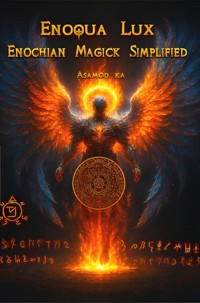
Enochian Magick Simplified is a modern and practical guide to exploring the mysteries of Enochian magick in an accessible way. With a clear and direct approach, it transforms complex ancestral concepts into techniques that can be applied in daily life, allowing readers to work with symbols, rituals, and energies effectively and safely. Ideal for beginners or curious practitioners, this manual brings the Enochian tradition into contemporary life, making magick not only understandable but also useful and practical. In this book, Asamod Ka turns profound and esoteric concepts into clear tools for expanding consciousness and mastering effective magical practice.
Das E-Book können Sie in Legimi-Apps oder einer beliebigen App lesen, die das folgende Format unterstützen:
Seitenzahl: 78
Veröffentlichungsjahr: 2025
Ähnliche








Copyright Notice
No part of this publication may be reproduced, stored, or transmitted in any form or by any means—mechanical, photographic, electronic, or otherwise, including phonographic recordings—without the prior written consent of the author.
In accordance with Article 12 of the Copyright and Related Rights Code, copyright protection is granted automatically and does not require registration, deposit, or any other formal procedure.
This work was registered with Copyrighted.com on October 26, 2025. Registration ID: oTgO2fdDjJZqmXSF
Any republication, adaptation, or reproduction of this material must not result in the distribution of modified versions.
Introduction
Dear reader,
Over the past few years, I have devoted myself to writing high-quality works—books that both I and my readers recognize for their rigor and authenticity.
I do not resort to artificial intelligence. I bring with me more than twenty-five years of practical experience in the occult, an experience that has shaped my own vision, free from mainstream trends. What I present here is not a repetition of dogmas, but rather the expression of a 21st-century neo-occultism, where quantum physics and metaphysics intertwine in a living body of knowledge.
I do not identify with Jewish Kabbalah or goetic magick. In fact, I directly confront the dominant view of self-proclaimed "wizards" and affirm: goetic magick does not deal with demons that are submissive or controllable by humans; it deals with extra-dimensional beings, cosmic spirits—even if they manifest in denser or more negative vibrations—but who are far beyond common ritualistic simplifications.
This theory is far from unreasonable. Kenneth Grant, of Aleister Crowley's Typhonian tradition, also suggested that the Enochian system does not invoke angels in the traditional sense, but rather pre-human or inhuman entities — chaotic, alien forces.
I also assert that most modern esoteric systems — Kabbalah, Golden Dawn, Freemasonry, Thelema — drew about 80% of their teachings from ancient Kemetic occultism.
In this book, I propose to approach Enochian Magick through this same prism, free, profound, and cosmic. Guided by my mediumship and the spiritual entities I work with, I am able to peer beyond the veil and offer a broader, more expansive perspective on this mystical tradition.
Note that in occult circles, "Magick" is spelled with a "K" at the end, to differentiate high magick from "stage magic" or folklore. Throughout this book, I will consistently use the spelling "magick".
What Led Me to This Title:
Enoqua Lux merges "Enoqua", a reference to the Enochian tradition, with "Lux", the Latin word for light and knowledge. The title thus symbolizes the illumination and wisdom inherent in Enochian Magick.
This book is not confined to the language or mindset of the 16th or 19th centuries. I embrace a modern, critical, and analytical approach, unafraid to challenge tradition where necessary.
John Dee and Edward Kelley developed what became known as the Enochian Magick system. Officially, they claimed to deal with angelic forces and that enochian was the "language of angels."
In my view, this narrative also served a practical purpose: it offered protection from criticism, religious persecution, and even execution. Within the historical context, framing these communications as "angelic" was a far safer approach than openly speaking of spirits or extra-human entities.
Personally, I perceive this system as a fusion of two distinct phenomena:
– On one side, spiritual entities—comparable to the Gnostic archons or the Sumerian Anunnaki—conveyed knowledge to Kelley.
– On the other side, the psyche, mediumship, and human interpretation of Dee and Kelley acted as a filter—shaping, reorganizing, and enriching the information they received.
The result was a hybrid system: part revelation, part mediumistic interpretation, which still fascinates and challenges students of the occult today.
It is important to note that we can never know whether the cosmic beings—or "angels," as Dee called them—transmitted this system in its entirety, or whether he himself introduced changes when recording the revelations. John Dee was a devout Christian, practicing Marian devotions, reciting psalms, and making constant references to the Trinity, as well as being deeply knowledgeable about Christian Kabbalah, inspired by thinkers such as Pico della Mirandola and Reuchlin.
Thus, everything he received through Edward Kelley, the medium and seer, inevitably passed through his mental filter. An unknown entity was classified as an "angel"; an obscure name was analyzed and reconfigured according to Kabbalistic or numerological patterns.
In the diaries, we sometimes see the "angels" correcting Kelley or communicating through enigmatic phrases, whose translation proves complex and ambiguous. There are passages that sound like fragments of a raw transmission—almost a glossolalia, a pure non-human language. In others, however, Dee's hand is evident: reorganizing, rationalizing, and adapting the messages to his personal Christian and Hermetic framework.
I believe we are dealing with dimensional or cosmic beings, a veritable pantheon of different vibrations—some higher and more luminous, others denser and more challenging. These beings presented themselves with specific names and titles, or perhaps it was John Dee himself who interpreted them in this way, molding them to his cultural and religious context.
The Enochian alphabet is notoriously complex and hermetic. Therefore, in this book, I propose to simplify the system, making it more accessible without losing its practicality.
We live in an era where most practitioners seek quick, simple, and above all, functional rituals.
I, Asamod Ka, follow a clear line in all my books: I focus on the essentials. I don't write 300-page works full of idle chatter. I reduce the content to what really works—straightforward, practical.
100 to 140 pages are more than enough to convey knowledge; anything more is noise.
I simplify without ever losing power. According to Chaos Magick, any system can work; what truly matters is the intention, concentration, and magnetism of the magician.
You can repeat mantras (calls) in Enochian, you may not even understand the meaning 100%, but if you glimpse and feel what you desire, if you vibrate with emotion and your ritual is strong, it will produce results. In fact, I'm not the only one who thinks this way, the Golden Dawn already did, as well as modern magicians.
Enochian magick falls into the category of theurgical magic.
John Dee also incorporated some planetary magic. For example, certain letters, quadrants, or angelic hierarchies are associated with planets, days of the week, and astrological energies. These planetary correspondences act as additional layers of attunement.
This system is not a single uniform block. John Dee and Edward Kelley developed different systems, with the "Heptarchia Mystica" being an initial and distinct part of the Enochian body.
The "Heptarchia Mystica" corresponds to Dee and Kelley's notes on planetary magick, prior to the Enochian Tables and angelic "Keys." It focuses on the invocation of the seven kings and seven planetary princes- , associated with the seven days of the week and the classical spheres.
Some occultists, including members of the Golden Dawn, consider the "Heptarchia Mystica" to be an independent system, distinct from the later Enochian.
Simply put:
You don't need to master the entire grammar—just use the established Keys (the 19 Enochian Keys).
Some mages use translations (in English) as reinforcement, and recite only a few keywords in Enochian to maintain the original energy.
Instead of assembling the entire arsenal (Sigillum Dei Aemeth, Lamen, Tabula Sancta, etc.), you can work with:
The seal of the entity (or a name drawn from the Table of Towers), a brief Enochian Key, and the use of a candle or incense serve as ritual anchors.
The Golden Dawn already did this in the 19th century: they cut out many parts of the original system, but kept its functionality.
Important Note:
This magickal system expands consciousness, but requires discipline and awareness of one's own limits.
When penetrating the Aethyrs (or Aires), one not only crosses the veil of the spheres, but also dismantles the veil of one's own mind.
Enochian Magick is not neutral: it is a living fire that redraws the subtle lines of the psyche. With each invocation, angelic frequencies—living codes from other realities—begin to reshape the mage’s field of perception.
A gap then arises between the everyday "I" and the transdimensional "I": the feeling of not belonging to the physical plane, stumbling over objects, feeling like a stranger in matter. These are symptoms of the soul expanding beyond the third dimension, while the body still moves within it. It is not madness: it is the process of attuning and decoding consciousness. But balance, anchoring, and preparation are necessary so as not to get lost.
Uses of Enochian Magick:
Unlike grimoires of goetic or folk magic, Enochian magick is not normally used for harm or control of others.
The modern focus tends to be on self-exploration, gnosis, and connection with higher planes, not "domination of entities."
In modern practice, enochian magick is used in different ways, depending on the mage or tradition:
Main modern use




