


8,49 €
Mehr erfahren.
- Herausgeber: Atlantic Books
- Kategorie: Sachliteratur, Reportagen, Biografien
- Sprache: Englisch
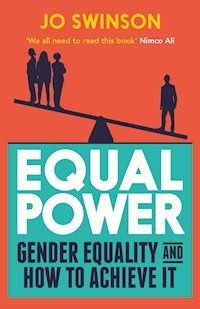
Shortlisted for the 2018 Parliamentary Book Awards (Best Memoir by a Parliamentarian) Why is gender inequality so stubbornly persistent? Power. Even today, power remains concentrated in the hands of men right across the worlds of business, politics and culture. Decisions taken by those with power tend to perpetuate gender inequality rather than accelerate solutions. And those who see the problem often feel powerless: ingrained sexism and gender inequality can seem too huge to solve. Equal Power holds a mirror up to society, showing the stark extent of gender inequality while making the case that everyone has the power to create change. Whether you are a teenage student, a global CEO or a taxi driver, there is much we can do as friends, consumers, parents and colleagues to create a world of Equal Power. In this inspiring and essential book, deputy leader of the Liberal Democrats and former Government Minister for Women Jo Swinson outlines the steps we can all take, small and large, to make our society truly gender equal.
Das E-Book können Sie in Legimi-Apps oder einer beliebigen App lesen, die das folgende Format unterstützen:
Veröffentlichungsjahr: 2018
Ähnliche


















First published in Great Britain in 2018 by Atlantic Books, an imprint of Atlantic Books Ltd.
Copyright © Jo Swinson, 2018
The moral right of Jo Swinson to be identified as the author of this work has been asserted by her in accordance with the Copyright, Designs and Patents Act of 1988.
All rights reserved. No part of this publication may be reproduced, stored in a retrieval system, or transmitted in any form or by any means, electronic, mechanical, photocopying, recording, or otherwise, without the prior permission of both the copyright owner and the above publisher of this book.
10 9 8 7 6 5 4 3 2 1
A CIP catalogue record for this book is available from the British Library.
The extract from Desert Flower by Waris Dirie (Virago, 2001) is reproduced by kind permission of Virago, an imprint of Little, Brown Book Group.
Every effort has been made to trace or contact all copyright holders. The publishers will be pleased to make good any omissions or rectify any mistakes brought to their attention at the earliest opportunity.
Hardback ISBN 978 1 78649 187 9
E-book ISBN 978 1 78649 188 6
Printed in Great Britain
Atlantic Books
An Imprint of Atlantic Books Ltd
Ormond House
26–27 Boswell Street
London
WC1N 3JZ
www.atlantic-books.co.uk
For Dad, who taught me the power of asking questions For Mum, who showed me the strength that lies within
Contents
Introduction
1. POLITICS: A Woman’s Place is in the House of Commons
2. CHILDHOOD: Learning the Ropes
3. BODIES: Blood, Sweat and Tears
4. PARENTING: It Takes Two to Tango
5. WORK: The Unlevel Playing Field
6. CULTURE: The Space Race
7. SPORT: The Gender Play Gap
8. VIOLENCE
9. MEN: Equal Power is a Win-Win
Conclusion: Towards Equal Power
Acknowledgements
Endnotes
Introduction
You’d have thought I’d have figured it out before. After all, I had been a Member of Parliament for a decade, and Minister for Women for more than two years. But every time I made a comment on gender equality, only to find my words twisted wildly out of context by newspaper stories the next day, I assumed that it was my fault, that somehow I’d got it wrong. I hadn’t been careful enough with my choice of language, or my meaning must have been unclear. Then it finally dawned that this media response was an inevitable part of the same endemic problem.
Gender inequality is everywhere. It is ingrained throughout society, in each and every one of us. We are all sexist, and so are our institutions and power structures. That’s why attempts to challenge it are often met with such ridicule and resistance. There is no perfect form of words to express ideas of gender equality that will not be deliberately misunderstood by those who feel threatened by the prospect. So there’s no point worrying about the shrieks of outrage from outlets that are committed to preserving the status quo of power inequality – where power is hoarded and concentrated in the hands of rich white men.
(Daily Mail, eat your heart out, I can’t wait for your hot take on Equal Power.)
What I have learned about gender power in society is what I want to share with you in this book. Most of all, I want you to feel encouraged, empowered and emboldened to take action that will challenge gender inequality. Each chapter includes lots of ideas for things you can do, from having a conversation differently to campaigning for major change. When something resonates, or you come across something you’d like to do, please jot it down, and make a promise to yourself to try it out. We’re all part of the problem to varying degrees – but equally, we can all be part of the solution.
Invisible, Unintentional, Universal
As a minister with a significant portfolio in the Department for Business, Innovation and Skills spanning corporate governance, employment law, competition policy, consumer affairs and the Post Office, my responsibility for Women and Equalities had to be fitted into about a fifth of my ministerial time (and this position had been tellingly forgotten in the 2012 reshuffle, so was not allocated to me until several days later). I’d initially viewed the equalities portfolio much like my other areas of responsibility, yet it was the most intractable and biggest of problems to address – and not only because of the difficulties of winning battles against Conservative members of the coalition government. The Department for Business had a budget of £26 billion, and 800 civil servants in one building alone, with thousands more across partner agencies. The Government Equalities Office had less than £20 million, and only narrowly avoided a further £6 million cut when I enlisted help from the Chief Secretary to the Treasury, my Liberal Democrat colleague Danny Alexander. Its 100 staff were cut to 50, and it featured low down in the official government pecking order.
But even with far greater resources, government alone is not going to solve the problem of gender inequality, because it is often invisible, unintentional and universal.
Celebrating the milestones in equality for women is important – such as the centenary of the first UK women achieving the right to vote in elections in 1918. But benchmarking against history can lead us into a false comfort about progress, instead of seeing the huge gulf that still exists and focusing on what we need to do to close it. A century on from women in the UK winning the right to vote, nowhere in the world has gender equality been achieved.
When I was 13, my school organised a day-long conference called ‘You Can Do Anything’ for all the girls in my year group. People who worked in a range of different jobs came and spoke about what they did and answered questions from the teenage audience – a firefighter, a scientist, a police officer, a salesperson, a council worker. This careers event was timed to broaden our horizons and inform our looming subject choices. While in subsequent years it was open to both boys and girls, it was clear that even in the early 1990s, people were trying to figure out why women were largely missing from some careers and what they could do to change it.
If you’d asked me, I’d have said I thought I could do anything. At the time I wanted to be an author; later on, inspired by Young Enterprise, I decided I wanted to go into business. My grandfather always said he thought I would be a politician. Throughout my 1980s childhood, it didn’t cross my mind that it was unusual for a woman to be prime minister – the very act of being the first woman to lead the UK government is one of Margaret Thatcher’s most powerful legacies, and it is too often dismissed in an understandable rage about the policies she advanced. Whatever you think of Theresa May’s politics and judgement, girls growing up today take as read that a woman can run the country. But while symbolism and role models matter, even with a woman at the top, the corridors of power are stuffed with men.
When I arrived in Parliament as its youngest member in 2005, a fresh-faced 25-year-old full of anticipation, I’d have told you I didn’t experience sexism. I expected the world to treat me on the same basis it would a man, and on the face of it, in the main, it appeared to do so. I didn’t see the covert closed circles of men making the decisions, and they didn’t see – or think it mattered – that they were all predominantly white men. When my husband Duncan was elected as an MP in 2010, the comparison between the experience of a man and of a woman as an MP was impossible to avoid. The lived experience of Parliament, of media scrutiny, the instinctive approach to situations, the acceptance into the club – all differed greatly.
The experiences of men and women in our society are different in countless ways, and as we don’t walk in one another’s shoes, these differences are often invisible.
Imagine that our society is a forest. Everyone is forging their own particular path. Gender inequality is pervasive: discriminatory laws and rules, sexist behaviour and incidents, gendered language and stereotypes, all form barriers across those varying paths to different degrees.
A mildly sexist joke might be just a gossamer thread or a fern falling down, easy for most to brush off, but when meshed with thousands of other tiny injustices it becomes part of a strong web that is harder to push through. Some will make it, then find themselves covered in sticky cobwebs and scratchy briars that linger for miles. A law banning women from travelling or working without a man’s permission, however, might be like an array of thick steel cables – a significant constraint and very hard to break.
Some of these roadblocks have been there for centuries, and at first glance it can be hard to tell which ones are so entrenched they have fossilised into impenetrable stone, and which have instead become a brittle facade and will fall away with a well-aimed kick.
All the while we make our way through the forest, we are spinning our own threads and webs of comments, assumptions and behaviours that can by turns constrain us, or float across and become fixed obstacles in the path of others. New barriers are produced constantly, whether the unintentional by-product of conversations and experiences, or in some cases a deliberate effort to preserve the status quo. The media outlets of some powerful rich white men create webs on an industrial scale, with publications like the Sun or the mainstream porn industry churning out their coils of misogyny and catapulting them far and wide.
The thick cords of sexual assault and violence against women are often darkly visible from miles away, and unite forest dwellers from all corners in their public condemnation. But these same cords can be translucent, and people often don’t see those blocked by violence and sexual harassment when it is close to home.
The bindings of the balance of domestic responsibilities or of the pressure of body image blend into the background as part of the normal landscape, a permanent and apparently natural feature of the forest canopy. A man taking parental leave to care for his child is met with signs telling him he has clearly wandered down the wrong path and should turn back. Often the interlocking meshes of political under-representation and economic imbalances are barely seen from a distance, or can only be seen in a certain light, from a certain perspective. Young women beginning their journey may be pleasantly surprised by the relatively open track in front of them, and dismiss the warnings of older women about what lies ahead, assuming that the paths have been cleared since their mothers’ day. Men may look across and imagine that women are facing a similar path to them, not seeing the myriad additional hurdles that women have to overcome to keep making progress.
Every now and again, a woman emerges in a clearing on higher ground – a position of power where everyone in the rest of the forest can see her. People look and point and say it proves that women can make it through the forest, quietly forgetting that the number of men in these clearings is so much greater. Some notice that these women are often covered from head to toe in a filthy gunge of cobweb, faces scarred and scratched from fighting through the thicket, and that as they reach this higher ground, from different corners of the forest comes a targeted assault of character assassination, sexualised abuse and patronising nonsense. These women brazen it out, holding their ground with grace and outward serenity. But plenty of women see this spectacle, shake their head and conclude: ‘No way am I doing THAT.’
In addition to obstacles created by gender stereotypes, there are a wide range of forces that hinder or propel different people through the forest, such as race, religion, disability, income, nationality, sexual orientation and age.
Socio-economic, racial and other power imbalances are interwoven with the issue of gender. This story can only be told by recognising those interplays, dubbed ‘intersectionality’ by Kimberlé Crenshaw back in the 1980s, and still not widely enough understood.1 Those imbalances are also topics worthy of full exploration in their own right, and as others have written more eloquently about them than I could, I encourage you to read their writings, too.
Plenty of people feel uncomfortable with the rigidity of gender norms, even those who are cisgender, or ‘cis’ – that is, they identify with the same gender as when they were born. There are many who do not define themselves as either a man or a woman, often describing themselves as gender-fluid or non-binary. Trans people identify with a different gender to the one they were assigned at birth. It is hugely important that trans and non-binary people are able to live freely without having to pretend to be someone they are not. Fighting prejudice against trans people is an important part of promoting gender equality. Indeed, restrictive and tightly defined gender roles in society are a problem for men, women and gender-fluid people alike, whether they are cis or trans.
The Power to Change
At the heart of this book is the issue of power, where it lies in our society and to what ends it is used. As a liberal, I distrust concentrations of power, whether in the hands of the state, large corporations, groups or individuals. A world of Equal Power is one where each individual is valued and can make their own genuine choices, free of fear and the constraints imposed by their gender. It is not a world of conformity where everyone has to be the same.
All sorts of things can confer power on people or institutions, depending on the circumstances: financial assets, fame, access to information, physical strength, property ownership, status within society or an organisation, political office, or control of media outlets. While different people will feel powerful or not depending on individual circumstances and situations, the gender imbalance in these centres of power is clearly weighted in favour of men as a group. That power imbalance is the focus of this book.
I’m a thirty-something, cis, able-bodied, middle-class, straight, white woman who happens to be a mother, an MP, Scottish, British, European, a liberal, a humanist and a feminist. All of these things have shaped my experiences and my path. Some of these are choices, some of these are innate. Some give me privilege and make it easier for me to navigate the world, others make it harder. We all tread our own path through the forest.
Instead of despairing at the state of the world, let’s roll up our sleeves and change it. If we want a world where every new baby arriving in it has the same opportunity to thrive, then we all need to do what we can to clear the forest paths. Those with the easiest routes have the most responsibility, and often the greatest resources, but everyone can and should do their bit.
So this isn’t just a book, it’s a call to arms. You haven’t just picked up some reading material for the commute, you’re holding an action plan. The power I’m describing doesn’t only lie with others – you yourself have the power to make a difference. So let’s do it. Equal Power, here we come . . .
Jo Swinson
October 2017
1
POLITICS: A Woman’s Place is in the House of Commons
Gladys Eagar was born in 1913 in north London, the daughter of a print worker and a cleaner. Ninety-five years later, she visited the Houses of Parliament to watch the pomp and splendour of the State Opening. It was a wonderful day. She put on her favourite dress, bought a few years earlier for her grandson’s wedding. Her middle son, Peter, picked her up from the maisonette where she lived in Winchmore Hill. She’d been there since 1947; her husband, David, worked for the gas board, and the flat came with the job. Even long after he’d retired, they continued living there in the home where they had raised their three sons. It was above a gas showroom, which later became an office furniture shop, and a door on the side street opened onto the steep staircase up to the living areas on the first floor. David walked with a limp which worsened with age, so they’d had a stairlift installed. When he died earlier that year, she’d decided to have the stairlift removed. Every day Gladys ventured out along the Broadway to chat to the shopkeepers and buy provisions, climbing the stairs and managing an independence of life that most of us will only be able to wish for in our nineties.
That morning, Peter helped her into the waiting taxi and they began the journey towards Westminster. The streets nearby were heavy with police and iron security barriers, and they were stopped by a cordon on the Embankment, some considerable distance from the entrance to Parliament. Approaching a nearby police van, Peter explained to the officer that he was taking Gladys to watch the State Opening, and asked whether there was anywhere closer that the taxi could drop them. The kindly officer encouraged them to jump in the van, and she helpfully drove them both along the road right up to the door of the House of Lords.
Gladys had always been a royalist, and a huge admirer of the Queen, and she was in awe of the sense of occasion. Her seat was in the Royal Gallery of the House of Lords, and she and the other invited guests there were shepherded into blocks of raised seating. She was a tiny woman – once 4’11” but the ageing process had concentrated her into a 4’9” stature. Struggling to see the events unfolding over the heads of those in front, she swapped with a taller gentleman so she could sit at the end of the row, with a perfect, unobstructed view down the gangway. At the allocated time, everything done with military precision, Her Majesty the Queen arrived in the royal coach, her crown and dress glittering, and made her way through Parliament. As she processed through the Royal Gallery, Gladys looked on with joy.
The span of Gladys’s life had seen huge change. When she was born, women were unable to vote. Her early years saw the devastation of the First World War, and one million more women entering the labour market,1 many stepping up to do the jobs left by men who were fighting on the front line. The suffrage movement gained ground, and in 1918 women won the right to vote with some restrictions, enfranchising about 40 per cent of women.2 The first woman MP, Nancy Astor, sat in the House of Commons a year later, although it would take almost four decades for women to be allowed to sit in the House of Lords (1958). The first woman minister was Margaret Bondfield, appointed in 1924, and she became the first female Cabinet minister in 1929, shortly after women gained the right to vote on the same terms as men (1928).3
By the time of the Second World War, Gladys had married and become a mother, nursing her infant son and cradling him in shelters as London was bombarded from the air during the Blitz, all on her own while her husband David was working away tending injured RAF pilots in a special burns unit. Again, the role of women in the war effort was a catalyst for wider social change, and increasing numbers of women entered the labour market, even after marriage. Gladys worked as a dinner lady for ‘pin money’, but the family model was still very much the husband as breadwinner. By the time her sons married and started their own families in the 1960s and early ’70s, women’s role in the workplace wasn’t seen in quite such limiting and patronising terms. Her daughters-in-law took up professional roles – one as a nurse, another as a teacher. In politics by this time, a total of seven women had become Cabinet ministers, though women were still very much the exception. Parliament was more than 95 per cent male. When the Conservative Party elected Margaret Thatcher as leader in 1975, Gladys had four grandsons and two granddaughters. Four years later, Thatcher became the UK’s first ever woman prime minister, and a few months after that, Gladys’s youngest grandchild was born. Another little girl, Joanne. Me. Twenty-five years later, I was elected to Parliament.
In my grandmother’s 101 years, huge strides were undoubtedly made towards gender equality in our politics, and many glass ceilings were smashed. Yet I remember what she told me after her visit to the State Opening of Parliament. She said she had ‘such a wonderful time, it’s like things used to be’ – the unfailing politeness and decorum, doors held open, people quick to offer assistance out of deference for age. I love that she had such an amazing day, and that the brilliant people who work in Parliament made it so special for her. But her remarks contained a wider truth that goes beyond courtesy and ceremony. There’s no doubt about it, Parliament and our political system is too much ‘how things used to be’ in all sorts of areas where it should have moved with the times.
Gladys sadly died in 2015, but there are still people alive today who remember a time when women were not even allowed to vote in Britain. That is how scarily recent such a grave political injustice is – and indeed in many other countries it took much longer to rectify. Women in Switzerland were only allowed to vote in 1971.4 In 2015 women in Saudi Arabia voted for the first time in local elections.5,6
There is a real danger that we fall into the trap of comparing now to days gone by and concluding that because things are better, things are fine. In the UK, women MPs comprise roughly one-third of the House of Commons. We have our second woman prime minister in Theresa May, Nicola Sturgeon serving as Scotland’s First Minister, and the most powerful politician in Europe is German Chancellor Angela Merkel. But this is far from political equality, and these historic achievements can mask continuing underlying problems and a power imbalance in politics. Just as Barack Obama’s presidency did not mean the end of racism in the US, individual women getting to the top of politics does not mean that political power is shared equally between men and women.
Welcome to Parliament
Wandering the corridors of the Houses of Parliament as a new MP at the age of 25, I was deeply aware of having arrived at a historic institution. The building itself feels like a maze, full of doorways tucked away and secret staircases that seem to move, Hogwarts-style. The grandeur and dated splendour is both beautiful and dominating – it took me a long time to feel like I fitted into these surroundings. People were friendly, but with a firmness for tradition that could make you feel like an alien in your own workplace. I remember my friend Jenny Willott, also newly elected, telling me that she had been gently but pointedly told off by one of the doorkeepers. She had, apparently, done two things wrong. The first was to go into the House of Commons chamber wearing a coat. The second had been removing the coat while in the chamber. At times, it felt like you couldn’t win.
Over time I got used to the weirdness of the institution, and found my voice and place within it. It took me longer to study and start to understand how political power ebbed and flowed, however. I think I expected that power came with positions – for example as an elected MP, or a government minister. The truth is much more complex, so let me tell you what I have learned about the nuances of political power.
I hadn’t fully recognised, even as an opposition MP, all the constraints that ministers were working under: legal advice, government procedures, the need to secure collective agreement, party management. I naively assumed individual ministers could just snap their fingers and make a decision to accept an amendment to a bill they were taking through Parliament.
There are many places political power lies. Party leaders, of course – though there are more checks than you’d think on their ability to manoeuvre. Then there’s the machinery of government, including ministers, civil servants, ‘private offices’ and special political advisers (SPADs). Informal cosy coteries surround political leaders and have their ear. The government schedulers, who decide which bills receive precious parliamentary time, enjoy their upper hand with a mixture of high principle, low politics and smugness – and woe betide anyone who suggests that the provisional timetable should be revealed even within government, let alone to others in Parliament. Party whips still jealously guard their power and the mystery over decisions on permitted absence from votes.
Maverick MPs can at times hold the whole proceedings to ransom until ridiculous hours by making lengthy speeches. Rebellious MPs can hold significant power, but if they are disorganised or become serial rebels that power fades, unless the government has an ultra-slim majority, as this current Parliament now demonstrates. Sections of the media that can command large audiences hold significant sway, with their ability to splash away reputations and strangle new policies at birth, sometimes with a casual regard for the facts. The power of the wider party machinery varies between parties, but includes staff in key positions, committee structures, conferences, elected representatives in different bodies, and sometimes external affiliated organisations. And ultimately, of course, the voters have power: once every few years rocking up to a local primary school or church hall, and making a mark with a stubby pencil on a piece of paper to sum up all their hopes, fears and ideas.
With the exception of the voters, every other power base within the political system remains overwhelmingly dominated by men.
It wasn’t until 2017 that the total number of women MPs ever elected to the House of Commons finally overtook the number of men elected as MPs in a single general election.7 We have never had a woman as Chancellor or Defence Secretary. The reshuffle after the 2017 election left five government departments with entirely male ministerial teams, including the Foreign Office and the Ministry of Justice.8 Gender equality at the top of the civil service is going backwards – just three of the top sixteen posts are held by women, down from eight in 2011.9 Pick any political party you like – with the exception of the Women’s Equality Party – and go to their conference: you’ll see man after man taking to the stage. Just a third of councillors in England are women,10 with even fewer in Wales (28 per cent)11 and Scotland (24 per cent).12Only 15 countries around the world are led by a woman, which is fewer than a tenth of the 193 countries in the United Nations.13
Governments at national and local levels wield huge influence over people’s everyday lives, making decisions on everything from health services to national security, taxation to transport, employment to education. The Houses of Parliament, the Scottish Parliament, the Assemblies in Wales, Northern Ireland and London, and councils up and down the country hold the people wielding the executive power to account. If these bodies do not reflect the society they serve, then they lack important voices and perspectives, and their debates and decisions are the poorer for it.
So far, so what? I’ve told you things you knew, or suspected at least. The interesting conversation is what is driving this power inequality between men and women in our political systems, and what we can do about it.
The barriers to greater participation in politics by women have often been described as ‘the 4 Cs’: cash, caring, confidence and culture. All of these do play a role, but I’d like to add a fifth ‘C’ – the closed club.
Cash
Politics can be pricey. Most people involved in politics are volunteers, and that includes political candidates. Travel, accommodation and registration fees to attend party conferences can easily run into hundreds of pounds each year. On top of that there are often training and campaign events or by-elections to go to, and party fundraisers with their endless raffles, requests for auction prizes, and sometimes even an expectation that candidates themselves should be able to write a fat cheque to help fund the campaign. But the biggest financial impact is no doubt lost earnings. Few successful candidates work in another job during the six-week election campaign, and many spend much longer than six weeks full-time as a candidate, without earning other income. One survey put the cost of a winning candidacy, taking all these factors into account, at over £40,000.14 The nature of the five-year political cycle encourages people to throw everything at their bid to win; unlike most job applications, if you don’t make it this time, you typically have to wait five years for the next chance. And, of course, there is no guarantee of success – I’ve known people remortgage their house and get into significant debt through a campaign, only to lose and find themselves exhausted, dejected and in severe financial hardship. This certainly affects men as well as women. But when men earn 19 per cent more than women on average in the UK, the financial barrier to politics is even higher for women. The Conservative Party is attempting to square that circle with bursaries for candidates who are less-well off,15 and the Women’s Equality Party offers candidates funding to help with childcare and other costs.16
It’s not just personal finances, however – the campaign has to be paid for, too. Fundraising often falls largely on the candidate’s shoulders: as the public face of the campaign, you’re asking people to buy into you as an individual, as well as the party. Over the course of 18 months or more, a parliamentary campaign can cost tens of thousands of pounds when you factor in staff, office costs, printing, postage and telephoning – and if you don’t have a large team of volunteers to help with delivering leaflets, stuffing envelopes and making calls then the cost can easily be much higher. I remember going on a training course about fundraising where one of the tips was to ‘think about your contacts, your friends, your family, your network – who would be able to write a cheque for £1,000?’. Let’s just say as a twenty-something, my list was devastatingly short. But this is even more of a barrier for people from lower-income backgrounds, and the socio-economic diversity in Parliament is worryingly going backwards.17 Anyone who has operated in the senior echelons of business and finance has an inbuilt advantage here – and they are disproportionately men. It’s like power squared. Those with financial power are better able to access political power.
Stricter spending limits on campaigning – not just at election time, but throughout the electoral cycle, would help solve this problem, as would limits on how much any one individual or company can donate. Cross-party talks on limiting political spending and donations have always got stuck in a stalemate because no party wants to lose the existing advantages they have – the Conservatives from big-business donations and Labour from the trade unions.18
There was an Access to Elected Office Fund established in 2011 to support candidates with disabilities to meet the additional costs they incurred.19 It is deeply regrettable that this fund was mothballed after 2015, with no current sign that the government intends to revive it. There is also some £9 million of public money given to political parties for policy development and the work they do holding the government to account.20 (The government of course has the extensive resources of the civil service at its disposal for policy research.)21 It is possible that this existing state funding could be tied to parties achieving some basic diversity targets, giving an additional impetus for them to improve the situation.
Public funding for political parties is never popular, least of all in post-2008 economic austerity, but an effective democracy costs money to run. Without using these levers and changing the finances, it will be much harder to draw power away from the wealthy in our politics, and the gender imbalance will be tougher to tackle.
Caring
Running for office while holding down a job is challenging enough, but when you add caring responsibilities into the mix, it often becomes impossible. The pattern amongst my Lib Dem colleagues was that women were either elected young, like myself, with no children, or when their children were teenagers or had left home. This was not the case for the men, many of whom were first elected when their children were very small.
Across Parliament there is a marked difference between the men and women MPs and how likely they are to be parents. Nearly three-quarters of the men are, and just over half of the women,22 yet in the general population around four in five women have children. Being a parent doesn’t make an individual better or worse at the job, though shockingly some try to score political points on the ‘childless’ status of their opponent – the brief 2016 Conservative leadership contest saw Andrea Leadsom suggest she had more of a stake in the future than Theresa May, because she has children and May does not.23 Interestingly, the parenting status of male politicians is much less likely to come under scrutiny. Labour Cabinet minister Ruth Kelly seemed to acquire a permanent prefix in newspaper articles – ‘mother-of-four Ruth Kelly’– but for the men it is much rarer that their role as a father is mentioned – generally at exceptional times like the birth, or tragically the death, of a child.
Looking at Parliament as a whole, however, a lack of parents in politics does matter. Firstly, because parents are underrepresented we are missing out on that perspective in debates, just as is the case with other under-represented groups. Secondly, the gender discrepancy means the parent-gap compounds the existing lack of women in politics: those parents who are missing from politics are mainly mothers.
Not many MPs are elected in their twenties. At any given time, of the 650 MPs only a handful are under 30. There’s a fair bit of media snark about young MPs: the patronising assumptions that they’ve ‘never done a proper job’, and the infantilising title ‘Baby of the House’ – you can imagine how much I loved that! As a young woman, it was a double whammy. I was experiencing a ‘meteoric rise’ when tipped to join government two years later than other MPs elected at the same time as me. Newspapers would emphasise that I was a ‘junior’ minister without applying the same descriptor to older male colleagues at the same level. Yet, if you look over time, many of our country’s greatest and most prominent politicians have been elected young: Charles Kennedy at 23, David Steel at 26, Lloyd George at 27, Roy Jenkins at 28, Ken Clarke at 29, Tony Blair at 30, Harriet Harman at 32, Gordon Brown at 32, Margaret Thatcher at 33, Shirley Williams at 34, and even Winston Churchill at 25. So perhaps we should be a little less dismissive of young MPs. Surely it would be better to encourage young people of all genders to become politically active, and celebrate their public service when they do.
Lots of MPs are first elected in their thirties and early forties, often after fighting a couple of elections and building up constituency support, or earning their spurs in an unwinnable seat before being chosen for one with a better prospect of success. This coincides with the point that many women are aware that if they want children but haven’t yet done so, they’d better get their skates on. I have lost count of the number of fabulous women candidates who ran brilliant campaigns in their twenties and then felt they were not in a position to fight the next election due to starting a family. Of course, you can stand and get elected while pregnant – as Harriet Harman did in 1983, Ruth Kelly in 1997, Kitty Ussher and Natascha Engel in 2005, Jenny Willott in 2010, and Lisa Nandy and Rachel Reeves in 2015. But it’s not without its practical challenges, and not all women will want to combine pregnancy with electioneering.
It doesn’t necessarily get easier after the birth. Caring for a newborn is exhausting, and breastfeeding requires a similar amount of energy as running ten kilometres every day, plus in the early weeks the frequency of feeds can make it well-nigh impossible to get anything else done. But as an MP with a fair degree of autonomy and flexibility in how you do the job, this is arguably much more straightforward to manage than as a candidate or in many other roles.
Combining politics and becoming a mother can seem a daunting prospect. It is also tricky to plan. There is uncertainty about when you’ll conceive, and uncertainty about the electoral timetable. That was even worse before the Fixed-term Parliaments Act, which apparently removed the ability of the prime minister to call an election whenever they liked – though 2017 showed that surprise elections are still possible.
But the biggest hurdle isn’t actually the year or so covering the physical experience of pregnancy, birth and early bonding. It’s the expectation, often shared by men and women alike, that women take the lion’s share of the responsibility for that child for the years and years that follow. Men don’t tend to consider combining politics and being a father a daunting prospect, any more than they plan their career around the best time to become a dad. And the same holds true for caring for elderly relatives, too. How often is it the daughter that visits her aged parents daily, organises care services and provides the emotional support?
‘Emotional labour’ is a term coined to describe the social glue that women tend to provide in families and friendship groups. From organising birthday presents to arranging social gatherings, remembering what day to pack the school gym kit to sorting out the playdates, it’s the business of taking responsibility for making relationships and home life work. In political terms, this is often undertaken by the ‘constituency wife’.
In the days where it was expected that women would not have a paid job, constituency associations expected something of a two-for-one deal. They would interview the male candidates, and also put them through their paces at a social event, at which they could also meet and ‘assess’ the wife. What an awful concept. While hubby was away in Parliament, she might even stand in for him at some local events – perhaps visit the local hospice or contribute a pot of homemade jam to the church fete.
In practical terms, though, I know how invaluable a constituency wife would be. As an MP you spend Monday to Thursday away from home, and often work 70 hours a week. When you’re back in your constituency, your diary is packed, fitting all the advice surgeries, meetings with constituency staff, visits to schools, businesses and local groups, fundraising, correspondence and knocking on doors into the Friday-to-Sunday block. The nuts and bolts of looking after a house, making sure there’s milk in the fridge, that the washing is done and the plants are kept alive is not easy to squeeze in.
At this point I feel I must pay tribute to my mum, who has been a tower of support and practical help for me every step of the way since I was first selected as a candidate in 2002. From the rainy Saturdays we spent delivering thousands of leaflets together in Bishopbriggs (followed by a takeaway in front of Strictly), to going round to my flat to replace the buckets when I had a leaky roof and was 400 miles away, I couldn’t have done it without her.
Changing patterns in the workplace mean fewer MPs now have a stay-at-home spouse, yet this has coincided with increased expectations of MPs. Gone (thankfully) are the days when an MP only made a visit to his constituency annually. MPs are now rightly expected to be visible and active within their patch, and it is positive that more people now contact their Member of Parliament – evidenced by a significant increase in correspondence levels to MPs. Voters expect more. But this means it is no wonder that money plays an even larger role. In this scenario, the people more likely to be successful as candidates are those who can personally dedicate unreasonable amounts of time and money to the campaign.
We therefore have a system where it is unusual for women MPs to be elected at an age at which they could later choose to start a family, yet the demands of candidacy are often incompatible for those with family responsibilities who are caring for small children or elderly relatives – usually women.
We need to get over ageism and encourage young people into politics, and banish the phrase ‘you’ve got plenty of time’, so often used to calm the ambition of youth. Similarly, we need to judge potential candidates on their skills and abilities, not just on how free their diary is. We should also look seriously at and pilot innovations such as job-sharing, to open up the role to people who don’t have 70 hours a week to commit. Then we need to take collective responsibility for the politics we have created. Even if you don’t want to stand for election, there are lots of things you could do to make it easier for others who are standing, whether you belong to a party or not. A few hours a month knocking on doors, delivering leaflets, making phone calls, volunteering in a party campaign office or even doing some childcare can make a real difference. The healthier local political organisations are, the more a candidate can focus on the role of leading the campaign, rather than having to be the fundraiser-in-chief, recruiter-in-chief and deliver 300 leaflets before breakfast, too. All of which makes it more manageable to combine political candidacy with other responsibilities.
Confidence
Putting your head above the parapet, making your point forcefully, stepping forward and saying firmly ‘I think I’m the best person to do this’ – these ingredients of politics do not chime with the subliminal, and often explicit, messages our society gives girls about how to be ‘feminine’, ‘ladylike’ and generally win praise. In fact, women who stand for office and are perceived or portrayed to be seeking power are penalised, while men are not.24 It’s not therefore surprising that confidence is a key factor in the under-representation of women in politics.
My own political journey owes a huge amount to the people who encouraged me at every step along the way, from my English teacher Mrs Reid, who nurtured my interest in debating at school, to countless individuals within the Liberal Democrats who kept pressing me to take my next step. A key moment was a campaign training event I went on called Activate. It was a quirk of fate that I went to it at all. I nearly didn’t go.
I had just finished my first year as an undergraduate at the London School of Economics, and was looking forward to summer adventures, possibly a trip to Paris with my boyfriend. Then he ended the relationship. Glumly mooching about one morning soon afterwards, my 18-year-old self opened a letter from the Lib Dems; I’d joined the party at Freshers’ Fair. This letter was an invitation to Activate, a residential weekend in the Peak District, to learn all about political campaigning. They had subsidised it, so it was only a tenner. Throwing caution to the wind, I figured it was time to stop mooching and meet some new people – what was the worst that could happen?
The weekend was brilliant: a great introduction to how the party worked, what was involved in campaigning, and how I could get further involved. Perhaps most importantly, it gave me a network of about 20 other young people at a similar stage, so it wasn’t like taking a step into the dark alone. A few of us decided to go to the party conference that autumn, which would be so much easier because we’d know at least a few people. My participation snowballed from there – being elected to the national committee of the Liberal Democrat Youth and Students organisation (LDYS), becoming a party trainer and then vice chair of my local party.
Even so, I still needed to build my confidence. I remember my early party conferences, and going to fringe meetings where a few dozen people would gather to hear from a panel on a specific issue and then ask them questions. Just raising my hand to ask a question prompted all sorts of soul-searching – what exact words would I say, what if people thought the question was stupid, maybe I should just let other people do the talking . . . Typically, I’d spend most of the session crafting a question, then eventually pluck up the courage to raise my hand, at which point it would be too late to be noticed by the chair and I’d feel frustrated and be kicking myself. The same thing happened when, as a student, I applied to be in the Question Time audience. A regular viewer, I was a bit in awe of even being there seeing it all happen: production staff rushing around, huge wheeled cameras being manoeuvred into position, and sensing the ripple of excitement in the audience as the warm-up act was replaced by David Dimbleby and the show was about to start. Again, I spent half of the recording worrying about whether I should put up my hand, and the other half frustrated that I wasn’t called on to ask my question.
Later, I decided to set myself little targets when I went to political events, to force myself to speak up. I’d look at the agenda, decide what debates or meetings I’d be attending, and think a bit in advance about the types of issues I might talk about. In 1999, a little over a year after Activate, I made my first speech to a party conference aged 19. At every conference after that, I looked for the right opportunity to have my say. Years later I did the same in the House of Commons. In such a strange and imposing place, I was determined to be confident and comfortable in the environment, so I endeavoured not to let a week go by without making some kind of intervention, asking a question or giving a speech. Asking my first Prime Minister’s Question terrified me. To this day I recall the exact words I used25 – so ingrained they had become by endless practice, pacing up and down the House of Commons’ Terrace – as well as the sweaty palms and my pulse racing so fast I felt sure people sitting next to me must be able to hear my heart thumping. But the next time was a little bit less terrifying, the time after a bit less still. Asking a PMQ still makes me nervous – I don’t think that ever goes away – but there is no doubt that practice is one of the best ways I’ve found to deal with nerves.
It was the chair of LDYS, Polly Martin, who first encouraged me to apply to become a parliamentary candidate. She said I’d be good at it, and learn a lot from doing so. I didn’t want to be an MP, but I figured it would be an interesting experience and a good talking point in the future – and of course there would be a wide range of seats where I could stand with no danger of winning. I was 20, not yet old enough to stand for Parliament (back then you had to be 21, though it was lowered to 18 a few years later), but I went through the process to become an ‘approved candidate’, which consisted of an application form, an interview, and a series of tasks like making a short speech, role-playing listening to a constituent in an advice surgery and a group discussion exercise. Once I was on the candidates list, I was allowed to apply for seats on the basis that my 21st birthday was in February, before the expected date of the election in May 2001. As I was working in Hull for the local radio station Viking FM, I decided to try to become the Liberal Democrat candidate for the constituency of Hull East, where the sitting MP was Deputy Prime Minister John Prescott.
We didn’t have many Lib Dem members in the constituency, and even fewer attended the hustings to select the candidate. I was chosen, beating the other contender, Angie Wastling, by eight votes to six. Our campaign was run on a shoestring, with one basic black-and-white A4 leaflet, a couple of public meetings and a few press releases sent to the Hull Daily Mail. We knew we couldn’t win Hull East at that election, so most of my time was spent campaigning in the nearby constituency of Haltemprice and Howden, where I lived and was vice-chair of the local party association. It was a bit of a long shot, as the Conservative MP David Davis had a majority of 7,500, but we ran a strong campaign which cut his majority to under 2,000.
I learned a bit about power on election night. I’d psyched myself up for the declaration of the result, which could be televised to millions. I’d planned the short speech I would give after John Prescott (in safe Labour Hull on the eve of a second Labour landslide – the winner was never in doubt). But unlike all the footage I’d seen on election-night TV coverage, with all the candidates lined up on a stage while the returning officer reads out the votes, I found that wasn’t the way it was done in Hull. Only John Prescott and his wife Pauline were allowed up on the stage in this Labour stronghold. So after the excitement of achieving a 6 per cent swing to the Lib Dems, and beating the Tories to take second place,26 the actual announcement felt like a bit of an anticlimax.
Nonetheless, I had caught the bug. At the same time, I was becoming more disillusioned about my job and the company I worked for. The important charity work we did in the local community only seemed to matter to the central management in how much publicity it would get us. I concluded that to be happy at work I would need to find a company whose values I shared. Then another idea started to take root in my mind. After finding my experience on the campaign trail fighting for my beliefs much more fulfilling than my job, I started to muse on whether I might stop treating politics as a hobby, and instead try to stand somewhere I had a chance of winning.
That summer I spent lots of time thinking why there were so few women MPs. For the Lib Dems, 2001 had been our best election yet, winning 52 MPs – but just five were women: Jenny Tonge, Sandra Gidley, Sue Doughty, Annette Brooke and Patsy Calton. It was a frankly appalling record. Discussion raged on our online forums: What was the problem? Was it sexist local parties, too few women coming forward to be candidates, or something else?
One viewpoint maintained that this was sexism – men being chosen over women due to sexist attitudes – and the only solution to this would be all-women shortlists. Labour had already implemented this, and it saw them elect more than 100 women MPs in 1997. Yet in the online posts analysing data from our Candidates’ Office, a stubbornly persistent percentage was everywhere – 23 per cent of our list of approved candidates were women, 23 per cent of our selected candidates were women, 23 per cent of people applying to be candidates in the first place were women. There were some variations – for example, 28 per cent of our target-seat candidates were women, but none of our candidates were women in seats where we had MPs standing down. Most tellingly, the actual chances of getting selected in target seats overall were the same for individual men and women, but there were overwhelmingly more men at all stages, which was giving us our skewed result.
Convinced that this was a pipeline problem rather than one of sexism in the selection process, a group of us developed an alternative plan. We needed to address the imbalance in candidates coming forward by proactively talent-spotting, and encouraging and supporting women to become more involved at all levels, including candidacy. We needed nothing short of a major campaign in the party, treating this problem like a critical by-election we simply had to win. It would require funding, serious commitment and resources. Real change at the grassroots was and is a better solution than cosmetic change among our group of MPs.
The decision would be made at a high-profile party conference debate, which pitted the all-women shortlists option against our alternative approach. I summed up our proposals in a speech at the end of a fiercely argued debate: the conference hall packed with hundreds of delegates was easily the biggest audience I’d ever addressed, which was a daunting prospect. Learning that I would have to follow my heroine Shirley Williams – but speaking on the opposite side of the debate – did nothing to ease my nerves.
We were in Bournemouth, where the conference centre is on the seafront by a steep hill, and my stress was so intense that I remember running up and down that hill in my suit to try to burn off my excess nervous energy. I felt so passionately about the issue – both that we should get more women into powerful positions across our party, and that we should do it by tackling the problem at the source rather than by a tokenistic gesture to place a few more women in winnable seats. Passion can help a political cause, but I was genuinely worried that for me it would spill over into that horrible sensation where your throat tightens and speaking becomes impossible. A squeezed voice catching on the brink of tears was not the rousing oratory I had in mind!
This moment helped me realise the power we all have to boost the confidence of others. Preparing for a television interview before the debate, fear must have shown on my face. I’ll never forget the kindness of the journalist Zeinab Badawi, who placed her hands on mine and just said calmly, ‘You’re going to be okay.’ That reassurance meant a huge amount to me.
Four years later, my challenge was different but the fear was the same, as I got ready for my first appearance on BBC Question Time as a new MP. Then it was Labour MP Douglas Alexander with the cheery encouragement: ‘Don’t worry, you’ll be fine. I’m the government minister, they’ll be shooting at me.’
Seven years after that, it was my first ministerial questions in the House of Commons. I felt nauseous as I approached the chamber, empty and quiet before the day’s session began. I saw Conservative MP Matthew Hancock, another new minister at the Department for Business, Innovation and Skills (BIS), and asked him how he felt. ‘Honoured’ was his strident response. Not quite the shared camaraderie I was seeking. From unlikely quarters, the reassurance did come, though. Michael Fallon was also a new minister at BIS, but had previously served as a minister in the 1990s – an archetypal Conservative who I didn’t expect to bond with. Seeing that I looked rather nervous, he quietly confided that he was too. ‘But you’ve done this before!’ I said. He replied that it was 20 years ago, and anyway, the fear never goes away and nor should it.
We all have this power at our disposal, to see when others – even our competitors or opponents – are approaching a difficult challenge and an extra boost will help; at the right moment it might be as little as a smile or a kind word at that human level that can make all the difference.
Back to 2001, and the all-women shortlists debate. My speech was well received and we ‘won’. The Liberal Democrats rejected all-women shortlists and instead set up the Gender Balance Task Force, now the Campaign for Gender Balance. I got stuck in, identifying and cajoling women to recognise that they could do more – to make a speech at conference, lead a campaign team and aspire to elected office. I still have the little Filofax I kept, with handwritten notes on the dozens of women I was encouraging, to keep track of what stage they were at in the process, how I could support them best and when I should make contact again.




