


13,99 €
Mehr erfahren.
- Herausgeber: Parkstone International
- Kategorie: Erotik
- Sprache: Englisch
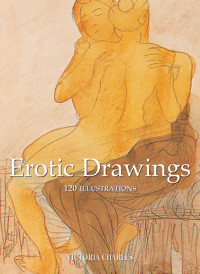
From Michelangelo to Rubens, Degas and Picasso, erotic art has attracted many great masters, who created works that captivate the beholder like few others. In spite of, or maybe even because of, this attraction, erotic art has never failed to evoke controversy, and regularly had to defend itself from charges of pornography. This book guides readers from early portrayals of erotic scenes produced in the 16th and 17th centuries, to contemporary highlights such as Picasso’s sketchbook drawings, encompassing a large variety of styles and techniques.
Das E-Book können Sie in Legimi-Apps oder einer beliebigen App lesen, die das folgende Format unterstützen:
Seitenzahl: 44
Veröffentlichungsjahr: 2022
Ähnliche

Victoria Charles
Erotic
© 2014, Confidential Concepts, Worldwide, USA
© 2014, Parkstone Press USA, New York
© Image-Barwww.image-bar.com
All rights reserved. No part of this may be reproduced or adapted without the permission of the copyright holder, throughout the world.
Unless otherwise specified, copyright on the works reproduced lies with the respective photographers. Despite intensive research, it has not always been possible to establish copyright ownership. Where this is the case, we would appreciate notification.
ISBN: 978-1-78160-819-7
Contents
THE ARTISTS
Michelangelo (1475-1564)
Rembrandt van Rijn (1606-1669)
François Boucher (1703-1770)
Johann Heinrich Füssli (1741-1825)
Jean Auguste Dominique Ingres (1780-1867)
Théodore Géricault (1791-1824)
Felicien Rops (1833-1898)
Edgar Degas (1834-1917)
Auguste Rodin (1840-1917)
Paul Gauguin (1848-1903)
Gustav Klimt (1862-1918)
Edvard Munch (1863-1944)
Aubrey Beardsley (1872-1898)
Ernst Ludwig Kirchner (1880-1938)
Pablo Picasso (1881-1973)
Jules Pascin (1885-1930)
Egon Schiele (1890-1918)
André Masson (1896-1987)
Jean Dubuffet (1901-1985)
Hans Bellmer (1902-1975)
Lucian Freud (1922-)
David Hockney (1937-)
LIST OF ILLUSTRATIONS
The Rest of Volupté
François Boucher, 1748
Foreword
“Eroticism has its own moral justification because it says that pleasure is enough for me; it is a statement of the individual’s sovereignty.”
Scherzo
Michelangelo, c. 1512. Doria-Pamphili Collection, Rome
The term “Erotic Art” is surrounded by a halo of hypocritical, misleading and dissimulating concepts. Art or pornography, sexuality or eroticism, obscenity or originality: all of these attempts of distinction and determination are so meddled that it seems almost impossible to reach an objective definition. From what point can one speak of “erotic art”?
Every collector of erotic art has been at some point presented with works esteemed as insufficient from every point of view, while he expected something better. Still, the seller would affirm that he had found an important object of the erotic genre. But sometimes it seems that the eye becomes stupefied when in contact with this free subject.
In order to be convinced of this, one simply needs to think of a man, often very cultivated, who considers as important a work of poor artistic value. On the other hand, it often so happens that a masterpiece will be considered as futile because of its subject.
This much is certain: the depiction of a sexual activity alone does not qualify as erotic art, just as a shocking and pornographic object does not loose its character as art because of a context considered as indecent and immoral. To identify erotic art only with its content would reduce it to one dimension, just as it is not possible to distinguish artistic and pornographic depictions only by describing their immoral contents.
The view that erotic works are created solely for sexual arousal and so cannot be art is erroneous as well. Pornography is also a product of imagination, while its structure is different than that of sexual reality. Gunter Schmidt states that pornography is “constructed like sexual fantasy and daydreams, just as unreal, megalomaniacal, magical, illogical, and just as stereotypical”.
Anyhow, those proposing the alternative ‘art or pornography’ may have already decided against pornography, driven by their moralising attitude.
Consequently, what is art to one person is the devil’s handiwork to another. The mixing of aesthetic with ethical-moralistic questions dooms every clarification process right from the start.
In its originally Greek meaning, pornography stands for prostitute writings – that is, text with sexual content. Such a definition could therefore permit us to equate the content of erotic art with that of pornography. This re-evaluation would amount to a rehabilitation of the term.
The extent to which the distinction between art and pornography depends on contemporary attitudes is illustrated, for example, by the painting over of Michelangelo’s Last Judgment in the Sistine Chapel. Nudity was not considered obscene during the Renaissance. The patron of this work of art, Pope Clement VII, saw nothing immoral in its execution. His successor, Paul IV, however, ordered an artist to cover the obscene parts of the Last Judgment!
Not every age is equally propitious for the creation of eroticism. However, erotic art is not only a reflection of achieved sexual freedom. It can also be a by-product of the suppression and repression with which eroticism is burdened. It is even conceivable that the most passionate erotic works were created not in spite of, but rather because of the cultural pressures on sexuality.
Eroticism thus would have to be understood as a socially and culturally formed phenomenon. In which case, it is the creature of moral, legal, and magical prohibitions, which arise to prevent sexuality harming the social structure. The bridled urge expresses itself; but it also encourages fantasy without exposing society to the destructive dangers of direct sexuality.
Eroticism is a successful balancing act between the rationally organised society and the demand for a licentious, destructive sexuality.
Yet, even in its tamed versions, eroticism remains a demonic power in human consciousness because it echoes the dangerous song of the sirens – trying to approach them is fatal.
Devotion and surrender, regression and aggression: these are the powers that still tempt us. This convergence of desire and longing for death has always played an important role in literature. Insofar as eroticism consists of distance and detours, the fetishist constitutes the picture-perfect eroticist.
Joseph and Potiphar’s Wife
Rembrandt van Rijn, 1634. Etching, 9 x 11.5 cm
The Monk in the Wheat Field




