


Erhalten Sie Zugang zu diesem und mehr als 300000 Büchern ab EUR 5,99 monatlich.
- Herausgeber: Vertebrate Publishing
- Kategorie: Sachliteratur, Reportagen, Biografien
- Sprache: Englisch
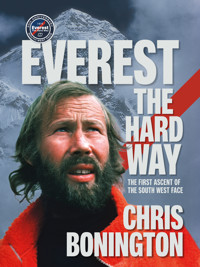
50th Anniversary Edition Everest – the highest peak in the world, the ultimate challenge to a mountaineer's skill and endurance. It had been climbed before, but never like this. Chris Bonington and his team had ambitions to climb it – the hard way. Yet before Bonington and his team set out in August 1975, even their well-wishers gave them only a fifty–fifty chance of success. The South West Face of Everest had already defeated five expeditions, including one led by Bonington himself. Everest the Hard Way is an exhilarating story of courage, endurance and teamwork. Bonington's narrative celebrates the big moments and recreates the excitement and danger of the climb with vivid immediacy. He shares the logistical problems involved in keeping a large expedition moving, and the very real psychological ones of balancing and pairing lead climbers and giving each a chance to make the route on the face. He describes the constant avalanche threat which made the Western Cwm more dangerous than the ever-treacherous Ice Fall, and explains how lowering the sites of camps 4 and 5 solved a supply problem and kept the upward momentum for the attack on the notorious thousand-foot-tall Rock Band at 27,000 feet which had barred the way to the summit for all previous attempts. Drawing upon his experiences and the first-hand accounts and diaries of his fellow climbers, Bonington gives us the first-time jitters and unexpected emergencies, the pressures of balancing egos and skills, the meticulous planning, and the undiluted joy of mastering a seemingly impossible climb which would see Britons stand on the summit of the world for the first time. It is an immensely absorbing narrative, stunningly augmented with photographs and maps, with eleven appendices on everything from communications and equipment to food and medicine. How Bonington's team climbed on Everest in 1975 bears no relation to how Everest is climbed fifty years on, with endless resources and helicopter support. It was much riskier in 1975. Weather forecasts were threadbare and, although equipment was improving, it was much more basic than today, so the risk of frostbite was much greater for mountaineers in the 1970s. These climbers, the best of their generation, were leading hard new ground in the only style which gave them a meaningful chance of success. Chris Bonington's Everest the Hard Way is a beautiful, fascinating and tragic story of their legendary achievement.
Sie lesen das E-Book in den Legimi-Apps auf:
Seitenzahl: 586
Veröffentlichungsjahr: 2025
Das E-Book (TTS) können Sie hören im Abo „Legimi Premium” in Legimi-Apps auf:
Ähnliche

















iii
Vertebrate Publishing, Sheffieldwww.adventurebooks.com
Copyright
EVEREST THE HARD WAY CHRIS BONINGTON
First published in 1976 by Hodder and Stoughton. This edition first published in 2025 by Vertebrate Publishing.
Vertebrate Publishing, Omega Court, 352 Cemetery Road, Sheffield S11 8FT, United Kingdom.www.adventurebooks.com
Published in partnership with Berghaus and Community Action Nepal.
Copyright © 2025 Chris Bonington.
Front cover design by Jane Beagley. Photograph of the South West Face by Nick Estcourt; portrait of Chris Bonington on Everest in 1975 from the Chris Bonington Picture Library.
Chris Bonington has asserted his rights under the Copyright, Designs and Patents Act 1988 to be identified as author of this work.
A CIP catalogue record for this book is available from the British Library.
ISBN: 978-1-83981-264-4 (Hardback) ISBN: 978-1-83981-265-1 (Ebook) ISBN: 978-1-83981-266-8 (Audiobook)
All rights reserved. No part of this work covered by the copyright herein may be reproduced or used in any form or by any means – graphic, electronic, or mechanised, including photocopying, recording, taping or information storage and retrieval systems – without the written permission of the publisher.
Every effort has been made to obtain the necessary permissions with reference to copyright material, both illustrative and quoted. We apologise for any omissions in this respect and will be pleased to make the appropriate acknowledgements in any future edition.
Acknowledgements to the 2025 edition Thanks to Anna Marchant for being the driving force behind this fiftieth anniversary edition of Everest the Hard Way and for pulling the entire project together, and to Frances Daltrey and David Nightingale for their assistance and diligence in tracking down photographs from the expedition (many of which were missing, but thankfully duplicates were made at the time). Thanks also to Trish Scott and Ed Douglas for their contributions, and to the team at Vertebrate Publishing, in particular John Coefield, Jane Beagley and Jon Barton.
v
To Mick Burke and Mingma Nuruvi
Contents
Introduction to the 2025 edition
I can hardly believe it’s fifty years since we climbed the South West Face of Everest. Fifty years since Dougal Haston and Doug Scott stood on the summit and then survived a brutally cold night out at the South Summit as they descended, the highest open bivouac in history and without oxygen too. I’ll never forget hearing Doug’s voice crackling across the airwaves as I waited anxiously for news at our camp below the Face. It’s fifty years, also, since Pete Boardman, then the youngest person to have reached the top, passed Mick Burke, still going up as Pete went down, never to be seen again.
When I went to the summit myself ten years later, only Doug and I were left from that list. Dougal died in 1977 skiing near his home in Switzerland; Pete disappeared on the North East Ridge of Everest in 1982, on an expedition I had led. At a break in the cornice, I looked across at the wild ice towers and snow flutings that ran down from its knife edge, where Charlie Clarke and I had looked in vain for signs of life. I thought also of my close friend Nick Estcourt, who, with Tut Braithwaite, had led the crux Rock Band on the South West Face, opening the way for success in 1975. Nick had died on K2 three years later, clipped to the same rope as Doug when an avalanche struck. Only Doug escaped.
All this was in my head as I neared the summit of the world, where my friends were waiting for me, including Pertemba Sherpa, who had been our Sirdar, or lead Sherpa, on the South West Face, when he reached the top with Pete Boardman. He was also Sirdar on this 1985 Norwegian expedition that achieved such success, with seventeen successful ascents, thanks in part to Pertemba’s organisation. I remember him beckoning me up those last few metres, and how I crouched at the top, weeping with joy and sorrow and exhaustion, thinking of my friends and how badly I had wanted, needed even, to reach the top. I was a little over fifty years old, and for a short time held the record as the oldest person to have climbed Everest. Now, as I write this, I’m ninety, and still thinking about it.
I first saw Everest in 1961, on the approach to its near neighbour Nuptse, part of the horseshoe that surrounds the Western Cwm. Nepal was a different xcountry then, without the bustle and pollution of today. There were no flights to the mountains in those days. This was three years before Ed Hillary’s team built the airstrip at Lukla. The road out of Kathmandu ended just outside the city. After that, we were walking. On our approach we saw just one other European, Peter Aufschnaiter, who, with Heinrich Harrer, had escaped a British internment camp and then into Tibet, where he had been living until the Chinese invaded. This was long before the trekking industry got going, nurtured by Jimmy Roberts, who a year before had led my first Himalayan expedition, to Annapurna II, at 7,937 metres just shy of the magic 8,000-metre mark the year before. Despite some altitude problems, I made the first ascent with Dick Grant and Ang Nyima. It would be the highest summit I reached before Everest in 1985, twenty-four years later.
Jimmy had proved a capable leader, not going up on the mountain himself but making sure logistics happened properly and marshalling the team. It was different on Nuptse, where Joe Walmsley was happy simply to put a team together, get us to the mountain with sufficient gear and then let us get on with it. Unlike Annapurna II, the Nuptse team was full of experience and talent, and it needed to be, because the face we were climbing was arguably the most technical route yet attempted in the Himalaya. Perhaps if we’d got on better personally, then none of that would have mattered, but as we made progress on the mountain, the team broke up into small parties, each thinking they were doing the lion’s share of the work. Despite it all, I reached the top with Ang Pemba, one of our six Sherpas, a day after Tashi Sherpa and Dennis Davis made the first ascent, and just ahead of our companions Les Brown and Jim Swallow.
For weeks we’d been looking at the same limited vista, but as Pemba and I reached the crest of Nuptse’s summit ridge, the narrow gorge of the Western Cwm opened beneath us and the surrounding mountains burst into view, stretching away to the far horizon. Right in front of me was the black summit pyramid of Everest, seamed and traced with ice and snow that had stuck to the Face. I had no thought of climbing it. In 1961 it seemed far too difficult. I was more absorbed by the Tibetan Plateau that rolled away into the distance, a seemingly endless panorama of brown and purple hills.
Himalayan climbing was put on hold after that. I left the army and met and married my first wife, Wendy. With her encouragement, I gave up the idea of a settled career for life as a freelance writer and photographer. During these years, in the mid 1960s, I did some of the best climbing of my life in the Alps, including the first ascent of the Frêney Pillar on Mont Blanc, and the first British ascent of the Eiger. I also met people like John Harlin, who xiunderstood the sort of big project that the media might buy into. John perished climbing a new route in winter on the Eiger’s North Face, which I covered for a weekend magazine. Whilst waiting on the summit to photograph his partner Dougal Haston, I suffered some frostbite, as did Dougal. We recovered together in hospital back in London, and we talked about the South West Face with our doctor, Mike Ward, who had been on the first ascent in 1953. We wanted him as leader, since neither of us felt capable, but political difficulties put an end to Himalayan climbing for a few years.
When I did go back it was to lead an all-star team on the South Face of Annapurna, the first truly steep Himalayan face to be climbed. I made mistakes, but I found I had a facility for it, loved the logistical challenge and the challenge of managing – or at least trying to manage – some hefty egos. In those analogue days you couldn’t just send an email to Kathmandu and book yourself on an expedition to an 8,000-metre peak. It took months of organisation; writing letters, making calls, begging gear, liaising with embassies, seeking advice, telexing agents in Nepal and organising the travel arrangements for a big team of climbers, akin to herding cats. Success on Annapurna, albeit at terrible cost right at the last with the death of my old friend Ian Clough, led inevitably to my renewed interest in Everest.
It felt though at the start of the 1970s that all the world’s best Himalayan climbers were looking at the same objective. Twice I was invited to participate in expeditions to the South West Face. I accepted the role of climbing leader on an all-star international attempt in 1971, but I had misgivings about its structure and finally withdrew. They wanted to try two routes at once and that didn’t seem practical to me. It wasn’t easy to say no. I had bouts of depression afterwards, not trusting my judgment. In those days only one team got a permit each season; even if they didn’t climb it, when would I get another chance? I had another offer the following spring from the controversial German expedition leader Dr Karl Herrligkoffer, but withdrew from that as well. Luckily for me, an Italian group with permission for the post-monsoon season of 1972 pulled out. So, I took their slot. Part of me thought to play it safe and repeat the 1953 route. At that stage no Englishman had climbed the mountain, and that Englishman could be me. I was tempted but it was yesterday’s challenge. I was more interested in the future.
In retrospect, it was almost inevitable that we would fail. No one had yet climbed Everest in the post-monsoon season, which grows progressively colder as the weeks pass. There was so much to learn. We had only made it halfway up the Face by mid-October, when the first of the bitter winter xiiwinds hit us like an express train and destroyed our camps. By the start of November temperatures higher on the Face fell to -40 °C. There were arguments and frustrations among the lead climbers about who would get to lead through the crux section of the Rock Band that separated the lower Face from the summit slopes. Even after we called it a day, we suffered the tragic loss of Tony Tighe, a young Australian who had been helping at Base Camp and who had wanted to see the Face for himself, only to die in the Ice Fall. It was a sad end to what had been a failure, but we had learned a great deal that we put into practice in our successful ascent.
When we came home in 1975 after our successful ascent there were plenty who thought our use of fixed ropes, fixed camps and a big team was outmoded. It’s true that by then the alpine-style revolution was underway, something I appreciated and welcomed. Yet how we climbed on Everest then bears no relation to how Everest is climbed fifty years on, with endless resources and helicopter support. It was much riskier in 1975. Our weather forecasts were threadbare in comparison to what’s now available. Equipment was improving, but the risk of frostbite these days is much reduced thanks to the quality of boots and down equipment, and the reliability and lightness of oxygen equipment. We were leading on hard new ground and the style we used was the only option to allow us a meaningful chance of success. I have no regrets on that score.
Our success on Everest changed my life. I was honoured for my role, and I found earning a living became easier, something that before Everest had been a worry, especially with a growing family. Everest gave me new avenues for public service, as chancellor of Lancaster University and with the Outward Bound Trust. It changed Doug’s life too. He had always been interested in the local communities he encountered on the way to his climbing objectives. That was certainly true on Everest, and I’d been a bit worried when he started taking a personal interest in hiring porters to carry gear to Base Camp. Sadly, a young deaf lad he’d taken a shine to fell into a river and drowned. That galvanised him, and he spent a good portion of the rest of his life dedicating himself to the charity he set up, Community Action Nepal. We had our ups and downs over the years, but I was devastated when he died. He would be so proud that the work he started goes on.
ChrisBonington
Hesket Newmarket
April 2025
Community Action Nepal
Throughout Doug’s career he always took an interest in the indigenous people of the countries in which he climbed.
After 1975, with an enhanced profile after summiting Everest via the South West Face, Doug made a conscious decision to commit his energies to improving the living conditions of the hill people of High Asia. He felt he owed them much from his various expeditions. He was strongly influenced too by the work of Lieutenant Colonel Jimmy Roberts and Mike Cheney with whom he forged a close friendship on the South West Face expedition. Roberts and Cheney had been pioneers in setting fair conditions for porters and high-altitude Sherpas in Nepal in the 1960s and 1970s.
When Mike Cheney died in 1988, Doug took up his mantle by improving the wages and living conditions of porters. Then, in 1990, whilst returning from the Latok peaks in Pakistan, the death of a porter occasioned an enforced stay in the village of Askole where Doug became aware of a fifty per cent mortality rate among children due to a dirty water supply. Thanks to his high profile he was able to contact the Aga Khan Rural Support Programme and with the added help of the American Alpine Club a clean water system was installed.
In the early 1990s Doug extended his energies with the founding of CAN – Community Action Nepal. The ethical basis of CAN is formed from the word ‘request’, with the charity advocating self-sufficiency and sustainability. ‘Shramadan’ or community self-help comes from voluntary labour.
As Doug himself had building experience, no stone was literally left unturned as health posts and schools began to take shape. Nor was he ever afraid to challenge authority, be it malpractice in villages, or by the Nepal government or Maoist commanders. In the early 2000s whilst walking up to Thimphu during the height of the insurgency, Doug fell into tense conversation with a Maoist commander who informed him that CAN was considered to be totally transparent and therefore had full freedom to work in all areas. The health post nurses during this time were especially brave and loyal, treating both Maoist and army casualties – often at gun point.
In 2015, the great earthquake struck, destroying or damaging the work of fifteen years in the space of twenty minutes. An immediate fundraising xivcampaign was launched and within a short time three million pounds was raised. Within three years all CAN buildings were rebuilt to earthquake-proof specifications.
With Doug’s sad death in 2020, I became afraid for CAN’s survival without his dominant and charismatic leadership. However, with CAN having now completed sixty-five buildings, comprising health posts, schools, and an old people’s home along with the employment of nurses and teachers, the provision of medicines and water projects, and numerous livelihood schemes supporting 250,000 people in remote areas, my fears have proved totally unfounded. CAN is thriving under the sage guidance of its trustees, the dedicated and hardworking office in Cumbria, and the careful husbandry of Murari Gautam in Kathmandu.
Doug would be proud of them all, just as I am so proud to play a small part in the CAN family.
TrishScott
Hesket Newmarket
April 2025
www.canepal.org.uk
xv
Doug and Trish Scott at the unveiling of the Leonard Cohen plaque at the reopening of the School for Deaf Children in Baharibse – one of the many projects that CAN has successfully completed over the last thirty years. Photo: Community Action Nepal xvi
Foreword to the 1976 edition
BY LORD HUNT OF LLANVAIR WATERDINE
In December 1972 I greeted Chris Bonington and his team at a reception on their return from his previous attempt on the South West Face, from which they had been turned back at 27,300 feet, and at the very limits of human endurance, by the combined effects of low temperatures and high winds at very high altitude. ‘Never again,’ was his verdict.
I knew how he felt. Many years before, in the winter of 1937, with my wife and Reggie Cooke, I had taken part in a light expedition during the months of October to December to the eastern surroundings of Kangchenjunga, third highest mountain in the world. One of our purposes was to try out climbing conditions during the long clear spell at the beginning of winter, so as to prove whether that period might offer a better chance to climb Everest than the usually favoured, but brief opportunity before the monsoon brings heavy snowfalls to the South East Himalaya. We had some successes, including a 23,500-foot peak; and we pushed a reconnaissance on Kangchenjunga to within a few hundred feet of its North Col, from which a ridge leads to the summit. But an indelible memory had been the bitter cold and a terrifying wind – especially that wind. Yet looking through my diaries, I find that I wrote later: ‘Taken all round, I feel that it is unwise to generalise as a result of this experience, and that it is most desirable to visit Everest in the post-monsoon period.’
So it came as no surprise when Chris phoned me in September 1973, to tell me that a Canadian expedition had cancelled their permit to attempt Everest in the autumn of 1975, and said he was keen to have another go. What did I think? Of course I agreed, and I meant it. Maybe the chances of success would not be much greater than before – I gave the odds at evens – but we both knew that some day that face would be climbed by someone. The urge to be that somebody was irresistible and with all the experience he had gained, Chris just had to try again.xviii
There were certain lessons from the last attempt by which he was determined to profit. One of these was to start earlier and be off the mountain before life was made intolerable. But this meant beginning the climb before the monsoon ended; there would still be masses of snow on the mountain and fresh snow would be falling from time to time. I agreed with that proposition, too, despite its snags. On our way up the Zemu Glacier in 1937 we had met a German party on their way down, flushed with triumph after climbing Siniolchu, a beautiful and very difficult peak, during September, in spite of the difficult snow conditions. Even more impressive had been the astonishing skill and endurance of an earlier German party led by Paul Bauer which, during more than two months of continuous hard climbing between July and September 1931, had forced their way up the North East Spur of Kangchenjunga, living in ice caves, to reach a height of 25,260 feet. They were finally defeated by an avalanche-prone snow slope just below the crest of the main North Ridge, whence the route to the summit appeared to be relatively straightforward.
So one of the problems attaching to Bonington’s choice of that earlier period was the danger of avalanches. This point was tragically brought home to us again a year after our telephone conversation when, whilst we were attending the centenary celebrations of the French Alpine Club at Chamonix, the leader of a French expedition on Everest and five Sherpas were swept to their deaths down a couloir leading to the West Ridge.
Reading this book, that word ‘avalanche’ looms large. An avalanche badly damaged Camp 4; a much bigger one wrought havoc in the Advance Base Camp at the foot of the Face; smaller snow slides, some of them serious enough to carry climbers out of their steps, were an almost daily occurrence on the great steep slopes between the high camps. That the climbers pressed on, taking calculated risks, without loss of life from this danger, speaks worlds for the new equipment they used, for their mastery of modern techniques, sheer determination – and a large slice of luck; there were some very narrow escapes.
As for equipment, there is no doubt that it played an important role. I will mention only the matter of the expedition tents. Watching members of the team, armed with improbable climbing weapons – spanners – laboriously piecing together the steel framework of a MacInnes box tent on a gentle grassy slope above the waters of Windermere on a sunny morning last summer, I found it hard to imagine the same operation being performed on a slope on ice tilted at fifty degrees, at 25,000 feet on Everest, with the temperature well below zero centigrade. Yet it was done, not once but at xixevery one of the four camps on the face. Those boxes, products of the inventive genius of Hamish MacInnes, were further proof of the foresight of the team; credit is also due to the inventor of their prototype, Don Whillans, whose own performance on earlier attempts by this route had made such a great contribution to the final result. The robustness of these tents, with the relative comfort and protection they provided, was an important factor in success.
On techniques, the extensive use of fixed ropes, up and down which all the climbers, attached by jumar clamps, can slide with security and relative ease once the leading climber has forced a passage, is the most revolutionary change in climbing big mountain faces during the past twenty years. It played an important part in all the onslaughts on the South West Face of Everest, and but for its skilful use last September several climbers would have been carried away by avalanches. But I think that all members of the party would concede (with the exception of the person I allude to) that the supreme example of climbing technique, applied with exceptional determination, was Nick Estcourt’s superb lead, without the normal safeguards or oxygen at 27,000 feet, up the rickety, outward-leaning ramp of snow-covered rubble which led from the gully in the Rock Band up to the Upper Snow Field. This must be one of the greatest leads in climbing history, comparable, at least in its psychological effect, with the original lead across the Hinterstoisser Traverse or the exit gully above the Spider, on the North Face of the Eiger.
I would like to say more about determination, for the urge to press on pervades the whole of this story. The will to get up Everest must be there in large measure in every Everest climber before he sets out, if he is to reach the top. It is a necessary reserve of inner strength which, if – and only if – it is in abundant supply at the foot of the mountain, may just about see him through – perhaps ebbing slightly all the time. It is a peculiarly personal thing, for which the word ‘ambition’ in its conventional sense is quite inadequate to explain the motive power needed for this kind of high endeavour. But no one reading those graphic passages from the diaries of the summit climbers, floundering and flaying their agonising way in deep, incoherent snow up the couloir below the South Summit, can question that it was this matter of will, reinforced by confidence, that carried Dougal Haston and Doug Scott to the crest. It was this same will alone, flickering, through a bitter night, which made it possible for them to return and tell their story to the world.
Everest imposes enormous emotional strains on the climber, which are an inescapable consequence of his determination and will; and those tensions xxare movingly conveyed to the reader of this book. Upon no one was the stress so great and so prolonged as on the leader of the expedition. His was the original decision to make the bid; his the choice of companions, the general strategy; the supervision of the whole complex plan and its unfolding on Everest. His was the responsibility for the lives of more than seventy men, exposed to risks of many kinds and for a considerable time: from crevasses and séracs in the Ice Fall; from the labyrinth of monstrous hidden chasms in the Western Cwm; from avalanches on the Face and the sudden onset of bad weather on the summit ridge. On the leader would be heaped the chorus of criticism – even obloquy – from some climbers and many members of the public if this expensive venture were to prove to be yet another failure.
Chris Bonington is such an effective writer partly because he writes himself, his doubts and fears, his irritations and rejoicings, into the story. We can feel his edginess as the effects of mental stress, physical exhaustion and oxygen lack during eight days and nights spent at and above Camp 5. Through his perceptive understanding of his fellow climbers, and by the inclusion of excerpts from their own accounts, we experience their moods, too. Nothing moved me more than Bonington’s tears when Dougal’s radio message from Camp 6 on the morning of 25 September announced success – and their safe return; and the unashamed weeping of Pete Boardman, youngest member of the team, when he staggered into that same camp after his own triumph and ordeal, with its accompanying tragedy of the loss of Mick Burke.
But when all has been said about equipment, climbing techniques and the individual qualities of the climbers, my final word must be about the team as a whole and their interaction one with another during this epic enterprise. For me, this is the most fascinating aspect of the story. Much has been written in praise of small, light expeditions, in condemnation of large ones. I share with most other climbers a strong preference for going to the mountains with a few close friends: some of my happiest memories derive from expeditions of this nature. But where the objectives are diverse, or when the scale of the undertaking demands larger numbers, there is also much reward to be enjoyed from its complexity, with many members playing different roles to produce a combined result. The satisfaction may come from the fact that unison in these circumstances is that much harder to achieve and, if it can be made to work, the experience can be exhilarating. I can say about this team that the quality of their achievement lies not only in the fact that they reached their objective; not only in some brilliant xxiclimbing, nor the perfect timing of the plan, which avoided the worst onslaught of the elements. It is to be found in the manner of the doing by the very individualistic members working as a team, in accepting their various parts, tempering their disappointments and being such a happy united band.
The British triumph on the South West Face is the culmination of a succession of attempts to solve this problem during the past five years: an international expedition in 1971; a European expedition in the spring of 1972, followed by Bonington’s first attempt that autumn. And before and after these three efforts came climbers from Japan: in the autumn of 1969, the spring of 1970 and finally the autumn of 1973. To all of these, but especially to the Japanese, much credit should be given for their contribution to the eventual British success.
This book is entitled EveresttheHardWay. Undoubtedly, the South West Face is a very difficult and arduous climb. Some day, no doubt, climbers will have so far improved their performances that this climb will be classified in a lower order of difficulty; such is the way of progress. Meanwhile, let nobody suppose that Everest by any other way, including our route in 1953, is an easy mountain; it is not. And at all times it is dangerous, as the sad toll of life in the Ice Fall, the West Cwm and on the Lhotse Face bears witness: whenever the wind is blowing strongly it is impossible to move along the summit ridges, and that means on most days in the year.
And it is well that this should be the case, for man should be humble before the greatest works of nature.
John Hunt
Henley-on-Thames
Author’s note
So many people have helped make this book possible, for a start the huge number of individuals and organisations who helped get the expedition under way. Without these, of course, there would be no book. I hope we have mentioned everyone, expressing our appreciation, either in the text or the appendices. I should like to express our very special gratitude, however, to Barclays Bank International for underwriting the expedition, for without this support it is unlikely that it would ever have taken place. We are particularly grateful to the chairman, Anthony Tuke, whose ultimate decision it was, and to Alan Tritton, who sat on our Committee of Management and looked after our interests throughout the expedition.
I should like to give my special thanks to all the members of the climbing team, who not only gave me their utmost support and friendship throughout the climb, but also made available to me their diaries, letters home and, in several instances, original writing of their experience on the expedition. They gave me a wealth of superb material from which to select what I hope represents a balanced, living account of an expedition, not just from my point of view, but also from the viewpoint of many other members of the team, recreating the day-to-day emotions, fears, enjoyment and stress of a group of climbers on Everest.
I should also like to thank the many helpers who remain in the background but without whom I should never have managed to write this book within my deadline: Margaret Body, my editor at Hodder and Stoughton, who has constantly helped me with encouragement, balanced advice and judicious editing; Ronnie Richards and an old friend of mine, David Hellings, for their painstaking proofreading and helpful suggestions; Betty Prentice, who not only typed most of the manuscript but also did some very useful initial editing; my secretary, Louise Wilson, who helped close the expedition down, completed one of the appendices and protected me from the outside world whilst I struggled with the book; my wife, Wendy, who looked after all the expedition transparencies and made the basic picture selection for the book; George Greenfield, the expedition literary agent, for his support and sound advice.
Finally, I should like to thank John Hunt, both for writing the foreword to this book, and for providing me with inspiration and an example to follow xxiiifrom studying his leadership of the 1953 Everest Expedition which provides a blueprint for organising any major venture, and for the kind support and advice he has given me at every stage.
Chris Bonington xxiv
Chapter One
A second chance
After we gave up our attempt on the South West Face of Everest in November 1972, I remember saying to Chris Brasher who had come out to Base Camp to report our story for TheObserver: ‘Climbing is all about gambling. It’s not about sure things. It’s about challenging the impossible. I think we have found that the South West Face of Everest in the post-monsoon period is impossible!’ Rash words for, of course, the story of mountaineering has proven time and again that there is no such thing as impossible – although, I think, we could be allowed this self-indulgence immediately after our beating.
Only two days before, on 14 November, I had been lying in my hoar-frost-encrusted sleeping bag in the battered box tent at Camp 4, at about 24,600 feet on the South West Face. The wind was hammering at the walls, driving small spurts of spindrift through the many rents caused by stones dislodged from the Face above. Outside there was a brilliant blue sky and a sun that blazed without warmth. From out of this void had come the wind, tearing and probing at tent and climber.
Somewhere above, Dougal Haston, Hamish MacInnes, Doug Scott and Mick Burke were pulling across the line of fixed ropes, towards Camp 6. The wind was so strong that it had lifted Doug, a big thirteen-stoner, bodily from his steps and hurled him down; only the fixed rope saved him. I had had some inkling what it was like, for the previous day I had made a solitary carry up to the site of Camp 6 – even then the wind had been buffeting hard and I had wondered just how they were going to be able to erect the box tent in those conditions.
But there had been nothing I could do but wait. Jimmy Roberts, my deputy leader, was far below, camped on Kala Pattar, the rocky hummock of just over 18,000 feet that rises above the Khumbu Glacier forming a perfect dress-circle from which to view climbers on the upper part of the South West Face of Everest. He had a walkie-talkie with him and throughout the day reported on the tiny black dots which were making their slow progress 2across the snow slopes below the Rock Band. One had turned back early but then, having reached the site of Camp 6, the remaining three turned back. For some reason Dougal Haston and Hamish MacInnes had decided not to stay at the camp as originally planned and I could only guess that because of the strength of the wind, they had been unable to erect their box tent. There was no way of knowing for certain until they got back to their tents at Camp 5 and made the seven o’clock call that night. Night fell quickly but then the time crept by slowly until, at last, I could switch on the radio.
I got Dougal. They had pressed on to the site of Camp 6, but as I had suspected, they had been unable to get the tent up and even if they had, there is little they could have done. The gully ahead had been swept clear of snow, and the rock could not be climbed in that intense wind and cold. They were coming down the next day. And so I started to arrange our retreat from the mountain; all the Sherpas at Camp 2 to come up to Camp 4 the next day to pick up loads; the Nepali foreign office to be informed.
It was all so terse and matter of fact but after switching off the radio I could not stop myself crying in the solitude of that small dark tent. We had tried so hard but in those last few days I suspect that all of us had realised that there was no chance of success, although none of us was prepared to admit openly to defeat. It was too late in the season; the winds of Everest were reaching over a hundred miles per hour; the temperature was dropping as low as -40 °C. We were all much too tired and our equipment was in tatters.
We returned to Britain with a mixture of emotions. There was sadness at the loss of Tony Tighe, a young Australian who had helped us at Base Camp during the expedition and who had been killed by the collapse of a sérac wall on the last day of the evacuation of the mountain. This was mingled with satisfaction at having taken ourselves beyond limits that we had previously thought possible and feelings of heightened friendship and respect for each other cemented by the experience. There were memories of fearsome nights in Camp 4 with the wind hammering at the box tent, bringing stones from the Rock Band above thundering over the roof as one huddled against the inner side of the tent and wondered when it would be crushed. But there had been moments as well which made all the struggle and suffering worthwhile. I shall never forget my solitary trip to Camp 6 on the penultimate day of the expedition as I plodded laboriously up the line of fixed rope. My oxygen system was only working for part of the time but as I slowly gained height, creeping above the confines of the Western Cwm – higher at that moment than any other person on the surface of the Earth 3– the very effort I had made and the loneliness of my position made the everexpanding vista of mountains seem even more beautiful.
Before leaving Kathmandu at the end of November 1972, I had already filed an application for another attempt on the South West Face in the next available spring slot. This was a slightly hopeless gesture since the mountain was now fully booked, autumn and spring, until 1979. The Nepali only allowed one expedition on the mountain at a time, and such is the popularity of Everest that it becomes booked up years in advance. There are two periods in which the mountain is considered climbable: spring and autumn. The former season, undoubtedly, has much to recommend it; there is less wind particularly at altitude but, most important of all, squeezed as it is between the end of winter and the arrival of the monsoon (sometime at the end of May or the beginning of June) an expedition starts at Base Camp at the coldest period of the season and then enjoys relatively warmer weather as it progresses up the mountain, having the warmest possible period just before making a summit bid. On the other hand, in the autumn the climbing period is slotted between the end of the monsoon, around the middle of September, and the arrival of the winter winds and cold which we had found, to our cost, come in mid-October giving an uncomfortably short period of tolerable weather in which to climb the mountain.
It seemed highly probable that the South West Face would be climbed before we could have another chance at it, even though a fair proportion of the expeditions that had booked Everest were not planning to attempt the South West Face. There did seem to be one hope, however, for the Army Mountaineering Association had the booking for the spring 1976 slot; by themselves they were not strong enough to tackle the South West Face and had no plans for doing so. During the previous few years the army had organised a number of successful expeditions to the Himalaya, climbing both Tirich Mir and Annapurna from the north side. I had been a regular soldier and was a founder member of the Army Mountaineering Association; this seemed an excellent opportunity to persuade the army to incorporate three or four strong civilian climbers, such as Haston or Scott, and try the South West Face at what appeared to be the best time of year for such an attempt. I was prepared to take on the role of climbing leader under the overall leadership of an active soldier, feeling that in this way the expedition could have been fully cohesive and that the civilian members could have fitted in.
I went down to Warminster to see Major-General Brockbank, who was chairman of the Army Mountaineering Association, and put my plan across. 4He did not like the idea and turned it down. I can sympathise with his thinking for there were obviously several problems. The Army Mountaineering Association naturally wanted to maintain its own identity and, although I was an ex-member, there was the possibility that my own reputation as a mountaineer could have engulfed them. Success could have been portrayed by the press as that of myself and the talented civilian climbers who had been brought in, rather than of the team as a whole. There could also have been personality problems inevitably created by bringing two groups of climbers together for reasons of convenience rather than selecting a team from scratch. I would, nevertheless, have been prepared to take this risk and make it work, since this seemed the only chance we had of reaching Everest.
In the spring of 1973, Guido Monzino – the Italian millionaire who had relinquished the autumn 1972 booking, thus allowing us our chance – organised a massive expedition to repeat the South Col route. This expedition used two helicopters, hoping to ferry gear up the Ice Fall and even into the Western Cwm. This was a controversial step since the Ice Fall and lower part of the mountain are an integral part of the climb and the use of aircraft to solve logistic problems seemed an unpleasant erosion of the climbing ethic. Monzino could have argued that it is preferable to use an aircraft rather than risk the lives of Sherpas who carry the brunt of the risk ferrying loads in the Ice Fall and Western Cwm but, in the event, this argument was proved specious. The helicopters, at altitude, could not manage a sufficiently effective payload to eliminate the use of the Sherpas and were used instead for ferrying members of the climbing team up and down the mountain for their rest periods. In the end, fate took a hand – one of the helicopters crashed, fortunately without any injury to the occupants, and this ended a very expensive experiment. Our objection to the use of helicopters on Everest is on aesthetic grounds, for one of the beauties of the Western Cwm is its majestic silence; both the sound and sight of a helicopter chattering up the cwm would be an unpleasant, if not unbearable, intrusion. In spite of these problems, the Italians were successful, placing eight men on the summit of Everest by the original South East Ridge route.
In the autumn of 1973 came the next serious onslaught on to the South West Face, with the biggest expedition so far: thirty-six Japanese climbers, sixty-two Sherpas and a twelve-man Base Camp group. The expedition was organised by the Japanese Rock Climbers’ Club. They started earlier than we had done, with an eight-man advance party going out to Kathmandu in early April, sending part of their gear by light plane to Luglha, the airstrip in 5the Dudh Kosi valley just below Namche Bazar. They brought the rest of their gear out with them in mid-July which meant that they had to carry it through the worst of the monsoon rain to Sola Khumbu.
They established their Base Camp on 25 August and at first made excellent progress, following the same route as ourselves in 1972. They were hit by a savage seven-day storm at the beginning of October, just after they had reached the site of Camp 5 at 26,000 feet. Sadly they lost Jangbo, one of their best Sherpas, who had also been with us in 1972, in an avalanche on the lower part of the Face. Influenced by this tragedy and the deterioration of the weather, they resolved to turn their main effort to an attempt on the South Col route. Two of the party, Ishiguro and Kato, reached the summit of Everest in a single push from the South Col on 26 October. They had to bivouac on the way down and suffered from frostbite. This was the first post-monsoon ascent of Everest and a magnificent achievement, but the South West Face remained unclimbed. The Japanese had not abandoned the attempt on the Face when they turned to the South Col, but on 28 October, after two other members of the expedition had reached the site of Camp 6 on the Face, they decided to call off the expedition.
Back in England I followed the Japanese progress as closely as sparse newspaper reports and intermittent letters from friends in Kathmandu would allow. In some ways I should have been quite relieved had the Japanese succeeded, since this would have removed the nagging problem, enabling myself and other British climbers to get on with our more modest but nonetheless satisfying schemes. It did seem fairly unlikely, anyway, that the South West Face would still be unclimbed in 1979 – the next date there was a free booking – and so, that autumn, I was already immersed in other plans. In the spring of 1974, Doug Scott, Dougal Haston, Martin Boysen and I were going to Changabang, a shapely rock peak of 22,700 feet in the Garhwal Himalaya. I had also applied for permission to attempt the Trango Tower, a magnificent rock spire off the Baltoro Glacier in the Karakoram for the summer of 1975.
And then, one morning in early December 1973, a cable arrived from Kathmandu. It was from Mike Cheney, who helps to run a trekking business called Mountain Travel. It was founded by Jimmy Roberts, who had been the leader of the first Himalayan expedition to Annapurna II in 1960, had given me advice and help in the intervening years, and had been deputy leader in our 1972 attempt. Mike had always been the back-room boy, doing all the donkey work of arranging documentation, booking porters, helping our gear through customs, but had never actually been a full member of 6an expedition. He had also always kept me very well informed of happenings in Nepal.
The cable read: ‘Canadians cancelled for Autumn 1975 stop Do you want to apply Reply urgent Cheney.’
Suddenly all my nicely laid plans were upset; I had another chance of going for the South West Face but at the wrong time of year. We had already found that it was too cold and windy to climb the South West Face in the autumn. The Japanese had also failed but at least that had shown that a man could reach the summit of Everest in late October by the South Col route and that he could even survive a bivouac within a thousand feet of the summit, admittedly at the price of severe frostbite.
It took me several days to decide. If I were to attempt the South West Face again I felt strongly that it should be in the spring rather than in the autumn. The memories of the bitter wind and cold of the autumn, the problems of leadership and organisation, the worries of finding the money to pay for it were all too fresh. Could I go through all this again for what might be little more than forlorn hope of success? Every consideration of reason and common sense said ‘Don’t go!’
But the fact that Everest is the highest mountain the world, the variety of mountaineering challenges it presents, the richness of its history, combine to make it difficult for any mountaineer to resist. And for me it had a special magnetism. I had been there before and failed, and in the end I knew that I could not let pass the opportunity to go to Everest again, even if an attempt on the South West Face seemed impractical.
One challenge that intrigued me was the possibility of organising a lightweight expedition to climb Everest by the original South Col route, employing no Sherpas and moving up the mountain as a self-contained unit of twelve climbers. I had pursued the same line of thought before committing myself to the South West Face in 1972, from similar motives of worry about the practical feasibility of a full-scale attempt on the South West Face. I talked to Doug Scott, Dougal Haston and Graham Tiso about my plans. All three had been with me in 1972. Doug and Dougal were non-committal but Graham, who had organised all the equipment for my first Everest expedition, was positively enthusiastic about the scheme. All too well he knew the problems of assembling the equipment necessary for a major expedition. He had put in a brilliant performance as a support climber on our 1972 trip, reaching 26,000 feet without using oxygen and staying at altitude as long as anyone on the expedition; the thought of taking part in a small, compact expedition, where he could even have the opportunity of 7reaching the summit of Everest, obviously appealed to him.
Through the winter of 1973–74, Mike Cheney pushed our cause in Kathmandu and I did what I could from this country, enlisting the help of the Foreign Office and any other contacts I could think of. But Everest filled only a small part of my mind for I was busy planning our expedition to Changabang which we hoped to climb with a group of Indian mountaineers. Even more important, we were in the throes of moving from suburban Manchester to a small cottage on the northern side of the Lake District.
I had lived in the Lake District from 1962–68 but then found myself getting more involved in photojournalism than in climbing, with all my work coming from London. The move to Manchester was rather an unsatisfactory compromise between staying in the Lakes and moving all the way down to London. I very much doubt, however, if I could have organised my first two expeditions – to the South Face of Annapurna in 1970 and Everest in 1972 – from the Lake District. At that stage I needed the amenities provided by a large city, near the centre of the country. We bought a small cottage in the Lake District for weekends and holidays and, in the spring of 1973, whilst lying in the garden one day, relaxing from the stress of closing down the 1972 expedition and writing its book, I suddenly realised how important was this quiet peace and beauty. My life was now much more closely involved with climbing and expeditions, and it seemed ridiculous to live in a place whose sole advantage was that it was easy to get away from and fairly accessible to London. And so we started the long, laborious task of making our cottage large enough not only to take a family, but also act as a place of work where I could organise my expeditions and write. Thus, that spring of 1974, Everest only occupied part of my mind.
When I set out for Changabang at the end of April the cottage still wasn’t finished, and I left Wendy and the children ensconced in a small caravan at the bottom of our field. We had reached Delhi and Doug Scott, Dougal Haston and I were staying at the Indian Officers’ Club before setting out on the final stage of our journey to the Garhwal Himalaya when the telegram arrived. We had permission for Everest in the autumn of 1975.
Chapter Two
It’s the South West Face
Doug Scott came into my room later on that morning. He told me that he and Dougal had been talking about the opportunity that had been given us and suggested that I might reconsider my decision to make a lightweight push by the South Col route. He asked me how we’d all feel if we arrived in the Western Cwm and conditions seemed suitable for an attempt on the South West Face, and yet by the very nature and size of the expedition we were forced to pursue our plan for making a lightweight push by the South Col. We should always be aware of the South West Face towering above us with its intriguing unknowns of the Rock Band and the upper stretches of the mountain. This was the real challenge, and until it had been met and overcome any other route or style in climbing could only be a second best.
I shared their feelings, but knew all too well that it was I that would have to spend the next year putting together the strong expedition that we should need to give us the slightest chance of success, with all its accompanying problems of raising funds, coordinating another large team and taking the ultimate responsibility for all our decisions and acts. This time we would have over a year to make our preparations and anyway, here in Delhi, on the way to another mountain, the romance of the challenge was stronger than my own practical doubts or memories of the months of worry and hard work which the last expedition had brought with it.
Even so, I was cautious in my reply, insisting that we must first find a single sponsor who could cover the cost. We had only just succeeded in raising sufficient funds in 1972 from several different sources, and most of my energies had been spent in fundraising instead of planning how best to climb the mountain. It was obvious that to have any chance of success we were now going to need an even stronger and therefore more expensive expedition. We should also have to take into account the effects of inflation and the fact that many companies and certainly the entire media were feeling the pinch of the economic crisis. In other words, we needed more money, but there was less of it around.
9We left Delhi that night for a rackety journey in the back of an open truck, across the moonlit Indian plains, on our way to the Garhwal Himalaya. On the approach march to Changabang, and even on the mountain itself, we often talked of Everest, analysing the reasons for our failure in 1972 and looking for the means of improving our chances in our next attempt. The key problems were the cold and high winds of the post-monsoon period. Somehow we had to get into position to make a summit bid before the arrival of the winds which seem to come at any time from early to mid-October. An obvious way would be to start earlier, but here one was limited by the monsoon, which continues until towards the end of September. By starting too early in the monsoon, however, quite apart from delays caused by bad weather, there would also be much greater danger from avalanche. The critical question, therefore, was just how early in the monsoon did one dare start? The Japanese had reported fine mornings followed by snow most afternoons when they established their Base Camp on 25 August. This, therefore – three weeks earlier than we had started in 1972 – seemed a reasonable target to aim for.
Having established Base Camp early, the next essential would be greater speed in climbing the mountain. Inevitably this meant a larger team would be required to give greater carrying power. In 1972, with eleven climbers and forty Sherpas, there had been several occasions when we had had to delay our advance on the mountain in order to build up supplies at one of the camps. Once again I had to find a balance between a sufficiently large team to ensure that we could maintain our speed up the mountain and yet, at the same time, avoid becoming unwieldy. We needed better tentage which could stand up to the high winds, the heavy snowfall and the stones that raked the Face. By the end of the previous expedition, hardly a tent remained undamaged and we had even had to cadge some box tents from a neighbouring expedition.
Finally, and perhaps most important of all, we needed to find a better route. The feature which had defeated all expeditions so far was the Rock Band. In the autumn of 1969 the Japanese had ventured on to the Face for the first time reaching the foot of this wall of sheer rock stretching across the Face, its base around the 27,000-foot mark. They approached it at the left-hand end where a deep-cut gully seemed almost to lead off the Face and a narrow chimney stretched up more towards its centre. They favoured this chimney as the best line when they returned in the spring of 1970 with a very strong expedition, but failed to climb the South West Face partially because there was practically no snow covering the rocks immediately 10below the Rock Band, thus making it difficult to establish Camp 5. Also, as a result of the scarcity of snow, there was heavy stone fall. Another reason for their failure was probably their decision to attempt two routes at the same time. It is all too easy to concentrate on the easier option once the going becomes rough on the other and the Japanese, turning back below the Rock Band, then climbed Everest by the South Col route.




