


Erhalten Sie Zugang zu diesem und mehr als 300000 Büchern ab EUR 5,99 monatlich.
- Herausgeber: Allen & Unwin
- Kategorie: Sachliteratur, Reportagen, Biografien
- Sprache: Englisch
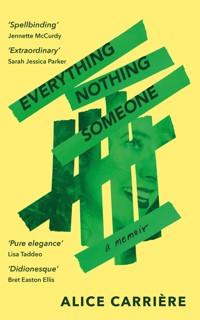
*GIRL, INTERRUPTED FOR THE 21ST CENTURY* *A JENNETTE MCCURDY BOOKCLUB PICK* 'The story is extraordinary, but more importantly, the storytelling is exceptional... If you read one memoir this year, make it this one.' - PANDORA SYKES 'An impressive feat of writing.' - THE DAILY TELEGRAPH 'Written elegantly with humor and compassion... Alice manages to tell her story with insight and forgiveness for her parents and herself, and we root for them all, all the way.' - SUSAN SARANDON 'I spent a feverish few days devouring it with a mixture of anguish and awe.' - SOPHIE WHITE, IRISH INDEPENDENT 'Mind-blowing' - LENA DUNHAM This exceptional memoir and love story tells of a young woman's harrowing coming-of-age amid glamour, excess, and neglect, and her journey, against the odds, to find herself. Alice Carrière tells the story of her unconventional upbringing in Greenwich Village as the daughter of a remote mother, the renowned artist Jennifer Bartlett and a charismatic father, European actor Mathieu Carrière. Her days are a mixture of privilege, neglect, loneliness, and danger-a child living in an adult's world, with little-to-no enforcement of boundaries or supervision. Alice begins to lose her grasp on reality as a dissociative disorder erases her identity and overzealous doctors medicate her further away from herself. She inhabits various roles: as a patient in expensive psychiatric hospitals, a denizen of the downtown New York music scene, the ingenue in destructive encounters with older men-ricocheting from experience to experience until a medication-induced psychosis brings these personas crashing down. With gallows humor and brutal honesty, Everything/Nothing/Someone explores what it means for our body and mind to belong to us wholly, irrevocably, and on our own terms. In pulsing, energetic prose that is both precise and probing, Alice manages to untangle the stories told to her by her parents, the American psychiatric complex, and her own broken mind to craft a unique and mesmerizing narrative of emergence and, finally, cure. 'Spellbinding' - JENNETTE MCCURDY 'It's extraordinary... make your way to this book.' - SARAH JESSICA PARKER 'Remarkable' - NEW YORK TIMES
Sie lesen das E-Book in den Legimi-Apps auf:
Seitenzahl: 441
Veröffentlichungsjahr: 2024
Das E-Book (TTS) können Sie hören im Abo „Legimi Premium” in Legimi-Apps auf:
Ähnliche



















First published in Great Britain in 2024 by Allen & Unwin, an imprint of Atlantic Books Ltd.
First published in the United States in 2023 by Spiegel & Grau
Copyright © Alice Carrière, 2023
The moral right of Alice Carrière to be identified as the author of this work has been asserted by her in accordance with the Copyright, Designs and Patents Act of 1988.
All rights reserved. No part of this book may be reproduced or transmitted in any form or by any means, electronic or mechanical, including photocopying, recording or by any information storage and retrieval system, without prior permission in writing from the publisher.
Every effort has been made to trace or contact all copyright holders. The publishers will be pleased to make good any omissions or rectify any mistakes brought to their attention at the earliest opportunity.
A CIP catalogue record for this book is available from the British Library.
Trade Paperback ISBN 9781805462439
E-book ISBN 9781805462453
Jacket design by Strick & Williams; front jacket photograph by Gregory Lattimer
Interior design by Meighan Cavanaugh
Allen & Unwin
An imprint of Atlantic Books Ltd Ormond House
26–27 Boswell StreetLondon WC1N 3JZ
www.atlantic-books.co.uk
For Gregory
Content warning: This book contains references to sexual abuse, self-harm, suicide and addiction.
Wo aber Gefahr ist, wächst das Rettende auch. / Where danger is, grows that which saves also.
—Hölderlin
To be mad is to be enraged is to be insane is to be uncontrolled is to commit violent action is to be fashionable, as of wind or as of sea.
—Jennifer Bartlett, History of the Universe
I / Everything
1.
My mother’s disembodied voice came through the intercom. “Alice. Alice.”
Or maybe it was “Alice! Alice!”
Or maybe it was “Alice? Alice?”
If I couldn’t get to the phone fast enough, she’d hang up and then I couldn’t call her back because she kept her phone on privacy mode. She could reach me, but I couldn’t reach her. I had to go looking for her to find out what she wanted. By the time I found her she didn’t seem to care why she had called me in the first place. Maybe my mother was just a voice in my head. Maybe I was just a figment of her imagination.
She had put her bed in the third-floor pool room, which had a fireplace and views of her lush garden. During the day she was below me, painting in one of her two downstairs studios, and at night she was above me in the pool room with her bottle of white wine and her books. My bedroom was below the pool room, on the second floor. The pool held ninety tons of water and I could feel it all balancing over my head. As I lay in bed at night, I pictured the ceiling giving way. I wondered at the shape that water would take once it was cut loose from its parameters, violently free.
The intercom connected us within the massive house in New York City. Our address was 134 Charles Street, between Greenwich and Washington Streets, in the West Village. We never got the numbers put on the door, so there was just a torn piece of paper with 134 written on it taped to the inside of the glass. It was a seventeen-thousand-square-foot, three-story building with a concrete facade, large windows, and steel doors. The building used to be a factory for manufacturing train parts back in the days when trains ran along the west side of the island.
On the ground floor was an office and a gigantic studio, which led, via a spiral staircase, to an even bigger basement studio, where my mother painted every day from 6 a.m. until 7 p.m., with a two-hour nap in the middle of the day. Between the office and the upper studio was a small room where my father lived after my mother kicked him out of her bed and before she kicked him out of the house. It was also where my uncle Roy came to die, where Max hemorrhaged, and Michael wept. It was where people came to lock themselves in and fall apart.
The building had huge windows that let the world see us as we moved through the house. Once, for one of her lavish parties, my mother had the staff light hundreds of votive candles and line them along the windows. In the middle of the party, firemen in full gear stormed into the house thinking it was burning down. A neighbor had misinterpreted the chic flicker of tiny candles as a deadly blaze, or perhaps they had seen something in us, identified a threat, that we couldn’t see ourselves.
On the second floor was my bedroom; a second room, which I called “my study”; Nanny’s room; the library with a fireplace and rolling ladders that extended to the ceiling for access to the walls of books; the kitchen where Katy the cook prepared our meals; and the living room with another fireplace and a wall of windows that looked out onto a garden. Nanny was Eileen Denys Maynard, who went by Denys but was only ever called Nanny. She existed to everyone like a paper doll Mary Poppins, two-dimensional, her life beginning and ending as the British governess paid to raise me. To me, she was a mother, but one who could be fired and disappear at any moment.
The garden on the second floor had fruit trees and a koi pond and a spiral staircase covered in roses that ascended to another garden with a grape arbor and apple trees. My mother liked to be surrounded by things that were growing because she always felt she was killing things, that if she touched something, it would die. There was a tool shed, like on a farm—I’d never been to a farm but I imagined that’s what a farm was like—but right on top of the building in the middle of Manhattan. I liked to go in there and smell the fecund fustiness of the shed. The bags of fertilizer, rusting tools, and drying twigs created a tranquilizing fog that curled itself between me and the city below. Our world had all the disparate components of the world from which we were disconnected—steel and trees, fire and water, soil and decomposition.
There were no locks on the doors inside the house. The doors were just sheets of opaque glass in steel frames. Not even the bathroom doors had locks. Nanny once walked in on me masturbating and said, “Oh dear, I forgot you are a woman now,” and walked out. Nanny once walked in on me cutting myself and cried. No locks meant I couldn’t say, “KEEP OUT!” When I was six, I put a No Smoking sign on my door. It didn’t work. My parents were both chain-smokers and their smoke entered the room before they did, making my eyes water and my throat itch. Only mythic beings could do that—make their presence known inside another person’s body. The boundaries were porous. In this house one could not tell the difference between fantasy and reality, art and object, parent and child. In this house, I couldn’t tell what I was to my mother. In this house, I couldn’t tell if I was my father’s daughter, wife, or mother.
The bathroom attached to my bedroom had two entrances, one from the hallway and one from my room. When my mother had parties and I was in my room, people sometimes didn’t notice the door connecting to my bedroom and didn’t close it, so I could hear them pee. Sometimes I could even see them if the mirrored door reflected into my bedroom. I liked to watch them and I liked the moment when they realized they had been seen. There would be a fat pause as they tried to remember what sounds they had made or what parts of them had been exposed. They would clear their throat before they zipped or yanked up their pants, before fabric fell back over knees. In this house, our most secret selves and our most private moments were meant to be spectated and thought about. The toilet flushed with an intensity that made me jump every time. The taps of the sink and bathtub and shower were marked with C and F, for chaud and froid—the French words for “hot” and “cold.” People unfamiliar with the house often scalded themselves when they washed their hands. The house forced you to move differently. It could be a bewildering, even harmful place if you didn’t know its rules.
It was as if I lived inside my mother’s mind. Everything had been designed especially for her and her alone. The space was built to accommodate the particularities and peculiarities of her gestures and habits. The house had many horizontal surfaces—daybeds, kitchen counters, spacious hearths, hardwood floors on which she could assume her typical recumbent pose: on her side, arm cocked to prop up her head while smoking or reading or talking on the phone. She spread herself out on these domestic plateaus like Manet’s Olympia, and life lived itself around her. She had transformed this place from a factory into a fortress, an irresistible nexus of strangeness, luxury, and niche functionality—the architecture of my mother’s desires. Everything around us had her in it. She designed her own jewelry (a gemologist who rode a unicycle and had worked with the Hope Diamond was her collaborator), the pieces so elaborate that they tested the limits of engineering. She designed her own very uncomfortable furniture. She designed and commissioned our drinking glasses, handblown cylinders so light you could hardly tell there was anything in your hand. The concept behind them was to create something as close to nothing as possible but still be functional. I hated them because I couldn’t stop breaking them. And I had to use them because they were part of the fundamental routine of my life. Which meant destroying them would also have to be a fundamental routine of my life. Even the most utilitarian aspects of our lives were impossible to negotiate—conceptualized beyond utility, aestheticized beyond the physics of living.
Nothing on the walls of my room was my own, nothing had been selected by me. There were no posters or drawings, only my mother’s art or her friends’ art. Every year my mother redesigned my room as a surprise for my birthday. She hung things up or took them down, added or took away, rearranged and reconfigured until the room was new and unrecognizable. Every year I would identify the changes from a master list and note what had been taken away or added. This new room had new rules, demanded new ways of living. This was the new place I would be doing my homework, the new direction I slept, the new view I had when I opened my eyes, the new me, curated by my mother. I felt the excess of it—the new teddy bear, rocking chair, computer, vanity mirror, canopy bed, and glow-in-thedark constellations stuck to the ceiling in the correct configuration by my mother’s studio assistants. It set me trembling with excitement but also panic, the trepidation of meeting the girl this unfamiliar room belonged to.
Roaming through the house was the purebred Welsh terrier, Charlie of Charles Street, my mother had bought me. She had sent him away to be trained at a fancy pet boarding school, where he was abused, and he returned to us a broken animal with a behavioral repertoire of biting, cowering behind the toilet, and eating his own excrement. I learned quickly that I could not touch or go near him while he ate or he would turn on me, snarling, and try to bite me. I’d encounter him in the hallway shitting on the floor and I’d edge by him as he growled, knowing if I tried to interfere with him feasting on his feces he’d attack. I tried to be affectionate with him, but he seemed consumed by the imaginary war that waged inside of him.
The house was full of people. There was a cook, a housekeeper, a house manager, a gardener, a fish man who looked after the koi pond, a studio manager, the studio manager’s assistant, three studio assistants, and a studio assistant intern who cleaned the brushes. They were like family, especially the studio assistants. They worked with my mother in her most intimate space—her studio. They knew her way of thinking, discussed math, patterns, what came next in a series of paintings. Their jobs had no clear parameters. They worked in the studio but they also decorated the house for Christmas, organized my birthday parties, played with me. When my uncle was dying in the downstairs bedroom, Nancy, one of the assistants, got him his marijuana. Ricky, the studio assistant intern, sat with him as he was dying. These people existed for my mother. To keep things moving, to keep things clean, to keep me tended to, to keep paint fresh and canvases stretched and the whole operation going with my mother at the center, head down, brush up, painting.
I would stand in her studio and look up at the massive canvases: a wall of fire devouring a tartan square, playing cards, a skeleton; the shape of a house made up of thousands of small dots; a man holding an axe. She had a real human skeleton in the studio named Lucy. I would hold Lucy’s excarnated hand, caressing the bumps and curves of her fingers in a morbid mother-and-child tableau. I wondered at the fact that my mother could casually own a human skeleton. Just because she wanted it, she could summon a whole dead human to hang out in the studio, to be named and petted and painted. Later, when my friend’s father, a war photographer, was crushed by the second tower on September 11, my mother was given the film from his camera, and she rendered his final moments in paint, huge and bright. My mother was powerful. She could take over someone’s remains, own the imprint they had left on the world, the imprint the world had left on them, and make that imprint even bigger, immortal. When my mother became the only Westerner commissioned to paint a temple ceiling in Japan, she let me put paint on the soles of my feet and walk across a square of paper. The idea that my feet would be walking across a ceiling in a temple in Japan made me feel like my mother could perform magic. She could make me everlasting; the feet that would only be tiny for a fraction of time, those feet would run forever across a ceiling where prayers were being chanted. I looked at the square of paper after the painting was done and saw for a brief moment how my mother had seen me, that my mother had seen me.
I spent most of my time in 134 Charles Street alone in my room listening to audiobooks. I didn’t have many friends. I didn’t know how to behave around children. I listened to audiobooks all the time. I listened to them to go to sleep at night, while I showered, while I did my homework, while I played in my room, on my way to school. The words slid down my ears and lit me up, helped me recognize where everyone else ended and I began. Stories taught me the right words for things; if I had the right word for things, everything could feel okay. I populated my life with the Watsons in 1963, with Marty and Shiloh, with Louis the swan, with Jonas and his memories. When I listened, I recognized my friends, I recognized myself. I had mastery over these spaces, these rooms built out of language. I could invite words in and I could say, “KEEP OUT!” I knew these worlds and I knew their rhythms and rules. I knew how Ron Rifkin pronounced certain words, where he paused to breathe, the exact inflection that came before the big reveal, and even though I knew to expect it, it thrilled me every time. I could say, “Aw, man!” in unison with LeVar Burton. These were disembodied voices too, but they didn’t hang up if I couldn’t get there fast enough; they let me turn them on and off again whenever I wanted. They could reach me, and I could reach them.
When I wasn’t listening to audiobooks, I thought about myself in the third person. Walking down the street to school I would think, “She is walking down the street. It is raining. The rain falls on her jacket.” I turned myself into words and my life into a story. Years later, when I didn’t recognize my own face in the mirror, when my body didn’t feel like my own, I would again recite myself to myself, narrating myself into existence, trying to locate myself in my story.
The characters in the story of 134 Charles Street were rich, brilliant, loud, drunk, high, beautiful, careless, reckless, genius, gluttonous, well-dressed. Anna Wintour dropped off clothes, Steve Martin joked at the table, Wynton Marsalis played trumpet in the first-floor studio, Joan Didion sipped vodka-on-the-rocks in the garden, Al Gore won votes in our living room after bomb-sniffing dogs deter-mined it was free of explosives, Merce Cunningham shuffled grace-fully through the upper studio, Susan Sarandon and Julia Roberts compared colonoscopy stories over brunch at the dining room table. Starting at the age of seven, it was my job to tell the story of 134 Charles Street. “Would you like a tour?” I would ask in my Bonpoint dress to every guest who arrived at the extravagant parties my mother threw. I brought them through the studios, the gardens, and the pool room, naming the artists and designers for them. I was good at talking about where and how we lived; I just had no idea who I was talking about.
I first cut when I was seven. My mother would throw pool parties for my entire class of twenty kids, all of whom made merciless fun of me in school and out. I only ever hung out with adults. I’d stay late after school to visit with my teachers, asking them questions about their lives. I was excellent at anticipating what adults wanted from me, but I just couldn’t read my classmates. Every year, they would descend on my house, invading my fortress. One year I walked into my room to get away from them and everything that belonged on my shelves was on the floor, much of it broken. We had just gotten Charlie and all my stuffed animals had been crammed into his crate. I couldn’t see the floor. I felt woozy and faint. Adrenaline burned the underside of my skin, heating up the surface of me until it pulsed. I held my breath and felt an immense pressure against my entire body and an unfolding outward from deep within, as if I could be crushed and explode at the same time. I was angry, I was sad, I was terrified at how anger and sadness felt inside me. I needed to get the feelings out. I found the Swiss Army knife my father had given me. I pried open the biggest blade and pressed the edge of it against my palm. I pressed and dragged until I saw blood. Instantly my heartbeat receded from my ears, tucked itself calmly back into my rib cage, and my mind folded itself into a neat origami brain—clean, calm lines. The wild pitching was replaced by a thick stillness, the laceration a hot horizon, steadying and orienting me. It had come to me so easily, so naturally, and it had worked. I didn’t know how I had known to cut myself to feel better; I had never heard about self-harm. With a tiny, shiny blade I learned I could unlock a doorway that led to a place that was entirely my own, even if I could only stay there for a moment within those seconds of pain. I didn’t yet understand that the rage and sorrow I felt were not from mean kids. The feelings emerged from deeper deposits, cavernous compartments where the disembodied voices of my parents echoed, telling me things I shouldn’t know, chanting the desires and fears that ruled them, until I couldn’t tell the difference between my voice and theirs. Each cut organized into legible symbols the confusion of cravings—my father’s, my mother’s, my own—that made me feel like too much and eventually nothing. As a teenager, when I started cutting regularly, it felt like a passion, like a calling. Me upstairs, crosshatching my skin with a razor blade, my mother downstairs, crosshatching canvases with oil paint, each of us telling our story.
IT WAS HARD TO KNOW what was true in my house. There were no absolute truths because there were endless ways to say something, innumerable angles from which to see, so many media with which to transform things. At any moment something could be what it was and also the exact opposite. 134 Charles Street was a place of abundance and of absence. The kitchen had a pantry that was stocked with extra everything. Four bags of Cape Cod Potato Chips next to five bottles of maple syrup next to four boxes of Walker’s Shortbread. I’d stand in the laundry room and stare at the repeating orange jugs of Tide detergent that stretched out along the shelves, a promise that things never ended. I didn’t recognize this muchness for the extraordinary privilege it was. I didn’t realize not everyone else had what we had, or that what we had was not an inherent quality of who we were. The excess felt like an exoskeleton, an impermeable shell that was naturally part of us. It never occurred to me to feel grateful, just like I wasn’t grateful for the skin stretching across my bones.
My mother was, in her chronic extravagance, somehow always almost broke. Once, she came into my room, sat on my bed, stared over my head, and told me she had made two million dollars. Months later she came into my room, stared at her lit cigarette, and told me we were broke. She was a woman who didn’t know her own social security number, how much money she had in the bank, the grand total of all the bills for all her extravagances. She didn’t know how to manage the resources that, in the ’70s, ’80s, and ’90s swelled and swelled and would later, from her profligacy, drain away. She only knew how to paint. She worked constantly, unflaggingly, and that meant that at any moment we could have everything or we could have nothing. Everything could change at any moment. Money, a parent, a mind, could all disappear.
I wasn’t taught anything about real life. I knew the locations of Fra Angelico frescoes, I could recite all the lyrics to Bertolt Brecht’s The Threepenny Opera in German, I could name all the famous examples of Gothic architecture. At fifteen, I still didn’t know how to use a tam-pon because no one thought to tell me and I hadn’t thought to ask. There were no lessons or tips or admonishments. My bed was made for me every morning, a towel was whisked away and washed every time I used one, my underwear was ironed. I floated around 134 Charles Street and didn’t leave a trace. Not in creases in my clothes, nor on the walls or floors of my room, where even my mess couldn’t stick. Later, I would do everything I could to make something stick to me, to the walls of my body and the sloping, slanting floors of my mind, until I finally understood the place that could contain me was the page.
Once, at my mother’s Christmas tree decorating party, when I was old enough for the subsequent reaction to be inappropriate, embarrassing, strange, I dropped an ornament and it broke. I stared down at it, paralyzed. The only thing I could think of to say was, “What do I do?” My mother’s assistant and a family friend were standing next to me. Their eyes widened with confused alarm. There was a pause, a heavy silence saturated by the colors of the lights and the density of my ignorance. “You get a broom and clean it up,” one of them said. I could hear the amazement glazing her voice. My mind was blank. Destruction came easy, but what to do after, how to clean it up and move on, was a confounding proposition. In a house with no locks, in a family with no rules, in a mind with no limits, it was in the moment of demolition that I felt most at home.
The house that had been a structure for putting things together turned into the place in which we slowly came apart. In her work, my mother was obsessed with the archetypal house image—a square with a triangle on top. The most elementary, identifiable shape that indicated so much more: house, home, family, history. My mother rendered this silhouette in ink, in pastel, in Testors paint, in charcoal, in oils. It was big, it was small, it was crosshatched or composed of dots. It was chopped in half, it was dissolved, it was splintered. It was repeated over and over, as if she were trying to learn the meaning of the word, decipher its secrets.
My mother’s muchness was matched by a grandiose but remote generosity. Our house became a repository for people fallen on hard times. Whether dying of AIDS, escaping an abusive parent or partner, facing poverty, or descending the spiral of manic depression, people would show up at our house and stay. I would be excited and curious about each new addition to the household and would focus all my thoughts and feelings on them, growing to love them as I walked by their rooms while they slept or wept. I liked to sit and talk to these people about their pain and their fears, nodding my head and thinking how big and unwieldy life could feel. I loved these people who seemed so lost, and I hoped our house could keep them safe. My mother cared from far away. She was not the person to bring the soup; she paid someone to bring the soup. But that was her way of showing that she wanted you to have soup. Later, when I would require ministration, my mother would lavish this care-by-proxy onto me in the form of psychiatrists and their pills, with the instruction to take them unquestioningly. Later, in the moments when I felt like I was disappearing, I wanted my mother to talk to me, to sit with me, to touch me. I craved a warmth that existed so deep inside her that it couldn’t reach me. It couldn’t even reach her. I wanted her to say, “Alice? Alice?” and mean it, unspooling the question mark until it made four walls and a triangle roof where she would finally invite me in. I wanted her busy hands that built everything that surrounded me to help me prop up the walls of myself. Maybe she thought 134 Charles Street would magically protect us, that nothing could get to us. Except she didn’t realize that the thing that wanted me dead was already inside the house.
2.
My mother, Jennifer Bartlett, broke onto the New York art scene in the 1970s. She was born in 1941 in Long Beach, California, to a bitter, beautiful, emotionally closed off mother, whose career in fashion illustration had been thwarted by my mother’s arrival, and a charming alcoholic pipeline contractor with a secret second family. At five, she stood on the beach and declared to the expanse that she would be a great artist. She had always wanted to get away and she succeeded, graduating from Mills College then moving east to get her MFA at Yale. She married a handsome psychiatry student and then divorced him to move to New York City and pursue her career. She took a teaching gig at the School of Visual Arts and rented a loft on Greene Street in SoHo, joining a social milieu that came to include the artists Jonathan Borofsky, Joel Shapiro, Richard Serra, Barry Le Va, Alex Katz, Brice Marden, Lynda Benglis, Susan Rothenberg, Elizabeth Murray, Chuck Close, and Jasper Johns. “I was just crazy about New York,” she said. “I remember the first time I got there, being knocked down by a big, fat woman when I was trying to hail a taxi. For some reason, this appealed to me enormously.” She was catapulted to art world fame in 1976 with a piece called Rhapsody. In the New York Times, the art critic John Russell called it “the most ambitious single work of art to have come my way since I moved to New York.” The piece, he said, “enlarges our notions of time, of memory, of change, and of painting itself.” It was over 150 feet long and composed of 987 one-foot-by-one-foot steel plates with a baked enamel grid silk-screened onto them, a medium she had invented, inspired by New York subway signs. Rhapsody was enormous—in size and ambition. When it later hung in the Museum of Modern Art atrium, it took up all three walls. She wanted to make a piece that “had everything in it.”
After hitting it big, Jennifer Bartlett bought her first mink coat, slapped on giant sunglasses and lipstick that was always crooked, sprayed on too heavily the Fracas de Robert Piguet perfume she ordered directly from Paris, and was dubbed “the Joan Collins of SoHo” by New York magazine. A 1985 twelve-page profile in the New Yorker, appropriately titled “Getting Everything In,” described her “disconcertingly direct manner, her helmet of close-cropped dark hair, and her habit of cracking jokes at her own expense” and wondered how California could have “produced an artist of her energy, analytic rigor, and undissembled ambition.” She had become, at that time, “one of the most widely exhibited artists of her generation.” Her best friend, the artist Elizabeth Murray, described her as “sort of a brat. She was outspoken, and she seemed very sure of herself, and she made people angry—especially men.” Another friend described her as “a monster pain.” An article written by Joan Juliet Buck in Vanity Fair declared that “there is no actress glamorous enough to play Jennifer Bartlett. She believes in hot lunches, good clothes, and champagne. And she never stops working.”
She was beautiful in a smudged way, crooked bottom teeth behind imperfect lipstick, short dark hair, and crystalline blue eyes that had an unexpected softness to them. She brought her own atmosphere with her wherever she went—a cloud of perfume, a cloud of smoke, a cloud of utter fucklessness. She had a loudness that came not just from the amplitude of sound waves, but from an orogenic pressure that brought the hilt of her desires—for something to stop or continue, to be given or leave her in peace—thrusting up through the moment, separating what was not about her (not much) and what was about her (much more). She was the center of attention all the time, but the way she tugged on the spotlight seemed protective, as if she were trying to conceal herself with the glare. There was a vulnerability about her that revealed itself precisely in the moments most marked by crassness, by will, by stubbornness; a clumsiness to her attentional gluttony. She was extremely guarded. There was no one she opened up to. And she couldn’t figure out affection. I received the occasional awkward pat, as if she were checking to see that all parts of me were still there, adjusting or confirming me, but never reaching me. When we did hug, she would cough out a laugh as our bodies touched, or a sarcastic “oh” would loop out of her, and I felt it, an overstuffed pillow between us, blocking the contact, the connection. She had zero ability to speak about emotions and often bit off the moment with the glib announcement that she “felt like working” or “felt like not feeling,” amputat-ing the sentiment at the joint. The New Yorker quoted her as saying she “developed an infinite capacity for work and none for reflection.” She worked all the time, and it was all she wanted to do.
I watched my mother as she lived her life around me, passing by on her way down to the studio or up to her bedroom and down again in her fog of perfume and smoke to work or attend a party. I read her traces like letters. I knew this story; I was familiar with the narrative of her goings-away. She was downstairs or upstairs doing and thinking about special, mysterious things. Maybe, if I became special and mysterious too, she would turn her eyes to me. But later, when the mysteries of my own mind proved nearly lethal, when I became special with madness, she would avoid my gaze even more.
MY FATHER WAS A European sex symbol. Mathieu Carrière had been working in film and television since he was thirteen years old, acting in English, French, German, Italian, and Spanish with Orson Welles, Isabelle Huppert, Brigitte Bardot, Marlon Brando, Romy Schneider, and Antonio Banderas. After a brief career as a teenage equestrian vaulting champion, he left Lübeck, a small town forty-five minutes outside Hamburg, Germany, in 1969 to live in Paris, performing in drag in cabarets, bedding Princess Caroline of Monaco, attending philosophy classes at the Sorbonne, and becoming the protégé of the famous philosopher Gilles Deleuze. He tripped on acid in front of Visconti and Alain Delon at Domaine de Monthyon. He and Andy Warhol drew different shaped penises on the backs of Polaroids at Angelina’s in Paris. “Some are curved,” said Andy, “and maybe some are even like spirals.”
My father spoke six languages, wrote a book about the poet Heinrich von Kleist, and was awarded the Légion d’Honneur, the highest French order of merit. He was six-foot-one and thin, had wavy light-brown hair that would turn white at forty, penetrating blue eyes, and puffy lips that gave the impression of sensuality and innocence. He was never still, always smoking, drinking, playing speed chess, inhaling cocaine, exhaling outrageous stories or wild theories. His body couldn’t handle inertia; he rolled his thumb over his fingers over and over, as if compulsively checking that they were still attached to his body. He was loud, explosive, disruptive. He left people jarred and exhilarated, offended and compelled. He asked personal, invasive questions, and people would respond by telling him the worst things that had ever happened to them, things they had never told anyone before.
My parents met at a dinner party in New York in 1980, when my mother was thirty-nine and my father was thirty. He made her smoked salmon sandwiches and piled them onto her plate. She lit a Marlboro Red and inhaled as she ate.
“Shouldn’t you do one at a time?” my father asked.
“I like to smoke and eat at the same time,” my mother replied, pungent oil and thick smoke on her lips.
At dinner, she was seated next to another man named Matthew. My father fixed his attention on her and asked, loudly from across the table, “Which Matthew do you want?”
“You,” she announced, and brought him back to her SoHo loft.
After my mother’s success with Rhapsody, there was only one goal left to achieve. As the psychiatric files from my later hospitalization explained: Alice was born to a mother with two driving ambitions: to be a successful artist and to have a child. After years of trying to get pregnant without success and a failed adoption attempt, my mother learned, at forty-three, she was pregnant.
As the doctor performed the cesarean, my father played a word game with my mother.
“Name a French writer who has the same name as a piece of meat,” he said.
“Colette,” said my mother.
“Not bad, but that’s côtelette,” he said.
“Chateaubriand,” the surgeon said and pulled me out, as if I were the answer to every riddle.
We spent the first four years of my life in Paris, with many trips across the Atlantic on the Concorde. My mother would hold her Abyssinian cat, Kanga, on her lap and feed her caviar. The apartment was a spacious penthouse on Rue Vavin, with terraces and a skylighted studio where my mother painted. A spiral staircase led up to my parents’ bedroom. It was steep with huge gaps, making it impossible for me to access their room, but I didn’t live there anyway. Nanny and I lived in a small apartment next to theirs. I spent my days with Nanny. She took me to the Jardin du Luxembourg, where she’d watch me ride the carousel. We pushed wooden boats across the pond in the center of the park and named the ducks that swam there. We watched the old men smoke cigars and play boules, listening to the tock of the metal balls and their rough laughter. She brought me to La Coupole, where I sat at the bar, my legs swinging, and pulled cold, booger-like snails out of their tiny black helixed homes with a pin and ate them. One day, my father brought home a crab as big as my head and put it in our bathtub as a joke. I was terrified of crabs and wet my pants because I refused to pee next to that monster that waved its claws and made skittering noises as it tried to escape.
While Nanny and I went about our routines, in our little apartment, with our little delights and disappointments, my father and mother tried to exist together. My father watched her paint and direct her assistants to build a giant replica of a house, cut it in half, and then put it back together again. He was in awe of her. It was entirely her world, he’d later say, occasionally visited by him and me. Everything she did, she did alone. He watched her neutralize everything with work—her feelings, her environment, her moods. My father, busy playing speed chess and doing cocaine, would disappear for days, returning home irritable and wired. He wrote, produced, and directed a film about a German pianist addicted to cocaine and gambling and married to a successful architect. In the movie, called Fool’s Mate, the wife, named “Alice,” kicks him out to protect their daughter, “Isabelle” (my middle name), and he confesses to a murder he didn’t commit to get out of his debts. He told me later he made the movie so the ending wouldn’t happen in real life, a creative prophylaxis, bending life into art to bend life. I played his daughter, Nanny played the nanny, and in the role of the main character’s mistress my father cast the woman he had been having an affair with. My mother designed the costumes, which meant she had to dress the woman my father was fucking. When my mother found out, they sat at Le Select, the bar around the corner from the apartment, and weighed their options. My mother decided they should stay together and never mention it again.
3.
We moved to New York City and into 134 Charles Street in September 1990, when I was five years old. My father spent his days writing screenplays and playing chess in Washington Square Park, making friends with his opponents—the drunks, hustlers, and unhoused who spent most of their lives curled up on the benches or hunched over the concrete chess tables. My mother’s crowd found him very cute, and her friends joked that she had married him because he was so photogenic.
My mother started therapy with Dr. Viola Bernard. She drank too much, had relationship problems, and had a troubling memory about walking in on her father fucking a family friend. Under Dr. Bernard’s care—intense psychotherapy sessions and hypnosis—my mother began to be flooded with what Dr. Bernard told her were repressed memories, horrific scenes of ritualized abuse and murder of children at the hands of a couple, Bertie and Russell, who were family friends from her youth. Dr. Bernard encouraged her to “remember,” disclose as much as she could, and write about it in journals. My mother, haunted, hunted for clues in her past. She hired a private detective who couldn’t find anything. She tracked down Bertie and Russell’s phone number and confronted them over the phone. She was convinced that her parents had been complicit and confronted her mother, Joanne, who told her it was all nonsense. She believed her younger sibling, Jessica, had been raped by Bertie and Russell as an infant. She asked Jessica, a trans woman, if her gender dysphoria could have been a result of the abuse she believed they had both endured. Jessica said no but remembered having sleepovers at Bertie and Russell’s and that there was not an extra bed for her, so she had slept in their bed. She also remembered their mother telling her that she could never go over there again. Something could have been happening, but no one could confirm any of my mother’s claims. My mother told her friends what she had discovered in therapy. They recalled her matter-of-factly describing child rape and murder in a flat affect as she sipped glass after glass of white wine. When speaking to me years later, my godmother Paula would wonder, “If all these children were going missing, where were the news articles? Where were the missing persons reports?” “How could they have been so well-organized and keep it so secret?” another friend wondered. “It didn’t seem possible or plausible. But she really believed it.”
I learned my mother’s story when I was eleven. I was spying on her for my father. She had filed for divorce when I was six, starting a custody battle that would last six years. When we were all in the middle of it, my father told me to look for a list of witnesses that my mother might call to testify. I looked in her closet and found a journal. I read an entry about my mother giving my father a blow job and that, in the middle of the act, she’d had a “flashback” to being on a boat with Bertie and Russell. Russell had pushed her head under the water as she threw up and he said, “You’re feeding the fishes.” The sides of my mouth twitched into the inappropriate smile I made when I felt the barbed worm of unease twist around inside me. When my mother came up from the studio to have her lunch, I told her what I had found. We sat in my bedroom, and she told me how a married couple who were friends of her parents had used her in a sex cult. They had raped her and her one-and-a-half-year-old brother. They took them on trips on their boat, where they had orgies with other children. They used the Black children of maids who worked in the neighborhood in ritualized sex games. They murdered a seven-year-old Black boy, who they called “Monkey Boy,” through erotic asphyxiation and made my mother bury the body on the beach at night, telling her that if she ever told anyone she would be thrown into prison for life.
She told me this story in a very straightforward way and then went off to take her nap. She told me the story as if I already knew it, as if we’d been through all of this already, and I sat and listened as if it were one of my audiobooks. She didn’t tell me how she felt about any of it or ask how I might feel about it. She didn’t cry and her voice didn’t strain against any feelings I could discern. I sat and stared at her, thrilled that she was sitting in my room talking to me. She told me that the series she had painted called “Earth Paintings”—some of which were hanging in our house—was about the abuse. My mother left me in my room thinking about my father getting a blow job and how to spell erotic asphyxiation.
I stood in front of one of the paintings. My mother had done several versions of each image—in oils on a large canvas, on a medium canvas, in gouache on paper, in pastels, in ink, until there were 108 of them. Over and over and over, she painted and drew and smeared and shaped and formed and brought to life these memories that had been brought to life inside of her. For days and weeks and months, she dragged her terrors into the world for everyone to see and froze them there forever. Maybe she was frozen in them too. I stared at the painting showing “Monkey Boy” being buried on the beach. I was suddenly able to see into my mother’s mind. I could be there with her on the beach, being forced to bury a body. I could be her. I stood in front of that painting and imagined all the feelings she must have felt. I understood the power of not feeling, too. Of being able to tell your story with paint or with words and then just going to sleep.
I WOULD LATER LEARN that my mother was most likely a victim of the Satanic Panic, a moral hysteria that swept the nation in the ’80s and ’90s. Unsubstantiated claims of children being used in Satanic rituals involving sex and murder were leveled against daycare workers and parents. Patients in psychotherapy were persuaded by overzealous clinicians that they had repressed memories of unspeakable abuse involving incest, pedophilia, and murder, and needed to uncover them. The science of recovered memory therapy would be debunked but the damage remained—families torn apart by accusations, patients tormented by the continued belief in these persuasive inventions or the awareness of their fiction. My mother’s memories were likely false, just stories. But “just stories” were powerful. Just stories led her far, far away from people, and killed off something inside her.
My father was negotiating his own indoctrination. For ten years, as the protégé of French philosopher Gilles Deleuze, he had been involved in the most anthropologically anarchistic, mind-boggling philosophical theories he had ever encountered in his life. It was not only a philosophy, he would explain, it was a militant activist movement to change the world based on a theory of desire. The only thing that existed was the constant production of desire, which was overflowing, and state and capitalism and laws were all ways to tame it and put it into oppressive structures. Deleuze and his students believed they were radical revolutionaries. In 1977, a group of influential French intellectuals penned an open letter to French Parliament calling for the decriminalization of sex between adults and minors. Among them was Gilles Deleuze. An excerpt from my father’s journals, written when I was three, captured the type of thinking the movement fostered: There is a possibility of a non-abusive, not traumatizing sexuality between children and grown-ups. Nakedness and tenderness and relaxation with the body of the other person is possible. My daughter does not excite me. I think the fear of the people who make the rules is that their own repressed desires could come up, which makes them see that area as an inappropriate field between a child and an adult. Maybe it’s their way of keeping their own incestuous desires in check. My father’s flirtation with this ideology would soon encounter the full force of the American puritanism he reviled, and his attempts, in the face of this convergence, to shore up his identity with these theories would leave me ever more confused and abstracted.
My mother, in the care of Dr. Bernard, saw transgression everywhere. She became terrified of my father’s behavior around me. One night, drunk, she came into my room and saw my father in bed with me under a blanket, reading me a book. Screaming, she ripped the blanket off and hauled him out of the room. The next day she banished him downstairs, to the small first-floor room between the office and the studios. The next night, I woke up and sneaked down the stairs to visit my father. I stood under the glowing exit sign, a remnant from when the building was a warehouse, which hung above the large steel door that separated upstairs from downstairs. The house was always kept very cold and I was chilly in my nightgown. I felt for the doorknob in the dark. The frigidness felt magical, the frosty bite on my palm marking the breaching of another world. I held my breath and turned the knob. As if my hand had exerted some powerful sorcery, alarms began screeching all through the house, convulsing the cold air around me. I felt the screaming in my body, the noise grabbing me by the arms and shaking me, trying to tell me something I wasn’t listening to. I stood at the threshold of my mother’s and father’s worlds, a limen loaded with alarms, and shook with fear and confusion.
A few months later, my mother began the divorce proceedings that would last six years. Those years would be crowded with lawyers and witnesses and judges and forensic psychologists. My mother told me nothing about the trial. My father told me everything—what he was accused of, how everyone was out to get us, what to say to the judge. I stared at the stenographer in the judge’s chambers while I recited what my father had told me, her face wooden, the chittering of her machine seeming to emanate from inside her, like she was a wind-up toy. I would keep the judge’s decree in a manila envelope for decades, and it grew yellow and faded as I read it over and over, trying to figure out what was true.




