


Erhalten Sie Zugang zu diesem und mehr als 300000 Büchern ab EUR 5,99 monatlich.
- Herausgeber: Pocket Essentials
- Kategorie: Sachliteratur, Reportagen, Biografien
- Sprache: Englisch
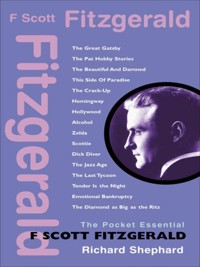
F Scott Fitzgerald is widely praised as the finest and most celebrated novelist of twentieth century America. His reputation is infinitely more lustrous since his untimely death than it was for much of his twenty-year literary career and is largely based on his 1925 novel, The Great Gatsby, as well as on the colourful and tragic incidents of his personal life. His alcoholism; his fairy tale marriage to the beautiful Zelda Sayre, and her gradual descent into schizophrenia; the incandescent blossoming and dissipation of his literary gifts have all added to his legend. Fitzgerald was an individual who seemed to be composed of opposites and who, fittingly, could have been one of his own characters. He was charming, witty and in love with the magic and splendour of life, but also felt compelled to embrace the darkness. As a writer, his perception of the world around him was so finely tuned and acute that his life and career were a mirror of the 1920s and 30s, so that just as the Jazz Age gave way to the Depression, Fitzgerald's dazzling and youthful success yielded to drunkenness, despair and what he termed 'emotional bankruptcy'. This Pocket Essentials examines both Fitzgerald's life and writing and probes the infinitely complex and symbiotic relationship between the two, revealing the man behind the myth and behind some of the finest prose of all time.
Sie lesen das E-Book in den Legimi-Apps auf:
Seitenzahl: 151
Veröffentlichungsjahr: 2013
Das E-Book (TTS) können Sie hören im Abo „Legimi Premium” in Legimi-Apps auf:
Ähnliche



















F. Scott Fitzgerald is widely praised as the finest and most celebrated novelist of twentieth century America. His reputation is infinitely more lustrous since his untimely death than it was for much of his twenty-year literary career and is largely based on his 1925 novel, The Great Gatsby, as well as on the colourful and tragic incidents of his personal life. His alcoholism; his fairy tale marriage to the beautiful Zelda Sayre, and her gradual descent into schizophrenia; the incandescent blossoming and dissipation of his literary gifts have all added to his legend.
Fitzgerald was an individual who seemed to be composed of opposites and who, fittingly, could have been one of his own characters. He was charming, witty and in love with the magic and splendour of life, but also felt compelled to embrace the darkness. As a writer, his perception of the world around him was so finely tuned and acute that his life and career were a mirror of the 1920s and 30s, so that just as the Jazz Age gave way to the Depression, Fitzgerald’s dazzling and youthful success yielded to drunkenness, despair and what he termed ‘emotional bankruptcy’.
This Pocket Essentials examines both Fitzgerald’s life and writing and probes the infinitely complex and symbiotic relationship between the two, revealing the man behind the myth and behind some of the finest prose of all time.
About Richard Shephard
Richard Shephard has worked in and teetered on the abyss of the book trade for two decades. He is the co-author of the obscure volume, Cult Fiction: A Reader’s Guide and his contributions to the world of contemporary literature have produced inestimable amounts of confetti.
To Jo, with love and thanks. Gggrrr!
POCKET ESSENTIALS
F. SCOTT FITZGERALD
By
Richard Shephard
CONTENTS
INTRODUCTION
PART ONE: THE EARLY YEARS 1896 - 1919
Childhood & School. Princeton. The War. Zelda. New York - Disappointment and Failure.
PART TWO: 1920 - 1940
Early Success. More Success and a Dramatic Failure. Long Island, Lardner & Liquor. Europe Again - and Gatsby. America and Europe - Again and Again. Emotional Bankruptcy and a Breakdown. America - Hospitals and Hollywood. The Depression - Drinking and Decline. Debts and Despair. The Crack-Up. Hollywood (Again). Sheilah Graham - A New Romance. Drinking, Sobriety and The Last Tycoon. Aftermath.
PART THREE: FITZGERALD'S WORKS
The Novels. The Stories. Non-Fiction and Letters. Fitzgerald on Screen. Biographies. Critical Works. Novels Written About Fitzgerald. Fitzgerald on the Web. Books by and about Zelda Fitzgerald. Books on Other People in Fitzgerald's Life.
Introduction
Show me a hero and I will write you a tragedy.
F Scott Fitzgerald wrote this memorable line probably in the early 1930s, jotting it down in his notebooks during a period when his life was starting to unravel and his confidence in his writing beginning to crumble. For just over two decades, however, he did exactly that, presenting a continuous tragedy that ran, not just through his work, but also throughout his short life. Of all his many achievement, perhaps his most remarkable was his unerring ability to write prose that has survived the mythic extremes and excesses of his legend and reputation and, in the years since his death, has flourished to such an amazing degree that it now stands as a pinnacle of twentieth century literature. Although it is ultimately the writing that matters, so complex is the relationship between his work and his life, that it’s virtually impossible to view them separately, a state of affairs that has fascinated and obsessed both his admirers and critics over the years. Despite his own assertion that ‘There never was a good biography of a novelist. There couldn’t be. He is too many people, if he’s any good’, Fitzgerald has been the subject of over eighty books, more than of any other modern writer, and even critical works have included substantial biographical content. Foremost among these scholars and biographers is Matthew J Bruccoli, who in his introduction to F Scott Fitzgerald: A Life in Letters, summed up the link between Fitzgerald’s life and simply and eloquently: ‘Everything F Scott Fitzgerald wrote was a form of autobiography.’
Fitzgerald’s abilities as a chronicler of the first forty years of the twentieth century remain unparalleled and perhaps it should come as no great surprise that his art and life are so inextricably linked, since, in writing about the these years, he was reflecting what he saw, perceived and felt of American society. To this effect, he and his writing thrived and dazzled in the 1920s, faltered and lost direction in the 1930s, just like the rest of the country and much of Europe. It could be argued that part of the reason that Fitzgerald’s portrayal of America, certainly in the 1920s, is so accurate is because he gives the impression of having invented it. At any rate, he named it, calling it the Jazz Age, and peopled it with a cast of flappers, bootleggers, impresarios, young lovers, gangsters, soldiers, artists, Broadway and Hollywood stars, killers and ordinary folk caught up in a life that had never seemed so fast. New York in the 1920s was the perfect place to find such a cast, and he skillfully assembled it from the kaleidoscope that he witnessed whirling around him: newspapers, magazines, his own friends, a vast array of celebrities, the movies, speakeasies and of course, his biggest inspiration – Zelda. Somehow, despite being caught up in, even at the vortex of, this fierce, relentless whirlpool, he was able to capture it on paper, and do so hundreds of times.
In spite of Ernest Hemingway’s and his friend Sara Murphy’s joint accusation that Fitzgerald didn’t understand people or have, in her words, ‘the faintest idea what anybody else but yourself is like’, he had exceptionally sensitive social antennae and his ability to capture moods and nuances was faultless, revealed in countless examples in his fiction. Alongside this, he also had the felicitous knack of sprinkling a bit of magic onto everything he did, so that even his most commonplace and commercial writing glimmers with a radiance that was his alone.
Because of his fame, notoriety and, at times, astonishing success, critics have found it difficult to take him seriously as a novelist, something that plagued him until his death, but, really, there is no American writer who is finer. Anyone, whether author or reader, who is still in pursuit of that hoary old beast, the Great American Novel, should read The Great Gatsby, and abandon the chase immediately. Fitzgerald’s early success, however, along with his and Zelda’s youth and glamour, and their taste for the recently Prohibited alcohol, almost obscured the brilliance of his writing. This critical blinkeredness may have been helped into place by his astonishing prolificity and the seeming ease with which he wrote, particularly his stories. Often derided, particularly by their author, for having jeopardized his standing as a novelist, Fitzgerald’s stories actually represent a major part of his talent, and without doubt, until his third and final sojourn in Hollywood, they financed his life and career. Including his early work, written for school publications, he produced 164 stories, which were sold to a wide range of magazines, and there are only eight, written in the last five years of Fitzgerald’s life, that have never been published in collections. These, according to his daughter, Scottie Fitzgerald Smith, are best left unread by present and future generations.
Fitzgerald’s career was as paradoxical as his life, since, while aware that he could only hope to achieve literary greatness through his novels, he knew that the stories were his real means of earning money, and in ever increasing sums. His story price with The Saturday Evening Post, for instance, rose from $400 to a peak of $4,000 in just ten years, and in 1929, the year in which it jumped from $3,500 to $4,000, he earned, minus agent’s commissions, $27,000 from new stories, while the income from all of his books for the year was a (potentially) sobering $31.17. Multiplying these sums by ten will give their approximate worth in today’s money, and this illustrates just how successful (and, sadly, how wasteful) Fitzgerald was in his prime. Even so, he appeared to be writing these lucrative stories just to pay off his debts, instead of using them to shore up money and time to devote on his next novel.
One of the great tragedies of his life was that he seemed unable to realise that he had the chance of having both an extremely comfortable existence and an enduring immortality, or, rather, he seemed incapable of moderating his chaotic lifestyle so that he could achieve both of these aims. Critics who concur with Fitzgerald’s dismissal of his stories also fail to realize that his depiction of America rest largely on the strength of these, since they were written in a short space of time, sometimes overnight, and provide an instant snapshot of the times, whereas the novels, even something as short and perfectly-formed as The Great Gatsby, were usually written, and rewritten, over a period of two years or so.
In his introduction to Babylon Revisited-The Screenplay, the published script that Fitzgerald had adapted from his magnificent story of the same, and which was actually re-titled Cosmopolitan, Budd Schulberg notes that ‘Fitzgerald’s life and career seemed to stagger from irony to irony’. While it’s interesting to see that Schulberg also treats this ‘life and career’ as if it were a single entity, his point about the landmarks of irony that Fitzgerald repeatedly encountered in his brief journey, is right on the money. The most profound irony of all, of course, is that Fitzgerald died in the belief that he was a failure and that his writing would be forgotten. Neither he, nor Zelda, if fact, were alive to witness the astonishing success of his books, which continues to the present day, with over twenty million copies sold around the world in the last sixty years or so. This makes an average of about 333,000 books a year. Not too shabby for a failure, and a dead one, at that.
Writing in a 1938 letter to his editor and friend, Maxwell Perkins, after his first novel, This Side of Paradise had gone out of print, Fitzgerald admitted, with his customary mixture of pride and self-depreciation, that he was beginning ‘to feel somewhat neglected. Isn’t my reputation being allowed to let slip away? I mean what’s left of it.’ In 1940, seven months before he died, he wrote again to Perkins, unhappy that The Great Gatsby would die and he would disappear, wistfully wondering if his masterpiece had already ‘had its chance’, and bemoaning the unfairness of the fact that he seemed destined to be forgotten as an author, despite his talent: ‘Even now, there is little published in American fiction that doesn’t slightly bear my stamp – in a small way I was an original.'
In one sense, he was wrong, of course, since he was an original in countless ways and remains one of the most influential writers of twentieth century prose. In 1999, almost seventy-five years after the book was first published, in a list of the greatest novels published in the last hundred years, as selected by authors, scholars and critics for the Modern American Library, The Great Gatsby came second, just under James Joyce’s Ulysses. In a similar list, instigated as a response to the male-oriented first one, and chosen mainly by women in their twenties at RadcliffeCollege, Fitzgerald’s novel actually came first. How’s that for immortality? In the Modern Library list, even his flawed masterpiece, Tender is the Night, was at twenty-eighth place. To put this into perspective, it’s interesting to compare Fitzgerald’s positions with those of his erstwhile friend and rival, Ernest Hemingway. Hemingway’s The Sun Also Rises came in at forty-fifth place, while his A Farewell to Arms reached seventy-fourth place. Such a reckoning is a far cry from the days when Fitzgerald wrote of himself and Hemingway: ‘I talk with the authority of failure – Ernest with the authority of success. We could never sit across the same table again.' Once again he was wrong, in that those positions of failure and success are now reversed.
At the time of writing, a stage adaptation of his second novel, The Beautiful and Damned, is attracting audiences in London’s West End, while TheNew York Times, hoping to draw in readers and advertising dollars, is serializing his third novel, The Great Gatsby. Sponsored, perhaps appropriately, by a group of New York BMW dealers, this will be the first time Fitzgerald’s most brilliant novel has been serialized, since it was turned down by Liberty magazine in 1925 on account of its quota of adultery and killing, deemed too racy for a publication aimed mainly at women. (An offer of a much needed $10,000 from College Humor was rejected by Fitzgerald, who wrote to his agent, Harold Ober, complaining that people ‘would be sure that Gatsby was a great halfback and that would kill it in book form.' The other problem was that serializing the novel in any magazine would take several months and delay publication, which was the last thing Fitzgerald wanted.)
Further proof of just how tenaciously Fitzgerald’s spell lingers can be found in the way his words have infiltrated popular consciousness, cropping up regularly in newspapers and magazines. A recent book review in the film periodical Sight and Sound, for example, opened with Fitzgerald’s memorable quotation: ‘There are no second acts in American lives’, and this same line also headed an article about the death of Marlon Brando in The Guardian. (Curiously, the newspaper omitted any quotation marks, although whether this was because Fitzgerald’s quote has become so famous that it’s now treated as a piece of folk wisdom, or was simply a result of the newspaper’s notorious typographic inconsistency is unknown.) All of this merely confirms what has been apparent for almost a century, that no one could say it quite like Fitzgerald. Even though, as he once said, ‘the two basic stories of all times are Cinderella and Jack the Giant Killer – the charm of women and the courage of men’, he found a way of spinning these two stories out infinitely and exquisitely, adorning them with every bright bauble and every shadow, every bit of truth his heart and imagination could muster.
Part One: The Early Years: 1896-1919
Chapter One: Childhood and School
Francis Scott Fitzgerald was born in St Paul, Minnesota, on 24 September 1896, the same year that movies and ragtime first appeared in New York, and a little over three years before the beginning of the twentieth century, arguably the century of America, and a period he would write about, and in some small way, create, with such resonance, wit and charm. Drawn to European literature and its sensitivities, he was nevertheless a consummate American writer, and was named after his ancestor, Francis Scott Key, the composer of The Star Spangled Banner, about as American a forebear as one could get. He was the only son of Edward Fitzgerald, a pleasant and kind, if rather unlucky, man, and Mary McQuillan Fitzgerald, an energetic, eccentric woman whose Irish family had a substantial sum of money and who looked down on the more genteel, but humble, Fitzgeralds. Edward Fitzgerald owned an unsuccessful wicker furniture business but he was a poor businessman and an ineffectual provider for his family. His meagre efforts to support them, often derided by his wife, had to backed up by her money.
Fitzgerald was the third child of the marriage, born a few months after the deaths of his two elder sisters in an epidemic, and the elder brother to Annabel, born five years later. He was spoiled by his indulgent, but erratic mother, while his father, whose side he took, struggled to be a salesman. After his furniture business went under, Edward Fitzgerald worked for Procter and Gamble, but he was sacked suddenly, aged fifty-five, and returned home, as his son described in an interview after his father’s death, ‘an old man, a completely broken man’, who was ‘a failure the rest of his days'. His father was humiliatingly obliged to rely on McQuillan money, and to make things worse, when his eleven-year-old son heard this distressing news, he was horrified, and cried, ‘Dear God, please don’t let us go to the poorhouse; please don’t let us go to the poorhouse’.
Following this, the Fitzgeralds were obliged to move around until they settled in a rather dreary house on Summit Avenue, where, in the attic, Fitzgerald would complete his first novel, This Side of Paradise, in 1919, an event that he would record in a brief bit of verse in a letter.
‘In a house below the average
Of a street above the average
In a room above the roof’.
This background of class and historical lineage on his father’s side, money and Irish eccentricity on his mother’s was already fermenting in the young Fitzgerald, so that the rather chaotic and humbling travails of his home life, and his need to dissimulate and create a better, if not perfect, world for himself, were starting to simmer away in the crucible of his imagination. Of the many themes that resonate in his fiction, two dominate: love and money. He received the former from his father and the latter had its origin with his mother and her family. She spoiled and pampered him, trying to make him a success, no doubt to overcome the disappointment she felt in her husband, but she didn’t bother to discipline him or teach him the modesty and self-restraint he might have found assets in later life. Clearly, his parents failed to live up to his, no doubt, exacting standards, being less glamorous, less prosperous, less effective and, in the case of his mother, less normal than he wanted them to be.




