


Erhalten Sie Zugang zu diesem und mehr als 300000 Büchern ab EUR 5,99 monatlich.
- Herausgeber: The History Press
- Kategorie: Sachliteratur, Reportagen, Biografien
- Sprache: Englisch
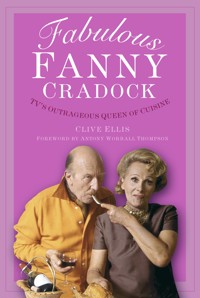
While Fanny Cradock cut a controversial figure – berating Margaret Thatcher for wearing 'cheap shoes and clothes', writing off Eamonn Andrews as a 'blundering amateur' and famously being forced to apologise for insulting a housewife cook on The Big Time – her cookery programmes were enormously popular. Dressed in evening gown, drop earrings and pearls, donning thick make-up, she boomed orders to her partner Johnnie, a gentle, monocled stooge who was portrayed as an amiable drunk. The programmes were watched by millions and were hugely influential: the Queen Mother told Fanny that she and Johnnie were 'mainly responsible' for the improvement in catering standards since the war; Keith Floyd declared that 'she changed the whole nation's cooking attitudes'; for Esther Rantzen 'she created the cult of the TV chef'. Lavishly illustrated and illuminated by amusing facts and anecdotes, Fabulous Fanny Cradock paints a fun, entertaining portrait of this extraordinary woman.
Sie lesen das E-Book in den Legimi-Apps auf:
Seitenzahl: 325
Veröffentlichungsjahr: 2011
Das E-Book (TTS) können Sie hören im Abo „Legimi Premium” in Legimi-Apps auf:
Ähnliche



















Every effort has been made to trace copyright holders. The History Press apologises for any unintentional omissions and would be pleased, if any case should arise, to add an appropriate acknowledgement in future editions.
Line illustrations by Val Biro.
Front cover image © TopFoto.
The recipes reproduced in this book have been selected to provide an illustration of Fanny Cradock’s style of cooking and have not been tested by The History Press for use.
First published 2007
This paperback edition first published 2023
The History Press
97 St George’s Place, Cheltenham,
Gloucestershire, GL50 3QB
www.thehistorypress.co.uk
© Clive Ellis, 2007, 2023
The right of Clive Ellis to be identified as the Author of this work has been asserted in accordance with the Copyright, Designs and Patents Act 1988.
All rights reserved. No part of this book may be reprinted or reproduced or utilised in any form or by any electronic, mechanical or other means, now known or hereafter invented, including photocopying and recording, or in any information storage or retrieval system, without the permission in writing from the Publishers.
British Library Cataloguing in Publication Data.
A catalogue record for this book is available from the British Library.
ISBN 978 0 75246 971 3
Typesetting and origination by The History Press
Printed and bound in Great Britain by TJ Books Limited, Padstow, Cornwall
eBook converted by Geethik Technologies
Contents
Foreword by Antony Worrall Thompson
Introduction
1 Beginnings
2 Fanny and Family
3 Fanny and Johnnie: A Love Affair
4 Bon Viveur
5 On the Box
6 At Home … and Abroad
7 Fanny: The Look
8 Triple Challenge
9 Fanny on Food, Wine and Cooking
10 Fanny in Print
11 Fanny: The Legacy
Notes and Sources
Bibliography
Acknowledgements
Foreword
BY ANTONY WORRALL THOMPSON
Fanny Cradock, a female colossus. Well before Germaine Greer encouraged the female sex to burn their bras, there she was beating the insecurities out of middle England. She stood up for women’s rights and it wasn’t just a TV thing; I can’t imagine that there were many men who weren’t scared of this woman.
I met her aged seven – me that is not her – and her opening words directed about, not to, me were: ‘Who does this ugly little runt belong to?’ My mother was the floor manager for Fanny’s TV show and there were times during my school holidays that I spent my time on the ‘studio floor’, with no childminder in sight. I thought she was a witch, a very scary witch.
Her sultry, booming voice would make everyone jump, her caked-on make-up and over-the-top dress sense reminded me of Cruella De Vil while I was one of the Hundred and One Dalmatians quivering behind my mother’s apron strings; I could never feel at ease in her presence.
And yet, for some extraordinary reason, my mother had the ability to still the raging flames. Some of it undoubtedly was calculated on my mother’s part; she plied Fanny with alcoholic drinks on her many dinner visits to our Putney house. And, as the alcohol flowed, so the pent-up liberationist anger was quelled and I saw a human side – not for long, but it was there.
On screen she was the same as she was in real life. Johnnie was there like a sponge absorbing the vitriol; he was Maggie to Dame Edna or perhaps Dennis to Maggie Thatcher. She didn’t need to play herself – she was herself and she had ten million women domestic prisoners hooked. In Fanny they saw their kitchen freedom.
I soon worked out that as long as you agreed with Fanny, life could be smooth. She needed to be treated like royalty – no one else mattered. Her food was absurd over-the-top creations that middle Britain, for some extraordinary reason, warmed to. They were splashes of colour in an otherwise grey post-war Britain. And yet I felt privileged to have met her and I feel that I am now right in the centre of the spider’s web she spun … she inspired me to cook.
Introduction
‘Ah, Fanny, the Madonna of her day’
Fay Maschler
Fanny Cradock still raises a smile of recognition, wherever and whenever her name is mentioned. Hindsight has distorted the image, choosing to highlight her basic failings as a human being and lampooning her idiosyncrasies; but in the 1950s she was an empowering, if slightly scary-looking, Pied Piper to the nervous, L-plated housewife-cooks who approached their ovens with trepidation as Britain cast off the shackles of rationing. On live television, and even more vividly in ground-breaking stage shows which earned her rock-star-style adulation, she transformed the polite tedium of cooking demonstrations into an exotic playground. Almost thirty years after her death she is still a natural reference point for documentaries charting the rise and rise of the genre, and, without having much idea what she achieved or represented, a new generation finds her imprinted on its consciousness.
T’adore: the photograph, signed to Johnnie under Fanny’s pet name Jill, which accompanied her post-war books and articles. (Lesley Studio)
Monocle man: a studio shot of Johnnie in the sixties.
For fifteen years she monopolised the medium of TV cookery with her unique brand of glamour-encrusted infotainment. There was sound advice for the serious student and voyeuristic amusement for the culinary clueless, who tuned in as much to see her brandy-snapping at Johnnie as to crack the kitchen code. He was a monocled, moustached quasi-husband of a sidekick. In times of cooing harmony he was addressed by Fanny as ‘darling’ or ‘my love’. As the heat rose he became the respected ‘Major Cradock’, the underling ‘Cradock’ and occasionally ‘the silly old fool’.
Neither quite realised the career-enhancing significance of his decision to quit the family wool business in 1952 to work full time alongside Fanny, but the double act opened up whole new avenues of possibility. Johnnie was the Pavlovian nod to Fanny’s assertion that women’s cooking ambitions were held back by dictatorial husbands, blindly clinging to the drab food they had been brought up on. Johnnie was living proof that an ex-Army major could be taught the rudiments of cooking in a few weeks and volunteer to deputise for his wife at least once a week. Johnnie was the harangued underling who stood in permanent, quivering fear of his viper-tongued partner and allowed himself to be caricatured as a hapless drunk. Women dared to wonder if this striking example of role reversal had a future.
Fanny’s overriding desire was to convey her love and knowledge of food to as wide a public as possible. In her eyes the rest was just garnish, but the fame and adulation had an aphrodisiac quality which she could not resist. She even enjoyed the mimicry and parody, most memorably Betty Marsden’s radio take-off, and entered the lexicon of cockney rhyming slang (as haddock, of course).
She found that she could amuse in public and in her private life, though she wore the puzzled expression of someone uncertain what the joke was. The humour was frequently in the excess: in the ball gowns and tiara which Fanny donned to cook on stage and on television (this, to her, was just the natural extension of what she had been doing as a cook-hostess since the age of sixteen); in the multi-layered make-up; in the pencilled eyebrows which appeared to be on an independent journey north to meet her hairline; in the staring, unsynchronised eyes; in that husky, seductive voice honed on twenty-a-day and after-dinner Corona cigars (it was once compared to ‘a circular saw going through a gin-soaked sheet’); and in the over-rolled Rs as she spat out the names of French dishes with an absurd flourish. In the BBC’s top three of fast talkers she split astronomer Patrick Moore and racing commentator Peter O’Sullevan.
The entertainer: Fanny holds court at the Royal Albert Hall in 1956. (North Thames Gas Board)
Fanny-watchers recruited in the early days were largely oblivious to, or uncaring about, her CV before Kitchen Magic. She was fortunate, too, that the press of the time did not regard celebrities’ lives as ripe for intrusion. The skeletons would have been beating each other up in an effort to escape the cupboard and to curse and tell. It was said of Fanny that she could have hailed from another planet, an apt theory given her regard for the supernatural and her acknowledgement of previous lives. On Comet Cradock the maternal gene was suppressed, resulting in a shaming inability to bring up children or reconnect with them later in life. One husband had died, a second had been ditched and a third was on borrowed time by the time she met Johnnie in 1939. Twice she married bigamously, more through administrative incompetence than amoral tendencies. Her whirlwind of a temper sent casual acquaintances running for cover and alienated family, friends and staff. Fanny’s universe was a self-centred monolith around which everyone else had to gather or be damned in their disloyalty. Her opinions and prejudices were heavily glazed with snobbery.
On the credit side, there was a tireless vitality. She was described in the fifties as having ‘enough energy to drive a power station’. Her assistant at the time, Wendy Colvin, asked why there was nowhere to sit down at the Cradocks’ South Kensington home. Fanny explained that chairs were things they sat on only to eat (though she occasionally took root to play patience and Evening Standard word games). She has been painted as an eccentric, and was included by Christine Hamilton in her Book of British Battleaxes, but Colvin correctly pinned her down as a fanatic with an inflated ego.
Fanny as she appeared in her passport in 1946.
When Fanny’s first cookery book came out in 1949 – from the age of ten an instinctive love of food had been nurtured by the smells, sights and sounds of hotel kitchens in the south of France – she was already established as a novelist and writer of quaint tales for children. She was a naturally inquisitive journalist, but she pulled her own shutters down when asked the most anodyne of questions by newspaper reporters. She gained the confidence of the famous (notably the Duke and Duchess of Windsor, Somerset Maugham and Douglas Fairbanks Jnr). She wrote on food and travel for the Daily Express, Daily Mail and Sunday Express. She was an impressively versatile woman’s editor for the Sunday Graphic in the early fifties, and she and Johnnie, under the pen name Bon Viveur, exuded authority and exerted influence for The Daily Telegraph for more than thirty years. Their restaurant and hotel reviews were pioneering and forthright – the good were praised and promoted, the indifferent and bad were ignored. Fanny helped to launch Egon Ronay, among others, to stardom when she extolled the virtues of his Knightsbridge restaurant, the Marquee. He regarded her more as an important ally than as a gifted cook.
She was a born campaigner. Immediately after the war she joined the British Housewives’ League to bemoan the homemaker’s over-rationed lot; she urged shoppers to complain about shoddy goods and services; she ridiculed restaurants that mixed menu-French with bill-of-fare English; she sounded an early warning over artificial foodstuffs and fertilisers. She terrorised builders, postmen, milkmen and local authorities.
The massed ranks of today’s TV chefs owe Fanny Cradock a mighty debt, though it is not one they are over-willing to voice. They acknowledge her entertainment value, but increasingly the retrospective stress is on Fanny’s irrelevance, as though her sell-by date expired in 1959. Archive clips focus on the green-dyed duchess potatoes, the overblown presentation, the Fanny look, the ever-so-slightly ribald stream of consciousness, and Johnnie as resident punchbag. Newspaper pundits’ analysis concentrates on the words she got wrong, the absurdly strict amounts in her recipes, and the dishes that allegedly don’t translate from paper to plate.
The start of something: Fanny and Johnnie make their debut in the photographer’s studio during the war.
Fanny Cradock was gloriously ahead of her time, a crusading cook who sensed that television must seduce before it could instruct. Transposed to the present day, she would be competing for the Ramsay millions; she would be introducing oyster appreciation classes to the National Curriculum; she would be more plain-speaking and outrageous than Anne Robinson and Simon Cowell combined; and she would be adopted as a national treasure. Bring on the hors d’œuvres.
1
Beginnings
FROM BILLIARD TABLE TO BALLET
Fanny Cradock’s loosely tethered childhood was defined by her change of ownership at the age of one. It was a story she retold a thousand times – in private, in public and in print – like a pop star regurgitating her first hit song. The most vivid rendition featured in Fanny’s autobiography, Something’s Burning:
I was a year old when Mother took me to see Gran on her birthday. We reached Apthorp at 11 a.m., the hour at which Gran trailed from bedroom to boudoir wrapped in a huge Turkish towel, cleaning her teeth with a dry toothbrush. Mother dumped me on the billiard table (why, we do not know) and, running upstairs to Gran, promptly forgot my existence.
Some time later – and it must have been a considerable time, for Gran never dressed in a hurry – the two ladies descended the staircase and heard my hideous yells. Gran traced me and whipped me off the billiards table into her arms. ‘Bijou,’ she said furiously, ‘you are not fit to have a child.’
‘She was such a mixture of being an absolute slut, wandering round in grubby trousers, and then being very grand.’
Alison Leach, Personal Assistant
‘I brought her to you for a birthday present,’ said Mum defensively. She had forgotten any more appropriate offering. Gran replied grimly, ‘Thank you, I accept her.’ Thus was my future determined. I stayed with Gran until I was sent off to school when I was ten.
Phyllis Nan Sortain Pechey (Fanny was a later acquisition) settled in at Apthorp, the imposing house in Leytonstone, east London, where she had been born on 26 February 1909, while her eighteen-year-old mother concentrated on her primary maternal purpose: producing a son and heir. Charles, a child she did care for in her own distracted way, was born in 1911.
Fanny, a ‘bloody awful little girl’ by her own admission, adapted without demur to the generation gap. Her grandparents took vague responsibility for her early education and her parents, who lived only a few miles away, were occasional visitors. In Fanny’s eyes her grandmother, Emily Frances Hancock, vied with Johnnie for top billing as the most important figure in her life. She described her as ‘the symbol of all that is cultivated and gracious, gentle and loving’. Both Fanny and she preferred an intelligent sinner to a foolish saint (of impeccable lineage of course).
Apthorp House: Fanny’s birthplace, converted into drab flats after the death of her grandparents in the 1920s.
Fanny upbraided journalists and letter-writers who spelt her surname with two ds, so she would not have enjoyed the plaque outside Apthorp House, where she was born in 1909.
‘She made me translate a paragraph of The Times leader every morning into both French and German,’ Fanny remembered. ‘A delightful old Austrian was engaged to teach me the rudiments of violin-playing on a tiny fiddle when I was only five; he had a huge spade beard and smelled of garlic. My ballet training began with a curious old girl whose hair looked like a whipped cream walnut; she had a slight tic and throughout my barre-work sessions wore a hat which looked like a well-stocked aviary.’
Fanny’s grandmother introduced her to colour-themed cookery, as well as the self-sufficient joys of bottling, potting, pickling and preserving. Her grandfather, Charles, who had been a surgeon-major in the Indian Army before returning to England in 1900, inadvertently fostered her love of cigars – she was rewarded with a weekly puff after filling his pipe – and an early appreciation of the grape. ‘My wine was pale pink at five, deep pink by eight and often straight from the bottle by the time I went to school.’
‘My wine was pale pink at five, deep pink by eight and often straight from the bottle by the time I went to school.’
SPOOKS AND SCHOOL
Fanny Cradock might have been more resentful of a chum-free early childhood if she hadn’t discovered a psychic sensibility. It was largely a private world but one of PlayStation normality to her, until, that was, adults began to shriek in disapproval. She claimed to have a hotline to the court of Louis XIV of France and played levitation games with her brother Charles. ‘If I had been handled differently,’ she wrote, ‘I would have continued to accept without question that what happened to me did not happen to everyone else and would have thought no more about it. But instead, when it came out later on and became a matter for the “gravest concern”, I grew up to regard it as something shameful like bed-wetting and I developed the most painful complex about it.’
Fanny’s spiritual guilt multiplied when she was bundled off to a ‘distinguished’ boarding school, the Downs, at the age of ten. ‘I learned nothing, forgot all I knew and hourly hoped to die,’ she recalled. A chance meeting with a fellow ex-pupil just before the Second World War brought the bitterness flooding back. ‘Socking and being socked with mud from lacrosse sticks in a slippery field with a biting north wind howling up knee-length gym tunics … Lesbian ties and lesbian matrons who wrenched those ties straight and only favoured little girls with pink cheeks and golden curls.’ After five years of misery, Fanny was caught holding a séance in the school library. Further investigation revealed documents in her locker relating to past lives. She stirred the pot a little more urgently:
About the same time I expressed my views with some force on the subject of unmarried women who chose child bullying as a career because no man would marry them and give them normal lives. It was also bad timing, which is inexcusable, that I chose this moment to resign publicly from the school’s Girl Guide patrol for the – to me – perfectly valid reason that it was a bad thing for girls to dress up in uniforms and play soldiers.
She was expelled, then given a term’s stay of execution when her parents mollified the headmistress. She was catapulted into adulthood at the age of fifteen.
FANNY’S FATHER
Tons of Money was the 1920s farce that made Archibald Thomas Pechey and indirectly dumped him, eight years later, in the quick sands of bankruptcy. The trouble, as it had been throughout his married life, was a wilful wife who drained both his finances and emotions, and a gambler’s double-or-quits mentality.
Tons of Money was a temporary passport to wealth for Fanny’s father, who co-wrote the 1922 farce as Valentine.
Fanny’s father was a typical public-school-educated product of his time: polite, modest and understated. Less typically, he had a song (or at least a lyric) in his heart, and was part-credited for the words of ‘A Bachelor Gay’, one of the best-known tunes from the 1917 hit musical The Maid of the Mountains. He had turned his back on the corn merchants’ business in 1910, the year after Fanny was born, and began writing verses for The Winning Post, a publication devoted to society gossip and horse-racing, and in particular horses owned by its charismatic editor-proprietor. Bob Sievier gambled his way from fortune to famine and back again, paying a world-record 10,000 guineas for the multi-Classic-winning Sceptre in 1901 and following Pechey into the bankruptcy courts in the 1930s.
Under the pen name Valentine, Fanny’s father addressed such pressing topics as mixed bathing, a school for kissing and the perils of kilt-wearing. In 1913 he popped up as the briefly famous Jester of the London Mail, touring England’s seaside hot spots to offer 2 guineas to anyone who could successfully identify him as the Jester. Two years later he joined forces with Will Evans to write Tons of Money (comic chaos ensues when Aubrey Henry Maitland Allington, a heavily indebted inventor, inherits a fortune). Several years of painful rejection followed before it was taken on by producers Tom Walls and Leslie Henson, who were alerted to the script’s potential by a chuckling office boy. Tons of Money opened at the Shaftesbury Theatre in April 1922, and graduated to the Aldwych later in the year, establishing both the acting team (led by Ralph Lynn) and the appetite for farce that sustained Ben Travers through nine sell-out productions. Tons of Money finally closed, 737 curtain-calls later, in February 1924 (it was revived by Alan Ayckbourn in the 1980s).
‘The pair of them were diametrically opposed on almost every subject except Mother, whom they both adored. Mother inspired him, believed in him, reviled him and gave him all his best plots, as well as every headache he ever knew. He adored her, and she drove him distracted.’
Archibald Pechey saw debts of £2,000 wiped out at a stroke. In 1922 alone he made an estimated £7,000 from the play (equivalent to about £500,000 today), and he embarked on a peripatetic lifestyle befitting his new wealth. As if trying to keep one address ahead of the taxman, Fanny’s family moved from Herne Bay in Kent to Swanage, to Bournemouth and finally to Wroxham in Norfolk. Fanny’s mother persuaded her husband – Archibald preferred home comforts – that winters in Nice were preferable to Norfolk. They stayed in the best hotels, headed for the casinos at night, and squandered a fortune. Warnings from the Inland Revenue went unheeded and Fanny’s father was finally hauled before Norwich bankruptcy court in 1930, owing more than £3,500. He cited the ‘drain imposed on him in helping relatives’ and admitted: ‘Tons of Money changed my position once and I have been waiting for it to happen again.’
The men in her life: Fanny dining out in 1948 with her father, Johnnie and elder son Peter.
The film rights for Tons of Money were sold soon afterwards and another Valentine play, Compromising Daphne, was also adapted as an early talkie. However, disgruntled creditors – he owed a furniture company about £50,000 in current terms – had still not been appeased by the outbreak of the Second World War. All too predictably, Fanny’s parents split up, though her father’s devotion survived. After the war, he settled in Somerset and established a contented routine of prolific novel-writing in winter and butterfly-hunting in summer (he accumulated more than 6,000 specimens). The gentle romances were penned by Valentine, the crime-busting exploits of Daphne Wrayne and her Adjusters appeared under the pseudonym Mark Cross. His hundredth novel, and forty-sixth in the Adjuster series, was published just before he died in 1961.
FANNY’S MOTHER
Long after Fanny’s mother had died, Johnnie Cradock was asked by the Daily Mail columnist Lynda Lee-Potter whether personality traits had been passed down:
‘Oh she’s just as mad,’ he said reflectively.
‘Like Mum?’ blazed Fanny. ‘Why she was round the twist.’
‘Yes,’ confirmed her husband. ‘Just as mad.’
Three of a kind: Fanny’s mother and grandparents pictured at Apthorp House, c. 1908.
Mother and daughter both spoke in an intimidating growl – they were frequently mistaken for one another on the phone – but, to Fanny’s mind anyway, the similarities ended there. The quaintly named Bijou (‘like some damned Pekinese,’ she complained) was as indolent and work-shy as Fanny was driven and industrious. ‘Her singing voice was exceptional and she was the Invisible Voice in D.W. Griffiths’ epic film Intolerance,’ Fanny wrote. ‘Offers for stage and films poured in, yet nothing tempted her away from her way of life. Anything that involved getting up at the same time every morning was impossible and unacceptable.’
‘Daddy wanted peace and quiet and Dickens and entomology and watercolours. Mum wanted parties.’
Fanny’s father, though already engaged to another, was no sooner introduced than smitten. He despatched a terse telegram from Henley post office to his fiancée which read: ‘Engagement off – letter follows’. Archibald and Bijou married in 1908 and Fanny was born the following year, christened Phyllis in deference to the fact that her parents had met at Phyllis Court in Henley. It soon became clear that the marriage was a loose alliance. Fanny later wrote wryly: ‘The pair of them were diametrically opposed on almost every subject except Mother, whom they both adored.’ She added: ‘Mother inspired him, believed in him, reviled him and gave him all his best plots, as well as every headache he ever knew. He adored her, and she drove him distracted.’
Bijou was the soul of extravagance, champion of the snap purchase, and hopelessly addicted to sales. ‘She once trundled up the drive towing a vast iron lawn roller which, she explained defensively, she had been forced to buy in order to obtain the dozen rose bushes which made up the Lot.’ While her ideal start to the day was an 11 o’clock breakfast of a dozen oysters and half a pint of champagne, she resented every piece of toilet paper used by other members of the family.
Fanny’s mother was an inadvertent aide to her husband’s plays and lyrics, an effortless supplier of malapropisms. The Receiver in Bankruptcy became the Official Retriever; politician Anthony Eden’s duodenal ulcer was translated as an eau-de-nil ulcer.
Mum’s Tripe and Onions
Ingredients
2 lb double or honeycomb tripe
2½ lb best possible onions
½ pt double cream
1 pt milk
cold water
2 rounded tablespoons of Fécule de Pommes (potato flour packed by Groult)
salt and black pepper.
Method
Slice raw tripe as for English chips. Slice peeled onions as thinly as possible. Place both in a really roomy pan and cover liberally with cold water. Simmer steadily until tripe melts in the mouth and onions are correspondingly tender. Strain off all liquor. Place this in a clean pan and reduce by simmering hard to a mere 1⁄4 pt of concentrated fluid. Stir in all but 1fl oz cold milk, then raise to boiling. Meanwhile mix potato flour with remaining 1fl oz milk. Stir into pot and stir fast as mixture will thicken instantly. Turn into tripe and onions, stir again until thoroughly blended, taste and correct seasoning with plenty of salt and pepper. Transfer to a casserole, stir in cream, leave until the next day and then reheat in the oven at Gas Mark 2 until bubbling and rather pale beige.
Time to Remember, 1981
Archibald Pechey dubbed her, among other things, the ‘oak-egger moth’. The female of the species, it is said, can, when feeling amorous, call on a natural radar system which summons males from 300 miles away. ‘She was totally fantastic, totally inconsequential and illogical,’ Fanny told the Observer in 1968, ‘with no more idea of raising kids than a bull’s foot.’
Bijou, sixteen years younger than Archibald Pechey, was comfortably the senior partner in her second marriage, to a Berkshire estate agent. She died in 1949, though for months afterwards Fanny set a dinner place for her at the Cradock home in South Kensington.
FANNY’S BROTHER
If Fanny Cradock had an amoral streak, her brother Charles was positively anarchic, playing the part of misfit with greater success than any of the other roles into which he tumbled in adulthood. Fanny preferred to carry an untainted image of Charles as he was in early childhood. ‘I remember him when he was five and quite ravishing. In my picture he wore a scarlet coat, bestrode an ancient mare and was borne like a baby Roman emperor, with his trophies (dead rabbits) slung from a stirrup and smothered in flies.’
Charmer Charles: Fanny’s brother, ‘ravishing’ at the age of five. (H. Oscar Southgate)
The beautiful boy turned into a wayward youth – he was expelled from Cheltenham College after attending the school for only a year – and a feckless soldier. He was slung out of the Royal Berkshire Regiment in 1942, court-martialled and cashiered for trying to pay prostitutes with dud cheques. At various times he worked as an actor, rag-and-bone merchant and publican (a job for which his drink reliance made him madly unsuitable).
He was a serial sponger – Fanny’s father told her in a post-war letter that despite Charles’s suicide threats he would not ‘lend’ another penny – and was apt to phone his sister out of the blue, pleading for shelter after a midnight bunk from rented accommodation. For all that, there was a bond between Fanny (or Phatti as Charles affectionately knew her) and her brother. They shared the grimmest of times in the 1930s when they came to appreciate the subtle difference between bread and pepper and plain bread.
Charles, more commonly known as John after the war, flitted in and out of Fanny’s life. Ever charming, plausible and perpetually broke, his greatest talent was for answering crisis calls. He stepped in at the last minute to produce and direct Fanny and Johnnie in their most prestigious cooking show, at the Royal Albert Hall in December 1956, and a month later supervised the couple as they gave Something’s Burning its test run at the Arts Theatre. Fanny recalled the television rehearsal for the Albert Hall show: ‘ “Lights,” roared Charles. “Quiet everybody please …” We looked at each other. “Bread and pepper,” he said suddenly, and for a moment neither of us could speak.’
Rose Petal Jam
one of Fanny’s grandmother’s specialities
Method
Gather red roses while the dew is upon them, strip the petals down and wipe them carefully. It is necessary to remove the white or yellow centre pieces from the petals. Now spread them out loosely and rub them with powdered loaf sugar (folded in brown paper and well beaten and rolled with a wooden rolling-pin).
Using rain water only, measure 11⁄2 pints water and 11⁄2 lb of preserving or lump sugar. Dissolve slowly and bring to the boil. Boil till the edges begin to crystal. Remove from the fire, add the strained juice of a small lemon and enough rose petals to absorb the syrup to a thick pulp. Reboil, add 1oz unsalted butter to clear. Simmer very gently for 45 minutes, stirring occasionally. Pot immediately.
The Practical Cook, 1949
The concord never lasted for long, and Christopher Chapman, Fanny’s son by her second husband, remembered a slightly surreal experience in the early sixties. ‘I never ever spoke to him. I only once saw him in my life when I was going round the Ideal Home Exhibition with my mother and in the garden. She suddenly grabbed my elbow and said, “We’re getting out of here quick. Look, there’s your wicked uncle John.” And she turned me round and marched me out.’
Alison Leach, Fanny’s personal assistant, brought about a brief reunion in 1966, when Fanny still faced an uncertain prognosis after being operated on for bowel cancer:
I remember saying, ‘Do you feel you’d really like to see your brother, who you’re very fond of but who you’ve written out of your life.’ She said, ‘How extraordinary, I’d not thought of that. I don’t know how to find him.’ Somehow or other I found where his bank account was. The very next day he came rushing down to see her and they established this very warm relationship for two or three years.
2
Fanny and Family
STARVING FOR A LIVING
Spoiled, indulged and subsidised through her childhood and early teens, Fanny Cradock was suddenly sentenced to a subsistence lifestyle. As the 1920s bowed out she had just turned twenty. Widowed from her first husband, irretrievably separated from her second, she had a two-year-old son in bewildered tow. She wrote later:
I came down to a hole-in-the-wall in West Kensington, where my son Peter and I led an existence that I am sure would have brought us before some authority or other in this era of Welfare State.
The room was about eight by twelve. It had an ancient gas ring and a gas bracket which hissed malevolently. It looked out (from the basement) at a blank wall which was indescribably sooty. My first job (down to tuppence and the last bottle of milk for Peter) was in a Roman Catholic canteen in Lower Thames Street, where I washed up from 11 a.m. to 3 p.m. for half a crown and my luncheon. I walked there, walked back, unlocked Peter, cleaned up the mess, and nipped into Kensington Public Library to study the situations vacant.
Fanny before fame: Phyllis Chapman in a photograph which was taken just before the war.
Fanny’s parents were about to split up – her spendthrift mother hustled her father towards bankruptcy and jumped ship when the debts were finally called in. Fanny was about to discover the fierce determination and bloody-minded persistence that sustained her through the bad times and fired her ambition when the dice began to roll in her favour. In her later accounts of this portion of her life there is a self-parodying echo of the Monty Python sketch ‘We were so poor that …’, but the truth cannot have been too far removed.
Having already honed her cutting talents by improvising cardboard soles for her shoes, she drew on her skills as a Vogue Pattern dressmaker (another hobby-cum-money-saving activity to which she remained stoically loyal) to start a business of sorts. A jilted, would-be boyfriend paid the deposit on a sewing machine which Fanny bought on hire purchase, but an early commission for an outsized garment went disastrously awry. ‘After calling with the dress and collecting a guinea, I received a card from the lady on which was written, “I don’t know whether you thought the dress was intended for me or an elephant, but when I slipped it over my head it fell straight down on to the floor.” ‘
Fanny persuaded a semi-skilled dressmaker to work for her and found temporary income in a variety of odd jobs. She worked in a grocer’s shop in Clapham, made and sold Swiss rolls at an Alexandra Palace exhibition, hawked 3d cures for tired feet at the Ideal Home Exhibition, and helped out in Selfridges bargain basement during the Christmas rush. Her guiding text, however, and the one that she expounded passionately from the pulpit at St Mary Woolnoth in the East End of London almost forty years later, was inspired by selling vacuum cleaners on a straight-commission basis. ‘I learned tout court that if you knock on enough doors you sell a vacuum cleaner. It is just as simple as that. And when you have a small boy locked in a bedsitting room waiting to be fed and the only hope is a vacuum cleaner sale (twenty-five shillings!) you knock on doors and you go on knocking on doors. One way or another I have never stopped knocking on doors since.’
‘When you have a small boy locked in a bedsitting room waiting to be fed and the only hope is a vacuum cleaner sale (twenty-five shillings!) you knock on doors and you go on knocking on doors. One way or another I have never stopped knocking on doors since.’
The slightly masochistic offshoot for Fanny was confirmation of her Conservative ideals. ‘Yet even at the most disagreeable time of all it failed to colour my politics,’ she wrote. ‘I came down to starvation level of my own free will in a free country. The opportunity of climbing back was always there provided I was prepared to sweat, so I sweated. Most malcontents are bone idle.’
WEDDING BELLS I
Sidney Vernon Evans, 10 October 1926
Major and often traumatic chapters in Fanny Cradock’s life were repackaged as anecdotal frippery; not just to please an impatient audience but to prove that her spirit was unbreakable. The first of three pre-war marriages was tossed on the emotional heap with a flip flourish: ‘I married on Wednesday, settled his debts on Friday and he died on Sunday.’ The truth, as with so many aspects of Fanny’s life, was more complicated.
Though no classic beauty – Fanny lamented that her mother and brother had been more benevolently blessed in that department – she appears to have been pursued by would-be suitors from her early teens. She boasted that she was first engaged, to a millionaire, when she was fourteen and returned to school sporting a square-cut emerald ring. A year later, in 1924, she met Sidney Vernon Evans, a public-school-educated, rugby-playing free spirit who had turned his back on the City to join the RAF.
Flying visit: Pilot Officer Sidney Vernon Evans (centre back) in a 56 Squadron picture at Biggin Hill in 1926.
Fanny’s guiding light of a grandmother died at the end of September 1926 and a fortnight later she was circumventing parental permission (which would not have been granted) to marry Sidney, by then stationed with 56 Squadron at Biggin Hill in Kent. He was twenty-two; she was seventeen, though she claimed on the marriage certificate that she was twenty-one. Two of Sidney’s fellow pilots were the sole witnesses to the wedding, which the couple celebrated by going sailing off Goodwin Sands. Fanny and Sidney were three weeks into married life when she thought she should break the news to her parents. She recalled, in her autobiography, that a telephone call brought a predictably dismissive response from her mother. ‘“No, you may not come home. I don’t want any soiled doves in my house.” I roared back down the telephone, “I’m not a soiled dove – I’m married,” and then the row began.’
The couple established a pattern of conspicuous overspending and shared a growing sense of foreboding, which accelerated their baby-making plans (they had already decided that the child would be a son called Peter). ‘On the first Wednesday in February, the station doctor confirmed that I was pregnant,’ Fanny wrote:




