


12,47 €
Mehr erfahren.
- Herausgeber: Seren
- Kategorie: Sachliteratur, Reportagen, Biografien
- Sprache: Englisch
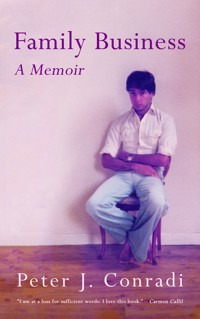
Peter J. Conradi's memoir Family Business includes a cast of characters ranging from his European Jewish forebears who came to Britain in the Victorian era to influential novelist and philosopher Iris Murdoch, whose biography Conradi himself wrote. The arc of Conradi's story travels, unusually, from the relative integration of his ancestors to his rebellion against this and his long association with Murdoch, another outsider in English society. Against the upwardly mobile successes of his immigrant ancestors – with their exotic, multifarious stories – and his relationship with his beloved grandmother came the more immediate dysfunction of his parents' marriage. Young, clever, bisexual Peter became a 'knight errant' protecting his mother, and set a precedent repeated later in his friendship with Murdoch. In between Conradi relates his public school education, becoming a kibbutznik, taking part in the early years of gay rights and becoming a writer. In the final chapters Conradi explores his long and close relationship with Iris Murdoch and her husband John Bayley. Conradi was both Murdoch's biographer and, on several occasions, her carer, and has much to say on the nature of biography, and on the world of Murdoch and Bayley, including previously unpublished material on them both. Family Business is an enthralling book – a biographer's autobiography – with numerous strands sensitively and thoughtfully explored, and including almost fifty previously unseen photographs. "I am at a loss for sufficient words: I love this book. The portrait of his parents and his relationship with them is a masterpiece. I don't think this portrait of the nineteenth century Jewish diaspora in England will ever be bettered." – Carmen Callil. "A mingling of charm, comedy, confessional and inevitable tragedy: all beautifully orchestrated. I can only congratulate you on a brilliant series of stories" – Michael Holroyd. "Worth reading, in the same way as Murdoch's books are, … because it's pleasurable and educational to spend hours in the company of a writer so thoughtful, so questioning, so open to human life in all its peculiarities." – Laura Feigl, The Daily Telegraph
Das E-Book können Sie in Legimi-Apps oder einer beliebigen App lesen, die das folgende Format unterstützen:
Seitenzahl: 381
Veröffentlichungsjahr: 2019
Ähnliche



















Family Business: A Memoir
In Memoriam, Prue Conradi, 1948-2013
Seren is the book imprint of
Poetry Wales Press Ltd.
57 Nolton Street, Bridgend, Wales, CF31 3AE
www.serenbooks.com
facebook.com/SerenBooks
Twitter: @SerenBooks
© Peter J. Conradi, 2019.
The right of Peter J. Conradi to be identified as the Author of this Work has been asserted in accordance with the Copyright, Designs and Patents Act, 1988.
ISBN
Hardback: 978-1-78172-501-6
Ebook: 978-1-78172-502-3
Kindle: 978-1-78172-503-0
A CIP record for this title is available from the British Library.
All rights reserved. No part of this publication may be reproduced, stored in a retrieval system, or transmitted at any time or by any means, electronic, mechanical, photocopying, recording or otherwise without the prior permission of the copyright holder.
The publisher acknowledges the financial assistance of the Welsh Books Council.
Cover photograph: PC, Wales, c 1976.
Printed by TJ International, Cornwall.
Contents
Preface
Prologue: Solicitude
Part One: Early Years
1. Florence Alice Conradi, 1892-1983
2. Parents-at-war, 1945-72
3. Being German
4. Being English
5. Frinton-on-Sea
6. Oundle, 1958
7. Affinity, 1965
8. Who: Whom, 1970
9. Son-into-Disciple
Part Two: Family History
Father’s Family
Family Tree
10. Quitting Paris, 1870
11. Settling in London, 1871
12. War, 1914
13. Brothers and others, 1870
14. Cousin Cyrus, 1943
Mother’s Family
Family Tree
15. George Cohen & Sons, 1834
16. Parvenus and Pariahs, 1920
17. Parents-at-war, 1940-45
Part Three: Iris Murdoch
18. Disciple into Biographer
19. Strange Beginnings and Endings
20. Organised Innocence
21. Philippa Foot
22. Canetti’s Sting
23. Hedda Gabler and other matters
24. The Fear of an Ending
End Notes
Acknowledgements
Index
Preface
The starting point for this book was the acquisition of various family pieces and papers. These came into my hands some years ago, leading to my desire to somehow document them and recover the life and times of my paternal grandmother, with whom I had a close relationship. It is her story with which the book begins and in writing it I realised that this would not only lead to the recreation of a larger family history, but would turn into an attempt to work out my own often troubled place in it. This led me to reflect on the sense and any purpose I have made of my own life, arising more immediately from the ‘family drama’ of my own (unhappy?) parents.
There are three distinct fields of enquiry which I found impossible to disentangle completely; hence the apparent digressive eccentricity of this book’s construction: Early Years, Family History, and finally an account of my discipleship of Dame Iris Murdoch. It thus describes three trajectories in succession rather than a smooth chronology. Written topic-by-topic as a succession of stories, essays and pen-portraits, it combines social, family and personal history with a biographer’s autobiography: a story made up of contrasting parts. Leading more than one life is what we all do; finding common threads can hopefully illuminate the whole.
In the 1980s I became deeply involved with the work and later – as her biographer – the life of Iris Murdoch. Her life and work seemed to me to reflect a set of psychological and philosophical issues that helped me understand not merely myself but also that larger history of my extended Jewish family against the background of European and American migration typical of the period. Iris Murdoch was first my admired friend and parent-surrogate, later my vulnerable subject. As I researched and drafted it dawned on me, that I had spent my first thirty-five years protecting my mother against my father; and my next thirty-five years protecting Iris Murdoch from the whole world. When, in chapter 22 of what follows, I protect a vulnerable Iris from a demonic Canetti, am I secretly re-living this old pattern? Both phases were at the time quixotic, neither fully conscious. Both entailed impracticality, idealism and hard work.
So a knight-errant’s symmetry is implicit in what follows, that oddly medieval cultural marker, still alive in the modern world. This narrative starts by investigating the topic of solicitude, the quality knight-errants are hardwired to display. Murdoch’s fiction and philosophy might be said to be concerned with the possibility of the idealism and solicitude involved in ‘knight-errantry’. What may bring the different parts of the book together is its exploration of this recurring pattern of anxious solicitude for others, first in my own make-up, then also in wider fields of speculation. Part One explores solicitude for my younger self; Part Two solicitude for my ancestry; Part Three for Iris Murdoch.
Prologue: Solicitude
I occasionally sleep in my American grandmother’s very comfortable bed, a useful (and unusual) width of four foot across. It was just large enough to accommodate her plump body together with the last of a succession of the poodles she adored, a miniature called Spice, in a series starting with Penny, her first big dog.
Florence Conradi and Penny, 1950s
I also possess – among much else that was hers – the low wicker nursing-chair on which she breast-fed my father in Coleherne Court a century ago in 1916, her sketching stool – still serviceable for weeding in the garden – her fire-screen, foot-stool and cushions all embroidered in her petit point, a magnificent blue Isfahan rug, and the elegant, round copper tray she used for her letters to sit upon.
Things often outlive their owners. She died aged ninety-one, in 1983, but all her diaries of annual trips to Europe before World War I survive, stuffed with picture post-cards of sights and cities visited, together with many home-made Alice-in-Wonderland cards from a surprise birthday party around 1898 that gave her joy to remember.
Granma also kept a fat scrapbook from the winter of 1909-10, when her elder sister Beatrice – of whom she was all her life passionately jealous – married a clothier called Leo Sulzberger, whose family co-owned the New York Times. Jealousy was probably one spur to her first idly but compulsively collecting, and then later conserving, mementoes. The cutand-glued frippery that fills this packed-to-overflowing scrap-book includes humorous cartoons of beautiful and supercilious swan-necked Gibson Girls and dried flowers. From this collection I learn that in one short season, among many other engagements (including much Vaudeville), she watched Princeton beat Yale at ice-hockey in the St Nicholas rink in New York City on 26 January 1910, saw Lionel Monckton’s musical comedy The Arcadians and Conan Doyle’s new play The Fires of Fate, heard Sergei Rachmaninoff perform, partook of a ten-course banquet in Atlantic City on 5 January, sent and received Valentine cards, went to the races on 23 March in New Haven, Connecticut and saved the race-cards, watched Coppelia with Pavlova as lead-dancer, Massenet’s opera Thais at the Met, and at the Manhattan Opera House Debussy’s Pelleas et Melisande and Offenbach’s Tales of Hoffmann on 19 March. Then there was Barnum and Bailey’s circus – ‘Greatest Show on Earth’ – in Madison Square Garden. A busy winter.
Mementos of her elder sister’s New York wedding reception at the new St Regis Hotel that she taped into this scrap-book include a maraschino liqueur chocolate that – over a period of over a century – has dissolved, leaving a brown stain that soaks through many pages, sticking them together. Her dried flowers have long since faded, their perfume lost and – brittle now – their petals rapidly turned to powder. The clear scent of young Florence’s personality nonetheless lingers: a seventeen year-old American girl on the brink of grown-up adventures, a budding aesthete hungry for culture, eager for travel and for attention, spoiled, charming, headstrong and missish. She was to be, while I was growing up, my closest friend.
Dying relatives often bequeath me trunk-loads of papers which I treat with superstitious reverence and have no idea what to do with and so stuff into cupboards, lacking the courage or resolution to burn or discard. Pride of ownership is also hard to surrender. Living relatives off-load papers and objects too.
I’ve inherited Florence’s mother’s sizeable library, which includes her
Studio portrait of Florence, c 1909
Warne’s Model Cookery (1900) and her various ‘guides to modern opera’ from 1909. A Hebrew Bar-Mitzvah prayer book published in Sulzbach in Germany and dated 1833, and a pen-and-ink drawing and also a framed daguerreotype of my great-great grandmother from the same period. Father’s wooden darning mushroom and needle from Normandy in 1940 and his solar topee from Nigeria in 1945; the violin of my Uncle John, shot down with the RAF and killed, aged 19, in 1941; and the essays he wrote at Clifton College, calf-bound by his grief-stricken mother, my other Granny. My mother’s egg-preserving pail from World War Two, in which she dunked eggs in isinglass extracted from the air-bladders of fish. (Where did you buy fish air-bladders to get isinglass? It was evidently both universally available and presumably cheap. The chemist maybe.) The deed-box of my great-great-grandfather George Cohen, who founded in 1834 what became the biggest scrap metal merchant in the UK, George Cohen & Sons, which demolished the Crystal Palace in 1936. He died in 1890, having started a dynasty as well as a big firm. My Franco-German great-grandparents’ papers survive from 1870, when they escaped from Paris and its attacking Prussians. There are also some fine pictures and good furniture.
No doubt because the dead no longer exist, their bygones come charged with an extra freight of responsibility and piety, suggesting other customs, other times – ‘Alas, poor ghost(s)’. We seem partly made up out of stories concerning dead people we never chose to be kin to and scarcely know. And if the oft-repeated truism that we suffer two deaths is accurate, the first when our hearts stop, the second at the point when nobody is left alive on earth who remembers us, then the act of burning old boxes of papers foreshadows final extinction or – more fancifully – slaughter.
Is it feeble-minded to feel sorry for and to want to stay loyal to the past? To worry and want to look after it? God has gone – together with his careful databases chronicling each human existence. Biographers alone now measure the weight of an individual life, and may feel that every human soul has a story worth safeguarding. Since I was a child I’ve felt an abstract pity for the lost and speechless generations fading silently into nothingness with no one to mourn or celebrate them.
A tipping point in later life comes when your address book contains more dead than living and many of the friends you talk to in your head cannot reply. We commune with spirits. ‘As for man, his days are as grass: as a flower of the field, so he flourisheth./ For the wind passeth over it, and it is gone; and the place thereof shall know it no more’, as Psalm 103 thrillingly has it. I feel sorry for the past, for the detritus of trivia its successive waves leave beached behind.
The task of looking after the possessions of the dead is a familiar one, for I was born to time-consuming, heavy responsibilities, my role as knight-errant defined early. Schooled to protect, from age six, my warring and unhappy parents from each other, and myself from them, I eventually graduated to rescuing wives-in-general from their husbands, regardless of their own wishes. This quixotic training had other long-term consequences. I volunteered during the Six Day War in 1967 to go to Israel to protect the Jews there for a lengthy thirteen months of kibbutz life, helped pioneer the UK’s first gay-lib magazine around 1972 and moved to Poland after the Berlin Wall fell to help save the Poles from their history. That took two years.
PC, Kibbutz Alonim, 1967
Then, in 1996-99 I and my partner spent an aggregate of eight months caring for the ailing Dame Iris Murdoch in our house in Wales, at the same time that I was starting to try to write her biography. I recently found in Wales a random cache of stones she had collected and taken into her own protective care. The history of my solicitude for her – which has dominated the last three decades – forms the substance of the last, very different, third of this narrative.
***
But it seems to me that my final solicitude, which might also have been my first, might be towards myself. Who was I? is a real question, albeit a teasing one, with no correct answer, and in my case a question comically complicated by my having a name-sake who is a writer on the Sunday Times. We two Peter Conradis have never met but share an optician who once offered me his new spectacles instead of my own, so the world was out-of-focus. In 2004 during the same week we both gave talks at the Savile Club and at the end of my evening an elderly man rose to his feet to say he had driven all the way from Doncaster (an ominous beginning) to hear me talk about being Hitler’s piano player and I had to tell him that that particular Peter Conradi’s talk had happened four days earlier. In 1987 his mother rang me out of the blue to suggest that as everyone confused us, and as her son was the better-known, it would behove me to change my name. ‘What name do you think might suit me?’ I should have asked. Her Conradis were Dutch Protestants, I learnt, while mine were German Jews, on which topic more, later.
How do you recapture your childhood self ? When I try, it feels like introjecting my present self into a faraway scene, rather like Scrooge guided by the Ghost of Christmas Past, or the ancient Professor Borg in Ingmar Bergman’s Wild Strawberries, who similarly haunts scenes from his own childhood as a silent and sometimes invisible interloper. (Surely Bergman’s film feeds off A Christmas Carol, both concerned with how apprehending the past might trigger a change-of-heart? Both configure remembering as an act of renewal, of redeeming lost time.)
This act of remembering, which sounds so simple, seems less so when subjected to analysis. My old PhD supervisor A.S. Byatt, together with my boss for two years at the British Council Harriet Harvey Wood, made an admirable anthology entitled Memory. The closer you get, the odder the act of recall appears. Not merely can we vividly remember events that never occurred, and forget those that did… but even the attempt to recapture the past alters it too. Moreover writing about it, which looks like a way of owning it, turns out also to be a way of making peace with it, and letting it go.
Part One: Early Years
1. Florence Alice Conradi, 1892 - 1983
When we went into Notre Dame Cathedral together my grandmother Florence Conradi wept. This was January 1967. She had thought she would never see Paris again. She recounted to me her first visit sixty years before, occasioned by her parents’ attempt to prevent her elder sister from marrying Leo Sulzberger. He managed the family cotton-goods business (N. Erlanger, Blumgarten & Co) on Fourth Avenue in Manhattan’s SoHo district and was brother of the future New York Times owner Arthur Hays Sulzberger. Probably they thought Beatrice – at 18 – too young to marry. As a voyage d’oubli or plan for diverting her energies, the scheme failed: the marriage took place the following year on 17 November 1909. Indeed Florence and I were now in Paris for the wedding of Beatrice’s granddaughter – our cousin Marina Sulzberger – who married Adrian Berry (later 4th Viscount Camrose) in a Greek Orthodox ceremony on the rue Georges Bizet followed by a reception a mile away at the Ritz in the Place Vendôme. Adrian’s mother was Lady Pamela Hartwell, daughter of F.E. Smith, society hostess, friend to Evelyn Waugh and wife of the then owner of the Daily and Sunday Telegraph. This was in a sense an alliance of two newspaper dynasties, the New York Times and Telegraph.
I was wearing desert boots with a mixture of defiance and shame: partly because they felt so comfortable but also because I relished feeling an imposter and out-of-place. Cousin David Sulzberger was handsome and charming; and kindly East Coasters, many of whom seemed to have flown in for the weekend from JFK, also tried – with limited success – to put me at my ease. To lack the knack of feeling at home seemed a token of authenticity.
Henry James wrote on the death of an old woman friend that ‘A window on the past has closed for good: henceforth there will be – for those of us who remain – that much less light and so much less air’. Granma – who remembered what she was doing on the day that President McKinley was shot by an anarchist in 1901 (she was attending the co-educational Horace Mann school, so progressive that boys were taught to sew while girls tended the garden; Jack Kerouac attended the school later) – was my window onto vanishing worlds.
Firstly a window onto the pleasurable cavalcade – pleasurable so long as you were well-to-do – of Europe before World War I, of ragtime and Baedeker Guides (many of hers survive, well-thumbed) and of easy travel in a world still innocent of passports. In the Grünewald outside Berlin there were brightly uniformed Guards officers, with one of whom she had a dalliance; while in London straw was still put down outside the houses of the prosperous sick to dull the sounds of the carriage wheels that might disturb them. In London too, they watched Isadora Duncan dance at the Alhambra in Leicester Square. Here they learnt a new and expressive dance themselves – the Maxixe (pronounced Mashish) or Brazilian Tango. Girls in that far-off epoch carried dance-cards and fans and wore aigrettes in hair that was ‘dressed’, not cut: after she died in 1983 we would find a dozen of these feather-sprays, of all colours, in her flat. Georges Clemenceau, she told me, watching the London young dance the Bunny-hug in the Connaught rooms, mused to Lloyd George that the English – despite their ‘visages tristes’ – sported when they danced ‘des derrières gaies’. It vexed her that being invited to dance made her blush.
Books helped me to understand our like-mindedness.… When I read Truman Capote’s ‘A Christmas Memory’ I recognised the boy child’s affinity with the old lady, and the easier understanding that can exist between distant generations. We conspired together to visit (one day, we hoped) New England to see the trees in their autumn colours, St Petersburg’s Winter Palace – we checked its accessibility to wheelchairs – and (improbably) Albania by coach. We liked and enjoyed each others’s minds. I was pleased to find sociologists describe this ‘reciprocity of alternate generations’ as a nearly universal phenomenon. So on reading Proust I was moved when the narrator’s grandmother Bathilde Amédée averts her face in the Gardens by the public lavatory. Having suffered a stroke she wishes to protect her grandson from seeing that she is dying. Granma and I, I thought, resembled this narrator and his grandmother, secret allies.
At any rate I loved her tales, her taste, her aestheticism and shared her love of dogs. She kept up with books, from Elizabeth and her German Garden as a small child in 1898, buying and devouring Hemingway’s A Moveable Feast as soon as it was published in 1964 and Doris Lessing’s Memoirs of a Survivor in 1974. That made another link. We were in league together to worship beauty and this pact made us superior to everyone else, especially my father. Father belonged to the merely humdrum activity of making the money that clothed and fed us: all his hard work over the years meant we could safely afford to look down on him. Meanwhile we sighed in sympathy over each other’s sorrows. Granma had problems with her beloved younger son’s hostile second wife, who kept her at a distance while Eric was dying, aged 52, of Hodgkins’s lymphoma; while we both boasted that my father didn’t much like either of us.
If money-making was tasteless and if work of the kind Father did was philistine and bourgeois, Granma’s world by contrast was rich and rare. Her sister Beatrice’s remarkable first marriage gave her access to the New York Times, and after Leo’s early death from pneumonia (1926) her second marriage was to the ‘socially acceptable’ architect Eli Jacques Kahn who designed art deco masterpieces like New York’s Squibb Building, 261 Fifth Avenue, 120 Wall Street and the glamorous Film Center building on Ninth Avenue. Granma referred to him – perhaps confusing him with Louis Kahn (no relation) – as Frank Lloyd Wright’s premier pupil.
When Uncle Eli visited London, he bought gifts of the good water-colours he liked to paint. He entranced me by comparing this medium ‘to morality itself ’, adding that both were a matter of ‘premier coup’. He meant that working in oils you could always over-paint and conceal your mistakes: while with water-colours your first attempt was also your last, and exposed your frailties for ever. In Manhattan close to Central Park he had a collection of phosphorescent glass phials and bottles that I was awed to learn were Phoenician and destined for the Metropolitan Museum.
From Granma I thought as a child that all Americans were patricians who spoke three languages and came out of worlds we recognised because Henry James and Edith Wharton had mapped them for us. Albeit a Jewish version.
***
Florence Josephi was brought up in a flat on the Upper West side of New York City between 100th and 101st St and at 853, West End Avenue. It
Florence, Nettie, Beatrice
was furnished in what Americans called ‘Mission Style’: Arts-and-Crafts. It cost a cent to walk across the pedestrian promenade on Brooklyn Bridge, two cents for a hog or a sheep, five for a cow or a horse. There was still a farm on 121st Street. Her parents took her out of school to travel. She was glad to get away from the elderly Miss Cornelia Frances Baird, who wore bombazine and ran an Academy two hours out of Manhattan by train, in Norwalk, Conn. They sailed first-class to Cherbourg on the Hamburg-America line (the SS President Lincoln), arrived on 15 June 1908 and stayed till October, making travel arrangements by ‘Marconigram’, as cables were then known. Meanwhile they went sightseeing in city after city, seeing opera and operetta, visiting museums, cathedrals, inns, great houses: her diaries are exhausting to read.
In Karlsbad on 27 August she and her Papa spotted King Edward VII riding by in a carriage with black horses looking ‘very pleasant but not at
Sight-seeing. Florence’s album
all imposing’ with three adjutants and liveried coachmen, ‘everyone wearing black like undertakers’. She wrote to friends back home that he ‘walks around and takes his cure like everyone else, talks and smiles at all and sundry, and anyone who wishes may speak to him’. Flo’s Papa, a prosperous clothier, had been prescribed a one month’s cure too. This is the first instance of her interest in the British royal family: her identification with Edward’s daughter-in-law Queen Mary belongs a little later in this narrative.
She was only sixteen. From her bossy letters it is clear that she looked older and flirted with Ivy League sophomores and handsome German students scar-faced from duelling.… The girls were brought up with some freedom. Flo comments on her own hypocrisy (this was July 1912, so she was 19) in asking an over-attentive suitor to request her mother’s permission for them to meet the following day: ‘That I, an American girl, should use this ploy!’ She could ‘get along nicely with French’ and could follow a poor play in her ‘indifferent German’, their Swiss governess Antoinette Sellner having taught them both languages. Europe thrilled her. Of ‘old’ Heidelberg, she wrote that ‘no artist can paint or orator describe [it] … the castle is known to be the largest in the world’ while Wiesbaden’s recently built Kurhaus (1907) was ‘… the finest in the world’. Her propensity for boastful hyperbole was life-long.
Florence with her parents
Henceforth a family trip to Europe happened most years. In May 1910 the Josephi family who had travelled elsewhere in Europe made their first trip together to London, on the RMS Mauretania, then the world’s largest ship. Actor-manager Forbes Robertson had the stateroom directly next to the Josephis; they docked at Fishguard, taking a Cunard ‘special’ train to London, where they stayed at the old Carlton Hotel (1899-1940) on Haymarket where it met Pall Mall. Their arrival coincided with Edward VII’s death and two women in their large party, despite being American, changed to wear ‘full’ mourning dress, which gives some idea of the astonishing quantity of luggage with which they must have travelled. They visited Selfridges, which had opened in 1909, termed by Flo ‘the new American-plan’ store, where they ordered ice-cream sodas. That only one American was available to make these drinks they thought probably accounted for their poor quality. However ‘all the sales people were most polite and courteous – quite a contrast to NYC’. At Marlborough House they had ‘dandy’ views of the state funeral and of the new King George V and Mary looking ‘very sad’ as they drove by. One old soldier came out crying; Flo cried in sympathy.
At eight her hero had been the pioneering French woman painter Rosa Bonheur and by 1910 she knew she wanted to be an artist herself: she spent weeks in the Tyrol studying how to create dramatic landscape wood engravings with mad King Ludwig II’s wood-worker Herr von Untertusch; then crossed the Dolomites in an open Victoria. Around December 1912 she met Emil Conradi, an Englishman, in St Moritz. Flo was coming down the hotel stairway wearing a whimsical muff in the shape of a pig (a life-long fetish: a colony of small pigs lived on her sill and the gift of a new wooden or glass pig was always a welcome addition).… He invited her to dance: she accepted. Discouraged from matrimony while hostilities lasted, they none the less married on 24 March 1915. Leo Sulzberger witnessed. The reception was at Manhattan’s Hotel St Regis: ‘Dancing at ten o’clock’. Emil called her ‘F’ by her initial letter; while he was ‘E’.
Florence at her easel
She had married an Englishman and would live in London for the next sixty-eight years. The American writer Alice Duer Miller’s bestselling poem sequence White Cliffs of Dover, a copy of which Granma cherished from its publication in 1941, ends with its American heroine, who had married an Englishman before World War I, reflecting:
...I am American bred I have seen much to hate here – much to forgive, But in a world in which England is finished and dead, I do not wish to live.
Perhaps this dramatised some of her own mixed feelings about her adoptive land.
The newly-weds cancelled their crossing on 1 May on the Lusitania, on which they had first booked, and which was sunk by U-boats eight miles off the coast of Ireland with huge loss of life. They came instead, a month earlier, on the New York on 3 April, on the American Line, docking at Liverpool. She kept up the habit of sailing the Atlantic for sixty-five years, into the age of jet travel. Over eighty in the early 1970s and dining at the captain’s table, she was still cultivating new and useful acquaintances.
***
She sometimes claimed her family had owned the site on which the Bank of England was built in 1694. Noticing that her picturesque tales were embellished differently to suit each new occasion, we understood and sympathised with her need to impress. Much contributed to her sense of insecurity. She had lost one entire year of schooling after contracting typhus and spinal meningitis, during which her hair was shaved off to ‘save her brain from over-heating’. She was incontinent for a while afterwards, and always very jealous of her sister Beatrice’s healthy smartness and beauty and ‘great blue eyes’. Flo and Beatrice fought like cats and dogs. We thought her a fantasist or romancer, who liked to ‘talk the family up’.
Jack Worthing, at the end of The Importance of Being Earnest, quips that it is a terrible thing for a man to find out suddenly that all his life he has been speaking nothing but the truth. Florence’s unexpected truth-telling propensity became clear only after her death in 1983. A sober-headed English cousin researching the family showed that her tales often carried credence. There was the odd exception such as her probably silly assertion to Emil that ‘the Josephis were once of noble blood’. Other tales turned out to be based on fact: that the Josephis became court jewellers and so-called Schütz-Juden to the Russian Czar in the eighteenth century, following their skilfully engraving the flaw within a gem-stone into a rose; that they fled Riga once a Grand-Duke threatened to adopt one of their sons; that her grandfather paid for his voyage to Chicago by purchasing in Paris a cheap stone that turned out to be a fine jewel.
I loved this latter tale with its happy ending. Nearing the end of his apprenticeship in Paris around 1850 and living in a slum room on the Left bank, her grandfather was starving himself so he could afford to visit all the museums. On his last day he bought for almost nothing what turned out to be a fine emerald. He was playing with it, tossing it up in the air when his boss identified it: the said boss then sold the gem to an Indian Rajah (of course) enabling her grandfather to leave for Chicago, where he opened a successful jewellery business, and to send for Celia Cohen, whom he loved and who sailed to join him.
The Bank of England story – it turned out – was widely circulated and believed. I have copies of Josephi letters seeking to recover this lost inheritance – a sum they believed to be held in Chancery – in Hebrew from Riga in 1813 and 1829, in German from Petersburg in 1833 and in English from New York in 1909, all concerning the contested estate of ‘an immensely rich Jew broker’ Benjamin Levy, an East India Company founder who conducted financial dealings on a grand scale in London from 1669.
***
When I read The Portrait of a Lady I recognised her compatriot Mme Merle’s pragmatic attire: stout boots, umbrella, waterproof overcoat. Granma went out, an American matron and redoubtable pilgrim, equipped with sensible shoes, plastic mac, a pleated plastic hood that concertinaed down into a convenient strip, and a bottle of Milton’s disinfectant to keep Old World germs at bay. She was my exotic grandmother, strange because of her American-ness. Her speech fascinated me. ‘Good’ when she was a girl had still been ‘dandy’. She was never thwarted but sometimes ‘stymied’ instead; when things went wrong they ‘gave her gyp’. And of discipline at my prep school, she remarked ‘I guess they whack you some’. Rich people were ‘swells’. Even her kitchen was different, from which she conjured corn-on-the-cob held at each end with tiny fingersized forks to stop your hands getting buttered, long thin spoons to scoop marrow from bones, a waffle iron, a broiling pan, Hellmann’s mayonnaise before it became commonplace and a special almost black American chocolate cake with white icing. Her good American silver, exotically hallmarked by the maker and belonging to her mother c. 1880, somehow (to me) conveyed the easy optimism of that period.
She cost my father both money and peace of mind. In the 1920s she started her own company, called Durée, off Hanover Square, selling expensive buckram and parchment lamp-shades hand-painted with Chinoiserie figures by herself and three girl apprentices. She met Somerset Maugham’s wife Syrie, a legendary interior designer, and visited her house at 213 King’s Road. But her greatest coup lay elsewhere: in a memorable fog on Albemarle Street she once spotted a great car that had broken down, stopped and offered Queen Mary in the back a lift. She graciously accepted. Or so one unlikely story went. Florence unquestionably attracted her attention, winning a commission to design and make lamp-shades for Sandringham. (Only one of these lamp-shades, the figure-painting sadly faded and a ghost of its former self, survives.)
Queen Mary – aka the Dragon – henceforth became an object of fantasy-projection, together with her toques, eagle-headed umbrellas and covetings of others’ furniture. In Granma’s fanciful account, their paths kept crossing. In the 1920s when chromium furniture became fashionable Queen Mary tried a chair in Fortnums (‘It looks very nice, but is it comfortable?’), got stuck and had to be pulled out. Laughter ensued: hers too. Granma saw her stomping around the Rose Garden in Regent’s Park once it was opened in the early 1930s, in a cut-away jacket, long-skirted, heavy-shoed, be-toqued, one lady-in-waiting with her, two following discreetly at a distance. Granma visited Spinks auction house on Southampton Row on the day the future Edward VIII and the Princess Royal were there and treasured the story that he left the ash-trays full, exhorting his sister, ‘Do hurry up May or we shall have George and the Dragon after us’. Aside from the snobbish and banal interest in royalty it was apparent that this dragon-persona fascinated her. Here was one role model for a woman exercising power.
She got permission from the Lord Chamberlain to take her boys round Buckingham Palace and sat them both experimentally on the thrones in the throne-room. (Angus Wilson collected these stories from me during the 1970s and from them wove the figure of Lady Mosson, an American grandee in a Baroque mansion competing with the royal family, in his final novel Setting the World on Fire. He admitted as much to me, and he catches her voice uncannily, considering he never met her.) When she tried again to secure the same permission for me and my brothers in the 1950s, she failed.
Durée lost large sums of money for each of its eight years, after which further difficulties followed when my grandparents could not sell the lease-hold during the Depression: their premature removal of my father from school before he matriculated – on financial grounds – was one direct consequence.
It took me years to understand that the whole rich panoply of her existence was entirely dependent upon my father and so a source of contention. Once he took over the family firm, after Emil’s death in 1947, he did the hard work, while his mother reaped considerable financial rewards and moreover as Chairman attended Board meetings to which she contributed with infuriating inconsequentiality. She arrived one day at the Institute of Directors, 5 Belgrave Square and claimed then and there to have registered as the first woman member. For my father she must have combined the roles of tyrant and parasite. In her turn she resented him because she had always preferred – indeed adored – his younger brother.
Her luxurious Kensington flat for which her son worked so hard was painted a pale green she termed eau-de-nil. There were stunning blue Isfahan rugs and Whistler etchings that included his 1858 La Marchande du Moutarde with its Vermeer-like sense of inviting you into a mysterious interior. There were also two gorgeous miniatures by her beloved uncle Ike Josephi, founder and first President of the American Society of Miniature Painters: a portrait on ivory of a Gilded Age lady (‘Ike’s lady-friend’, who resembles a Gibson Girl) wearing peacock colours, and a landscape she claimed – after she had admired the full-size original – that he miniaturised in a week for her in 1899. Entrancing bibelots apart, she had curtains of Thai silk, sheets of Egyptian cotton and blankets spun from camel-hair, while the goose-down cushions on her pink settee sighed as you sat on them, taking their time to work out how best to support your behind. She displayed her mother’s stately library, which boasted bound editions of Guizot’s History of France, Hugo’s five volume Les Miserables, Ruskin’s Stones of Venice, together with the collected works of Maupassant, Flaubert, Kipling, Robert Louis Stevenson and Goethe. A library conventionally Europhile and aesthetic.
She summoned her housekeeper with a Swiss cow-bell, kept a chauffeur and entertained liberally, from American friends staying at Brown’s Hotel to Lady Baden-Powell visiting from her grace-and-favour flat in Hampton Court. Little Miss Margaret Popham, ex-head-mistress of Cheltenham Ladies College, came down from the flat above every week for supper. ‘Why do you bother to go to Brighton?’ asked Miss Popham idly one evening: ‘It’s nothing but Jews and jelly-fish.’ Granma took a few careful moments to savour and then explain this discourtesy. Friendship survived.
She knew and loved London as only an American can, always hungering to know it better and conveying to me a potent sense of its romance. She taught me not just Rotten Row and Richmond (where in the Park she and her closest friend Polly Gordon-Roberts – a Brigadier’s widow from Idaho – always known to one another as ‘Comrade’, liked to roll sideways down a slope together after picnics) but the Chiltern villages, and the Epstein mother-and-child on the Cavendish Square convent. She also knew a terrace in Campden Hill created by a speculative builder who – if Napoleon had successfully invaded the UK – wished to profiteer from French officers’ need for housing. In A Handful of Dust (1934) Evelyn Waugh created an interior decorator called Mrs Beaver, full of comical energy and networking ability, who is also the secret agent of a destructive modernity. Florence seemed to me an essentially benign Mrs Beaver who knew how to find the best joiners in Stepney or Peckham – i.e. hidden London – and where to go to buy not just chandeliers but Venetian rowlocks and then how to adapt these as andirons or fire-dogs.
***
When I read Thomas Mann’s magnificent artist-tales – especially Budden-brooks and Tonio Kroeger – I recognised his depiction of business families throwing up writer-aesthetes as a kind of final and unhealthy biological ‘sport’. I identified with Tonio Kroeger’s attraction to those who were happy in their skins and un-fussed by the world, like his beloved Hans Hansen and Inge. Mann was evoking himself in these characters; he was also describing me. I knew what he meant when Tonio is described as ‘rasped by the banal’, irritated by any conventional expression and so tiresomely supercilious. ‘The thing about intellectuals,’ a cousin once told me, ‘is, you think you’re getting on perfectly well with them, plain sailing and so forth; and then suddenly, completely out-of-the-blue, they say something sour. Now why do they do that?’. I had plenty of sour things to say. Sourness and articulacy were ways of surviving parental battles, and of holding my own.
Worrying about being gay and aged 20 or so, I decided to sound Granma out as to what she felt about homosexuals. The comical inadvertence of her reply – no doubt fuelled by encounters with inter-war interior designers – delighted me. ‘What they do is quite disgusting,’ she pronounced with solemnity. ‘But they all have perfect manners.’
I was aware very young of needing to flirt with old ladies, and the efficacy of politeness in doing so. Recruiting my father’s mother in this way as my intimate ally – together with my mother as the person I had to rescue – meant that my father was now perfectly encircled. The two most important women in his life had joined my side in the family war and the scene set for battle.
2. Parents - at - War, 1945 - 72
I was born on VE day, 8 May 1945, and lucky not to be called Victor: perhaps I did not want to be a war-baby and in any case waited three weeks after full ‘term’ for peace to arrive. A plump baby – which I was – was particularly admired during that time of austerity and rationing. But my father, stationed at army barracks in Catterick in the Yorkshire dales, did not learn of my arrival for some days: telephone operators went AWOL during the celebrations and telegrams were delayed. He was soon stationed in Nigeria for six months and I bonded with my mother, not him.
***
PC, Mother, Richard, 1945
The lost little boy I once was survives only as a ghost, and ghosts are sad when they need our help. If I invoke the spirit of this child he politely shows up again without expecting that anyone can do much for him. Embattled in his time by the grown-ups, sharp-wittedness and fluency were his chief ways of negotiating trouble…. Language and wit were his firepower. I loved learning new words. I learnt the word ‘disturbed’ when I was very small indeed.
When, aged six, I asked Mother ‘why my father hated me’, he had probably shown reasonable impatience at some now forgotten misdemeanour on my part. But her reply after a pause was unexpected: ‘You have to understand, Darling, that he is psychologically disturbed’.
She was busy drying me with a large fluffy white towel after a bath. What did ‘disturbed’ mean? I gazed at my parents with new eyes and thrilled with pity and importance: my beautiful mother had to cope with a man suffering from the condition of disturbance. Here was a brand new word to savour, treasure and try out. I could guess from her demeanour that being disturbed was worse than chilblains, tonsillitis, or whooping cough. Being disturbed was clearly sad, dangerous and offensive. But by happy chance there I was, willing and able to help, living in a permanent state of Boy Scout-like preparedness, on red alert.
Sixty years later I see that ‘disturbed’ probably referred to his dalliances with other women; that he never wished to hate me, and that my alliance with my mother, cemented now by this single terrible phrase, excluded and disempowered him cruelly, rendering him understandably jealous.
No doubt it was because of his being disturbed that my parents had such weirdly violent arguments. Over high tea with buttered toast and jam, she once spat at him, ‘How DARE you?! You are an absolute menace!’ He came back at once and unexpectedly with ‘And you’re as bad as the Japanese’. Evidently the Japanese were disturbed too. ‘Pah!’ my mother retorted, winning this round with suspicious ease: ‘You are even WORSE than the Japanese, you’re the giddy limit’. She favoured conversation-by-flat-contradiction and frequently came out with strange comments that baffled. The chief problem with the Soviet Union, she once observed confidently if to general puzzlement, was that everyone there was believed to be harbouring an ulterior motive.
Understanding adults was a challenge. Mr Cooper, headmaster of the local kindergarten (where I much later discovered the writer Roger Deakin was at the same time), called the school together as the King (George VI) had died, school was dismissed, and, as he explained, ‘All the shops in the country were to close in sympathy’. By strange chance he had a big dog he loved whose name was ‘King’, and I at once understood that he was, reasonably enough, announcing the death of this Alsatian. I walked home and saw that all the shops were indeed closing; I remarked to my mother, deeply impressed, ‘Boy!... What a dog!’
Nor did I understand why the Monarch had such a voracious appetite for plums that the country at large sang ‘Send her Victorias’. Adults often mis-communicated, I saw. Perhaps the entire adult world needed my childish help, prone as it clearly was to ambiguity and disturbance? My life task might be rescuing and protecting adults. They were given to ailments with mystery-names like ‘lumbago’ and ‘sciatica’. Meanwhile I could practise defending my mother from my father.
My parents had been happy at first. Early photos give out warmth and mutual affection and there were still long peaceable interludes. They were in themselves entirely admirable people – kindly, well-intentioned, public-spirited – yet increasingly unhappy together. Mother came home unexpectedly one day and found him in the arms of a woman she termed a prostitute. Twice when Father was found out in this manner he bought and thus tried to seal the peace with the gift of an oil painting.
When a marriage decays, the bedroom is implicated sooner or later. Maybe Mother could not, in great-aunt Betty’s old-fashioned and graphic phrase, ‘take the blanket off the bed’: perhaps she became frigid. In any case Father had a dominant sexual drive and, when he was caught straying, mistrust grew. Visitors stayed away, complaining of the black atmosphere, and we children experienced at home a Pooter-ish Dance of Death, our version of the Strindberg play about a marriage locked in hate-filled warfare, staged with all possible suburban bathos.
If Mother felt she were losing a round, cornered or found out, tears, then tiredness were weapons of last resort. She would announce, ‘I’m afraid I’m feeling very tired’, a deadly ruse that drove us all into guilty silence, so energetic and capable was she really. Her tiredness must be our fault and we dreaded its onset: our frailties and imperfections had exhausted her.
If Father felt he were losing he was by contrast capable of violence. He once threw our part-corgi mongrel dog, whom we loved despite his habits of ring-barking trees and biting our friends, down the staircase by its tail. Later this dog was destroyed without our foreknowledge, and we




