


9,99 €
Mehr erfahren.
- Herausgeber: Parkstone International
- Kategorie: Geisteswissenschaft
- Sprache: Englisch
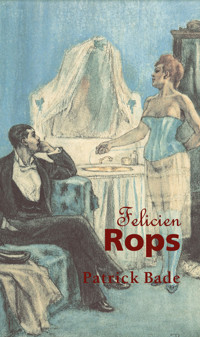
Felicien Rops (1833-1898) is a very surprising artist. Engraver and drawer of exception, Felicien Rops captures and anticipates, with astonishing talent, the female body with great modernity. Abandoning the conventional forms of the time, the artist creates a world full of humour, tenderness and, at times, insolence for the jubilation of the spectator's eye. Many of Rops' most famous works dealt with erotic and sensual themes, often depicting nudes or scenes of debauchery. He also frequently incorporated elements of the supernatural and the macabre, such as skeletons or demons, into his works. Some of his pieces were overtly political or social in nature, often criticizing the hypocrisy of the Church or the bourgeoisie. Overall, Rops' art is complex, multifaceted, and often confrontational. It challenged societal norms and pushed the boundaries of what was considered acceptable in art during his time.
Das E-Book können Sie in Legimi-Apps oder einer beliebigen App lesen, die das folgende Format unterstützen:
Seitenzahl: 40
Veröffentlichungsjahr: 2023
Ähnliche

Patrick Bade
Publishing Director: Jean-Paul Manzo
Text: Patrick Bade
Design and layout: Cédric Pontes
Cover and jacket: Matthieu Carré
© 2023, Confidential Concepts, Worldwide, USA
© 2023, Parkstone Press USA, New York
© Image-Barwww.image-bar.com
All rights reserved. No part of this may be reproduced or adapted without the permission of the copyright holder, throughout the world.
Unless otherwise specified, copyright on the works reproduced lies with the respective photographers. Despite intensive research, it has not always been possible to establish copyright ownership. Where this is the case, we would appreciate notification.
ISBN: 978-1-63919-854-2
Contents
1.Photograph of Félicien Rops, 1879.
2.Self-portrait, ca. 1860.
3.Don Juan’s Greatest Love,1879.
4. Gustave Moreau,Salome tatooe, 1876.
5. Munch,Puberty, 1894.
6. Edgar Degas,Woman with a towel, 1898.
7.The Model, ca. 1864.
8. Edgar Degas,Miss Lala at the Cirque Fernando, 1879.
9. Gustave Courbet,Sleep, 1866.
10.The Row, 1874.
11.Maturity, 1886.
12.The Puppet Mistress, ca. 1883-1885.
13.The Puppet Mistress with Fan, 1873.
14.Parisine, 1867.
15.The Temptation of Saint Anthony, 1878.
16.Pornocrates, 1878.
17. Munch,The Cry, 1893.
18. Edouard Manet,The Brandy, ca. 1877-78.
19.The Absinthe Drinker, 1876.
20. Edgar Degas,In a Café, also called The Absinthe-Drinker, 1875-76.
21.L’Amour Mouché, 1878-1881.
22.Cherub’s Song, 1878-1881.
23.The Scales at Cythera, 1871-1881.
24.The Love Fair, 1885.
25.Love through the Ages, 1885.
26.The Incantation, ca. 1878.
27.The Great Lyre, 1887.
28.The Death Penalty, 1859.
29.Medical illustration of Secondary Syphilis.
30.Parodie Humaine, 1878-1881.
31.Le Rideau Cramoisi, 1879.
32.Sentimental Initiation, 1887.
33.Naturalia, ca. 1875.
34.Death at the Ball, ca. 1865-75.
35.Dancing Death, ca. 1865.
36.Les Diaboliques: The Sphynx, 1879.
37.Epidemies, Endemies, 1870.
38.The Librarian, ca. 1878-80.
39.Two Friends, ca. 1880-90.
40.Prehistoric Love, ca. 1878.
41.The Right to Work - The Right to Rest, ca. 1868.
42.In the Wings, ca. 1879-1881.
43.Nubility, ca. 1878-1890.
44.Sunday at Bougival, 1876.
45.Sailors’ Dive, 1875.
46.The Dressing, ca. 1878-1881.
47.The Christ’s Lover (l’Amante du Christ),1888.
48.Les Diaboliques: A un dîner d’Athées (Dinner for Atheists),1879.
49.Le Cathéchisme des Gens Mariés, 1881.
50.Les Sataniques: The Kidnapping, 1882.
51.Les Sataniques: The Calvary, 1882.
52.Les Sataniques: The Idol, 1882.
53.Les Sataniques: The Sacrifice, 1882.
54.Les Diaboliques: le Dessous de Cartes d’une Partie de Whist (The Hidden Side of a whist Game),1884.
55.Les Diaboliques: Le Bonheur dans le crime, 1884.
1.Photograph of Félicien Rops, 1879.
Felicien Rops
The nineteenth century Belgian printmaker and painter Felicien Rops was essentially a literary artist. He drew the inspiration for many of his best works from Baudelaire, Poe, Barbey d’Aurevilly, Huysmans and Peladan. The writers of the late nineteenth century reciprocated with extravagant admiration for Rops’ work. In the last two decades of the century, probably only Pierre Puvis de Chavannes and Gustave Moreau came close to matching the prestige of Rops in avant-garde literary circles. As early as the 1860s Rops’ great mentor Charles Baudelaire wrote a charming and later much quoted versified tribute to him;
Use all your eloquence….
To say how much I like
That bizarre Mr. Rops
Who may not be a Rome First Prize
But whose talent is as great
As the pyramid of Cheops.
2.Self-portrait, ca. 1860, pencil drawing, 16,2 x 11,2 cm.
His glory peaked in 1896 with the publication of a special edition of the literary revue “La Plume” entirely devoted to him to whom numerous distinguished literary figures contributed eulogies, including Joris-Karl Huysmans, Octave Mirbeau, Josephin Peladan and Jose-Maria De Heredia. Writer after writer compares Rops unblushingly to Leonardo da Vinci, Durer, Rembrandt and Goya and proclaims that it was Rops, rather than Manet, Degas, the Impressionists or Toulouse Lautrec, who best expressed the spirit of modernity. As well as the men of letters, there were artists too who were fascinated by Rops and paid him the compliment of imitation or even plagiarism. He was greatly praised by Puvis de Chavannes whose serene and heavenly visions seem like an inverted reflection of Rops infernal ones. As has frequently been pointed out, Edvard Munch lifted the figure of the terrified naked girl in his famous painting “Puberty” directly from Rops print “Don Juan’s greatest love”.




