


11,49 €
Mehr erfahren.
- Herausgeber: Atlantic Books
- Kategorie: Sachliteratur, Reportagen, Biografien
- Sprache: Englisch
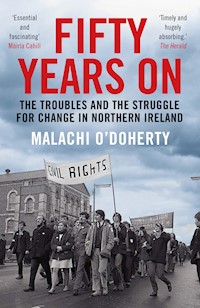
In 1969, an eruption of armed violence traumatized Northern Ireland and transformed a period of street protest over civil rights into decades of paramilitary warfare by republicans and loyalists. In this evocative memoir, Malachi O'Doherty not only recounts his experiences of living through the Troubles, but also recalls a revolution in his lifetime. However, it wasn't the bloody revolution that was shown on TV but rather the slow reshaping of the culture of Northern Ireland - a real revolution that was entirely overshadowed by the conflict. Incorporating interviews with political, professional and paramilitary figures, O'Doherty draws a profile of an era that produced real social change, comparing and contrasting it with today, and asks how frail is the current peace as Brexit approaches, protest is back on the streets and violence is simmering in both republican and loyalist camps.
Das E-Book können Sie in Legimi-Apps oder einer beliebigen App lesen, die das folgende Format unterstützen:
Veröffentlichungsjahr: 2019
Ähnliche

















Fifty Years On
Malachi O’Doherty is a writer and broadcaster based in Belfast. He is a regular contributor to the Belfast Telegraph and to several BBC radio programmes. He covered the Troubles and the peace process as a journalist and has written for several Irish and British newspapers and magazines, including the Irish Times, New Statesman, Scotsman and Guardian.
‘Timely and hugely absorbing... A beautifully layered and engaging profile of Northern Ireland as it reels into the 21st century.’ The Herald
‘An essential and fascinating memoir which also doubles as an important historical and social reference, shining a light into aspects of life here that sometimes are overshadowed by conflict.’
Máiría Cahill, journalist and political activist
‘A superbly written and thought-provoking book, replete with Malachi O’Doherty’s expert observations on how the past can be a catalyst for both change and continuity.’
Aaron Edwards, author of UVF: Behind the Mask
‘In this highly readable and up-to-date book, the author proves himself an astute and tireless chronicler of his times.’ Linda Anderson, co-editor of Female Lines: New Writing by Women from Northern Ireland
‘Malachi O’Doherty’s fascinating and intimate account of the outbreak of the Troubles is compelling. He skilfully weaves his personal family history through the layers of turmoil engulfing his city.’
Yvette Shapiro, journalist, commentator and TV producer
‘What does shine is the lucidity and persuasiveness of O’Doherty’s arguments. He made me stop and think. I like that.’ Richard O’Rawe, biographer and novelist
‘A compellingly personal alternative history of a turbulent half century... This thoughtful personal chronicle of how a society has changed in the adult lifetime of one man is witty, poignant and beautifully written.’ Sam McBride, political editor, Belfast News Letter
By the same author
The Trouble with Guns
I Was a Teenage Catholic
The Telling Year: Belfast 1972
Empty Pulpits
Under His Roof
On My Own Two Wheels
Gerry Adams: An Unauthorised Life
Terry Brankin Has a Gun
Fifty Years On
The Troubles and the Strugglefor Change in Northern Ireland
Malachi O’Doherty
First published in Great Britain in 2019 by Atlantic Books, an imprint of Atlantic Books Ltd.
This paperback edition first published in Great Britain in 2020 by Atlantic Books.
Copyright © Malachi O’Doherty, 2019, 2020
The moral right of Malachi O’Doherty to be identified as the author of this work has been asserted by him in accordance with the Copyright, Designs and Patents Act of 1988.
All rights reserved. No part of this publication may be reproduced, stored in a retrieval system, or transmitted in any form or by any means, electronic, mechanical, photocopying, recording, or otherwise, without the prior permission of both the copyright owner and the above publisher of this book.
1 2 3 4 5 6 7 8 9
A CIP catalogue record for this book is available from the British Library.
All photographs are reproduced by permission of the author.
E-book ISBN: 978-1-78649-665-2
Paperback ISBN: 978-1-78649-666-9
Printed in Great Britain
Atlantic Books
An imprint of Atlantic Books Ltd
Ormond House
26–27 Boswell Street
London
WC1N 3JZ
www.atlantic-books.co.uk
forCiaran Carson
CONTENTS
Prologue
The Sixties and Me
Trouble in the Background
Remembering Civil Rights
Revolution in the Air
The Tilt towards War
Revolutionary and Moderate
The Troubles Tour
The Past in the Present
Women’s Rights Movement
Boys Will Be Boys
Whose Body Is It Anyway?
Fighting for Life
Pride
A Fair Cop
Loyal Rebels
Sick Society or Bad Men?
An Teanga
It’s God’s Fault
The Catholic Reformation
The Other Revolution
The Past Catching Up
Brexit
Who Wants a War?
The Battle of the Bogside
Conclusion to the 2020 edition
Notes
Acknowledgements
Index
Prologue
I have made it to my bed but I do not feel safe. The shooting continues. Not up close – distant but heavy. I now believe it is real; at first I didn’t. When I was walking away from the rioting on Divis Street I was stopped by two American journalists who asked me if there had been any gunfire here yet.
I said, ‘Only blanks.’
Why did I say that? What did I know about what people were doing, how bad this would get? I had no insights into the organisation of the riot, no familiarity with the people who led the attacks on the police. But I just assumed that this skirmish would be like others I had seen; and if there was the odd crack or rattle that might have been a gunshot, I had heard these before and no one had suffered bullet wounds or seen holes in walls or windows afterwards. So, pretending to understand the pattern of trouble that had become familiar over the past year, I said no, only blanks.
When I heard machine-gun fire, there was no mistaking it. It was murderous. You wouldn’t confuse that with fireworks or something falling over. You could hear the clear intentionality of it in the blunt, abrupt, clean dunts, like rapid hammer blows. I had left Jo to the bus station. We had not been able to go down the Falls Road, so we had detoured to the south of the city and taken a bus along the Lisburn Road and walked across town. We saw a huge water cannon trundle across King Street in front of us, and heard the clatter and banging and shouting further away. She scoffed at the mob. ‘If they had jobs to go to tomorrow they wouldn’t be at that carry-on.’
She is a protestant and comes at this differently. For one thing, she knows more people in the police, for very few catholics are in the Royal Ulster Constabulary – none at all in the Special Constabulary, those part-timers who were called up tonight for back-up. So she has more sympathy with men in uniform.
Her family probably votes for the Unionist Party, which has been in unbroken control for fifty years and which is challenged by these riots and the demands for civil rights. She doesn’t believe that teenagers chucking petrol bombs at the police care a fig about civil rights: they are out enjoying themselves. She’s probably right.
I left her to the bus and came back. There were about a dozen of us watching. It was some show. Police in black uniforms with shields confronted young men throwing bricks and petrol bombs at them. The bombs were milk bottles, which arced through the air then smashed on the ground and produced a sliver of flame.
This was all under the view of Divis Tower and there were men on the roof. I watched them throw down a whole crate of bottles, smashing them on the ground. I thought at first they were just discarding them, making a racket, but as the rioters pulled back and the police charged, I saw what they were up to. One of the men on the roof dropped a petrol bomb into the mess and whoosh, it went up in flames.
I saw a young man in a pink cheesecloth shirt and jeans being grabbed by two policemen and led back behind the lines in front of us to the station. The police had their sneaky strategies too. They would pull back, closer to us, and entice the rioters into the range of armoured cars parked in Conway Street and Dover Street. These weren’t like the big water cannon. A man near me in the crowd called them whippets. They were small, almost pyramid-like on top. They had mounted machine guns. They whirred and they spun. Two came out from different directions to break up the rioting mob and then the police launched a baton charge after the scattered men and brought one or two down with a strike at the knees and pulled them in.
I saw a delivery van for a sausage factory pull up on our side of the line and special constables with rifles climb out the back and rush along the wall into the police station. A senior officer in ordinary uniform, with a peaked cap, not a helmet, came and spoke to us. ‘I urge you to disperse. We cannot guarantee your safety. This is getting much more serious.’
‘They should bring in the army,’ said the man beside me. ‘They’d soon show them. They’d throw their petrol bombs back at them.’
I left the group and went back the way I had come with Jo. The buses were all off now.
That was when I met the Americans and reassured them, and they must have marvelled at my innocence, my ignorance.
*
I walked up the Grosvenor Road, to join the Falls Road on the other side of the riot, anticipating a three-mile walk home. I had turned the corner on to the Falls when I heard the first string of blurts from a machine gun. At first I had no idea where it had come from. There was another.
I was passing the front of the hospital and worked out that there must be a sniper on the roof, for the noise of the gun was so loud it seemed almost beside me. I ran into the front of the hospital for cover and faced the double escalator. Both sides were coming up now. There was no way in. I wondered if my panicked mind was hallucinating. I was fired with urgency – not debilitated by terror, as I would have expected. I was studying everything and reading my reactions. Even as I turned and ran up the road, close to the front of the hospital, I was registering an insight: that if Jo had been with me in those moments I would have been no use to her. Then I walked with my head down, but the shooting started again. Bop-bopbop-bop-bop. A couple of boys on the other side of the road started running for cover along the stone wall of the convent school, St Dominic’s.
I ran. And as I did so a car pulled up ahead of me; a man jumped out and grabbed me by the arm and with his other arm pressed my head down. ‘Keep low.’ And he ran with me to the car. There was a young fella in the back seat. They drove me home. We passed groups of people at bus stops, apparently still thinking there was some normality there. There was. The man and I did not talk about the gunfire or the politics. He just said, ‘Your mother will be worrying about you.’
*
I am eighteen years old. I live in a housing estate called Riverdale on the very edge of Belfast. Beyond our streets when I moved here as a child there were only fields to play in, trees to climb, goats to outrun, the remnants of wartime Nissen huts and coils of barbed wire. When I was smaller I had dreams of war, my imagination fired up by those traces.
Later there were building sites all around me, and I was outrunning the nightwatchman when he caught me and my friends sneaking in after the workmen had gone, on summer evenings, to bounce on planks, climb through window frames.
Eight of us live in a semi-detached house with three bedrooms – or really two bedrooms and a box room. One bedroom at the front is for my parents. The box room is for my two sisters and the rear bedroom is for the four boys.
The house was built for two parents and three children at most, on the understanding (later voiced by the Northern Ireland prime minister) that catholics, if given proper housing, would live like protestants and, by implication, have smaller families.
There are several protestants living in our street, most of them families of policemen. And they are friendly, though their children go to different schools so we don’t get to know them as well. Other protestants down at Finaghy are more fearsome and sometimes shout at us when we go to the railway station.
One of the anxieties of British Northern Ireland is that those of us who are Irish – that is, catholic – will outbreed the protestants and take the territory into the Irish nation, where most of us think it rightly belongs.
By that thinking, building new housing estates for catholics is reckless self-harm. The counter-idea is that full citizenship will help us to feel at home.
When I was young, one of the advantages of Britishness was the welfare state. My mother was paid a family allowance for each of her children. The doctor would come out to the house in those days if one of us had a temperature. He would press down my tongue with a flat piece of wood and tell me to say Aaah.
And if by some miracle any of my mother’s children would get a place at university, or at least at the teacher-training college, the state would pay all the fees and a maintenance grant.
I went to catholic schools, which asserted their distinction from the state while taking most of their funding from the government. My first school in Belfast was the pavilion of a sports ground, Casement Park, which smelled of damp concrete. At Mass every Sunday my parents paid into the School Building Fund to help augment the cost of the new primary school, the Holy Child.
We would be holy children ourselves, the boys going in one door, the girls another, our models being Dominic Savio, who mortified his flesh by sleeping on walnut shells and died young, and Maria Goretti, who resisted the man who would rape her. He stabbed her fourteen times but she forgave him on her deathbed and he went on to become a monk while she went to Heaven.
Discipline in primary school was applied with the cane, three feet of fine bamboo with a curve at the end like the handle of a walking stick, swiped at the tips of the fingers and not just for running in the corridor, scuffling in the yard or failing to do homework but also for bad handwriting and not getting the sums right.
Our house is much more spacious than the redbrick terraces of the back streets where most working-class people live. We have an indoor toilet and a bathroom. In many other houses down the road, children and grandparents make up beds for themselves at night around the fireplace, on the sofa or the floor, and smaller children squeeze in beside their parents. And they wash in a tub brought in from the yard and filled from pots of hot water boiled up on the cooker.
They don’t have gardens but open their front doors on to the footpath.
We are on the corner so the waste ground is our garden. It extends like a blade towards a point, and we shout at people who take shortcuts across it. This is a new estate, and some of the best rental residential housing in Belfast for families. I don’t know that we are crowded here, that my own adult self will look back and say this was poverty.
I don’t know anyone who has central heating in their home, so I don’t miss it.
We take heat in the living room from a coal fire, supported on colder nights by a paraffin heater at the other side of the room. Nearly all of us smoke at home. Some of us still maintain a pretence to Mum and Dad that we don’t smoke and therefore only light up outside or when we have the house to ourselves.
We watch television together most evenings through a grey-blue haze, from Teatime with Tommy through Crossroads or Space Family Robinson and Panorama or Bonanza, often arguing over which channel to watch. There are three of them now. The proliferation of choice has only made home life more contentious. Richard Baker and Robert Dougal read the news to us in tones that assure us that everything is under control despite the devaluation of the pound and the grotesque violence in Vietnam.
It’s 1969. My mother is fifty-three and my father is fifty-five, their parenting having been delayed by the Second World War. Like a lot of people their age, neither of them has teeth. When the NHS arrived they thought the most sensible thing to do was to have them all taken out and replaced with dentures in order to have no more trouble with them. My father could jut his from his mouth with a flex of his jaw to startle us as children with an impression of an animal struggling to get out of him. This trick might have been the inspiration for the mouth within a mouth of the creature in Ridley Scott’s Alien.
My schooldays are nearly over. I have been to a catholic secondary school where most of the teachers were Christian Brothers, like half-formed priests in black robes. Each was armed with a coiled strap in a pocket in the robe, which could be curled out ready for swinging as the other hand reached for my wrist to position my palm as a target. The relationship between religion and violence on this scale is familiar to me.
I was raised in religion, to a belief that I had the one true faith. I believed in Hell and damnation; I believed also in Heaven but that was a long way off, for I would still have to endure the fires of Purgatory to cleanse me till I was fit for it.
The Church is changing. After 1964 and the Second Vatican Council our teachers said that protestants might go to Heaven too, though it would be even more of a struggle for them.
It was difficult to be sure of how much of this my parents and teachers really believed. Worries about salvation clearly did not preoccupy them, and they would even scoff at those who took religion seriously. The culture was one in which you fulfilled your religious duties to the satisfaction of your neighbours and gave little thought to how much God noticed or didn’t.
By 1969 I have never been more than a hundred miles from my home. My cousins are in Dublin and Donegal, both in the Irish Republic. Day trips to visit them take us over the border to another country that is a bit dilapidated, which has brands of chocolate and soft drinks we never see at home, like Tiffin and Cidona, and cigarettes like Sweet Afton and Major. Sometimes there are armed special constables on the northern side of the border, those men of a force that is all protestant, amateurish and of whom we are taught to be wary. It is always a relief to arrive at the other side, as if that’s home.
When I was younger I enjoyed the mischief of wearing a lapel pin of the Irish flag when I was in Donegal, for the flying of that flag was illegal in Northern Ireland – or the Six Counties, as we called it. I wanted a united Ireland. I could sing all the rebel songs, like ‘Kevin Barry’ and ‘Roddy McCorley’ and ‘Kelly the Boy from Killane’.
Later I had a school friend called John who was a republican. I was a socialist then and argued that the border had become a petty concern. Besides, what chance had you of getting a decent job if you were a rebel, if a police file somewhere said you had flown the Irish flag from your bedroom window?
Very few people I know are republicans. There are occasions when the numbers seem greater, like at the close of a ceili when the Eddie Fegan Ceili Band declares a final end to the night by playing the Irish national anthem – ‘The Soldier’s Song’ – and we all stand and declare our lives to be ‘pledged to Ireland’.
I have a weekend job in a bar now, as a waiter in the lounge, where men drink pints of lager and buy Carlsberg Specials or vodka and orange for their girlfriends. I have worked in other bars, where most nights ended with a fight and Bert the barman wading in with the broom to break it up.
There was a lot of fighting then, as there had been at school dances, in the school yard or on the corner of the street. There seems to be a pent-up violence in young men. My brother has read Freud, in summary at least, and says it is sexual frustration, but that can’t be right. I’m sexually frustrated myself but I don’t want to fight anybody.
Sometimes it surprises me how civil people are. Those who come into the lounge bar are the upper working class, people who behave themselves, who value manners. Class distinction here is between the mannered working class and the unmannered working class. None of us are middle class yet. The disparaging term for the unmannered is ‘common’. You don’t want it to be said of you that you are ‘awful common’. I know immediately whether someone is common or not by their language and attire: the girls who wear bobby socks and chew gum and say ‘fuck’; the boys in their winkle-pickers, dressed for a fight.
When the common boys fight they kick and give headbutts. Those of a better class might learn to box or do judo – not so that they will fight better and more cleanly but, they say, so that they will never have to fight at all.
Fighting between boys has always been part of the culture, going back to the school playground. I knew boys who preferred a fight to any other way of amusing themselves, who would stand at a corner, near the chippie, and wait for a likely target to come along, one of the lighter-built nicer boys who annoyed them so much. I was one of those.
I don’t seek to understand those who accost me by reference to misfortune in their lives. Why should I? It is just in them to be like that; their fathers and brothers are the same.
They impose themselves on others; they assert that they know better than anyone else what this place is and who belongs here. If they lived in England they would be beating up homos and Pakis but there are no Pakis here and very few homos that anyone knows.
Thankfully, few men of this type came into the public bar, the Star and Garter, which was a ‘queer bar’ I worked in. Here effete and good-natured older men drank sherry and smoked cigars and, on the occasions I was sent to help out, they spoke very nicely to me, took a great interest in my education, my hopes for myself, detained me at the table to know me better.
The queers came to this bar but there was no particular welcome for them and the staff sneered at them but put up with them. Once, two men who had been drinking in the lounge at the back, the Red Barn, got thrown out after visiting the toilet together. Tommy, the owner, would have none of that carry-on.
I’m still not sure what I want to do when I finish my education. A lot of the boys I went to school with are already working. Some left at fifteen, into apprenticeships to be plumbers or barmen or electricians. Some that stayed on for O levels left then to get jobs in the civil service or at the City Hall as junior clerks and some went into the post office as telegraph boys. These were considered the luckiest of all because they were issued with little red motorbikes, to deliver telegrams about the city.
Frankie Callaghan from our class has gone into Short Bros to make aircraft. He’ll go into the army. Caoimhín de Búrca who sat beside me has gone away to be a Christian Brother. A small few are preparing to tackle A levels, which are considered almost unattainable by my generation, and may go to university. Some among us got redirected for various reasons towards the ‘tech’ or the College of Commerce to do ONDs or City & Guilds exams. We might end up as accountants or quantity surveyors. I want to be a journalist. Some chance!
I have seen the reporters for the Daily Mail and other papers in the Star and Garter using our phone to relay copy to their offices, reports of court cases or civil-rights parades or some of the disturbances in Belfast, Derry and Armagh that came with the political unrest.
I don’t know if these are good reporters and I assume that being a reporter is a stage on the way to being a proper writer. I would like to ask them what they think of Hemingway or Steinbeck. I will later meet some of the great reporters, like Simon Winchester and even Christopher Hitchens, when Belfast has become one of the biggest stories in the world, but this seems unlikely now. If I want to cover wars and tumult I will have to go abroad. And I am not sure that I do.
There are big employers in Belfast, managing the heavy industries of shipbuilding, aircraft and missiles, machinery for textiles manufacture. Most of their employees are protestant. Many protestants in working-class areas think they don’t need education to get jobs; the way is cleared for them by older brothers and fathers who have jobs in those big industries and can get them in.
The news occasionally includes reports that the Irish Republican Army – the IRA – has been conducting arms training for members on the other side of the border.
Three years ago, 1966, was the fiftieth anniversary of the Easter Rising, which triggered the Irish War of Independence, which led to the creation of an Irish state, though with our six counties in the north locked out of it. That anniversary roused fervour for unity again and paranoia among unionists. The IRA set off a few small bombs. Loyalists shot dead a catholic barman who had gone to a protestant area for a drink, with little or no apprehension that he was taking a risk.
I work in bars near there myself now. There are two of them facing each other on Agnes Street off the protestant Shankill Road, the Enfield Arms and the Cliftonville Hotel. They are owned by a catholic family who have asked my father to manage them. I go there every Saturday and help behind the bar in the Cliftonville. I know all the regulars and they know me. I have learned to pour a decent pint of porter, which costs a shilling. There is an art to it. It might be the cheapest drink in the bar but it is the one that takes most work. You pour the flat body and the high head from different barrels on a shelf and scoop out some of the white with a plastic blade and top up with more black until the balance is right.
Now I am at the College of Commerce, where for the first time in my education I am mixing with girls and protestants and, most illuminating of all, protestant girls.
We are drawn by curiosity to each other. They want to know just how much I am answerable to the Church, what happens in confession when I go every Saturday at noon to kneel in a built-in cupboard in the chapel and unburden myself of my sins, including my sinful thoughts about protestant girls. I want to know if they have casual sex; is it just like being nice to someone for them?
It will be hard for catholics to get promotion in the civil service and big companies. In the expectation of discrimination there, many are seeking employment in small businesses like pubs, law firms, accountants’ offices. And they and others are taking to the streets in civil-rights protests now to demand an end to discrimination, better housing, a fairer local-government franchise that isn’t weighted in favour of house owners and graduates.
There is a sense among catholics that they have inherited injustice. Ireland was partitioned in 1921. With a strong protestant majority in the North, that is hardly likely to change. People grumble rather than organise. They tell me that with my Irish name I ‘would be better off with a number’. Some few organise for a future war against Britain to unite Ireland but I don’t know any of them. On occasions there have been big republican parades but I was only ever urged by my parents and teachers to stay away from them. The civil-rights campaigns are different. We think these can focus on rights and entitlements, posing no threat to the state, simply demanding that it meet its commitments to citizens and treat them as well as citizens in other parts of the UK.
I have marched with the students and sat on the street and chanted ‘One man, one vote’ and sung ‘We Shall Overcome’. We have learned from watching other marches on television, in Alabama and Paris. I was bewildered when a protestant cleric called Ian Paisley organised counter-protests and urged the government to ban our parades for we were the puppets of Rome, the pawns in a papal conspiracy against the British monarchy.
He thinks that a 400-year-old war has resumed. And he is eager for it.
One answer to the growing threat of war was that the youth might be rallied to demonstrate their greater interest in pop music. Father Marcellus organised a Pop for Peace concert at Minnowburn, open countryside by the Lagan. Marmalade came. Dave Dee, Dozy, Beaky, Mick and Tich came. John and Yoko sent a telegram and it was awarded to the person who picked up most litter afterwards. We were all such nice people but our manners and enthusiasm made no difference to anything.
The news coming from Derry showed chaos, hundreds of people on the streets for days, chucking stones and petrol bombs at the police, and the police a shambles in their management of it, stumbling about the road, beating the flames off their fallen with their coats, running back uphill with the rocks and bottles bouncing at their feet, regrouping to attack with batons and looking as if they would do less harm by just going away.
Then it spread to other towns.
In the morning we will get the news of the dead and the damage.
My parents are on holiday. I am at home with my two sisters, Ann and Brid, and two of my three brothers. Brid wants me to go with her into town to meet her boyfriend. He is a protestant too. We go by the south of the city, to avoid the mayhem on the Falls Road, and we join Eddie in a pub. I like Eddie. He has a candid smile and he glows when he has a drink in him. He is relieved that Brid is safe. He buys me a beer, though it is only the middle of the day, and it feels good to be drinking it.
‘Our Malachi was shot at last night,’ says Brid.
‘Yes.’ I tell him about the sniper with a machine gun on the roof of the hospital.
Eddie says it was probably just one of the police machine guns from further down the road. ‘It’s really hard to locate gunfire.’ I wonder if he has ever been shot at.
Later we walk up Divis Street and the Falls Road and see the scale of the damage. The road is scorched and littered with stones and broken glass. Several shops and pubs are burned-out. One of the old mill buildings is still smoking. Men are stopping and directing traffic and I wonder who they are and who appointed them.
We turn up Northumberland Street, which takes us to the Shankill Road. From here, last night, protestants had come down on to the Falls to join the riot in support of the police. Some of them had been killed, but the Shankill shows no signs of damage or abnormality. We go to the pubs at the top of Agnes Street. My brother Brian is working behind the bar. I know many of the customers from having worked here myself but the atmosphere is different. No one says hello.
Brian alerts me to the mood of the place. ‘I think I’ll have to close up. This isn’t good. People that would be civil to you any other day are just keeping to themselves. They buy a drink and give you the money and then turn their backs on you.’
There is Billy, a trade-union man who would usually be pleased to see me and I think if I catch his eye and give him a nod I can lighten the atmosphere, assure him that it wasn’t us who were attacking the police last night; that we had nothing to do with it. He meets my eye for a second and looks away.
Brian will close the bars early. That night both will be burned to the ground by a loyalist mob. My father will keep a copy of Paris Match for years with a colour spread showing the flames.
Brid and I walk down Agnes Street and across the Shankill and back to the Falls. The atmosphere is almost carnival. People say the army has arrived. I see a phalanx of soldiers come up Durham Street.
‘I wonder where they think they are going,’ says Brid. They march with bayonets fixed and helmets on. ‘It’s not bloody World War Two.’
The Sixties and Me
Nineteen sixty-eight was the year I left secondary school. I had fallen a year behind my peers because I had chosen to repeat some O levels, essentially to take a pause in my education and have an easy year in which to reflect on my options. The school I went to was called CBS Glen Road. Some Christian Brothers schools didn’t get saints’ names; God knows why. It still stands, but it is nothing like it was then. It was opened in 1962.
Half of the teachers then were members of the Christian Brothers, a religious order founded to educate the catholic urchin poor. The Brothers had a reputation for liberal use of corporal punishment. My father had been to one of their schools in the 1920s and told me that he had sworn he would never send his own children to the Brothers. Forty years later he relaxed his resolve, presuming that they had changed.
The men of the Christian Brothers teaching in Belfast were mostly from the Irish Republic. They were celibate but their strange clerical collars, only the top half of which was white, implied that they were only part way to being real clergy.
The strap each one carried was commonly called the ‘leather’ and was used for slapping boys on the hands for bad behaviour or poor performance. So, corporal punishment was carried on into secondary school though most of the Brothers preferred the strap to the cane. I would get a wallop for every Latin sentence I got wrong in my homework. The leather wasn’t a belt: it was manufactured for its sole purpose, with a sculpted handle and layered to provide the weight that would inflict an appropriate amount of pain.
The Brothers have virtually disappeared now but they retain a reputation for abuse far worse than anything I saw in Belfast, including rape.
The area at the front is now a car park. Fewer people had cars when I went, so there was more space to run around.
I had a basic education there, some of it intended, some not; some of it useful, some merely the play on conundrums. I still don’t know what a quadratic equation is for, though I had to learn how to resolve one. I acquired a rebellious spirit through a slow realisation that the authority that I was up against was an unwarranted burden and trivial in most of its concerns.
But in my early years there I was compliant. I made an effort. And I got slapped with the leather all the same.
I went to the Gaeltacht during my first summer, to learn Irish, clustered mostly with other boys from our class: Tony Henderson, who later joined the IRA, and Caoimhín de Búrca, who was Kevin Burke back then and would go on to join the Christian Brothers.
This was an organised educational holiday in an Irishspeaking area of north-west Donegal. We were there in 1963. Tony was homesick and so was I.
We were at a timid age, not ready to understand even the dirty words the big boys used. Because this was a holiday the teacher was not allowed to use his cane on us, so he compensated by shouting a lot.
He taught us rebel songs in Irish. ‘Roddy McCorley’:
Tá faghairt ’na rosc ’s feidhm ’na gcos
Tá siad mall, ró-mhall, monuar
Mar tá Rodaí Mac Corlaí ag dul chun chroch
Ar dhroichead Thuama inniu
They come with vengeance in their eyes.
Too late! Too late are they,
For Roddy McCorley goes to die
On the bridge of Toome today.
He also taught us the Irish version of the theme tune to Z Cars.
Ceol ar maidin, ceol arís tráthnóna, ceol
The house we were sent to was a cottage with a vegetable garden bounded by fuchsia hedges. At the end of the back garden was a little toilet shed. Inside was a bucket under a wooden seat with a hole in it. That was the only toilet for the eight boys staying there and for the women who ran the house, cooked our meals and kept up our spirits.
All eight boys slept in the one bedroom of the cottage, where four double bunk beds had been fitted.
The most amazing thing for me was that the area was so dark and silent. When the lights went out I was in blackness so deep that opening or closing my eyes made no difference and the absence of the slightest sound beyond our room, which perhaps a country person would find reassuring, was unnerving at first.
One of the older boys made ghostly sounds. There was a statue of the Virgin Mary on the mantelpiece. It was luminous green. When he lifted it and moved it around it seemed to float in the air of its own volition.
We were, in theory, conscientious catholic boys sent there to immerse ourselves in spoken Irish. The Christian Brothers who had organised this worked to a theology that, in effect, merged the language with the faith and with the idea of an Irish nation. The revered exponent of this was the martyr Patrick Pearse, who had been executed by a British firing squad in Dublin in 1916 for leading a rebellion while the sons of most of his neighbours were in Flanders.
Pearse’s rebellion was linked to the theology of Catholicism through his own writings, connecting his blood sacrifice to that of Jesus. And the Brothers endorsed this, where a more rational reading of scripture and theology might have concluded that he was a heretic.
Sending a concentration of pubescent boys off on holiday together was inevitably going to provide them with a chance to air their own interests. In our house, we organised a farting competition. Each contender had a verifier to follow him through the day and monitor his output. Boys would be seen squatting by their bunks trying to force through their body gases as noisily as they could, as often as they could.
Some of the boys, during those weeks in Donegal, would advance their interest in girls, or claim they had. Word went round that Iggy Jones had got a girl to take her bra off for him. This marvellous information was shared from boy to boy across the whole Gaeltacht region and Iggy came to be seen as one who bore himself with the confidence of having moved on ahead of us.
We learned bawdy songs. At the start of the summer there might have been only one boy who knew the full version of ‘Good Ship Venus’. By the end of July thousands could recite it in full, and some were composing new verses to add to it. Though why the ‘figurehead, nude in bed’ would even want to ‘suck on the old man’s penis’ was beyond my comprehension then.
So, there were people who were devout catholics and ardent Irish-language enthusiasts, but that didn’t describe most of us. The Gaeltacht experience was meant to be a chauvinistic reference back to an Ireland that was disappearing.
We didn’t imagine that, in decades to come, Falls Road shopfronts and bus stops would be in Irish, let alone that the interest in the language would have come away from the culture of religious devotion. Through the Brothers and the legacy of Pearse, these were seen as organically linked.
The Christian Brothers would organise afternoon ceili dances for us with girls from other catholic schools on condition that we took a lecture in Irish and tried to speak it while there. So I have these celibate chauvinists to thank for helping me meet the first girl I kissed.
And the teaching of Irish was intermixed with a reverence for the republican tradition, the nation building that required Ireland, if a claim for independence was to be justified, to be culturally distinct from Britain. And that meant being catholic and having a native language.
For me, Irish language and dancing became an avenue into fun and love.
But Irish was more a school subject than a cultural definer outside school.
That would change over the period of the Troubles. Now there are Irish-language schools in Belfast, along with Irishlanguage street signs and shopfronts and bus stops. The casual visitor will likely see these as evidence of a cultural tradition with deep roots rather than of a revival that had yet to happen when Caoimhín de Búrca and Frankie Callaghan and I were trying to impress girls with our vocabulary and dance moves at the ceili.
An early sign of the change after the start of the Troubles was that in 1971 Tony Henderson’s comrades in the IRA, many of whom had paid little attention in class, sent out a message from the prisons and internment camps asking the Christian Brothers to send Irish-language teachers to them.
And what became of us boys?
Frankie Callaghan would spend his army career on the Eastern Front anticipating a Russian advance. Tony Henderson would die from gunshots on an IRA training camp at a time when half of the IRA casualties were accidents. Joe McDonnell, a natural prankster like Frankie, would starve himself to death in a prison protest. Caoimhín de Búrca would become a Christian Brother then leave and become the lay headmaster of a Christian Brothers grammar school. I would become a journalist.
Each of us took a journey away from the society we knew back then, but so did everybody.
My first experience of writing to win an argument, the type of writing that would form my career, was there, in school.
Caoimhín de Búrca and Frankie Callaghan and I were members of the Legion of Mary. This was a religious group devoted to prayer and voluntary work. It was structured, in theory at least, on the model of the Roman legion. The school group was a praesidium. The higher administrative group was the curia. Our praesidium was devoted to Our Lady Mediatrix of All Graces. This credits the mother of Jesus with more than any account of her life in the Bible implies, that all of God’s graces bestowed on Earth are channelled through her.
We were soldiers devoted to Mary.
To protestants and others who took their religion directly from scripture and admitted of no further embellishment of it, this would all have seemed bizarre and unchristian; but in the catholic tradition, revelation was recognised as having continued even up to recent times through apparitions of the Virgin Mary at Fatima in Portugal, Knock in the west of Ireland and Lourdes in France, and even since then at Medjugorje in Bosnia and Herzegovina.
The Legion had adapted verses from the Song of Solomon into a prayer to Mary, the Catena, that imagined her more like the hindu goddess Kali than the demure carpenter’s wife in Nazareth.
Who is she that cometh forth as the morning rising, fair as the moon, bright as the sun, terrible as an army set in battle array?
In the hindu Shakti tradition the female aspect of God, usually the consort, Parvati or Durga, is the active agent in His power – what you might call the Mediatrix of His graces, or indeed of His wrath.
Each Friday evening we met in the school and knelt in prayer, then reported how we had carried out our Legion duties during the week and had new duties assigned to us for the following week. My duty, or assignment, might be to go with another boy to visit children in hospital or pensioners in their homes.
We dedicated ourselves more fully at a huge ceremony in St Mary’s church in Chapel Lane. We were processed in pairs to stand before the Legion standard. An anthropologist would probably call it a totem; Mary standing on the globe, one bare foot on the head of the serpent, the dove over her own head. The words we had been rehearsed in were: ‘I am all thine my Queen and my Mother, and all that I have is thine.’
I said those words with honest devotion, as did hundreds of other Belfast teenagers that night.
It is barely conceivable that such a ceremony could be organised today.
There was a boy in Musgrave Park Hospital who had been there for weeks after a tractor accident. He was always pleased to see us and chatted warmly about the nurses and other patients and even indulged us when we suggested a prayer. After a few visits I thought we could safely waive the praying part and still consider that we had done good work for Mary, Queen of Heaven.
One night Frankie Callaghan went there on his Legion duty and the nurse on the ward asked him if he was going to stay for the concert. A stage had been set up on the ward with microphones and he assumed that some of the staff were going to sing for the children, but as he was leaving the Everly Brothers came in. They had been performing in the city and volunteered a free show for children in hospital.
So Frankie was late getting home.
He told me, ‘My mum and dad played the Everlys all the time so I was familiar with the songs, but when I got home I thought I was going to get the dog for lying.’
After a year or two I was made secretary of our praesidium. I had to make notes of all the reports of Legion duties performed, excuses for them being missed and the general trend of the meeting, including a summary of the little inspiring talk from our spiritual director, Brother Quinlan.
One job we might be given was to prepare the newspaper orders in a kiosk in the grounds of St Theresa’s church. We would go there on a Saturday evening when we would have bundles of the respectable Irish and catholic newspapers, like the Universe and the Sunday Press. We would have a list of the names of people and the papers they had ordered and we would roll the papers together, pencil the name of the customer on the front page of the top paper and stack these for collection the next day after Mass.
This could pass a fun few hours on a summer’s evening while being more onerous in the dark and in the rain.
At one meeting of the praesidium, I reported on having performed this Legion duty successfully but then the president or chairman said that he had received complaints about the antics of the boys in the kiosk preparing the papers.
I thought it very likely that we had chatted and joked among ourselves as we made up the orders. I didn’t offer the defence of being young and hormonally charged but in retrospect it seems a reasonable one. The kiosk was on Church ground but we didn’t think of it as a sacred space requiring a sedate and hushed manner; yet apparently we had let ourselves forget the decorum appropriate to that circumstance. Passers-by, coming from confession or from praying before the Real Presence, did not need to be shaken from their inner reflections by the laughter of teenage boys.
I didn’t think we had behaved badly. I, and the other boy who was with me, protested that we thought the complaint was unreasonable.
‘Well, we’ll leave it at that,’ said the chairman.
I didn’t.
In the minutes of that meeting, I reported the complaint about the behaviour of Brother O’Doherty – myself in the third person – and his partner in the performance of that duty. We were not actual Christian Brothers like Brother Quinlan but on Legion of Mary business we addressed each other and referred to each other by that title.
I took smug pleasure in reading out ‘Brother O’Doherty’s’ defence in great detail and then asking the others if this was an accurate account of the previous week’s meeting.
The chairman was disconcerted but all agreed that the account was accurate and the chairman had to sign it.
He said that perhaps I had dwelled ‘overlong’ on the matter, that he had hoped to put it behind us, and I noted down all his words to recite back to him the following week, for the approval of the others and for him to sign.
I kept this up for three weeks to ensure that my defence was solidly on the record. I had had no previous political or journalistic training, but I’d worked out for myself that the person who writes the record has the last word.
I don’t know what happened to the minutes book I kept. I asked the Legion of Mary headquarters in Belfast if they had any ideas where I might find it and they invited me to look through their archives. It wasn’t there but I did come across the Legion’s record of its experience of the violence of August 1969.
The minutes of the 514th meeting of Legion of Mary Down and Connor Comitium, Sunday 7 December 1969, record that their Immaculata Curia
reported that St Peter’s parish had lost 130 homes during the disturbances and in the Relief Centre on the nights of the 13th and 14th of August over 300 people were attended to, 70 of whom had serious gunshot wounds. Medical opinion confirmed that 50/60 of those would have died had it not been for the efforts of legionaries and members of the Knights of Malta. During the crisis and after, street cleaning and sanitation was organised, and claims for housing were dealt with from the Centre.
An earlier meeting had heard that the legionaries had ‘helped out in an emergency at a non-Catholic centre at the request of the Minister’.
After leaving school, I was still interested in being part of discussion groups on religious and ethical questions. I wasn’t ready to fully break with catholic religious practice and an added attraction of Catholic Information Centre debates was that girls came to them and took part.
These meetings were on Wednesday nights in Belfast near Castle Street, an area distinguished by Smithfield Market, which the IRA had yet to burn down. Kelly’s Cellars was nearby, one of the oldest pubs in the city, where the 1798 Revolutionary Henry Joy McCracken was said to have taken refuge. So also was St Mary’s church, one of the first catholic churches in Belfast, built with financial support from protestants, and St Mary’s Hall, the venue for the routine meetings of the Northern Ireland Civil Rights Association (NICRA).
The Catholic Information Centre meetings were organised by Father Alex Reid.
Father Reid was a stiff and uneasy man of hesitant speech and seemed not to be the type who would have been naturally inclined to running a youth group and trying to rouse us to enthusiasm for devotion. For a time he had a younger trendy sidekick who allowed me to call him Frank, but some of the more conservative young people there took me aside one day and expressed their objection to me not showing sufficient reverence for his collar.
We didn’t know that Father Reid would have a central place in the history of the Troubles as a mediator from Gerry Adams and a facilitator of truce talks at Clonard Monastery. In 1986, when political parties travelled to Duisberg in Germany (or West Germany, as it was then) to try to resolve their differences and agree terms on how Northern Ireland might be governed, Sinn Féin was barred from the talks because of its support for the IRA – but Father Reid went along as the eyes and ears of Gerry Adams.
In the middle of the 1960s I was a teenager with little sense of the patterns of change, and certainly no notion that three or four years later my nights would be punctuated with gunfire.
I was interested in Irish history and particularly in the history of what was then called the Troubles, the period between 1916 and 1922, from the Easter Rising through the War of Independence to the Civil War.
One night in the Gaeltacht, at the kitchen table with the bean a tí (the woman of the house) and some of the other boys, we had a heated argument about whether Michael Collins should have signed the treaty that created the Irish Free State in 1921 and left the six counties of Northern Ireland inside the United Kingdom with a devolved parliament.
I was repeating an argument I had heard at home, the case made by my mother, that de Valera, who was later the taoiseach and then the president of the Irish Republic, should have participated in the negotiations himself and had no right to turn against Collins if he had not been prepared to face the British across the table.
I was twelve years old and holding forth against the bigger boys, some of them as passionate themselves in insisting that Collins had betrayed his comrades and his people. This was the argument that had divided Irish politics in the Republic ever since; but, while it had split other families and pitched brothers at war with each other, by 1963 the Donegal women looking after us could enjoy the debate and pat me on the head for being eloquent and clever.
I was reading the memoirs and biographies of IRA men and learning the rebel songs.
My mother told me a story about how an aunt of hers had witnessed the Black and Tans drive up the street in a Crossley Tender. A dog was sleeping on the pavement. She saw the vehicle veer on to the footpath to go over the dog.
For me, the Black and Tans were an evil that fascinated.
In the Legion of Mary I was asked with a group of boys to provide some entertainment for a social event with other praesidia in a hall down the Malone Road. I suggested doing a recitation of Patrick Pearse’s speech at the grave of O’Donovan Rossa and was scoffed at for coming up with such a stupid idea.
‘People are coming here to enjoy themselves.’
Trouble in the Background
I was learning that republicanism and religious belief alike were important but could be made too important. I was similarly belittled for unwarranted seriousness about that same time when I passed through an intensely devotional phase and wanted to be a priest. I had failed to calibrate my relationship with the wider culture and made myself eccentric by reading it literally.
But around the middle of the decade this republican enthusiasm was to grow, for we were approaching the fiftieth anniversary of the Easter Rising.
This was a period of peace in Northern Ireland. I knew about the past periods of violence but I assumed that history was only behind us, that the passions which had produced warfare were expired, not dormant; a toxic residue perhaps, hardly the fresh shoots of a new round of warfare.
I had seen, a few years earlier, a tattered poster on a tree calling for the release of political prisoners. My mother assured me that there were no political prisoners. This was something left over from the IRA campaign that had run from 1956 to 1962 and ended because the IRA itself acknowledged that the people were not interested – were distracted, presumably, by Elvis Presley, The Black and White Minstrel Show, The Lone Ranger and Sputnik.
Mum would not have viewed the fifties campaign as a legitimate continuation of the War of Independence, though the border dividing the country clearly showed that there was unfinished business for republicans. And this would be precisely the message of the Easter Rising commemorations.
This was also the time of the Second Vatican Council, which would liberalise the idea of authority in the Catholic Church. There was a special relevance in that to Northern Ireland because Unionism saw the Church as a threat. It viewed the Irish Republic as a state that had given an inordinate amount of power to the Church and therefore supposed that if Northern Ireland was absorbed into a united Ireland it would be dominated by catholic bishops.
Since I was a serious young catholic who believed in the Church, I did not see that as a problem at the time, and nor did many other catholics. We saw that perspective as daft – but, looking back on it now, after the increasing secularisation of Ireland and the disclosures about sexual abuse by clergy and the religious orders, it seems more reasonable.
The Ireland that Ulster protestants rejected then is being rejected by young people today. Even back then some protestants saw the beginnings of that liberalising trend.
William Craig, then the commerce minister, saw the Second Vatican Council as a breakthrough, offering freedom of conscience to catholics.
What was more important to him, probably, was that the Republic was interested in trade with Britain and Northern Ireland. Anticipating problems from the evangelical right of Unionism and the emerging evangelical firebrand Ian Paisley, Craig was trying to reassure them that improved trading relations would not expose protestants in the North to perfidious machinations by Rome because even Rome was changing its ways. In 1968, as minister for home affairs, Craig would ban civil-rights parades – and four years after that he would lead Ulster Vanguard rallies at which he’d vow to unleash his forces on the IRA to ‘shoot to kill’.
Times changed and people changed with them.
The IRA and the loyalist paramilitaries were small at this time.
That contrasts with the current period. Now the IRA, which led the Troubles from 1970 on, is reduced in size and has cleared the way for Sinn Féin to advance the republican cause through politics. The loyalists in 1966 were as small as the IRA was then but now form extensive organisations among the youth in protestant working-class areas, though they are currently not involved in the traditional pursuits of murder and sabotage to the same degree.




