


Erhalten Sie Zugang zu diesem und mehr als 300000 Büchern ab EUR 5,99 monatlich.
- Herausgeber: RM Verlag
- Kategorie: Sachliteratur, Reportagen, Biografien
- Sprache: Englisch
When Frida Kahlo, died, her husband Diego Rivera asked the poet Carlos Pellicer to turn the Blue House into a museum that the people of Mexico Could visit to admire the work of the artista. Pellicer selected those of Frida's paintings which were in the house, along with drawings, photographs, books, and ceramics, maintaining the spaces just as Frida and Diego had arranged them t olive and work in. The resto f the objects, clothing, documents, drawings, and letters, as well as over 6.000 photographs collected by Frida in the course of her life, were put away in bathrooms converted into storerooms.
Sie lesen das E-Book in den Legimi-Apps auf:
Seitenzahl: 127
Veröffentlichungsjahr: 2022
Das E-Book (TTS) können Sie hören im Abo „Legimi Premium” in Legimi-Apps auf:
Ähnliche
















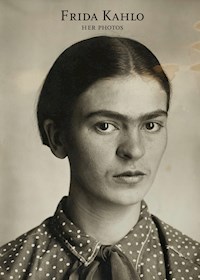
FRIDA KAHLO
her photos
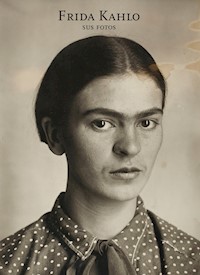
FRIDA KAHLO
her photos
Pablo Ortiz Monasterio Edition and Page Layout
EDITORIAL RM
© Photographic Archive
The Bank of Mexico
Trustee for the Diego Rivera and Frida Kahlo Museums Trust Fund
© Texts
Carlos Phillips
Hilda Trujillo Soto
Masayo Nonaka
Gabriela Franger and Rainer Hule
Laura González Flores
Pablo Ortiz Monasterio
Gerardo Estrada
James Oles
Mauricio Ortiz
Horacio Fernández
Edition and Page Layout
Pablo Ortiz Monasterio
The Frida Kahlo Museum Editorial Coordinators
Xochiquetzal González
Editorial RM Editorial Coordinator
Isabel Garcés
Typography and Design Adjustment
Gabriela Varela + David Kimura
Archive Research
María Elena González Sepúlveda
Nieves Limón Serrano
Iconographic Research
Leticia Medina Rodríguez
Restoration
Cecilia Salgado Aguayo
Liliana Dávila Lorenzana
Diana Díaz Cañas
Translation
Mario Murgia (Spanish to English)
Sandra Luna (English to Spanish)
Copy-editing and Proofreading
María Teresa González
Pre-press
Agustín Estrada Pavia
First edition 2022.
© 2022
The Bank of Mexico
Trustee for the Diego Rivera and Frida Kahlo Museums Trust Fund
Av. 5 de Mayo 2
Colonia Centro
Delegación Cuauhtémoc
06059 México, D.F., México
© 2022
RM Verlag, S.L.
c/ Loreto, 13-15 Local B
08029 Barcelona, España
© 2022
Editorial RM, S.A. de C.V.
Córdoba 234-7, Colonia Roma Norte
06700, CDMX, México
Edición en papel:
ISBN: 978-84-92480-75-3 (Editorial RM Verlag, S.L.)
ISBN (epub): 978-84-17975-66-1 (Editorial RM Verlag, S.L.)
RM @7
Digitization
Reverté-Aguilar
All rights reserved. No part of this book may be reproduced or transmitted in any form or by any electronic or mechan‑ ical means―including photocopying, recording, or any other means of information storage and retrieval―without prior permission in writing from the publisher.
At press time, it has been impossible to determine the copyright status of certain works contained in this book. Also, several subjects remain unidentified. Should you possess any information regarding these issues, please contact: [email protected]
Actividad subvencionada por el Ministerio de Cultura y Deporte
Contents
Presentation
Carlos Phillips
Frida Kahlo, Her Photographs
Hilda Trujillo Soto
Introduction
Pablo Ortiz Monasterio
I The Origins
The Influence of Frida Kahlo’s
Maternal Heritage / Masayo Nonaka
II Father
The Mysterious Father
Gaby Franger / Rainer Huhle
III The Casa Azul
The Casa Azul Photographs
Laura González Flores
IV Broken Body
The Broken Body
Mauricio Ortiz
V Love
Gelatin Silver Gossip
James Oles
VI Photography
The Years Went By
Horacio Fernández
VII Political Struggle
A Commitment to Life
Gerardo Estrada
Credits
Presentation
Carlos Phillips
The Diego Rivera-Anahuacalli and Frida Kahlo Museums Trust Fund, as well as its Technical Committee, are honored to present the book Frida Kahlo, Her Photographs, which includes over 500 pictures from the Frida Kahlo Museum Archive. Pablo Ortiz Monasterio―a photographer, editor, curator, and eager promoter of photography in Mexico―was in charge of this selection.
Upon making his donation through the Trust Fund, the great artist Diego Rivera asked Ms. Dolores Olmedo to store the archive and only make it public fifteen years after his death. Ms. Olmedo kept the archive for over fifty years, and so, after her passing, the Trust Fund Technical Committee decided to open it, catalog it, and make it public. Both the recovery and the classification of materials were possible due to the generosity of ADABI (Department for the Development of Archives and Libraries in Mexico), an institution chaired by María Isabel Grañén Porrúa and Mr. Alfredo Harp Helú.
This is an important and original archive that will certainly allow us to delve into the life and works of Frida Kahlo. Out of the vast range of works discovered, the selection here presented constitutes a true expedition into Frida’s intimate family life and also provides a good chance to know the artist’s world through pictures taken by her father, other photographers, and Frida herself.
This book, published as a co-edition and generously supported by Ramón and Javier Reverté, chairs of Editorial RM, features seven different sections into which the photographic works have been divided: “The Origins,” “Father,” “The Casa Azul,” “Broken Body,” “Love,” “Photography,” and “Political Struggle,” which are accompanied by essays written by Masayo Nonaka, Gaby Franger and Rainer Huhle, Laura González Flores, Mauricio Ortiz, Gerardo Estrada, James Oles, and Horacio Fernández. These personalities are experts from different countries―Germany, Spain, the United States, Japan, and Mexico―who present to us their views on the materials gathered in this publication.
It is so, then, that the Diego Rivera Anahuacalli and Frida Kahlo Museums Trust Fund materializes Diego Rivera’s will―to preserve the artistic treasures donated to the people of Mexico and to render them accessible for a better understanding of the works by these great artists.
✭
FRIDA KAHLO, HER PHOTOGRAPHS
Hilda Trujillo Soto
The Frida Kahlo Museum
Photography was a key influence on Frida Kahlo’s work. This was because of the early contact she had with visual images due to her father’s occupation, and later on, because of her close relationship with photographic artists whom she befriended, like Tina Modotti, Edward Weston, Nickolas Muray, Martin Munkácsi, Manuel Álvarez Bravo, Lola Álvarez Bravo, Fritz Henle, and Gisèle Freund, among others.
Thoroughly and lovingly, Frida amassed a vast photographic collection. In it, we can find photographs that must have belonged to either her family or Diego Rivera. However, it was she who took the trouble to keep them. The artist was undoubtedly fond of these beloved objects―she would alter them by adding colors and lipstick kisses, by mutilating them or by writing her thoughts on them. She cherished them as substitutes for the people she loved and admired, or as images portraying history, art, and nature.
Through the means of photography, devised in the 19th century, Frida knew and used the artistic power of images. Either in front or behind the camera, Frida Kahlo developed a strong, well-defined personality, which she managed to project by means of an ideal language―photography. Her relationship with Nickolas Muray, an outstanding fashion photographer for magazines like Vanity Fair or Harper’s Bazaar, illustrates the way Frida established a natural connection with the lens. Many of Frida’s finest and best known pictures were taken by the Hungarian-born American photographer. However, the photographs that Muray took while Frida was in the hospital, painstakingly painting her pictures, also stand out for their crudeness. These images greatly contrast with those in which we can see her before her surgeries, flirty and challenging, as she naturally was. Despite the excruciating pain that tormented her, Frida never lost her fascination for the camera, a device she always thought of as an instrument for portraying her vitality and strength.
Thanks to Frida’s photographic collection, we can now state that her father’s fascination for self-portraits was a fundamental influence on both, the artist’s work and the way she always posed for the camera. Even in the childhood portraits taken by her father we can sense Frida’s astonishing talent for exploiting her best angles and poses.
A piercing frontal stare, always focused on the objective, was the look Frida would always sport, both in her paintings and in the pictures taken by the greatest photographers of the 20th century―Imogen Cunningham, Bernard Silberstein, Lucienne Bloch, Lola Álvarez Bravo, Gisèle Freund, Fritz Henle, Leo Matiz, Guillermo Zamora, and Héctor García, among others. Many of these images were published at the request of Claudia Madrazo in the book La cámara seducida (The seduced camera, published by Editorial La Vaca Independiente), in 1992. Similarly, the exhibition Frida Kahlo, la gran ocultadora (Frida Kahlo, the Great Pretender, 2006–2007), presented in Spain and London at the National Portrait Gallery, showed over 50 original photographs, most of which were the only surviving copies. They were part of a collection belonging to Spencer Throckmorton, an American art dealer, who has collected many of Frida’s pictures over the years. To a great extent, the artist’s self-made character is owed to the great influence that photography exerted on her.
Even if once she said that she was a painter rather than a photographer, Frida, like her father, knew and handled the principles of photographic composition with great dexterity. She even experimented with the camera, as is witnessed by the images found in the Casa Azul archives. She is the author of three pieces, which she also signed in 1929. Nevertheless, there are many more that remain anonymous, but which can be attributed to her given certain features shared by her paintings. One of the pictures signed by Frida is a portrait of Carlos Veraza, the painter’s favorite nephew. The other two photographs are undeniably thought-provoking. The first one is reminiscent of Frida’s traffic accident at the age of 18, which would become the core obsession in her pictorial work. The piece shows a rag doll lying on a mat, next to a riding horse and a wooden cart at the side. The second appears as a very modern still nature where the objects may have been set out to be photographed in the fashion of modernist compositions by Manuel Álvarez Bravo, Tina Modotti, or Edward Weston.
The stack of unsigned photographs includes one that stands out for its evident visual intention. It is a provocative image showing a huge cardboard-and-wire skeleton lying on a lawn.
The artist’s interest in photographic technicalities becomes evident in a letter from Tina Modotti containing instructions for Frida. Modotti answers Frida’s questions regarding certain aspects she would need to take into account in order to copy three negatives of Diego’s mural in Chapingo. “I have just received your questions, and I’m answering right away because I can imagine how difficult it must be for you to make the copies. Had I known you would make them yourself, I would have given you some personal directions […] I should say only one thing. Pan-chromatic film must be developed in a green light, not red, since red is the most sensitive color on this kind of film.”
On the other hand, and putting aside the technicalities of photography, this artistic means reflected Frida’s love and devotion. The artist altered some of her portraits and colored certain images or reproductions of her work, as is evident a photograph of her painting Self-portrait in a Velvet Suit (1926), which she lovingly called “the Boticelli.” This was a canvas painting dedicated to her first flame, Alejandro Gómez Arias.
In some other cases, Frida would cut out, fold away, or even tear up the photographs after being involved in conflicts with their subjects. And so happened with Carlos Chávez, who, as Director of the Institute of Fine Arts, refused to display Diego Rivera’s mural A Nightmare of War, A Dream of Peace (1952). This compelled Frida to send him an aggressive letter of rebuke and to banish him from her private album. Another example is the artist’s portrait with Lupe Marín, Diego’s second wife, which Frida carefully folded in two, thus detaching herself from the muralist’s ex-wife. It may be thought that Frida half-displayed the picture, hiding Lupe’s image yet keeping from destroying it, as she did in the case of Carlos Chávez’s picture.
Frida’s illnesses prevented her from spending much time outside and from entertaining her models for long periods of time. This is why she would use photographs to portray the characters on her canvases. In the Casa Azul archives were found, among many other examples, pictures of Stalin, which she would use for her unfinished painting Frida and Stalin (1954) and for Marxism Shall Cure the Sick (1954); portraits of Nickolas Muray’s daughter, which she would also use in one of her paintings; family pictures, on which she based the genealogy tree in Family Portrait (ca. 1950); photographs of her physician and friend Leo Eloesser; images of her pets, which she would portray in The Little Doe or Wounded Deer (1946); and several self-portraits with her parrot, her xoloescuintle dog, or Fulang Chang, her monkey.
Frida replicated in her paintings some photographs that would prove especially shocking or moving for her. Such is the case of a portrait featuring a small child lying dead on a mat, which she would then reproduce on canvas in Dimas Rosas, a Deceased Little Child (1937). Frida even used photographic fragments in some of her paintings, such as My Dress Hangs There (1933), where she accurately reproduces the image of the photographed crowd.
The great variety of photographs in this archive also accounts for the intellectual restlessness of a woman interested in topics ranging from biology and medicine to science and history, and particularly, art history. Frida utilized photography to put together a series of images she found in books and magazines, which she would later on re-use in her paintings. Those she obtained from gynecology books to illustrate female anatomy and childbirth are also decidedly outstanding.
The photographs in this book―a brief display of the thousands that Frida treasured―bear witness to the multiple purposes that the artist put them to. They are objects that throw new light on Frida Kahlo’s work. These images pave the way to the understanding of social life in the Casa Azul and also provide information on the personality and intelligence of one of the most renowned artists of recent times.
✭
Introduction
Pablo Ortiz Monasterio
I. A Hidden Photographic Archive
There are in Frida’s archive over six thousand photographs. They have lain locked in wardrobes and drawers, next to drawings, letters, dresses, medicine bottles, and many other things. When Frida died in 1954 Diego Rivera decided to donate the Casa Azul to the people of Mexico so it would be converted into a Museum celebrating Frida’s work. He asked poet Carlos Pellicer―a friend of the couple’s―to design the project, and also selected some of Frida’s paintings, including an unfinished one, a portrait of Stalin. He left the portrait in the studio where Frida used to work: It was placed on her easel, beside her paintbrushes and paints. He also picked out some of her sketches, hand-made pottery, her votive offerings, a painted girdle, books, some photographs, documents, and various objects. He put the rest away. The mythical bathroom in the Casa Azul was bound to become the most important art repository in Coyoacán and its sur- roundings. Years later, Diego Rivera would legalize his gift to the people of Mexico, including the Casa Azul and the Anahuacalli, a massive structure built on and out of volcanic rock and designed by Diego himself to house his collection of pre-Hispanic “dolls.”
Shortly before his death, Diego asked his friend and executor Lola Olmedo not to open his personal archive before 15 years had passed. When the time came to do it, Lola decided that, if it wasn’t her friend Diego’s wish to open it, she wouldn’t do it either. So, the treasure was secluded for fifty long years. It remained asleep, like in La bella durmiente story, waiting to be given the breath of life. The enormously talented and industrious Hilda Trujillo, the museum’s current director, finally breathed new life into it.




