


Erhalten Sie Zugang zu diesem und mehr als 300000 Büchern ab EUR 5,99 monatlich.
- Herausgeber: The Lilliput Press
- Kategorie: Sachliteratur, Reportagen, Biografien
- Sprache: Englisch
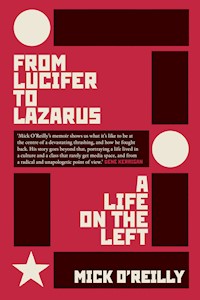
In From Lucifer to Lazarus: A Life on the Left, Mick O'Reilly shares his experiences as a politician and trade unionist and his unwavering thoughts and insights on controversial, complex issues. O'Reilly discovered socialism and militant trade unionism in the early 1960s when he joined the National Union of Vehicle Builders. He went on to join the committee of the Irish Communist Party in 1967 and the Dublin Housing Action Committee, and helped establish Connolly Youth. He took part in strikes against the European Economic Community and negotiated for protection for car workers. This book explores the power struggles and negotiations that O'Reilly has faced throughout his career, without generalities or truisms. After a party dispute in 1977, O'Reilly was employed by the Transport and General Workers' Union, and in 1979 negotiated a huge equal pay claim. Later, O'Reilly's Labour Left group sparked reform within the Labour Party, establishing that its leader must be elected by its members. O'Reilly was even suspended from the Party for a time before the charges against him were proven to be untrue, and he was reinstated in 2004. Despite navigating a career filled with adversity, O'Reilly remains decent, honest and humble. The authenticity of From Lucifer to Lazarus: A Life on the Left emphasises these often overlooked values, setting itself apart as a unique, intimate read. The foreword is written by Gene Kerrigan of The Irish Independent.
Sie lesen das E-Book in den Legimi-Apps auf:
Seitenzahl: 353
Veröffentlichungsjahr: 2019
Das E-Book (TTS) können Sie hören im Abo „Legimi Premium” in Legimi-Apps auf:
Ähnliche


















the lilliput press
dublin
Abbreviations
AEUAmalgamated Engineering Union
ATGWUAmalgamated Transport and General Workers’ Union
CPCommunist Party
CPNICommunist Party of Northern Ireland
CWCCatholic Workers’ College
CYMConnolly Youth Movement
DHACDublin Housing Action Committee
ESBElectricity Supply Board
ETUElectrical Trades Union
IBECIrish Business and Employers’ Confederation
ICTUIrish Congress of Trade Unions
IDATUIrish Distributive and Administrative Trade Union
ILDAIrish Locomotive Drivers’ Association
IRSPIrish Republican Socialist Party
ISMEIrish Small and Medium Enterprises Association
ITGWUIrish Transport and General Workers’ Union
IWPIrish Workers’ Party
NBRUNational Bus and Rail Union
NUVBNational Union of Vehicle Builders
SIPTUScientific, Industrial, Professional and Technical Union
SLPSocialist Labour Party
TDTeachta Dála
TEEUTechnical Engineering and Electrical Union
TGWUTransport and General Workers’ Union
TSBTrustee Savings Bank
TUCTrades Union Congress
WUIWorkers’ Union of Ireland
YCLYoung Communist League
Introduction
In June 2001 RTÉ’s Morning Ireland informed the nation that the Regional Secretary of the ATGWU, Mick O’Reilly, had been suspended. Also removed from office was Regional Organizer Eugene McGlone. This, the news programme reported, was due to an ‘extensive administrative audit’ of O’Reilly’s stewardship of the union.
The Morning Ireland report was based on a story in The Irish Times. The reporter who wrote the story was interviewed and asked what kind of audit was involved. Was it about ‘how things are run, or how money is spent, or both?’
‘It’s everything,’ explained the reporter. ‘It’s finance, it’s how things are run …’
I remember breathing a weary sigh. The suspensions took place during a period in which various sorts of corruption in public life were coming to light. It wasn’t a surprise that a scandal had emerged in a trade union. The unions, like everything else, are run by humans, and none of us is immune to temptation.
But if anyone could resist putting his fingers in the till, I thought it would have been Mick O’Reilly. I didn’t know him personally (since then I’ve met him once, briefly) but I knew his reputation as an implacable class warrior, totally committed to the trade union movement. In a society that too often values people not by what they do but by what they accumulate, O’Reilly was one of those who seemed to have higher values. To use the old phrase – he did not seek to rise above his class, he sought to rise with his class. He supported his own members in their fight for better pay and conditions. Beyond that, his principles and instinct led him to support anyone fighting for a fairer world. The Labour movement is full of such people, banding together in self-interest, committed to a wider solidarity.
Still, lefties are as vulnerable as anyone else to the laws of temptation. So, bugger it, I concluded. There was no escaping the fact that one of the good guys had been caught doing what he shouldn’t. It was the word ‘audit’ that did it. You don’t ‘audit’ someone’s work rate or their competence, you measure it. You audit finances. It was obvious that this wasn’t about O’Reilly becoming lazy or careless on the job. Much as I didn’t like the idea, the conclusion had to be that if the union was doing an audit, it was because union money had gone missing or had been in some way misused.
I write for the Sunday Independent, and had written about various scandals. As it happened, I knew some people in the union, people fiercely protective of the integrity of the movement. Such people might respect O’Reilly’s record, but they wouldn’t stand for any betrayal of the union. As an outsider, I expected them to refuse to badmouth O’Reilly, or at best, be lukewarm in defending him. Instead, they quietly, and in convincing detail, explained the background to the ‘scandal’ and confirmed their trust in him. There was no issue of financial wrongdoing. O’Reilly’s militancy hadn’t gone down too well in certain quarters, words were quietly spoken, an ‘audit’ was arranged, and inevitably word got to the media. O’Reilly’s memoir explains how the alleged scandal fell apart over the next two years.
In a few words, on a radio programme with more listeners than any other in the country, O’Reilly’s well-deserved reputation for honesty and decency had been destroyed. I can’t think of another occasion in which a reputation was so thoroughly shredded in so few words. The media was doing its job, reporting in good faith on a public development, so there was no libel involved. It wouldn’t have been as damaging had it been a vicious tabloid attack rather than a sober report by a radio programme with a solid reputation.
Mick O’Reilly’s memoir shows us what it’s like to be at the centre of such a devastating thrashing, and how he and Eugene fought back. His story goes beyond that, portraying a life lived in a culture and a class that rarely gets media space, and from a radical and unapologetic point of view.
Had certain cuddly trade union leaders, politicians, journalists or academics been attacked as O’Reilly and McGlone were – had they had their reputations and their careers smashed, been gagged, forbidden to speak about what was being done to them – and had they somehow got the message out, there would have been widespread outrage. Are we not, they would have asked, a democracy? The answer is: yes, we are – for some. For others, defined by class, race or gender, not so much. Which is why both O’Reilly and McGlone, and their trade union comrades who supported them, knew immediately what was happening, and why.
Gene Kerrigan
Prologue
‘Who steals my purse steals trash; ’tis something, nothing;
’twas mine, ’tis his, and has been slave to thousands;
But he that filches from me my good name
Robs me of that which not enriches him,
And makes me poor indeed.’
William Shakespeare, Othello
On 25 June 2001 I flew back from holiday in Lanzarote, landing in Dublin around 3.30 am. My phone had been stolen while I was away, so I was out of communication. I drove home and had a terrible night’s sleep.
The following morning, 26 June, I put four sugars in my coffee to wake myself up – and I don’t usually take sugar. RTÉ’s industrial correspondent Peter Cluskey came out to record an interview with me at 9 am on the appointment of David Begg as the new General Secretary of the Irish Congress of Trade Unions (ICTU). It was a ten-minute interview to be put in the can in time for the ICTU conference the following week.
As soon as that was done, I had to drive to Belfast for a meeting in the office of the Amalgamated Transport and General Workers’ Union (ATGWU). On the way I picked up Ben Kearney in Finglas, who was also going to the meeting. We had a great chat. He was my deputy in the union and was just about to retire, and I was saying that we could get him to do some part-time work for us, that I would nominate him to the employment appeals tribunal – in brief, that I would find a role for him. Retirement is a big deal in a person’s life. It was a very amicable, engaging conversation. I asked him what would come up at the meeting and he said, ‘Ah, nothing much, just a bit of moaning over the train drivers, but what’s new?’ That was it. I had no idea he’d been in contact with London.
We arrived in Belfast. Present at the meeting in Transport House were Jimmy Kelly and Norman Cairns, members of the ATGWU executive, the chair of the Irish region Jackie McCoy, the vice chair Alex Thompson, Eugene McGlone the regional organizer, myself and Ben Kearney. People asked how my holiday had gone.
Eugene McGlone said, ‘I’m after getting a phone call from Lillian Deery in the Derry office. Harry McBride [Harry was on the regional committee] has said that we’re going to be suspended this morning – that we’re going to be gassed.’
‘Fuck off out of that, Eugene, and don’t be annoying me with scare stories,’ I replied.
‘I’m telling you!’ he said emphatically.
I looked out of the window and saw Jimmy Elsby, who had been Scottish regional secretary and recently promoted to a job in London and wasn’t supposed to be at this meeting. I saw Sharon Withers – a peculiar person to be there because she was the financial administrator in the union. And I saw Ray Collins, the eyes and ears of the General Secretary who had worked in the union since he was in the boy scouts, a competent and able apparatchik who knew everything and believed nothing. I became a bit apprehensive.
‘I told you so,’ said Eugene.
We were about to start the meeting – with just a normal trade union agenda – when Collins leaned over to me. ‘Can I see you privately in your office? I have a letter for you from the General Secretary.’
I said it would wait until after the meeting, but he insisted. We went next door into my office. He handed me a letter and said he wasn’t sure what was in it, then proceeded to tell me as I tore open the envelope and read the letter. I was flabbergasted. It said that matters had come to Bill Morris’s attention and I was under precautionary suspension. I had to leave immediately. I was not to communicate with anyone in the union, or enter a union office. I could keep my mobile phone and my car. They’d let me know if they found anything once the investigation was over.
I’m not easily alarmed, but the effect was the same as having a sawn-off shotgun pointed at my head. I was dumbstruck, clueless as to how to proceed. Yet despite the shock, two things struck me. The letter mentioned ‘a number of matters that have been brought to my attention’, which sounded like he didn’t have a case yet but was going to shake the trees until he found one. Then I’d been told not to talk to anyone in the union, ‘nor any third parties with whom the union deals’.
‘I have a meeting with our members in the TSB tomorrow,’ I said to Collins.
‘Well, you’ll just have to not have it.’
It hit me that this union was prepared to leave people behind while they made wider decisions. I was out. The enormity of what was happening began to sink in.
Collins told me not to talk to anyone and the first words that came out of my mouth were, ‘Are you telling me I can’t go to mass because the Catholic Church is an institution the union deals with? Can I not talk to my wife Mary? She’s a member of the union.’
‘The words mean what they mean. You should leave the office now.’
I might have hit him, had I stayed, caught between being dumbfounded and angry. As I was leaving the office, my secretary, Valerie Cornish, said, ‘Oh, Mick, the staff will all walk out!’
‘Valerie, I’ll probably never be back here again. Don’t put yourself at risk,’ I replied. She was close to retirement and persisted in saying she would leave. In the end I got her to stay.
I walked out the front door of Transport House and hadn’t gone three steps down when I stopped. My whole life was crashing down around me. What should I do? I have to fight this union but I don’t know how to, or if I can.
A feeling of utter bewilderment surged through me. Of course you do things wrong in a union. Something happens every day; you’re in conflict with people, arguing and taking decisions, signing off on expenses. But I couldn’t think of what I might have done. In time I began to realize that I had to go the fifteen rounds, but on that morning in June 2001, I no longer knew where I was, or who I was.
ONE
The powerlessness of kindness, of senseless kindness, is the secret of its immortality. It can never be conquered.
Vasily Grossmann
Cork Street in the early 1950s was a special place for smells. They assaulted the senses. The decaying meat from Keeffe’s, overlaid with the hops from the Guinness brewery, which hung over the whole of the Liberties, and then the reek of Jeyes Fluid, permeated every room and corridor. I have vague memories of the tenement I grew up in, but I can’t be sure whether the stories have just been told so often that they’ve become reality. I do remember Morelli’s, the fish and chip shop next door, and crawling under the tables there, and the darkness of the tenement.
Our bedroom was downstairs, at the back of the building. I never saw the rats but I know they were there. My father, a gunsmith, took home a torch and a pellet gun to kill them. I remember us three kids lying on the bed with the torch watching as he did in the rats. That was pure enjoyment for us; there was no question of poverty or awfulness. In fact, we were probably better off than a lot of people. There would have been five of us children had my mother not lost two boys before me who all died shortly after being born. She then underwent a medical procedure and I was born in the Coombe hospital on 21 October 1946. The painful reality of working-class life is that although I lost my brothers, we had more money.
My father was a builders’ labourer before the war. He was working where the family lived, in Crumlin, paying a flat rather than a differential rent. Differential rent was something you might expect in an advanced left-wing state – you were allocated a house on the basis of your social need and paid for it according to your ability. Essentially, the policy followed Marx’s principle and came from Jim Larkin’s time on the Corporation, influenced by what was going on in other countries. (It was unpopular with some workers because the income they got from overtime was included when the rent was calculated.)
When my father lost his job we could no longer afford the flat rent so we moved back to the tenement. It must have been a huge setback for my mother to have to move from a Corporation house back into a tenement. The houses in Crumlin were built by a Corporation direct labour scheme, where you worked three months on and three months off. Just before the Second World War started in 1939 my father went to England to work on an aerodrome. My mother told me he won the fare to England in a coin-tossing game in Crumlin. It sounds harrowing, but it was seen as a normal thing to do.
My father ended up joining the army. He had previously been a boy soldier, having joined the British army in Dublin at the age of fourteen soon after the First World War and using his elder brother’s name and age to enlist. He served in India for a good few years and learned how to make curry, which was extremely exotic in Ballyfermot back then. He served in the artillery in the Second World War, and was on the ack-ack guns in Dover, then developed a heart condition and subsequently received a pension from the British army, an extra bit of a cushion against the normal poverty.
After the war he worked for my mother’s brothers as a gunsmith and specialized in adjusting individual gun stocks. It was an unusual profession, but every job has its perks: ours was plenty of fish and fowl, because some of his wealthier clients would bring him a perch or a pheasant or whatever. He’d take me clay pigeon shooting, and fishing. But I have very little memory of my father because he died so young: he developed angina and was dead at the age of fifty-two, when I was only seven and a half.
We moved out to Ballyfermot in 1949 or 1950 to a corner house with a big garden, the last house on Landen Road, number 453. There was a great sense of freedom in being able to just run around the garden. The other thing I couldn’t get over after we moved out of the tenement was that our new house was both upstairs and downstairs. We had a neighbour in Cork Street, Mr Fogarty, who’d lost a leg in the First World War and who my sisters used to help on the stairs. I remember saying in Ballyfermot, ‘Is Mr Fogarty upstairs?’ I just couldn’t get used to the idea. The way they built in Ballyfermot was amazing: they started at the top of the road, but the bus only went to the bottom. Landen Road is nearly a mile long, and we’d have to walk over a building site to get the bus.
I remember when my father died. He was leaning down to put the lead on our dog for my sister and I to take it for a walk, and just fell down. There was no one else in the house, and we didn’t know what to do. We had no phone at home – the nearest one was at the top of Kylemore Road. My sister ran up there and called the doctor, but my father was already dead by the time he got to us. My mother later said to my sister, ‘Oh, you should have got his tablets and put one under his tongue.’ It was only a casual remark, but fifty years later my sister told me how much it still weighs on her.
My mother’s pension from the British army was a bit more than the widow’s pension she would have got, so we weren’t the poorest family in Ballyfermot, but it was tough enough. I don’t remember hunger. You had to be careful with the food, of course, and there was no waste, but at the time there was very little choice. My mother used to shop in Fay’s in Meath Street, which had everything. You’d see rabbits hanging up and you’d pick one, and there was bacon and butter and tea. There was just butter; not a million different types of butter, just butter. There were only two types of bread. Biscuits were just broken biscuits in a bag. There was tea, just one type of tea. The quality of the food was good. People couldn’t afford lots of it, but it was nearer to where it came from, and vegetables were in season. Food was very regimented, a day for this and a day for that, and it never varied. If you were lucky you had meat on a Sunday, which might carry over for a day or two, a stew one day, a fry another day. Most households were the same.
There was no political tradition in the family. My father would have voted for Clann na Poblachta and a lot of people in working-class areas did, because they thought they offered a kind of alternative. Sometimes there would be arguments. I remember a sharp conversation between my parents when it was announced on the BBC Home Service that Stalin had died. My mother thought it was a good thing, that religious freedom would come back in the Soviet Union. My father didn’t disagree with that, but like a lot of people he had a sneaking admiration for Stalin, having survived the Second World War as he did. What must it have been like hearing the news that thousands of German soldiers had surrendered to the Red Army at Stalingrad and that the war was effectively won?
During a butchers’ strike and a picket on the butcher on Decies Road, my mother made a remark that’s come back to me over the years: ‘They’re fighting for their bread.’ I was bemused by butchers fighting for bread, and it was only years later that I understood that ‘bread’ has a wider meaning. Lots of revolutions have been fought over the price of bread. I later worked in Johnston Mooney & O’Brien and was in the Bakers’ Union for a short period, and I remember the union lobbying for an increase in the price of bread so that we could get an increase in our wages, all the while looking up and down the street to make sure none of the other union members saw us!
I was enthralled by my first Communion, and went through the motions with huge levels of sincerity and commitment. Catholicism has a lot of collective values, and the idea of all these children dedicating themselves to a wider Church has a particular appeal. I still regard myself as culturally a Catholic even though I haven’t been in a church to worship since I was about twelve years old. It’s part of my being, what I was reared with. The smell of incense still takes me back to childhood.
The whole family went shopping the day before my Communion and my mother bought me a very nice second-hand blue suit and a fawn Crombie coat in Francis Street market. It didn’t get any better than a Crombie in Ballyfermot. We then went to Johnny Ray’s ice-cream parlour in Francis Street, where my sister was delighted to be given three wafers with her ice cream instead of the usual two.
The next day I was walking down Decies Road to the school with my friend from next door. I remember my coat kindling a feeling of division between us and it didn’t feel right, so I walked down to the corner – the turn into Thomond Road – took the coat off and bundled it under a hedge. He said nothing, but there was a sort of smile and I felt at one with him. So I carried on down to the school, happy as a pig in shit, until I spotted my mother on the street. All I can say is I’m glad I found that coat again. I couldn’t explain myself to her, didn’t want her to feel that somehow she’d done something wrong, but I resented the fact that she didn’t understand.
Inequality is more than just a concept: it’s instinctive. I read the terrific Life and Fate by Vasily Grossmann, in which he talks about the danger of big ideas, Stalinism, fascism, the Gulag, the Holocaust, and that what really matters is small acts of ‘senseless kindness’. Humans – particularly children – have an instinctive feeling for freedom and tolerance. It’s part of the human spirit and we should aim to achieve a society where as little of it as possible is lost. The socialist movement is in danger of losing it with its many silly intolerances and bragging about sectarianism towards one another. I’ve tried to avoid sectarianism during my life. People in the Communist Party used to tell me not to work with Trots, and Trotskyists would tell me not to work with Stalinists.
We were always going to the pictures when I was a kid, as often as four times a week. The Gala cinema in Ballyfermot was one of the biggest in Ireland, perhaps even in Europe, holding nearly two thousand people. I went the first week it opened to see a black-and-white film called Blowing Wild, with Gary Cooper and Barbara Stanwyck. Before the Gala we would regularly go to the Tivoli or the Phoenix.
My sister Teresa is four years older than me, and Anna, the eldest, is eleven years older. It was a very warm household. As the baby of the family, I was let away with everything, and I suppose there was an extra bit of affection for me because the other three boys died. The downside was a lack of discipline. My sisters went to school in town: they took the bus from Ballyfermot to Whitefriars Street school and Weavers Square school but my mother didn’t like the idea of me going in on the bus. In 1954, when I was six and a half years old, I started in the De La Salle school in Ballyfermot. Then, when my father died, I missed school for two or three months because I was very ill. I was eleven, just into fifth class, when I left for good. My parents probably weren’t tough enough with me to make me go, and so I ended up with no formal education.
The Brothers were very violent. Although I never experienced it myself apart from a couple of slaps, I saw them kneeing and using leathers and canes. They attempted to teach us through fear. Education has gone through a complete transformation since, and I marvel at my own children and grandchildren and how they love going to school. It wasn’t all bad: you were with your mates, getting up to things, keeping busy, and I did learn how to read and write, just about – and that’s a powerful thing. As Brecht said, ‘Hungry person, read a book: it’s a weapon.’ That’s always stuck with me, and I’ve always read a lot. But it was a cram shop, an absolute cram shop. I’ve a photograph with over fifty kids in the class. How do you teach fifty kids? Of course religious people in Ireland gave a lot to education, but certainly the Brothers were violent towards the kids.
I didn’t like sport. We’d drill in Croke Park before big matches, dressed in white with the school emblem in green. A band played, and you moved to their tempo. It was like the mass parades in fascist countries or in the Soviet Union. But I fell well behind after my father died. The rest of the boys were drilling every week, but I had been out for several months after his death and couldn’t keep up with the movements. A few of us who kept getting it wrong were pulled out of the crowd to stand and wait. One of the head Brothers, Brother Leo, came up and twisted my ear – not terribly hard, he just twisted it – but I had an abscess in my ear canal at the time and the pain of it was excruciating. In my agony I headbutted him; he fell backwards and I scarpered over the wall, in front of the whole school. I didn’t really go back to school after that. It was near the holidays anyway and I might have gone back for a while after, but then I just left for good.
TWO
We’ve been accused of a lot, but I wouldn’t like to add kidnapping to it.
Johnny Nolan
I did very little after I left school. There was talk of going to the technical school, but in 1960, around the time of the massacre of Irish UN troops in the Congo, I answered an ad in the paper and got a job in Howard’s of Capel Street as a presser, making women’s clothes for thirty-eight shillings a week, ironing the inside seams so they would be flat for the linings. There were about a hundred women there, but the three pressing jobs were done by men, two older lads on the machines and me doing the seams by hand. It was a payment-by-results system, so I had to be fast to keep up with the women. It was good but hard work.
Although I should have handed my keep to my mother, I didn’t. I finally had money to buy books, and I also started drinking – usually cider in the fields, graduating to pints in the pub. I was fourteen or fifteen when I was first served in a pub, in Mattie Langan’s. Of course there was a strong drinking culture later on in the socialist and trade union movements: no meeting was complete without a pint afterwards, where the real meetings took place and the real decisions were made.
I worked in Howard’s for just over a year, until one day there was a bus strike. My sister, who worked in May Roberts, a chemist on Grand Canal Street, had always given me lifts home on her scooter but never lifts to work since we started at different times. But the boss insisted I work overtime. I said I couldn’t or I’d lose my lift and so he sacked me. That was my first experience of employers and their power. I could have come in earlier, but there was no discussion, no compromise. It was, ‘I have the power and you do as I say, or you don’t do it here.’ I had no redress – the union wasn’t strong, and I wasn’t even in the union. I vowed never to be in that situation again. And although I had many scraps with employers, I never had to fight for myself again. Still, what he did was completely unreasonable and still rankles with me today.
Then I got a job in a place called Stirling’s, near Suir Road Bridge, sorting scrap metal – lead here, copper there – and putting it into barrels. That union was better organized, but there was no shop steward. I then moved on to May Roberts, where my sister also worked. The committee in the Irish Transport and General Workers’ Union was called the drugs committee – there was even a drugs branch! The shop steward was Robbie Kavanagh, quite an ethical sort of man, very conservative. His brother became auxiliary bishop of Dublin and wrote a book called A Manual of Social Ethics, which Paddy Carmody dissected month by month on the back page of TheIrish Socialist. Robbie was a decent man, but weak, totally reliant on the idea that if you explained yourself to your betters, they would somehow find a way of looking after you.
We did overnight runs, and country runs where you came back the same day and for which you got dinner money and tea money. One of the van drivers was Jim Devves, and I occasionally went with him. The total allowance was two shillings and sixpence, but he’d give me six penny Gifty toffees instead of the six pennies, keeping the rest. I rebelled. It’s interesting that the first row I had on the job was not with the company but with another worker. Within the working class, the distribution of resources is not always fair – but it was dealt with, and he handed over the money. He was just chancing his arm but it was child labour, really. I worked six days a week, including a half-day on Saturday, so two and sixpence was a lot of money, and taking two shillings out of it was a big deal.
One of my pals, Bernard Browne – he’s still one of my best mates – was sacked along with another person for playing cards on the job. The chemists would put in the order and you went to the shelves and put it in the box. They’d work away, putting away the orders and playing a card here, turning a card there – but was it damaging the quality of the work? These people had families, yet they were just sacked with no warning.
And the workforce was passive. The rationalizations were like scenes from The Ragged Trousered Philanthropists: ‘Well, sure, what else could you do? The employer had no choice.’ I was appalled. I went to the union but didn’t even get a hearing.
Bernard got another job. I also left and walked into a completely different world, a car assembly plant making British Leyland cars called Lincoln & Nolan down in Wapping Street on the quays. There must have been five or six hundred people working there. I started at 1.30 pm on 21 October 1962, my sixteenth birthday. A foreman, Tom Dent, interviewed me for the job. He asked me a couple of questions, told me I’d be working in the stores, and then – this hadn’t happened to me in any other job – said, ‘Go and see the shop steward.’
I went to see the shop steward, Billy Wheatley. At that time in the factory there was a small group of people who used to say the rosary at lunchtime and Wheatley said: ‘Them fuckers are up there praying for overtime. But kid, you don’t mind them. You join the union, and we’ll get you time and a half for it. That’s the way this place operates.’ That went into my lather of thoughts. There’s something different about this place. Billy really looked after me and the conditions were fantastic: I worked a 35-hour week because I was under eighteen, but got paid £٤ ١٧s for forty hours, a huge increase compared to May Roberts.
The whole atmosphere was different. It wasn’t madly left wing, but the attitude to management was, ‘If you want us to do something, ask us. And you’d better listen to us, because we have a point of view on things.’ We had rows, bans on overtime, meetings in the canteen. When I went to my first union meeting in Lincoln & Nolan, I was absolutely amazed at these fellas I worked with, wearing their Sunday suit, being able to articulate about the cost of living. Everyone was as good as the people at the top table. People in the union had been to Britain, bringing a slightly more left-wing stance. The National Union of Vehicle Builders was a very militant union with a different structure, and in the British unions there was more of an emphasis on rank-and-file involvement.
A lot of unions today don’t want to let go like that. A good union is one that does things for you, but it must also teach you to do things for yourself. There is often a lack of self-belief in the working class, that they can’t get involved in negotiations or take responsibility, that they need a ‘professional’ to do it for them. That leads to consumer trade unionism, where you pay an official to work magic for you. The various union bureaucracies are not all the same. A leader in the Transport and General Workers’ Union in Britain is a very different animal to a leader of SIPTU here.
Nowadays in the trade union movement no one on the Right ever gets elected. They may end up being on the Right, but when they’re running for election in a union now, everybody’s left wing, more left wing than each other. When I was first active in the trade union movement, there was a contestation between Left and Right, with the Left being smeared generally with communism. There was a feeling that people in the Communist Party might be working for another state. Ordinary fellas would have a reservation about you in the back of their mind: they might elect you to be the General Secretary of the union, but they’d never elect you to be prime minister of the country. Éamonn McCann tells a story about his father, who was a daily communicant but always voted for communists in union elections. He said the communists were the best people to look after you on earth, and the Church would look after you afterwards. Working-class people had that pragmatic attitude.
When I first joined the union, one of their campaigns was to spread out production over the whole year. This was before the Redundancy Payments Act: people would be laid off for a few months and then taken back, and others would be weeded out. The union had a campaign to create continuity of employment, requiring the employers to carry a stock of fully built-up cars to balance them over the year in order to make roughly the same amount all the time. We forced the employers to carry the extra costs of balancing production to meet our human needs. That’s a valuable lesson. It wasn’t a Left–Right argument, because everyone agreed that this was what we should do. They kept at it and won.
It’s important for trade unions to have ambition beyond simply wages and conditions. James Connolly, in his ‘syndicalist’ phase, talks about trade unionists being soldiers who are going to move into this area of control. Wresting control and influence from employers isn’t an absolute, except in some kind of final revolution, but consists of acquiring bits and pieces of power. Gramsci is perhaps the greatest socialist writer on the idea of workers being organized as producers. Before Leninism there was a theory that socialism was about the freedom of producers. When you deal with productivity, output and efficiency, there has to be something in it for you.
The participation in and understanding of wealth production as part of the trade union agenda is critically important. The struggle between labour and capital is not just about wages, but about what and how you produce; and what we managed to do later, in the 1970s, was to erode the prerogatives of management and their control of production. That’s an important ambition for unions to have and nurture.
Billy Wheatley was helpful and encouraging, a shop steward as well as an active member of the Labour Party. He was the first person to tell me, when I was sixteen or seventeen, that I should look to lead the union one day. ‘I’ve never met anyone so young that had such potential,’ he once said. I had no idea what he was talking about.
Billy was a great wit. He worked in the underbody section of the production line with Jimmy Ronan, who we called ‘Jimmy Ronan, the Mother of Sorrows’. Jimmy was about four foot six, and Billy was about six foot four. Obviously, if you’re working in the underbody, it’s better to be four foot six. We made three basic bread-and-butter cars: the Mini, the A40 and the A60, but maybe once a year we’d make a Princess, or a batch of four of them. They would wait to get four orders, and they came in CKD (complete knock-down) packs to be broken down and assembled. The chat was that one of these Princesses was for President Éamon de Valera. Whether it was or not I’ll never know, but some of the fellas wanted to add two coats of paint and extra bitumen because it was for de Valera, while others were against it. The company made it clear that it was to be treated just like any other Princess.
Wheatley was in the underbody, pushing up the sump of the car when a big crack appeared. This was a disaster: ordering a new one would take ages and the car would be unusable in the meantime. Jimmy Ronan started on Billy in his nasal whine: ‘Is it ten or eleven children you have, Billy?’
‘Ten.’
‘Oh, God, how are they going to live? You won’t survive that, you’ll be sacked. You broke a Princess! That’ll be lying around for months. We’re talking about thousands and thousands of pounds …’
This gnawed away in Wheatley’s head until, in a rage, he ran down the factory to the foreman Billy Cunningham, caught him by the coat, pulled him up, pointed to the sump and said: ‘You see that crack?’
‘Yes?’
‘Well, I put it there! It’s all my responsibility. It’s on my shoulders it rests.’
‘Sure, we’ll just order another one. What are you getting excited for?’
His relief was immense, but I always remember the straightforward way he took his responsibility and his refusal to accept fear. He’d be the type to take up his gun and go over the top of the trench.
That’s what factory life was like. This idea that it was all bleak and awful, with no sense of fun, isn’t true. I remember they used to play the Music While You Work programme, then decided to knock it off. We all started singing instead: people have to find a way to get through the day. A lot of that is lost in modern factories. When a shop steward called Paddy McGowan, who had a droll Dublin accent, came out from negotiations, crowds of people would slowly follow him to find out the outcome. He’d turn around, adjust his glasses, and say, ‘My lips are sealed. Only nicotine can open them.’ They’d all give him cigarettes, and he’d add, ‘Nothing happened today.’
The United Irishman, the journal of the republican movement, circulated in the factory. It’s also where I saw my first copy of The Irish Socialist, the only socialist newspaper being produced in Ireland at the time. In fact, it wasn’t even produced in Ireland: it was printed in England because any printer who touched it here would have been picketed. I started reading the Socialist and found out about the Irish Workers’ Party bookshop on Pearse Street. And then I decided that I’d better join the Communist Party.
I’d joined the library and was reading every anti-communist tract I could find: George Orwell, André Gide, Koestler’s The God That Failed, the ex-communist Douglas Hyde, a book by a Jesuit called Ignace Lepp, From Karl Marx to Jesus Christ. I wasn’t reading them because I wanted to be anti-communist but because, from their titles, they were books about communism. It’s a comment on propaganda or ideas: if your disposition is such that socialism presents some set of answers to the difficulties you have in life, then no matter what the ideological superstructure tells you, you will find a way through it. Logically, I should have joined the anti-communist league, had there been such a thing, but I drew completely opposite conclusions.
I joined the party with a sceptical view of world communism. I knew it wasn’t just an idealistic organization, but if you’re going to organize to get rid of capitalism, you need armies, big forces, intellectuals, papers. And even though communism was quite small in Ireland, on a global scale they were the only show in town. I remember reading 36 Million Communists Say …, which came out in 1960 and claimed that, quite simply, if you could unite the people of the socialist world, the working class in the metropolitan countries and the national liberation movements, you could push back capitalism and open the door to socialism. Of course it didn’t happen – the opposite did – but it wasn’t an unreasonable proposition.
The gap between theory and reality is always strange. I asked Johnny Nolan behind the counter of the bookshop: ‘This Irish Workers’ Party – where do you join it?’ Nolan, who was in his fifties at the time, was first involved in the socialist movement in 1923. I think he was born in a Comintern filing cabinet. He’d been through a long socialist life. He was an absolute ringer for Captain Mainwaring from Dad’s Army and had the same mannerisms too. He was the most unrevolutionary revolutionary, a typical shopkeeper in a brown suit like you’d wear in a Catholic sodality, with a trilby hat and thick glasses. And he looks at me, while hardly looking at me at all, and says, ‘I know nothing about them.’ I didn’t know what to say, so I bought a pamphlet by the British communist Harry Pollitt, The Irish Socialist and Tribune, the British left-wing paper.
But as I turn to leave, Johnny walks out to the door and says, looking up and down the road, ‘We’ve been accused of a lot, but I wouldn’t like to add kidnapping to it.’ This might have been the beginning and end of my involvement with Irish communism. I wanted nothing to do with those cowards.




