


Erhalten Sie Zugang zu diesem und mehr als 300000 Büchern ab EUR 5,99 monatlich.
- Herausgeber: The History Press
- Kategorie: Sachliteratur, Reportagen, Biografien
- Sprache: Englisch
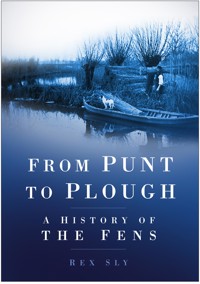
A superb examination of the history of the Fens, containing a great deal of stunning photographs.
Das E-Book From Punt to Plough wird angeboten von The History Press und wurde mit folgenden Begriffen kategorisiert:
Sie lesen das E-Book in den Legimi-Apps auf:
Seitenzahl: 226
Veröffentlichungsjahr: 2003
Das E-Book (TTS) können Sie hören im Abo „Legimi Premium” in Legimi-Apps auf:
Ähnliche



















FROM PUNTTO PLOUGH
Fen barges loaded with reed being pulled by horses in the late nineteenth century. (CC)
FROM PUNTTO PLOUGH
A HISTORY OF THE FENS
REX SLY
Inundations have always been part of life on the Fens. These men are harvesting corn by punt in 1912, when 10½ inches of rain fell in the months of July and August. (CC)
First published in the United Kingdom in 2003 by Sutton Publishing Limited
Reprinted 2003 (twice), 2004, 2006, 2007
Reprinted 2009 by The History Press The Mill, Brimscombe Port Stroud, Gloucestershire, GL5 2QGwww.thehistorypress.co.uk
This ebook edition first published in 2013
All rights reserved © Rex Sly, 2003, 2013
The right of Rex Sly to be identified as the Author of this work has been asserted in accordance with the Copyright, Designs and Patents Act 1988.
This ebook is copyright material and must not be copied, reproduced, transferred, distributed, leased, licensed or publicly performed or used in any way except as specifically permitted in writing by the publishers, as allowed under the terms and conditions under which it was purchased or as strictly permitted by applicable copyright law. Any unauthorised distribution or use of this text may be a direct infringement of the author’s and publisher’s rights, and those responsible may be liable in law accordingly.
EPUB ISBN 978 0 7509 5415 0
Original typesetting by The History Press
Contents
Introduction
1 ‘City, Mead & Shore’
2 ‘Brethren of the Water’
3 The Wash: The Fenman’s Last Challenge
4 ‘Water Loves its Own Way’
5 ‘Many Worlds More’
Acknowledgements
A map of the Fens dating from the late nineteenth century.
Introduction
I cannot claim that my ancestors were warriors with Hereward the Wake, the last of the Old English, nor the Normans he did battle with, who became the New English: I can, however, claim to be a true fenman. In 1273 the name Sly was recorded at Huntingdon, on the edge of the Fens, and from the mid-sixteenth century my family can be traced back to the southern and central parts of the Fens. There was a George Sly in Peterborough during the Civil War, and a Richard Sly from Dogsthorpe later in the century, and from the eighteenth century property transactions mention many Slys around Thorney.
Some of our family still live and work in these areas, doing what we have done here for three and a half centuries, farming and draining. In this sense my ancestors did fall in battle, not against their fellow men but against nature: theirs are the bones of drainers, farmers and, perhaps somewhere through the centuries, Fen Tigers. It is because of my deep roots in this area that I look back at the world my ancestors lived in and try to evaluate what has been achieved and what lost in these Fens. Every generation does what it believes to be right during its span on earth, and history tells us what we did and could have done; but it is the visionary who shapes our future and makes our history. Inevitably mistakes have been made in creating our environment, as mistakes have in many other fields and chapters of our history – foresight is too often based on the will to change without evaluating the alternative. Gone, for example, are the meres and moors, osier and reed, turburies and salterns; gone are gunners and decoys together with their quarry; gone are the millions of eels and the eelmen, who are but memories and fables to the fenmen of today. I mourn the loss of something so beautiful and untamed as the Fens one thousand years ago, but I am also aware that I did not have to eke out a living then and endure its hardships and uncertainties. Instead my ancestors have left the legacy I share today with others, a rich farming area, the feedlot for many and home to people who have come to live here. Slys are still farming in the Fens and serving on three Internal Drainage Boards across the land that our ancestors drained. There are many other families throughout the Fens who carry on this tradition, passed down from generation to generation, people whose forefathers passionately believed that the Fens needed to be drained and cultivated for themselves and their fellow men.
It is our duty to preserve what others laboured for and at the same time to remember what we owe to mother nature. I would like to dedicate this book to the adventurers and drainers of the past, for their vision, determination and unending resilience in creating our heritage. I am particularly indebted to the many men and women who today maintain the enormous task of keeping the Fens from inundation so that we can live, work and farm here – to the Environment Agency, their engineers and clerks; to the Internal Drainage Board members and Commissioners; to the people who operate and maintain the equipment to manage water for drainage and irrigation; and especially to the men who man the pumps, managing the engine room of the Fens on a constant vigil, day and night, to provide us all with a safe haven.
Rex Sly July 2003
CHAPTER ONE
‘City, Mead & Shore’
THE FENS
The counties of Lincolnshire, Cambridgeshire, Norfolk, and in a minor way Suffolk all lay claim to a part of the Fens. The Fens consist of fenland and marshland. Fenland is the land at some distance from the sea, which has been drained and protected from water from the highland rivers; marshland has been reclaimed from the sea. Since Roman times the landmass of the Fens has increased by one-third of its present-day size, thanks entirely to the ingenuity, hard work, and determination of mankind, to make up the largest plain in the British Isles, covering an area of nearly three-quarters of a million acres, which is roughly the size of the county of Surrey.
The rivers running through the Fens have a catchment area from the surrounding high country five times the size of the Fens themselves, making a total area of over 4 million acres to be drained. These rivers are all gravity fed through the Fens into the Wash and are almost all above the level of the land, some many feet higher. The fenland waters are pumped into the main drainage dykes and drains that traverse the Fens and from there they are pumped up into the rivers above or near the coast directly into the Wash itself. Many low-lying areas are pumped twice and some three times before being discharged into rivers. The total pumping capacity of all the pumping stations in the Fens is capable of moving in the region of 10 million gallons of water per minute when they are all in operation. Add this to the highland water passing through the Fens and this gives one some idea of the water that is discharged into the Wash at times of flood. This highlights the management and expertise needed to maintain the status quo created by run-off. For thousands of years this has happened but what has changed is surface run-off, the time difference between the water being deposited on the soil or man-made surface and passing into the drains and rivers, a man-made problem created by urbanisation and changing farming patterns.
An artist’s impression of a fen before drainage. (RS)
On his journey through the Fens Daniel Defoe (1660–1731) described this area as being ‘the soak of no less than thirteen counties’. The main rivers discharging their waters through the Fens are the Witham, Glen, Welland, Nene and the Great Ouse, all beginning their life in the surrounding uplands. There are other small rivers of no less importance, such as the Little Ouse, the Steeping, the Wissey, the Lark as well as smaller becks, lodes and eaus all adding to this soak. The Great Ouse is the longest of them all, over 150 miles in length, with its source not far from the Cotswolds, gathering water from five counties on its way to the Wash. Its catchment area is over 2,600 square miles, or 1.5 million acres in total. Both the rivers Nene and Witham have catchment areas of over 1.6 million acres each from which to gather water and carry it to the Wash. The River Welland rises under Studborough Hill, 3 miles south-west of Daventry, and is joined by many tributaries on its way to the Fens, with a catchment area of over 0.45 million acres.
For thousands of years these rivers have gathered their waters from the hills and gleaned the soils of its finest particles of earth to be deposited in the fenlands. Forests blended with peat and over time decomposed, leaving us with rich black peat soils. Since the Ice Age the rise in sea levels at different periods caused large areas to be covered with seawater, and the inhospitable North Sea has also enriched this land with marine estuarine muds gathered from around our shores. These natural phenomena have left a legacy of soils unique to the Fens, silts, clays and peats of many variations. And just as it was water, from the sea and the uplands, that endowed us with this legacy of precious soils, so, ironically, it would be water that was to become man’s greatest adversary in controlling them for his own exploits.
Valuable topsoil that mother nature has taken several thousand years to create can be destroyed by one man during his lifespan on earth. Nowhere is this more in evidence than in the Fens themselves. The complex drainage system we have in the Fens today has been created over a period of almost 1,500 years, and would require several volumes and maps to explain how it evolved. Indeed, many books have been written and will continue to be written on this subject, for the question of Fen drainage is a never-ending, ever-changing phenomenon fuelled by controversy.
BOG OAKS
One of the characteristic features and great wonders of this area are its bog oaks, found in the black peat soils bordering the southern edges of the Fens. The ancient forests that have left this legacy flourished from the Neolithic Age, and were made up largely of oak (80 per cent of the total), but also of elm, birch, Scots fir, yew, hazel, alder, willow and sallow. The bog oaks are now buried in the peat soils but appear on the surface occasionally like skeletons of prehistoric monsters from a bygone age, spirits from the past to remind us of what was once here. They are found mainly around Holme Fen, but have been uncovered along the northern fringes of the Fens as well, usually exposed during the course of deep cultivations or land drainage. When the ploughs catch them they are uncovered by mechanical means and carted out of the fields for disposal. Piles of oak, pine or yew of varying sizes can be seen by the roadsides or near farms where they are cut up for burning as domestic fuel, or sold as garden features. As the depth of the peat soil is decreasing so are the number of bog oaks; they, like the great meres, will one day be just another Fen legend, with only relics remaining in suburban garden ornaments. Some bog oaks have been recorded measuring 90 feet in length, with no branches below 70 feet and severed 3 feet above the base. Historians say that these oaks lay in a north-easterly direction and that the storm that destroyed them must have come from the south-west. The oaks in Holme Fen, however, lie in a south-westerly direction, suggesting that a violent storm from the north-east destroyed them. Most of the oaks have their stumps still on them while some have been broken off about 3 feet above the stumps, indicating that they were buried beneath peat before the storm.
Bog oaks at Holme Fen below the surface along a fen dyke after cleaning out. The deposits of estuarine mud can be seen between layers of upland deposits illustrating the climatic changes over a period of thousands of years. (RS)
The stumps of bog oaks are sold for garden features. (RS)
This bog oak would have been over 90 feet tall. (RS)
The trees that can be seen today protruding from the soil on the side of the dykes lying in a layer of estuarine muds with a layer of peat above and below illustrate three distinct climatic changes that occurred over long periods of our history. The dark layers were caused by fresh water from the high land surrounding the Fens, which deposited soils that brought a regeneration of trees, plants and shrubs. This was followed by a rise in sea levels that caused flooding and layers of estuarine mud to cover the decomposed vegetation. The third change occurred when the sea levels fell, causing the uplands to flood the Fens once again with fresh water, forming new deposits of soil. These unique features can only be seen in certain parts of the Fens, mainly in the south, east and west sections or other low-lying parts, which would be the last to be drained. Today we can see them as the areas of black peat soil, or what remains of them. The variation in distance of the catchment areas of each river and the differing rainfall in those areas would only affect the parts of the Fen those rivers flowed through. This caused some parts of the Fens to flood while other parts, perhaps only 20 miles apart, remained dry, illustrating the effect these catchment areas had, and still do have, on the Fens themselves. With only natural drainage in the Fens at that time deposits of soil particles would have accumulated quickly, causing a mammoth build-up. This is evident by the post indicating the wastage of peat in Holme Fen since 1852, almost 13 feet in fifty-two years. Bog oaks have been uncovered over many years in varying depths of peat as it has shrunk and wasted, which may indicate that no one storm destroyed them but several. One tree I measured is 42 feet long, 3 feet in diameter at the base and 2 feet where it has been sawn off, making it probably 80 to 100 feet in length. It is also worth noting that the first branches were 30 feet from the base and the condition of the tree was excellent. The trees must have been hundreds of years old before they died and had ideal growing conditions to achieve this size, and, being of such mammoth proportions, must have reached maturity before the peat formed because forests and peat do not go hand in hand. We cannot be precise about the age of these trees because even carbon dating techniques cannot reveal such significant detail, but evidence suggests that we are looking at a period of many thousands of years back in our history.
HISTORY OR MYTH?
Many of the early writings and maps relating to pre-sixteenth-century drainage were in the hands of the religious houses that proliferated in the Fens during the Middle Ages, but as many of these were plundered by the Danish invaders of the ninth century or were destroyed in the Reformation much of this early information has been lost. Fire was another hazard: Crowland Abbey had one of the most extensive libraries in the land, but in 1091 was destroyed by a great fire. It is this lack of written sources that has led many historians and writers to speculate on what degree of drainage and embankment was carried out during the late Roman and medieval periods in the Fens. As H.E. Hallam says in The New Lands of Elloe, ‘Few parts of England can have their history so grossly misrepresented as the Lincolnshire Fenland, ignorance and interest have combined to produce a hardy myth, which continues to perpetuate itself, even now, in the works of reputable authors.’ In part this ignorance has been due to the absence of major trunk roads and industrial urbanisation, which has left the fen soils undisturbed, except to the fenman’s plough, for hundreds if not thousands of years. This has preserved the past to some extent and kept historians and archaeologists in limbo. But we are now seeing major changes in the Fens, with mass house-building, increasing industrial expansion and a more extensive road programme, all of which could unearth many historical facts and quell the ‘hardy myths’. With almost all the Fens under intensive arable farming much of the surface evidence of our past has already been destroyed. Such progress is inevitable, but for some it will lessen the mystery of the Fens and its past. For my part I pray that the origins of the dykes and sea banks, the names of villages and places may never be disproved by modern science, to spoil our dreams and fables; for without these the Fens will never be the same. A life without mystery is like a sleep without dreams, refreshing but unenchanting.
THE EARLY YEARS
To understand the intricate network of drains, rivers and bridges, together with the pumps, sluices and slackers we have today, it is essential to look back in time at man’s achievements and failures. Evidence from all the major periods of human existence – from Bronze Age to Iron Age, from Romano-British to medieval – is to been seen in and around the Fens, denoting the importance of this land for settlement. At Maxey, on the north-west edge of the Fens, flint implements have been found and aerial photographs clearly show up the boundaries of a Neolithic settlement. At Flag Fen near Peterborough there is a Bronze Age settlement, discovered partly as a consequence of the construction of a new gas power station in 1982. Now one of the most important sites of this period in Europe, this was the first proof of Bronze Age human activity in the Fen, and was preserved under layers of peat in remarkable condition. In the past few years the extensive gravel extraction works between Peterborough and Thorney have revealed further evidence from this period, suggesting that agrarian practices were carried out here on a commercial scale rather than mere subsistence farming.
Wingland New Bank, 1910. Most pre-seventeenth-century drainage took the form of embanking, not drainage proper, as this photograph shows. (CC)
The Romans had several garrisons on the edge of the Fens and evidence has been found of settlements in the Fens themselves. In 2002, when the Weston bypass was being constructed, new evidence was unearthed of a Roman settlement at Weston, 2 miles east of Spalding. The coastline of the Wash recedes inland and has always been a natural receptacle for the tides. Wainfleet and Burnham in Norfolk were major Roman ports and with the many rivers running inland for long distances this must have made the Fens attractive for ships. We can assume that many of today’s inland towns and villages were also used as ports or staging posts for the transport of goods. Aerial photographs have also revealed the sites of other Roman (and medieval) settlements. At certain times of the year, especially when the fen soils are void of arable cropping, these pictures are perfect platforms for this panoramic x-ray of the past.
The Romans were attracted to the Fens because of the fertile soils and their products, such as fish, eels and waterfowl, but also because of the tradition of extracting salt from the sea along the tidal stretches of the Wash, which in Roman times would have been much further inland than it is today. There is considerable evidence of Iron Age and Romano-British salterns in several parts of the Fens, and new finds are still being unearthed to further our knowledge. Much has been written on this subject, especially by Heritage Trust of Lincolnshire and the Cambridge Unit, both of which have carried out and continue to carry out extensive excavations and research in this field.
While some evidence of Roman settlement is undisputed, other evidence is open to interpretation (and has been judged myth rather than historical fact). Since almost all the Roman sites that have been identified have been covered with a layer of marine estuarine muds, historians and archaeologists claim that the banks commonly referred to in the Fens as Roman have long been washed away. The banks, they say, were probably built later, either during the Saxon or post-conquest periods. Despite this later dating the fen people have always called them Roman, they are on our maps as Roman and I believe will always remain so. Examples are to be found between Wainfleet and Boston and between Boston and Spalding, mostly running north/south as flood defences from the sea. We also have remains of banks running east/west between Spalding, Wisbech, Cowbit and Tydd. The northernmost of these banks would have been sea defences while the southern ones were to protect the Fen from the upland waters. These waters needed to be contained so that they could be vectored through the Fens to discharge into the Wash, keeping large parts of the land from flooding.
An aerial photograph of Iron Age/Roman salterns near Holbeach St Johns. (Heritage Trust of Lincolnshire)
Many archaeologists also claim that the Cardyke, which runs from Lincoln along the edge of the Fens to Peterborough, may not be Roman either, despite the fact that the Fen people have since time immemorial referred to it as the ‘Roman Cardyke’ (car being the British word for fen). The dyke begins on the east side of the city of Peterborough near Eye and skirts along the edge of the Fen. Passing Peakirk, where it meets the River Welland, it then heads north through the Deepings clutching Kings Street, the Roman road, at Kates Bridge near Baston. From there it stretches on to Bourne, the birthplace of Hereward the Wake, and close by the site of the Cistercian abbey of Vaudey, now Grimsthorpe Castle, and, still trying to make us fenmen believe it is Roman, it hugs Mareham Lane, another Roman road. Passing the Gilbertine abbey of Sempringham it would have intercepted the causeway of Salters Way, a trade route from the many salterns to the east, around Gosberton Quadring and Helpringham. It then heads along the edge of the higher ground past Sleaford, Metheringham, Brandon and on to Lincoln, to meet up with its relation the Fosdyke (fossa is the Latin for canal or ditch).
The Cardykes may have served a dual purpose, one taking the upland water around the Fens into rivers for discharge into the sea and the other as a navigable transport system. It could have linked the rivers Nene, Welland, Glen and Witham, making access on these waterways to Lincoln in the north. If the Romans had used this intricate system of Cardykes and rivers, they would have been following their tendency to move themselves and their goods on water, which required far less effort and fewer bridges – which helps to explain why there remain no bridges from the Roman era in the Fens. The Cardykes may also have been of logistical importance for the transport of goods such as salt, linking to or near Ermine Street and Long Hollow, both roads of Roman origin. Near Durobrivae, the important Roman town of Peterborough, the River Nene would flow close to the Cardyke linking up to the Fen Causeway which ran from Castor eastwards to Denver in Norfolk. The Roman road of King Street commenced here, creating a link to the north of England. Other old trade routes, probably pre-Roman, near the Cardyke, were Salters Way, from Donington to Saltersford and Marham Lane from the edge of the Fens at Threekingham north to Sleaford.
A Roman bank. (RS)
The Roman Cardyke east of Peterborough, within close proximity of the Roman roads of The Fen Causeway and King Street. (RS)
The building of the dykes and sea banks required many hundreds of men, and would have had to be built over a very short space of time because of high tides. A large labour force was not available in the Fens at this time; it has to be assumed therefore that as well as the indigenous people, soldiers and prisoners of war were used. (The use of prisoners of war to dig Fenland drains and banks would last into the nineteenth century, when thousands of French prisoners from the Napoleonic wars were used in the Thorney area. Large-scale use of hand labour was also used in the early twentieth century, even after mechanical excavators had been invented.)
THE ANGLO-SAXONS
Some historians believe that when the Romans left Britain in AD 420 the Angles and Saxons from northern Europe invaded unhindered, free to burn and plunder as they wished, and virtually destroyed all traces of ancient Britain and Roman culture. However, this image of aggressive invasion has been challenged on several counts, not least because the rise in sea levels that inundated the Fens in this period has buried or destroyed much of the evidence relating to pre-Saxon settlers. Nevertheless, there is evidence that the Anglo-Saxons settled in the Fens, where they survived on fish, wildfowl and primitive agrarian practices. Settlements were scattered and survived best on the higher ground, probably through the legacy of the Roman banks. Many of the names of present-day villages bear witness to these Old English origins. Place-names ending with ‘ton’ (e.g. Kirton, Sutterton, Boston) denote the island settlements established by the earliest Saxon settlers, usually prefixed with the name of the head of the community. Names ending in ‘beck’ (e.g. Pinchbeck) denote settlements on a small stream or beck, originating from the Old Norse bekkr. The suffix ‘wick’ (e.g. Butterwick) is derived from the Old Norse wik, meaning creek, whereas the prefix ‘tydd’ (e.g. Tydd Gote, Tydd St Giles) is from the Old Saxon tid, meaning tide.
CHRISTIANITY
The Fens were soon to witness another invader, a peaceful one, but one that would change it for ever. The coming of Christianity was a major chapter in fen history, a turning-point, shaping its future as a place not only of worship but of governmental power, wealth and culture. The Romans built the first sea defences but it was the clergy who would lay the foundations for draining the Fens and civilising its inhabitants. Celtic monks were the first Christians to settle in the Fens, establishing monasteries at Thorney, Peterborough, Ely, Crowland, Ramsey and a nunnery at Chatteris between the seventh century and the Norman invasion of 1066, while the Benedictine order was established here in 960. The rules of this order stipulated that monks were to act as scholars and educators, and to maintain high standards of art and music in the sacred liturgy. The Benedictines added Ramsey to the list of fenland abbeys in 969, and by the time of the Reformation Ramsey Abbey was one of the richest in the kingdom.




