


17,99 €
Mehr erfahren.
- Herausgeber: The Robson Press
- Kategorie: Sachliteratur, Reportagen, Biografien
- Sprache: Englisch
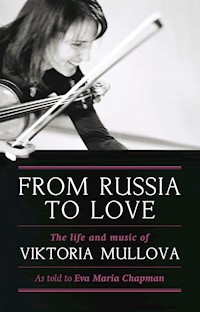
The great violinist Viktoria Mullova's story is one of striking contrasts and huge challenges. As a young musician she was a bright star in the Soviet musical firmament, but she stunned the world when she escaped the KGB and fled to the West, leaving behind her family, friends and all she knew. And in her flight from Finland, Viktoria also abandoned on her hotel bed the priceless Stradivarius she'd played during her triumph at the International Tchaikovsky Competition. From Russia to Love recounts the journey of a remarkable woman. Armed only with her violin bow and her exceptional talent, Viktoria went on to conquer the West. As her new life unfolded, first in America and then in Europe, Viktoria met fellow exiles Nureyev and Rostropovich, fell in love with conductor Claudio Abbado and learned to throw off the shackles of her Russian training. Granted unparalleled access to her subject, Eva Maria Chapman paints an intimate, truthful and sensitive portrait of a unique artist.
Das E-Book können Sie in Legimi-Apps oder einer beliebigen App lesen, die das folgende Format unterstützen:
Veröffentlichungsjahr: 2012
Ähnliche



















CONTENTS
Title Page
Author’s Preface
Chapter 1 Viktoria Mullova turns Fifty
Chapter 2 Ryabukhi
Chapter 3 Yuri Mullov
Chapter 4 Moscow
Chapter 5 Going for Gold
Chapter 6 Escape and Freedom
Chapter 7 Claudio Abbado
Chapter 8 Branching Out
Chapter 9 The Barley Factor
Chapter 10 The Barley–Mullova Household
Chapter 11 Letting Go
Chapter 12 Encompassing the Past
Chapter 13 Back in the Limelight
Chapter 14 La Baroqueuse
Chapter 15 The Peasant Gypsy Girl
Chapter 16 Journey to Love
Acknowledgements
Index
Plates
Copyright
AUTHOR’S PREFACE
I met Viktoria Mullova and her husband Matthew Barley at a music festival in Norfolk in 2008. Viktoria and I immediately formed a strong connection because of our common Ukrainian Russian past. She read Sasha &Olga, my memoir about my parents, and was moved by its echoes of her own history. I attended her concerts and was thrilled by the exquisite mastery of her violin. She was inspired by my book to find and reconnect to her relatives; I was inspired by her musical gift to research and write her story, much of it in her own words. It has been a privilege to have done so.
As we embarked upon this journey together we discovered astounding similarities in our backgrounds. She was familiar with the peasant songs my mother sang to me and even the punishments doled out. To our surprise, our mothers came from Ukrainian villages only seventy-five kilometres apart. They and their immediate families suffered the brutalities of Soviet suppression of the peasantry. Several of our forebears died of starvation in the man-made famine of 1932–33, my own grandmother cradling her son Trofim as he wasted away in her arms. Many of our family members were sent to the gulags for stealing a few morsels of food for their starving relatives, including my aunt Anna, uncle Ivan and Viktoria’s grandfather Nikolai and great-aunt Dasha. Both Viktoria and I had faced great danger escaping the Soviet totalitarian regime, me with my mother Olga at the age of three, she as the last great musical defector, aged twenty three. The families we left behind suffered as a result and were forced to endure censure from the KGB. My long-lost uncle Leonty was still afraid to talk about any of it when I finally tracked him down in 2000. Both Viktoria and I carried with us a legacy of the great terror that was wrought upon the Ukrainian people. My mother Olga could never escape it and succumbed to psychosis, spending the last seventeen years of her life in a mental hospital, never free of the fear that the KGB would come and find her.
It was the healing of the bitter 33-year rift with my father Sasha, who as a result died a happy man, which moved Viktoria to forge a closer relationship with her own father Yuri. As she said at the time, ‘I admire you so much for your strength and will to heal your family and go through all that hard work. I myself give up very easily on my relationships and you really inspired me.’
But she did not give up. On the contrary I have seen her relationships deepen as she has moved from fear to love. One of the great pleasures of writing this book has been watching Viktoria’s interaction with her father develop. The utter love and devotion that blossomed between them has been inspiring and humbling to witness.
Other highlights have been hearing Viktoria play so many different kinds of music, ranging from sublime renditions of Bach’s ‘Chaconne’ and jaunty interpretations of Vivaldi, to spirited jazz, pop and folk tunes with the Matthew Barley Ensemble. Her soulful performances of the Russian songs ‘Yura’ (for Yuri) and ‘Ochi Chernye’ (Dark Eyes), one of my mother’s favourite songs, I find especially moving and personally healing.
Eva Chapman
CHAPTER 1
VIKTORIA MULLOVA TURNS FIFTY
Viktoria could have had a very flashy superficial career based on the rather romantic story of the girl who defected. But she’s too good a musician to settle for that. She just goes for the core of the music, and I like that very direct approach. She is also a very warm human being who enjoys life tremendously. Finnish conductor Esa-Pekka Salonen
A group of people stands in front of Viktoria Mullova’s house in a tiny street in Holland Park. They have been asked to be at the door at precisely six o’clock. This group is one of fifty birthday surprises which Matthew Barley has arranged to be presented to his wife over three days. Matthew, a devilish glint in his eye, beckons the guests in. They pad across the larchwood floors and up the stairs to an elegant sitting room with handsomely crafted antique furniture. Here Viktoria (Vika to her friends), flushed with happiness and a glass of sparkling champagne, is chatting with other groups of ‘surprises’.
She can’t wait to tell her new arrivals of her first surprise, who arrived at midnight on her birthday. Her son Misha dashed in fleetingly from Cambridge University, where he is in his first year, studying music. Misha is the son she had with Claudio Abbado, and is her first-born. Her voice is warm as she speaks of him. It is the first time he has lived away from home, and the fact that he was able to come down, even briefly, is truly special for her. Her other two children, Katia, vivacious at fifteen, and Nadia, sparkly at eleven, have been planning these surprises for weeks. Katia is wearing a red dress and with her long hair parted down the middle looks remarkably like her mother as a young woman. Nadia cartwheels effortlessly across the wooden floor in her ballet outfit. She is a proud weekly boarder at the Royal Ballet School. With dimples and shining brown eyes, she bubbles with excitement. As guests sip champagne, the party unfolds. Exquisite food is arranged downstairs in the basement kitchen, and more bottles of champagne are popped. Candles flickering from containers illuminate flowers, arranged simply in glass tumblers.
It is the last evening of the three-day party and there is one more special surprise in store, the grand finale. This has been shrouded in great secrecy, and judging from the barely suppressed hysteria of Viktoria’s daughters it is obvious that something big is about to happen. As people gather around a large wooden table in the kitchen and sample the sumptuous array of food, various muffled noises, door bangings and stifled shrieks are heard in the background. The guests have been asked to keep Viktoria distracted. She, her cheeks pink with bon vivant and champagne, seems oblivious to the drama unfolding behind her.
The final fiftieth surprise has been tricky for Matthew to arrange. He has secretly flown in one of Viktoria’s favourite performers, comic violinist Aleksey Igudesman, from Vienna. Aleksey accepted the undertaking on the condition that another violinist acts as his foil. The only one Matthew can find at short notice has been touring in Canada, but has flown back to London this very evening. The muffled sounds are Matthew smuggling these musicians and their instruments in through the front door, down the stairs, past the kitchen and into the music room at the front of the house. Fortunately Viktoria, humming with happiness and social interaction, does not notice a thing. At ten o’clock all are ushered into the spacious music room, a Steinway piano gracing the corner. Viktoria is placed on a giant soft leather beanbag in the centre of the room, her eyes wide with expectation at what could possibly happen next. Aleksey, violin aloft, leaps out in front of her. Astonishment and joyous shock flood her face. She can’t believe that she has Aleksey Igudesman in her own house. He is a rare breed, a stand-up comic with violin who performs hilarious concerts. Viktoria’s kids love watching him on YouTube. All laugh uproariously. Aleksey, as well as being a good violinist, has the kind of wacky Russian humour that chimes with Viktoria.
The lavish life that Viktoria Mullova has created is a far cry from where she was born fifty years earlier: grim, wintry, 1950s Moscow. Viktoria’s mother, Raisa, in the throes of early labour, had to travel to a maternity hospital in the city in the dead of night, bracing herself and her unborn child against a temperature of minus forty degrees. She had to travel alone on the long trek from the suburb of Zhukovsky forty miles away, first on a rattling train then a change to the metro. Raisa’s husband Yuri, an aeronautics engineer, was not able to take time off from work. Then a few days later, Raisa had to pick her way down the icy road from the hospital, carrying her newly born child, bundled up against the arctic winds of early December. Old women in scarves and boots swept the ice and snow off the pavements with straw brooms as mother and child headed towards the metro and the tedious journey home. Home was a badly heated, tiny, one-room flat.
Then twenty-three years later this child had grown up, and, during a particularly frosty era of the Cold War, escaped through an iron curtain of man-made ignorance and cruelty to the West. Defection from the USSR was a deadly serious affair, courting great danger from one of the grimmest regimes of all time. Viktoria Mullova was the only solo violinist who tried. The young and beautiful heroine carried her worldly possessions, including her violin bow, in a plastic bag. The dash to freedom – containing high drama, KGB guards, a Georgian boyfriend, secret accomplices, aliases and disguises – was fraught with peril.
Viktoria’s life has been like that: full of extremes. The impoverished young woman with just her bow has become a doyenne in the world of classical music. From practising in the corner of a tiny apartment in a soulless Moscow suburb, she now lives in a stunning house which she herself has designed and decorated. This woman is full of grit and determination, fashioned by the circumstances in which she honed her exceptional technical skills. She is an inspiration. When Viktoria escaped from the USSR, she left her family and friends behind, believing she would not see them again. Now she is reconnecting with many of them. She has nurtured her relationship with her father Yuri, whom she thought she might never see again when she defected. She has reconnected with his family, who live in Irkutsk, Siberia, and has found long-lost relatives in St Petersburg.
She has travelled back to her past, to her roots, to her humble peasant origins. Being a peasant was frowned upon in Communist Russia; peasant farmers or kulaks were accused of holding back the revolution and were hounded, murdered, imprisoned and starved. Raisa, Viktoria’s mother, jumped from being a poor peasant girl straight to university. Yuri Mullov’s maternal grandmother had never gone to school in the Ukraine, yet Yuri leapt to being an aeronautical engineer in a prestigious Soviet military establishment. Even though the leap landed them both in a little box on the edge of Moscow, they felt they were part of a glorious historic revolution, and at least they had an inside toilet. As dutiful citizens they were now educated Soviet professionals, and banished any peasant antecedents from their psyches. Their daughter, however, has leapt into a unique stratosphere of her own, having become a highly acclaimed solo artist on the classical world stage. But now Viktoria Mullova is determined to reclaim her humble beginnings.
In her 2011–12 ‘The Peasant Girl’ concerts, Viktoria explores music with folk and gypsy overtones to recapture a peasant past, a time that was severely disrupted by totalitarian regimes. In these concerts, the accompanying recordings and film, she plays a selection of music with her cellist husband Matthew Barley and his Ensemble which expresses the beauty and simplicity of the land and is full of peasant humour, romance and spontaneity – all aspects frowned upon in Viktoria’s training at the Moscow Conservatoire.
Viktoria is one of the top violinists in the world today and commands that position by dint of her outstanding technical virtuosity and adventurous spirit, unafraid to venture into unknown realms both past and present. Now fifty, her life falls into two radically different halves – the first in a repressive Soviet system and the second in the comparative freedom of the West. How she has combined those antithetical experiences musically, emotionally and spiritually makes for a fascinating story.
Viktoria is also on a journey to love. As she says,
I was so single-minded when I was growing up. The fact that everything was aimed towards one goal – to succeed as a violinist – made me very tough. I was continually told by my mother to be very careful with people, because they all wanted something from me. She insisted that I must never trust anyone. Basically she herself didn’t believe in unconditional love and human kindness, and that’s what she passed on. It was impossible for me to trust people so I became a loner with no friends, not that I had a lot of time for them anyway.
When I was a teenager and started to think for myself a big crack appeared in my relationship with my mother, which grew wider in the years to come. It seemed impossible for her to let me grow up and separate. The more I rebelled against her, the more she would say, ‘you are cruel’ and ‘nobody loves you’. The more she said those words, the more I believed I was a bad person. As a consequence I became harder and harder.
I barely knew my younger twin sisters and had no idea what they were up to. There wasn’t any time to be with the family, since each day was taken up with four hours’ travel to and from school and violin practice. I saw little of my father, who was working very hard to support the family.
I didn’t feel much love in my family, not very much love for them nor for myself. The only thing they talked about was my successful future as a violinist. Who I was as a person was never important. Later on, when I was in the West, I started to crave love. I wanted to have children. I wanted to love someone unconditionally. That was the most important thing for me.
And when it happened it changed my life and I began to become a different person. I began to open up.
Viktoria says that among the most sublime moments in her life is when she is playing Bach and the audience is totally with her. As Tim Ashley of The Guardian has said, ‘To hear Mullova play Bach is, simply, one of the greatest things you can experience.’
A comment after a video of one of her Bach concerts on YouTube reads, ‘I remember how she played and won in the Tchaikovsky competition which was broadcast on American television all those years ago … she was so pretty and what a talent. Here is the finished artist in her own true voice.’ Viktoria is certainly playing more with ‘her own true voice’, but she is not ‘finished’ as an artist. Far from it.
Viktoria was twenty-two when she won the Tchaikovsky gold, the most prestigious prize in the classical world, an honour which recognised her technical mastery. Now she plays Bach in a completely different way, aiming to reflect more accurately the original ‘true voice’ of Bach, and her interpretations continue to evolve.
She has moved breathtakingly quickly from the confines of the Russian style of classical music. She has conquered one of the most sophisticated of musical art forms, mastering the core repertoire of Bach, Mozart and Beethoven. However, she keeps moving, broadening her skills and techniques to embrace music and herself in greater depth. She has excelled in the extraordinary variety that music in the West has to offer, changing her phrasing and learning subtleties of interpretation – for which she has won countless accolades. Not content with that, she has returned to an earlier incarnation of her instrument, using gut strings, changing the pitch and wielding a shorter bow – all in a new exploration of Baroque music. And she is delving into the music of twentieth-century composers and improvising.
Due to her adventurous nature she is willing to brandish her virtuoso musicianship in unusual directions. With the Matthew Barley Ensemble, which features jazz pianist Julian Joseph and her husband Matthew on the cello, she plays jazz and pop classics first performed by the likes of Duke Ellington, Miles Davis, Alanis Morissette, the Bee Gees and the Beatles in clever arrangements. Her music keeps evolving into new and exciting directions.
Whether in eliciting the depth of Beethoven’s emotion from a gut string, or improvising around peasant melodies and pop tunes with her husband, or meditating on the intricacies of Bach with her bow, or being a selfless mother to her children, or Skyping her sick father in Moscow, or feasting with her family in Siberia, Viktoria Mullova is on a journey to love, working her way towards a 21st-century future which combines all the good, bad and ugly of the last century.
To understand this we have to go back to her roots.
CHAPTER 2
RYABUKHI
There is something deep in Viktoria’s basic aesthetic of how she relates to the world, and more importantly to the music she loves and plays. She loves simplicity, and emotional directness and power, as well as the virtuosity that comes from the heart and for the heart. While I was musing on all this, we listened to ‘The Peasant’ by Weather Report, and it occurred to me that this was the key that I’d been searching for! Just two generations ago, Viktoria’s ancestors were living off the land in a tiny village in the Ukraine, and it was this peasant quality that is so deep in her – of course not in any pejorative sense, but in the sense of a deep, calm honesty and simplicity. Matthew Barley,2010
Up until a couple of years ago, Viktoria knew very little about her past. Her parents didn’t mention their early lives. Her mother was ashamed of her peasant origins and never spoke about them. Viktoria on the other hand, is not. ‘I am not ashamed at all. I am very proud of being a peasant girl. I want to discover as much about my roots as I can.’
As this history is uncovered it has become understandable why it has been hidden. Viktoria’s past is steeped in tragedy, humiliation and persecution. Viktoria’s maternal grandparents, Marusia and Nikolai Ivanenko, were born at the start of the First World War and their daughter Raisa during the Stalinist purges of 1938. They came from the tiny Ukrainian village or selo of Ryabukhi, Marusia and Nikolai being children just as the new Bolshevik regime began its long, lethal war against the peasants. Both Nikolai’s and Marusia’s parents were branded kulaks, peasants who dared resist the regime. When Raisa was born, no one was safe in the USSR and people became extremely secretive and were forced to obliterate normal human feelings. As Viktoria says, ‘there are many things we will never know; so many of my family were killed. We were kulaks who were hated by the Soviet regime. But I am so happy now to start to know; to know something.’
With more information gathered from surviving relatives by Viktoria and myself, a picture emerges which puts a frame around this rare woman who straddles an era of repressive terror and an era of boundless liberation, her sublime music weaving its common thread through both.
One of the people approached is Viktoria’s mother Raisa. She is divorced from Viktoria’s father and now lives in Italy. Viktoria Skypes her to gather information about her past. Her mother is a fair-haired, youthful-looking woman in her early seventies who can be very sharp and to the point, as witnessed immediately when Viktoria introduces me as her biographer. ‘I don’t understand why this person is writing your story. I should be writing it, not her.’ Viktoria sighs apologetically. ‘This is typical of my mother. She thinks she knows everything about me and the way I feel.’
When Viktoria tells her that my family, the Nesterenkos, came from Tarasivka, a village only a short distance from her own, she softens a little.
‘Can you say something about your grandparents?’ Viktoria asks, hoping to get over this hiccup. Raisa seems reluctant to answer but does say that her grandmother Lydia was a healer and midwife in Ryabukhi, her grandfather Konstantin Palaus had a small plot of land from which to feed his family and that her mother Marusia was the seventh of thirteen children, and enough other details to build up the picture. It starts during a time of relative calm in the Ukrainian countryside, before the explosion of the First World War and other drastic events which would change the lives of the people in Ryabukhi forever.
Lydia Palaus led the sickly horse gently through the old orchard her husband’s grandfather had planted, and headed out towards the woods, two of her five children trailing behind. She and the children were singing their favourite ‘going to the woods’ song:
‘Pashli detki tam gulyat, lat lat
Shtob svitochki tam narvat. vat, vat’
(Come on children let’s go wander, wander, wander
Picking flowers yonder, yonder, yonder.)
The horse belonged to her neighbour, who was convinced someone had cast the evil eye on the animal and had asked Lydia to bring it back to health. On the edge of the woods, in a sunny clearing, she let the horse graze while the children ran off to gather wildflowers. As the horse foraged, she spoke to it soothingly, gently stroking its mane. Lydia knew the animal would instinctively find the grasses and herbs it needed in order to be well. Her healing knowledge was revered in the selo of Ryabukhi, nestling on a tributary of the Dnieper river in Eastern Ukraine. Lydia stretched up and breathed in the clear air that blew across the steppe, admiring the undulation of the grasses which shimmered like a vast inland sea in the summer heat. She patted her hand on her stomach where her sixth child was beginning to grow. Little Dasha, a delightful little girl, came running up and gave her some wildflowers and clutched at her skirts. Lydia looked down affectionately at the sweetest of smiles dimpling Dasha’s apple cheeks.
‘Yes I remember my great Aunt Dasha,’ says Viktoria. ‘We visited her in Ryabukhi when I was a child, and she was always such a happy old lady, despite the dreadful hardships she suffered in her life.’
The horse regained its strength, and pulled the wooden plough once again, making deep furrows in the rich black earth. Wheat and rye sprouted forth abundantly and, at the end of each summer, men and women cut the hay with scythes, singing in harmony as they worked. Another child was born to the Palaus family and took its place on top of the alcove above the stove which was the warm heart of their thatched, whitewashed cottage. Lydia’s husband Konstantin, the proud owner of a few goats and chickens, tended their fruit orchard and grew potatoes and vegetables on his own patch of earth to feed his growing family. Life was tough but much better than in olden times when their grandparents were yoked by serfdom. The ground was rich, the river bubbled forth fresh water and in spring, when the warm sun melted the snow, the orchard sprang into a glorious symphony of blossom. Konstantin made samogon, a kind of vodka which was drunk on feast days, when travelling troubadours came to play on their balalaikas and skrypki and sang. Life was simple, harmonious and direct.
In 1914, Lydia gave birth again and called her child Marusia. But the rhythm of the land was rudely disrupted and was never the same again. War! All the men went off to fight. Not many knew who or what they were fighting for. A variety of foreign armies joined the fray. Soldiers came to the Palauses door with terrible injuries. Lydia didn’t even have time to sing lullabies to the new baby Marusia; lullabies she had always sung to soothe her other babies to sleep. Marusia was overlooked as chaos swirled around her.
‘My babushka Marusia was definitely neglected,’ Viktoria observes. ‘She always seemed so bitter and unhappy, not like my Aunt Dasha at all.’
Then came the Revolution! The country was in breathless upheaval. Trumpeting voices proclaimed that the centuries-old rule of the House of Romanov had fallen. The Russian cellist Gregor Piatigorsky graphically described what had hit his country:
Everything was disrupted in a mighty gust of wind that changed direction chaotically, and spread like wildfire. It was a hunt-a-hunt for Whites and Reds, for the ghosts and for the living. The wounded with their insides out charged forward, and none believed himself dead. The cries for vengeance or freedom made calls for mercy too feeble to hear. The mice of yesterday were the tigers of today, and rabbits laughed like hyenas.
Independence for Ukraine was proclaimed in Kiev. Samogon flowed freely as peasants in Ryabukhi feasted and cheered. But independence, like cherry blossom, was short-lived, trodden underfoot by the Bolsheviks, who demanded loyalty for the newly formed Soviet state. After four years of being embroiled in a world war, the countryside was now plunged into brutal civil strife, soaking the steppe in blood. Any men left in Ryabukhi were even more confused about who to fight for. Reds, Whites, Blacks, even Greens? All armies vied for recruits to join their bedraggled forces. Marauding bands grabbed anything they could lay their hands on: horses, stored food, even the boots fresh off any hapless peasant’s feet.
Konstantin Palaus just wanted to stay home quietly and tend to his goats, cut his hay and sow his garlic before the frosts set in. Lydia was pregnant again. She feared for the child within, gripped by fear of what the future would hold for all her children. Bolsheviks had torn down the local wooden church, in which she had proudly married her handsome husband. The priest who had officiated had been dragged off, never to be seen again. Monks and priests everywhere were hounded and murdered. Dreadful diseases such as typhus and Spanish flu raged through the population. Lydia’s services as a healer were in great demand and she was far too busy to pay little Marusia much attention.
The Bolsheviks were gaining more control. Lenin had demanded the peasantry sell their excess grain to the state at fixed prices. Because of runaway inflation these payments were worth virtually nothing, so most of the peasants opted not to sell. Lenin retaliated by sending in Cheka teams to seize the grain directly. The Cheka, the Soviet secret police formed in December 1917, started its unsavoury infiltration into the heart of all villages. Ryabukhi was not spared as the Cheka embarked upon the Red Terror, a campaign of executions and starvation of the peasantry. Whether wealthy or not, peasants were branded kulaks and the full fury of the Cheka was unleashed upon them in what came to be known as the ‘Bread War’. Not only were individual peasants executed but entire families and whole villages as well.
Marusia’s father Konstantin, who had inherited his father’s orchard and a modest plot of land, was branded a kulak. Lydia puzzled about this term kulak, which was being bandied around so freely; it was to become the scourge of their lives. The word kulak normally meant tight-fisted. If Lydia’s husband had any faults it was that he was far too generous, always giving away cucumbers and tomatoes to the poor and needy. But, as Lydia was to find out, truth did not seem to matter any more. The poorest peasants or bednota in the selo joined the disparaging chorus against the kulaks. Lydia was shocked as she watched the poorer lads of Ryabukhi turn against her family. As local midwife she had helped bring them into the world, and her husband had always given them cherries and apples from their orchard. The Cheka stirred up dissension, filling the lads’ heads with revolutionary fervour, agitating strongly for division between kulak and poor peasant. The lads joined the Young Pioneers and the Komsomol, where they adopted new identities as revolutionary fighters and were encouraged to combat what in the new jargon was described as ‘the proprietorial psychology’ of the peasant. Often the only thing that distinguished peasants was ownership of an extra horse or cow, a plough, or a house made from brick, or one which had boards on the floor instead of earth. The Cheka exploited old grievances between people, encouraged denouncements and legitimised murder.
The shame of her family being branded kulaks is one of the reasons Raisa is reluctant to answer questions about her past. When pressed for more information, she says to Viktoria, ‘Why do you want to know all this? It is so long ago.’ Raisa finds it so difficult talk about her peasant origins. She does not want to dwell on her past. ‘All that is not at all interesting.’
But it is very interesting to us, in our search for what makes up the peasant girl within Viktoria and our knowledge of the incredible hardship and virtual genocide of kulaks, especially those unfortunate enough to live in Ukraine.
The Bolshevik Party hated the peasantry, whom they regarded as superstitious, backward and a liability to the values of the unfolding new revolution. Lenin called them ‘hoarders, bloodsuckers and leeches’ who were starving the factory workers. In fact the civil war was regarded as a necessary stage of the revolution, a class war in which not only the aristocrats and bourgeoisie had to give up their privileges, but also peasants in the villages. When peasants who were modestly prosperous dared to resist the pressures of selling grain to cities for low prices, they were dragged from their farms, tortured, forced off to Siberian labour camps if they were lucky, or just murdered. Viktoria’s great-grandparents were not to be spared such ignominies.
The Civil War raged on. Property was looted and young Marusia cowered in a corner of her house. Her father vented his frustrations on her and beat her with a leather belt. ‘My poor grandmother was beaten a lot,’ says Viktoria. ‘I think it’s a large part of why she became such a bitter, unhappy person.’
Nowhere felt safe. Lydia’s respected position as a healer and a midwife was in jeopardy. She was now the wife of a kulak. The harvest of 1921–2 was poor and the grain quotas demanded by the Soviet masters even higher than before. People, if they had not been killed in battle, or by disease, or murdered, now died of starvation. The countryside was littered with orphans, bezprytulni, who searched in vain for something to eat. Four hundred of them were found frozen to death in the nearby district of Poltava when they jumped on to a train in search of food. Lydia had little for her children to eat. Marusia huddled on top of the stove, thin and cold. At least Lydia had managed to hide her precious seed collection in a box and bury it deep in the woods.
As the Bolsheviks consolidated power, Lenin took stock and saw how civil war, famine, and exorbitant grain quotas had taken their toll. The countryside was devastated. This was a state of affairs that would not aid the revolution, so he started to ease up.
The garlic poked its fresh green shoots in the Palaus garden as the spring sunshine thawed the ground. Linnets flitted from branch to branch of the poplars, chirping melodiously, and life regained some of its former rhythm. But people were now more subdued, more guarded. Resentments and hatreds simmered. Lydia knew in her bones as she watched Marusia collecting duck eggs that the old certainties were gone. An uneasy peace hovered over the steppe.
Lenin died, and a darker, more sinister figure cast his shadow over the lives of the people of Ryabukhi: Stalin. The one whom the poet Osip Mandelstam said had ‘cockroach eyes’, for which slander he was eventually liquidated. Stalin hated the Ukrainian peasants even more vehemently than Lenin had. In Soviet propaganda these people became synonymous with the class enemy. They had to be exterminated so that the valiant Soviet worker could prosper. Superstitious customs like Christmas trees were banned. In 1929 an internal passport system was devised so that kulaks could not escape to the towns and poison the working class with their presence and deeply flawed personas. The dreaded Secret Police were closing in again.
While Marusia was having such a tough time, her future husband Nikolai was suffering a similar fate. Viktoria has been able to find out a lot about Nikolai’s past, as she recently discovered that Nikolai’s sister Maria is still alive. Viktoria, inspired to find more of her family, was able to track down her uncle Vitaly and his mother Maria, who now live in St Petersburg. Maria was born in Ryabukhi and remembers the hard times very vividly. She, unlike Raisa, was delighted to tell Viktoria all about it.
She describes how her father Sergei Ivanenko was a prosperous kulak who worked hard on his piece of land, supporting his wife Katia and his three children, Nikolai, Kostia and herself. He owned pigs, cows, goats, and grew wheat and rye. On a fateful night in August 1930, when Nikolai was fifteen years old, men on horses stormed his parents’ farm and ordered the family out. This happened to countless peasant families all over the Soviet Union, including the Nesterenkos in Tarasivka who lost everything. Olga Nesterenko, who was just six, the same age as Maria, always remembered the terror she felt at the sound of horse hooves in the middle of the night, after which the life she knew changed forever.
This ominous event heralded the beginning of Stalin’s first five-year plan. Collectivisation was now the name of the game. Stalin was pushing for the immediate transition from private holdings to giant collective farms or kolkhozy. During the raid on the Ivanenkos’ farm, Nikolai’s father resisted and refused to be collectivised. He was condemned as a ‘bloodsucking kulak’. The Ivanenkos couldn’t bear watching all they had worked for being destroyed. They hated the kolkhoz and would rather die than be part of it. During the ensuing mayhem and upheaval, the family went into hiding. The Secret Police were always searching for Sergei. The strain became so terrible that Sergei grew ill and died. Katia, pregnant with her fourth child, was distraught and sought an abortion. In the process she contracted a fatal infection. Nikolai and his two siblings were now orphans.
Meanwhile Nikolai’s future wife Marusia Palaus stared heartbroken as her great-grandfather’s orchard, whose apple trees she loved to climb, was hacked down to make way for a massive ugly kolkhoz building. Horses and cows were forcibly taken from the peasants and put in the kolkhoz. Any resisters were branded kulaks.
Marusia was again dreadfully hungry. The famine of 1932–3 was far worse than the famine of 1922. Millions died. It was rumoured that starving gangs hunted children to eat. No linnets sang. They had been consumed. In fact singing was not heard any more. Ukrainians once loved to sing lustily and from their hearts. Peasant songs were banned.
When asked if any of her family played musical instruments Raisa’s answer is a surprise to Viktoria. ‘Yes my mother played a balalaika. A little.’ Viktoria did not know this about her grandmother. She had believed none of her family to be musical. Perhaps Marusia retreated to the cellar to play a battered old balalaika for a modicum of solace during those dismal times.
The Palaus’ goat was taken away. What pulled the family through was Lydia’s knowledge of herbs, berries and wild mushrooms. Lydia, Dasha and Marusia collected the mushrooms furtively, dried them and hid them in muslin bags under the mattress, where no one would find them and confiscate them to feed the workers of the revolution. Lydia was creative with leaves and grasses. Cherry, blackcurrant and birch leaves were made into soups. But the young Marusia became thinner.
‘My grandmother Lydia had thirteen children and three died during the Holodomor, the Hungry Years,’ Raisa tells us. This term is familiar to those with any connection with this part of the world. Only ever spoken in grave tones, it refers to the famine of the early 1930s when several million people died of hunger.
The Secret Police came to flush out more kulaks. A quota was instituted for the number of kulaks who had to be arrested in each village. Stalin damned kulaks as evil class enemies, insidious counter revolutionaries who fomented discontent. They had to be exterminated.
The denunciations resumed with lethal vigour. Lydia and Marusia watched in horror as neighbours were given only a couple of hours to collect their goods and chattels before being deported to correctional prisons.
Orlando Figes describes a scene in TheWhisperers where one old woman, who had been denounced, went up to each of her neighbours and friends to say goodbye. With great dignity, she bowed to each person in the watching circle, and said, ‘Forgive me if I have offended you.’ No one in the circle responded. Villagers all over Ukraine stood mute, terrified of the guards and afraid to support the latest victim, in case they too were carted off.
This would have been so hard for Marusia. She feared for her family. Her father had already been hounded to divulge where he had hidden their non-existent grain. She was sure her family would be hauled off next.
With the murder and deportation of a million kulaks, thousands of orphans roamed the steppe. One such group of bezprytulni comprised Viktoria’s grandfather, Nikolai Ivanenko, and his younger brother and sister.
The three orphans, Nikolai, Kostia and Maria, had been left with only the clothes on their backs. They moved in with a babushka who lived in a hovel in Ryabukhi. The old lady was frail, poor and could hardly feed the children. She subsequently died in the famine of the winter of 1932–3. Nikolai and his siblings lay low, did not speak of their parents and tried to hide the fact that they were the children of a deceased kulak. They survived on scraps, often scouring the frozen fields in the dead of night for wheat husks. Nikolai worked on the railway to try and get some money to feed his brother and sister. However, he was involved in an accident where two trains collided. The authorities, seeking to apportion blame, hounded Nikolai and discovered that as well as being under suspicion for stealing grain, he was the son of a kulak. He was arrested and dispatched to a correctional labour prison for seven years (seven to eight years was the standard term for all kulaks). In fact there was now a recruitment drive for more workers for the Soviet nation. The prison to which Nikolai was sent was attached to a coalmine in Donbass, in the south-east of Ukraine. He was set to back-breaking work as a coalminer.
Kostia, who couldn’t bear not knowing what had become of his brother Nikolai, made the long trek to find him, leaving their little sister behind. Dasha Palaus, Marusia’s older sister, befriended Maria and kept an eye on her. Travelling in those days was very difficult as everyone had to have an internal passport. As Kostia’s was stamped with the dreaded word kulak, he had to be stealthy. Eating the cold potatoes and onions stuffed into his pockets by his sister, he walked 200 kilometres and found the prison. He was appalled by the conditions in which the ‘enemies of the people’ were being ‘corrected’. They were subjected to beatings, fed appalling food and made to work like dogs for the Communist state. Exceedingly high quotas of coal had to be mined. A certain Aleksei Stakhanov dug a record amount of coal in the Donbass mine and was applauded in the national press as a hero towards whose actions all should aspire. It was announced that only the bare hands of such strong Communist workers could resist and defy the capitalist enemies who circled like hawks around the Soviet state.
Nikolai’s brother roamed around the prison camp furtively and watched the miners trudging to and from the mines. Finally he glimpsed Nikolai and they managed a brief contact. He was shocked at the state of Nikolai, who looked little more substantial than a skeleton. He wrote a letter to his sister saying that their brother would not survive and was on the verge of death.
When Viktoria reconnected with her great aunt Maria in St Petersburg in 2009, the old lady still had this letter from Kostia. ‘It was devastating for Maria to receive it,’ says Viktoria. ‘It was the last she heard from him.’
Kostia never returned to Ryabukhi. It was rumoured that he had drowned. No one knows what really happened to him. Maria, who had just turned twelve, was heartbroken. She believed both her brothers dead and wept bitter tears into the dirt floor of her hovel. Dasha, who was now in her twenties and married, was very kind to the orphaned girl and, as well as comfort, gave her food whenever she could.
At the coalmine, Nikolai had been heartened to glimpse his brother. The look in Kostia’s eyes as they said goodbye did not escape him. It said: ‘I’ll never see you again.’ This gave Nikolai the steely determination he needed to survive. So he decided to become a model coalminer, and follow Stakhanov’s example. He used every muscle he had to dig out more coal, deferred meekly to his Communist supervisors and became the epitome of a ‘corrected worker’ for the Revolution. After four years he was deemed ‘corrected’ and was able to go home. This was a huge feat, as most kulaks had to work out their full term, if they survived that long.
It was a highly emotional moment when Nikolai walked into the hovel with the dirt floors. He fell into his sister’s arms, sobbing with relief. But Maria was horrified at the sight of Nikolai. He was gaunt, emaciated and the only clothes he owned in the whole world were his grubby white undergarments. Everyone was so poor that there were no clothes to be had from anywhere. Dasha asked her sister Marusia, who was deft at using her grandmother’s old sewing machine, if she could make any clothes for him.
‘No,’ she said sadly. ‘I only have small scraps of rags.’ She had spotted the good-looking young man and wished she could help.
But Dasha and Maria had a bright idea. They got a bottle of ink from one of the abandoned buildings of the old school house, made a solution and dipped the underwear into it. Nikolai now had a new set of clothes. In fact he looked so handsome, Dasha said, ‘I’d like you to meet a very nice girl. She is my younger sister Marusia.’
Dasha introduced them to each other. Marusia couldn’t believe her luck that such a handsome young man had just walked into her life and was regarding her most appreciatively. Marusia Palaus and Nikolai Ivanenko were married shortly afterwards in a civil ceremony.
However, any happiness for the newly married Ivanenkos was short-lived. Dark clouds again rolled over their lives. Fresh persecutions, arrests and executions were sweeping the country. New enemies were found everywhere – even enemies among the Communists themselves, who with their supposedly revisionist ideas were accused of undermining the revolution from within. Instituted in the Kremlin and carried out by the dreaded NKVD, the Great Terror was a mass of campaigns to purge Soviet society of even a murmur of dissent. By far the biggest of these mass campaigns was the infamous ‘kulak operation’. This was a dreadful blow for kulaks like Nikolai, who had managed to survive punishing correctional prisons. Stalin was afraid that the freed kulaks would return to their villages, become discontented and cause trouble.
The family lived in fear of the knock on the door. The NKVD always came at night. Villagers were unable to sleep for dread of the sharp rat-a-tat. It was into this fear and uncertainty that Viktoria’s mother Raisa was born in 1938. The world was entirely unsafe. Terror reigned. No one could be trusted. Every family now had a relative either in prison, awaiting trial or shot. People waited their turn paralysed by fear, hypnotised by the power of the NKVD – caught like rabbits in its glare. Informers were everywhere.
The Great Terror effectively silenced the Soviet people. Marusia learnt to keep her mouth shut. She knew that she, daughter and wife of a kulak, was under the executioner’s knife, any slip was fatal, any flutter of the heart was fatal, any tiny mistake was fatal. She closed off all feeling, banished all sentiment and shut down totally. Her balalaika remained untouched. It stirred too many sentiments. As the writer Prishvin wrote in a secret diary at the time, ‘You have to eliminate completely in yourself the need to “speak from the heart”.’
Marusia looked at tiny Raisa in her arms, so cute, so sweet. Her heart was melting but she felt she could not afford to express too much love to her child. No lullaby warmed her throat. Like her mother before her, Marusia really feared for the future of her little girl.
A photo shows Nikolai, Marusia and their new baby Raisa ensconced on Marusia’s lap, a ribbon on top of her head. Nikolai’s sister Maria stands in the background, her hand on her brother’s shoulder. Nikolai is handsome and dapper as he can be in his ill-fitting suit. But Marusia looks old before her time and bitterness seems permanently settled around her mouth.
Fortunately Nikolai’s prowess as a coalminer and his model behaviour in the correctional camp saved the family. It was deemed that Nikolai had now attained ‘worker’ credentials and was useful to the state. Nikolai, Marusia and Raisa were ordered to travel to south-east Ukraine to Donbass, so Nikolai could resume his work in the coalmines. Marusia was not happy about leaving her mother behind, nor her village, but felt she had no choice. They wearily trudged east. Lydia hated saying goodbye to her little granddaughter Raisa.
War clouds were gathering again as Hitler made aggressive noises behind the western horizon. After the Germans attacked and stomped aggressively through Ukraine, Stalin instituted a massive evacuation of factories and essential workers. Nikolai and his family were ordered to move again, but this time thousands of kilometers to far eastern Siberia. Nikolai, a ‘corrected’ kulak, was at the mercy of the Soviets. When they said jump, he had to jump. Nikolai and Marusia were given just three hours to settle their affairs, say their goodbyes and get moving.
‘Just three hours! Can you imagine?’ Viktoria says, her voice incredulous.
Marusia put her foot down. She refused to go. She had already moved 200 kilometres from her mother and refused to travel any further. She decided that she and Raisa were not going anywhere. Stubborn and rebellious, she defied the Communist will as well as the authority of her husband. She was staying put! Desperately Nikolai pleaded with his wife. But nothing would induce Marusia to leave. The NKVD barked at her husband. His time was up. He had no choice: he had to go or he would be shot. At gunpoint he was shoved into a cattle truck. Marusia and Raisa never saw Nikolai again.
A dreadful war ravaged the beleaguered Ukrainian countryside. The superior German army overran the ragged Soviets. The Luftwaffe pulverised the steppe with streams of bombs and bullets. Marusia, Raisa and their people lay low. At least the enemy was external. At least all peoples of the Soviet Union were temporarily united against a common foe. Marusia became hard and even more bitter and taught Raisa to trust no one. Even though they now had a common enemy, old hatreds continued to fester. Marusia still felt doubly branded because she, daughter of a kulak, had married a kulak. The walls came up. All the men were gone, dead or transported. Nikolai’s sister Maria couldn’t understand why Marusia and Raisa hadn’t gone with Nikolai. At least in Siberia they would have been spared this humiliating occupation.
The war was finally over. The country, littered with millions of dead, slowly rose up from its bleeding knees. However, the people had been uplifted by the victory over the impossible Nazi foe, and life went on. The Soviet Union, barely having had time to recover, now marched ahead with industrialisation and entered a new race with the West: space exploration and the manufacture of the atom bomb. The Cold War had begun.
Raisa became single-minded in her determination to escape from her roots and carve out a new life. The way she chose was to work harder than anyone else. She dreamed of having a profession. It seemed impossible, but this was her goal. She kept herself to herself, had few friends and studied day and night. Her mother Marusia told her that her father was bad and that she must forget him. Marusia did not want her husband back. She had heard on the grapevine that Nikolai had another family in the far east. He had abandoned Marusia and Raisa. That proved he was dissolute, a no hoper. Best to be forgotten. In the future Raisa would transmit this portrayal of Nikolai to her daughter Viktoria.
Raisa was determined to succeed. She was interested in languages, making sure she learnt Russian well. Ukrainian was a kulak tongue, atavistic, barbaric, peasant-like. She wanted to study to be a school teacher. But it seemed a fantasy. How could she get away? She knew it was the only way out – the only way to prove that she was socially equal to her countrymen and leave her experience as a pariah behind. She progressed well at school and was a member of the Communist Youth League. She was happy to reject her father and all that he stood for.
When Raisa was fifteen Stalin died. She and the whole country mourned. But fear still stalked the land. Khrushchev came to power with the words of the great leader ringing in his ears, that ‘the capitalists would wring the necks of his successors like chickens’. Raisa had to remain diligent, work for the strong Soviet future. That is what a good Communist did. By dint of grit and determination, Raisa managed to get a position in an Institute for Languages in Kharkov. This was a fantastic achievement for a poor peasant girl with a highly dubious ancestry. Kharkov was a model Soviet city. It was also a distinguished centre of learning. Stalin had travelled there many times and impressive buildings had been constructed to commemorate the great leader. As Raisa entered this hallowed centre of learning she knew that this was her passport away from her backward, illiterate, peasant roots. She would now gain the professional recognition she desperately craved. She became an excellent Soviet citizen and never divulged an inkling of her past.
She visited her grandmother Lydia and Aunt Dasha in Ryabukhi, wearing modern new clothes. She strutted about like a ‘lady’, showing off her new persona. Lydia was so proud. In her old age she had begun to relax. Since Stalin died times were slightly better. She could let herself love her granddaughter in a way she could not love her daughter Marusia.
Back in Kharkov, Raisa went to a student dance. She curled her hair and wore a pretty dress which showed off her shapely figure. There she attracted the attention of a dashingly good-looking young student who was a fantastic dancer: Yuri Mullov. He was very clever, excelling at martial arts and a variety of sports. He was also a good Soviet citizen and seemed an excellent catch.
June 2009, and Viktoria has just been to visit her Uncle Vitaly and her great aunt Maria in St Petersburg. Her younger daughter Nadia accompanied her. ‘Oh, I found out so many more things,’ Viktoria’s eyes sparkle with animation. ‘It’s incredible.’
Vitaly is the child of Maria, her grandfather Nikolai’s sister, the one who had dipped his underwear in ink. Maria had married during the war and shortly afterwards gave birth to Vitaly. Viktoria, inspired to reconnect with her relatives, tracked Vitaly down, and with Nadia went to visit. They met Vitaly and his aged mother in St Petersburg. It was a joyous reunion.
What has excited Viktoria the most is that she has found out fresh information about Nikolai, her grandfather, and she is bursting to share it.
My mother always told me that her father abandoned her. Vitaly finally let me know the truth. It was not like that at all. He told me that Nikolai was heartbroken that Marusia and Raisa did not accompany him to Siberia, but was determined to return as soon as he could. Distraught to be leaving his wife and child, he was shoved into a cattle truck and shunted eastward for seventeen days across the vast expanse of Siberia. Seventeen days! Can you imagine? No food. One bucket in the corner. Dreadful. People died like flies. Every time the train stopped, the doors were flung open. Someone shouted, ‘Throw out your dead.’ Nikolai was grateful at this point that Marusia and little Raisa had not accompanied him.
Viktoria takes a deep breath. ‘At last, after seventeen horrible days, Nikolai arrived at a coalmine in the far east, near the border with Japan. The work was hard and terrible. We don’t know what happened at that time.’
Here the story becomes muddled; the country was in such turmoil and so many Russian families were broken up, the men killed, husbands and wives separated by vast distances. At some stage contact with Nikolai was lost and he later remarried. When Viktoria was born he attempted to get back in touch, but Marusia and Raisa had already closed that chapter in their lives.
This last detail shed new light on the story:
That changed a lot for me. I’d grown up thinking that I didn’t have a grandfather, and my mother had always been so negative about her father. Apparently Nikolai had continued to write letters to us all the time, tried to visit and offered money, and I never knew. The whole story was completely twisted, just like Marusia twisted the story to Raisa in the first place.
Also I found out that Nikolai’s daughter from his second family came to St Petersburg in the 1990s and my mother was reluctant to communicate with her. Eventually, after being persuaded by Vitaly, she did speak to her on the phone. It is such a shame that these divisions run so deep.
Did Vitaly speak about his own life?
Yes, he and his mother told me loads. Vitaly had a tough time as a child in Ryabukhi. His own father abandoned his mother after the war and he lived with Maria in that hovel with the dirt floor. They were so poor. So poor! You know he didn’t even know what butter tasted like till he was fourteen! And that was only after he and his mother made the long trek to Eastern Siberia to be with Nikolai. As Maria had been abandoned by her husband, she wanted to be with the only relative she had left in the world, her brother. When Vitaly and Maria arrived at their new destination, Vitaly was completely illiterate. A peasant. He only spoke Ukrainian and was ridiculed by Russian children at school. He was determined to educate himself and he did.
Viktoria’s face glows as she speaks about her uncle. ‘He went to school and worked hard but that was not enough for him to achieve what he wanted to achieve. So he worked in the local library after school and taught himself everything.’
Viktoria feels proud that Vitaly is so clever and is samaouchka (self-taught). And that he managed to pull himself out of such desperate poverty.
He worked so hard that he was put in charge of the library at the age of fifteen. He was very bright and picked up things quickly and was determined to go to university. He was also very tough and rebellious. At one point, he was approached to take a high position as a Communist Party member. He refused. He knew what he wanted and it was very dangerous to refuse.
Viktoria repeats this in wonder.
He refused! So rebellious. And he managed to get into university. Now he is director of the law faculty at St Petersburg State University, formerly Leningrad University, once attended by the likes of Turgenev, Stravinsky, Lenin and Putin. No mean feat for a poor peasant boy.




