


Erhalten Sie Zugang zu diesem und mehr als 300000 Büchern ab EUR 5,99 monatlich.
- Herausgeber: The History Press
- Kategorie: Sachliteratur, Reportagen, Biografien
- Sprache: Englisch
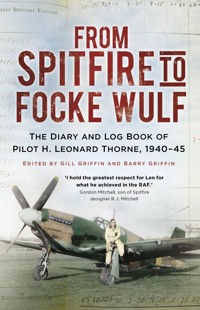
'I hold the greatest respect for Len for what he achieved in the RAF.' – Gordon Mitchell, son of Spitfire designer R.J. Mitchell In May 1940, 20-year-old Len Thorne joined the RAF, as did many young men during the Second World War. After two hectic tours of operational duty as a fighter pilot, including some desperately dangerous low-level flying at Dunkirk, he was posted to AFDU (Air Fighting Development Unit) and remained there as a test pilot for the rest of the war. Fortunately for us, Len kept a detailed diary, which, set alongside his log book, tells the unique story of a test pilot tasked with developing operational tactics and testing captured enemy aircraft, such as the feared Fw 190. During Len's career, he worked alongside some of the most famous fighter aces and his records cast light on some of the most famous flyers of the RAF, including Wing Commander Al Deere and Spitfire aces Squadron Leader 'Paddy' Finucane, Ernie Ryder and many others. A unique record of military aviation history, From Spitfire to Focke Wulf offers a window to this era of rapid and high-stakes aircraft development.
Sie lesen das E-Book in den Legimi-Apps auf:
Seitenzahl: 327
Veröffentlichungsjahr: 2013
Das E-Book (TTS) können Sie hören im Abo „Legimi Premium” in Legimi-Apps auf:
Ähnliche



















Dedicated to the memory of F/Lt H.L. ‘Len’ Thorne, A.E. and all of the brave men of Fighter Command who took part in the Second World War and subsequent conflicts.
Photographs from Len Thorne’s personal collection.Edited and made ready for publication by the author’sdaughter and son-in-law, Gill and Barry Griffin.Any errors are purely ours or Len’s.
All royalties from the sale of this book are donated to the Royal British Legion and the Royal Air Force Benevolent Fund.
First published 2013
This paperback edition first published 2023
The History Press
97 St George’s Place, Cheltenham,
Gloucestershire, GL50 3QB
www.thehistorypress.co.uk
© H. Leonard Thorne, 2013, 2023
The right of H. Leonard Thorne to be identified as the Author of this work has been asserted in accordance with the Copyright, Designs and Patents Act 1988.
All rights reserved. No part of this book may be reprinted or reproduced or utilised in any form or by any electronic, mechanical or other means, now known or hereafter invented, including photocopying and recording, or in any information storage or retrieval system, without the permission in writing from the Publishers.
British Library Cataloguing in Publication Data.
A catalogue record for this book is available from the British Library.
ISBN 978 0 75249 728 0
Typesetting and origination by The History Press
Printed and bound in Great Britain by TJ Books Limited, Padstow, Cornwall.
eBook converted by Geethik Technologies
CONTENTS
List of Photographs
The Logbook
Foreword
Introduction
1 Training
2 41 Squadron, Home Base Catterick
3 602 Squadron
4 RAF Duxford AFDU (Air Fighting Development Unit)
5 Development Flight AFDU, RAF Duxford
6 Development Flight AFDU, RAF Wittering
7 Enter the Focke Wulf 190
8 Mustangs and Others
9 The Wind-Down
Appendices
1 List of Aircraft Flown
2 Aerodromes at Which I Landed or from Which I Operated
3 Civilian Flying
4 Some Recollections of Those I Have Known
5 Letters of Condolence
Cadet Len Thorne, 1940.
Len and Estelle Thorne on their wedding day, 16th September 1941.
Len with Mustang 3 (P51b), 1944.
Len in September 1990, dressed for a church parade in Stratford-upon-Avon.
LIST OF PHOTOGRAPHS
Cadet Len Thorne, 1940
Len and Estelle Thorne on their wedding day, 16th September 1941
Len with Mustang 3 (P51b), 1944
Len in September 1990, dressed for a church parade in Stratford-upon-Avon
Logbook page beginning 15 October 1941
Group photograph of RAF cadets of 3 ITW on Babbacombe beach. Late May 1940
Pilots under training outside Norfolk Hotel, Torquay, 1941
3 ITW, September 1940
Logbook page, July 1941
602 Squadron, 1941
Johnny Niven
Cartoon by Aitkin of Al Deere
F/Sgt Les Scorer
Sgt Sanderson inspecting the cannon shell damage to his wing
Johnny Niven, Jimmy Garden, Sgt Smith and Len Thorne
Logbook extract, 1–3 October 1941
602 Squadron at rest
Len Thorne giving instruction in aero engines to Southwark ATC, February 1942
Len Thorne lecturing on combat manoeuvres to Southwark ATC, February 1942
F/Lt Roy ‘Lulu’ Lane, F/Lt Turley-George and F/Lt Desmond O’Connor
Sgt Paul Green, Sgt Sanderson and S/Ldr Brendan ‘Paddy’ Finucane
Logbook extract, early May 1942
Officer Commissioning certificate
AFDU ground crew with Spitfire Mk II P7292
Len Thorne in Spitfire P7290
AFDU group at Wittering
Tadeusz ‘Teddy’ Kulczyk and Len Thorne with Mustang Mk I
Inter-unit Christmas card to Len from his brother Leslie
LAC Leslie G. Thorne
Air-to-air filming. Spitfire VI
Logbook extract, Summary of Flying and assessment June 1942–December 1942
Len Thorne with Mustang P51b in 1943, Duxford
Certificate for a ‘Mention in a Despatch’, June 1944
AFDU Officers’ Mess Dinner
AFDU Group in front of Tempest Mk 1
Bill Burge and Bud
Len Thorne, ‘Wimpy’ Wade, ‘Susie’ Sewell and Cpl Green on a cold winter’s day, 1944
Len Thorne with crunched ME109G at Wittering, 22nd November 1944
F/Lt Len Thorne, 1945
Certificate for a Mention in a Despatch, January 1946
John Timmis, Len Thorne and Ron Rayner at Hullavington, 1991
Len Thorne and Ron Rayner at Hullavington
Len sitting in ME109G at Duxford air show, 1996
Len being shown the ‘taps’ on Messerschmitt Bf 109 G-2, 1996
A visit to Old Warden
Swapping memories with Stuart Waring and Andy Sephton at Old Warden
Len with Connie Edwards and Spitfire MH415 in Texas, 2000
THE LOGBOOK
Below is a photograph of a page in Len Thorne’s logbook dated October 1941. The left-hand side has been copied almost exactly in the following pages of this book but the right-hand leaf has had to be condensed so that both can be displayed on one sheet. There are columns for Single-Engine and Multi-Engine aircraft, sub-divided into Day and Night Flying. This is further divided into Dual or Pilot in single-engine aircraft and Dual, 1st or 2nd Pilot in multi-engine aeroplanes. There are also columns for Passenger, Instrument or Cloud flying. These have all been condensed to three columns, Dual, Pilot or Passenger. The detailed notes on the right-hand leaf have been incorporated into the story told in the text.
The summary boxes occur at the end of each month. They give details of the hours flown on each type of aeroplane and are signed by the pilot, the officer in command of a ‘Flight’ and the squadron leader. In this case the O/C ‘A’ Flight was F/Lt Norman C. Macqueen, DFC. Six months after this, on 4th May 1942, he was killed when his aircraft was hit by tracer fire from an ME109, while he was flying with 249 Squadron over Malta. The 602 squadron leader who signed above was Al Deere. Some of the figures in the flying columns were written in red. This denoted night flying.
FOREWORD
This book was first conceived almost accidentally. Len Thorne was a Second World War fighter pilot. He still had his wartime logbook and it was one of his proudest possessions. It was originally to have gone to his younger daughter, Penny, who then lived in Texas. When he was in his 85th year he decided that he did not wish it to leave England and so it was willed to the Imperial War Museum at Duxford. Because he could not keep his promise to give the logbook to his daughter, he felt guilty. This led him to make a handwritten copy of the book to give to her. When it was completed and handed over, he thought he should also give a copy to his elder daughter. She persuaded him that his reminiscences should be formalised so that we did not lose this first-hand history. Len found that the exercise of writing out his logbook had brought back many memories, so he created another manuscript copy, this time annotated with all his memories of the events which took place during his wartime RAF career and many of the people he had known. This book is the result.
It shows him to be one of the unsung heroes of the Second World War. He completed two tours of front line duty as a fighter pilot, when their life-expectancy was between two and four weeks. He then went to AFDU, the Air Fighting Development Unit, where he spent the rest of the war combat-testing new British, American and captured enemy aeroplanes.
Yet he was never decorated. He had been recommended for a medal and the citation had been written up but a change of commanding officer sent his medal elsewhere. I would not say he was bitter about it but the fact that he had no decoration did leave a scar. He was twice ‘mentioned in dispatches’, once for flight testing various Allied planes but mostly for flying comparative combat trials and demonstrations in the Focke Wulf 190A-3. His second mention was for flight testing, under operational conditions, the Spitfire Mk XXI in comparative trials against RAF, FAA and USAAF fighters to evaluate its suitability for service use and to prepare and submit a detailed report.
This was the man who held air speed records, setting a straight and level speed of 455mph in a Mustang, which made it the fastest operational airplane in the world at the time (see the entries for 5th March 1943 and 28th January 1944). He also made the first flight of a Spitfire as a fighter-bomber on 30th November 1942. Then, in late 1944 and early 1945 he was involved in the early operational testing of the Gloster Meteor Mk III, so his flying extended into the jet age. He always talked of himself as a ‘hack’ pilot, an ordinary Joe. Perhaps his lack of a medal left him with a feeling that he had done nothing special. He was always happy to talk about his time in the Royal Air Force but it was more to tell you about the aircraft and the people he had met than about himself.
Herbert Leonard ‘Len’ Thorne always denied being a Battle of Britain pilot. In British military eyes the ‘Battle’ started at the end of July 1940 and was over at the end of October 1940. He gained his ‘wings’ on his 21st birthday, 13th April 1941, went to the Operational Training Unit at Hawarden and was then posted to 41 Squadron, a front-line fighter squadron, starting active service on 11th June 1941. He always maintained that he missed being ‘one of the Few’ by six months. However, the Luftwaffe was still making bombing raids and by the end of June the RAF was sending attacking sweeps over occupied France and Belgium. The life of a fighter pilot was still measured in minutes in the air.
He flew and was friends with many of the top ‘aces’ of the war and his personal memories of these heroes add to our historical knowledge. Among others he talks about are Al Deere, Brendan ‘Paddy’ Finucane, T.S. ‘Wimpy’ Wade and James ‘One Armed Mac’ MacLachlan. He explains air combat tactics clearly. He describes technical details of the aeroplanes coherently and his lifelong love of those beautiful machines and of flying shines through.
This is the story, told through the medium of his pilot’s logbook, of a man who so loved flying that, after making a full recovery from a cancer operation six months earlier, he performed an aerobatic display to celebrate his eightieth birthday.
This was no ‘hack’ pilot. He was an extraordinary one.
* * *
After his time in the RAF, Len returned to work for High Duty Alloys in Slough and Redditch. He later moved into rivet manufacturing with Pearson and Beck, a local Redditch factory. He moved on to Black and Luff, which became a subsidiary of Bifurcated and Tubular Rivet Company of Aylesbury, rising to the position of executive Managing Director of the Midland Division of that company.
He became a Freemason in Slough in 1948, being initiated into Industria Lodge No. 5421 and when he moved permanently to Redditch he joined a local Lodge, Ipsley Lodge No. 6491 in the Province of Warwickshire. He was also a member of Bordesley Abbey R.A. Chapter No. 4495, meeting in Redditch and in the Province of Worcestershire. He remained a Freemason for the rest of his life. He died just before he was due to receive his 60 Years Certificate.
He was a member and Past President of the Redditch Probus Club and delighted in telling anyone who would listen that his very ‘correct’ wife Estelle liked to explain the acronym as ‘Poor Retired Old B***s Useless for Sex’. Len and his wife were also active members of the League of Friends of the Alexandra Hospital in Redditch. They worked together in the coffee shop for many years until Estelle became ill. Following her death in 1997 Len continued for a short time in the coffee shop, now working with his daughter Gill. He was also a member of the Committee and edited the League’s quarterly newsletter.
He was a very gregarious man and was a member of the Bromsgrove branch of The Royal British Legion. He joined the Stratford branch of The Air Crew Association and became President and he was a life member of the Spitfire Society. For several years he was Chairman of the civilian committee of Studley ATC, 480 Squadron.
Len died on 6th June 2008 – D-Day. His interest in and love of flying never died. In his last letter, to the chairman of the local Spitfire Society, four days before he died, he wrote ‘My interest in the Spitfire will never wane.’
Like many other pilots and ex-pilots, Len Thorne was deeply moved by this poem. He had a copy of it on a bronze plaque in his lounge.
High Flight (An Airman’s Ecstasy)
Oh! I have slipped the surly bonds of earth
And danced the skies on laughter-silvered wings;
Sunward I’ve climbed, and joined the tumbling mirth
Of sun-split clouds – and done a hundred things
You have not dreamed of – wheeled and soared and swung
High in the sunlit silence. Hov’ring there
I’ve chased the shouting wind along, and flung
My eager craft through footless halls of air …
Up, up the long delirious, burning blue,
I’ve topped the windswept heights with easy grace
Where never lark, or even eagle flew –
And, while with silent lifting mind I’ve trod
The high untrespassed sanctity of space,
Put out my hand and touched the face of God.
Pilot Officer Gillespie Magee
No. 412 squadron, RCAF.
Killed 11 December 1941
INTRODUCTION
I was born on 13th April 1920 in the village of Waddesdon, Buckinghamshire, the fifth child born to Benjamin and Lydia Thorne. My sister Doris was fifteen years my senior, my brother Leslie thirteen years older and Gwen ten years older. My other sister, Sybil, died in infancy. I attended the C of E school in the village. Waddesdon is the site of Waddesdon Manor, a Rothschild home, now part of The National Trust. Mother and father were the landlords of The Five Arrows Hotel in Waddesdon. Sadly, my father Benjamin Thomas Thorne had died in 1927 and three years later my mother married a Birmingham man, Ernest Massey.
In 1931, having passed a scholarship, I moved to Aylesbury Grammar School. After Father’s death my stepfather Ernest helped my mother with the hotel and garage business but in the year I started at grammar school, his health, too, became a problem and they were forced to give up the hotel and also the garage business which had been started by my father before the First World War. They moved to Birmingham. I remained at Waddesdon for the remainder of my year at Aylesbury, living with my ‘second mother’, Auntie Betty, one of my mother’s younger sisters. At the end of that year I moved to Birmingham and for a brief six weeks attended Saltley Secondary School. In late September 1932, further deterioration in my stepfather’s condition caused another move to Tewkesbury and I became a pupil at Tewkesbury Grammar School, where I spent two happy years. In the summer of 1934 my stepfather died, leaving mother in a very poor condition both financially and in health. It was decided that she would go to live with my younger sister Gwen at Poletrees Farm and for a time there was a strong possibility that, like my stepbrother, Gordon Massey, I would go into the Licensed Victuallers School, a type of orphanage, at Slough. My elder sister Doris, married to Percy Climer, a policeman, refused to accept this and I went to live with them and spent my final two grammar school years at Slough Secondary School. In 1936, having passed the Oxford School Certificate examination, I went to work as a junior clerk at High Duty Alloys, at the main factory on Slough Trading Estate and in 1938, I moved to the newly built shadow factory at Redditch.
I volunteered for aircrew training on Sept. 6th 1939 at the recruiting centre in Dale End, Birmingham. Because I was employed by High Duty Alloys Ltd, a company heavily engaged in production of aircraft components, I was deferred for three months. I was called to Cardington in January 1940 for medical and educational tests and accepted for pilot training as a cadet, rank AC 2. I again returned to Redditch, to await final call up. This came in May 1940 and summoned me to the receiving wing at Babbacombe in Devon.
Three weeks later I moved to No. 3 ITW at Torquay. With forty-nine others, I was billeted in the White House Hotel, situated high up the bank at the end of the harbour. During our stay we experienced some enemy bombing but suffered no damage. During the raids, mostly at night, we had to go down into the cellars; these cellars still contained an excellent store of wines but to our disappointment all were behind locked grills and remained untouched. My memory of ITW is of much polishing of buttons and buckles and much blancoing of webbing and, on evenings off, drinking Devonshire rough cider, all we could afford. Our officers and NCO instructors were a fine and efficient bunch of men, with whom we got on well. The WO in overall charge of 3 ITW was a super-efficient NCO who, we understood, had been transferred from the army. I remember his name as Warrant Officer Edsal, a much-feared disciplinarian who was not popular. Of course we were viewed as objects of interest and, dare I say, admiration, by the young ladies of Torquay. I expect the uniform had something to do with the attraction. Naturally, we took advantage of this whenever possible and I remember a pretty little girl who worked in the big store, Bobby’s, in the High Street. It was strongly rumoured that to discourage our amorous activities, our tea was laced with bromide or some such chemical. If this was true it did not work on me!
After successful completion of the ITW course towards the end of September 1940, at the height of the Battle of Britain, I was posted to No. 7 EFTS (Elementary Flying Training School) at Desford near Leicester, where I would be taught to fly the DH 82, De Havilland Tiger Moth, a small biplane training aircraft.
Pre-war, Desford had been a rather expensive private flying club owned by Reid and Sigrist, the instrument makers. At the end of 1939 it was taken over by the Air Ministry. The civilian flying instructors were ‘invited’ to stay on and those who did so were commissioned into the RAF. The school facilities were palatial, with a central block of buildings housing a large lounge with an adjoining dining room and kitchens. We cadets were treated like young gentlemen: pre-war habits had not yet died out. We had our own rooms in the nearby living quarters and even a batman to every four cadets.
Group photo of cadets under training at Babbacombe, late May 1940. Top row, Jonnie Timmis, shot down in September 1941 and became a POW. 2nd row, George Winter, crashed October 1941. Third row, Doug Hartwell shot down or lost, 1941, circumstances unknown and fourth from left, Len Thorne. Bottom row, John Walters from Studley, shot down in North Africa 1941/42.
Pilots under training outside the Norfolk Hotel, Torquay, 1941. Len Thorne far left.
A small number of the boys on this course were from wealthy backgrounds and had university or public school educations. These chaps were destined to become commissioned officers if they successfully completed the flying courses. The majority, like myself, were grammar school boys. To us, after the bare rooms of commandeered hotels at Torquay, Desford was pure luxury. Having entered the service as AC2s (Aircraftsman Second Class), popularly referred to as the lowest form of animal life in the Air Force, those of us who had passed the physical and ground training examinations were promoted to LAC (Leading Aircraftsman).
For the first few weeks there was no great sense of urgency and things moved at a leisurely pace. Our days were spent partly in flying and studying the Tiger Moth and partly in lessons and lectures. The latter included the theory of flight, aircraft engineering, Morse code signalling using an Aldis lamp or buzzer, navigation, meteorology and Air Force law. We studied engine starting procedure and safety precautions. Most light aircraft were started by swinging the propeller by hand. First the engine was turned over in reverse (blow out), then turned over (suck in) with the magneto switches turned off, to draw fuel into the cylinders. Then, the pilot having shouted ‘contact’, the prop was pulled over sharply and hopefully the engine would start. In the event of a non-start, the pilot would shout ‘switches off’ and raise both arms to indicate that it was safe to proceed with a re-start. I well remember being told to keep a large spanner handy as the magneto contacts sometimes stuck but a sharp tap with the spanner would cause them to part. I passed the course with the rating ‘average’.
Early in December I was posted to No. 9 SFTS, Hullavington, for advanced training, first on the Miles Master Mk 1, then to Hawker Hurricanes for all solo flying. I successfully completed the flying course, attended the passing out parade in April 1941 and received the coveted Silver Wings on April 13th, the date of my 21st birthday. I was then promoted to the rank of sergeant. My next posting was to No. 57 OTU, Hawarden, near Chester, for intensive training in the art of a fighter pilot, most of the instructors being those men who had survived the Battle of Britain. I experienced my first solo in a Spitfire Mk 1, flying from Speke airfield, now Liverpool airport.
B Flight No. 2 Squadron, 3 ITW, September 1940. Signatures on the reverse of the photograph were annotated by Len Thorne during the 1940s as information came to him. There are notations for those who failed the course, those killed in training accidents and some missing or killed in action. Red ovals, ‘halos’, were sometimes used to indicate deaths.
I was posted to Catterick in late May, to become a member of 41 Squadron, flying the more advanced Spitfire Mk 2 and, after a period of flying patrols over the northeast coast, I moved to Tangmere to take part in operations over enemy-held France. Here I saw my first enemy aircraft and experienced my first anti-aircraft fire.
After a period with ‘41’, I was posted to No. 602, City of Glasgow, Royal Auxiliary Airforce Squadron, to complete a full tour of operations lasting until May 1942. I flew under the command of many famous fighter leaders, among them Al Deere, Paddy Finucane, Francis Victor Beamish, Findlay Boyd and several others. In January 1942 I was promoted to Flight Sergeant and became senior NCO pilot in ‘A’ Flight, authorised to act, on occasions, as a flight leader. In the course of this service I was credited with five victories, three confirmed destroyed, two others probably destroyed and three damaged. In 602 we had Spitfire MkVb’s armed with 20mm cannons.
In May 1942 I was posted, on rest, to the AFDU, the Air Fighting Development Unit, which was then at Duxford and after six months I was offered the chance to become an experimental test pilot and remain at AFDU as one of the permanent staff. The following year, in August, I was appointed Flight Commander of the unit. My most notable task at this time was to fly captured enemy aircraft, including the much-feared Focke Wulf FW 190. Apart from normal flights and comparative tests I took the latter machine all over the country giving demonstrations and mock combat to our own pilots. In the spring of 1945 I was briefly acting OC flying during the absence of S/Ldr. T.S. Wade. Also at that time I had a partial rest from flying and performed the duties of range instructing officer at the Selsey bombing and firing ranges.
At the end of the war, in August 1945, I was offered a posting to the Air Ministry in London and for the next three years I was attached to the Ministry of Supply as a liaison officer with the aircraft manufacturing companies. The end of my service career came in September 1948 when I returned to civilian life.
Ex RAFVR Flight Lieutenant No. 121518(NCO No. 1164397) H.L. (Len.) ThorneOne-time Flt Commander of the Air Fighting Development Unit (AFDU) later, as part of CFE, the Air Fighting Development Squadron (AFDS)
1
TRAINING
No. 7 E.F.T.S. (Elementary Flying Training School), Desford
No. 9 S.F.T.S. (Service Flying Training School), Hullavington
No. 57 O.T.U. (Operational Training Unit), Hawarden
Towards the end of September 1940, at the height of the Battle of Britain, I was posted to No. 7 E.F.T.S. (Elementary Flying Training School), Desford, near Leicester, to be taught to fly De Havilland Tiger Moth biplanes.
Explanation of exercises
The sequence of flying lessons is in accordance with the following numbers:
1.
Air experience
1a.
Familiarity with cockpit layout
2.
Effect of controls
3.
Taxiing
4.
Straight and level flight
5.
Gliding
6.
Medium turns
7.
Taking off into wind
8.
Powered approach
9.
Gliding approach and landing
10.
Spinning left and right
12.
Side slipping
13.
Precautionary landing
15.
Steep turns
16.
Climbing turns
17.
Forced landing
18.
Instrument flying
20. & 20a.
Night flying
22.
Aerobatics
I believe that 11, 14, 18 and 21 are lessons that apply to multi-engined aircraft training.
7 October: In my logbook at this point is a pencilled note, as follows:-
Times at Desford
WEEK ENDING 4/10/40. 4 hours 50 minutes. A red stamp follows that says:
Certified correct, dated 5 Oct 1940 and signed by my instructor F/Lt Wardell, No. 7 EFTS. Desford.
29 October: Although we started out full of confidence, it still came as a surprise when we achieved our first solo flight. On this day, after weeks of training, I made the first flight of the day with F/Lt Hall, my usual instructor. There was nothing untoward about it so it came as a surprise when, for my next flight, I was taken up by Sgt Males who, although an NCO, was a very experienced instructor and he put me through the complete list of exercises I had learned so far. After landing, we taxied in to the dispersal point and he climbed out, leaving the engine running. To my amazement he was holding the joystick (control column) from the second cockpit. He shook it towards me and shouted, ‘She’s all yours; do one circuit and landing then come in and switch off.’ There is a song that originated in the Navy that starts:
‘They say in the air force a landing’s OK
If the pilot gets out and can still walk away.’
I could and I did – a wonderful feeling!
On this day I had one more short flight with F/Lt Hall. He then sent me off again; this time he had switched off and stopped the engine, so I had to go right through the starting procedure before taking off for a solo flight of 1 hour and 5 minutes. A wonderful day, I felt like one of the gods.
Depending on possible previous experience (including manual dexterity developed by an activity such as horse riding), most cadets would go solo in 12 to 14 hours, so my 14 hours 35 minutes was fairly average. 16 hours was crunch time; those who had not made it by then were subjected to a CFI (Chief Flying Instructor) Test, and his verdict was final. If he decided that a cadet was not going to make the grade as a pilot, the unlucky chap would be offered a transfer to other aircrew duties, i.e. navigator, observer, air gunner, radio operator and later the new category of Flight Engineer. Refusal to accept usually resulted in a transfer to ground duties. As far as I remember, roughly 10 per cent failed to clear this obstacle.
3 November: Through October and November there was no leave and the occasional day, or half day, off was spent locally. There were church parades on Sunday, otherwise just assemblies in the mornings, very relaxed, no ‘bull’. There were infrequent visits to Desford village for a drink at the local pub, but these were not encouraged. Most of us were fairly short of cash or engaged in revision of lectures. There were also one or two evening trips to sample the wartime delights of Leicester. We had, of course, been given further lectures in personal hygiene and the dangers of VD, the ET (early treatment) room and how to use that little tube of ointment with the long, pointed nozzle.
It was after one of these trips to Leicester that three of us missed the last bus back to base. We had no alternative but to start walking the 10 miles back to Desford. When about halfway, foot sore and weary, a kindly motorist offered us a lift. It was only after our arrival at our quarters that we realised to our horror, that our benefactor was none other than the CFI (Chief Flying Instructor) F/Lt Wardell. He pretended not to notice that we were cadets and said nothing but ‘Good night’. We should, of course, have been back in camp by 2200 hours and it was then nearly midnight.
5 November: By this time the RAF’s losses of fighter pilots in the battles over France, in the Dunquerque evacuation (operation Dynamo) and in the Battle of Britain, had become grave. Over 1,000 pilots were killed and many others were out of operation with wounds, burns, injuries from crashes and sheer fatigue. Most of these were pre-war trained, very experienced pilots. Replacements were a matter of great urgency and our flying training was stepped up to as many as six flights a day. (See 15 November.)
7 November: The flying lesson on this day was an exciting step forward. After running through various emergency procedures, I was given my first introduction to the joys of aerobatics. Incredibly, after just that one lesson, I was let loose to perform aerobatics on almost every following solo flight. As I remember, these in the Tiger Moth were limited to slow rolls right and left and straightforward loops. The rolls would have been really slow, around a level axis. I do not remember performing barrel rolls until much later and then probably by accident. In the perfect slow roll, when inverted, you would leave the seat and your weight would be taken by the shoulder straps or harness. It was therefore most important to ensure that the latter were properly tightened.
8 November: The next step forward was the navigation exercise on that day. Although only 50 minutes flying time it was the culmination of the many hours spent in the classroom. A destination having been selected, we had to complete a flight plan by laying out a line of flight on a map, allowing for wind speed and direction. We then calculated the compass direction, the IAS (indicated air speed) as shown on the ASI (air speed indicator), and the speed over the ground TAS (true air speed). Finally, we had to decide on the height at which we would fly and set the altimeter for air pressure at ground level.
13 November: Just five days after my dual navigation lesson came the high spot so far: I was trusted to fly solo to Cosford, land and check in to the duty officer in the control tower to record my safe arrival. Then refuel, take off again and return to Desford. Although it was only a distance of 30/35 miles, it felt wonderful to know that I could really fly alone, out of sight of the airfield.
There must have been quite a high head wind to account for the longer time on the outward flight. It should be borne in mind that the Tiger Moth cruised at only 75/80mph so a head wind would have made that much difference. I was filled with confidence that I could go anywhere I chose. Of course I had to give way to the urge to show off my prowess to my nearest family member, so two days later I set a course of 290 degrees on the compass and flew the 20 or so miles, just over 20 minutes, to Streethay near Lichfield. I quickly located my elder brother’s house and performed 10 minutes of aerobatics, slow rolls, a loop and a spin, and waved to my sister-in-law, Ivy, and my nephews, Terence and Robin. Leslie himself was, of course, in the RAF in India. Very pleased with myself, I returned to Desford. The trip was my secret but I always suspected that F/Lt Hall knew perfectly well where I had been.
16 November: Poor weather at the end of November curtailed our activities and terminated our flying at Desford. During the remainder of our time there, a matter of about a week, we took our examination in the ground subjects, with particular emphasis on navigation and instrument flying. Those cadets who failed or had failed their flying were ‘washed out’ and transferred to other duties. The lucky ones were transferred to further training in other aircrew categories.
17–25 November:
TOTAL HOURS
FLYING
SOLO
DUAL
25-05
22-10
Instrument flying
4-10
Proficiency as Pilot
Average
To be assessed
Exceptional
Above average
Ab initio as:-
Average
Below average
Any special faults in flying which must be watched:- nil
Signed by
J.W.A. Wardell S/Ldr.
Chief Flying Instructor.
No.7 E.F.T.S. School
Date 17/11/40.
Desford
The one serious accident that I remember during the course involved a young man from Warwick or Leamington. He failed to recover from a spin and crashed into a wood near Leicester. I believe he was seriously injured and invalided out of the service. Bearing in mind that some days in October and November we had to contend with the early winter weather, it says a great deal for the quality of our instructors and the dedication of the members of our ground staff who serviced the aircraft, that we were able to complete the course in a little over six weeks.
On 30th November the Luftwaffe made their devastating bombing raid on Coventry, giving rise to the word ‘Coventrated’. We stood on the airfield only six miles from the city and watched it all happen. Two days later I was given a weekend pass and decided to hitchhike the forty or so miles to Redditch to see my girlfriend Estelle Ludgate. There was very little chance of making the journey by public transport but I eventually got there, after many deviations for wrecked buildings and areas closed due to unexploded bombs. Searches were also continuing throughout the area for any inhabitants still alive but buried in the rubble.
Early in December I was posted to No. 9 SFTF (Service Flying Training School), Hullavington, Wiltshire, between the old towns of Malmesbury and Chippenham.
22 December: For the training of those lucky enough to be chosen to become fighter pilots (every boy’s ambition) our further training was on single-engine aircraft. The Miles Master was an all-wooden, low gull winged monoplane, powered by a Rolls-Royce Kestrel, liquid-cooled engine. Later versions were powered by the American Pratt and Whitney Wasp radial engine, as too were the American Harvard trainers which eventually took over the training role, particularly when the Empire training scheme came into being. The Master was a modern machine, a big step forward from the little Tiger Moth, with a retractable undercarriage, flaps and a controllable pitch airscrew. It was now that certain initial letters were imprinted in my heart and mind, indelible for ever. Before take-off:
TMPFFF standing for T – trim, M – mixture, P – pitch, F – fuel, F – flaps, and F – friction nut; these may be briefly explained:
T
trimming controls set neutral for take-off
M
mixture set rich
P
airscrew pitch of propeller fully fine
F
fuel on
F
flaps in the take off position (the Master did not require flaps for takeoff)
F
friction nut tightened to ensure that the throttle and pitch control was firmly held
After take-off a slightly different set of letters applied, UMPFFF:
U
undercarriage up and locked
M
Mixture set for flight
P
pitch set for flight
F
flaps up
F
fuel as before
F
friction nut loosened as required
Before landing, the same acronym, different meaning:
U
undercarriage down and locked
M
mixture rich
P
pitch fully fine
F
fuel as before (except that on some aircraft a particular tank had to be selected)
F
flaps down
F
friction nut tight
These letters were our bible and applied in varying form to all aircraft. (Do they still apply to modern jets or does a computer do it all?)
23 December: The two-day break for Christmas was very welcome and although there was not yet any snow, it was crisp and cold as Christmases used to be. I was invited to spend the holiday with my cousin Gladys Sawtell (née Fisher) and Geoff, her husband, at his family home in the country, near Bradford on Avon. He collected me at the main gate and I spent two very pleasant days with them. We had some excellent food and modest quantities of drinks but my main memory is of a very pretty young girl with the unusual name of ‘Saramae’. It must have been the uniform and cadet flash that produced a real case of hero worship; she must have been all of 11 years old but it still made me feel good.
28 December: We cadets were billeted in an ‘H’ complex of wooden huts on the south side of the main quarters, away from the central buildings. The two uprights formed the dormitory areas, ‘A’ flight on one side and ‘B’ the other. The connecting bar housed the toilets. We had to rise at 6 a.m. and go to a nearby building for ablutions; it paid to be early before all the hot water had been used up. In the huts the only source of heating was a pot-bellied coke-burning stove. 1940/41 proved to be a very cold winter and fuel was in very short supply. We used to sneak out in the night to raid the station fuel dumps and it paid to be extremely careful because if caught the punishment was severe.
Apart from an iron-frame bed, we each had an upright plywood cupboard in which to keep spare clothes and personal belongings. These often included food and sweets and attracted various scavenging rodents. It was not unusual to wake in the night and find a rat sitting on one’s chest, followed by a mad scramble of those nearby to catch and kill the offending creature; but they usually managed to escape.
We slept on ‘biscuits’, three square kapok (it used to be straw) filled mattresses. They were called palliasses. Each morning, before other duties, the sheets and blankets had to be folded in the exact manner laid down in regulations, placed on the three ‘biscuits’ laid at the head of the bed frame. Once a week there was an inspection by the duty officer and various service items, such as the ‘hussif’ (housewife) containing button and shoe cleaning items, etc. had to be placed exactly, ready to be checked. Woe betide any cadet who failed to meet the laid down standard or had anything missing.
Summary for:- December 1940
1 Miles Master
Unit:- No. 9 SFTS Hullavington
Date:- 1/1/41
Signature:- G. Paul F/Lt O/C ‘A’ Flight




