


Erhalten Sie Zugang zu diesem und mehr als 300000 Büchern ab EUR 5,99 monatlich.
- Herausgeber: The History Press
- Kategorie: Sachliteratur, Reportagen, Biografien
- Sprache: Englisch
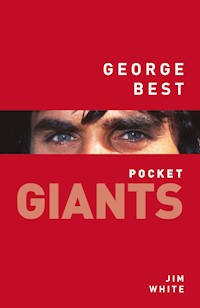
On Sunday 5 October 2014, the 75,000 strong crowd at Old Trafford for Manchester United's game against Everton joined in with an extended version of a chant which echoed around the stadium. 'We all live in a Georgie Best world,' it went. Eleven years after his death, forty years after he walked out of the club for the last time as a player, Best remains a Giant – extraordinary given that his star shone for such a brief time. He was at the top of the game for no more than half a dozen years. How did he do it?
Sie lesen das E-Book in den Legimi-Apps auf:
Seitenzahl: 119
Veröffentlichungsjahr: 2017
Das E-Book (TTS) können Sie hören im Abo „Legimi Premium” in Legimi-Apps auf:
Ähnliche


















Why is George Best a pocket GIANT?
Because he rose to stardom from a humble background.
Because he brought the Swinging Sixties on to the football pitch.
Because he remained an idol after he had walked away from his career, and even after his death.
Because he is arguably the best British footballer of all time.
JIM WHITE is a journalist and broadcaster on a number of subjects, including sport. He has written for the Independent, the Guardian and latterly the Telegraph. He is a regular contributor to BBC Radio 5’s Fighting Talk and BBC Radio 4’s Saturday Review and is frequently heard on TalkSport.
Cover image: © Colorsport / Rex / Shutterstock
First published in 2017
The History Press
The Mill, Brimscombe Port
Stroud, Gloucestershire, GL5 2QG
www.thehistorypress.co.uk
This ebook edition first published in 2017
All rights reserved
© Jim White, 2017
The right of Jim White to be identified as the Author of this work has been asserted in accordance with the Copyright, Designs and Patents Act 1988.
This ebook is copyright material and must not be copied, reproduced, transferred, distributed, leased, licensed or publicly performed or used in any way except as specifically permitted in writing by the publishers, as allowed under the terms and conditions under which it was purchased or as strictly permitted by applicable copyright law. Any unauthorised distribution or use of this text may be a direct infringement of the author’s and publisher’s rights, and those responsible may be liable in law accordingly.
epub 978 0 7509 8205 4
Original typesetting by The History Press
eBook converted by Geethik Technologies
Contents
Introduction
1 This Is Your Life
2 A Boy Who Knew How To Play
3 First Team Regular
4 El Beatle
5 Gloriously Unstoppable
6 The Greatest Day
7 Che Sera
8 Wilf
9 Disenchanted
10 Limbo
Timeline
Further Reading
Introduction
When I die and they lay me to rest
I’m going on the piss with Georgie Best
Chant sung to the tune of Norman Greenbaum’s ‘Spirit in the Sky’ by Manchester United supporters during a Premier League match against Manchester City, Etihad Stadium, Manchester, Sunday 20 March 2016.
It was no more than half an hour after he had staggered out on to the stage that George Best called Bobby Charlton a cunt. We had gathered in a small theatre in Richmond upon Thames one evening in 1993 for an audience with the greatest footballer Britain has ever produced and this was not what anyone had paid to hear. Best was onstage with his former Fulham teammate Rodney Marsh and things had got more than a little ragged. The star turn (though Rodney would probably remember the billing differently) had arrived late, his progress delayed by a diversion via what appeared to be several bars.
Marsh was there first, forty minutes after the advertised start time, doing his best to fill. Resplendent in a glittery dinner jacket and soft blond mullet, on his feet he wore shiny, low-cut slip-ons that barely covered his white towelling socks.
‘Gout,’ the man next to me said, pointing at the footwear, as Marsh struggled to hold the audience’s attention. ‘Those are the shoes of a man with gout.’
It was already shaping up into that kind of evening. But when Marsh was able – eventually – to pass on to the audience the news that the headline act was in the vicinity and summoned Best from the wings, there was a sizeable ovation. There may have been no more than 100 of the faithful gathered there to see the footballing giant speak, but the affection was obvious, mingled with relief that he had actually, finally, turned up. How we all wanted him to charm us, to tell us how it was, to throw in a few indiscretions, to be the Bestie of our imagination.
The visual signs, however, weren’t encouraging. This was the man whose physical attributes were once so arresting he would invariably leave any room accompanied by the most beautiful woman in it. Now he didn’t look good. The collar of his dinner jacket was flecked with dandruff, his face was bloated, his skin flaky, greying stubble was sprouting untamed from all parts of his face and neck. He stumbled across the stage to his seat, swaying, emitting a Tourette’s-like series of grunts and grumbles.
The frame of mind he was in as he took his seat was horribly familiar to those who knew him. A hugely intelligent man, when afflicted by this sort of mood he became overwhelmed by a nihilistic sense of purposelessness. It had stalked him all his adult life. A few drinks were all it took for the questions to start filling his head. Why was he here? What was he doing sitting on stage in a poxy regional theatre spinning yarns to a few dozen sycophants? What was the point? He looked like someone who wanted to be somewhere, please God, anywhere, other than where he was. Even from the back of the auditorium you could see the dismay clouding those once sparkling blue eyes.
It was billed as a question and answer session and it soon became clear the questions for which the audience sought answers were not going to trouble the judges of the Pulitzer Prize. Who was his toughest opponent? Who was the best player he had played with? What did he reckon to Paul Gascoigne, at the time the latest footballer to be dubbed the new George Best? And, talking of Gazza, if he were picking a first eleven of top footballing drinkers, who would be in it? Apart from himself, obviously.
This audience of men – we were all males occupying the auditorium – wanted to revel in the old days, the good times, those matches when we had gaped in wonder at Bestie’s panache on a football field. All we needed was a line or two, thrown from the stage. Simple openings for a joke, these were easy questions to be soft-batted back whence they came with a smile. For a speaker mining the nostalgia circuit, it was the gentlest of audiences, the safest of open goals.
But Best was never one attracted by open goals. For him there was no challenge in easy. When he played football, if ever faced by an unguarded net, he would check back and mischievously find a defender to beat again, or the goalkeeper to taunt before slipping the ball past him. You can see it in the footage of the six goals he scored for Manchester United in an FA Cup tie against Northampton Town in the early spring of 1970. It remains a record individual goal tally in the competition, but he doesn’t look happy about achieving it. As the count tots up, his shoulders sink, the celebrations become more muted. For his final goal, as he jinks his way round the goalkeeper, for a moment he stalls, stops on the spot, as if waiting for a show of resistance, as if hoping for a contest, as if rather insulted that it was all so routine. When he finally puts the ball in the net, rather than leaping in the air or embracing his colleagues, he grabs the goal post and nuts it, apparently angered by the ease of it all.
So it was in Richmond. You could see it on his face: what was the bloody point? He started by insulting the dress sense of a man sitting on the front row, asking him if he had nicked that suit out of a dead man’s coffin. He then proceeded to mock the questioners, dismissing their queries with a sarcastic snort. He chuckled constantly to himself, finding his rude responses invariably hilarious. At least somebody did.
For a man who boasted an IQ of 154, this was not the brightest of demonstrations; his answers were by turns grumbly and mumbly. Never mind that his public had paid good money to spend time in his company; he showed little intention of delivering any return on their investment.
Sensing that his partner was in the sort of disruptive temper he had seen all too often, Marsh moved the agenda on. He called out from the wings the third speaker on the programme, the man who was meant to be a highlight of the evening’s second half. It was Jack Charlton, England’s World Cup-winning centre back, who in his retirement had mastered the art of crinkly anecdotage. If any man could haul things back on track, Marsh clearly thought, Jack could.
As the big fella walked out, grinning and waving to the audience, Best had found his challenge. Suddenly animated by the new arrival, he was the first to speak.
‘I’ve gorra question Jack,’ he slurred. For a moment, the audience was enthralled. What was he going to ask? Would it be a reminder of the kickings Charlton delivered in those hard-man battles that characterised meetings between his Leeds United and Best’s Manchester United? Was it going to be a joke about the relative merits of Leeds’s manager Don Revie and United’s Matt Busby? Was he going to recall an international game between England and Northern Ireland, when Best’s trickery had flummoxed the English defence and he had a perfectly legitimate goal disallowed after he had artfully kicked the ball out of Gordon Banks’s hands and into the net?
It was none of those.
‘Tell me this Jack,’ said Best. ‘Why is your brother such a cunt?’
Now this was properly shocking. Because it wasn’t just anybody Best was slandering. This was Bobby Charlton, alongside Denis Law and Best himself one third of United’s holy trinity of the 1960s, England’s finest ever footballer and a man of irrefutable, unimpeachable integrity – the patron saint of the English game. The colour vacated Marsh’s cheeks. Big Jack looked hurt. Best, though, apparently oblivious to the shuffling unease of his fellow speakers, or the silence thickening in the auditorium, seemed to think he was in possession of comedy gold.
‘C’mon Jack,’ he continued, giggling and snuffling. ‘I know he’s your kid and that, but you’ve gorra admit he’s a cunt.’
It was at this point that Marsh intervened and declared the first half of the show over. We would reconvene after a short interval, he explained. Go get yourself a drink, he said. Not that his companion on stage needed any encouragement. He had already amply demonstrated that he was in a Father Jack mood: drink, girls, feck.
When everyone returned from the bar twenty minutes later, no one in the audience was surprised that it was just Marsh and Charlton who came back on stage. Best, we were told, had been taken ill. Yeah, right.
In 1993, that was what the world had come to expect when faced by George Best. This was only a year after he had appeared plastered on Terry Wogan’s television chat show, sealing his place alongside Oliver Reed and Alex Higgins in the pantheon of the nation’s drunks. It wasn’t his prowess on a football field that was by then remembered, it was his fondness for the booze. When he pitched up on Mrs Merton’s sofa in 1997, his facial tics twitching overtime, his habitual grunts and snuffles projected by the microphone on his lapel, he was asked by the spoof talk show host whether as a child he had ever dreamed of one day being known in every bar in Britain. He chortled politely. But, sharp as the barb was, it was no more than the recognised truth.
The irony was, he wasn’t drunk with Mrs Merton. But then he wasn’t always drunk in those days; it wasn’t inevitable, he wasn’t like that every time. When he was sober, he could be witty, engaging, thoughtful, exactly what his worshippers craved. But when in drink, spite and bile overwhelmed him. Riddled with self-loathing of his drunken self, he took out his frustration on those around him – his women, his son, anyone. This was a boozer who could pick a fight in an empty bar. And it happened often enough for notoriety to grow into expectation.
As I left the Richmond theatre later that night, after Marsh and Charlton had done their best to be convivial, I was walking behind a middle-aged man and his teenage son.
‘And you say he was good?’ the boy asked his father, finding it hard to reconcile his dad’s claims of Best’s footballing excellence with the shambolic display he had just witnessed.
‘He wasn’t just good,’ the dad replied. ‘He was the best there’s ever been.’
And the thing is, despite a performance like that – despite his latter days on a football field when he became engaged in a spiralling downward trajectory of phoned-in cameos and insulting has-been exhibitions, despite the prison term, the bankruptcies, the tales of domestic abuse, the stories of bullying his only child, despite the insistent urge to run whenever confronted by responsibility, despite it all – the man was right. Best was great. He was a giant.
In his pomp as a footballer, shimmering across the turf in a swish of dynamism, bravery and panache, sending defenders the wrong way, scoring and making goals by the bucket-load, Best was unimaginably good. Better than good, he was sublime, an artist in studded boots, his grace and elegance gilding the game. When the mood took him, he could provoke a similar emotional response as a great piece of music or work of art might; he could lift the soul. In his teammate Paddy Crerand’s evocative phrase, he left opposing defenders with twisted blood. To have seen him in action at his peak, when he was still fit, engaged and interested, performing as he was capable of performing, was to have been blessed.
At his finest, so good was he, so assiduously had he honed his natural excellence through practice, practice and more practice, that his manager Matt Busby reckoned him the most accomplished player in every position at Manchester United. Chuck him a pair of gloves, Busby said in 1967, and inevitably he would prove himself the finest goalkeeper in the squad. His name was no coincidence. As far as the British Isles is concerned, Best is the best there has ever been.




