


9,99 €
Mehr erfahren.
- Herausgeber: The History Press
- Kategorie: Sachliteratur, Reportagen, Biografien
- Sprache: Englisch
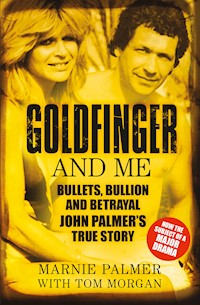
The life, crimes and bloody end of John 'Goldfinger' Palmer were straight out of a Hollywood blockbuster – and Marnie Palmer, his wife of forty years, had a front row seat. The poor Solihull lad, whose childhood home was so cold the goldfish froze, fought his way up to a lifestyle of private jets, yachts and Ferraris, thanks to a home-made gold smelter in his back garden and a multi-million-pound timeshare empire. By the turn of the millennium, Palmer was 105th on the Sunday Times Rich List, but Goldfinger had a long list of enemies. In Goldfinger and Me, his widow Marnie shares her unique insight into his roller coaster life, from dealing scrap in Bristol, to the Brink's-Mat raid that changed their lives – ending with his downfall of betrayals, jail stints and his still unsolved assassination.
Das E-Book können Sie in Legimi-Apps oder einer beliebigen App lesen, die das folgende Format unterstützen:
Veröffentlichungsjahr: 2018
Ähnliche



















This book is dedicated to my two daughters. I love you both so much, and hope your futures are much brighter and happier.
First published 2018
The History Press
The Mill, Brimscombe Port
Stroud, Gloucestershire, GL5 2QG
www.thehistorypress.co.uk
© Marnie Palmer and Tom Morgan, 2018
The right of Marnie Palmer and Tom Morgan to be identified as the Authors of this work has been asserted in accordance with the Copyright, Designs and Patents Act 1988.
All rights reserved. No part of this book may be reprinted or reproduced or utilised in any form or by any electronic, mechanical or other means, now known or hereafter invented, including photocopying and recording, or in any information storage or retrieval system, without the permission in writing from the Publishers.
British Library Cataloguing in Publication Data.
A catalogue record for this book is available from the British Library.
ISBN 978 0 7509 8954 1
Typesetting and origination by The History Press
Printed and bound by CPI Group (UK) Ltd
eBook converted by Geethik Technologies
CONTENTS
Acknowledgements
Prologue
1 Keystone Cops
2 Humble Beginnings
3 Family First
4 Meteoric Rise
5 Fools’ Gold
6 New Life
7 London Calling
8 Money Talks
9 Cash Rules
10 The Downfall
11 Other Women
12 Time’s Up
13 Busted
14 Doomed
15 Diamond Wheezers
16 Fallout
The Appeal Goes On …
ACKNOWLEDGEMENTS
Thank you to my two beautiful daughters, and to my dear departed dad. He gave me everything he had. I also would never have been able to write this book without the loving support of my new partner, John, who has made a future possible. Lastly, I want to thank my husband of forty years, John Palmer.
Marnie Palmer
2018
Tom Morgan would like to thank Charlotte Dunlavey, Quita Morgan, Robert Smith, Alex Waite and Mark Beynon.
(Some names of close family members have been amended in the following pages at Marnie’s request, in order to protect their privacy.)
PROLOGUE
On 24 June 2015, John Palmer’s luck ran out. The underworld kingpin with riches to rival the Queen collapsed on the grass after being blasted six times by a contract assassin lurking in the shadows of his garden.
For his long list of enemies, Palmer’s death had been a long time coming. Murders and fatal ‘accidents’ had wiped out at least twenty criminals and police officers connected to the spectacular Brink’s-Mat bullion raid of 1983. Palmer, who melted down and sold the gold, was the one that got away. Dodging the so-called ‘Brink’s-Mat curse’ for thirty years, he masterminded a fraudulent timeshare empire of which his rivals could only dream.
The press nicknamed Palmer ‘Goldfinger’; his rivals knew him as ‘Teflon John’; and, as his business assets swelled to an estimated £300 million, associates on Tenerife called him ‘Timeshare King’. For those he crossed, however, he was Public Enemy No. 1. By the time he was shot, police estimated tens of thousands of people had reason to want him dead.
Palmer started with nothing and rose to the top by living on his wits. He was born into poverty in September 1950, one of seven siblings who often went to bed hungry in their two-bedroom council home in the Birmingham suburb of Solihull. He left school at 15 barely able to read and write, but with a fierce appetite to prove himself.
As a teenager, his prospects were limited to casual roofing work or the odd shift on his brother’s market stall. Young John wanted more. He moved down to Bristol and dreamed big. Silver-tongued and cunning, he was a natural entrepreneur. He soon launched a number of businesses, selling second-hand cast-offs, carpets, antiques and eventually bullion. He then hit upon the idea to build a smelter in his back garden to melt down jewellery, cutlery and unwanted scrap.
Life was good. He fell in love with Marnie Ryan, a warm-natured and charismatic young hairdresser with the looks of Brigitte Bardot. They wed in 1975, eventually having two daughters and buying a beautiful Georgian pile near Bath. In the driveway, of course, was the Rolls-Royce.
But Brink’s-Mat changed everything. The newspapers called it ‘the crime of the century’, but in reality, the operation wasn’t so well planned. Six men broke into the US security company’s warehouse at Heathrow in November 1983, thinking they were about to steal £3 million in cash. Instead, they stumbled across 3 tonnes of gold bullion. It was Britain’s most profitable robbery, a haul that sparked so many spin-off investments over the years that its total worth at today’s rates is estimated in the hundreds of millions.
The gang never intended to pull off such a feat. Police had soon made the connection that one of the security guards on duty was a relative of a known criminal. Detectives quickly rounded up the raiders, but not the loot. Most of it had been hidden by fencer Kenneth Noye, who, in turn, needed a man who could turn his red-hot haul into cold hard cash.
As the biggest hunt for stolen property in Metropolitan Police history was launched, Noye asked Palmer’s former business partner if he would be interested in doing business. The bullion was ghosted down to the West Country from Essex. Much of it was mixed in with scrap before being melted down in John’s smelter and recast. The bars were re-formed into apparently legitimate bullion. Marnie claims that John Palmer had no inkling it was Brink’s-Mat loot until it was too late to stop. Like so many of his antics back then, he operated on a ‘no questions asked’ policy. Such was the gang’s audacity – or downright ignorance – that some of the ‘new’ gold was sold back to the victims of the heist.
A pair of neighbours reported to police that they had seen a crucible operating in Palmer’s Georgian home, but when officers visited they said it was outside their jurisdiction to investigate further. It would be another year before Scotland Yard was on the trail. By that point, Marnie and Palmer had jetted off to Tenerife for some winter sun. Police launched an SAS-style dawn swoop on their home, arrested the two unsuspecting house-sitters, and recovered just a solitary gold bar.
Needless to say, John and Marnie were spooked. He was suddenly front-page news, and lying low in Tenerife seemed the best option. Before long, he was named as one of twenty wanted Britons hiding out in Spanish enclaves.
During this extended stay, Palmer set about turning his talents to the rapidly expanding timeshare industry. It would be another eighteen months before Spanish authorities, alerted by their British counterparts, declared him an undesirable alien. He eventually flew to Brazil, but was arrested on the tarmac and forced back to Britain to face the music.
This was just the beginning of a plot that could have been lifted straight from a Hollywood script. Palmer’s reputation was largely built on the trial that followed. He was a likeable defendant and argued his case with a smile, saying that while he had certainly melted down plenty of gold as part of his jewellery business, he couldn’t possibly know its origins. Police were dumbfounded when the jury believed him.
Everyone now knew him as Goldfinger, yet it was his silver tongue that saved him from the cells. As his Brink’s-Mat accomplices were locked up, Marnie watched with shock as John swaggered out of London’s Old Bailey and flicked two fingers at the humiliated Scotland Yard detectives in the public gallery.
Palmer was on a roll. His Tenerife holiday business escalated faster than he could ever have hoped. Eventually he was ripping off Britons through a vast timeshare con. He launched a labyrinth of companies to disguise his antics and reportedly relied on the help of a small army of thugs. Police claimed profits were soaring thanks to swindles, violence, racketeering and cash laundering.
At the peak of his offending, Palmer was said to be running a mafia-style firm feared throughout the island. The newspapers claimed his armed heavies launched a swathe of attacks, using knives and baseball bats, across the shady nightspots of Playas de las Americas and the neighbouring resort of Los Cristianos. A Briton was shot dead in a turf war between rival timeshare businesses. If threats or violence from Palmer’s henchmen did not work, they could call in two South American heavyweights, who drove around the resort in a black limousine and were known, by the newspapers at least, as The Sharks.
By the turn of the millennium, Palmer was 105th on The Sunday Times Rich List, with an estimated fortune of £300 million. This Birmingham lad, whose childhood home was so cold the goldfish froze, was now flying around the world on Concorde, with private jets, helicopters and a yacht at his disposal. He got his pilot’s licence, bought a French chateau and began collecting classic cars, including a rare ‘Gullwing’ Mercedes. His yacht, the Brave Goose of Essex, was moored in Tenerife’s Santa Cruz harbour. He stocked his pond on the island with piranhas and rare albino frogs. Unfortunately for Marnie, he was also investing heavily in two other hobbies: drugs and womanising. Palmer was now openly splitting his time between Marnie and their two daughters, and his mistress, Christina Ketley, who in 1991 bore him a son.
The first cracks in the Palmer empire had already appeared. In 1994, The Cook Report television programme secretly recorded Palmer offering to launder up to £60 million a year for an investigator posing as a heroin trafficker. Palmer demanded a 25 per cent commission, saying: ‘I’m not cheap, but I’m good.’ The Cook dossier was delivered to Scotland Yard, where sources said there was ‘cogent intelligence’ that Palmer was involved in laundering drug money. But clear evidence also emerged of timeshare fraud. Roy Ramm, a commander in the Metropolitan Police’s specialist operations department, said at the time: ‘I had to make a decision on what was the best way to spend public money. It’s a bit like Al Capone; they got him on tax.’
Then, in 2001, Scotland Yard detectives got the result they had spent years working towards: Palmer behind bars. Police estimated that Palmer had duped at least 17,000 timeshare victims. Investigators untangled a fraudulent network that stretched from dodgy Canary Islands resorts to numbered accounts in countless tax havens.
Palmer accused detectives of waging a vendetta against him because of his acquittal in 1987. Roy Ramm rejected this in the witness box. At least four times during Palmer’s questioning of him, Ramm described him as ‘a serious organised criminal’. Palmer was eventually given an eight-year jail term – and was later hit with the biggest damages claim in British legal history.
Behind the scenes, as you will read in these pages, Palmer was losing his grip on reality. He admitted to Marnie that he was snorting two grams of cocaine on a modest day. Spiralling further into addiction, his once razor-sharp judgement disintegrated. His decision to represent himself during his fraud trial and his outrageous behaviour in various media interviews illustrate his descent into self-destruction, she believes.
After his release, Marnie felt divorce was all but certain. Christina, a former employee who had received a suspended sentence as a co-conspirator, was now the leading woman in Palmer’s life, leaving Marnie saddled with a crumbling mansion and mounting repair bills. She would make three attempts for a decree nisi, but each time John would refuse to sign the papers.
In the decade before his death, Palmer’s powers diminished. He returned to Tenerife and found the streets were no longer paved with 24-carat. A friend, Billy Robinson, 58, was ambushed, tortured and murdered along with his wife, Florence, 55, as they drove home from a restaurant to their £1.5 million villa. Mobsters from Eastern Europe were moving in, and violence escalated. Palmer’s former head of security, Mohamed Derbah, had struck out in business on his own amid a bitter rift with his former boss. Marnie remembers dining with Derbah regularly. But when Palmer was jailed, Derbah was quoted by one newspaper as saying: ‘John Palmer is finished on this island. If he comes back and throws his weight around, I have 50 people I can call on to defend my interests.’
Then, on the Easter weekend of 2015, Palmer was linked to Hatton Garden, an extraordinary jewellery heist carried out by at least one known associate, Brian Reader. Rumours swirled in the underworld and the papers that Palmer was in some way connected, even though detectives were sceptical.
Then came his shooting just months later. Palmer was aged 64 and in poor health. Security had been scaled down at the isolated cottage he shared with Christina on the edge of the Weald Country Park, near Brentwood, in Essex. He was also anxious about a host of asset freezing orders and another trial on a long list of charges in Spain relating to alleged timeshare fraud.
Typically for Palmer, even his shooting at point-blank range would raise more questions than answers. After an astonishing oversight by paramedics who declared him dead at the scene, police initially said that his death was not suspicious. Then, six days after the hit, they revealed that a post-mortem examination had shown his body was littered with bullet injuries. Palmer was shot in the right elbow, right breast, right upper abdomen, top of the back, left renal area and left bicep. A ballistics expert would eventually conclude that the gun used was a .32 calibre silenced revolver. Avon and Somerset Police told Marnie investigations by their Essex counterparts were a mess.
So, who did pull the trigger on Goldfinger? ‘I’m no angel, but I’m no gangster,’ he told one reporter in 1999. ‘I’ve become a silly gangster-legend. They blame me for everything.’ It has since emerged that Palmer was under police surveillance at the time of his death, fuelling suspicions he had turned supergrass. Those rumours would have unnerved the criminal fraternity, be they Russian, Spanish or closer to home.
Now, with police nowhere near solving the case, Marnie is finally ready to give her unique insight into Palmer’s life, in fascinating and disturbing detail.
In these pages, Marnie relives the extraordinary roller coaster ride – the riches, the glamour and the disastrous denouement.
The life, times and bloody end of the real-life Goldfinger were blockbuster. And Marnie Palmer, his wife of forty years, had the only front-row seat.
Tom Morgan
April 2018
1
KEYSTONE COPS
James could still feel a heartbeat as he desperately begged the 999 operator to help him keep his father alive.
‘It’s my dad,’ he screamed down the phone. ‘He’s covered in blood. I don’t know what’s wrong with him … Come on Dad. Please come back.’
No bangs, no voices, not even a dog barking. Nobody heard a peep as John collapsed face down in the turf shortly before 5.30 p.m. on 24 June 2015.
‘You’re doing everything you can,’ the operator told James on his mobile as paramedics and police raced to their country pile near Brentwood, Essex.
John, 64, had undergone gallbladder surgery a week earlier, but had recovered rapidly. He was certainly buoyant enough that afternoon to get under the skin of Christina Ketley, his long-term live-in mistress. After a little tiff, she had driven off at 2 p.m. to go horse riding.
James, in his mid-20s and training for an accountancy qualification, had last seen his dad pottering about in the garden, slurping his coffee and gathering old twigs and branches for the bonfire. It was a typical scene. James then joined his girlfriend for a forty-five-minute workout in the home gym.
By the time they surfaced again from the basement, John was sprawled lifeless on the grass, his pristine white T-shirt – a birthday present from his daughter – drenched in blood.
Detectives reportedly refer to what they call ‘the golden hour’: the time immediately after the discovery of a body in a murder investigation. It is when they are most likely to find the best clues.
In John’s case they didn’t just lose an hour, they lost a week. It would be one of the most hopeless starts to a murder investigation in police history.
I’m no expert in detective work and I’m certainly no authority on forensics, but you would imagine any call to HQ that started ‘body believed to be John Palmer found at Sandpit Lane, South Weald’ would arouse at least a flicker of interest from any officer worth his or her salt. Police had been monitoring the place for more than a decade, and John for thirty years.
Yet the Essex Police officers who eventually arrived on the scene were all too willing to assume there was nothing suspicious about this most notorious criminal dead in a pool of blood. Given a recent keyhole op, they were happy to conclude the wounds had reopened and he’d had a heart attack. The attitude that day was: ‘Stick him on the mortuary slab and get the kettle on. Accidental death. Case closed. Home for EastEnders.’
John and I had been married since 1975, but he was now living full-time with Christina and James. Our relationship had deteriorated to the point where I was hopeful of divorce by Christmas.
The news reached me and my older daughter, Janie, in Bath at 6.30 p.m. – an hour after his body was found. I was in the front room of the Coach House watching television when I heard a roaring engine outside. Through the window I saw Janie’s boyfriend, Red, skidding through the front gates in his old rag-top BMW and screeching to a halt sideways.
Red is a reckless fool, but the door slamming and wheelspins were extreme even for him. He sprinted through Janie’s front door and all I could hear suddenly were her screams and howls. Their relationship was always tumultuous, and I initially thought, ‘God, what’s happened. He’s beating her up.’
The phone was ringing from my own kitchen, but I took no notice and sprinted round to see what was going on. All I could hear as I ran up the gravel path were screams of: ‘My dad, my dad’. It was terrible.
When I got to her front room window I could see Red chasing after Janie, who had her arms raised and was bellowing: ‘Argh, my God, my God.’
My daughter and I weren’t speaking. As my divorce loomed, Janie had sworn never to forgive me. I wanted to sell the house I had shared with John for forty years, which would mean she would need to move out of the adjoining cottage. She was in her 30s and I believed she would cope. But John and her boyfriend were telling her she wasn’t getting a fair deal.
As I stared through the window, Red came to the door and told me to fuck off. Nothing unusual there – he has always hated me. I went running back to my own kitchen where the phone was still ringing. I picked up the receiver to hear my youngest daughter, Sammy, completely distraught and barely able to speak through her tears.
‘It’s Dad,’ she said, ‘He’s dead. Please go over to Janie because she will be beside herself.’
Before I had a chance to ask any questions, the line went dead. I sprinted back to Janie’s, this time running through her front door, with my arms wide open. I yelled, ‘Do you want me?’ She raced towards me screaming, ‘Mum, mum!’ And we put our arms around each other.
Then Red, always thinking of himself, stormed in and shouted, ‘You bitch. How can you throw your daughter out of the house?’ ‘Get out,’ Janie said, ‘Leave her alone, this is not the time,’ and I just said, ‘Come to me, whenever you need.’
I wasn’t bothered about Red’s threats, even when he suggested he would have me ‘finished’; it was just the girls and John I needed to worry about at that point. Details of what had actually happened to him were very woolly. Christina had told Red the most likely scenario was a heart attack. I sat on the settee frozen in fear for days as we waited for information. There was nobody we could phone who knew anything. I had never spoken to Christina before, and the emergency services fobbed us off when I tried to ask them for answers.
There were five agonising days before Essex Police showed up. They apologised because they had failed to realise that I was John’s widow, his next of kin. Officers had only worked this out thanks to a call from Avon and Somerset Police. The Essex detective sat down out at our kitchen table and told Janie and me that John may have died because of complications after his gallbladder surgery. The medical staff were told of the recent operation when they arrived and had apparently concluded that he had suffered heart failure.
That week was surreal. My daughters were inconsolable, and I was numb. John and I had been through so much. Our marriage was all but over, yet so much was unresolved. I wasn’t ready for him to take his secrets to the grave.
I was living in a fog. Then, the following weekend, everything was turned on its head again.
I received a call from a withheld number at noon. It was Christina. For the first time in our lives we exchanged words. She said: ‘Marnie, I’m so sorry about this, but I’m afraid there’s some very bad news on its way down there – will you please get Janie home.’
Soon afterwards a police officer arrived. There were strained pleasantries. I asked the young man to get to the point.
‘I’m very sorry to tell you that John was murdered,’ he said. ‘He was shot.’
After several days with their feet up, it seemed that somebody at Essex Police had decided it might be worth chasing up the cause of death. John’s body had been left waiting in a hospital morgue over the weekend for a duty pathologist to inspect it. Of course, the post-mortem examination established what had really happened in a matter of seconds.
Further inspection showed John had been shot six times at close range, probably by a professional assassin, using an 8mm .32 calibre pistol fitted with a silencer. The gunman had been hiding behind a 6ft wooden fence, monitoring John’s movements through a discreet spy hole that had been drilled into one of the slats. The timing of John’s injuries suggested he had been shot soon after getting off his green six-wheel garden buggy.
The jaw-dropping blunders kept coming. Paramedics had warned police at the scene that they had spotted ‘small wounds in various stages of coagulation’ on John’s chest and abdomen. They added that James had said he was unsure if this was connected to the surgery. The two police officers on the scene neglected to examine the body, and failed to call an inspector to the scene or check John’s antecedents on the police national computer.
The handsome young detective, with a side-parting and a smart suit, looked like butter wouldn’t melt. He relayed all of this to me as he sat at my kitchen table. I couldn’t take it in. This catalogue of mistakes would have made the Keystone Cops blush, and the murder investigation was now a week behind schedule, leaving forensic teams with a near impossible task.
How do you react to that sort of news? In my case, it sparked the biggest breakdown of my life. I suddenly felt so alone in the world. The house where John and I had lived for decades, and where we had brought up our children, was now haunting me. John had turned my two girls against me just months earlier, and now he was dead. I loved him, yet I hated him. I walked out the front door and ran up the long drive towards the busy B-road at rush hour. There was no plan until I started staggering towards the oncoming traffic.
‘Kill me, kill me,’ I shouted as the headlights bore down on me. I was only wearing a nightdress. No shoes on my feet. The next hour or two is a haze. I remember sitting on a grass verge and being attended to by paramedics. I also recall Janie shout at me to ‘pull yourself together’. The police took me to a hospital in Bath and I was assessed for hours.
I returned to the Coach House at 3 a.m., knowing that nothing was ever going to be the same again.
*
John and I were together for four decades and I knew him better than anyone. He came from nothing and was a passionate and loving man. But I had also seen him at his absolute worst. He could be violent, paranoid, ruthless and cruel, as well as being a womaniser and a drug abuser. It was a lifetime of betrayal, and in some ways his death would be a relief.
But in those first few weeks, I was unravelling. I didn’t know where the truth began and the lies ended. It may seem strange but within twenty-four hours of finding out that John had been murdered, I vowed to write this book. Somehow, I thought that piecing everything together might help us all understand why John was who he was – and maybe even uncover who killed him.
The chances are you’ve read the headlines and have already made your mind up about John. I am not here to change that or make excuses for him. Yes, he was violent, ruthless and cruel. The tens of thousands of people he eventually ripped off can vouch for that. But now, perhaps for everyone’s sake, it might help to have his true story from the only person who saw it all.
Until now, there were two versions of the John Palmer story. The first version he hated: ‘Goldfinger’, the most ruthless criminal kingpin of his era – a tale of dirty money, racketeering, violence and intimidation. The second version he revelled in: the working-class lad who became richer than the Queen – the ultimate 1980s ‘yuppie’ who went from selling scrap to buying Learjets. Both tales were true to a certain extent, but the real story fell somewhere in the middle.
John might have made the same millions had he stayed on the right side of the law. The richest men in the underworld – the really big fish – are not unlike some prominent business executives and world leaders. Greed, lies and ego make the world go round. I can easily imagine John in his favourite pinstripe suit, leaning back in a plush leather chair with his feet on the desk at some investment bank.
But playing by the rules was never even an option for my late husband. He was driven by desperate childhood poverty, and his blood burned to make cash. This ruthless approach bought us a first-class ride around a world that neither of us could even have dreamt of. I just never realised the true price we would all end up paying.
As you will see in these pages, the 1983 Brink’s-Mat raid changed everything for John and me. I’ve heard it said that if you have bought a gold necklace made since then, the chances are that a significant percentage of it comes from that raid, and was melted down in our back garden. I’m not proud of that. Was the heist cursed? Read on, and decide for yourself.
2
HUMBLE BEGINNINGS
‘It was so cold at home the goldfish froze one Christmas.’
John loved telling me this anecdote. He wore his childhood hardships in Solihull, Birmingham, like a badge of honour. The pair of us came from deprived homes. Knowing how it feels to be really poor – that genuine fear of going hungry – never leaves you. It drove John to achieve everything he did.
His father, George William Palmer, abandoned his family to shack up with a lover when John was just 5 years old. George ran a shop at one point but never gave his old family a penny. There was no welfare state in those days, no handouts at all. The only breadwinner had fled and the family were on the brink of homelessness. The Palmer siblings had to grow up fast, scratching around to earn every penny, no matter their ages.
John was the youngest of the ragtag bunch. He and his four brothers and two sisters were fiercely loyal to each other and their embattled little mother, Dot. She was tough, but loving. She had her hands full dealing with the most boisterous boys on the block.
Dot spotted something special about John, and always reckoned her youngest son had the luck of the gypsies with him. ‘He was born with a lump of lard on his head,’ she would say. I had no idea what this meant. She claimed it is a gypsy phrase for those blessed with good fortune.
‘It’s from his father,’ she would say. ‘He is from French traveller stock. Somehow he will always find a way to come up on top.’
George, the eldest brother, was straight-laced, as were his sisters. The other brothers, however, were like peas in a pod – sticking together and constantly getting into scrapes.
David and Mike both struggled with mental health. Dave was a loose cannon, probably the naughtiest. He would show up in the middle of the night in stolen cars. It was always a drama. He would hammer the horn and flash his headlights towards our bedroom window until John let him in and gave him a feed. David was eventually caught at an airport with a huge stash of drugs. He died of a heart attack while locked up for drug trafficking in a prison on the Isle of Wight.
Mike was also a handful, owing to his schizophrenia. For years it went undiagnosed, but John always looked after him. During his episodes, he battered his girlfriend, and even tried to burn down Dot’s house at one point. Like David, he died young and in tragic circumstances.
The fourth brother, Midge, was most like John. Both of them had good business brains, were willing to cut a few corners, and had God-given gifts for charming even the most miserly customer. The pair could and would work in synch with each other when it came to making money.
The boys stuck together like glue because they had to. Not a week went by without a scrap kicking off in the street. John might have had a fearsome reputation later in life but the Palmers weren’t even the most formidable family on their own street.
Their working-class district had a fierce gang culture, stretching back decades before John. I smiled when I saw the drama Peaky Blinders on television. The gangs were much scruffier by the time John arrived but that ruthless lifestyle was still thriving.
The family never had enough money to heat their home, but Dot instilled in them the golden rule: Never show weakness.
John went to school on and off until he was 13. He put bags on his feet because his plimsolls had holes in them and, for years, he would wet himself in class. In private, his brothers would give him hell about his little pee problem, but nobody else would have dared bully him about it. His older brothers always looked out for him, even if it meant chaperoning him home when his trousers were sodden. Midge would escort him without fail when he had one of his accidents.
The Palmer household was a place where you always needed to be on your toes. The brothers would roar with laughter together, and get up to all sorts of mischief. Home life was raucous, and there were occasional brushes with the law: usually petty thefts or street fights. Without a father around, they had grown up angry.
It is all too easy to judge, but the brothers were doing everything they could to bring money in. They begged, borrowed and took any work they could get. Mike had regular work on the roofs, and would often bung John a tenner for help humping tiles around. John also helped Midge out on the markets.
John was an entrepreneur from the very start. With no qualifications, he had to be. By 14, he was going house to house like a rag and bone man asking if anyone had anything they wanted to sell. He had such a sharp eye for a bargain and was soon making more cash than everyone but Midge.
John and Midge were a great team. Throughout their teens they bounced between jobs in Birmingham. The two of them were blessed with silver tongues and an appetite for hard graft. For both the brothers, deal-making was instinctive.
Midge had a big market stall. He worked seven days a week shifting anything he could get his hands on. Bedding, towels, clocks, you name it. He did really well and was a huge influence on John.
Work with either Midge or Mike was regular but John had bigger ambitions. At 17, he travelled down to Bristol with Mike, who had a girlfriend in the city. Something clicked in John: he loved the place. A weekend stay with Mike turned into a couple of weeks before they both moved down permanently.
Despite knowing barely a soul in the city, John and Mike were soon making ends meet by selling leather belts in pubs and at markets. They would get the leather from a Bristol tannery and make these things themselves. Neither of them had a clue about fashion but John had such an uncanny ability to find a gap in the market. Doing his rounds of the pubs, he quickly made friends and always ended a conversation by asking: ‘Anything you’re looking to sell?’
*
My own childhood had been lonely, and we were pretty hard up as well. My mother, Jean, couldn’t even afford to run a bath for me; we had a tin one that we shared with the neighbour next door. Their child, Squeaks, would have the first wash, then me. We were so short of cash that all my long hair was cut off once to sell to wigmakers.




