


4,49 €
4,49 €
oder
-100%
Sammeln Sie Punkte in unserem Gutscheinprogramm und kaufen Sie E-Books und Hörbücher mit bis zu 100% Rabatt.
Mehr erfahren.
Mehr erfahren.
- Herausgeber: Kim Paradowski
- Kategorie: Gesellschafts- und Liebesromane
- Sprache: Englisch
- Illustrated Edition with 20 evocative illustrations
- Includes a clear and engaging summary
- Features a detailed characters list
- Contains a concise biography of Robert Graves
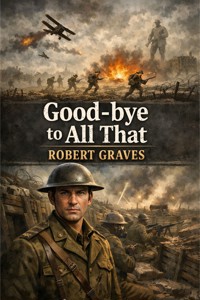
Written with sharp intelligence and understated emotion, Robert Graves traces his journey from the strict traditions of English public-school life to the brutal reality of the trenches. Stripped of glory and false heroism, the war emerges as a world of chaos, fear, loyalty, and loss, where survival itself feels miraculous. Graves’s voice—ironic, candid, and unflinchingly truthful—cuts through patriotic myth to reveal the personal cost of conflict.
But this book is more than a war story. It is a farewell to an entire way of life: to inherited values, rigid social systems, and the illusions that shaped a generation and led it into catastrophe. With moments of dark humor, quiet reflection, and haunting clarity, Graves captures the emotional dislocation of returning from war to a society that can never fully understand what was endured.
This beautifully prepared illustrated edition brings the memoir to life for modern readers. The carefully selected illustrations enhance the atmosphere of the era, while the included summary, character list, and author biography provide valuable context and deeper insight into both the book and its creator.
A timeless classic of world literature, Good-bye to All That remains as relevant today as when it was first published—an essential read for lovers of history, memoir, and profoundly honest storytelling.
Das E-Book können Sie in Legimi-Apps oder einer beliebigen App lesen, die das folgende Format unterstützen:
Veröffentlichungsjahr: 2026
0,0
Bewertungen werden von Nutzern von Legimi sowie anderen Partner-Webseiten vergeben.
Legimi prüft nicht, ob Rezensionen von Nutzern stammen, die den betreffenden Titel tatsächlich gekauft oder gelesen/gehört haben. Wir entfernen aber gefälschte Rezensionen.
Ähnliche







Good-bye to all that by Robert Graves
ABOUT GRAVES
Robert Graves (1895–1985) was an English poet, novelist, critic, and mythographer whose career bridged the violent upheavals of the twentieth century and the ancient worlds he loved to reimagine. Born in Wimbledon to a culturally mixed family—his father a poet and school inspector, his mother from a German scholarly background—Graves grew up immersed in literature, languages, and classical myths.
His life was profoundly shaped by the First World War. Serving as an officer in the Royal Welch Fusiliers, Graves was gravely wounded at the Battle of the Somme and left for dead. The trauma of trench warfare haunted him permanently and found powerful expression in his early poetry and in Goodbye to All That (1929), one of the most influential war memoirs ever written. The book’s stark honesty and disillusionment with English public-school values and military heroism made Graves a defining voice of the postwar generation.
Though he achieved early fame as a poet, Graves refused to be confined by any single literary identity. He wrote historical novels (I, Claudius and Claudius the God), literary criticism, translations, and speculative works on myth and religion. His most controversial and enduring intellectual legacy is The White Goddess (1948), a highly personal and imaginative theory of poetic inspiration rooted in ancient matriarchal myth. While widely criticized by scholars, the book profoundly influenced poets, writers, and myth-oriented thinkers for decades.
Graves spent much of his adult life in self-imposed exile from England, eventually settling in Majorca, where he lived simply and wrote prolifically. Fiercely independent, often combative in his opinions, and deeply committed to poetry as a sacred vocation, he rejected modernism, academic orthodoxy, and what he saw as the corruption of true poetic tradition.
By the time of his death, Robert Graves had become a singular figure in English letters: a survivor of war, a master storyteller of ancient history, and a poet who believed that myth, memory, and imagination were inseparable forces shaping human culture.
SUMMARY
Good-bye to All That is Robert Graves’s gripping farewell to the illusions of youth, patriotism, and inherited tradition—told through the lens of one man who survived the First World War but was forever changed by it.
With piercing honesty and dark wit, Graves recounts his journey from an idealistic public-school boy into a shell-shocked officer on the killing fields of the Somme. The book strips away romantic notions of war, revealing instead a world of mud, fear, arbitrary authority, and quiet heroism that rarely resembles the propaganda of the home front. Battles are not glorified; they are endured. Survival itself becomes an act of defiance.
Beyond the trenches, Graves turns his sharp eye on the rigid social codes of Edwardian England—its schools, class systems, and patriotic myths—which he sees as complicit in sending a generation to destruction. His “good-bye” is not only to war, but to the values that shaped him and failed him.
What makes the book unforgettable is its voice: unsentimental yet deeply human, often ironic, sometimes bitter, but never self-pitying. Good-bye to All That is both a personal reckoning and a timeless anti-war testament, capturing the moment when innocence collapsed and a modern, disenchanted world was born.
CHARACTERS LIST
Main Figures
Robert Graves
The author and central figure. A sensitive, intelligent young man shaped by public-school discipline and shattered by the realities of the First World War. His voice—ironic, candid, and disillusioned—guides the entire narrative.
Family and Early Influences
Alfred Perceval Graves
Graves’s father, a poet and scholar. He represents intellectual discipline and traditional values, influencing Robert’s early love of literature and learning.
Amy von Ranke Graves
Graves’s mother, of German descent. Her background becomes significant during the war years, exposing Robert to suspicion and divided loyalties.
School and Literary Figures
Schoolmasters and Fellow Students (Charterhouse School)
Collectively important figures who embody the rigid discipline, bullying culture, and moral codes of English public-school life—values Graves later rejects.
Siegfried Sassoon
Fellow poet and close friend during the war. Sassoon’s courage, literary brilliance, and moral protest against the war deeply influence Graves both personally and artistically.
Military Figures
British Army Officers
Graves’s superior officers represent a wide spectrum—from brave and humane leaders to incompetent and class-obsessed commanders whose decisions cost lives.
Fellow Soldiers (Royal Welch Fusiliers)
Ordinary men from varied backgrounds who share the horrors of trench warfare. Their quiet endurance and sudden deaths highlight the human cost of war.
Medical Officers
Figures who treat Graves after he is gravely wounded at the Somme—symbolizing the fragile line between life and death and the army’s impersonal handling of trauma.
Social and Cultural Figures
English Society and Institutions
Though not individuals, these act as “characters” in the memoir—public schools, the military hierarchy, and patriotic culture that Graves ultimately bids farewell to.
Overall Significance
Rather than focusing on dramatic heroes or villains, Good-bye to All That presents a gallery of real people whose lives intersect briefly amid chaos. Together, they form a powerful portrait of a generation shaped—and broken—by war.
Table of Contents
GOOD-BYE TO ALL THAT
LIST OF ILLUSTRATIONS
WORLD’S END
I
II
III
IV
V
VI
VII
VIII
IX
X
XI
XII
XIII
XIV
XV
XVI
XVII
XVIII
XIX
XX
XXI
XXII
XXIII
XXIV
XXV
XXVI
XXVII
XXVIII
XXIX
XXX
XXXI
XXXII
Dedicatory Epilogue To Laura Riding
Footnotes
ERRATUM
Transcriber’s Notes
Corrections:
THE FULL PROJECT GUTENBERG LICENSE
LIST OF ILLUSTRATIONS
Robert Graves, 1929
Frontispiece
Cuinchy Brick-stacks seen from a British trench on the Givenchy canal-bank. The white placarded brick-stack is in the British support line; the ones beyond are held by the Germans. The village of Auchy is seen in the distance. (By courtesy of the Imperial War Museum.)
To face page152
Trench Map showing the Cambrin-Cuinchy-Vermelles Trench Sector in the summer of, 1915. Each square-side measures 500 yards and is ticked off into 50-yard units. Only the German trench-system is shown in detail; a broken pencil-line marks the approximate course of the British front trench. The minecraters appear as stars in No Man’s Land. The brick-stacks in the German line appear as minute squares; those held by the British are not marked. The intended line of advance of the 19th Brigade on September 25th is shown in pencil on this map, which is the one that I carried on that day
190
Maps. (_Reproduced by the courtesy of the Imperial War Museum._)
Somme Trench Map—The Fricourt Sector, 1916. This map fits against the map facing page 262
246
Somme Trench Map—Mametz Wood and High Wood, 1916. This map fits against the map facing page 246
262
Robert Graves, from a pastel by Eric Kennington
296
Various Records, mostly self-explanatory. The Court of Inquiry mentioned in the bottom left-hand message was to decide whether the wound of a man in the Public Schools Battalion—a rifle-shot through his foot—was self-inflicted or accidental. It was self-inflicted. B. Echelon meant the part of the battalion not in the trenches. Idol was the code-name for the Second Battalion the Royal Welch Fusiliers. The notebook leaf is the end of my 1915 diary only three weeks after I began it; I used my letters home as a diary after that. The message about Sergeant Varcoe was from Captain Samson shortly before his death; I was temporarily attached to his company
322
1929, The Second Battalion the Royal Welch Fusiliers back to pre-war soldiering. The regimental Royal goat, the regimental goat-major and the regimental pioneers (wearing white leather aprons and gauntlets—a special regimental privilege) on church parade at Wiesbaden on the Rhine. The band follows, regimentally. The goat has a regimental number and draws rations like a private soldier. ‘Some speak of Alexander, and some of Hercules....’
To face page364
WORLD’S END
The tympanum is worn thin.
The iris is become transparent.
The sense has overlasted.
Sense itself is transparent.
Speed has caught up with speed.
Earth rounds out earth.
The mind puts the mind by.
Clear spectacle: where is the eye?
All is lost, no danger
Forces the heroic hand.
No bodies in bodies stand
Oppositely. The complete world
Is likeness in every corner.
The names of contrast fall
Into the widening centre.
A dry sea extends the universal.
No suit and no denial
Disturb the general proof.
Logic has logic, they remain
Quiet in each other’s arms,
Or were otherwise insane,
With all lost and nothing to prove
That even nothing can be through love.
LAURA RIDING
(From Love as Love, Death as Death)
GOOD-BYE TO ALL THAT
I
The objects of this autobiography, written at the age of thirty-three, are simple enough: an opportunity for a formal good-bye to you and to you and to you and to me and to all that; forgetfulness, because once all this has been settled in my mind and written down and published it need never be thought about again; money. Mr. Bentley once wrote:
The science of geography
Is different from biography:
Geography is about maps,
Biography is about chaps.
The rhyme might have been taken further to show how closely, nevertheless, these things are linked. For while maps are the biographical treatment of geography, biography is the geographical treatment of chaps. Chaps who are made the subjects of biography have by effort, or by accident, put themselves on the contemporary map as geographical features; but seldom have reality by themselves as proper chaps. So that Who’s Who? though claiming to be a dictionary of biography, is hardly less of a geographical gazetteer than Burke’s Peerage.... One of the few simple people I have known who have had a philosophic contempt for such gazetteering was Old Joe, a battalion quartermaster in France. He was a proper chap. When he had won his d.s.o. for being the only quartermaster in the Seventh Division to get up rations to his battalion in the firing line at, I think, the Passchendaele show, he was sent a slip to complete with biographical details for the appropriate directory. He looked contemptuously at the various headings. Disregarding ‘date and place of birth,’ and even ‘military campaigns,’ he filled in two items only:
Issue
. .
Rum, rifles, etc.
Family seat
.
My khaki pants.
And yet even proper chaps have their formal geography, however little it may mean to them. They have birth certificates, passports, relatives, earliest recollections, and even, sometimes, degrees and publications and campaigns to itemize, like all the irrelevant people, the people with only geographical reality. And the less that all these biographical items mean to them the more particularly and faithfully can they fill them in, if ever they feel so inclined. When loyalties have become negligible and friends have all either deserted in alarm or died, or been dismissed, or happen to be chaps to whom geography is also without significance, the task is easy for them. They do not have to wait until they are at least ninety before publishing, and even then only tell the truth about characters long dead and without influential descendants.
As a proof of my readiness to accept biographical convention, let me at once record my two earliest recollections. The first is being held up to the window to watch a carnival procession for the Diamond Jubilee in 1897 (this was at Wimbledon, where I had been born on 24th July 1895). The second, an earlier recollection still, is looking up with a sort of despondent terror at a cupboard in the nursery, which stood accidentally open and which was filled to the ceiling with octavo volumes of Shakespeare. My father was organiser of a Shakespeare reading circle. I did not know until long afterwards that it was the Shakespeare cupboard, but I, apparently, had then a strong instinct against drawing-room activities. It is only recently that I have overcome my education and gone back to this early intuitional spontaneousness.
When distinguished visitors came to the house, like Sir Sidney Lee with his Shakespearean scholarship, and Lord Ashbourne, not yet a peer, with his loud talk of ‘Ireland for the Irish,’ and his saffron kilt, and Mr. Eustace Miles with his samples of edible nuts, I knew all about them in my way. I had summed up correctly and finally my Uncle Charles of the Spectator and Punch, and my Aunt Grace, who came in a carriage and pair, and whose arrival always caused a flutter because she was Lady Pontifex, and all the rest of my relations. And I had no illusions about Algernon Charles Swinburne, who often used to stop my perambulator when he met it on Nurses’ Walk, at the edge of Wimbledon Common, and pat me on the head and kiss me; he was an inveterate pram-stopper and patter and kisser. Nurses’ Walk lay between ‘The Pines,’ Putney (where he lived with Watts-Dunton) and the Rose and Crown public-house, where he went for his daily pint of beer; Watts-Dunton allowed him twopence for that and no more. I did not know that Swinburne was a poet, but I knew that he was no good. Swinburne, by the way, when a very young man, went to Walter Savage Landor, then a very old man, and asked for and was given a poet’s blessing; and Landor when a child had been patted on the head by Dr. Samuel Johnson; and Johnson when a child had been taken to London to be touched by Queen Anne for scrofula, the King’s evil; and Queen Anne when a child....
But I mentioned the Shakespeare reading circle. It went on for years, and when I was sixteen curiosity finally sent me to one of the meetings. I remember the vivacity with which my mother read the part of Katherine in the Taming of the Shrew to my father’s Petruchio, and the compliments on their performance which the other members gave me. Mr. and Mrs. Maurice Hill were two of the most popular members of the circle. This meeting took place some years before they became Mr. Justice Hill and Lady Hill, and some years, too, before I looked into The Shrew. I remember the lemonade glasses, the cucumber sandwiches, the petits fours, the drawing-room knick-knacks, the chrysanthemums in bowls, and the semi-circle of easy chairs around the fire. The gentle voice of Mr. Maurice Hill as Hortentio was admonishing my father: ‘Thou go thy ways, thou hast tamed a cursed shrew.’ I myself as Lucio was ending the performance with: ‘’Tis a wonder by your leave she will be tamed so.’ I must go one day to hear him speak his lines as Judge of the Divorce Courts; his admonishments have become famous.
After earliest recollections I should perhaps give a passport description of myself and let the items enlarge themselves. Date of birth.... Place of birth.... I have given those. Profession. In my passport I am down as ‘university professor.’ That was a convenience for 1926, when I first took it out. I thought of putting ‘writer,’ but people who are concerned with passports have complicated reactions to the word. ‘University professor’ wins a simple reaction—dull respect. No questions asked. So also with ‘army captain (pensioned list).’
My height is given as six feet two inches, my eyes as grey, and my hair as black. To ‘black’ should be added ‘thick and curly.’ I am described as having no special peculiarity. This is untrue. For a start, there is my big, once aquiline, now crooked nose. I broke it at Charterhouse playing Rugger with Soccer players. (I broke another player’s nose myself in the same game.) That unsteadied it, and boxing sent it askew. Finally, it was operated on. It is very crooked. It was once useful as a vertical line of demarcation between the left and right sides of my face, which are naturally unassorted—my eyes, eyebrows, and ears being all set noticeably crooked and my cheek-bones, which are rather high, being on different levels. My mouth is what is known as ‘full’ and my smile is crooked; when I was thirteen I broke two front teeth and became sensitive about showing them. My hands and feet are large. I weigh about twelve-stone four. My best comic turn is a double-jointed pelvis; I can sit on a table and rap like the Fox sisters with it. One shoulder is distinctly lower than the other, but that is because of a lung wound in the war. I do not carry a watch because I always magnetize the main-spring; during the war, when there was an army order that officers should carry watches and synchronize them daily, I had to buy two new ones every month. Medically, I am a thoroughly ‘good life.’
My passport gives my nationality as ‘British subject.’ Here I might parody Marcus Aurelius, who begins his Golden Book with the various ancestors and relations to whom he owes the virtues of a worthy Roman Emperor. Something of the sort about myself, and why I am not a Roman Emperor or even, except on occasions, an English gentleman. My mother’s father’s family, the von Ranke’s, was a family of Saxon country pastors, not anciently noble. Leopold von Ranke, the first modern historian, my great-uncle, brought the ‘von’ into the family. To him I owe my historical method. It was he who wrote, to the scandal of his contemporaries: ‘I am a historian before I am a Christian; my object is simply to find out how the things actually occurred,’ and of Michelet the French historian: ‘He wrote history in a style in which the truth could not be told.’ Thomas Carlyle decried him as ‘Dry-as-Dust’; to his credit. To Heinrich von Ranke, my grandfather, I owe my clumsy largeness, my endurance, energy, seriousness, and my thick hair. He was rebellious and even atheistic in his youth. As a medical student at a Prussian university he was involved in the political disturbances of 1848. He and a number of student friends demonstrated in favour of Karl Marx at the time of his trial for high treason. Like Marx, they had to leave the country. He came to London and finished his medical course there. In 1859 he went to the Crimea with the British forces as a regimental surgeon. All I know about this is a chance remark that he made to me as a child: ‘It is not always the big bodies that are the strongest. When I was at Sevastopol in the trenches I saw the great British Guards crack up and die by the score, while the little sappers took no harm.’ Still, his big body carried him very well.
He married, in London, my grandmother, a Schleswig-Dane. She was the daughter of Tiarks, the Greenwich astronomer. She was tiny, saintly, frightened. Before her father took to astronomy the Tiarks family had, it seems, followed the Danish country system, not at all a bad one, of alternate professions for father and son. The odd generations were tinsmiths and the even generations were pastors. My gentler characteristics trace back to my grandmother. She had ten children; the eldest of these was my mother, who was born in London. My grandfather’s atheism and radicalism sobered down. He eventually returned to Germany, where he became a well-known children’s doctor at Munich. He was about the first doctor in Europe to insist on clean milk for his child patients. When he found that he could not get clean milk to the hospitals by ordinary means he started a model dairy-farm himself. His agnosticism grieved my grandmother; she never ceased to pray for him, but concentrated more particularly on saving the next generation. She was a Lutheran. My grandfather did not die entirely unregenerate; his last words were: ‘The God of my fathers, to Him at least I hold.’ I do not know exactly what he meant by that, but it was a statement consistent with his angry patriarchal moods, with his acceptance of a prominent place in Bavarian society as Herr Geheimrat Ritter von Ranke, and with his loyalty to the Kaiser, with whom once or twice he went deer-shooting. It meant, practically, that he was a good Liberal in religion as in politics, and that my grandmother need not have worried. I prefer my German relations to my Irish relations; they have high principles, are easy, generous, and serious. The men have fought duels not for cheap personal honour, but in the public interest—called out, for example, because they have protested publicly against the scandalous behaviour of some superior officer or official. One of them who was in the German consular service lost seniority, just before the war, I was told, because he refused to use the consulate as a clearing-place for secret-service reports. They are not heavy drinkers either. My grandfather, as a student at the regular university ‘drunks,’ was in the habit of pouring his beer down into his eighteen-fortyish riding-boots. His children were brought up to speak English in their home, and always looked to England as the home of culture and progress. The women were noble and patient, and kept their eyes on the ground when they went out walking.




