


Erhalten Sie Zugang zu diesem und mehr als 300000 Büchern ab EUR 5,99 monatlich.
- Herausgeber: The History Press
- Kategorie: Sachliteratur, Reportagen, Biografien
- Sprache: Englisch
From a child's viewpoint, the pre-war years of the 1930s were full of carefree, halcyon days when the sun always used to shine; but for many people the 1930s were, regrettably, quite the opposite. In this book all aspects from pre-war to post-war Uxbridge are covered, including street scenes, schools, buildings, transport, leisure and entertainment, and personalities. The book will also be of interest to younger generations growing up in Uxbridge and to those who wish to learn more about the history of the area.
Sie lesen das E-Book in den Legimi-Apps auf:
Seitenzahl: 133
Veröffentlichungsjahr: 2011
Das E-Book (TTS) können Sie hören im Abo „Legimi Premium” in Legimi-Apps auf:
Ähnliche



















GROWING UP IN
WARTIMEUXBRIDGE
GROWING UP IN
WARTIMEUXBRIDGE
JAMES SKINNER
This book is dedicated to all those men and women whose sacrifice made it possible for us to continue growing up in peacetime.
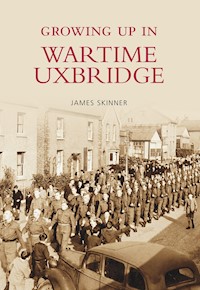
Front Cover: Local Home Guard units formed part of a ‘Wings For Victory’ parade through Uxbridge on 6 March 1943.
Back Cover, left: The author aged nine. Right: Yiewsley housewives in Castle Avenue responding to the call to save food scraps for pigs and poultry. The council’s collector (left) is Benny Jones.
Frontispiece: Front cover of the brochure for visitors to the Operations Room in peacetime.
First published in 2008 by Tempus Publishing
The History Press
The Mill, Brimscombe Port
Stroud, Gloucestershire, GL5 2QG
www.thehistorypress.co.uk
This ebook edition first published in 2012
All rights reserved
© James Skinner, 2008, 2012
The right of James Skinner, to be identified as the Author of this work has been asserted in accordance with the Copyrights, Designs and Patents Act 1988.
This ebook is copyright material and must not be copied, reproduced, transferred, distributed, leased, licensed or publicly performed or used in any way except as specifically permitted in writing by the publishers, as allowed under the terms and conditions under which it was purchased or as strictly permitted by applicable copyright law. Any unauthorised distribution or use of this text may be a direct infringement of the author’s and publisher’s rights, and those responsible may be liable in law accordingly.
EPUB ISBN 978 0 7524 8014 5
MOBI ISBN 978 0 7524 8013 8
Original typesetting by The History Press
Contents
Acknowledgements
Introduction
one The Pre-War Years
An Early Bereavement
Schooldays
Shopping Around
The Outdoor Life
Royal Celebrations
The Munich Crisis
two The War Years
Preparing for War
Evacuation
The Miracle of Dunkirk
The Battle of Britain
Peril on the Sea
The Blitz
Families of War
D-Day and Doodlebugs
Peace at Last
three The Post-War Years
Victory Celebrations
Life in the RAF
Back in Civvy Street
Wedding Bells
New Beginnings
Acknowledgements
Again I am indebted to the Uxbridge Gazette for the loan of archive material and for granting permission to reproduce it in this book.
And, as always, my grateful thanks are due to Carolynne Cotton, Gwyn Jones and Richard Daniels of the Heritage Department, Uxbridge Central Library for their help and the loan of their photographs.
My sincere thanks also to the following individuals for providing me with information, and for generously allowing me to use their personal photographs: Chris Wren (former curator of the RAF Museum) Ken Pearce, Dr R.T. Smith, Joyce Burden, Patrick and Sheila Burgoyne, Eva Adnett, Peter Koenig, Maureen and Philip Sherwood, Audrey Beasley, Val Culmer, Bryan Williams, Alan Noad, Brian Moores, Gareth Owen, Robert Caughey, Agnes Eggleston, Maureen Franklin, Pamela Holden, Vivienne Drewett, Audrey and Michael Skinner, Alan Johnston.
Finally, a special thank you to Elaine Verweymeren for processing my manuscript.
Introduction
Although the title Growing Up In Wartime Uxbridge is self-explanatory, and would not appear to need an introduction, I am taking this opportunity to sketch a broad outline of the book’s format.
The main body of the work is contained in the middle chapter and lives up to its title, since it focuses on the Second World War years of 1939-1945. However, by way of added interest, I decided to preface this with an opening chapter dealing with the previous decade. From a child’s viewpoint, those pre-war years of the 1930s were full of carefree, halcyon days when the sun always seemed to shine. But before anyone protests about that statement, let me hastily add that for many people, the 1930s were, regrettably, quite the opposite. It was a time for the ‘haves’ and the ‘have nots’; to quote from Dickens ‘It was the best of times: It was the worst of times’.
So, having started with a prologue, I thought it appropriate to round off the book with a shorter final chapter on the post-war period up to the end of the 1940s.
Finally, I hope that readers will bear with me if I complete these introductory notes with a brief personal reference to my family background, especially in view of my forebears’ involvement with the military and previous wartimes.
My father (also James) served with the RASC (Royal Army Service Corps) during the First World War, being mentioned in dispatches in 1917, and my grandfather (another James) was a Lieutenant in the 45th regiment of the British Army. My great grandfather was a Major who commanded the Indian 14th Irregular Cavalry, while my great great grandfather, Col James Skinner, CB (1778-1841) was the founder of the illustrious Skinner’s Horse Cavalry Regiment (later the First Duke of York’s Own Skinner’s Horse).
However, despite coming from a long line of military men, I was the first to break with the family’s Army tradition when I joined the RAF early in 1946.
Thankfully, I was also the first in the line not to have been actively engaged in warfare.
Cover of the programme of events during Warship Week 1942. Uxbridge adopted the Destroyer HMS Intrepid which unfortunately sank in October 1943.
one
The Pre-War Years
On a bleak, midwinter day in January, 1928, a cross-channel ferry from Calais was riding on a storm-tossed sea, carrying my mother back to England. And she was carrying me. After living in France for eighteen months, she wanted me to be born in this country, but was obliged to make the journey alone as my father could not leave due to work commitments.
After serving in France during the First World War, my father returned home, not to the ‘land fit for heroes to live in’ as the politicians had promised, but to a country reeling from mass unemployment, widespread strikes, food shortages, lawlessness and a general feeling of despair. The unemployment figure soon topped the one million mark – over two thirds being ex-servicemen. With no prospects of a job, he went back to France, finding employment with the BRCS (British Red Cross Society) Mobile Unit and the War Graves Commission. He worked around Lille and Arras for eight years, during which time he met my mother in Uxbridge on one of his leaves.
I first saw the light of day at No. 6 Cleveland Road, the nursing home run by sisters Hilda and Maud Franklin, before being taken home to How’s Road, where my mother lived with her parents. The twenty Edwardian terraced houses in the road and eleven others in adjoining How’s Close were built in 1906 on the site of a large apple orchard. They were the ‘three up, three down’ type with bathrooms (but no hot water); tiny gardens with outside toilets, and no electricity. Heating was provided by fireplaces in every room.
Both roads and paths were gravel surfaced, prone to potholes that became quagmires in winter and dust bowls in summer. They stayed that way until 1936 when tarmac surfaces were laid along with paving slabs on the paths.
Living with parents and grandparents was an enjoyable experience, even if it meant being spoilt. My father had returned to England soon after my arrival on the scene, and I have fond memories of him and my grandfather joining in my childhood games, especially when I careered round the living room on a baby tricycle followed by one of them on a wooden horse and the other on a similar toy on wheels.
Another wartime. My father serving with the Royal Army Service Corps in France, c. 1917.
At the same time my mother enlisted in the Women’s Royal Air Force at Uxbridge.
My father’s certificate for being mentioned in dispatches, signed by Winston Churchill, Secretary of State for War.
My birthplace – the Nursing Home at No. 6 Cleveland Road.
My home for twenty-one years at No. 18 How’s Road. The iron gate posts remain, but the railings were removed to aid the war effort.
My grandfather, Walter Turton, a keen musician, had played the bass euphonium in the Uxbridge and Hillingdon Prize Band for thirty-seven years. One of their regular engagements was a twice-weekly concert in the Fassnidge Recreation Ground. He was also a respected member of the Uxbridge Volunteer Fire Brigade for fifteen years, and became something of a local hero, when in April 1924 a mystery fire broke out at the top of a 450-ft aerial mast at Northolt Post Office Wireless Station. Appeals for assistance were made to several local Fire Brigades who, according to The Evening News report, felt obliged to decline, considering ‘that it was a job for steeplejacks, not firemen’. Nevertheless, when the Uxbridge Brigade arrived on the scene my grandfather volunteered, along with two colleagues, F.C. Wright and R. Crook, to make the ascent. To quote again from The Evening News, ‘With fire appliances on their backs it took them nearly an hour to climb the mast, and on reaching the top they hacked away the burning wood support – it was well above the aerial wires – with their axes’. Shortly afterwards the three volunteers became the proud recipients of letters of commendation from the Postmaster General, and their photographs appeared in the Daily Mirror with the caption ‘Steeplejack Firemen’.
In view of his 450-ft climb, it was cruelly ironic that seven years later he should lose his life falling from 35ft up – and even worse – that it should be during a practice fire drill. It was the evening of 28 May 1931, and a dozen members of the brigade were engaged in a routine escape drill at Kings Mill, Denham. Suddenly my grandfather appeared to lose his footing at the top of the ladder and while reaching for the Davy escape apparatus, fell to the ground. On arrival at Hillingdon Hospital he was examined by the then head, Dr ‘Jock’ Rutherford, who found a fractured pelvis, arm, femur, and several broken ribs. He died on the following morning, and the coroner’s report indicated that he had remained lucid and never lost consciousness.
My maternal grandfather Walter Turton, a bandsman for thirty-seven years with Uxbridge and Hillingdon Prize Band.
The bandstand in Fassnidge Park, the venue for twice-weekly band concerts during summertime.
Kings Mill by the River Colne at Denham, where my grandfather met with his fatal accident.
On 2 June, after a Requiem Mass at the church of Our Lady of Lourdes, his coffin, draped with a Union Jack together with his fireman’s helmet, axe and bandsman’s cap, was carried by colleagues from the Brigade Messrs Bodger, West, Finch, Pearce, Harvey and Horan, while the hearse was driven by Fireman Burrows. It seemed that almost the entire community had turned out to pay its respects and witness the funeral procession as it proceeded up Lawn Road and along the High Street to beyond The Greenway. Traffic came to a standstill as the long cortege slow marched past the crowd lining the High Street. It was headed by a body of the Metropolitan Police, followed by over fifty firemen in full dress uniform including Chief Officer Harry Gales and Hon. Sec. G.J. Crook. Then came the Silver Band led by Mr A.B. Sims, playing my grandfather’s favourite hymn ‘Days and Moments’ and the ‘Dead March’ from ‘Saul’. Following the band were members of the RAF Central Band, representatives of twenty neighbouring brigades, local dignitaries Alderman H.S. Button JP, Maj. R.W.C. Flavell JP, Mr R.W. Hudson JP and others, close friends including Messrs Bell, Finch, Gardiner, Sopp, Worley and Brown, and finally the hearse and family mourners’ cars. At the municipal offices the flag flew at half mast, and council officers stood to attention as the procession passed in what was a fitting tribute to a greatly respected member of the community. Being so young I was spared a lot of the grieving, although I don’t think my grandmother or mother ever really got over the shock.
I did not know him for long, but later I gathered that I was the apple of his eye. This probably accounts for the inscription on my parents’ second wreath, ‘His best boy, to Grandpa’.
My elementary school, St Mary’s, in Rockingham Road.
Two years later, on 12 June 1933, my schooldays began at St Mary’s, Rockingham Road – a small, Victorian brick and slate building with only three classrooms, each with an open fireplace. The school roll numbered about 100, and the teaching staff comprised the head, Elizabeth Hoey, and sisters Molly and Madge Smith – a formidable trio who collectively chalked up over 100 years of service.
We were fed a strict diet of the three R’s and the headmistress, a strong disciplinarian and brilliant academic, also displayed her generosity by treating us to a seaside outing every summer in addition to educational cinema visits.
Molly Smith not only included maths, English, history, geography and nature study in her repertoire, but also taught needlework, country dancing and physical training. Additionally she ran the girls’ netball team, and because of a great interest in soccer originating from her Geordie background, the boys’ football team as well. All this on a salary of £195 per annum. After she died in 1996, I felt honoured when her family invited me to deliver the eulogy at her funeral service.
During the 1930s, the majority of pupils walked to school. Some had a bus or train journey as well. Bicycles were a luxury few could afford. Those who lived nearby, as I did, went home to lunch; the rest brought sandwiches. No canteens in those days! A ha’penny bottle of milk – a third of a pint – was available during the morning break, when the playgrounds became hives of activity. Boys and girls were separated by a wire fence and no one dared to cross the frontier.
The boys’ main pastime was football played with a tennis ball but non-players found numerous other interests. ‘Fag’ cards, marbles, ‘five-stones’, conkers, ‘bung the barrel’ were all in evidence while a thriving trade existed in swapping anything from cigarette cards to ‘tuppenny bloods’ such as Hotspur, Wizard, Adventure and Rover comics.
On the road to school, by Rockingham Bridge, stood a small, shack-like, corrugated-iron sweetshop called The Bon Bon. Owned by Charles and Avis Rashbrook who lived nearby, it housed a treasure chest of goodies displayed invitingly under its glass counter top. A ha’penny could purchase a sherbet fountain, liquorice pipe or bootlaces, ‘everlasting strip’ toffee, aniseed balls or gobstoppers – and prices started at a farthing. Only the poorest children – and unfortunately there were several – could pass the shop without buying something.
Avis Rashbrook in the doorway of ‘The Bon Bon’, her sweet shop by Rockingham Bridge. 16
Two months after I started at St Mary’s, a new teacher joined the staff of Frays College, the private school in Harefield Road. He was Eric Blair, who would achieve fame later through his books Animal Farm and 1984, written under his pseudonym George Orwell. Mr Orwell was one of a number of distinguished residents of Uxbridge over the years. Anti-slave campaigner William Wilberforce lived at Chestnut House, Honeycroft Hill from 1824-1826, the renowned Victorian actress Ellen Terry used a medieval house at the western end of the High Street as a weekend cottage during the 1880s, and T.E. Lawerence, better known as Lawrence of Arabia, was a recruit at RAF Uxbridge in 1922, using an alias – John Hume Ross. His book The Mint chronicles his stay at Uxbridge. In addition, stage and film actor Bernard Miles was born and bred in Hillingdon.
George Orwell left Frays College after only one term due to catching pneumonia and spending time in Uxbridge Cottage Hospital during January 1934. Soon afterwards I had my first introduction to that same hospital when our family doctor Harold Vickers referred me for an exploratory throat examination followed by a second one at Guy’s Hospital in London. The results of both proved inconclusive – the consultant at Guy’s only succeeding in knocking out my front teeth!




