


Erhalten Sie Zugang zu diesem und mehr als 300000 Büchern ab EUR 5,99 monatlich.
- Herausgeber: Luath Press
- Kategorie: Sachliteratur, Reportagen, Biografien
- Sprache: Englisch
Alan Rae was the physio at Hearts for over 20 years. He joined the club in 1982, languishing in the First Division and looking at the prospect of part time football. In that time he has seen 8 managers come and go as well as 3 owners and too many players to mention. Six years after leaving 'The Jambos' he has penned a memoir of his time at Hearts. He has anecdotes about home games, European games and even pre and post season tours abroad. Woven into these memories is the medical knowledge of a true professional, from players suffering career threatening injuries to managers for whom the pain of losing is physical as well as mental. BACK COVER: As Heart of Midlothian FC's physiotherapist, Alan Rae was a vital member of the Tynecastle backroom staff for more than two decades. He was one of the few constants during a tumultuous period in the club's rich history and his behind-the-scenes recollections will fascinate and entertain in equal measure. From international superstars to mischievous boot-room boys, Rae shares his unique insight into the life of a great Scottish football institution. Hands on Hearts is a must-read for football fans everywhere - Jambos or otherwise -and for anyone who has ever wondered about the healing properties of the physio's magic sponge!
Sie lesen das E-Book in den Legimi-Apps auf:
Seitenzahl: 285
Veröffentlichungsjahr: 2013
Das E-Book (TTS) können Sie hören im Abo „Legimi Premium” in Legimi-Apps auf:
Ähnliche



















ALAN RAE was a long-serving employee of Hearts Football Club, a firm presence in the team’s dugout on match days. Part-time from 1982 whilst also working at Edinburgh Royal Infirmary, he later joined the club on a full-time basis. He was a well-respected member of the off-pitch team, and throughout his career witnessed eight managers, three owners and numerous players come and go. Alan left Hearts in 2005 after 23 years at Tynecastle Stadium. He now lives in the Scottish Borders.
PAUL KIDDIE began his journalistic career with DC Thomson in Dundee in 1984, where he spent twelve years before joining theEdinburgh Evening Newssports desk. A similar length of service with Scotsman Publications saw him report on Hearts for six tumultuous seasons, during which time he first met Alan Rae. After a year living in the USA, Paul was offered the chance to return to Scotland as communications Manager at Heart of Midlothian FC, a position he took up in January 2007.
From the brink of possible collapse to the arrival of Vladimir Romanov, most fans of football will find something of interest in this book. SCOTTISH FITBA
Rae’s wealth of medical knowledge is evident in the book, and his psychological insight into the players he treated is also much to the fore…the book is above all a modern history of Hearts. THE SCOTSMAN
Football-wise, Alan Rae was the best physio I ever worked with. He was second to none and other physios even came to him to ask for advice. He brought a real professional approach to the physiotherapy side of things at Hearts and was a real gentleman as well. WALTER KIDD
I remember coming back to Tynecastle after breaking a leg in Majorca and doing my ankle pretty seriously. He got things healed up pretty quickly using the good old fashioned methods and my fitness test before my last game for Hearts involved jumping on a trampete three or four times on my dodgy ankle! Alan told me if it felt alright, that was fine, I’d play. It was still pretty sore but he strapped me up, and I scored the winner against Dunfermline at Tynecastle – and then Dick Advocaat put in a £2 million bid for me so Alan must have known what he was doing! He was always very straight with players and was a great guy to have at the club. I had a lot of time for Alan and as all good physios should be, outwith all the medical side of things, he was brilliant in the dressing room. It’s so important for someone in his position to have a good relationship with the players and in my time at Hearts Alan was brilliant.NEIL MCCANN
Alan was a fantastic physio and fantastic for the young boys. When it came to the discipline side of things, there was no one better than Alan and that stood them all in good stead for when they progressed. It’s something you don’t normally associate with a physio but they knew what he was about and feared if they didn’t do a job properly, they could be there all night. He was a one-off, a bit eccentric but a top guy and a fantastic character. JIM JEFFERIES
Alan Rae was a top man for me, a fantastic person and not just from the physio side. When I came to the club as a 16-year-old straight from school he helped me settle in and turned me into a man. He never just gave treatment, he taught me how to apply myself away from the football, the way to dress, the way to turn up for work, etc. The ground staff back then was a lot different to now as they all had to do the crap jobs and Alan kept me on my toes and wasn’t shy in telling me I had done something wrong. He was just fantastic for our development as people not just players. In my time as a player I had a really bad injury and there were times when I would get quite low, but he was a massive influence, always there encouraging me and he got me back quicker than I maybe should have. I can’t speak highly enough of him as he saved my career when I was just 20 years old. His patter was horrendous, though!GARY LOCKE
When I first came back to Hearts they didn’t have a full-time physio – Alan was the physio but he worked at the Royal Infirmary – and I found that bizarre for a club of Hearts’ stature. If you wanted treatment you had to go to the Infirmary and Alan would see you in his lunch break! That continued for a couple of years until he turned full-time. He didn’t suffer fools gladly. He had the youngsters organising things to within an inch of their lives, while having a great relationship with the senior players. I had nothing but the highest respect for him. He did have a ‘mental’ side to him when he could explode at a youngster for asking a daft question.EAMONN BANNON
Alan was really good at his job, was loyal to every manager at the club and was brilliant for Hearts. Every time I think of him I recall a story from a break at Christmas time when we went to Marbella when I was manager. George McNeil and Bert Logan were there and we were out for a few beers when Alan for some unknown reason decided to climb a tree and raced up it like a monkey! He came back down and just started laughing and that summed him up for me – he was very professional but had a jovial side to his character when he would come away with the unexpected.SANDY CLARK
The physios never dictated to the gaffer, he told them he wanted the players fit. And Alan knew his job really well. I thought he was great and he had a terrific manner with the players. He brought a bit of discipline to the younger ones and you definitely didn’t want to walk into his room uninvited or you’d get short shrift. People might have taken him the wrong way but he was a good character who cared for his players. Even if he was a bit of a nutcase! STEVE FULTON
He wouldn’t do anything before his coffee break first thing in the morning! He was an absolutely fantastic physio who even though he worked in a tiny little physio room at Tynecastle got people back from injury very quickly. A wonderful man with a very dry sense of humour who was brilliant company. ALLAN PRESTON
Alan was the best physio I worked with in my career, without a shadow of a doubt, and I was shocked when he left Hearts as I thought he would have been there for ever.SCOTT CRABBE
He was one of the most trustworthy, wonderful, lunatic, crazy, loveable, straight-jacketed men I have ever met in my life.JOHN ROBERTSON
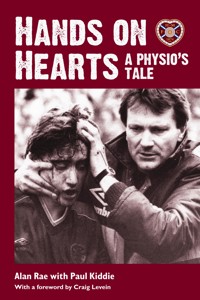
Hands on Hearts
A Physio’s Tale
ALAN RAE
with Paul Kiddie
LuathPress Limited
EDINBURGH
www.luath.co.uk
First published 2011
This edition 2012
This editon in eBook 2013
ISBN (paperback): 978 1 908373 54 0
ISBN (eBook): 978-1-909912-08-3
The authors’ right to be identified as authors of this book under the Copyright, Designs and Patents Act 1988 has been asserted.
© Alan Rae and Paul Kiddie 2011
Contents
Acknowledgements
Foreword by Craig Levein
Preface
Chronology
CHAPTER 1 Kicking Off
CHAPTER 2 Bad Day at Dens
CHAPTER 3 Craig, the Fife Flyer
CHAPTER 4 High Road to Munich
CHAPTER 5 New Faces
CHAPTER 6 Falling Short
CHAPTER 7 Madrid and Belgrade
CHAPTER 8 Hydrotherapy
CHAPTER 9 Speed Ball
CHAPTER 10 Canadian Capers
CHAPTER 11 Italian Renaissance
CHAPTER 12 Norrie Gray
CHAPTER 13 War Horses
CHAPTER 14 Pair of Aces
CHAPTER 15 A Trophy at Last
CHAPTER 16 Dutch Master
CHAPTER 17 Last Bus from Gorgie
IMAGE SECTION
Appendix: The Basic Management of Football Injuries
To my wife Sheila and my family – Frances, Helen, Christine and Neil – who all suffered for the cause.
Alan Rae
To Margaret for the wonderful job she does as a wife and mother, and to Caitlin and Michael for their love and laughter.
Paul Kiddie
Acknowledgements
While writing this series of recollections I received help and information from many former players who gave their time generously. The book itself would have remained a notion but for the able assistance of Paul Kiddie who has worked well beyond what any reasonable person would put up with. All or nothing must be his motto. For his commitment alone I hope this book has some modest success not least because a proportion of the proceeds will be donated to the Sick Children’s Hospital, Edinburgh.
I wish to thank Gavin MacDougall at Luath, who chose to take a punt onHands on Heartsand my editor Jennie Renton, who slapped the text into shape and yours truly along with it, metaphorically of course. My gratitude to Gavin, Jennie and the staff at Luath pales to ‘a daimen icker in a thrave’ in terms of their assistance.
A man for whom I have great respect read the text prior to publication; Pilmar Smith, the former vice chairman of Heart of Midlothian, who had almost a monopoly on common sense during his tenure at Tynecastle and still retains this faculty. A former director of the club, James Clydesdale, was largely responsible for making my side of Tynecastle habitable and also kindly advised me on the chronology of the stadium reconstruction.
Many of the photographs in this book (accompanying my own) are the gift of Eric McCowat. I thank him for this huge contribution from his Sports Photo Archive which has so enriched the visual aspect of this book. I’d also like to thank Scotsman Publications Ltd for kindly allowing me access to their archive.
Mr Craig Levein needs no introduction from me. In his Foreword he has written more than a few words about his time at Tynecastle as player and manager. His reflections on my state of mind echo the notion that you don’t have to be mad to work at Tynecastle, but it sure helps. Thank you, Craig, for your support in this project.
When searching for dates, scores and names, the London Hearts website and Norrie Price’s fine book,Gritty, Gallant and Glorious, proved invaluable. I would recommend both to all dedicated Hearts supporters.
I am grateful to Heart of Midlothian FC for kindly allowing the club badge to be used on the cover of this book.
Finally, I must thank my wife Sheila and the family, who encouraged me throughout this undertaking and helped by reading through material and criticising when the text got out of hand.
Foreword by Craig Levein
When I first started at Hearts in 1983, Alan Rae was full-time at the Royal Infirmary and did his work with the players on a part-time basis. The injured ones would have to jump in their cars at lunchtime and drive to the hospital to get treatment during his lunch break – and he was looking after just about all the squad at the time.
I probably spent more time with him than anyone else at the club and that is why nowadays I question my sanity! I maybe spent more time with him over a long period than I did my team-mates. He was as mad as a hatter, completely nuts, but a man for whom I have huge admiration.
Quickly becoming the club’s full-time physio, he wasn’t someone who allowed you to feel sorry for yourself and that was something which benefited me with my history of knee injuries. He was good at setting small goals so that I could focus on something in the near future rather than think, shit, I’m out for a year. He would set these little targets to help make me feel I had achieved something in a short space of time and for me that was a much better approach.
I have an awful lot of time for Alan, who was very supportive when I was injured. I have always had a lot of respect for him and I think he respected the fact I’d had a lot of setbacks. He was an extremely fair person with everyone and didn’t have favourites – he went off his head at all of us! He had his quirks and it wouldn’t take much to set him off and it wouldn’t be the first time I have seen a bottle of talc bounce off someone’s head!
Part of physiotherapy is psychology and keeping players focused, and he was really good at that while maintaining a bit of fun as well – we used to have some great laughs, mostly at Kevin Thomas’ expense who was in there for a while!
He was a hard taskmaster and not very tolerant of people not doing their work properly, which I think is a great thing. If you want to come back better than ever from an injury you have to be focused on doing your rehab properly.
Our relationship was quite close because I had been in his room for what must have been around three years altogether and we got to know each other quite well. It was almost like a marriage as such – we were comfortable even with silence and when I became manager of Hearts it didn’t change that much.
The absolute trust I had in him meant that when I was manager I knew he could take charge of situations and he didn’t need me breathing down his neck asking questions all the time. I would let him dictate the rehab and tell me when people were going to be fit. Some previous managers would be at him all the time telling him they need so and so fit, whereas I knew Alan was doing everything he could to get players back fit as quickly as possible.
As a manager you take immense comfort from people around you doing their job properly, you want to feel secure, they are all thinking the same way and focused on the same goals. I didn’t need to worry about Alan on that score so he became part of the backroom team along with Peter Houston and John McGlynn. When I came back to the club as manager it was like stepping back into an old set of slippers – it was comfortable for me to have Alan as the physio and I trusted him completely as I knew he was the best man for the job, that he understood the demands on a manager, and that allowed me to get on with my job which was hard enough without worrying about anything else.
His humour was off the wall but for me it was the unpredictability of his explosions. One such occasion happened when we were in getting treatment and someone conducting a stadium tour opened the door and came right through with a bunch of school kids and up towards the gym. He had this incredulous look on his face as if to say: ‘Where the **** are they going?’ They were just kids but as the last one disappeared out the door to go up to the gym, they left it open. Alan looked at me with his usual deadpan expression and said, ‘Excuse me a second,’ walked over to the door, grabbed it and shouted after them: ‘Were you born in a f****** barn!” before slamming it shut and turning round and coming back as if nothing had happened. On pre season tours he would do his work but was then a bit like a tourist either wandering around doing his own thing or photographing stuff – some of his efforts you will see later in the book.
At times I felt he got taken for granted with an enormous work load and consequently he was unable to have a normal family life. His durability and stamina shone through as what he did was above and beyond the call of duty and Heart of Midlothian Football Club owes Alan Rae a huge debt of gratitude.
Preface
I have always enjoyed the challenge of fresh circumstances. Practising physiotherapy had taken me round the globe in the years before I came to Hearts and I had become adept at coping with change, which was just as well. For the next 23 years – years that saw momentous changes at the Hearts – I worked under three owners and eight managers, all of whom put their own stamp on the continuing development of the club. The following chapters will jog some memories, not all happy, of the period 1982 to 2005, when I was fortunate enough to practise my clinical skills as a physiotherapist at Tynecastle where I came to know, players from youth level to the first team at Heart of Midlothian FC.
Alan Rae, September 2011
Chronology
1982
In June Alan Rae is invited to provide physiotherapy services for Heart of Midlothian.
1982–83
Alex MacDonald and Sandy Jardine guide Hearts to promotion into the Premier League.
1983–84
After five straight league wins at the start of this season Hearts qualify for Europe.
1984–85
Hearts play Paris Saint-Germain and comfortably stave off the memory of recent relegations.
1985–86
Hearts beaten by Glasgow Celtic on goal difference for the league title and lose the Scottish Cup Final to Aberdeen.
1986–87
Hearts lose narrowly to Dukla Prague, Wayne Foster making his European debut by scoring first in the home leg.
On 31 October Craig Levein is seriously injured in a reserve match at Easter Road.
1987–88
End of season league position, second behind Celtic, guarantees European football at Tynecastle in the next season.
1988–89
John Robertson sold to Newcastle in April 1988, Iain Ferguson signed as replacement in July 1988.
Joint manager Sandy Jardine sacked in October 1988.
Bayern Munich play at Tynecastle in February 1989 in the UEFA Cup quarter-final.
John Robertson re-signed in December 1988.
1989–90
In March 1990 Hearts lose by 4-1 at Pittodrie in Scottish Cup.
Alan Rae joins Hearts on a full-time basis in January 1990.
1990–91
After a poor pre-season and a losing start in the league, Alex MacDonald and Walter Borthwick are sacked in November 1990.
Fine victory v Dnepr. 1-1 away and 3-1 at home.
Craig Levein and Dave McPherson play in the World Cup finals.
Joe Jordan and Frank Connor are appointed as manager and assistant manager in September 1990.
1991–92
Joe and Frank split the Old Firm. Hearts second in league behind Rangers.
Ian Baird signed in July 1991 and Glynn Snodin signed in March 1992.
1992–93
Hearts’ youth policy pays off: Youths win prestigious BP Cup against Rangers at Ibrox.
After an unlucky loss in the cup semi-final and losing 6-0 at Falkirk on 1 May 1993, Joe and Frank are sacked.
Sandy Clark manages the team until the end of the season.
1993–94
Sandy Clark and Hugh McCann are appointed as manager and assistant manager.
Justin Fashanu is signed in July 1993.
Hearts play Atlético Madrid in September 1993.
Wallace Mercer sells Heart of Midlothian to Chris Robinson and Leslie Deans who take over in June 1994.
Clark and McCann sacked. Vice chairman Pilmar Smith leaves.
1994–95
Tommy McLean and Tom Forsyth are appointed as manager and first team coach in June 1994.
Eamonn Bannon is appointed assistant manager, Walter Kidd becomes youth coach in July 1994.
Wheeling and dealing after the loss of McLaren and McKinlay. In come Cramb, McPherson, Miller, Nelson, Jamieson, Hagen and Hamilton.
Hearts beat Rangers in Scottish Cup quarter-final at Tynecastle but lose 0-1 to Airdrie in the semi-final at Hampden on 8 April 1995.
Relegation is avoided on 13 May 1995, the last day of the season, in a victory against Motherwell at Tynecastle.
McLean and Forsyth leave the club in July 1995.
1995–96 Jim Jefferies and Billy Brown are appointed as manager and assistant manager in August 1995.
Rousset, Bruno and Eskilsson signed.
Hearts reach Scottish Cup Final in May 1996.
Captain Gary Locke seriously injured as his team is soundly beaten by Glasgow Rangers.
1996–97
Steady improvement of the team – Bruno, Pointon, Cameron, Weir, Fulton and Rousset steady the ship.
Rangers again the opponents in the Scottish League Cup Final in November 1996.
Locke returns to fitness in January 1997 after six months’ rehab.
1997–98
After three home ties and a semi-final at Ibrox against Falkirk, Hearts reach the Scottish Cup Final, once more against Rangers.
A Fifer and a Frenchman seal the first cup victory since 1956.
1998–99
Steven Pressley is signed.
A resurgence in the final quarter of the season sees the team pull away from relegation zone.
1999–2000
A much improved Hearts side qualifies for Europe and clinches third spot in the league.
2000–01
Popular Rousset loses his place to Antti Niemi.
Hearts are unlucky to lose on away goals to Stuttgart.
Disaster at Easter Road in October 2000 where the team lose six goals to their arch rivals, Hibs.
Jefferies leaves the club in November 2000.
Craig Levein is appointed manager in December 2000.
2001–02
Shrewd signings Alan Maybury, Kevin McKenna, Ricardo Fuller and Austin McCann stabilise the team.
Steven Pressley rising to prominence.
2002–03
Under Levein’s guidance Hearts reach third place in the SPL.
Phil Stamp is signed.
2003–04
A comfortable win in a preliminary round against Bosnian opposition takes Hearts into the second round of the UEFA Cup.
Despite a fine 1-0 victory in the away leg, Bordeaux win at Tynecastle on 27 November 2003.
Consistency in the SPL again secures third spot in the table. Hearts move to the new Soccer Academy at the Heriot-Watt Riccarton campus in May 2004.
2004–05
Pre-season training in Vancouver.
Andrew Driver makes a brief appearance in friendly match.
A home win against Braga in the UEFA Cup at Murrayfield followed by an away leg draw takes Hearts into the league sections of the competition.
Levein’s managerial credentials soar and he leaves for Leicester in October 2004.
Enter Hearts legend John Robertson as replacement manager with Donald Park as his assistant.
Robinson sells Hearts to Vladimir Romanov in December 2004.
Alan Rae contemplates end game.
Robbo and Parkie leave – scunnered – in May 2005.
Youth team coach John McGlynn and former player Stephen Frail take control until end of season.
2005–06
George Burley is appointed as manager.
During a pre-season match in Dublin against St Patrick’s, Graham Weir sustains a leg fracture.
League season starts well.
Alan Rae leaves after a home match against Motherwell.
CHAPTER 1 – Kicking Off
IN ALEX MACDONALD’S COMPANY I once ventured, ‘When I played…’ A moment’s uneasy silence, then the Hearts manager said: ‘You never played!’ After that rebuke, when in professionals’ company, I have always listened without comment. Clearly, some care has to be taken here when I write about my own modest experiences on the football field.
My uncle, a useful inside forward playing in the summer amateur leagues, took me to watch Queen of the South when I was a lad growing up in Lockerbie. Applegarth, Kinnel Rovers, Kettleholm and Hoddam Rangers (who paradoxically wore green hoops) were the teams I followed. In my teens I turned out for youth and local amateur sides and later for a works’ team in Renfrew, and, for a season, for Gala Rovers. Football was the game I watched and tried to play. Marriage, children and work put paid to both.
In 1962 I enrolled at Tom McClurg Anderson’s Scottish School of Physiotherapy. Physiotherapists for many UK teams qualified here, including the pioneering Tom McNiven, who became the pathfinder for physios who wanted to get involved in professional football. From Third Lanark, a club which was strong in the early ’60s, he moved on to Hibernian, where his talents were recognised by the Scotland team manager. In his wake came Ronnie McKenzie, John Watson, Eric Ferguson, Jim McGregor, Tom Craig, Ricky McFarlane, Neil Falconer and Bill Shearer, all products of Anderson’s School.
In mid-July 1982 I received a phone call from an old school friend, Jim Donaldson, who told me that Sandy Jardine was leaving Rangers to join Hearts as a player, but also to assist his player-manager buddy, and that he was looking for a physiotherapist. I took the job, reasoning that I could combine following the game with expanding my clinical knowledge. I had been working outside Scotland for many years and when I came to Edinburgh in 1979 I was not particularly familiar with Scottish professional football. All that was about to change.
On my first visit to Tynecastle I was staggered by the state of the place. The ground was under-maintained and everything looked shabby, including the physio room, which appeared to multi-function as a laundry room (if an old bath full of dirty kit was anything to go by), a temporary dormitory for the ground staff and a canteen. Just where clinical treatments were carried out was anybody’s guess. And as I would soon discover, when kit was being handed out, the devil took the hindmost.
On one occasion shortly after starting in the job, I saw a lad, after washing the floors, proceed to suck up the excess water with a vacuum cleaner. It was not unknown for bath towels to be used for generally rearranging the dirt and cleaning boots. There was one washing machine and one dryer in the place, and laundry was often suspended on ropes under the grandstand to dry. However I should mention here that all the other grounds I visited around that time were every bit as bad as Tynecastle.
Willie Montgomery, the groundsman, didn’t suffer fools but was quite gentle, at least in footballing terms, with the young lads who acted as ground staff. I liked him. He had served his time at one of the esteemed golf courses in the capital and was a source of many anecdotes.
During cold spells, when the covers had to be pulled over the playing surface, it was all hands to the pumps and it was hard work for the youngsters. No gloves, no tracksuits, they pulled the sheets on and off.Willie would roar: ‘Pull!’
The reply: ‘Wur pullin’, Wullie.’
Willie’s disdainful retort: ‘Pull? Ye couldnae pull a sodger aff yer sister!’
On the positive side, everyone I met at Hearts was helpful and keen to have someone around who at least knew some first aid.
Alex MacDonald was going into his second season as player-manager and Sandy and he were very much on the same wavelength. Walter Borthwick was the team coach and it wasn’t long before John Binnie was recruited to look after the reserves and part-time playing staff. Walter and John were especially helpful to me, someone who was totally ignorant of the professional game.
Wallace Mercer, the chairman, who needs no introduction, had taken over this ailing club, supported by two dedicated Hearts men, Les Porteous and Pilmar Smith. In the background was former chairman and player, Bobby Parker, whose great depth of inside track was invaluable to the club.
The Hearts team was a blend of youth and experience. David Bowman, Gary Mackay, John Robertson and Ian Westwater were to become top class Premier League performers. Henry Smith, Roddy McDonald, Paddy Byrne and Stewart McLaren were seasoned professionals, as was prolific goal-scorer Willie Pettigrew. Playing alongside Willie was Gerry McCoy, with Peter Marinello as a wide man (winger). In the First Division that year, Airdrie, Partick Thistle, Falkirk and St Johnstone would all be competing for the two promotion places, their campaigns underpinned by home grounds that were uninviting as far as the opposition was concerned. I discovered that many people associated with Hearts were pessimistic regarding the club’s future. Pilmar Smith, a self-made man, was dismissive of the doom merchants: ‘Ravers, out and out ravers,’ he would say in his own inimitable fashion. ‘Hearts will always survive!’
An East of Scotland Shield tie at Easter Road was the venue for my first match as physiotherapist. I couldn’t have got off to a worse start. I realised I had forgotten to pack the treatment hamper and confessed to Alex while he was having his pre-match shower. He took this in his stride, as he did with most things in football. Needless to say, the round trip to collect it was completed in an embarrassed blur. The home side won the match, scoring with a rebound off Hibernian star defender Jackie McNamara’s back. One of my lasting memories is being showered with grit thrown from the home dugout by Pat Quinn, no less. Perhaps he picked up this stunt from his days at his junior club, Bridgeton Waverley.
The League Cup campaign started with an away match against Motherwell. It was a hot afternoon with the home team shading it 3-2, Hearts undone by a late Alfie Conn Jnr goal. Derek O’Connor kept Hearts in the match with a back post volley. A part-time player who had been in and out of the team, Derek had played for other clubs but he was always Hearts-daft. Rumour had it that he failed to turn up for his current club some Saturdays as he preferred to watch his beloved Jambos at home.
In the dressing room after the final whistle, I looked around at the players as they sat there totally drained; no injuries, but wiped out. I realised that it was going be my role to help them cope not just with the physical but with the mental and social impacts of the professional game. Many of the attributes of players are overlooked by lay people and I found it illuminating when the management and coaches pointed out to me how moves and techniques were performed. But I kept it firmly in mind that my own focus was how to get these guys out onto the field of play in as good shape as possible.
Pre-season 83–84 official photograph. Back row: Donald Park, David Bowman, Alan Redpath, Stuart Gauld, Stuart Dall, Roddie McDonald, Paul Cherry, Malcolm Murray, Neil Irving, Derek O’Connor, Gary Mackay. Middle Row: Walter Borthwick (first team coach), John Binnie (reserve team coach), Jimmy Bone, Paddy Neilson, Willie Pettigrew, John Brough, Henry Smith, Ian Westwater, Stewart MacLaren, Jimmy Sandison, Willie Johnston, Alan Rae (physiotherapist). Front Row: Alex MacDonald (player/manager), Mark Tomassi, Peter Shields, Gerry McCoy, Walter Kidd (captain), Gary Sutherland, George Cowie, Colin Scott, John Robertson, Peter Finlay and Sandy Jardine (assistant manager/player).
Many of the techniques I had learned had lain dormant when I was working in other fields of physiotherapy. Now I was applying them and I soon appreciated their efficacy. The use of strappings became of paramount importance when working with a small first team squad. By laying adhesive tape supportively on the skin, the underlying nerve endings transferred ‘stretch’ impulses to muscles, enabling them to react quicker over damaged joints. As a student I had gained work experience with Clydebank Juveniles, which now proved invaluable as I set about developing my working practice, as did the attitude and example of Bill McIntyre and Jimmy Strang, who ran these teams with total commitment to nurturing young talent.
The first leg of the quarter-final of the League Cup was played on 27 October against John Greig’s Rangers at Ibrox. David Bowman was given the task of marking Jim Bett, a fine attacking midfield player. This ploy frustrated Rangers. With ten minutes left, a wide right player by the name of John McDonald was introduced. He ran with a peculiar gait, as though his legs were not a pair, but he proved too much for a tired defence. Rangers won 2-0.
At Firhill a nervy point was gained, although Airdrie ensured that vital share of the spoils was soon forgotten when they ran out 5-2 winners at Tynecastle. But even with results like these, Bobby Parker was reassuring. He had seen it all before – many times!
Hand ball in the box from Hearts left back Peter Shields early in the return leg semi against Rangers gave Hearts a mountain to climb, and when Derek Johnstone scored late on the Glasgow outfit progressed on an aggregate 4-1 score.
Nevertheless, Hearts had shown what they were capable of doing against three top flight sides over six games. The drama continued to unfold with Hearts returning pointless from three games in Fife, two against Raith and one against Dunfermline, the cruel nature of these defeats making them all the more difficult to accept.
On a snowy night at East End Park, Dunfermline, with the final whistle about to be blown, scored with the last kick of the ball. On 29 March, in the second game against Raith Rovers, the lean and wiry Hearts full back Stuart Gauld – aka ‘Bamber’ – was hit on the forearm at Stark’s Park. His upper limb was glued to his side – ball to hand – to this observer. Not so, as far as the referee was concerned. He deemed it ‘hand to ball’ and awarded a clinching penalty.
Life at Hearts was nothing if not a steep learning curve. At home to East Fife in a Scottish Cup tie, left back Peter Shields hurt his wrist and without any thought as to the consequences of his not being on the park, I helped him to the sidelines to tape things up. No sooner had I started to work on him than the opposition exploited the positional hole left by Peter and scored! In those days, depending on the referee, a player could be treated on the park and didn’t have to go to the side and await a summons to re-enter play. After that incident, you can be sure that I made the player stay on until I was expressly ordered to remove him.
The Tynecastle faithful were beginning to realise this was a different Hearts outfit to those of the recent past. The return of decent crowds began, but it was a slow transition. Dynamo Kiev, with Oleg Blokhin and Vadym Yevtushenko on board, came to play a friendly. Only 3,000 fans turned up to watch these world-class players strut their stuff.




