


Erhalten Sie Zugang zu diesem und mehr als 300000 Büchern ab EUR 5,99 monatlich.
- Herausgeber: Nonsuch Publishing
- Kategorie: Sachliteratur, Reportagen, Biografien
- Sprache: Englisch
Harry Peckham was educated at Winchester College and New College, Oxford, before being called to the Bar and becoming, in time, a King's Counsel, a Commissioner for Bankrupts and Recorder of Chichester. He was also a witty rake, a keen sportsman (he was a member of the committee that drew up the laws of cricket) and a relentless tourist. Harry Peckham's Tour is a collection of letters he wrote in 1769 while travelling through the Netherlands, Belgium and France and contains insights into the society and culture of the places that he visited, including Rotterdam, The Hague, Amsterdam, Antwerp, Brussels, Ghent, Paris, Rouen and Calais. Perceptive and funny, Harry Peckham's Tour is written in a very engaging style and is a delight to read. This edition contains a new introduction and notes by Martin Brayne and is the only available version of Peckham's text.
Sie lesen das E-Book in den Legimi-Apps auf:
Seitenzahl: 333
Veröffentlichungsjahr: 2008
Das E-Book (TTS) können Sie hören im Abo „Legimi Premium” in Legimi-Apps auf:
Ähnliche



















HARRY PECKHAM’S
TOUR
HARRY PECKHAM’S
TOUR
EDITED BY MARTIN BRAYNE
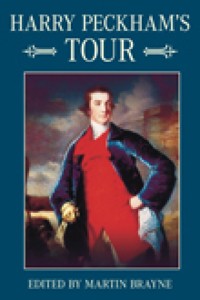
Front cover: Harry Peckham (oil on canvas), Joseph Wright of Derby, c. 1762. Private Collection
Back cover: General View of the Chateau and Pavilions at Marly, 1722 (oil on canvas), by Martin, Pierre-Denis (1663–1742) © Chateau de Versailles, France/Giraudon/The Bridgeman Art Library
First published in 1772
This edition published by Nonsuch Publishing in 2008
The History Press
The Mill, Brimscombe Port
Stroud, Gloucestershire, GL5 2QG
www.thehistorypress.co.uk
This ebook edition first published in 2013
All rights reserved
© Martin Brayne, 2008, 2013
The right of Martin Brayne to be identified as the Author of this work has been asserted in accordance with the Copyright, Designs and Patents Act 1988.
This ebook is copyright material and must not be copied, reproduced, transferred, distributed, leased, licensed or publicly performed or used in any way except as specifically permitted in writing by the publishers, as allowed under the terms and conditions under which it was purchased or as strictly permitted by applicable copyright law. Any unauthorised distribution or use of this text may be a direct infringement of the author’s and publisher’s rights, and those responsible may be liable in law accordingly.
EPUB ISBN 978 0 7509 5145 6
Original typesetting by The History Press
Contents
Introduction
Letter I
Letter II
Letter III
Letter IV
Letter V
Letter VI
Letter VII
Letter VIII
Letter IX
Letter X
Letter XI
Letter XII
Letter XIII
Letter XIV
Letter XV
Letter XVI
Letter XVII
Letter XVIII
Letter XIX
Letter XX
Appendix A—The Coins of Holland
Appendix B—The Flemish Coin
Appendix C—The Coin of France
Appendix D—Distances and Cost of Travel
Bibliography
Notes
Introduction
When in 1807 Robert Southey, purporting to be a Spanish gentleman, wrote the preface to his Letters from England, he began:
A volume of travels rarely or never, in our days, appears in Spain: in England, on the contrary, scarcely any works are so numerous. If an Englishman spends the summer in any of the mountainous provinces, or runs over to Paris for six weeks, he publishes the history of his travels …1
The present book is a good example of the genre to which Southey referred. It was originally published in 1772 under a typically overweight eighteenth century title—The Tour of Holland, Dutch Brabant, the Austrian Netherlands and Parts of France: in which is included a Description of Paris and its Environs. In common with many travel books of its time it took epistolary form; a device made famous by the French Huguenot François-Maximilian Misson whose Nouveau Voyage d’Italie had been published in The Hague in 1691 and translated into English four years later. Greatly admired by Joseph Addison, Misson’s book was much imitated. One of the most successful books of the type, Patrick Brydone’s Tour through Sicily and Malta in a series of letters addressed to William Beckford, was published in the year following the appearance of Peckham’s Tour.
Self-effacement was another frequently adopted authorial ploy, designed to stress that the writer was a gentleman and not a Grub Street hack scratching away in a garret. Edmund Bott, Peckham’s exact contemporary, declared that his book, The Excursion to Holland and the German Spa 1767, ‘must not be dignified with the magnificent title of Travels. A lounge it might very properly be called, as it was undertaken without any hope of instruction to the traveller himself or of utility to his country but for the gratification of his curiosity and for that alone’.2 Harry Peckham insisted that his letters ‘cannot do their author credit’ so that he was obliged to insist upon ‘my name being concealed’.
Although the book turned out to be a considerable commercial success, running eventually to five editions, its author remained anonymous until the fourth appeared in 1788 when he was revealed to be—
the late Harry Peckham Esq.
One of His Majesty’s Council and
Recorder of the City of Chichester
Christened Harry, not as some have assumed Henry, Peckham was the son of the Reverend Henry Peckham of Amberley, Sussex, later Rector of Tangmere, near Chichester. Henry was a kinsman of Henry ‘Lisbon’ Peckham, the builder of grandiose Pallant House in Chichester.3 A striking feature of the house is the stone birds on the gate piers; intended as ostriches, their appearance gave rise to the nick-name ‘The Dodo House’. The ostrich appears on the crest of the Peckham family’s arms and can be seen on Harry’s bookplate.
Educated at Winchester and New College, Oxford, of which he was a Fellow from 1761 until his death in 1787 at the age of 46, Peckham was called to the Bar in 1767, became King’s Counsel and bencher in 1782, died in his chambers in the Middle Temple and was buried in the Temple Church. At the time of his death he was Steward of New College, one of His Majesty’s Commissioners for Bankrupts and, as we have seen, Recorder of Chichester.
Harry Peckman was thus a successful lawyer but by no means a famous one, so that, whilst most of the principal events of his existence are not difficult to trace, it is harder to put flesh on the biographical bones. His book, of course, helps, revealing as it does a man of tireless energy and strong—if not always original—opinion. We know something of his physical appearance, for at about the time he graduated he had his portrait painted by the up-and-coming Joseph Wright of Derby. It is a swagger portrait typical of the day, so whether he was quite so handsome or cut quite so dashing a figure we must doubt. He does seem to think rather highly of himself.
The portrait is one of six painted by Wright for Francis Noel Clarke Mundy of Markeaton Hall, Derbyshire; they are of himself and five sporting friends. Mundy was a contemporary of Peckham’s at New College where he was a gentleman-commoner. Such students were invariably from rich families and were admitted in the expectation that they would prove to be, in the fullness of time, generous benefactors.4 The pictures were painted shortly after Mundy inherited Markeaton and each of the young sparks is shown wearing the distinctive livery of the private Markeaton Hunt.5 Although not averse to excessive drinking, Mundy was no Squire Western.6 He was also a poet, most famously the author of Needwood Forest (1776) and, after enclosure, The Fall of Needwood (1808). He was to become a member of the distinguished Lichfield literary circle which included Erasmus Darwin, Sir Brooke Boothby, Richard Lovell Edgeworth and Anna Seward.7
That the rakishness suggested by Peckham’s portrait had some substance in the man himself finds support both in the Tour and elsewhere in the written record. The Tour hints at a youngish man—he was 29 when it was undertaken—with an eye for the ladies; be it the ‘young, sprightly and handsome’ daughter of his Parisian landlord or the nude subject of a Titian painting or the celebrated statue of the Venus aux Belles Fesses in the garden at Marly-le-Roi. More conclusive evidence of the sowing of wild oats is to be found in his Will, drawn up on the 29 December 1784.8 Firstly, there is the French snuff box ‘with a saucy picture set in gold’ which he gives to a Chichester friend. Then there are some matters which must have weighed more heavily on the testator’s mind. We discover that he bequeathed an annuity of sixty pounds to Sarah Thompson, widow, and daughter of John Cooper of St Martin’s le Grand, London, as recompense ‘for an injury which many years since I attempted to do her’. We also find that his principal beneficiary was his daughter Sarah ‘born the third of May seventeen hundred and seventy one’. This despite the fact that nowhere, either in the Will or elsewhere, is a wife mentioned. One explanation, however, certainly presents itself; as a fellow of an Oxford college he was expected to be celibate and upon marriage his fellowship would have been automatically rescinded. We must assume either that he married in secret or that Sarah was born out of wedlock. Clearly he concealed, but did not deny, paternity. Alas, the Will was still the subject of a case in Chancery twenty years after Peckham’s death; the heirs of his executors fighting over their share of the spoils.9
We have another source of information which helps to fill out our picture of the author of the Tour. James Woodforde was another contemporary of Peckham. Born in the same year—1740—he too was educated at Winchester and New College. From shortly before going up to Oxford in the autumn of 1759 until a few months before he died in 1803, Woodforde kept a diary fascinating not as a record of great men and events, for he became a country clergyman, but for the remarkable wealth of quotidian detail of eighteenth-century life which it preserves. Peckham makes his first appearance in Woodforde’s diary—best known as The Diary of a County Parson—shortly after going up to Oxford when, on 6 October 1759 ‘Geree, Peckham & myself had a Hogshead of Port from Mr Cropp at Southampton.’10 How long it took the three students to consume the 57 imperial gallons which a hogshead comprised we cannot be sure, but Woodforde’s Diary suggests not very long.
In general the two undergraduates probably rubbed along pretty well together. Woodforde lent Peckham his ‘great coat and black Cloth Waistcoat’11 to go to Henley Assembly and, when the diarist was confined to his college rooms with an attack of boils, Peckham and another student ‘had their Suppers here and spent the Evening with me’.12 On the day after they had both obtained their fellowships they went, together with two others, to London. They visited Vauxhall, which Peckham in the Tour was to compare with a pleasure garden of the same name in Paris and, in the evening, they went to the Theatre Royal, Drury Lane, to see All in the Wrong, a new play by Samuel Johnson’s friend Arthur Murphy.13 As we shall see, Peckham had a keen interest in the stage and in his book was to make illuminating comparisons between London theatres and those of The Hague, Amsterdam, Brussels, Lille and Paris.
However, although they often drank, gambled and played together, the relationship between future parson and future lawyer seems to have found expression in rivalry as often as in comradeship. On one occasion Peckham, a keen sportsman, ‘laid me that his first Hands at Crickett was better than Bennett Snr’s and he was beat’,14 but on another—
Peckham walked round the Parks for a Wager this Morning: he walked round the Parks three times in 26 Minutes, being 2 miles and a Quarter. Williams and myself laid him a Crown that he did not do it in 30 Minutes and we lost our Crown by four minutes. I owe Peckham for Walking—0:2:615
Although Woodforde sometimes had sharp words for fellow collegians he is rarely quite as critical as he is of Harry Peckham whose energy and ambition the somewhat slothful diarist may well have envied. He made no particular objection when the barrister-to-be sconced (i.e. fined) him, two bottles of wine ‘for throwing’ in the Bachelors’ Common Room16 but when they argued against one another in the Latin disputation which formed part of the degree examination, Woodforde dismissed his opponent’s arguments as ‘very low, paultry and false’17. At a later date, when Peckham’s position as Senior Collector required him to make a speech in the Sheldonian Theatre before the Vice Chancellor, the highly conventional Woodforde described it as ‘very indifferent … being of his own composing.’18 But by this time their friendship had certainly cooled. On 1 June 1763 they had both, together with a number of other New College men, taken their BA degree. As was customary they had treated the other members of the College to wine and punch. Woodforde, usually no slouch when it came to the circulating bottle and the punchbowl, had stayed up until mid-night and had then retired to his room but at three in the morning, he subsequently complained to his Diary—
had my outward Doors broken open, my Glass Doors broke, and [was] pulled out of bed and brought to the BCR where I was obliged to drink and smoak, but not without a good many words—Peckham broke my Doors, being very drunk altho’ they were open, which I do not relish of Mr Peckham much—19
Peckham was not, of course, the first drunken vandal in university history and was certainly not the last but his action that night probably ensured that James Woodforde would not be one of the two friends with whom at the end of July six years later Peckham set off on his continental tour.20
At a later date the undergraduate body at Oxford was divided, stereotypically at least, between boisterous, sports-playing, champagne-drinking ‘hearties’ and limp-wristed, poetry-reading ‘aesthetes’. Although, as we have seen, Harry Peckham had more than a little of the ‘hearty’ about him, the Tour reveals that he was by no means a philistine. Whilst his taste in architecture, painting, gardening and sculpture was conventional, it was neither uninformed nor unintelligent. He was neither a great connoisseur—the works of which he approved were rarely other than ‘fine’, ‘admirable’ or ‘magnificent’—nor a ‘grand milord’ buying-up all that he could irrespective of quality. Thus in painting he is dismissive of ‘mere mannerism’ but is always happy to be deceived by a well-executed trompe d’oeil such as the ‘Game-piece’ by Pieter Snyers he sees in Brussels—‘in which is a hedge-hog, alive I believe, but I am afraid to satisfy my doubts by the touch, lest it should prick my finger.’ In Paris he visited the 1769 Salon but was unable to recognise the merits of artists as diverse and gifted as Greuze, Drouais and Hubert Robert for whilst ‘In the choice of their subjects there is much imagination … their colours are glaring and instead of nature you have only the tinsel of art.’ He lacked the sophistication of Horace Walpole, the individuality of William Beckford and the perspicacity of Arthur Young yet the very ordinariness of his observations, tells us much about mid-eighteenth-century taste, whilst the practicality of his advice and relentlessness of his curiosity render Peckham’s Tour both instructive and enjoyable. Whether he visits Versailles or an Amsterdam brothel, travels by treckschuyte in Holland or stage coach in Normandy, he takes us along with him on what was not so much a grand tour as a modest, but highly entertaining, excursion. It lasted just nine weeks.
The particular merit of Peckham’s Tour is that whilst, like Thomas Nugent’s The Grand Tour, it was clearly intended as a guidebook—containing information on routes, the cost of travel, inns and the sights to be seen—it also included much that is anecdotal and personal. Whilst Nugent’s book was aimed at wealthy young men, accompanied by an older governor or ‘bearleader’, the point of whose travelling was ‘to enrich the mind with knowledge, to rectify the judgment, to remove the prejudices of education, to compare the outward manners and, in a word, to form the complete gentleman’, Peckham and his friends travelled for pleasure and set off hoping to ‘blunder through the country as well as we can without other assistance than a little French and some money’.21
Although eighteenth-century Oxford was a stronghold of Toryism, Peckham’s sympathies, as revealed in the Tour, are of a decidedly Whiggish cast.22 Thus protestant, capitalist Holland is seen in a generally favourable light; the struggle for independence from Catholic Spain being treated with particular admiration. This is not to say that all things Dutch receive a seal of approval—their language, for example, ‘even from the mouth of a beauty would be an antidote to venery’. Clean, well-dressed, hard-working and ingenious, the contrast between the inhabitants of the United Provinces and the French, whose good qualities ‘are confined in very narrow compass’, could hardly be more stark. Of the latter he asserts ‘Their religion seems calculated for the vulgar, and is rather to amuse than to amend’, whilst all but those who can afford to pay—the aristocracy and the clergy, who are excused—are burdened with an oppressive system of taxation in order to support a tyrannical monarchy. Had he lived to be fifty, the Revolution would have come as no more of a surprise to Harry Peckham than it did to Arthur Young.23
What he could never have imagined was the degree of disruption which the Revolution and the subsequent wars would bring about. Many of the abbeys, churches and palaces he had strolled around on the tour would not survive into the new century. Bronzes would be melted down for cannon and art collections dispersed. Had he reached the age of 70 and once again wished to admire Paulus Potter’s painting The Young Bull, he would have had to travel not to The Hague, where he had seen it in 1769, but to the Louvre where it formed part of Napoleon’s vast cultural trophy bag. In 1815 many of the Emperor’s ill-gotten gains would be repatriated but no such happy outcome awaited the countless families bereaved by sabre thrust, musket ball and guillotine. The Tour pictures a world soon to be irretrievably changed.
On his return from the tour Peckham, like a friend who lives a long way from us, is seen only occasionally. In the summer of 1771 we glimpse him on Broadhalfpenny Down, a member of the Sussex cricket team which defeated the Gentlemen of Hampshire. Three years later he was one of the Committee of Noblemen and Gentlemen who codified the laws of the game.24 As in his student days, when he had gravitated towards the wealthy gentlemen-commoners, he was quite clearly moving in socially elevated circles; the Committee included the Duke of Dorset and a sprinkling of knights.
Later in 1774 he was one of the Sussex freeholders who, unhappy with the performance of their sitting M.P., Richard Harcourt, refused to endorse his candidature and, wishing to break the power of the Pelhams in the county, persuaded the reluctant Sir Thomas Spencer Wilson to stand. Peckham, in striking contrast to Wilson, threw himself into the campaign, bombarding the candidate with information and advice. His motive seems not to have been personal gain for not only did the freeholders make voluntary subscriptions to support the cause but Sir Thomas made clear that he ‘would not be at any expense, either in carrying, supporting or ornamenting any voter, or on any other account, except the legal expenses of the poll’.25 From London Peckham sent exuberant, hastily-written bulletins full of news of how badly Wilson’s rival, Sir James Peachey, was faring—‘I have seen since I left you every symptom of a dying party making their last efforts’—and of reassurances about the cost of the election—‘If your Election continues till Wednesday you will have saved above a 100gns’. ‘Go and prosper!’ he urged the unenthusiastic baronet.26 Wilson’s total election expenses amounted to £720, a very modest sum for a contested election at a time when bribery and lavish entertainment was the norm.27 His success was doubtless far more welcome to Peckham than to the half-hearted new Member.28
In the following year Peckham was himself an election candidate. The post of Steward of New College fell vacant and Peckham put his name forward. Woodforde decided to vote for him on grounds of convention—‘his Application being first’—rather than friendship or suitability to the task.29 The matter was decided on 14 December when, the diarist records:
We had one of the fullest Meetings I think I ever saw in the Hall to day on the Stewards Affair. The first question on the same was whether the Future Steward should keep his Fellowship or not, which after many learned Arguments being Advanced pro & con it passed in the Affirmative—
This decision persuaded Peckham’s opponent to withdraw and ‘Peckham was declared to be the Steward and received his Patent for the same’.30 He was clearly happy to retain his fellowship even though it meant keeping quiet about the existence of his daughter, born four years before.
Harry Peckham’s legal career reached a climax in 1781 when he was a member of the defence team in the Old Bailey trial of the Frenchman François Henri de la Motte. De la Motte was accused of communicating Royal Navy dispositions to the French allies of the American rebels. During the course of the trial the leading defence barrister was taken ill and Peckham was handed the awful responsibility of summing up in a case in which guilt meant being hung, drawn and quartered. Despite his best efforts the jury were out for a mere eight minutes before bringing in a verdict of guilty. The following year he became a King’s Counsel.31
The last time Woodforde saw Peckham was in April 1784 when the Warden of New College accompanied, writes the diarist, by ‘Peckham the Steward and Jeffries & Jeanes the Outriders’ went on a ‘Progress’—essentially a tour of inspection—of the College’s properties in East Anglia. Woodforde whose parish of Weston Longville was just 8 miles from Norwich met them at the Swan Inn in that city:
… soon after Tea I went To them & there supped & spent the Evening with them. They were very glad indeed to see me & so was I them.32
Except for the Warden ‘who looks thin and had a bad Cold & a Cough’, they all looked ‘pretty well’. The following day Woodforde gave his friends a conducted tour of the city—Castle Hill, the Cathedral, the Bishop’s Palace and St Andrew’s Hall—sightseeing which surely would have pleased Peckham. In the afternoon they dined upon ‘a nice Dish of Fish, Rump of beef boiled, a Veal Cutlet, forced balls, a Turkey roasted & some Lemon Cream’.
On that convivial note we leave Harry Peckham until we rediscover him later in the same year at the solemn business of writing his Will. His youthful excesses behind him, he was clearly anxious to ensure that, posthumously, his responsibilities were discharged. He remained, however, a sportsman to the end; he died in his rooms in the Temple after breaking his neck in a hunting accident. Quite probably it was the journey back to London which killed him. His lively, forceful and ambitious nature would be more faithfully reflected in his Tour than in the very modest epitaph—for ‘Ostentatious Monuments meet not with my Approbation’—beneath his parents’ memorial in Chichester cathedral.33
The first edition of Peckham’s book is here introduced in its entirety. Original spelling has been retained, only obvious errors being altered. Punctuation has occasionally been modernised to clarify meaning. The footnotes are Peckham’s own. Later editions of the book, published after the author’s death, contain material, allegedly by ‘a Gentleman of Groningen’, inserted for purely commercial reasons (containing reference, for example, to places that Peckham did not himself visit). This is of little value to the modern reader and has not been included.
* * * * *
Harry Peckam has for the last four years been an agreeable, if somewhat opinionated, companion. In the course of editing his Tour I have introduced him to many friends, acquaintances and complete strangers whose help I have sought and who, without exception, have obliged with their expertise. I would mention in particular Dick Ayres, Pat Creamer, Roy Creamer, Keith Haughan and Peter Searby who have all read and commented helpfully upon parts of the work-in-progress; Aurélien André, the Diocesan Archivist of Amiens; Nicole Backus; Anneke Bakker of the Frans Hals Museum, Haarlem; Penelope Carter of the National Gallery of Scotland; Dick Claessen; Mike Eagles; Matthew Edwards of Derby Art Gallery; Aart van der Houwen; Timothy McCann, formerly of West Sussex Record Office; Noel S. McFerran of Jacobite Heritage; Roy Miles; Ann Raia; Jennifer Thorp, Archivist of New College, Oxford; and H.D. Wessels of the City Archives, Breda. I am especially grateful to Dick Bateman for putting my ‘O’ Level Latin and much else to shame and Keith Haughan for placing his encyclopaedic knowledge of eighteenth-century French culture at my disposal. Most of all I want to thank Ann, my fellow traveller in the footsteps of Peckham; a happy detour on the journey we share.
Letter I
Dear Sir,
You have sacrificed your judgment to your friendship, or you would not have asked my permission to publish these letters I sent you from abroad, nor endeavoured by compliments to win my consent.
Consider the hasty manner in which they were written; frequently at table, and in the company of my friends; both language and grammar therefore, I am afraid, have often been violated and I have neither time to polish the one, nor inclination to correct the other. The observations are too thinly scattered, and are either crude or common; even the purpureus pannus is wanting to recommend them.34
You tell me they prove of infinite service to you: because the names and values of the different coins were ascertained and compared with the English: that the distance from place to place with the mode and expense of travelling, was accurately calculated, and none of the places within the tour worthy of a stranger’s attention were omitted.35 I confess that these are advantages to the few who travel, but to other readers will prove only a dry detail.
I have not the vanity to suppose that such letters can benefit either the publisher or the public. I am convinced that they cannot do their author credit, must therefore insist upon my name being concealed, and that you will erase every sentence that might lead to the detection of
Your ever affectionate friend..............36
Letter II
Helveotsluice, July 30.
Dear Sir,
Nothing could have added to the pleasure I promised myself in this little excursion, but the addition of your company; as the pursuits you are engaged in render it impossible, I must submit, and console myself with endeavouring to make my letters a faithful guide, though not an agreeable companion. As I write with this view, I must often be very tedious in mentioning a thousand little nothings which in your intended tour will not be wholly immaterial, as I know not of any treatise to guide you through Holland, and instruct you in these articles, which every traveller must otherwise be at a loss to know.
After having hunted all the booksellers shops and stalls in London, I at length picked up a voluminous octavo in English, whose title promised me a Description of Holland, with the whole et caetera of manners and customs;—but this pompous Title afforded me only a tedious detail of the Hague; we must therefore blunder through the country as well as we can, without other assistance than a little French and some money.37
I left London at four in the morning with my two friends, and an English servant who knows no language but his own. The road is well calculated for expedition, being free from hills, and there is but little sand to retard a carriage. We breakfasted at Witham, where there was nothing to attract our attention, but the very great civility of our host at the Blue Posts. We made some little stay at Colchester, to take a cursory view of the town, which is considerable in the number, as well as the goodness of the houses. The grand street is very spacious, on the left of which is an old quadrangular brick castle, converted now into a prison, the only use it can be adapted to.38 The road does not abound in views, but between Manningtree and Harwich, there are some scenes tolerably picturesque, which are heightened by the tide river which divides Essex and Suffolk.39
Harwich is, I think, the worst of all possible places, but the accommodation at the White Hart perhaps made me peevish; add to this, the shoal of scoundrels who pick your pocket with impunity.40 As it is a borough town, the voters must be provided for, and are rewarded with salaries arising from the fees of such emigrants as myself.
We were first attacked by a clerk for thirteen shillings and sixpence each, for which he generously gave us a piece of paper, which he called a permit, and which was of no other use but for a Dutchman to light his pipe with. He told me, in answer to my inquiry into the nature of his demand, that he was rather thick of hearing; I thought his reason conclusive, and we paid him his fees immediately.
The officers of the customs then insisted on their fees for tumbling our clothes, and deranging our trunks, and for what they called Sufferance, which is, “to permit a man to take out of the kingdom what the laws have not prohibited”. Having thus run the gauntlet of imposition, we set sail in the Prince of Orange, Captain Story, at half past six in the evening. This vessel carries twelve men, and her burthen is one hundred and six tons. We found excellent accommodations, the cabin being a spacious room and rather elegantly fitted up. The passage must be difficult and extremely dangerous to men not perfectly conversant with these seas, on account of the innumerable shoals and rocks. We were very fortunate in the fineness of the evening, and fairness of the wind. I know not a more glorious sight than the sun setting in the waters; and as the night came on, was much pleased with observing the different lighthouses for the direction of pilots, and the waves striking against the prow of the ship. Philosophers have entertained various opinions concerning this luminous appearance; Boyle attributed it to some cosmic law of the terrestrial globe, or at least of the planetary vortex: but Mr Canton, F.R.S. has proved by experiments, as simple as ingenious, that it arises from the putrefaction of the animal substances in the sea.41 The Captain entertained us with throwing the log line: this is done by a little square piece of wood let down from the stern of the ship, which is tied to a cord wound on a reel, and at equal distances has knots made in it; from the number of knots which run out in a minute (for which purpose there is a minute glass), the sailors compute how many miles the vessel makes in an hour.42
In this manner we land-men amused ourselves, till drowsiness warned us to our cabins: these are little boxes within the sides of the ship of sufficient size to hold one person. As there were no sheets, I turned in with my clothes on and slept very soundly till the Captain waked me in the morning, with the pleasing news of our being within sight of Helveot, where we landed about ten o’clock; and as soon as we had refreshed ourselves with a dish of tea, spent the remainder of the day in examining this little sea-port.
Helveotsluice is situated on the island of Voorn, in the province of Holland; is surrounded with a wet fosse and a strong rampart faced with brick; which is intended, as much, I believe, to guard against the irruption of the waves, as of an enemy. The harbour, which seems wonderfully safe, runs through the middle of the town, and projects by the help of piers, about fifty yards into the main ocean. There is grandeur in this attempt, which I should not have thought the Dutch capable of, though I am well aware that their industry would surmount the difficulty. The water at the pier-head is ninety feet deep, the piles are one hundred and forty feet long, and are driven thirty-five feet into the shore, the interstices are filled with Bavins, which are kept down with large stones brought from Norway.43 The dexterity of our naval charioteer pleased me much, for he turned round the corner of the pier as sharp an angle as I have ever seen made by a carriage.
This harbour is full of ships; on each side is a spacious quay laid with Dutch clinkers beyond which is a façade of houses most whimsically pretty; the window shutters are all painted with yellow or green, and there is a painted bench at every door, where the people sit in stupid inactivity, and I believe without any conversation, for I have scarce seen a mouth open unless to yawn. The houses are built in a wretched style, with narrow fronts, running up to a point, by which means the gable end destroys the attic story.
The harbour runs through the town to a large bason, which contains at present twelve men of war lying in perfect security. It is divided from the harbour by a pair of flood-gates, over which is thrown a bridge of curious mechanism. It divides in the middle, and under the centre of each half are sixteen brass wheels fixed on an axle which stands on a large buttress; it is so nicely hung that a child may turn it, when both parts of the bridge point up and down the harbour, which effectually stops the passage.
In the dock there seems to be but a very inconsiderable quantity of naval stores, and in the barracks, which are extremely neat, only two companies of soldiers. The walks upon the ramparts are very pleasing, being turfed and perfectly clean, as indeed is almost everything here—so nice are they, that at our hostess’s, Mrs Wykham’s, there is a little scale hangs upon the nose of the boiler to catch the drops lest they should fall upon the hearth, which is of polished stone and I narrowly escaped a beating from the chambermaid for having my hair powdered in my bed chamber. We strolled into a church, which had nothing but cleanliness to recommend it. The men sit with their hats on, and both men and women are seated in the body of the church in chairs numbered on the backs. The priest spoke extempore with fluency but as I know not the language am ignorant of his merit.
The Captain promised to put this letter in the post at Harwich; you shall hear from me again, as soon as I have matter to communicate, and time to write. We purpose leaving this place tomorrow morning.
Adieu!
Letter III
Rotterdam Thursday Aug. 3
Dear Sir,
We left Helveot on Monday morning in a stage waggon, which was the best conveyance the place afforded; and even to get that requires no little form. I went to the Commissary, who upon receiving six stivers rang a bell, which in a few moments summoned all the waggoners in the town, when thus assembled, to prevent partiality in the Commissary, and disputes among the drivers, the dice determine who shall have the fare, for which purpose there is fixed over the Commissary’s door a kind of manger with a large box and dice.44 The price is fixed, imposition therefore is impossible. This miserable vehicle differs only from an English cart in being somewhat slighter, and by having the cover painted with different colours; it is drawn by a pair of horses, and guided by the boor who sits in the head of it. To this machine there are no shafts, but a piece of wood, like a bugle horn, comes from the axle, with an iron hook, into which the driver puts one foot, and with it guides the carriage to a hair’s breadth, the other he claps on the posteriors of one of the horses, in this manner we travelled through very indifferent roads, and at a very modest pace to the Brill; I believe their pace is fixed as their price; and you might as easily persuade one of these savages to accelerate the one as to diminish the other.
The Brill is larger than Helveot, and is tolerably fortified; the buildings are old but regular, the streets are spacious, and some of them lined with trees. This town is situated on the mouth of the Maes, which is a mile and a half wide. All the vessels that go to Rotterdam pass by this place; and there is a boat for passengers which sails every tide for Rotterdam. A tolerable trade is still carried on here, but it has dwindled much from its former importance.
This was the first town taken by the malecontents [sic], under the Count of Marche, from the Spaniards in 1572, which was afterwards delivered up to Queen Elizabeth, with Flushing and Ramekins, as a mortgage, for the money she had expended in supporting the states against Philip the second of Spain.45
These cautionary towns were given up by James the first, in 1616, for one third of the money they were originally pledged for, owing to the poverty and folly of the king and to the subtilty of the pensionary Barneveldt, who managed the negotiation.46
There are twelve companies of soldiers quartered in the town; the Dutch uniform is blue, faced with red, which is not so brilliant in appearance as the English and French uniforms. We attended the parade and were treated with much civility by an officer of the corps who could speak English. The parade being finished, a grenadier was flogged for drunkenness; he received twenty two strokes with the flat of a broadsword over his clothes; a punishment as trifling as with us the offence is common. From the Brill we passed the Maes in a ferry boat to Boors Island, a place of inconsiderable extent, but large enough to sustain six hundred head of cattle, four hundred of which have died within these three months of the distemper, which rages through the whole province with the most fatal violence.47
We were shaken over this island in a common cart, the only convenience of the place and crossed another branch of the Maes which brought us to Maesland-sluice, esteemed one of the finest villages in the south part of Holland. It is an extensive place, well-built with canals running through almost every street; those which have not the benefit of the water are ornamented with rows of walnut-trees; and though chiefly inhabited by fishermen, the town is as neat as cleanliness can make it. We stayed here only for the setting out of the Treckschuyte, which goes to Delft six times a day. It resembles a livery barge on the Thames, but is smaller and less ornamented; it is drawn by one horse, and goes with the greatest ease four miles in an hour, which is the Dutch method of computing distance; so many hours to such a place; not leagues like the French, nor miles, as the English.48 In fine weather this method of travelling is absolutely delightful; for a mere trifle you may hire the roof, which is a small cabin at the end of the boat with two sash windows on each side, a table in the middle, velvet cushions to sit on, and good room for six or eight people.49




