


Erhalten Sie Zugang zu diesem und mehr als 300000 Büchern ab EUR 5,99 monatlich.
- Herausgeber: The History Press
- Kategorie: Sachliteratur, Reportagen, Biografien
- Sprache: Englisch
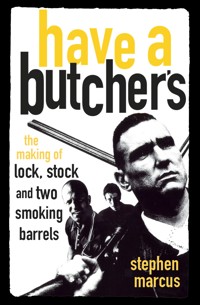
When Lock, Stock and Two Smoking Barrels was released in 1998, few would have prophesied quite the impact this low-budget crime comedy would have. Almost overnight it became a cultural phenomenon, launched the careers of Guy Ritchie, Matthew Vaughn and Jason Statham, amongst others, and spawned a television series and numerous British gangster film rip-offs in the process. But box office gold didn't come without huge upheaval, and the making of the film was often fraught. In Have a Butcher's, actor Stephen Marcus (Nick The Greek in the film) recounts the on-set dramas, the behind-the-scenes banter, his initial meeting with Guy Ritchie, the subsequent trips to Hollywood as the boys basked in success and critical acclaim, and the numerous financial problems that were only solved when Sting and Trudie Styler came on board. Drawing upon interviews with his co-stars, never-before-seen photos and original storyboards, Stephen tells the story of a film that has become a firm cult favourite.
Sie lesen das E-Book in den Legimi-Apps auf:
Seitenzahl: 170
Veröffentlichungsjahr: 2017
Das E-Book (TTS) können Sie hören im Abo „Legimi Premium” in Legimi-Apps auf:
Ähnliche


















Front-cover image: © Universal.
First published 2017
The History Press
The Mill, Brimscombe Port
Stroud, Gloucestershire, GL5 2QG
www.thehistorypress.co.uk
© Stephen Marcus, 2017
The right of Stephen Marcus to be identified as the Author of this work has been asserted in accordance with the Copyright, Designs and Patents Act 1988.
All rights reserved. No part of this book may be reprinted or reproduced or utilised in any form or by any electronic, mechanical or other means, now known or hereafter invented, including photocopying and recording, or in any information storage or retrieval system, without the permission in writing from the Publishers.
British Library Cataloguing in Publication Data.
A catalogue record for this book is available from the British Library.
ISBN 978 0 7509 8649 6
Typesetting and origination by The History Press
Printed and bound by CPI Group (UK) Ltd
eBook converted by Geethik Technologies
contents
Introduction
Thanks To
Foreword by Paul Tanter
1 ‘Dunno Tom, seems expensive’
2 ‘They lack any kind of criminal credibility’
3 ‘If you hold back anything, I’ll kill ya’
4 ‘He’s got some adhesive mates’
5 ‘Can we lock up and get drunk now?’
6 ‘It’s a Samoan pub’
7 Lenny McLean
8 ‘It’s Been Emotional’
introduction
Life is interesting. It sends you lots of curve balls – some little, some huge. Some change your life completely and some just make you change course for a little while. I’m not sure what the curve balls in my life have done for me, to be honest. I do know that Lock, Stock and Two Smoking Barrels has thrown some pretty big curve balls into the lives of most of its cast and, of course, those of Guy Ritchie and Matthew Vaughn. Guy Ritchie wrote and directed Lock, Stock – he’s now a top Hollywood director working with the likes of Robert Downey Jr and Jude Law. Prior to Lock, Stock and Two Smoking Barrels he was directing music videos. Matthew Vaughn, the producer, is now a Hollywood producer and director who launched Daniel Craig to stardom in Layer Cake and brought us Kick Ass, Kingsman and X-Men. Jason Statham was a market trader when Guy put him into Lock, Stock and Two Smoking Barrels and then into Snatch. From there he hasn’t looked back, and is now a total Hollywood action hero (as if you didn’t know). Dexter Fletcher, child star, is now a top director and writer. Nick Moran is a director and writer. Jason Flemyng and Vinnie Jones have both carved out Hollywood acting careers. As for me, I’ve gone onto work in Hollywood and the UK with Kate Winslet, Michael Caine and Joaquin Phoenix in Quills. Bill Paxton called me from his car while driving down the Pacific Coast Highway to offer me the part of Ted Ray in The Greatest Game Ever Played, opposite Stephen Dillane (Game of Thrones) and Shia LaBeouf.
Lock, Stock has allowed me to create and guide a walking tour. It’s called The Gangster London Tour and it’s a tour around the East End of London, taking in the sights and sounds of the gangster world (in that area mainly the Kray twins, with a few others thrown in) and gangster-related film locations, including several locations from Lock, Stock and Two Smoking Barrels. I get all sorts of people on the tour, from fans of the Krays and fans of the films to people who just love tours. I occasionally get a stag do, and it was on one of these stag tours that I had a bunch of Australians who had all come over for their mate’s wedding. Being huge fans of Lock, Stock they thought a tour with Nick The Greek would be a good way to start the stag weekend. There was one lone English guy in the group, and during the walk we got talking. At the end of the tour he told me he worked for The History Press, and asked if I would be interested in writing a book about my experiences with Lock, Stock. I considered it for a few days and initially thought that having only worked on it for six days’ actual shooting I might not have much to say. Then I thought, why don’t I get in touch with the others involved in it and add in some of their stories as well? At least that way it’d be bigger than a church pamphlet.
That part of the introduction was written nearly two years ago. The book is now finished. I have got contributions and anecdotes from Jason Flemyng, Nick Moran, Vas Blackwood, Frank Harper, Nicholas Rowe, Steven Mackintosh, P.H. Moriarty, sound operator Simon Hayes and director of photography Tim Maurice-Jones. Tim has also given me some great photographs – Polaroids from the set, which head up each chapter. Lock, Stock was one of the last films to be shot on film, and Tim took Polaroid photos of nearly every set-up so that he could be sure of his lighting. During pre-production for the film, Tim and Guy met up on loads of occasions to discuss the shots. After each meeting, Tim would go away and meet with Peter Wignall and together they drew up the storyboard for each shot. Peter and Tim have let me use some of those images in the book (some original and some kindly redrawn by Peter). Thanks very much, chaps.
I have tried to get together with Guy and Matthew to get their stories – after all, it is their film – but due to schedules it hasn’t been possible. Maybe we’ll get together in the future and there’ll be an updated version available.
thanks to
Tim Maurice-Jones for his contribution and the Polaroids.
Peter Wignall for all the storyboard images he drew.
Rory Gilder at Incentive Images for all his press images.
To all the contributors: Nick Moran, Jason Flemyng, P.H. Moriarty, Frank Harper, Tim Maurice-Jones, Nicholas Rowe, Steven Mackintosh, Vas Blackwood.
To my editor, Mark Beynon, for suggesting this book in the first place.
To my wife, Sarah Nelson, for her constant support in everything I do.
To the fans for just being fans of one of the best movies in British gangster movie history.
And of course thank you to Guy Ritchie and Matthew Vaughn for creating this film in the first place and giving me and many others a huge boost to our careers.
foreword by paul tanter
Paul Tanter is a British director, writer and producer. He’s been making films since 2008, his list of credits include Jack Falls, The Rise & Fall of a White Collar Hooligan, The Fall of the Essex Boys and Kill Ratio. When I asked around for filmmakers to give me their thoughts on Lock, Stock and Two Smoking Barrels, Paul Tanter sent the reply below. I thought it would be a good foreword. Thanks, Paul.
I first saw Lock, Stock during its initial cinema release in 1998. British film had been a rather mixed bag of late, but I always endeavoured to see the new releases in the cinema rather than wait for video. Sometimes this meant something enjoyable but a bit bland like Shooting Fish, and sometimes it was edgy new stuff like Final Cut. I was already aware of Lock, Stock due to a slightly naff ITV London news piece several months earlier about a gangster film featuring Vinnie Jones – one of those ‘shooting now’ reports. I’ve always wondered if they ever actually translate into publicity as they are likely forgotten by the time the film is out. Anyway, being a Wimbledon fan, the segment piqued my interest for the novelty value. As much as I loved Vinnie for his performance on the pitch, I figured his talents wouldn’t extend to the big screen. How wrong I was.
A group of friends and I piled into the local Odeon in Putney, excited to see something that wouldn’t be about a group of poverty-line northerners overcoming adversity to put on a performance of some kind. I realise now that Brassed Off, Up ‘n’ Under and The Full Monty were in the minority back then, but at the time to us it felt like they were very much the zeitgeist. Even Trainspotting, as cool as it was, wasn’t exactly a feel-good film. I remember being excited by the Ska Films logo and crunchy guitar riff. It was slightly reassuring that the production company indicated quality with its cool logo and theme! You needed a few seconds to adjust to the very sepia tone of the film, but Jason Statham had us hooked straight away with his cockney sales patter, trying to flog his dodgy gold chains for a tenner each while Nick Moran roused the crowd up into digging their hands into their pockets. A terrific chase sequence with the boys and police overlaid with (yet more) crunchy guitars banging out ‘Hundred Mile High City’ by Ocean Colour Scene had us excited from the start.
Coming out of the screen and heading to the pub, we couldn’t wait to excitedly dissect the film. Usually a film would get a cursory discussion before moving on to other things, but this one kept us discussing, debating and quoting all night. From the music (‘All solid, even the Robbie Williams song was catchy.’), to the cast (‘Haven’t seen Hatchet Harry in much since The Long Good Friday’... ‘Vinnie Jones was great!’) and the locations (‘That was definitely Putney Bridge in that last scene with Jason Flemyng!’ – It wasn’t). It had captured our imaginations and several of us went back the next day to watch it again. This was the first time in my life I’d gone back to a cinema to watch a film a second time.
The perfectly cast ensemble of actors was a mixture of new talent and some familiar faces from various films and TV I was a fan of. Dexter Fletcher was arguably the biggest name amongst the four lads, while P.H. Moriarty was a good link to possibly the best British gangster movie ever made, The Long Good Friday. Then there were the ones we knew of but didn’t know their names at the time: ‘It’s young Sherlock Homes!’ (Nicholas Rowe); ‘It’s Bear Strangler McGee from the ‘Gunmen of the Apocalypse’ episode of Red Dwarf!’ (Stephen Marcus); ‘It’s Danny John-Jules!’ (We all knew Cat from Red Dwarf); ‘It’s that guy with the really throaty voice from the beginning of Face’ (Steve Sweeney). I will admit that at the time I had absolutely no idea who Lenny McLean was, but I read up about him in the days that followed as I researched the film. The casting of the film is flawless. The four main guys have a perfect chemistry with each other, while every single support, especially Vas Blackwood, Frank Harper and Stephen Marcus, is just so right for his or her role.
The look of the film was and remains one of its defining characteristics. Guy Ritchie plays out many sequences almost like a music video: the card game and drinking session look and feel incredibly exciting. It was a style that many filmmakers would try to emulate in the following years, yet the only person who has ever bettered it is Ritchie himself in his subsequent works – Snatch, Revolver and Sherlock Holmes all being examples where he’s continued to work this magic with this visual style.
I bought the soundtrack as soon as it was out and got the video on the day of release. Yes, video. The film was also on DVD, as I recall, but this is when DVD was about a fiver more than the video, and I was working at Tesco to fund my upcoming university course. I was to subsequently upgrade a year or two later once I had caught up with everyone else in the technical transfer to DVD, but for now it was video; and it got watched a lot. It was Lock, Stock that persuaded me and my friend Alec that we should pursue the idea we’d always had of trying to make a film, so he purchased a second-hand camera and we commenced. Everything we shot was terrible and thankfully none of it survives to this day, but you gotta start somewhere, right? Once I finally made the full switch to DVD, Lock, Stock was one of the first I got – for the extras as much as the film, special features still being something of a novelty then. It’s one I still watch regularly, and it stands up today as strong as it did at the time. It has such a unique look that nothing about it has particularly dated. You could play out the same story today with no problem. Repeated viewings allow you to appreciate the nuances of the film – the varied but effortlessly cool soundtrack, Alan Ford’s wonderful voiceover, Rob Brydon’s comedic turn as the Traffic Warden – all easy to gloss over on first showing. Lock, Stock regularly and justifiably turns up in ‘top ten’ lists of British films and/or gangster films, and is currently #143 in the IMDB top 250. It stands now as a British classic alongside Get Carter and The Long Good Friday.
As a British filmmaker, particularly one who’s made his fair share of gangster films, Lock, Stock has undoubtedly been an influence on me. Whilst it may have been followed by some attempted clones and copies, there’s no doubt that it inspired a generation of filmmakers and reignited the gangster genre in the UK. Some critics would lazily accuse anything involving a voiceover or freeze frames as being a Guy Ritchie copy, forgetting these have been cinema staples for decades and notable in other crime films of the ’90s, such as Goodfellas. Whilst Tarantino was already influencing films with pop culture references and emphasis on cool and funny dialogue, suddenly in the UK we had our own guy (no pun intended) to fly the flag for us. What was doubly great was that he followed it up with Snatch, proving he wasn’t a one-hit wonder or a one-trick pony. As well as the flashy editing and cool sequences, there are some lessons for filmmakers in how to do things on a budget. Take for example the end shootout: it’s vicious, and exciting … and you don’t see any of it beyond the very first shot fired from Plank. The rest of it plays out off screen, through great sound design, breaking windows, and reactions from Frank Harper and Steven Mackintosh. Now there’s a way to save yourself the time and expense of shooting an intricate gunfight between eight people in a tight space. The aftermath, in which Jason Flemyng walks through the ‘pile of corpses’, is suitably bloody and broken to match what we earlier heard and think we saw. I know Guy Ritchie storyboarded the whole film, so I assume this wasn’t done on the fly when they were running out of time. It’s just a canny and creative way to do something when perhaps the budget doesn’t stretch far enough to enable you to do the all-singing, all-dancing version. Considering the budget was so relatively low that they had to get the first assistant director to play the Samoan pub barman, the Director of Photography to be drowned by Barry The Baptist (Lenny McLean) and even producer Matthew Vaughn to be carjacked by Dog (Frank Harper), the film still punches way above its weight in terms of production value. Its influence on popular culture was felt for years to come, with the mod look designed for the characters by costume designer Stephanie Collie making a big comeback over the following decade as the male audience chased down the same look as their on-screen heroes.
When I was casting for my first feature as a director, the producer and I went on something of a mission to get some Lock, Stock cast members involved, and it was a privilege to work with Dexter Fletcher, Jason Flemyng and Alan Ford on Jack Falls. We managed to last about four seconds with each before telling them how much we loved Lock, Stock and then asking them a variety of questions that I’m sure they’d answered a million times before (and with Jason and Alan this extended to Snatch too). I’ve since had the pleasure of working with Vas Blackwood several times, and I hope one day to work with Stephen Marcus, Nick Moran, Frank Harper, Vinnie Jones and Jason Statham. Lock, Stock definitely taught me the value of a talented ensemble with good chemistry, something I made sure we had on projects like The Rise & Fall of a White Collar Hooligan and Essex Boys Retribution. As someone who is often working on a budget, scenes like Big Chris caving in Dog’s head with the car door, or the aforementioned shoot-out, showed me the value in violence sometimes taking place off screen rather than always having to show it on camera.
I’m still thankful to the film now, not just for the entertainment over the years but for inspiring me and a generation of other filmmakers to follow our dreams of making something just as entertaining.
1
‘dunno tom, seems expensive’
Tom sells Nick a stereo.
Ed arrives at Tom’s shop.
Ed, Tom and Nick walk through the shop.
Nick The Greek and Tom do a deal.
Tom gets money out of the oven.
BRIGHTON ROCK
1947
THE ITALIAN JOB
1969
PERFORMANCE
1970
GET CARTER
1971
VILLAIN
1971
THE LONG GOOD FRIDAY
1979
SCUM
1979
MCVICAR
1980
THE KRAYS
1990
As the list above shows, British gangster films have been around for years. These are some of them that came before Lock, Stock and Two Smoking Barrels, and below is a list of some that have come since. Some good, some bad and some great. We all have different opinions on which is which.
SEXY BEAST
2000
GANGSTER NO.1
2000
SNATCH
2000
LOVE, HONOUR & OBEY
2000
ESSEX BOYS
2000
LAYER CAKE
2004
THE BUSINESS
2005
RISE OF THE FOOTSOLDIER
2007
IN BRUGES
2008
BONDED BY BLOOD
2010
Lock, Stock and Two Smoking Barrels was released in 1998 by Polygram after almost three years of hard work by Guy Ritchie and Matthew Vaughn: three years of meetings, script writing and rewriting and rewriting and more rewriting, fundraising, pre-production, hunting down locations, putting together the crew and, of course, casting.
Guy Ritchie was introduced to Matthew Vaughn in 1995 through a friend of Guy’s. Matthew had told the friend that he was a producer, so first-time director Guy exaggerated a few things about himself and a partnership began. Guy sent Matthew a copy of Lock, Stock and Two Smoking Barrels and Matthew took Guy’s script down to the country and read it:
It had no ending and no real structure but it was a diamond. It had so much energy and was strong, funny, clever, new and original.1
MATTHEW VAUGHN
A few days later Matthew called him up. Guy acted some of the scenes over the phone to him and Matthew was convinced, ‘Let’s make this film.’
For two years they worked tirelessly on getting the film made. The whole process was made harder by the fact that Guy was a first-time film director; investors are wary of funding untried talent. The whole process brought them both close together and they built a strong friendship based on honesty and taking no bullshit from each other and the others involved in the film. For example, if you allow them to, a film crew can take forever to set up a scene and get going. The director of photography may take a long time lighting it, the art director may take forever dressing the scene, and of course the actors will stand around talking forever if allowed. When this happened Guy was often heard counting down from ten. When this was heard everyone would get going because nobody wanted him to get down to one. I never saw what happened if he did get to one.




