


2,99 €
Mehr erfahren.
- Herausgeber: tredition
- Kategorie: Sachliteratur, Reportagen, Biografien
- Sprache: Englisch
This is the story of an armored infantry company in action north of Saigon during the phase the Vietnam War spanning the Tet offensive. The narrative unfolds from the vantage point of a young infantry captain who commanded Company C, Second Battalion, Second Infantry Regiment in the First Infantry Division from late September 1967 through the end of April 1968. 'Heavy Metal' spotlights the central role of armored vehicles as fast-moving gun platforms in the deployment of his mechanized infantry soldiers. Apart from combat actions, the book describes a soldier's everyday life in fortified field positions, the defense of the division's forward base at Lai Khe, the company's decimating outbreak of falciparum malaria and the inevitable accidents with explosive ordinance.
Das E-Book können Sie in Legimi-Apps oder einer beliebigen App lesen, die das folgende Format unterstützen:
Seitenzahl: 173
Veröffentlichungsjahr: 2020
Ähnliche



















For the men of Charlie Company, Second Battalion, Second Infantry Regiment, who shared this experience.
Edward Roby
HEAVY METAL
Memoir of a distant war
© 2020 Edward Roby
Verlag und Druck: tredition GmbH, Halenreie 40-44, Hamburg
ISBN
Paperback:
978-3-347-13049-4
Hardcover:
978-3-347-13050-0
E-Book:
978-3-347-13051-7
Cover design: Tamara Pirschalawa
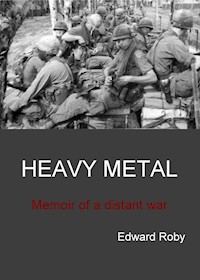
Cover photograph: Soldiers of Company C, 2/2 Infantry, returning in column on their armored personnel carriers to Lai Khe base as pictured on First Infantry Division calendar page for October 1967.
Source: contribution from Willie C. Garner.
All rights reserved.
Contents
Introduction
Chapter 1
Shenandoah II
Chapter 2
Mines and Men
Chapter 3
'Commie' Mosquitoes
Chapter 4
Night Attack
Chapter 5
Lai Khe Fireworks
Chapter 6
The French Fort
Chapter 7
Friendly Fire
Chapter 8
Bad Bees, Good Turtles
Chapter 9
The Eyes of Buddha
Chapter 10
Slaughterhouse in the Sun
Chapter 11
Clash of Cultures
Chapter 12
Trouble Shooting
Chapter 13
An Uncertain Trumpet
Chapter 14
Homecoming
Chapter 15
Happy Camping
Chapter 16
Staff Doldrums
Chapter 17
The Conflict in Retrospect
Glossary
Introduction
Reflecting two decades ago on the yawning indifference of his cadets to the study of their army's role in Vietnam, a West Point instructor admitted: "I might as well be teaching the Peloponnesian Wars."
Col. Cole C. Kingseed's stinging remark on the shelf-life of military art rippled controversially through the news columns during the post-911 war fervor. If the colonel's subject looked quaint even then, why straggle in now with more ink on things that happened in Indochina at least 52 years ago? Hasn't it all been said?
History shelves are already full of good books on the Vietnam War. Courage, heroism, victories, even defeats have been duly memorialized in print. The authority of many exhaustively documented accounts is enhanced by eloquent prefaces from generals, politicians, historians – frequently adding their own abstract allusions to freedom, democracy and national greatness.
My collection of personal anecdotes lays no claim to such distinction. It began as a memoir, finally offering a frank response to the unspoken question: "What was it like in Vietnam, Grandpa?" That, at least, was the working title when I belatedly started to write. But the story took on a larger life of its own.
This narrative tracks the experience of Company C, 2nd Battalion, 2nd Infantry Regiment from late September 1967 through the end of April 1968. I was in command during that period, including the Tet offensive, so this small slice of our unit's history is treated from that vantage point.
The chapters roughly follow the chronological sequence of events. Exceptions are those on land mines, accidents, trouble shooting and daily life in the field camps – recurring themes illustrated with examples gathered from the entire tour. The last chapter, with an historian's retrospective, goes beyond the small world of Company C to shed critical light on the nature of this 30-year conflict.
As a mechanized – armored and mobile – infantry unit, we were somewhat rare in Vietnam. We probably spent more time in the field than the more common light infantry units, but they often saw more intense action when inserted by helicopter into contested spots. By contrast, we were so heavily armed that a prudent enemy had to look for softer targets. The greater threat to us and our armored vehicles was his land mines.
This account owes some important details to others. Prominent among them were our battalion commander, Lieutenant Colonel Henry L. Davisson, and the commander of our sister Company B, Captain George "Sonny" Gratzer, both now deceased. Retired Col. James Perlmutter, who had served with us as a senior medic, supplied many a forgotten fact and was a source of encouragement for my project. My wife, Margarete, kindly helped with proof reading. And I remain most grateful to my guardian angel, who has never taken a day off.
The narrative's actors are mostly identified by their radio call-signs in lieu of proper names and titles because that was the way we usually addressed one another. Another reason to dispense with names is that I am working from memory. My field notebooks went missing in the course of eleven subsequent career moves on three continents. But scenes etched in vivid memory aided recall of the described actions. For the uninitiated, a glossary of military terms of art is included.
Around two thousand names are engraved on a First Infantry Division monument in a small park behind the Blair House, half a block off Pennsylvania Avenue in Washington, D.C. This memorial to the division's Vietnam War dead honors at least a dozen men who were with me in Company C, which also counted its wounded in the high double digits.
This is a story of a company of men with little in common who came to trust even their lives to one another. Thrust into hazardous circumstances, these companions answered the call of duty and contributed admirably to our mutual purpose – especially the will to survive. Their youthful enthusiasm, curiosity, energy and inborn gift of humor steeled them against daunting hardships.
It's often said that war is hell. Yet warfare stubbornly stands forth in human history as the recurring hallmark of what we call civilization. Friend or foe, those lucky enough to look back on such an early crucible of experience often cherish it as the greatest adventure of their lifetime. That alone makes our tale worth telling.
Chapter 1
Shenandoah II
Know your enemy, know yourself. You will win a hundred battles. The ancient martial wisdom may work well against Viet Cong in the bush. But Sun Tzu neglected to mention another possibility: The first "battle" for a newly minted commander could also pit him against an enemy in disguise – the ambitious lieutenant standing right behind him.
A captain in command of an infantry company is backed up by a first lieutenant, the right-hand man called an executive officer (XO). But it happens every so often that this same senior lieutenant had already been serving as acting company commander in the interregnum before his new captain arrived.
That could cause friction if the junior officer deeply resents the revised command arrangement as a de facto demotion. So it was with my first XO, who was loathe to relinquish his authority over the company just because a new boss with two silver bars of rank had been installed.
Two bighorn rams in rut would have settled the matter of primacy pronto, the bigger one butting the other straight off an alpine cliff. But the unspoken challenge from my second in command was a gentlemen's battle of wits. A subtle tug-o-war over who should be calling the shots in Charlie Company flickered for roughly the first ten days of my tenure as commanding officer.
My lieutenant was confident, well spoken and assertive. He already knew the platoon leaders and key personnel, having basked in his temporary role as their leader. Never openly disloyal, he also never skipped a chance to remind the company of his own authority, issuing all sorts of "valuable" guidance, often in my name.
By contrast, I was the greenhorn. I still hadn't had to duck that fabled "shot fired in anger", the real rite of passage for a combat infantry commander. While learning the ropes, I also needed to rely on the support of my seasoned executive officer. That's perfectly normal. But this change of command was less than smooth.
About two days after my arrival, our battalion struck its defensive base west of Phuoc Vinh on the Song Be river in War Zone D. We were going to join a corps-sized operation called Shenandoah II in the Long Nguyen Secret Zone near a Michelin plantation to the northwest. The mission of the First Infantry Division and the Twenty-Fifth Infantry Division was to cut VC/NVA infiltration and supply lines running toward Saigon from the Ho Chi Minh Trail coming out of Cambodia. The enemy's main staging area was this thickly forested bulge of War Zone C.
Light infantry battalions were already converging by helicopter on assigned positions in this war zone. The Second Battalion, Second Infantry Regiment punched into the operation from the southeast, making an uppercut starting at Ben Cat, just northeast of the Iron Triangle and Saigon River, Being a mechanized unit, we then headed northward along still usable portions of an old French laterite trace, Road 240, or 41 on our maps, camping initially near the last hamlet before the declared free-fire zone.
The villagers took no notice of us. Children frolicked outside the slightly elevated thatch-roofed houses, ignoring the cobras hunting rats under their homes – a fascinating and practical symbiosis. Cleaning our newly issued M-16 rifles had become the command obsession. Too often they tended to jam from all the dust and mud. Platoon sergeants preferred the lighter, semi-automatic AR-15 version that somehow seemed to work better, at least until the M-16 was reissued with 10 design improvements. To be on the safe side, some soldiers swpped the new rifles for reliable old M-14s.
In the ebb and flow of the decades-old Indochina conflict, Road 41 had been repeatedly mined and de-mined, sabotaged and repaired again. Here and there, excavated tiger-tooth obstacles still detoured tracks and wheeled vehicles around strategic bottlenecks. But the route north was now generally passable, which was no special favor to us. NVA units and equipment heading toward Saigon were certainly using it as a transit corridor.
Lorraine II
Moving ahead, our lead element discovered a hand poking up from the soil beside the road. Attached to a VC body, it qualified as an initial body count. Alpha Company and the battalion headquarters established their next base a dozen miles to the north. Bravo and Charlie companies did the same further up the road. We shared our first base camp, called Lorraine II, with a 105-mm howitzer battery lifted in by workhorse helicopters. The surrounding forest was full of VC/NVA and their camps, tunnels, caches and trails. They watched our every move. Daily sniping or small gunfights would soon cost Charlie Company at least half a dozen casualties.
I spent the daylight hours with my three rifle platoons looking for trouble in the woods. My executive officer looked after logistics, supply, personnel and administrative tasks back in our night defensive position. The clear division of functions left little room for ego-driven grandstanding, although my XO had already gotten on the wrong side of Bravo's CO by evicting one of his squads from a position he claimed as ours.
One afternoon my executive officer crossed a red line. He saw fit to radio my line platoon leaders with some operating instructions – combat operations being my command prerogative. In another age, that might have brought forth the dueling pistols. When my temper cooled, I realized that this gratuitous gaffe handed me carte blanche to clean house.
I also keyed the company radio net. When all platoon leaders had responded, I revoked any and all orders they may have been given. I told them a time to report to my command track in the evening to receive the order of operations from their commanding officer, Charlie Six. The next morning a helicopter transported my Charlie Five with a bruised ego back to the battalion base camp to await reassignment.
Battalion headquarters routinely monitors all company networks, so no one was surprised at the blowout in Charlie Company. It created an opportune time for other big changes already in the air. Daring Six, the battalion commander, simultaneously replaced his own operations officer with a more able major. The battalion sergeant major seized the occasion to fire my first sergeant, in whom he lacked confidence. My new executive officer and new first sergeant proved highly professional. Both stayed with me for the next seven months.
Meanwhile, in the other war, the enemy was standing his ground for a change. The intensity of combat was building toward bigger engagements in this part of the war zone. This was toward the end of the wet monsoon that had brought daily rains since the spring. The light infantry battalions were all in position, probing day and night for the main enemy formations. Finding them was inevitable, given the sheer concentration of U.S. troops maneuvering around the Michelin.
The secret zone was heavily wooded and drained by small streams. Patrols and listening posts around our base weren't enough to suppress brazen VC snipers in the forest. A Soviet-designed B-40 rocket launcher fired down from a tree just outside our perimeter blasted a hole in a track gunner's armored hatch copula, inflicting a gory gut wound on the gunner. No one expected to see him again. The light 40-mm VC anti-tank weapon, also called RPG-2, was recoilless, portable and lethal.
The next day, a VC marksman concealed in a spider hole picked off a soldier in one of my patrols before it had advanced a hundred yards outside the base. The unlucky private first class was our first combat fatality on my watch. We never could find the spider hole or the shooter.
After sorting out the tactical situation, I asked my new first sergeant about finding a replacement. He'd already beaten me to it. Toward evening there was a quiet ceremony in the NDP. We gathered around the fallen soldier's rifle, bayonet fixed and thrust in the ground vertically upside down, his helmet placed on top of the rifle butt. A few words were spoken. We returned to our routine, each with his own thoughts.
Late one evening, a three-man listening post about fifty meters outside our western wire called to say it was not alone in the forest. It was hearing strange noises, something moving around them in the undergrowth. Their next radio call reported more of the same. VC? Maybe not, they said. Some animal? Yes, they were now pretty sure they were being stalked by a tiger. Are you locked and loaded? Yes, but we can't see anything, although the growls are getting closer. No one was eaten that night. After dawn a patrol searched the LP's location. There were plenty of prints, including VC. The presence of a big cat couldn't be confirmed – or ruled out.
Charlie and Bravo conducted daily dismounted sweeps through thick woods, following assigned compass headings. Progress was glacial, visibility curtailed. To avoid ambush, we'd stop our advance every so often to "cloverleaf". The flanking platoons of the company's triple column would send scouts out to the left or right; the platoon in middle would send men to the front and rear.
After crawling through a bamboo thicket one day, we reached a wide rice paddy at the edge of a woods. The easy way forward was to walk atop the paddy dike. Two long antennae made my command group with its RTOs a prime target. A couple of bursts of automatic fire kicked up the dirt at our feet. The shooting came out of a wood line on the opposite side of the paddy.
This was a new experience for some of our men, who were slow to take cover and return fire. I pegged a few rounds toward the shooters, knowing that my .45 was practically as harmless as a slingshot beyond 50 feet. About the same time, Bravo Company took three casualties in a nearby firefight.
Bravo's contact reports on the battalion network immediately attracted a command & control helicopter. This C&C was that of the deputy division commander, call-sign Danger 79. Dropping a smoke grenade to mark a landing spot for a medical evacuation helicopter, he told Bravo to go there pronto. Urgent guidance continued when the company failed to move fast enough to suit the man in the sky. Yet the soldiers, scarcely visible from the air, were carrying wounded men on makeshift stretchers while cutting paths through impenetrable brush that only machetes could clear.
Exasperated, Bravo Six finally keyed the net, snapping that he could run his company if he could just get off radio. Pausing to digest that, the general signed off, "I understand, son. Carry on." Capt. George "Sonny" Gratzer, Bravo Six, became a battalion legend for asserting his command prerogative as the unit leader on the ground. The sources of annoying radio static from the sky came to be derided as "flying squad leaders."
Yet the commander on the spot isn't always privvy to the bigger picture. I had a brush with my boss, call-sign Daring Six, when he check-fired my mortars and told me to break off a pursuit that looked promising. As he later explained, marching to the sound of the guns would have taken us into a sister battalion's AO where we would likely have tangled with their reconnaissance patrol.
The battalion commander also recommended we go mounted for a change. Having avoided taking the APCs on sweeps into such soggy, heavily wooded terrain, I soon found that they actually performed quite well. Our M113A1's were powered by 215-hp Detroit Diesel engines, unlike the gasoline-driven version that caused me constant maintenance headaches in Germany. The new tracks would simply mow down small trees, making Charlie Company's mounted sweeps faster and deeper. I also quit directing my maneuvering vehicles with hand signals when the boss opined that standing atop my command track, gripping an antenna for balance, made me too inviting a target.
Looking on foot for a suspected encampment one day, the Second Platoon drew fire from a wood line. I joined them as the lead squad entered the trees. The point man froze in mid-stride, pointing to a large circular object standing head high on a wooden tripod. It looked like a white cyclopse-eye the size of a wagon-wheel pizza. This homemade claymore mine went off almost simultaneously, spraying hot chunks of jagged scrap metal. An unseen enemy had detonated it by electric wire. This was the base camp. An elaborate underground complex suggested a unit headquarters. We followed a blood trail.
Close by was the entrance to a long tunnel that must have served as a field hospital. We recovered assorted items of equipment and a trove of pharmaceuticals and surgical kit. Our paramedics put the captured medicines in a sandbag that was sent on to division intelligence. They were keen to know what foreign countries were supplying the enemy with sophisticated medical equipment. We rigged the tunnel complex with C-4 charges, demolishing whatever we couldn't take with us.
On another sweep a VC anti-armor team with an RPG scored a hit on a track. The Third Platoon leader, Lt. Willie Ruffin, was among the wounded. Brave and taciturn, he recovered to rejoin us within a week. My new executive officer was also sidelined a couple of days – by a scorpion. It stung him twice in the back of the neck inside his M-114 track. Why the critter was lurking so high up on a radio wall mounting as the XO leaned back his head made for a bit of a mystery.
We also lost our most experienced mortar gunner, a tall sergeant known as "Slim", to a disabling freak accident during a fire mission. On balance, though, the enemy seemed less than eager to face down our oncoming armored vehicles and heavy machine guns. A few light infantry units were less favored. One of them was the Second Battalion, 28th Infantry.
Death Trap
That outfit was ambushed and destroyed just southwest of us on Oct. 17, 1967. The engagement entered military annals as the Battle of Ong Thanh. Apart from stateside news dispatches and the official military accounts, more than one book* covers this battle. I mention it here because Charlie and Bravo companies happened to be four kilometers from the scene, making us perhaps the nearest fresh infantry that could have been sent as a relief column. Instead, our soldiers were detailled to pass in daisy chain a steady flow of ammunition to the 105-mm howitzers firing in support of the doomed battalion.
We followed the fighting on both the infantry and artillery radio networks. My map reconnaissance showed three small streams to be crossed between us and them. I issued a warning order to my platoons. One after another, the embattled battalion and company nets fell silent as their command groups fell under deadly fire from bunkers and from the trees. As we listened, two wounded artillery forward observers trying gamely to direct supporting fires, their voices weakening to raspy whispers as they bled to death.
Lieutenant Colonel Terry de la Mesa Allen Jr., the 2/28th commander, was the son of a World War II commanding general of the First Infantry Division. His battalion, call-sign Dauntless, entered the 17 Oct. ambush with just two half-strength rifle companies after a couple of off-target airstrikes and without precise artillery preparation on a probable enemy concentration. The division later called Ong Thanh a "meeting engagement."
An intelligence fix passed to our battalion and included in my boss' order to me and Bravo Six the evening of Oct. 16 went into our field notes: "Multi-battalion base camp 500 men heavily armed 2 K’s north” of Lorraine I. That pretty much pegged the ambush site on Ong Thanh stream. Try to imagine Scotland Yard using the term meeting engagement to explain a victim's last encounter with Jack the Ripper.




