


6,99 €
Mehr erfahren.
- Herausgeber: The History Press
- Kategorie: Sachliteratur, Reportagen, Biografien
- Sprache: Englisch
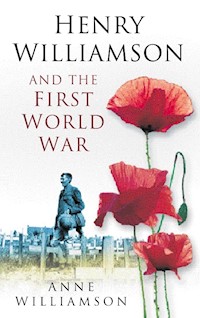
Henry Williamson is known for his book 'Tarka the Otter', yet his time in World War I trenches affected him profoundly. This book draws on his letters, diaries, photographs and notebooks written at the time to give us a detailed account of life in the trenches of the First World War. It also offers us a rare insight into the making of a novelist.
Das E-Book können Sie in Legimi-Apps oder einer beliebigen App lesen, die das folgende Format unterstützen:
Veröffentlichungsjahr: 2004
Ähnliche



















Henry Williamson and the First World War
_____________________________
Henry Williamson and the
First World War
_____________________________
H.W. was a soldier 2¼ months later; in France 5¼ months later. And Finish, Finish, Finish the hope and illusion of youth, for ever and for ever and for ever.
(Written in later life at the end of Henry Williamson’s childhood ‘Nature Diary’ which ended with his first visit to Georgeham, North Devon, in May 1914.)
This is believed to be the original drawing for C.R.W. Nevinson’s oil painting entitled ‘Group of Soldiers’. The drawing bears the inscription ‘To H. Williamson’ and is signed ‘C.R.W. Nevinson, 1917’. The soldier facing the front looks remarkably like Henry Williamson. Staining round the edges was sustained when Henry Williamson tried to soak the work off its mount in the 1960s so that it could be used on the back cover of his novel A Test to Destruction. (Drawing copyright Mrs Anne Patterson)
Henry Williamson and the First World War
_____________________________
Henry Williamson and the
First World War
Anne Williamson
First published in the United Kingdom in 1998 by Sutton Publishing Limited
The History Press The Mill, Brimscombe Port Stroud, Gloucestershire, GL52QGwww.thehistorypress.co.uk
This ebook edition first published in 2013
All rights reserved © Anne Williamson, 1998, 2013
Henry Williamson’s writings copyright © The Henry Williamson Literary Estate, 1998
The right of Anne Williamson to be identified as the Author of this work has been asserted in accordance with the Copyrights, Designs and Patents Act 1988.
This ebook is copyright material and must not be copied, reproduced, transferred, distributed, leased, licensed or publicly performed or used in any way except as specifically permitted in writing by the publishers, as allowed under the terms and conditions under which it was purchased or as strictly permitted by applicable copyright law. Any unauthorised distribution or use of this text may be a direct infringement of the author’s and publisher’s rights, and those responsible may be liable in law accordingly.
EPUB ISBN 978 0 7524 9528 6
Original typesetting by The History Press
Contents
List of Plates
Acknowledgements
Preface
Key Dates in the Life of Henry Williamson
The Henry Williamson Society
‘To An Unknown Soldier’, page from manuscript
1 A Dreaming Youth
2 Private 9689 and the London Rifle Brigade
3 In the Trenches – Christmas 1914
4 Promotion
5 Transport Officer at the Front
6 With the Bedfordshires
7 Beyond Reality: Henry Williamson’s fictional writings on the First World War
Appendix: Maps of the Western Front
Notes
Bibliography
Dedicated to all who took part in the First World War
Lost for ever in Ancient Sunlight, which arises again as Truth
(Henry Williamson, The Wet Flanders Plain, ‘The Valley of the Ancre’)
Henry Williamson never forgot.
‘We will remember’
List of Plates
Group of soldiers, 1917
‘To An Unknown Soldier’, page from manuscript
Between pages 48 and 49
1.
Home from the trenches, March 1915
2.
Cover from the journal of the London Rifle Brigade, 1913–14
3.
A cartoon sketch, drawn in 1914
4a.
Letter to Henry’s father, 19 September1914
4b.
Letter to Henry’s mother, 8 October 1914
5.
Camp of 2nd Brigade 1st London Division, Camp Hill, Crowborough
6a.
Henry’s postcard from Crowborough
6b.
Roland Barnes, a school-friend from Colfe
7.
Letter to Henry’s mother at the time of the Christmas Truce, 1914
8.
Christmas card sent to troops from Princess Mary, 1914
9a.
Gifts from Princess Mary to the troops, Christmas 1914
9b.
Postcard to Henry’s mother, January 1915
10.
Henry Williamson, March 1915
11a.
Certificate of Discharge from the Territorial Force, April 1915
11b.
Document of Commission as a 2nd lieutenant, April 1915
12a.
Details of kit purchased in 1915
12b.
A packing checklist, 1915
13.
Pages from Henry’s diary
14.
Henry as a newly commissioned officer, 1915
15a.
Group of fellow officers, 1915–16
15b.
Henry’s friend, Eugene Maristany
16a.
Henry with Terence Tetley, 1918
16b.
Terence Tetley with Henry’s sisters
Between pages 144 and 145
17.
Henry on joining the Machine Gun Company, 1916
18a.
Henry’s father, a Sergeant of the Special Constabulary
18b.
His uniform and accoutrements
18c.
Pages from his notebook
19.
Surviving items of Henry’s uniform
20a.
Henry’s riding and dress spurs, and leather gaiters
20b.
Personal items
20c.
Trench maps
21.
Sketch of the ‘Golden Virgin’
22a.
Notes from Henry’s Field Notebook, February 1917
22b.
Fellow officers of the Machine Gun Company
23.
Page from an album in Henry’s archive
24a.
2/Lts McConnell and McClane, April 1917
24b.
Henry and Lt. Tremlett, March 1917
24c.
Henry with a crashed plane
25.
German souvenirs
26.
Notes from Henry’s Field Notebook, April 1917
27.
Henry convalescing in Cornwall, summer 1917
28a and b.
Henry at Trefusis with fellow officers and nurses
28c.
Henry with his friend Gibbo
29.
Henry in his Bedfordshire Regiment uniform
30a and b.
Postcard to Henry’s father, 1918
30c.
Henry and his tennis partner, Milling, August 1918
30d.
Henry in Folkestone, early 1919
31a.
Henry with his father and two sisters, late 1918
31b and c.
Medals and uniform badges
32a.
Henry among battlefield graves, France, 1925
32b.
In the Ancre Valley
32c.
German crosses at Arras
Acknowledgements
I am indebted to the efforts of Brian Dolan of the Henry Williamson Society, who undertook the arduous task of being my research assistant, almost involuntarily, as the original question I referred to him grew into what he must often have felt to be an unending and at times turbulent stream.
Brian has worked patiently through the many obscure and difficult points I have thrown at him, not only diligently but also with the greatest of good humour, which has frequently saved my sanity – if not literally then certainly metaphorically! His letters full of amusing ‘asides’ have been highlights in the difficult task of putting this book together and I am grateful to him beyond measure. I certainly would not have been able to finish the work within the publisher’s deadline without the input of his expertise and time and there are many details that would not have been clarified. A great deal of research never shows in the final product: only the tip of the iceberg is seen, but to see this small percentage an enormous amount of legwork has to be done.
I have drawn also on the work of other members of the Henry Williamson Society already published in the Society Journal which is acknowledged in situ. However, I am further indebted to Peter Cole who sent me his manuscript notes made some years ago at the Newspaper Library on items relevant to Williamson’s life during the First World War.
Major Tim Morley, another Society member, provided me with notes on the structure of the Army hierarchy which gave me something to cling onto within the plethora of ‘brigades’ and ‘battalions’ etc. I am likewise grateful to David Filsell who very kindly provided me with copies from his own typescript to further clarify the composition of the infantry divisions of the First World War.
The frontispiece illustration of a drawing by the well-known war artist C.R.W. Nevinson, which is possibly the original sketch for his oil painting ‘A Group of Soldiers, 1917’ and was given to Henry Williamson by the artist himself, is reproduced by permission of his niece, Mrs Anne Patterson, holder of the Copyright of Nevinson’s estate. I would also like to express my gratitude to the courtesy and helpfulness extended by the staff at the Imperial War Museum, London, particularly Jan Bourne, Documentation Manager, who provided me with background information on C.R.W. Nevinson. A short article on this background will appear in HWSJ, no. 34, September 1998.
The Trustees of the Liddell Hart Centre for Military Archives, the depository for the text of the letter from Henry Williamson to Captain Sir Basil Liddell Hart, have kindly given permission for its use in this work (the letter itself is Copyright of the Henry Williamson Literary Estate). This letter was drawn to my attention by John Glanfield, who came across it when engaged on research at the centre.
In his later writing about the First World War Henry Williamson relied extensively for reference purposes on The History of the Great War Based of Official Documents – Military Operations, Belgium and France 1914–18, compiled mainly by James E. Edmunds and published by Macmillan over several years. (All the volumes in Williamson’s archive were published by Macmillan, although they inform me other publishers were involved with some volumes.) Thus by necessity I have also made great use of these volumes. All specific references are in situ but I would like to pay particular tribute here to what is not only a most remarkable work but also surprisingly easy and interesting to read.
Quotations from Henri Barbusse, Under Fire (Le Feu) are from J.M. Dent’s Everyman Library edition, No. 798 (reprint 1969), translated by W. Fitzwater Wray, introduction by Brian Rhys. Dent’s have kindly given permission for their use in this work.
Librarians and archivists are very patient with obscure queries and try hard to find the answers to difficult questions. I am particularly indebted to Jamie Campbell of the North Devon Reference Library at Barnstaple, to the reference librarians at Manchester and Cambridge and the archivists at the Essex Record Office and Hertfordshire Record Office.
Finally, I add to the list my husband, Richard Williamson, for his support in general and, in particular, for photographing the artefacts from Henry’s archive.
All quotations from Henry Williamson’s previously unpublished archive material and from his published work are Copyright of the Henry Williamson Literary Estate.
Please note that grammar and spelling contained in Henry’s letters home have been kept as they are in the original holograph documents. These letters were written in pencil under the stress and difficulties at the Front; they reflect his hopes and his fears and are a remarkable witness of that era – and became an aide-mémoire to his later writings.
Preface
On the day that the First World War ended, 11 November 1918, Henry Williamson recorded in his diary: ‘Armistice signed at 5.30 this morning. peace !’ So ended just over four years of hellish warfare.
This book traces Henry Williamson’s progress through that war virtually in his own words and thoughts, by the use of his diaries, letters and notebooks. It must surely be unique to have a first-hand account of its everyday happenings published some eighty years later, especially when the man concerned was a writer of vast output and literary renown. Though now perhaps best known for Tarka the Otter, Williamson’s writings on the First World War itself run to many hundreds of thousands of words, encompassing five volumes of his masterpiece A Chronicle of Ancient Sunlight, 1 written in his mature years and acclaimed by many critics as the finest writings on the war, as well as the earlier books The Wet Flanders Plain2 and Henry Williamson and the First World War,3 apart from a very large number of articles written for newspapers and magazines on the subject.
The First World War had a profound effect on all who took part in it and particularly on the very sensitive young Henry Williamson. He came from an ordinary middle-class adolescence and was plunged into the confusion of a bloody and terrible catastrophe, of which he was to write so truly in the future. His experiences in the First World War were a crucible that marked everything that he did, felt, and wrote during the rest of his life. When the war began he was a raw naïve youth as is so evident in his diary writings; by the time it was over he was set towards his life’s driving purpose to show the world the ‘Truth’ as he saw it. His main objective, having endured those four years of war, crystallized in his resolve to do his utmost to show the futility of war, the stupidity of its causes, and to try to explain and educate the world, through the medium of writing, and finally to ensure that such a catastrophe would never happen again.
This is epitomized in a letter from Henry Williamson to Captain Sir Basil Liddell Hart written from his Norfolk Farm on 9 July 1939, immediately before the outbreak of the Second World War. Williamson, referring to their mutual friendship with T.E. Lawrence as an introduction, wrote to invite Liddell Hart to a meeting to take place on the evening of Sunday 16 July at the Earls Court Exhibition Hall. This letter (which has only very recently been drawn to my attention) contains the clearest statement in existence that Williamson’s belief and only intent was purely and solely to maintain peace and to prevent another war:
… It may be that I suffer from illusions; but every experience in the Great War, every thought and feeling I have had since, every word I have struggled to write, finds its meaning and aspiration in the ideas and hopes (still in the pioneer stage) of British Union; and I cannot help believing that in the course of time it will be the means of bringing the truth to our land and people and Empire. At present it is like Cairo to TEL in 1916; and cannot be proved. An Idea.
Please forgive this intrusion if you are busy, or disinclined; but the way to a peaceful Europe is so different from the usual conception, which seems to be leading direct to war.
Yours faithfully, Henry Williamson.
P.S. T.E.S. would have come to this way of seeing things, I believe, had he lived.4
Liddell Hart replied on 22 July apologizing for the delay in replying as he had been away. He stated that he himself doubted the value of ‘mass movements of any kind’ and suggested that they met for lunch later on in the autumn to discuss such matters. Events overtook them and the meeting never took place.
The son of a bank clerk and of a typical Victorian middle-class background, Henry Williamson was an extremely sensitive child, nervous and highly strung; he was always frightened of doing the wrong thing and getting into trouble, yet it seems quite wilfully committed those misdemeanours that would earn him a beating. He was frightened of his father, William Leopold Williamson, who, by all accounts, was what we understand to be a typically stern and withdrawn Victorian man.5 He was jealous of his two sisters, between whom he was sandwiched, who although they annoyed their father continuously as they grew up, as children enjoyed the softer approach afforded to young girls. Henry Williamson also became increasingly irritated by his mother as he grew into adolescence; he felt that she should have stood up more to what he saw then as his hectoring father, although later in life he saw the situation more from his father’s viewpoint and offered a sympathetic rendering of his feelings in his books.
In gaining knowledge for the background events leading up to the First World War, and in the events of the war itself, I have drawn extensively on Henry Williamson’s own collection of books, both reference and first-hand accounts by others, particularly the Official History.6 There has been no intention of writing a history of the war, which has been done thoroughly and ably by many others, but I felt that it was necessary to give at least a simple commentary and background of events to show how Williamson’s own experience and his fictional writings fit into the total scenario.
In recent years we have gained a far better insight of what the First World War was like, as anniversaries have given rise to television documentaries using archive film which enables us to understand its full horror. In looking at that war, we must not forget the overall view of which the British contribution was only a part: the valiant defence by the French and Belgians of their own countries, and the role of other Allies. Massive losses were sustained by the Indian troops who were involved from the earliest stages; many countries, like Portugal and Algeria, outside the conflict contributed, while the overwhelming participation of the Russians on the Eastern Front until late 1917 kept a large part of the German Army occupied and inflicted enormous losses on them, thus dividing their strength. Henry Williamson pointed out in a letter home to his mother in 1917 just how much more dreadful it could have been if the whole of the German Army had fought on the Western Front from the beginning.
It has been fashionable to vilify the generals of the First World War, in particular Field Marshal Sir Douglas Haig. Although in the years immediately after the war Henry Williamson also blamed the generals, in later years he supported Haig (always the scapegoat) and was unstinting in his praise, particularly in his essay ‘Reflections on the Death of a Field Marshal’.7 It has been easy in hindsight to criticize the decisions that were made during the height of the battle and to point to the huge losses of British men. But careful reading of the Official History of the First World War reveals no such criticism. Rather it shows that politics played a large part in all the decisions that were taken and Haig had not only to deal with the politicians but also to constantly adjust his plans (often against his will) to that of the French generals who were in overall charge. He also had to struggle against a very imperfect system of communications and was on occasion deliberately given misleading information. It can be seen from official records that British losses were no larger in proportion to the number of troops involved than any of the other countries, frequently they were less in proportion. This does not make them any less appalling, of course, but war is a bloody business. Death and destruction are inevitable. Mistakes are made. Recently it would seem that the tide has turned although some commentators still persist in this rather bigoted view. However, most modern commentators recognize that much of the criticism has been merely an over-reactive ‘wiseness after the event’.
It has also been fashionable for certain sections of the media to vilify Henry Williamson: to put labels onto him that he did not truly deserve because they made easy eye-catching headlines. Apart from concentrating on his later political stance (largely exaggerated and frequently misinterpreted – the letter quoted earlier shows clearly what HW was trying to achieve), some critics have had a most peculiar attitude to his war writings, confusing the fact that his writing was fictional, however much or little it was based on his real life. Far from criticizing, as some have, the fact that Williamson did not take part in many of the battles that Phillip does in the novels, and thus branding him a liar, the war volumes of A Chronicle of Ancient Sunlight should be seen as an overview – a statement about the total war. In fact the work in its entirety is an overview of life in the first half of the twentieth century, a social history encompassing events that happened within that era. Hopefully there will be more understanding with the publication of this volume; perhaps the tide will also turn for Henry Williamson.
My book reveals what life was like for one single British patriot. Henry Williamson, like the hero of his book Henry Williamson and the First World War, was himself a ‘John Bullock’, an ‘Everyman’ of the First World War. His war was not particularly distinguished. He was not a hero. He won no medals, other than the general handouts for being present. He was constantly afraid. This book reveals him in all his vulnerability. There is no deliberate sense of the dramatic, just the everyday happenings of a man caught up in a horrible war. Henry Williamson fought for his country; he endured; he was a patriot.
KEY DATES IN THE LIFE OF HENRY WILLIAMSON
1895
Born 1 December, at 66 Braxfield Road, Brockley, London. Parents were William and Gertrude Williamson.
1900
Family moved to 11 (now 21) Eastern Road, Brockley.
1907–13
Attended Colfe’s Grammar School, Lewisham.
1913–14
Clerk with Sun Fire Insurance Office in the City. In January 1914 HW joined the London Rifle Brigade as a Territorial.
1914
On 5 August was mobilized as a private in The London Rifle Brigade.
1914–18
War Service, serving in France on the Western Front.
1919–20
After demobilization returned to family home. Became reporter on Weekly Despatch, Fleet Street. First articles published in several leading periodicals. Found living at home too restrictive.
1921
In March left home, riding on his Norton motorcycle to Georgeham in North Devon where he rented a cottage next to the church. First book The Beautiful Years(vol. 1 of The Flax of Dream) published in October. Other volumes of Flax followed and further nature books.
1925
While working on a book about an otter, he met Ida Loetitia Hibbert, daughter of a local gentleman and official of the Cheriton Otter Hunt. They were married on 6 May 1925. First son born February 1926.
1927
Tarka the Otter published in the autumn to great acclaim. This won the prestigious Hawthornden Prize for Literature the following year. Prize presented by John Galsworthy (to whom he was unknowingly related).8 With the prize money he bought a field at Ox’s Cross above Georgeham where he built himself a Writing Hut.
1929
The family moved to Shallowford near South Molton, Devon, where over the next few years thirteen more books were published, including Salar the Salmon (1935). Four further children born.
1937–45
Bought and moved into Old Hall Farm, Stiffkey, Norfolk. In addition to reclaiming the derelict farm, HW wrote a further eight books and wrote hundreds of articles. Sixth child born in 1945.
1945
In October, exhausted, he sold the farm. The family moved to Suffolk but the marriage was virtually over and HW returned to Devon the following year alone and later was divorced.
1949
Married Christine Duffield, a teacher. Son born 1950. Later divorced.
1951–69
His major work, the semi-autobiographical novel sequence collectively entitled A Chronicle of Ancient Sunlight written and published in fifteen volumes. The writer and critic John Middleton Murry said, ‘This will be one of the most remarkable English novels of our time.’
1972
Published his final book The Scandaroon, tale of a racing pigeon, the writing as fresh as the first book he ever wrote. (Total oeuvre over fifty books – see Anne Williamson, Henry Williamson for complete list or apply to the HWS, see below.)
1974–5
Worked on script for the film of Tarka, but health was failing and task too much. Filming went ahead unknown to him.
1977
HW died at Twyford Abbey Nursing Home in London on 13 August 1977. He was buried in Georgeham Churchyard in North Devon, next to his first home. A Memorial Service was held on his birthday, 1 December, at St Martin-in-the-Fields, London. Address given by Ted Hughes (now Poet Laureate).
THE HENRY WILLIAMSON SOCIETY
In 1980 the Henry Williamson Society was formed. Its stated aim is:
to encourage interest in and a deeper understanding of the life and work of Henry Williamson
Two meetings are held each year, one in the spring and the other in the autumn, and the Society publish a substantial Journal and also a Newsletter. Readers interested in joining the Society should contact the Secretary:
Mrs Margaret Murphy, 16 Doran Drive, Redhill, Surrey, RH1 6AX
‘To An Unknown Soldier of the Great War, from one who survived’
(September, 1932)
The page of manuscript reproduced above is from a talk Henry Williamson prepared in 1932 for broadcasting on Armistice Day that year. But the BBC did not find it suitable and it was not used. It was printed with some amendments in Goodbye West Country (1937) where Henry shows his sadness that: ‘no one has spoken to you, or for you, Soldier, … the lack is most sad.’
The manuscript version opens more powerfully than the printed one (which had to
change ‘voice’ to ‘words’ and lost ‘etheric waves’), giving an immediate vision of contact with that mass of dead men waiting in eternity:
It may be that the etheric waves will carry this voice, or the thoughts behind it, to its destination. The unknown soldier and those with him who did not return, may be waiting, curiously and a little sadly, this address to the living. Therefore the voice must strive to say what is true.…
Chapter One
______________________________
A Dreaming Youth
In the summer of 1914 Henry Williamson, at 18½ years of age was, as he wrote in 1964 in an essay published to commemorate the fiftieth anniversary of the outbreak of the First World War, ‘a dreaming youth’.1
I was a dreaming youth who had said goodbye to freedom and happiness; soon I must leave school and be enclosed in a sunless office. My dream lay in the countryside of north-west Kent which began four miles from London Bridge. Here partridges were still to be seen on the Seven Fields of Shrofften. There were roach in the little cattle-drinking ponds, each inhabited by its pair of moorhens. Below the Seven Fields, which sloped to the grey Bromley road, there were trout in the watercress beds by Perry’s Mill. Then came Southend Pond. Thence towards London the River Ravensbourne was dying.…
My own woods, or preserves as I thought of them, were safe. They lay up to a dozen miles away. I was the fortunate holder of a card signed ‘Constance Derby’, giving me permission to study wild birds in Holwood Park at Keston. Squire Norman had also given me leave to roam his woods and coverts at The Rookery, and Shooting Common. Likewise I was allowed to roam the estate called High Elms near Downe, owned by Lord Avebury. My farthest ‘preserves’ were at Dunstall Priory, near Sevenoaks, and Squerryes Park at Westerham. Not that I belonged to such places. I had written formal letters, as instructed in a book of etiquette studied in the public library, to the owners, and in every case had received a gracious reply.
The Williamson family (Henry’s parents, William Leopold and Gertrude, his two sisters, the slightly older Kathleen and Doris, a little younger, and Henry himself) lived at 11 Eastern Road opposite the Hilly Fields in Lewisham in south-east London. Henry Williamson had been educated at the local grammar school, Colfe’s, which was run on the public school principle.2 Although he had won an entrance scholarship in 1907 and it is obvious that he was interested in writing from an early age, he was not to prove a scholar. His energies during his school days were devoted mainly to outdoor pursuits. He took a full part in various sports, particularly being a keen cross-country runner and becoming Captain of Harriers in his last year. He was a keen member of his local scout troop, at that time still a very new and exciting movement for boys. It is particularly significant that he was a member of the school rifle team and took part in shooting competitions at Bisley, where he usually took a very high score. Above all he loved to be out in the countryside, cycling around the lanes of Kent looking for birds’ nests and collecting eggs, sometimes with his especial school friends Terence Tetley, Rupert Bryers, Victor Yeates, Hose, and ‘Bony’ Watson (whose christian names are never mentioned) but, as his 1913 Lett’s School Boy’s diary shows, he was at his happiest when alone.
Henry’s entries in his diary show the thoughts of a typical seventeen-year-old youth; the first stirrings of curiosity about sex, the squabbles and intrigues among the cliques and gangs at school, and their pastimes both at school and at home. Particularly noticeable are frequent visits to the local Hippodrome usually with Terence Tetley and Victor Yeates, but mainly the entries refer to ‘birding’ expeditions.
This diary was supplemented by fuller nature notes in an exercise book, now coverless and much stained, entitled rather pompously in the self-conscious way of adolescence, and in a rounded juvenile handwriting, ‘Official diary of observations made in 1913, as supplementary to pocket diary’. These notes were to be used in his writing in later years, first in the early book Dandelion Days3 as a nature diary that the boy-hero Willie kept and then directly as ‘A Boy’s Nature Diary’ added into a revised edition of The Lone Swallows published in 1933.4 Here is a direct example of Henry’s intense early interest in natural history and it is evident that, like Wordsworth, ‘fair seed-time’ had his soul.5 Apart from the tiniest of amendments here and there (a very few commas and semi-colons added, some full names taken out, and a few paragraphs deleted) the published version was exactly as it was written in 1913 and shows his early ability for writing and a marked tenacity for sticking to his self-allotted task over several months, which was to be one of the strengths of the adult writer, but was perhaps unusual in a schoolboy. Already the obsession for writing was apparent.
Henry Williamson left school at the end of May 1913. Unfitted for and uninterested in university entry (although he had passed the Cambridge matriculation examination that March, admittedly with only 3rd class Honours) his last months at school had been spent in the ‘Commercial Class’ – which according to his later novels was known as the ‘Special Slackers’ by the boys and some of the staff. Here he learnt book-keeping and other clerical skills, and certainly practised shorthand as there are several ‘coded’ messages in his 1913 diary. At the beginning of August 1913 he started work as a clerk with the Sun Fire Insurance Company in an office in the City; a fairly mundane prospect and the first step on the ladder of middle-class mediocrity. But the events of 1914 changed the lives of many, and Henry Williamson in particular.
The summer of 1914 was idyllic for the young Henry. He was ostensibly a young man working in the City and, however humbly, earning his own living (from his diary entries it appears that he was paid £5 every two months supplemented by extra earned from working overtime). Yet he was still little more than a child in his emotional make-up, in his inner psyche. He spent Easter 1914 at the home of his cousins Charlie and Marjorie Boone6 at Aspley Guise near Woburn Abbey in Bedfordshire, where as usual they roamed around the countryside, including the Woburn Estate, looking for birds’ nests. His pocket diary notes that he ‘saw swallows, martin, chiffchaffs, warblers etc’ and found a kestrel’s nest in a nearby field ‘in an old magpie’s nest (in oak tree). Saw birds hovering near, and female flew off nest (one egg, fresh). Just laid today. I don’t think birds will desert.’
Then in May 1914 he went by train to Devon, having been invited to spend his annual two weeks’ holiday with his father’s sister, his Aunt Mary Leopoldina, who rented (seemingly on a long lease) a cottage in the village of Georgeham,7 a couple of miles inland from the north Devon coast near Braunton. Apart from his pocket diary he also wrote up notes in the previous year’s ‘Eggs Collected’ exercise book, so precise details of this holiday are known. He spent his time roaming the Devon countryside, climbing the steep hill north out of Georgeham to the confluence of lanes at the top of the hill known as Ox’s Cross, passing the gate that led to the field that he was in future years to buy. No doubt he leaned over the gate to catch his wind after the steep climb and so saw for the first time beyond the empty field that great breath-catching view across the intervening countryside to the estuary of the rivers Taw and Torridge. He continued down the other side into the woods at the tiny hamlet of Spraecombe. On other days he found his way to the huge sand-dune complex at Braunton Burrows at the end of the estuary, and favourite of all, walking out along the cliff path that led to the wild black craggy clifftop known as Baggy Point. This remote and romantic landscape instantly struck into his inner being and became his soul’s home. In later years he would look back at this time as ‘The Last Summer’. In that anniversary essay of 1964 Henry Williamson describes that first journey down to Devon.
With bag and rod, and wearing a new pair of grey flannel trousers and Donegal tweed jacket costing 3s. 6d. and 12s. 6d. respectively, I bought a return excursion ticket at Waterloo for 9s.6d. This left a credit of 8s.3d. in my Post Office Savings book.
Everything seen during the long journey to the West Country from my carriage window was fresh.… Rambler roses grew on all the platforms we stopped at, with beds of wallflower, sweet william, and pansy. Porters wearing red ties, for emergency signalling, spoke in burring voices that made the words unintelligible. Faintly from afar came the cries of sheep, heard during long stops. Enormous glass globes bulged inside the frames of lamp-posts. I wanted the journey to continue for ever. Now we were thundering over iron bridges; below swirled greenish water. An angler with a two-handed salmon rod stood on one bank holding the butt well forward to keep pressure on the fish, which leapt – a salmon! If only they would stop the train.
The valley widened under hills leafy with oaks. Seven buzzards were soaring, tier over tier, in the evening air. Seven! A bird seen hitherto only in photographs in the fortnightly parts of British Birds, by Richard and Cherry Kearton. If only I might find a nest, and take back a buzzard to be tamed, and then set free upon the Hill, where my father and other men flew large kites, in tiers of two and three, some of them almost of man-lifting size and held on winches with steel wire. My buzzard would outsoar them all.
At last, nearly twelve hours after leaving Waterloo Station, we stopped at my destination, a village of thatched cottages and orchards; across the road ran a trout stream. I had been told by my aunt that a jingle would be waiting for me. This turned out to be a small tubby twowheeled affair like a governess cart. A fat Exmoor pony seemed to be asleep in the shafts. The driver had a big brown moustache and said he was Arty who had come for me. We went up a steep hill so slowly that I got out and walked to help the pony which then stopped. I pushed the jingle to keep it from running back …
The days were wide and shining, the sands bore only prints of gull and shore-rat and my own wandering tracks. Sky and sea were fused in a candent blue. I walked all day and every day and in the mystic night of dew on rising corn and the voice of the crake in the later milky mists of moonlight. The white owl floated over the hedge and down the lane. Heather was nearly in bell, and the paler blossoms of ling were appearing among the stunted furze bushes of the moor. Twelve, fifteen, once nearly thirty miles in one day, to Exmoor and back, my face dark brown, my bony limbs all sinew. I fished in the brook, using a dark hawthorn fly, and caught my first trout.
His true 1914 diary was more prosaic and he recorded:
Saturday 16 May
Sparrowhawk and 2 missle [sic] thrushes in field. Barn owl in cottage roof. ‘Cob’. Nightjars ‘reeling’. Cuckoos on gate. Stonechats; hopeless watch for nests.Sunday 17 May
Spraecombe – deserted tin mines (?silver) works & cottages (wagtail, owl etc). Caves. Cuckoo flying. Cole-tits nest with young. Buzzard hawk & raven (?crow). Barking cry of buzzard & crows shriek when they saw him.
Tuesday 19 May Found crows nest in coombe at Georgeham – 4 eggs, nearly fresh. There were 4 other crows nests there, all new looking, but empty. Took the eggs.Wednesday 20 May
Got a fresh willow-wren’s egg. In quarry near coombe, saw Kestrel fly out. Looking for nest in cleft on rocks & saw female sparrow-hawk fly out of ledge at base of furze-bush. One egg. Saw magpies building near.
Mist over sea. ‘Saunton Marshes’ (= Braunton Burrows)Saturday 23 May Spraecombe. Yellow bunting. Chiffchaff.Sunday 24 May Saunton sands. Ringed plover.Tuesday 26 May Goldcrest. 3 nests. Seagulls down cliff.Saturday 30 May
Spraecombe. Buzzard in fir-tree. Aerie. Many years nests. 3 eggs. Nearly hatched. Luck.
The actual diary note about the buzzard’s nest was expanded just a little more in the ‘Eggs Collected’ exercise book:
May 30
Buzzard, Common (very rare). In wood near mansion at Spraecombe. Wood was sloping on side of hill, composed of ash, fir, oak, and beech. Nest a huge aerie where, keeper said, buzzards have nested for many years. Difficult climb, as nest was situated thus; [a little sketch accompanies this] on horizontal branches. Three large eggs, set hard. One was slightly cracked. Another was scarcely marked at all. The old birds settled at some distance, and uttered plaintive crys: like a large kestrel. There are several pairs about here: they can often be seen soaring over the hills. The nest was I believe, several nests of different years.
Sunday 31 May
Saunton. Plovers (Ringed) Curlews. Saw wild goose.
Whit-Monday 1 June
Home. Baggy point for farewell. Gulls on nest. Cormorant.
‘The Last Summer’ essay fills this briefest of final notes out for the reader:
And on the last day visited my near and familiar sands and headland and to all I said Goodbye, I shall return, speaking to tree, cliff, raven, stonechat and the sky as though they were human like myself. And at last, the black bag packed and the walk up and down hills until the last descent from Noman’s Land, a waste-plot where, of old, suicides were buried, with its views over sandhills to the estuary and far away the blue risen humps of Dartmoor. It was over, but the magic remained as I sat still with nine others all through the night and into the dawn, and Waterloo at six in the morning which, to my relief, was as fresh as the mornings in Devon.
After this break in Devon there were no more entries, only the poignant words that were added on the last page of his ‘Nature Diary’ in later years that show what this simple holiday was to mean to him for the rest of his life:
H.W. was a soldier 2¼ months later;
in France 5¼ months later
And Finish, Finish, Finish,
the hope and illusion of youth,
for ever and for ever and for ever.
Chapter Two
______________________________
Private 9689 and the London Rifle Brigade
Once Henry Williamson had settled down to his new adult life as a clerk in the Sun Fire Insurance Office in the City he quickly became aware of the existence of the Territorial Rifle Brigade. There was in fact, with the official knowledge of the great probability of war, an active recruitment campaign in progress to increase the numbers. Several people from the office already belonged as did various friends around his home. Henry Williamson actually enlisted in the Territorial Force, the 5th Battalion City of London Regiment, the London Rifle Brigade on 22 January 1914,1 enrolment No. 9689. His diary entry for 9 January states: ‘Territorial grant £4, Clayton (Tailor) 10/-’ and a further entry on 12 January, ‘Paid Tailor £2’. (He later wrote that he joined because he wanted a new suit. Here is the proof.) Strangely these dates precede the official one by ten days. He was expected to attend three drills a month and no doubt his experience at rifle shooting while at Colfe’s Grammar School stood him in good stead. Henry Williamson gives a good description of the School of Arms in How Dear Is Life,2 which is borne out by and enlarges on the factual description given by K.W. Mitchinson in Gentlemen and Officers.3 Attendance was also obligatory at the summer training camp, and this was looked forward to with great excitement. Mitchinson also verifies that the London Rifle Brigade did pay a subscription and were the butt of various jokes because of this, being regarded by the regulars and most of the other Volunteer units as a ‘smart lot of cranks’.4
The London Rifle Brigade, known as the LRB, was formerly the 1st London Volunteer Rifle Corps of the City of London Rifle Volunteer Brigade.5 The Rifle Volunteer Force was created originally as a result of fear of a threat from an invasion of the French army in the mid-nineteenth century. At that time France had begun to modernize its navy and the British Government became increasingly uneasy. In 1859, in order to create a defensive force should an invasion actually occur, it was decided that each county should raise its own ‘Volunteer corps’ which would be linked to the growing national interest in rifle shooting (with attendant clubs) and the Lord-Lieutenants were instructed to begin recruiting. The first unit raised by the City of London came into being on 23 July 1859 at a meeting convened by the Lord Mayor and was called ‘The London Rifle Volunteers’ taking as its motto Primus in Urbe.6
Recruiting was particularly successful, eighteen hundred signed up within the first week, and so two battalions were formed, thus giving the status of Brigade, and in 1860 HRH the Duke of Cambridge was appointed Honorary Colonel. He apparently never missed an annual inspection until his death in 1904.7 He created the regimental toast which reveals the over-riding social make-up of the battalion : ‘Gentlemen and Officers, of the LRB’. The original headquarters were at No. 8 Great Winchester Street but in 1893 the Regiment moved to new and fine premises situated in Bunhill Row designed by Lieutenant Colonel Boyes and erected entirely from regimental funds.
In 1908, when the possibility of a new national crisis was perceived, the ‘Territorial Force’ (despite much opposition) was formed by Lord Haldane. The Rifle Volunteer Forces, including of course the LRB, were taken under the new command. From that time the Bunhill Road headquarters were shared with the Post Office Rifles; 130 Bunhill Row, situated just north-west of Liverpool Street station, was the largest drill hall in London and when not in use for parades was fully equipped as a gym and boxing ring. It possessed an excellent billiards room, which was run along the lines of a fairly exclusive club with subscription fees being paid by its members.
On becoming part of the Territorial Force the battalion was reduced from sixteen to eight companies, namely : A, D, E, G, H, O, P, and Q. The LRB attracted the young, middle-class patriot, mainly young men from the southern suburbs who travelled into the City to work as clerks. Bunhill Row was close by and so it was easy for the men to call in after work for the evening drills, or to use the sports facilities, or simply to have a drink. ‘Bohemian Concerts’ and suppers in London restaurants were held when the men all wore dress uniform. Another feature was a strong athletics team which competed with other Territorial battalions, especially in the annual march of a 13 mile half-marathon course completed in full marching order, which in 1913 was won by Captain Husey and the London Rifle Brigade team.8
There was also a London to Brighton march, probably created deliberately as an opportunity for publicity and recruiting. In 1911 the LRB did the march in eighteen hours but the London Scottish won the next two years. Then in April 1914 the LRB team, under Captain Ralph Husey, established a new record by completing the 52½ mile march in fourteen hours twenty-three minutes.9
Kevin Mitchinson, describing the LRB on the eve of war sums up the situation thus: ‘Somewhat understrength, but a unit which through its social composition had developed a particular brand of esprit, and one which had through its marching, shooting and drill, reached a good standard of proficiency.’10 Official figures show that by July 1914 the total number of non-commisssioned men with fully paid up subscriptions according to the company records was 603. Once war was declared a further 350 men were admitted very quickly to bring the Brigade up to full strength.11 There was no lack of volunteers and the list had to be temporarily closed, until a Second Battalion was organized in September. It was considered by the men of the LRB that should an emergency arise the battalion would be on home defence duties around London as guard duty for bridges, railways and power stations, or at the most used as a deterrent force against possible invasion of the east or south coasts of England.
So the summer passed and the longed-for annual two-week camp to be held on the coast at Eastbourne approached. The battalion was split into two contingents; the first was to leave on 1 August for two weeks, followed by a second wave later. Henry Williamson was in the second contingent. But he was destined never to go on the camp. The first contingent of men set off by train from Waterloo on 1 August, the Saturday of that fateful Bank Holiday weekend, but the camp was cancelled on hearing of Germany’s declaration of war; they were abruptly returned to London the very next day and were dismissed at Waterloo. The second contingent never set off.
In Williamson’s novel How Dear Is Life,12 the headlines read out by Richard Maddison (after reminding his family of their German heritage), from the special Sunday edition of The Trident, were in fact those of the Daily Mail for Sunday 2 August. Headlines and sub-headlines reflect the concern and confusion which was compounded by a disclaimer: ‘We print all news under reserve. The Government censorship all over the continent is exceedingly strict.’ The newspaper hinted that much news was held back and that it might even have been tampered with at source ‘to give a false impression’ of the situation in what were now enemy countries.
ALL EUROPE ARMING – PRECAUTIONARY MEASURES – RUSSIA’S PARTIAL MOBILISATION – BRITISH FLEET PUTS TO SEA – MR. ASQUITH ON THE CRISIS – EXTREME GRAVITY – FINANCIAL STRAIN – FOREIGN BOURSES DEMORALISED
FIGHTING NEAR BELGRADE – BRIDGE BLOWN-UP – AUSTRIAN CAPTURE OF AMMUNITION
HOPES OF PEACE – HIGHEST INFLUENCES AT WORK – RELIANCE ON GREAT BRITAIN
GERMANY BEGINS WAR – HER TROOPS IN LUXEMBURG – BREACH OF NEUTRAL STATE – CONTROL OF LINE TO INVADE FRANCE – GERMAN DECLARATION OF WAR ON RUSSIA – FIRST SHOTS
INVASION OF LUXEMBURG – GERMAN ADVANCE – GOVERNMENT OFFICES SEIZED – FATE OF BELGIUM – GERMAN REFUSAL OF PLEDGE – FRENCH PLEDGE – THE IMPORTANCE OF LUXEMBURG – GERMANY’S BREACH OF EUROPEAN LAW
FRANCE’S CLAIM ON BRITAIN – GERMANY THE AGGRESSOR – ‘TO BE ABLE TO CLAIM BRITISH SUPPORT’
TODAY’S CABINET – LAST EFFORTS TO LIMIT WAR – THE NAVY READY – GREAT BRITAIN’S POSITION
THE KAISER’S ORDER – MOBILISE OUR ENTIRE FORCE – SAFEGUARDING THE EMPIRE
WAR FEVER IN BERLIN – SPEECHES BY KAISER AND CHANCELLOR
HOW FRANCE MOBILISED – UNCANNY CALM – SCENE IN PARIS – THE LAST WORDS OF THE GERMAN AMBASSADOR
THE DECLARATION OF WAR BY GERMANY – EMBASSY STAFF LEAVE ST PETERSBURG
‘The Austrian declaration of war against Servia appears to have been followed by action … But the hostilities, actual or rumoured, between Austria and Servia, shrink into insignificance before the military preparations and movements now reported, apparently with substantial basis, to be in progress in every part of Europe.’13
By Wednesday 5 August the same paper recorded another set of headlines and text:
GREAT BRITAIN DECLARES WAR ON GERMANY – SUMMARY REJECTION OF BRITISH ULTIMATUM – ALL EYES ON THE NORTH SEA – INVASION OF BELGIUM
HOME FLEETS – SUPREME COMMAND – SIR JOHN JELLICOE K.C.B. – THE KING’S MESSAGE TO THE FLEET
FIRE AND SWORD IN BELGIUM – GREAT GERMAN ADVANCE – BATTLE NEAR LIEGE – TOWNS ABLAZE – LIEGE FIGHTING – GERMANS IN GREAT FORCE – ATTACK ALL ALONG THE FRONTIER
WILL ENGLAND DELAY – KING ALBERT’S SUPREME APPEAL TO THE EMPIRE
30 GERMANS DROWNED – TORPEDOE BOAT SUNK
BOMBS FROM THE AIR – GERMAN AIRMAN OVER FRENCH FRONTIER TOWNS
THE NATION CALLS FOR LORD KITCHENER – IS LORD HALDANE DELAYING WAR PREPARATION? – WHAT IS HE DOING AT THE WAR OFFICE?14
The military machine swung into action. The actual arrangements for procedure in the event of war had been laid down three years previously so when the order for mobilization was signed by King George V, this was activated into a detailed but precise routine. The descriptions Williamson later wrote in his novels of mobilization, training and early war were based on his own experiences in the London Rifle Brigade.
Headquarters was all faces, movement, equipment, rifles, grey kit-bags. The drill hall was portioned off into eight sections, one for each company. Letters on the wall denoted the company areas, ‘A’ on the left to ‘H’ at the far end. He went to ‘B’ Company and was told to draw rifle and bayonet from the Armoury downstairs.
Hundreds of men in all sorts of suits, morning coats, tweed coats, blue serge, carters’ jackets, were waiting to join up.…
Later in the morning, his bayonet was collected, without its sheath, and taken away with many others in a wheel-barrow. They were, said Lance-Corporal Mortimore, to be sharpened on the grindstone.…
After some drill by sections, they paraded outside in the street for a route march. They were in drill order, wearing webbing belts with bayonets only. Rolled greatcoats, water-bottles, entrenching tools, ammunition in side-pouches were left in line on the floor of the company area.
As they marched off, rifles at the slope, angles varying considerably, some people on the pavement cheered. Phillip felt proud to be taken for a real soldier defending England. Led by Captain Forbes who had led the famous, record-breaking London-Brighton march – they entered a park … the man next to him, with whom he had exchanged names, Baldwin, told him that they were in Hyde Park.…15
At the end of Hyde Park some of the beautifully polished carriages were stopped by soldiers. “They’re commandeering horses for regimental transport,” said Lance-Corporal Mortimore.16
When ‘B’ Company got back, they piled arms in the drill hall, and before being dismissed, were told to find their own lunches, and to be back at 2 o’clock. They would be paid 2s. a day in lieu of rations for the time being; and £5 10s. for equipment money – shirts, socks, towel, razor and case, table-knife, spoon, fork, comb, clasp knife with tin-opener, tooth brush, shaving brush, and housewife fitted with needles, threads, buttons, etc. Five pounds ten shillings! Plus salary, plus overtime! If the war ended soon, he would buy that wild-fowling gun!
How Dear Is Life, Chapter 11, ‘Military Ardour’
For the first few days the men returned to their own homes at night, but it was decided this was very inefficient and potentially hazardous to organization should an emergency arise, and a decision was made to keep the men together. The London Rifle Brigade then spent a few days at the Central Foundation School, Merchant Taylors, in Cowper Street, before going on to Charterhouse School. (The schools were away for the summer vacation.) By 24 August they were encamped at Bisley, a scene familiar from Henry’s schooldays, but which must have had a frightening unfamiliarity about it because of the very changed circumstances in which he now found himself. In the middle of September the Brigade moved on to the main training camp in Ashdown Forest near Crowborough, Sussex.
So the war began for Henry Williamson, aged 18 years and 8 months, No. 9689, a private in P Company of the London Rifle Brigade: a very emotionally young and raw youth in a wild flux of alternating excitement and trepidation. At this point, separated from his family for the first time, he began to write letters home, mainly to his mother. These, when read in conjunction with the added details from his ‘photographic memory’ that can be found in How Dear is Life, provide an accurate and vivid picture of his life at this time.




