


Erhalten Sie Zugang zu diesem und mehr als 300000 Büchern ab EUR 5,99 monatlich.
- Herausgeber: The History Press
- Kategorie: Sachliteratur, Reportagen, Biografien
- Sprache: Englisch
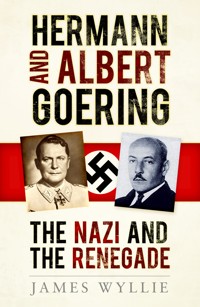
They were the most unlikely of siblings – one, Adolf Hitler's most trusted henchman, the other a fervent anti-Nazi. Hermann Goering was a founder member of the Nazi Party, who became commander of the Luftwaffe, ordering the terror bombing of civilians and promoting the use of slave labour in his factories. His brother, Albert, loathed Hitler's regime and saved hundreds – possibly thousands – across Europe from Nazi persecution. He deferred to Hermann as head of the family but spent nearly a decade working against his brother's regime. If he had been anyone else, he would have been imprisoned or executed. Despite their extreme and differing beliefs, Hermann sheltered his brother from prosecution and they remained close throughout the war. Here, for the first time, James Wyllie brings Albert out of the shadows and explores the extraordinary relationship of the Goering brothers.
Sie lesen das E-Book in den Legimi-Apps auf:
Seitenzahl: 437
Veröffentlichungsjahr: 2011
Das E-Book (TTS) können Sie hören im Abo „Legimi Premium” in Legimi-Apps auf:
Ähnliche



















Cover illustrations: Hermann (left) and Albert Goering.
First published 2006
This edition published 2021
The History Press
97 St George’s Place, Cheltenham,
Gloucestershire, GL50 3QB
www.thehistorypress.co.uk
© James Wyllie, 2006, 2010, 2021
The right of James Wyllie to be identified as the Author of this work has been asserted in accordance with the Copyright, Designs and Patents Act 1988.
All rights reserved. No part of this book may be reprinted or reproduced or utilised in any form or by any electronic, mechanical or other means, now known or hereafter invented, including photocopying and recording, or in any information storage or retrieval system, without the permission in writing from the Publishers.
British Library Cataloguing in Publication Data.
A catalogue record for this book is available from the British Library.
ISBN 978 0 7524 6814 3
Typesetting and origination by The History Press
Printed and bound in Great Britain by TJ Books Limited, Padstow, Cornwall.
eBook converted by Geethik Technologies
Contents
Acknowledgements
PART ONE
Chapter One
Siblings
Chapter Two
Cataclysm
Chapter Three
Munich
Chapter Four
Going Up, Going Down
PART TWO
Chapter Five
Power
Chapter Six
Ski Bunnies and Bolsheviks
Chapter Seven
Showbusiness
Chapter Eight
Death March
PART THREE
Chapter Nine
Resistance
Chapter Ten
All or Nothing
Chapter Eleven
Agent Albert
Chapter Twelve
Destruction
PART FOUR
Chapter Thirteen
Judgement
Chapter Fourteen
Verdict
Notes
Bibliography
Acknowledgements
This book would not have been possible without the dedication, skill and belief of my sister, Dr Barbara Wyllie, author, academic, researcher and editor, and Adam LeBor, author and journalist, who together discovered the forgotten story of Albert Goering and set about trawling the archives for the truth. Their labours resulted in a feature length piece in the Sunday Times (1998) and a sixty-minute documentary for Channel 4 produced by 3BM TV (1998). Both Barbara and Adam continued to unearth material and provided the bulk of the raw data on Albert. Since I embarked on this project they have offered their full and enthusiastic support for which I will be eternally grateful.
I am equally in debt to the individuals who were kind enough to take the time to share memories of Albert with me: Jacques Benbassat, George Pilzer, George Staller, Elsa Moravek Perou de Wagner and Dr Christa Hartnigk-Kummel.
I would like to thank Dan Korn and his team at 3BM TV for their cooperation and Ann Williams for her expertise. An American researcher, Robert Fink, has provided invaluable assistance throughout. Professor Dennis Deletant at the School of Slavonic and East European Studies offered expert advice on the complexities of Romania’s involvement in the Second World War. I look forward to his forthcoming biography of Marshal Antonescu.
My editor at Sutton, Jonathan Falconer, has been nothing but positive ever since he read my proposal, as have all the staff at the company. Without my agent of many years, John Rush, who retired earlier this year, I would never have got this far. Thanks to Amanda Preston for being a fan of the book and guiding me through the deal making process, and thanks to my current agent at Sheil Land Associates Ltd, Emily Hayward, for stepping in so effortlessly.
The constant and unquestioning support of my mother and father has been nothing short of miraculous. To all my friends and family I extend my love and gratitude. Finally, three cheers for the History Department at Latymer Upper School, circa 1977–84, for taking a hungry adolescent mind and teaching it how to think.
James Wyllie
PART ONE
Nobody knows the real Goering. I am a man of many parts.
Hermann Goering, 27 May 1946
Just name any subject to me and I will be glad to give you all the information at my disposal. I swear by God I am not trying to hide anything.
Albert Goering, 25 September 1945
Every morning as we woke up, every night as we lay down to sleep, we cursed Death who had vainly beckoned us to his mighty banquet. And each of us envied the dead. They were at rest beneath the soil, and next spring violets would grow from their bones. But we returned home, fruitless and inconsolable, crippled, a generation dedicated to death, by death disdained.
Joseph Roth, The Emperor’s Tomb
CHAPTER ONE
Siblings
Stockholm, 1925. Hermann Goering, future head of the Nazi war economy, commander-in-chief of the Luftwaffe and chosen successor to Adolf Hitler, was a morphine addict and refugee from German justice. His chances of recovery depended on his Swedish wife, Karin. Her wealthy family had agreed to pay for his treatment at a private clinic. After attacking a nurse he was put in a straitjacket and deposited in a lunatic asylum. There was no guarantee he would see the outside world again. However, with Karin at his side, he quit the morphine and regained his health.
This was significant, not only for the Nazi movement but also for his brother Albert. Two years Hermann’s junior, Albert loathed Hitler from day one. Had Hermann not achieved immense power, Albert’s feelings about the Nazis would have had little consequence. As it was, he saved hundreds, perhaps thousands of people across Europe from persecution, spending nearly a decade working against his brother’s regime, rescuing humble shopkeepers and heads of state, running escape routes, hauling prisoners out of concentration camps, influencing policy and assisting the Resistance.
But none of this would have been possible without Hermann. During preparations for the Nuremberg trials, Albert informed his sceptical Allied interrogators that, ‘Hermann Goering often saved his life and never tried to curtail his Samaritan activities, only cautioning him to have some consideration for his position.’1
* * *
On 8 May 1945, as the Second World War ground to a halt, Albert Goering walked into the Allied Command Centre in Salzburg and was immediately detained by the Americans. They had located a base there in response to rumours that German troops might attempt to regroup in that mountainous region and launch a rearguard action. Large numbers of soldiers were fleeing in that direction seeking safety, clogging roads already jammed with civilian refugees.
Among their number was Hermann Goering, who had set off towards inevitable capture in the style of a warlord embarking on a triumphal procession through his homeland. Surrounded by his close family and attendants, sporting his array of medals, trailing a conspicuous amount of luggage, he passed through the throngs of defeated and dispossessed, their morale momentarily lifted by the sight of the Reichsmarschall in all his brazen glory, seemingly unaffected by the disasters that had befallen him. Some 30 kilometres south of Salzburg, he was taken into custody by First Lieutenant Jerome N. Shapiro. The young American officer could not believe his luck. He had been fruitlessly scouring the region only to run into Hermann, full of bonhomie and delighted to be arrested.
When Albert turned himself in a few hours earlier he was seriously ill. Suffering from inflammation and swelling of the liver, compounded by heart problems, he had dragged himself off his sick bed in order to fulfil what he considered to be his duty. As the brother of one of the most influential men in the Third Reich he believed it essential he set the record straight at the earliest opportunity.
Both brothers regarded the Americans as potential saviours. Neither felt guilty of any crimes and expected fair treatment. They were equally mistaken, failing to grasp the victors’ determination to set a precedent for future conflicts. In Albert’s case the miscalculation was understandable given that he had resisted the Nazis in any way he could. For Hermann it was symptomatic of the degree of delusion and denial he was capable of.
Their geographical proximity when arrested was an example of the strange synchronicity that existed between them. Despite having had no contact for months, no information about each other’s whereabouts, or of their fate, both sought refuge in the familiar surroundings of their youth.
* * *
When Hermann Goering entered the world on 12 January 1893, his family had been in the service of the Prussian state for over 200 years. His earliest ancestor on record was an economic administrator for Frederick the Great. His father, Heinrich Goering, worked in the consular service. As a young man Heinrich had fought in the wars against the Austro-Hungarian Empire and the French which had made possible the unification of a disparate federation of states and principalities into a single Germany under the dominance of Prussia and its mercurial chancellor, Bismarck.
Its territorial integrity secure, the new Germany looked to expansion, eyeing jealously the global empires of its main rivals. The options available for realising Germany’s imperial ambitions were already disappearing fast as its established competitors made their own headlong dash to wrest control of the remaining bits of the map from their indigenous populations. Africa was the focus of much of this attention, having only recently been opened up to the European.
The fear that Germany might miss out altogether was not shared by Bismarck, who was always suspicious of the actual value of colonies, having declared them to be ‘good for nothing but supply stations’. But, ever the opportunist, in 1884 he seized a broad strip of West Africa, encompassing an area that today includes Namibia and Cameroon, on the flimsy pretext that Germany’s main trading outlet at Angra Pequena needed some extra protection.
During the spring of 1885, Heinrich Goering was posted to Windhoek, designated capital of German South-West Africa. He was accompanied by his second wife, Fanny. His first wife had died not long before he had received the appointment, having borne him five children. Fanny, a mere nineteen years old, had captivated Heinrich with her startling blue eyes.
As Resident Minister, Heinrich was expected to create conditions under which Germans could prosper. First an accommodation had to be reached with the two dominant tribes in the region, the Herero and the Nam. Heinrich had no military support to speak of and therefore relied on their goodwill. They also controlled the cattle trade, which dominated economic activity in the province. Heinrich set about drawing up conditions that would respect their autonomy.
In exchange for the right to trade freely without harassment and control over foreign policy, Heinrich agreed to honour the sanctity of their laws, customs and property. These treaties helped secure peace for the rest of Heinrich’s stay – not that this was entirely down to his efforts. The tribes were preoccupied with a long-running war between them, while the actual number of Germans in the colony remained tiny. In any case, much of the territory under Heinrich’s management was nothing but desert. In effect he had very little to administer.
Then his young bride became pregnant. In hostile conditions of unbearable heat and dust, aggravated by poor sanitation, Fanny and her unborn child were at considerable risk. However, help was at hand. Offering good company, comfort, and his expert counsel was the doctor who became a formative influence on Hermann and Albert Goering, Hermann von Epenstein.
Epenstein was a charismatic, eligible bachelor from Berlin. Something of a playboy, he was an established figure on the international circuit that catered for the cream of European society – St Petersburg one week, Cairo the next. Though not conventionally handsome and given to corpulence, he had an imposing voice, extravagant clothing and dashing demeanour, described as ‘swashbuckling’. In acknowledgement of his service to the crown as Prussian court physician he had been ennobled, signified by the addition of ‘von’ to his name.
Not long after the birth, the Goerings returned to Europe. Sources suggest Heinrich’s departure was less than dignified. Though he had an agreement with the Herero tribe, their chief was in secret dialogue with the British in the Cape, who were keen to destabilise this new German dominion on their doorstep. With no garrison of any kind and threatened with revolt, Heinrich allegedly fled with his tail between his legs.2
Increased German involvement in the region, combined with crude racist attitudes, eventually caused the Herero people to rise up. In 1904, the German Army launched an extermination campaign against them: ‘Within the German boundaries every Herero, whether found armed or unarmed, with or without cattle, will be shot.’3 This order from General von Trotha drove the Herero into the deserts, cutting off their food and water supplies. Having left sufficient time for them to die of ‘natural’ causes, troops were sent in to finish off the survivors.
* * *
Heinrich’s diplomatic career had reached a critical juncture. His next appointment, a posting to Haiti, was a definite step down. Haiti had been in Germany’s sphere of influence for centuries as a minor trading centre and there was some talk of it as a springboard into South America, but formal occupation was ruled out and policy was restricted to occasional sabre-rattling in defence of German interests. The job was an exercise in killing time.
Once again his young wife packed her bags for a tropical destination. While they were there Hermann was conceived. For health reasons Fanny went home and booked into the exclusive Marienbad clinic. A couple of days after Hermann was born Epenstein arrived to check on their progress. Within a week he had decided to become Hermann’s godfather. Fanny rejoined her husband and Hermann was left in the care of a Bavarian family in the small town of Fürth.
Three years later, Heinrich had completed his duties in Haiti and faced the prospect of early retirement. His finances were in a poor condition. Civil service pay was meagre in comparison to other professions. To serve the state was reward enough. His reunited family based themselves in Berlin. It was here that Heinrich began to unravel. He began drinking heavily to dispel the melancholia that enveloped him. Just fifty-six, he appeared much older.
Epenstein took this as his cue to ride to the rescue. He offered to take the whole family under his wing and provide for their needs. Whether his generosity was prompted by the start of his affair with Fanny, is hard to establish. It did coincide with the birth of Albert Goering in March 1895. This inevitably raises the question: was Epenstein Albert’s biological father?
The consensus of many who knew them was that Albert was Epenstein’s son. They cite the facial resemblance between them – both were dark haired and shared a Central European physiognomy while Hermann was fair and blue eyed – and the glaring differences in personality between the brothers.
For Hermann and Albert it was never an issue. Both were well aware of the nature of their godfather’s relationship with their mother. As a close family friend observed, ‘Everyone accepted the situation and it did not seem to trouble Hermann or Albert at all.’4 As far as they were concerned they were united as siblings. Even years later, when it would have been incredibly convenient for Albert to claim his ‘real’ lineage, he resolutely stuck with the Goering name.
* * *
Epenstein divided his time between two medieval castles. Castle Veldenstein was a stone fortress built on a cliff high above Neuhaus, a beer-producing town about forty kilometres north of Nuremberg. The original buildings may well have been constructed as early as 918 but the castle only entered the historical record in 1269. Epenstein bought it in 1897 for 20,000 marks. He spent the next seventeen years and 1.5 million marks restoring its former splendour. Today the castle is host to a successful hotel and restaurant business.
His other acquisition was Castle Mauterndorf, built around the end of the first millennium, former home of the local feudal lord, situated to the south of Salzburg and just east of Innsbruck. An imposing structure, set deep in the mountains, the castle towers over the small village that carries its name. Epenstein took over in 1894 and began redecorating. Nowadays the castle is a medieval theme park, with its own tour guides and adventure activities.
The Goering family went back and forth between both castles, often having Veldenstein to themselves for long periods. At Mauterndorf, Epenstein installed them in lodgings built in the grounds. They were free to roam except when Epenstein entertained visitors. Then only Fanny was allowed to show her face, taking the part of lady of the manor, which in effect she was, while the others remained elsewhere. She would then retire to Epenstein’s bedchamber and not return to her family until the next morning.
Given that Epenstein’s lavish dinner parties were almost a nightly occurrence, this embargo made Heinrich a virtual exile. He retreated further into depression and alcoholism, resigned to the fact that his wife was his benefactor’s mistress. At a glance it seems odd that there was not some kind of scandal. The rise of mass media had created a public arena for salacious gossip, and tales of the sexual misdemeanours of the ruling class were guaranteed to shift newspapers. The courts then dealt with the sensational litigation that followed the headlines.
Prince Philip Eulenberg, former ambassador to Vienna and one of the Kaiser’s closest friends, was accused by a newspaper of being part of a homosexual clique that operated at the highest level of society. The libel trial lasted two years, 1907–9, and held the nation’s interest every sordid step of the way. It revealed, among other things, details of orgies held at an elite cavalry officers’ club in Berlin. The Goerings were spared this kind of indignity. Their domestic arrangement barely raised an eyebrow.
Epenstein, Fanny and Heinrich maintained their masquerade for nearly fourteen years. Then, in 1912, Epenstein fell hopelessly in love with Fraulein Lilli, an engaging beauty in her twenties who knew exactly how to twist him round her little finger. At sixty-three years old the confirmed bachelor was ready to marry. Lilli left him little choice, refusing to succumb until her wedding night. Heinrich and Fanny were unceremoniously ejected from their quarters in the spring of 1913, the old man mumbling darkly about this ‘betrayal of friendship’.
At the time Hermann was nineteen and Albert seventeen. Neither boy was there to witness the end of the affair. Hermann had just received a regimental commission and Albert was away at school. A few months later Heinrich died. He was already ailing and the shock of moving to a rented house in Munich in such degrading circumstances was enough to kill him. He was buried in the grand Waldfriedhof cemetery.
Though there was some bitterness felt towards Epenstein in the immediate aftermath, particularly by Hermann, the family crisis was quickly overshadowed by the advent of the First World War. The damage was soon repaired. Lilli was just as keen as Epenstein to maintain contact with his godchildren. When Hermann was granted convalescent leave from his fighter squadron in 1916 he chose to spend it at Mauterndorf.
* * *
Though not born to it, Epenstein flaunted his newly earned aristocratic pedigree with all the energetic enthusiasm of a self-made man who had reinvented himself in the pursuit of respectability. For Epenstein was Jewish. This was not an absolute block on advancement, but Epenstein still decided to become a Roman Catholic.
The pitfalls of being a successful Jew were exemplified by the life of the financier Bleichröder. As Bismarck’s personal banker he helped pay for the wars that delivered unification and, in 1872, was the first Jew ever to add the coveted ‘von’ to his name. Bleichröder also backed Bismarck’s overseas expeditions. In 1885, at the same time that Heinrich Goering was Resident Minister in Windhoek, Bleichröder set up the German South-West African Colonial Company to handle commerce in the region. However, his wealth left him open to bribery. A legal battle that lasted throughout the 1880s began with an accusation by a wronged mistress, who felt entitled to a share of his fortune. She took him to court. The case was dismissed but the scandal sheets got a whiff of it and made sure the whole thing snowballed into an anti-semitic witch hunt, orchestrated by state officials who wanted to charge Bleichröder with perjury. Though he avoided another trial, the mud-slinging continued right up to his death in 1893.
Epenstein side-stepped such prejudice and was not alone in seeking total assimilation, despite legislation passed in 1871 that removed the last legal restraints on the Jewish community in Germany, which then numbered around 600,000 people, about 1 per cent of the population. During the nineteenth century over 22,000 converted to Christianity. Epenstein never looked back. He remained a dedicated Roman Catholic for the rest of his life, making great show of his devotion.
Though the Goerings were Protestant, the brothers’ main exposure to the ritual of weekly worship was through Epenstein. Every Sunday, either at Mauterndorf or Veldenstein, he led a parade of pious observance, taking his extended family and guests to Mass at the village church where rows of pews were reserved for them. Hermann had little interest in religion. He paid his respects to a generic God and avoided churches. A British Tory MP later observed that, ‘There is something un-Christian about Goering, a strong pagan streak.’5 Sentenced to death at Nuremberg, Hermann did not seek absolution from the prison chaplain, or forgiveness from the Almighty. Instead he ‘launched into a tirade on the homosexuality of the Catholic clergy’, and the affairs of ‘the priests and the nuns. The nuns are “brides of Christ” you know, what a set up!’6 Albert took religion seriously and grew up to adopt a broad spiritual awareness based on tolerance and fundamental humanism: ‘I am a Protestant by confession, but I have been in Orthodox churches, in synagogues, I have been to Buddhist and Brahmin services, and it does not make any difference to me. There is only one God.’7
* * *
Daily life at Mauterndorf resembled that of a medieval court. The castle staff were expected to bow and scrape before their master. The arrival of food was signalled by a blast on a hunting horn. On special occasions Epenstein would hire a band of minstrels and musicians to play in the gallery of the main hall. He strode round his domain wearing regal costume, issuing commands, laying down the law: ‘We had to stand to attention while he was talking to us and we were not allowed to address him without permission.’8
Hermann was seven when his family moved to this world of turrets and dungeons, and already obsessed by tales of ancient Germanic heroes and their exploits. The dramatic setting made a lasting impression on him; as his sister Olga remarked years later, ‘You must come and see Castle Veldenstein, then you will understand him better.’9 He quickly took to re-enacting skirmishes with Roman legions.
Epenstein encouraged Hermann’s natural inclination towards adventure. When he was only five Epenstein gave him a hussar’s uniform. As soon as Hermann was old enough to hold a gun he joined Epenstein on hunting trips into the forests to stalk game. He was a natural, and in later years, when he had the necessary power and wealth, he would indulge his passion for the sport on a grand scale.
Hermann was also a particularly fearless climber, intent on scaling the area’s most dangerous peaks. Aged ten he took on the sheer cliff face that Castle Veldenstein had been carved out of. Three years later he reached the peak of the 3,800-metre-high Gross Glockner by the most hazardous route available. Hermann showed a barely concealed contempt for the risks involved: ‘I have no fear of heights. They stimulate me. Besides, any danger is worthwhile if you reach the top of the mountain. You know you will have a view few men will ever see.’10
In 1906, aged thirteen, Hermann was enrolled at Karlsruhe military academy, after Epenstein had pulled a few strings to get him into this exclusive training camp. The Army was virtually a state within a state, commanding huge respect and influence. Though the Army had doubled in size between 1880 and 1913, the aristocracy’s monopoly on leadership remained intact. On the eve of the First World War, 48 per cent of all German infantry officers were nobles. This proportion rose to 80 per cent in the cavalry. By securing a place for Hermann at the academy Epenstein had given him the best possible start towards a distinguished career. Hermann repaid his efforts by excelling. He became an ‘exemplary pupil’. An unruly, difficult child in all the conventional schools he had attended, Hermann had finally found an environment which inspired him and drove him to achieve.
At sixteen he had no problem graduating to the elite Gross-Lichterfelde officer cadet school after getting excellent grades in all his academic subjects and displaying leadership qualities. In his final report it was noted that Hermann had ‘developed a quality that should take him far: he is not afraid to take risks’.11 When he left he was able confidently to say, ‘I am the inheritor of all the chivalry of German knighthood.’12
Hermann was referring to the period of expansion masterminded by the Teutonic knights. This holy order was a contemporary of the Templars and the Knights of Malta. Organised around a hard core of military monks, the knights spread from their power base in southern Germany through pagan Prussia and into the Baltic States. During the thirteenth and fourteenth centuries they waged a succession of wars to consolidate and extend their gains, defended by a network of castles and fortifications. Christian knights, landowners and merchants were drafted in to assist the monks as they imposed their social organisation on the natives. Their armies were constantly replenished by crusaders, mercenaries, robber barons and peasant conscripts. The Teutonic knights fell from grace at the Battle of Tannenberg, 15 July 1410, annihilated by a combined force of Poles and Lithuanians. As a military outfit they were finished. Deprived of further support for their endless war, the order withered away, only to be resurrected as one of the most potent ingredients of German nationalism. The defeat at Tannenberg became a pivotal moment in the collective memory.
In late August 1914 the Teutonic knights were finally avenged by a week-long counter-offensive against Russian armies that had advanced to the German border near the scene of the monks’ original downfall. The onslaught broke the Russian line and it collapsed. The tsar’s troops were surrounded and crushed as they tried to retreat. Such was the scale of the triumph that the German generals, Hindenburg and Ludendorff, were quick to give this series of battles a suitable name: Tannenberg.
The original battle continued to exert a hold on the German psyche. In 1927 a memorial was raised in honour of the fallen knights at a massive ceremony with speeches broadcast on the radio. It was attended by a crowd of military and political figures, including Hindenburg, who was by then president of Germany. When Hindenburg died in 1934, Hitler insisted that he was buried at the site of his most famous triumph.
To establish feudal rule across the lands of their historic enemies, purged of all undesirables, was a cherished dream of the Nazi faithful. Alfred Rosenberg, the movement’s self-appointed philosopher, wrote in his theoretical tome Der Mythus about the need for ‘an association of men, on the lines of the Teutonic Order’.13 Hitler first expressed his ideas on the subject in the second edition of Mein Kampf: ‘We take up where we broke off 600 years ago. We stop the endless German movement to the south and the west, and turn our gaze to the east.’14
In 1913, ready and willing to lay down his life for the Fatherland and hoping to die a warrior’s death, Hermann joined the Prinz Wilhelm Infantry Regiment. A year later he wrote in a letter to his sisters, ‘If war breaks out you can be sure I will do credit to our name.’15
* * *
Albert was a shy, introverted, sensitive child, given easily to tears. These were not attributes that appealed to Epenstein. Aged five, Albert was sent to a boarding school in Hersbruck to toughen him up. A young man was expected to have steel in him. At a time when over 95 per cent of German children ended their formal education at the age of eleven, Albert started attending a Realschule in Munich, a specialist form of grammar school that concentrated on scientific and technical training. The Realschulen were linked to Technische Hochschulen, tertiary level institutes with a strong reputation for academic and research excellence. By the late nineteenth century there were twelve Technische Hochschulen across Germany. Their syllabuses were geared to the needs of industry, which had quickly recognised that technological innovation, and therefore scientific education, was the key to future prosperity and success in the world economy. Each Technische Hochschule was connected to a major firm which recruited directly from the student ranks. Most courses offered on-the-job training. As long as Albert did well at Realschule he would join this new elite. Though not quite as prestigious as a military career, his chosen path was no less respectable and potentially more lucrative.
Albert was a competent, if unexceptional student. Alongside his school work, he showed enthusiasm for arts and culture. His interest was met with approval by Epenstein who believed that an appreciation of the finer things in life was vital. Even Hermann, who had no particular aptitude, developed a well-trained eye: ‘I never could paint or draw but from my earliest youth I was an emphatic lover of art. I liked bright colours such as blue, red and green.’16
Albert had a real talent for music. He was a decent pianist with a good singing voice. He shared this love with Epenstein, as did a great number of Germans. Music was everywhere, with opera houses, concert halls, academies and orchestral societies in every major town. It was a national hobby that bordered on an obsession. Albert was allowed to join Epenstein for late-night recitals at the piano where they would romp through entire operas. Albert’s affection for an impromptu sing-a-long stayed with him forever.
The count was a big Wagner fan and made sure he always had excellent seats at Bayreuth, not far from Castle Veldenstein, where regular festivals dedicated to the composer took place. These were gala nights. The cult of Wagner attracted the great and good from across Europe. The young Albert would have watched sparkling carriages pull up and unload their gilded cargo – women in their extravagant finery escorted by their impeccably suited companions. The spectacle continued inside the auditorium. Performances were enlivened by spectacular sets and stunts. During some productions a real horse frolicked on stage.
Music was not their only mutual passion. Albert grew up to have a similar attitude to the opposite sex to that of his mentor. Though discreet, Epenstein was an inveterate womaniser. If a lady took his fancy he would woo her, regardless of his other commitments. He had an excellent bedside manner. How much of this he consciously passed on to Albert is difficult to gauge, as is the degree to which Albert absorbed his methods of seduction. What cannot be disputed is Albert’s own varied and busy sexual history. Married four times, he was a consummate ladies’ man: ‘He loved to have nice women around him. Everybody had a crush on him.’17
* * *
Hermann’s and Albert’s education was designed to instil core values in them that represented the moral currency of the majority of society, regardless of class, and informed the consensus of what constituted a decent citizen. Loyalty, duty, honour, a willingness to serve the greater good, selfless courage in the face of adversity: these were virtues to be exercised with absolute conviction.
The importance European civilisation placed on these notions of duty and unquestioning obedience was evident in the response that greeted the opening of hostilities in 1914. Though many were nervous at the prospect of war and the left was quick to voice its concerns, there was little organised resistance. The call to arms was answered in droves. A patriotic war was, by definition, a just one. The bonds of loyalty that wed the masses to their leaders’ suicidal policies held firm.
The code that nourished this commitment to arms was found wanting and inadequate when subjected to the horrors of industrialised, mass produced warfare. All the countries involved experienced serious repercussions.
Imperial Germany was already riven by contradictions. The ruling elite clung to the old verities and extolled them in the face of huge technological, demographic, material, political and intellectual challenges, whilst trying to exploit these for their own benefit and preservation.
The degree, scale and speed of transformation was unprecedented. Between 1870 and 1913 the German population grew by 25 million. This increase was concentrated in urban areas. While 64 per cent of Germans had lived in small rural communities of fewer than 5,000 people at the time of unification, by 1910 this figure had dropped to 40 per cent. During the same time cities and towns with over 100,000 citizens had gone from only 5 per cent of the population to 21 per cent. The social landscape of Germany had irrevocably changed.
This process was driven by economic revolution. In 1872 Germany’s GNP stood at 16 billion marks. By 1913 it had leapt to 55 billion. Agriculture was overtaken by industry. The factory worker replaced the field hand. Such a momentous shift reconfigured the division of labour and led to the thorough commercialisation and capitalisation of business practices and the emergence of a well organised working class. The aristocracy were reluctantly obliged to accommodate middle-class aspirations and relax the rules of membership.
Epenstein was as much a product of these upheavals as he was a throwback to days of yore. The very forces that threatened to topple the established order were responsible for his rise through the ranks. The loosening of feudal ties and obligations increased social mobility. Epenstein abandoned his Jewish roots and secured his status. Like many who travel upwards he had little time for reflecting on the journey. The fact that he was only able to assume the lifestyle of a medieval lord because he seized on the possibilities that modernity offered was an irony completely lost on him.
His spirited example was followed by Hermann: ‘I have come to the conclusion that there was no difference between myself as a boy and as a man. I believe that the boy had all the markings which later on appeared in the man.’18 However, as a prominent Nazi, Hermann saw fit to erase Epenstein from any discussions of his childhood. Though he inherited both Veldenstein and Mauterndorf castles, he was not prepared to publicly admit that his patron and mentor was a Jew as defined by the anti-semitic laws he had put his signature on.
Albert’s professional life was quiet, conservative and uncontroversial. Only when his brother’s political party set about destroying everything he believed in did Albert reveal the extent of his personal courage, conviction and incorruptibility: ‘When Goering was asked why he undertook all this assistance to the Jews and other victims of Nazi persecution he replied that he was completely disinterested in politics, that he loathed all oppression and tyranny, and that he was doing in some small way, everything in his power to atone for the evil and brutality of his brother and all the leaders of the Nazi regime.’19
CHAPTER TWO
Cataclysm
By winter 1914 the Western Front had already solidified into the shape it would stay in, with only minute variation, until the last few months of the Great War. The British and French Armies had established a line of defence stretching from the Belgian coast to the Swiss mountains after managing to halt a massive offensive by the Germans which had been intended to end the conflict swiftly. The Germans dug in opposite them. Four years of trench warfare lay ahead, four years of mind-numbing slaughter.
In the early days of the war the pilots of the fledgling German Army Air Service were drawn largely from the cavalry corps and represented the social elite of the army. Their primary strategic function was reconnaissance, providing aerial photos of enemy positions and troop concentrations. Their daring caught the imagination of many, including Hermann. In the early days of the war his infantry regiment was stationed at Mülhausen (Mulhouse) on the Rhine, away from the main action. Having endured several weeks in cold, damp trenches, he was struck down with rheumatic fever and transferred to a hospital in Freiburg to convalesce. While there he met Bruno Lörzer, who was at air training school, and they embarked on a life-long friendship.
Erich Gritzbach wrote the ‘authorised’ biography of Hermann in 1938 with his subject’s full cooperation. Gritzbach became Hermann’s creature in the early 1930s, when he was private secretary to Franz von Papen, an establishment figure who considered himself a potential dictator of Germany. As Papen put it, ‘Gritzbach . . . very soon joined the “winning side” and deferred to Goering more than he did to me. His reward was that he continued to remain in office for many years.’1 In his book, Gritzbach described how Hermann joined the air service by stealing a plane and becoming attached to a squadron by default, only narrowly escaping a court martial. This story has since given rise to a slightly watered-down account that sees him effectively desert, though not by flying away, and evading a custodial sentence thanks only to the intervention of Epenstein.2
Military records reflect a more mundane reality. Hermann’s initial request to join the air service was successful, helped no doubt by a recommendation from his new comrade Bruno Lörzer. By the end of October 1914 Hermann was on an observer training course with the 3rd Army Air Detachment. Once he had taken to the skies, he never looked back.
* * *
While a struggle of pitiless attrition was being waged on the ground, another, apparently more glamorous, battle was soon being conducted in the skies above. For the generals and politicians it was hard to create popular heroes out of the men in the trenches, whose countless acts of bravery, dragging a comrade to safety, clearing a trench, leading a frontal assault on a machine-gun nest, diminished in meaning against the sheer scale of the conflict and the catastrophic number of casualties. This lent a certain anonymity to the front-line infantryman or gunner. He was just one of a multitude. All the main combatants erected monuments in honour of the Unknown Soldier, marking the extent to which the heroes of the trenches remained nameless. By contrast, the air war was perfectly suited to creating legends.
High in the clouds the airmen manoeuvred against each other, machine guns blazing as they went head to head, close enough to see the expression on the enemy’s face. They needed lightning-quick reflexes and nerves of steel. They had to contend with terrible weather, deal with faulty equipment and mechanical malfunctions, and face the ever-present threat of burning to death: ‘If the fuel tank is punctured and the stuff squirts around the legs, the danger of fire is great . . . one drop and the whole machine will burn.’3
The extreme peril attracted mavericks and colourful personalities, which, added to the visual spectacle of the dog-fight, gave this form of warfare a powerful allure. It was quickly likened to medieval jousting. The pilots became knights who fought according to the rules of chivalry. To a population spoon-fed and reared on tales of old Germanic heroes this was inspiring stuff. This image of noble sparring between medieval lords was encouraged by the media: ‘We perceive very strongly how much the old knightly gallantry has come alive again in the conduct of modern aerial combat.’4
In the spring of 1915 a French engineer fitted an aircraft with interrupter gear, which allowed bullets from a fuselage-mounted machine gun to pass between the blades of the propeller. A young Dutch engineer, Anthony Fokker, was convinced he could improve on the French design. He demonstrated his plane, equipped with rapid-firing machine guns, to the German Army on 15 May 1915, after lunch at a nearby château with a group of young pilots, one of whom was Hermann Goering.
* * *
Throughout the war, the Western Front was convulsed by a series of huge battles. Up to 1918 the onus remained on the Allies to attack, the Germans to defend. The aim was to smash the enemy’s line by the sheer weight of assault, the concentration of men and firepower. This thinking applied increasingly to the air war.
The immediate effect was a reorganisation of the German Air Force. 1916 saw the formation of specialist fighter units, Jagdstaffeln, known as Jastas, which became attached to areas of the front in order to support the operations down below. An elite unit was set up for combat fighters, comprising men from Jastas 1 and 2. Minor skirmishes were replaced by battles between large formations of planes.
This only served to accelerate the arms race in design and manufacture. An interlocking process of increased production and expanding, multiplying squadrons – by spring 1917 there were thirty-five Jastas in the skies – meant casualties at an increased rate and continuous missions, day after day, for months on end. During the Battle of the Somme in 1916, the British lost 308 pilots. German losses were similarly severe. In 1917 this carnage was repeated again and again.
German industry struggled to keep pace. While Germany made 45,704 aircraft between 1914 and 1918, the British were able to produce 55,061. Take into account the French total of 52,146 and then add the potential of American factories, especially after the US entered the war in April 1917, and it is clear that the German air force was fighting an uphill struggle. Nevertheless, 800 of the new Fokker DVIIs, considered to be the best all-round fighter of the war, joined the last great offensives in 1918. Between 21 March and 29 April 1918, the Jastas destroyed 1,302 British aircraft. By then, what may have started as an ‘honourable’ contest between a small band of ‘knights’ had ended up as a relentless cull, another cog in a war machine that devoured men by the thousands. Chivalry was no longer an issue: ‘War is not as the people at home imagine it, with a hurrah and a roar: it is very serious, very grim.’5
Nevertheless, compared to the slog of the trenches, the diving, swooping men in their brightly coloured flying machines remained highly appealing. The German war leaders desperately needed heroes to lift the morale of their troops. The fighter aces supplied that boost: ‘When I fly out over the fortified trenches and the soldiers shout joyfully . . . often they forget all danger, jump out on the roofing, swing their rifles and wave at me.’6 They also offered hope to the embattled home front, enduring economic deprivations, unprecedented social upheaval and the loss of loved ones. After 1916 the Allied blockade of Germany bit hard. Even the most basic foodstuffs, such as potatoes, were in desperately short supply: ‘Hunger destroyed our solidarity; the children stole each other’s rations.’7 It is estimated that by the end of the war nearly half a million civilians had died due to dietary restrictions. In these increasingly harsh conditions, the exploits of dashing young pilots were seized upon as proof of Germany’s inevitable victory.
Consequently a successful flyer had the world at his feet. He had access to the highest tier of German society and was honoured accordingly. He became a household name, celebrated wherever he went, front page news. Manfred von Richthofen, the infamous Red Baron, set the bar. Hermann aspired to that level of fame and nearly reached it. As far as his fellow Germans were concerned, he was cut from the same cloth and merited his share of hero worship.
Richthofen came from a long established family. His forebears were feudal lords who entered the Prussian aristocracy in the eighteenth century. His father had been a major in the cavalry. Hermann’s father, Heinrich Goering, was also in the cavalry but of lower rank, because his ancestors carried less social clout. Aged five, Richthofen was packed off to an elite cadet academy, once attended by the infant Hindenburg. Hermann kicked his heels in a regular classroom. In 1909, Richthofen went to the Gross-Lichterfelde military school, the same one Hermann attended thanks to his godfather’s influence. When Richthofen graduated he was privileged enough to go into a cavalry regiment. Hermann went into the infantry.
Richthofen shared Hermann’s youthful passion for hunting. His mother claimed he shot his grandmother’s ducks dead with his first rifle and his skill as a marksman translated into combat. He experienced the ‘same feeling in the moment when the bull came at me, the same hunting fever that grips me when I sit in an aeroplane and see an Englishman’.8 This rush peaked at the moment of victory: ‘My heart beats a little faster when the opponent, whose face I have just seen, goes roaring down from 4,000 metres.’9
Richthofen’s cavalry regiment was sent to the Eastern Front, where the vast, open plains left some scope for horses, before being transferred to the west. It was here he began his pilot training in May 1915, just a month before Hermann. Since joining his friend Bruno’s unit as an observer in October 1914 and flying reconnaissance missions over the French fortress at Verdun, Hermann had made a name for himself. While Bruno was in the pilot’s seat, Hermann was in charge of taking the photographs of the French positions. Flying very low, with soldiers on the ground shooting at him, Hermann would literally hang out of the plane to take the snaps, earning the nickname ‘the trapezist’. Such was the quality of the pictures Hermann and Bruno provided that they were awarded the prestigious Iron Cross First Class on 25 March 1915. The Iron Cross had been introduced by the Prussian king during the Napoleonic Wars. It was designed to resemble the black cross on white background that was the symbol of the Teutonic knights, worn on their shields and tunics, flying from their pendants, as they went into battle.
Meanwhile Richthofen’s career took off. Oswald Boelcke, one of the first flying aces and the brains behind German fighter tactics, became his mentor. By spring 1916 Richthofen was leading the fight against the British air offensive. During that summer and autumn he notched up fifteen kills. In 1917 he downed forty-eight planes. By then he was internationally renowned and a domestic superstar. His total number of Allied scalps stood at eighty when he was shot down and killed on 21 April 1918.
Hermann’s record was modest in comparison, adding up to only a quarter of Richthofen’s tally. Training complete, he joined Jasta 5 in October 1915. On 16 November he gained his first official kill. After the winter break, when weather made flying nigh on impossible, fighting began in earnest. By June 1916 his total had risen to three. Days later he was lucky to escape with his life when a Sopwith fighter attacked his plane. The wing was damaged and the fuel tank hit. Hermann had a bullet lodged in his thigh, which had splintered the bone. He was forced to crash-land in a cemetery. Fractions of inches and fractions of seconds decided Hermann’s fate. Somehow he survived.
His injuries did put him out of action until the following spring, the first six months in hospital, the rest convalescing at Epenstein’s Castle Mauterndorf. On his return he was posted to Jasta 26, which was under the command of good old Bruno Lörzer. During the Bloody April of 1917, that bled on throughout the summer, Hermann was in the thick of it. His reputation grew and he was promoted to command the newly formed Jasta 27. Between April and November he recorded a further thirteen victories and joined a handful of pilots who basked in the glow of Richthofen’s fame.
1917 was a stellar year for the Red Baron. He was awarded Germany’s most coveted medal, the so-called Blue Max. He became the centrepiece of a propaganda campaign to lift the nation’s flagging spirits. He was given a substantial commission to write his memoirs by a Berlin publisher, and a stenographer to help type it. Der Rote Kampfflieger (‘The Red Battle Flyer’) came out that year. In 1918 his diaries were published posthumously. Other books compiling Richthofen’s thoughts followed. They were all reissued during the Nazi years.
Postcard manufacturers mass-produced collectible portraits of the top aces for an eager market. A card autographed by one of these heroes could sell for hundreds of marks. Everywhere the Red Baron went he was mobbed. Crowds met him at railway stations and followed him down the street. He received honours from the kingdoms of Saxony, Bavaria and Württemberg, to name a few. He was even granted the privilege of hunting the rare European bison on the private estates of one of Germany’s richest landowners. This immense wildlife reserve would become one of Hermann’s private playgrounds after he became Master of the German Forests and Master of the Hunt in 1934.
Though Hermann may not have been exposed to the degree of adulation that Richthofen was, he still benefited from the limelight. There were postcards with his face on them too. He was featured in magazine articles, his exploits reported in the press. He moved with ease in similarly elite circles, a regular in the officers’ mess reserved for royalty. He relished dressing up and going on show. He was slim and handsome, with magnetic blue eyes that he had inherited from his mother. He had considerable charm and charisma. A member of the Prussian royal family wrote in his memoirs that Hermann ‘displayed conspicuous dash and zeal’.10
Hermann enjoyed a raucous party as much as a genteel dinner. Lavish events were laid on at the best hotels for the pilots’ entertainment by the aeroplane manufacturers: ‘What they wanted most, and what we tried to give them, was gaiety, charm, diversion, the society of pretty girls, the kind of good time they had been dreaming about.’11 Richthofen was uncomfortable at these events, anxious to get back to the world he understood: ‘One could see that he was a front line soldier not a courtier.’12 This assessment was echoed by his mother: ‘He longed for the din of the propeller, the laughter of the machine gun . . . that was his nature.’13 He had a pragmatic attitude to flying a plane. It was a means to an end, not an end in itself: ‘As for flying . . . he did not care much for it. He has never made a loop out of sheer joy of sport.’ It was strictly forbidden for his pilots to indulge in any ‘acrobatic tricks’.14
Hermann, on the other hand, loved the buzz he got soaring above the clouds: ‘I seem to come alive when I am up in the air and looking down at the earth. I feel like a little God.’15 He became a skilled exponent of aerial gymnastics. After the war he briefly made his living as a dare-devil stunt pilot. Even so, he was not irresponsible in the line of duty. Richthofen wanted to ‘draw a line between daring and stupidity’, otherwise a brave but hot-headed pilot might ‘pay for his stupidity with his life’.16 The efficient fighter must be cold and calculating. He may have admired ‘splendid daring’, but he did not endorse it.
Hermann followed these principles to the letter. His official mission reports bear witness to his sober attitude. Here he is describing an apparent victory, ‘I immediately closed in on the nearest hostile and loosed off a few short bursts at it. I then attacked the second Nieuport, which suddenly lost height and made off at low altitude’, or reflecting on a near disaster, ‘The Englishmen attacked me and shot out my rudder . . . I could not see what happened then as I had my hands full flying my plane without a rudder.’17 This modest language is light years away from the kind of egomaniacal boasting that became second nature to Hermann the Nazi warlord.
As the war entered its final year, the Red Baron could not envisage a life for himself beyond the battlefield: ‘I myself cannot think of a more beautiful death than to fall in aerial combat.’18




