


Erhalten Sie Zugang zu diesem und mehr als 300000 Büchern ab EUR 5,99 monatlich.
- Herausgeber: The History Press
- Kategorie: Sachliteratur, Reportagen, Biografien
- Sprache: Englisch
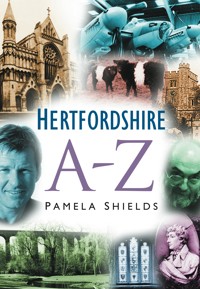
Pamela Shields's new book, a compendium of fascinating Hertfordshire facts, is an introduction to the county aimed at residents, visitors and tourists. Home to many 'firsts', such as the English Pope, the Garden City and the New Town, Hertfordshire was also home to many famous people, from King Offa to Laurence Olivier, George Orwell, Graham Greene and Henry Moore - all of whom are featured here. This is where England's crown was surrendered to WIlliam the Conqueror and where a Frenchwoman and a Welshman started the Tudor dynasty. Among the county's geniuses are Sir Geoffrey de Havilland, Sir Jon Sulston and Sir Stephen Hawking. Peculiar survivals such as the Hertfordshire Spike and Hertfordshire Puddingstone are included, as are urban myths, local legends and much more.
Sie lesen das E-Book in den Legimi-Apps auf:
Seitenzahl: 259
Veröffentlichungsjahr: 2005
Das E-Book (TTS) können Sie hören im Abo „Legimi Premium” in Legimi-Apps auf:
Ähnliche

















HERTFORDSHIRE
A-Z
PAMELA SHIELDS
First published in 2005 by Sutton Publishing Limited
Reprinted in 2011 by
The History Press
The Mill, Brimscombe Port
Stroud, Gloucestershire, GL5 2QG
www.thehistorypress.co.uk
This ebook edition first published in 2013
All rights reserved
© Pamela Shields, 2011, 2013
The right of Pamela Shields to be identified as the Author of this work has been asserted in accordance with the Copyright, Designs and Patents Act 1988.
This ebook is copyright material and must not be copied, reproduced, transferred, distributed, leased, licensed or publicly performed or used in any way except as specifically permitted in writing by the publishers, as allowed under the terms and conditions under which it was purchased or as strictly permitted by applicable copyright law. Any unauthorised distribution or use of this text may be a direct infringement of the author’s and publisher’s rights, and those responsible may be liable in law accordingly.
EPUB ISBN 978 0 7509 5320 7
Original typesetting by The History Press
To the memory of my mother, my first and best history teacher
Other books by Pamela Shields
Islington: The First 2000 years
Essential Islington: From Boadicea to Blair
The Private Lives of Hertfordshire Writers
Hertfordshire’s Secrets & Spies
Royal Hertfordshire: Murders & Misdemeanours
The Little Book of Hitchin
Websites
www.pamela-shields.co.uk
www.roytrs.com
scribbling4bread.wordpress.com/wp
Contents
Introduction
The A–Z
Resources & Further Reading
Acknowledgements
Picture Credits
Introduction
At 634 square miles, Hertfordshire is one of the smallest of the English counties, with a population of around one million. Buoyant and prosperous, it has one of the strongest economies in the UK, with residents enjoying high standards of living, high per capita income and low unemployment. Home to leading pharmaceutical, bio-technology, financial services, film and computer-related businesses, it is, however, heavily dependent on the London economy.
Surrounding counties are Buckinghamshire to the west, Bedfordshire to the north, Cambridgeshire to the north-east and Essex to the east.
The original spelling of the county was Hart – the old word for stag, particularly red deer. The area referred to was around Hart Ford, mentioned in the Anglo-Saxon Chronicle of 1011, but even by then the county was already ancient. Axes and harpoons dating from 8000 BC have been found, as have cemeteries dating from 2500 BC and Iron Age settlements at Ivinghoe, Ravensburgh, Wilbury and Telegraph Hill.
The climate is so mild and dry that London doctors once advised those in poor health to move here. An old saying is: ‘He who buys a home in Hertfordshire pays two years’ purchase for the air.’
Although a shire, it is administered by a county council. Shire is Anglo-Saxon; county comes from the French ‘comté’. Boundaries of the newly formed Norman counties corresponded with those of existing Saxon shires.
Owing to its proximity to London it was always (and still is) a popular retreat for the rich, who built grand houses with parks and gardens, which partly explains its 170 Scheduled Ancient Monuments, 110 Grade I, 472 Grade II and 7,477 listed buildings, 45 parks and gardens of special historic interest, 43 Sites of Special Scientific Interest (SSSIs) and 22 local nature reserves.
Hertfordshire has earned its place in history. This is where the Anglo-Saxons surrendered England’s crown to William the Conqueror, the world-famous Tudor dynasty was born and the first manned flight was witnessed, beginning the county’s long love affair with aviation.
Today, the southern border is a mere 12 miles from central London, the swiftly encroaching metropolis. Because of local government boundary changes many Hertfordshire inhabitants woke up one morning in 1965 to find they were Londoners. The natural environment is subject to constant pressures from development.
The county, served by Luton and Stansted airports, has woods, valleys, canals, lakes and open farmland. The Chilterns to the west is an Area of Outstanding Natural Beauty and more than half the county is classified as Green Belt. Inhabitants of large modern conurbations such as Stevenage and Letchworth and Welwyn Garden Cities are within walking distance of picturesque villages and historic market towns.
Hertfordshire has produced one or two actors, painters, and even a pope, but in the main the air seems to suit writers and scientists best. Poets George Chapman and William Cowper, novelists Graham Greene and W.H. Johns were born here. Writers Claud Cockburn, Maria Edgeworth and E.M. Forster were brought up here. As for scientists, among many born here are Henry Bessemer, who gave the world steel; Dr Thomas Dimsdale, who pioneered inoculation against smallpox; Sir John Bennet Lawes of artificial fertiliser fame; and William Ransom, founder of the first independent pharmaceutical company in the UK (still going strong 150 years later). Polar expedition zoologist Apsley Cherry Garrard, Professor Stephen Hawking, Joseph Lister and Sir John Sulston moved here as young children.
Authors give themselves a cut-off date for research, otherwise the book never gets written. Publishers give them a cut-off too – 50,000 words. Although I have been making jottings for eight years, my research of the county is just beginning. This is work in progress. Like the BBC, I hope it manages to educate, inform and entertain.
A
Abbots Langley Has gone down in history as the birthplace of Nicholas Breakspear (1100–59), the only Englishman to become pope. Born in Bedmond, he was baptised at St Lawrence the Martyr, Abbots Langley. His name is depicted on his coat of arms as a broken spear, which may refer to family skirmishes during the Norman invasion – a mere thirty-four years before his birth. Born on a farm, he ended up ruling the Vatican as Adrian IV (1154–9). There was a farm on the site of his birthplace (painting in Vatican archives) until the 1960s (plaque in Bedmond Road in front of the new houses). His father Robert became a monk at St Albans Abbey, but when Nicholas tried to join Robert he was rejected (coincidentally, Nicholas ended up in Albano, Italy). Nicholas chose the name Adrian after the pope who had sanctioned the founding of St Albans Abbey. It is thought his mother was still alive to witness her son’s great achievement, but there is no record of either parent attending his coronation. His red marble sarcophagus in the crypt of St Peter’s in Rome is decorated with deer skulls representing the county, roses representing England and the inscription ‘Hadrianus Papa IIII’. Commemorations include plaque, St Lawrence; bust, St Saviour’s; Pope, Adrian and Breakspear Roads, Abbots Langley; Nicholas Breakspear Week, Abbots Langley; Wallingford Screen, Cathedral and Abbey Church of St Alban; painting, County Hall, Hertford.
Commemorative plaque: Nicholas Breakspear, st Lawrence the Martyr, Abbots Langley.
Addis factory, Ware road, Hertford.
Addis, William (1734–1808) Invented the toothbrush in 1780 using pig bristles and white horsetail hairs backed onto ox bones or ivory. 1914: during the First World War every ‘Tommy’ was issued with a toothbrush. 1920: Addis company took over the Steam Laundry, Ware Road, Hertford, converted it into a factory and began to export all over the world. 1935: Donald Hamilton designed the Addis building in Ware Road, a pioneering example of a modern factory. Present tenants include the Hertfordshire Mercury (local newspaper). One of the town’s major employers, Addis remained a family firm until 1996, when it was bought by Wisdom/Jordan.
Aesop’s Fables Introduced into Britain when Alexander Neckham* of St Albans* translated them into English. Aesop, born into slavery under King Croesus in 564 BC, was sent to Delphi with gold for distribution among the citizens but, disgusted by their greed, returned it to his master. Furious locals pushed him over a cliff. He has a statue in Athens.
Agriculture 65 per cent of the county is farmland. Out of a population of almost one million just 3,500 (includes 1,794 farmers in 2005) work in agriculture. Crops include wheat, barley, beans, oilseed rape and peas. Wheat is grown for flour and feed; barley for feed and malting beer; rape for oil and feed; beans for animal feed. There are also specialist growers of apples, strawberries, blackcurrants and salad crops. The county has 33,000 sheep, 21,000 cattle and 16,000 pigs. The first crop of swedes in Britain was grown on a farm near Berkhamsted.
Alban First* Christian martyr in northern Europe, executed in 209. Offa built the abbey dedicated to him in the 700s. Albanus means ‘The Briton’, which is strange because he was a Roman. His real name is not known. The story goes that a Roman priest, Amphibalus, on the run for preaching Christianity, was befriended by ‘Albanus’, who changed clothes with him so that he could escape. Some sources say Amphibalus hid in Wales, others that his remains were found on Redbourn* Common; a priory was founded to hallow the spot and he was promoted to Saint. In the Middle Ages, to raise funds, Benedictine monks built a massive mechanical Saint Alban which said ‘thank you’ to those who fed it coins.
Albury Often confused with and misspelled Aldbury* even in guidebooks. In 1552 St Mary’s had four bells plus the Sanctus, but one (possibly cracked) later disappeared. In 1880 another bell fell down and also disappeared. Some muttered that the devil had taken it; the more cynical said louts had dumped it in the pond ‘as deep as the church spire is tall’. Albury Hall, a magnificent mansion, dominated the village for generations, but this historically important Second World War base, well known to the Germans, has been demolished. It played a vital role in Britain’s survival. Special Operations Executive* agents were flown out from nearby RAF Sawbridgeworth and dropped behind enemy lines. Churchill and Eisenhower both visited the hall on a number of occasions.
Alexander, Harold (1891–1969) Field Marshal Earl Alexander of Tunis, son of Earl of Caloden of Tyttenhanger*, is buried in St Margaret’s, Ridge. The gravestone says simply ‘Alex’. He spent childhood holidays and part of his honeymoon at Tyttenhanger. Famous for his North African campaigns against Rommel, the Second World War hero is said to have been Britain’s greatest military commander since the Duke of Wellington. His funeral was held in St George’s Chapel, Windsor.
America John Eliot (1604–90) of Widford* founded Harvard University; William Penn* founded Pennsylvania; Samuel Stone* founded Hartford, Connecticut; registers for the Church of St Peter and St Paul, Tring*, have entries for the ancestors of George Washington*; Jimmy Carter, 39th President of the United States, is a direct descendant of Carters from Chipperfield*; Second World War American Air Force bases were located at Bovingdon and Nuthampstead.
Anglo-Saxon Mercia No one had heard of Mercia until Penda (d. 655) seized it from his cousin, Ceorl, in 626. Settlements: Benington, Berkhamsted, Caldecote, Gosmore, Hitchin, Letchworth, Offley, Pirton, Royston, St Albans, Standon, Therfield Heath, Walkern. Churches: Ashwell, Hitchin, Little Munden, Northchurch, Reed, St Albans (St Michael’s, St Stephen’s), Walkern, Westmill, Wheat-hampstead. Museums all over the county have local finds. Warrior graves under prehistoric barrows at Therfield Heath show old burial traditions were still practised by Anglo-Saxons after the introduction of Christianity. 851: King Bertwulf/Bertulph, driven out of London, relocated his headquarters to Benington*. 886: the Peace of Wedmore established the River Lea as the boundary between Wessex and the Danelaw. 895: Danes fortified the Lea (Viking sword found in the river), so King Alfred diverted it via a system of ‘Waras’ (weirs) – old name for Ware* – making it impassable. 912: to defend the River Lea, Alfred’s son Edward the Elder founded Hertford*, which retains the Anglo-Saxon grid pattern in the street layout. It was probably at this time that Hart Ford became a ‘shire’ and its boundary was set. Edward also built Hertford Castle*, where the Rivers Beane and Mimram meet the Lea, as a defence against the Danes.
Anstey The lychgate of the church incorporates the old lock-up. The Norman castle was demolished by Henry III, who accused the village of being ‘a nest of rebels’. Thomas Campion (1567–1620), doctor, poet and musician, was born and baptised here. He wrote masques for James I. 1944: a B-17 bomber failed to become airborne after taking off from nearby Nuthampstead airfield and crashed into the castle mound. When the moat was drained to recover it, a door was revealed below the water line, reminding villagers of the local legend that once upon a time a local man, ‘Fiddler George’, went into a tunnel and was never seen again. 1972: The Selected Songs of Thomas Campion, edited by W.H. Auden, was published.
Architects (selected) Lutyens*. Voysey*. Adam Brothers: architects to George III. James Adam (1732–94) designed Shire Hall, Fore Street, Hertford* and worked on Panshanger House (demolished). His brother Robert Adam (1728–92), who designed The Priory for the Radcliffes of Hitchin*, was the driving force behind the practice, James preferring to stay at home in Hertfordshire. Bennet and Bidwell: Broadway Cinema, Eastcheap, Letchworth (originally had neon lighting around the entrance). Sir Reginald Blomfield (1856–1942): designed Abbots Langley and Little Berkhamsted war memorials, as well as Lambeth Bridge and Chequers; educated at Haileybury College*. His uncle, Sir Arthur Blomfield, designed the college chapel’s enormous dome. Edward Blore (1787–1879): architect to William IV and Queen Victoria and of Westminster Abbey. Designed The Grove*, Watford and The Frythe, Welwyn. William Butterfield (1814–1900): architect of Keble College, Oxford. Rebuilt St Margaret’s, Barley, which incorporated fifteenth-century screen, Jacobean pulpit, twelfth-century tower and Norman arch. He also rebuilt Holy Saviour, Hitchin, designing everything, including hinges, light fittings and heating. He disapproved of hassocks, which he said people fell over, so designed a fold-out kneeling board. Sir Clough Williams-Ellis (1883–1978): Portmeirion’s famous architect; Sweetings, Brickendon. Leading figure in the Garden City movement and Chairman of Stevenage New Town Development Committee. Donald Hamilton: Addis Factory, Ware Road, Hertford. Nicholas Hawksmoor*. E.B. Musman: Comet* Hotel, St Albans Road, Hatfield, named after the de Havilland* Comet, which had just made its historic flight to Melbourne. In front is a stone pole topped by a model of the plane. David Nye: Rex Cinema, Berkhamsted is the best remaining example of this cinema architect’s work (saved by people power*); Sir John Soane (1753–1837): Beechwood, Flamstead; Hamels near Braughing and lodges leading to the park, Marden Hill near Hertford; Micklefield Hall, Sarratt* Tyttenhanger for the Hon. Mrs York; Kelshall Rectory near Royston* for the Revd Thomas Waddington; Wydiall Hall for Mr Heaton Ellis; North Mymms Park for the Duke of Leeds; Wall Hall for Mr G.W. Thellusson; Moor House, Rickmansworth for Mr T.H. Earle. William Wilkins (1778–1839): architect of the National Gallery. As a 27-year-old he designed Haileybury in 1806 for the East India Company. Sir Christopher Wren (1632–1723): Tring Manor for Colonel Guy; Bishop Seth Ward Almshouses, Buntingford*, are attributed to Robert Hooke, but it is thought his close friend Wren had a part in its design. Recently restored, the almshouses are still occupied. F.R.S. Yorke (1906–62): architect of Gatwick airport. Barclay School, Stevenage; ‘Torilla’, Wilkins Green Lane, Hatfield, inspired by le Corbusier and saved by the Hertfordshire Building Preservation Trust.
Shire Hall, Hertford (designed by James Adam).
The Priory, Hitchin (designed by Robert Adam).
Comet Hotel, Hatfield (designed by E.B. Musman).
Arts and Crafts Edward Burne-Jones (1833–98): window in Hatfield church. William Morris (1834–96): east window, St Mary the Virgin, Rickmansworth; south window showing three archangels at St Mary’s, King’s Walden; south porch (1526) stained glass of the four evangelists (two on each side, may be the last of Pre-Raphaelite glass), St Mary’s, Aspenden. Together Burne-Jones and Morris designed windows in St Michael and All Angels, Waterford*. The painter Patrick Heron CBE (1920–99) was brought up in Welwyn Garden City, where he lived until 1945 (he joined Bernard Leach in St Ives). Herbert Read* lived in Much Hadham. Rex Whistler (1905–44) was educated at Haileybury. He was a master of trompe-l’oeil, and the murals in the Tate Gallery restaurant are by him. Killed in action during the Second World War.
Ashridge In 1921, when the estate was sold, the National Trust bought 5,000 acres, much of which has open access. Rare birds, fallow deer, muntjac, badgers and the now rarely found glis glis* (dormouse) live here. The monument erected in 1832 to the 3rd Duke of Bridgewater, the Canal Duke, who once owned Ashridge, is a focal point. Lorna Doone was filmed here in 1934. During the Second World War General de Gaulle rented a house on the estate and began writing his memoirs.
‘Torilla’, Wilkins Green Lane, Hatfield (designed by F.R.S. Yorke).
Ashridge House There has been a college on the site for 700 years. A monastery, College of Bonhommes, was founded by Edmund of Cornwall, nephew of Henry III, in 1283. When Henry VIII dissolved the religious houses, he took possession of it. Edward VI gave it to Elizabeth I, who sold it in 1579. She knew it well; she was imprisoned here when ordered to go to London to answer charges of treason against her half-sister Mary Tudor. Ill at the time, she stopped at Redbourn and North Mimms before being taken to the Tower. Her statue was taken from Ashridge in 1925 and is now in Harrow School. The present house, by James Wyatt, dates to the early nineteenth century, as do the gardens by Humphrey Repton.
Ashwell ‘The well by the ash’. Source of the River Cam. Loved by poets Betjeman* and Holbrook*. Visual delights include Guildhouse, Chantry House, Town House (museum – which began with the collection of two village boys), The Maltings (flats) and a small brick house (1681 Merchant Taylors’ School). Ashwell Bury, a large Victorian house remodelled by Lutyens* in the 1920s had a garden by Jekyll*. Lutyens also designed the war memorial. Famous graffiti in the church record the Black Death of 1350. The village has one of the county’s remaining lock-ups, where drunks were thrown to sober up overnight. Until the early twentieth century workers were brought in to find coprolite*.
Aston Bury Moated. Built in 1540 and still inhabited in 1968, this was the famous Station XII of Special Operations Executive* fame, about which local man Des Turner wrote the definitive book. Sadly, the house has been demolished.
Aubrey, John (1626–97) Antiquarian to the Crown who discovered the megalithic remains at Avebury. His Brief Lives contains wonderful gossip about Bacon*, More*, Penn* and Myddelton of the New River*.
Austen, Jane (1775–1817) Novelist. Her parents, Cassandra Leigh and George Austen, had eight children, including Jane and James. James’s son James Edward (1798–1874) wrote Memoirs of Jane Austen. 1828: when appointed curate of St Peter and St Paul, Tring, he married Emma Smith and moved to Tring Park. 1925: Sir Frank Mackintosh, writing in Cornhill magazine on the topography of Austen novels, said that Meryton in Pride and Prejudice is Hertford, where the militia talked about in the book was then based. It also had a mayor and locals carried out the occupations mentioned. The ballroom in Shire Hall resembles Meryton Assembly Rooms, where Mr Darcy first appears; he identified Longbourne, where Mr and Mrs Bennet live, a mile from Meryton, as Hertingfordbury; Charles Bingley takes Netherfield, a house on the other side of Meryton, said to be Balls Park*; Sir William Lucas is said to have lived either at Panshanger* or Goldings*. Colonel Forster, after Wickham’s elopement with Lydia, makes enquiries at Barnet (in the county until 1965) and Hatfield coaching inns.
Aviation Hertfordshire was the centre of the aviation industry. When Goering said that with a week of good weather his Luftwaffe would knock England out of the war, he had not bargained on Geoffrey de Havilland* and Fred Handley Page*. 1784: Vincenzo Lunardi*, first* in Britain to travel by air. 1912: Captain Patrick Hamilton and Lt Atholl Wyness-Stuart, pioneer aviators, first* airmen to die serving their country. Although the granite commemoration obelisk is on the roadside between Willian and Wymondley, the tragedy happened in nearby Gravely. 1916: first* Zeppelin shot down at Cuffley. Another was shot down a month later at Potters Bar*. Sir Frank Whittle (1907–96) inventor of the jet engine in 1941, once lived at 41 Bearton Green, Hitchin. 1950s: Britain’s first* aircraft museum opened behind Salisbury Hall*, London Colney.
‘New’ church, Ayot St Lawrence.
Commemoration obelisk, Willian.
Ayot St Lawrence One of three Ayots (Ayot Green and Ayot St Peter). Much-loved home of playwright G.B. Shaw*. Land once owned by King Harold. One lord of the manor was Sir Richard Parr, whose daughter Catherine, destined to marry Henry VIII, is said to have spent her childhood here. When Sir Lionel Lyde, a tobacco millionaire, built Ayot House in the 1770s he demolished the twelfth-century church because it spoiled his view. Forced to build a new church, he insisted it resemble the Temple of Apollo at Delos. Lyde’s house, once a silk farm where material for royal christening robes was woven, was home to King Michael* of Romania.
B
Bacon, Sir Francis (1561-1626) Politician, lawyer, philosopher. Created 1st Viscount St Albans* (title extinct upon his death). Youngest son of Sir Nicholas Bacon of Gorhambury, Lord Keeper of the Great Seal under Elizabeth I, who often visited. 1601: Bacon, born in St Albans and a pupil at St Albans School, inherited the estate from his brother Anthony. Ousted from power after admitting to bribery (‘I do plainly and ingenuously confess that I am guilty of corruption’), he spent the last five years of his life here, using his father’s house as a base while he built himself a much grander one (cost £10,000; in today’s terms over £1 million). Sir Harbottle Grimston sold it for £400 to a carpenter, who sold it on for £800. Grimston removed Bacon’s coffin from St Michael’s Church to make room for his own. Of the original 1568 mansion, only the porch, masonry of the Hall and one wing survive (cared for by English Heritage*).
Baldock Once pronounced Baudac, this market town, which will reclaim its old-world charm once the bypass is opened, has always been here. The main road from the A1 is on top of the ancient Icknield Way*. The town is listed by the Council for British Archaeology as being of national importance because of Iron Age and Roman settlements. 442: first recorded charter. 1142: given to the Knights Templars*. When they fell from grace it was transferred to the Knights Hospitallers*. Charles I is said to have passed through here as a prisoner. The rector brought him wine from the church in a silver chalice. Samuel Pepys* often stayed at the George and Dragon. John Bunyan* and John Wesley* also stayed there. Pepys said Baldock was full of informers who lobbied to get the town’s Quakers transported. John Smith* first* to decipher Pepys’s diaries, was Rector for almost forty years. Whenever George Orwell had to leave his beloved Wallington* this is the station he used. 1960s: old film studios, now Tesco, became Kayser Bondor. The Rolling Stones played there in 1963.
Balls Park Pevsner* called it ‘one of the most puzzling houses of Hertfordshire’. The feet of Charles I and his son Charles II trod these halls, as did those of Cromwell. In 400 years the house was owned by just two families, and the second of those didn’t arrive on the scene until 1900. The land was owned by Simon Balle MP (local school named after him) but why, in 1638 when Sir John Harrison bought it he called his mansion Balls, not Harrison’s Park, is a mystery. John Evelyn* visited the Harrisons at their new house and wrote about it in his diaries. The Harrisons lived through hair-raising times. When Charles I borrowed £55,000 to pay the Scots who fought for him, Cromwell arrested Harrison and took Balls Park. Charles II returned it to the family. 1739: Lady Audrey Harrison Townshend inherited. 1899: the last Harrison Townshend died. For the first time in its history Balls Park was put up for sale. Sitting tenant Sir George Faudel Phillips bought it. 1939: home for children suffering from TB. 1941: the last Faudel Phillips died. 1947: County Council used it as a teacher-training college and appointed Monica Wingate principal. She stayed until it closed in 1970. Her brother was Orde Wingate of Chindit fame (Burma). 1979: taken over by the University of Hertfordshire. 2001: sold to a private company. Now used as a film location.
Balls Park.
Barley Inspiration for any village in danger of losing its pub, post office or shop. The community-minded villagers raised funds for tennis courts, flashing ‘Slow Down’ signs, the Tudor Town House (written about by Defoe*), GP surgery, play area and nursery. 1872: St Margaret’s was rebuilt by Butterfield. William Warham, one-time Rector, became the Archbishop of Canterbury who crowned Henry VIII. The village has a seventeenth-century lock-up.
Barrie, Sir James Matthew (1860–1937) Close friend of the Llewellyn Davies family of Egerton House, High Street, Berkhamsted* (now The Rex). Wrote Peter Pan for the five brothers. One Christmas when one brother was too ill to go to the pantomime, Barrie took it to him at Egerton House. He became their legal guardian after the tragic early deaths of their parents. One brother died in the First World War, two committed suicide. When Barrie failed to consummate his marriage, Mary, his actress wife, left him for Gilbert Cannan, a writer from Berkhamsted.
Battles Three of the most important of the fifteenth-century battles between the houses of York and Lancaster were fought here. The first battle, St Albans, opened the Wars of the Roses, the last, Barnet (in the county until 1965) ended them. 1455: at Royston, Richard, Duke of York wrote to Henry VI setting out terms for peace. Barricaded in at St Albans, Henry never received the letter. In the first so-called battle, a half-hour scuffle, Henry was taken prisoner and Richard afterwards declared himself Protector. 1461: the Second Battle of St Albans was a victory for the Lancastrians. The Yorkists left Henry under a tree on Nomansland common. Two weeks later Edward, the new Duke of York (Richard had died in battle), defeated the Lancastrians at Towton and proclaimed himself Edward IV. October 1470: Warwick, ex-head of the Yorkists, now leader of the Lancastrians, reinstated Henry VI. 1471: the Battle of Barnet could have been the third Battle of St Albans. Instead, Warwick went through to Barnet. The battle lasted four hours and ended in victory for Edward when Warwick was killed. 1740: commemorative obelisk erected, known as the Hadley Highstone. Shakespeare wrote about the battle (Henry VI, Part III), as did the novelist Bulwer-Lytton* in The Last of the Barons.
Bayford 1366: villagers asked if they could bury their dead here instead of at Essendon 3 miles away, because corpses had to be carried past a watermill on carts which often fell in the river. 1767: Sir William Baker of The Bury planted firs. A pinetum planted in the nineteenth century is now a collection of national importance with 130 species of conifer. It was restored by the John Innes Horticultural Institution which owns part of the estate. A haven for rare birds, badgers, foxes and muntjac; there is a grotto in the grounds.
Bearskins One of the most potent of British symbols is French. Popularly called a Busby, the hats, 18in high and weighing 2lb, were taken from the heads of defeated soldiers at Waterloo. Each week Mr Green of Weston, the only master of the craft in Britain, makes eight by hand – the skin is stretched onto a wicker frame – for the Ministry of Defence. He was taught the skill in preparation for the Coronation in 1953. Five regiments wear hats made from the skins of Canadian black bears as part of their ceremonial uniform (2,500 Irish, Welsh, Scots, Coldstream and Grenadier Guards). Every year the army needs sixty-five new hats, each requiring the pelt of a black bear. Experiments with synthetic materials have been going on for twenty years but so far they have turned out the wrong colour, become distorted in the rain and wind and attract static electricity.
Beaufort, Margaret (1443–1509) Edmund (of Hadham) and Jasper (of Hatfield), sons of Owen Tudor, had joint custody of the orphaned heiress of the Duke of Somerset. Edmund, who married her when she was 12, was killed in battle when she was pregnant with their first child (Henry VII). Jasper took Margaret and the baby into his protection. No. 84 High Street, Ware, is thought to have been built by Henry VII for his mother, who was Lady of Ware Manor.
Becket, Thomas (1118–70) 1154: as Chancellor of the Exchequer was granted the Honour of Berkhamsted* Castle, where he lived in state. When he spent £800 of the King’s money – unauthorised – doing it up, a furious Henry II took it back. Henry enjoyed the improvements, however, and it became one of his favourite places to stay.
Witches’ hat flues.
Beer




