


6,99 €
Mehr erfahren.
- Herausgeber: The History Press
- Kategorie: Lebensstil
- Sprache: Englisch
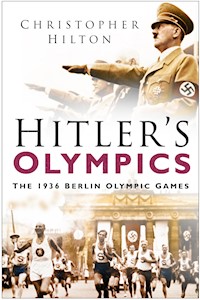
The Berlin Olympic Games, more than 70 years on, remain the most controversial ever held. This book creates a vivid account of the disputes, the personalities, and the events which made these Games so memorable. Ironically, the choice of Germany as the host nation for the 1936 Olympics was intended to signal its return to the world community after defeat in World War I. In actuality, Hitler intended the Berlin Games to be an advertisement for Germany as he was creating it, and they became one of the largest propaganda exercises in history. Two Germans Jews competed in the Games while the most memorable achievement was that of black American Jesse Owens, who won four gold medals. Ultimately, however, Germany was the overall biggest medal winner. The popular success of Owens allowed the Nazis to claim that their policies had no racial element and charges of antisemitism that did arise were levelled at the Americans.
Das E-Book können Sie in Legimi-Apps oder einer beliebigen App lesen, die das folgende Format unterstützen:
Veröffentlichungsjahr: 2011
Ähnliche












ACKNOWLEDGEMENTS
Many people have helped in recreating the story of the Berlin Olympics but I must begin with the German National Olympic Committee – and particularly Bernd Roeder, their legal counsel, and Michael Schirp of the Press Office – for allowing me to use the 1936 Official Report, an immense and extremely detailed document. It acted as a pillar.
William J. Baker of the University of Maine very kindly gave me permission to quote from his book Jesse Owens: An American Life, and, holidaying in England, he provided me with a penetrating, thought-provoking interview.
Margaret Lambert (formerly Gretel Bergmann) allowed me to use the letter telling her she was not selected for the German team and, at ninety-one, was a merry, youthful voice down the telephone from New York City, her home since before the Second World War. She gave a long, heartfelt and utterly candid interview about her life in the 1930s. She also sent a fascinating video of her life and allowed me to quote from her lifestory, By Leaps and Bounds. I have, incidentally, called her Gretel Bergmann throughout for simplicity. Christine Duerksen Sant allowed me to reproduce generous portions of her beautifully researched thesis, submitted to the Graduate Faculty of Wake Forest University, North Carolina, ‘“Genuine German Girls”: The Nazi Portrayal of its Sportswomen of the 1936 Berlin Olympics’. Professor Yasuhiro Sakaue of the Faculty of Administration and Social Sciences, Fukushima University, Japan graciously allowed me to quote from his paper on ‘Sport, Politics and Business’ at the International Committee of Historical Sciences Congress in Sydney, July 2005.
Two duets – if I may use the word – had essentially the same invaluable idea: to let Olympians tell their stories in their own words. Tales of Gold by Lewis H. Carlson and John J. Fogarty carried interviews from American gold medal winners from 1912 to 1984; ‘A Proper Spectacle’: Women Olympians 1900–1936 was self-published by Britons Stephanie Daniels and Anita Tedder under their imprint ZeNaNa. It concentrated, as the title implies, on women. Both duets were happy to let me quote the memories of those who competed in Berlin.
For permission to quote I also thank Chris Rudge, Chief Executive Officer of the Canadian Olympic Committee and their Canada at the XI Olympiad 1936 Germany; Mike Tancred, Media Director of the Australian Olympic Committee for their Official Report; Lee Rogers and Toby Harris for Jews and the Olympic Games by Paul Yogi Mayer; Deborah E. Lipstadt, Dorot Professor of Modern Jewish and Holocaust Studies and Director, Rabbi Donald Tam Institute for Jewish Studies, Emory University, Atlanta, Georgia for Beyond Belief: The American Press and the Coming of the Holocaust, 1933–1945. Jerry Papazian, past president of the University of Southern California Alumni Association, allowed me to use his research on where the oak trees – given as saplings to gold medal winners – are today in America.
Terryl Asla and Matthew Walker of I, Witness to History in Wichita, Kansas were instantly helpful and Walker carried out an invaluable interview with a spectator at the Games as well as sending a little treasure trove of photographs taken by that spectator, Esther Wenzel (then Myers). Velma Dunn (now Ploessel), who won a silver medal in the diving, took me gently down memory lane. So did John Woodruff, who won the 800 metres and remains a man of enormous dignity.
Birgit Kubisch found two invaluable eyewitnesses and interviewed them – Fritz Wandt and Werner Schwieger – and their memories give little human touches which are so evocative. To her, and them, sincere thanks – and equal thanks to my neighbour Inge Donnell for translating all manner of German newspapers and documents.
For help: Jason Black, Daily Courier, Connellsville, Pennsylvania; Malcolm Fare, fencing historian, who took great pains to try and unravel several mysteries surrounding the women’s event in Berlin; The Journal of American History; Terri Wykoff of Frankwykoff.com; Klaus Amrhein of the German Athletic Federation; Heather M. Gillette of Wake Forest University, Winston-Salem, North Carolina; Maren L. Read, Photo Research Coordinator/Archivist at the United States Holocaust Museum, Washington, DC; B.J. Folin of the Swedish Olympic Committee. Michael Salmon, Librarian at the Amateur Athletic Foundation of Los Angeles (aafla) responded wonderfully to every bizarre and obscure problem I threw at him. Randall Northam of SportsBooks Ltd, Worcester, England – an old friend – was generous with whatever background information I requested. Gustav Shrenk, German athletics historian, dipped into his records to find much invaluable information. Simona Rychtecky, Robert Bolton and Ross Arnold of the Olympic Television Archive Bureau were helpfulness and efficiency personified. P.K. Mohan and S.A. and M.A.R. Salazaar sorted out when the Indian hockey team left, opening the way to their journey to Berlin. Stan Salazaar pointed me towards the website www.bharatiyahockey.org, the internet home of Indian hockey where the full text of the evocative The World’s Hockey Champions 1936 by M.N. Masood can be found. I have used it extensively and many thanks to his son, Enver Masud, for permission to quote. The Deutsches Creditbank AG in Berlin are trying to revive the Olympic Village. Barbara Eisenhuth of the Bank helped with information about that and sent an invaluable booklet by VBN Verlag Bernd Neddermeyer GmbH.
I consulted and used the superb archival coverage of the New York Times throughout the book, but especially of their reporting team in Berlin; and also consulted The Times, London, the Daily Express, London and the Los Angeles Times.
The Internet has changed many facets of the historian’s life. To be able to summon instantly such vast amounts of information on even the most arcane and obscure subjects remains slightly breathtaking. The trick for the historians of the future will not just be discovering information for themselves in musty libraries but penetrating the internet mazes and extracting what they want. In relation to this book, you will see to what extent I have used the internet in the footnotes.
Leni Riefenstahl’s monumental two-part film record of the Games, Fest der Volker and Fest der Schonheit (Festival of the People and Festival of Beauty), (Videoyesteryear) remains revealing and compulsive viewing, not least because one can relive some of the great moments as they happened. I used it heavily in some re-creations.
The British Olympic Committee (thanks Amy Terriere) opened their extensive library in London to me, let me loose on their photocopying machine and treated me with their customary kindness.
Thanks must also go to Bow Watkinson, who drew the maps on pages xii and xiii.
MAPS
Map 1. The scale of the Reich Sports Field astonished the world.
1.The Platz where Hitler arrived for the Opening Ceremony.
2.Bell tower.
3.The May Field where the competitors waited.
4.Olympic Stadium.
5.Olympic Platz.
6.Reich Sports Field station.
7.Swimming pool.
8.August-Bier-Platz where the gymnasts practised.
9.The House of German Sport and the Cupola Hall.
10.The Friesenhaus, the living quarters for the female athletes.
11.Hockey stadium.
12.Tunnel to the stadium.
13.Marathon Gate.
Map 2. The Olympic Village was in the countryside to the west of Berlin.
Map 3. The torch run from Olympia to Berlin.
CONTENTS
Title
Acknowledgements
Maps
1.Man at the Centre of the World
2.Poisoned Chalice
3.No Jews or Dogs Allowed
4.Stormy Waters
5.Light My Fire
6.War Games
7.The Führer and the Runner
8.Bitter Taste
9.Last Shot Fired
10.Village People
Statistics
Bibliography
About the Author
Copyright
As guests of honour my daughters and I were deeply moved by the dignity of the commemorative act and by the gratitude that the democratic Berlin feels towards Jesse, because, looking back on the events of 1936 from today’s perspective, the towering figure of Jesse and the admiration for him do eclipse Hitler.
Ruth Owens, 1993, in Berlin 2000 Olympia GmbH
Chapter 1
MANATTHE CENTREOFTHE WORLD
The German nation … provided the world with … its willingness to co-operate in large international projects designed to further universal peace.
Josef Goebbels1
That August day the city of heavy stone, the city with its new god, waited. A million people, held back by 40,000 storm troopers,2 stood twenty and thirty deep all along the 3-mile route. Each of them knew he would be coming in a moment from the enclosed Chancellory courtyard.
At the far end of that courtyard two statues of heroic naked men, one symbolising the Party and the other the armed forces, guarded shallow steps up to the Chancellory entrance. An open-topped Mercedes waited there. Two bodyguards in dark uniforms sat on the rear seat, motionless.
He wore military uniform, knee-length leather boots and the peaked cap designed for him. He wore a golden Party badge and his prized military medal, an Iron Cross.3 As he moved briskly down the steps, the Mercedes door swung open and he stepped in. He stood and remained standing. He knew the power of his physical presence over the millions and as he passed they would all see him, feel that power. The Mercedes moved off towards the courtyard’s double doors at the instant the timetable decreed it should: 3.18 p.m.
A little drizzle had fallen from an overcast sky and, as the Mercedes emerged and turned into Wilhelmstrasse, the road glistened. Four similar Mercedes with more bodyguards followed, making a convoy with a symmetry and a power of its own. The timetable decreed that the journey from here to the great amphitheatre last 32 minutes.
At the intersection with Unter den Linden, a wide thoroughfare whose buildings were draped with flags, the convoy turned left. The lime trees populating the central area between two carriageways had been replaced by swastikas 45 feet high. The crowd began cheering and, in great ripples, gave the stiff-arm Nazi salute. Along the 3 miles a voice echoed from loud speakers set at regular intervals ‘He is coming, He is coming’.
The convoy glided through the Brandenburg Gate, with its statue of a horseman on top, and was out onto the long avenue which stretched – rigid as a backbone, straight as a rod – away through wooded parkland. The avenue was so long it changed names several times, but people called it collectively the Via Triumphalis. It continued to the suburb of Charlottenburg and the amphitheatre.
Every moment brought him closer, every moment the ripple of cheering and saluting travelled with him, and from above the voice echoed ‘He is coming now, He is coming now’.
At 3.45 p.m. the amphitheatre gates closed; there were 100,000 inside.
At Charlottenburg the convoy turned off the avenue, moved towards a platz – deep crowds circling it – and the entrance. The convoy halted, he stepped down at 3.50 p.m. and passed through the entrance: an opened gate. He inspected a battalion of honour, walked briskly under a tall bell tower, passed four field guns ready to fire a salute and onto a vast field of manicured grass. The amphitheatre loomed at the far side of the field.
Two rows of dignitaries and officials waited for him and as he reached them a fanfare sounded in the distance. Now he faced a multicoloured panorama of some four thousand people arranged by nationality, half to one side of the field, half to the other. Some had spent weeks travelling half the world to be here. Some had come an exhausting journey by train, others caught trains quite normally. Some were in large groups, some came as individuals. Some brought pageantry with them: straw hats, naval caps, turbans, blue berets.
At 3.56 p.m. he walked briskly between them. He had 4 minutes to reach the amphitheatre. As he went, the dignitaries – military officers among them – fell in behind him, were towed along in his wake.
Two heroic statues of men holding horses guarded the amphitheatre entrance. Nearby young people in shorts, perhaps a thousand of them, jostled for their glimpse and raised their arms stiff in the salute.
He walked past a stone buttress with a huge iron tripod and crucible on it that would receive the sacred flame. As he descended stone steps, tier after tier of the 100,000 were on their feet raising a forest of arms in another ripple.
He crossed the reddish running track onto the circular grass of the infield. A tiny girl in white proferred a bouquet of flowers. He patted her, accepted it and reflexively she stepped back, gave the salute. He recrossed the track and at 4.05 p.m., as the timetable decreed, ascended to his private box cut into one of the tiers.
He had come.
The rest would be anthems and triumphal music, the hoisting of flags, the tolling of the bell, the march past of the nations who’d waited outside – programmed to last 46 minutes – and speeches.
Then he stood at the centre of the world for the first time in his life.
He held himself erect and said ‘I hereby proclaim open the Olympic Games of Berlin celebrating the Eleventh Olympiad of the modern era’.
The field guns fired, a great host of pigeons representing doves of peace swarmed into the overcast sky and at 5.20 p.m. a runner bearing a torch with the sacred flame entered the amphitheatre, padded towards the stone buttress and the crucible.
The runner lit it.
The most controversial sporting event in history had begun.
Notes
1.The XIth Olympic Games, Berlin, 1936 Official Report.
2.Hitler had his own army, Sturmabteilung (Storm Section). They were also known as the storm troopers and Brown Shirts.
3.Paul Yogi Mayer, Jews and the Olympic Games (London, Vallentine Mitchell, 2004), p. 102. Hitler won the Iron Cross, Germany’s highest award for bravery, during the First World War.
Chapter 2
POISONED CHALICE
The German sports authorities have declared their intention of promoting the racial and anti-Semitic, the pagan and anti-Christian and other political policies of the German Government and the Nazi party … in the selection of the German Olympic team.
American Athletic Union resolution, 1935
In May 1930 people could still speak the language of reason and normality. Adolf Hitler was nowhere near power and nobody except perhaps the man himself could imagine what he would really do if he got it. That month, to emphasise the normality, his autobiography Mein Kampf came out in a new English edition with all the profits going to the British Red Cross Society. That month, too, one of the regular Olympic Congresses met in the principal auditorium of Berlin University, giving the city a chance to lobby for the 1936 Games – the 1932 Games were already allocated to Los Angeles. The Congress comprised a wide group invited by the International Olympic Committee (IOC), the movement’s governing body, and played a consultative role.
The city hosted a banquet in the town hall for Congress members and, there, the Municipal Corporation joined the application, as required by the Olympic Statutes.
The whole impetus created a favourable impression, enhanced by a glimpse of scale and efficiency: 2,000 rowing boats formed a procession on the proposed Olympic course. When the IOC met next, in April 1931 in Barcelona, the application would almost certainly be a formality and the Berlin bidders felt so confident they began to draw up plans to remodel the stadium they already had. They appointed an architect, Werner March, to work on it.
Far from being a controversial choice Berlin seemed a normal continuation of the great tradition stretching back into the very mists of time. Some historians dated the ancient Games to 900 BC, others claimed evidence taking it back several centuries further. Everybody agreed they lasted until AD 393 when the Roman emperor Theodosius banned them because winning had become paramount, inviting professionalism and corruption.
The Olympic idea did not die but remained dormant. In the nineteenth century various sports festivals around Europe included one at Much Wenlock, the scenic town in the English county of Shropshire. There a Dr William Penney Brookes founded an Olympic society in 1850 and campaigned for the Games to be reinstated.
In 1889 the French government wanted to study physical culture, and an all-round sportsman called Pierre Frédy, titled baron de Coubertin, became actively involved. He was already engaged on reforming the French educational system and believed passionately in the virtues of fitness and sport. De Coubertin went on a world tour to see what was happening elsewhere and, towards the end of it, met Brookes. The meeting seems to have been genuinely inspirational.
In 1892, during a lecture at the Sorbonne in Paris, de Coubertin put forward the idea of reinstating the Games and two years later he founded the IOC. He would be its president for four decades. The first Games of the modern era were held in 1896, appropriately at Athens, and thirteen countries sent 311 competitors.
Obeying the original four-year cycle, the next Games went to Paris in 1900 (twenty-two countries, 1,330 competitors) and women competed for the first time, in tennis and golf. St Louis, Missouri proved too far for many to travel (back to thirteen countries and 625 competitors), but the movement grew via Athens in 1906 (breaking and reinvigorating the cycle), London in 1908 and Stockholm in 1912. The 1916 Games were to have been in Berlin but the long shadows of the First World War crept across the Continent. De Coubertin and the IOC harboured the notion that having the Games might persuade the German people towards peace rather than alienate them: Germany, an Olympic stalwart, had sent teams to every Games from their reinstatement. Even when the First World War broke out in 1914, planning continued, no doubt helped by the general belief that the war would be over long before 1916.
Two men worked long and hard to make the Games happen, Dr Theodor Lewald, the chairman of the German Organising Committee, and Dr Carl Diem, the secretary. Lewald had been a central figure in German Olympics for a generation. Who knew, or cared, that his grandmother on his father’s side was a Jew who’d converted to Christianity? Diem, only thirty, was ‘a fine athlete, a scholar, an historian, an enthusiast for classical Greece, an expert on sport and sporting history the world over’.1 He looked like an ascetic university professor.
The war quickly locked into a savage, brooding stalemate between trenches on either side of no man’s land and, all else aside, that brought pressure within the IOC to take the Games elsewhere – America, perhaps, or a neutral European country. De Coubertin hesitated, feeling Germany would have to withdraw first but by 1915 the situation simplified itself – Berlin was now unthinkable. Meanwhile the IOC established its headquarters in Lausanne, physically safe from the buffetings of the twentieth century in neutral Switzerland.
The movement needed a second reawakening, this time at Antwerp in 1920, but the ‘enemy’ countries – Germany, Austria, Bulgaria, Hungary and Turkey – were not invited. ‘Taking on the Games wasn’t easy for the organisers in a country that already faced an enormous rebuilding task. Visiting athletes slept on cots in schoolrooms, but for the most part they accepted the accommodation and many of them even praised the food.’2
The movement grew. In 1924 the first Winter Games, at Chamonix in the French Alps, were added to the Games in Paris (Germany not invited again). De Coubertin, now in his sixties and decorated by a bushy white moustache, resigned as president after Paris and Count Henri de Baillet-Latour, a Belgian who had been a member since 1903, co-founded the Belgian Olympic Committee and helped organise the Antwerp Games, succeeded him. Baillet-Latour, hair receding and a wispy little moustache, looked like a doctor or a bank manager: a sympathetic face of character.
The 1928 Winter Games were held at St Moritz, the Summer Games at Amsterdam. There a team from Germany found acceptance again and quite normally an eighteen-year-old fencer, Helene Mayer, was chosen. She came from Offenbach of middle-class parents. Who knew or cared that her father, a respected member of the community with a general practice, was a Jew? Who knew or cared that her mother was not Jewish? As a young girl she’d liked ballet, riding, swimming and skiing but fencing attracted her more and more, and Offenbach was the centre for it. In 1924, and still only fourteen, she finished second in the German championship and won it a year later. Mayer considered herself German and looked stereotypically so – blonde hair, blue eyes. At Amsterdam she took the gold medal and became rightly famous.
The problem was that some people did know about her Jewish father and, however incomprehensible, they did care – manically:
While the daily German newspapers wrote in glowing terms of the success of the ‘nice, blonde German girl,’ the Jewish papers emphasised the Jewish origin of an athlete eminently suited to making all the anti-Semitic cliches seem absurd. Besides reporting her athletic achievement, the press drew attention to one other event: She had waved a little black, white, and red flag. While conservative newspapers … praised this as an heroic deed, liberal and left-wing papers criticised it as being in poor taste, a pathetic demonstration and a disavowal of the nation’s colors. In … a Jewish paper the incident was dismissed as a mishap: the flag had been forced upon her by one of her fellow fencers. Helene Mayer was described as a ‘simple girl, completely averse to any political activity.’ … At any rate, although Helene Mayer was at the center of public attention, her Jewish heritage was totally ignored by the non-Jewish press.3
Some of the great and good of the day were at Barcelona for the IOC meeting and the attendance reads like a glimpse of a vanished world: counts and generals, doctors and professors, senators and councillors. It is true that human competition – essentially combat – on the scale of the Olympics inevitably produced drama and controversy, but these people in charge of it governed, as they thought, by right because then such people governed everything else as well. They did it on their own terms, calmly, without hurry and with a maximum of decorum. They made their decisions and they enforced them. It was the way the world was before Hitler got hold of it, bringing with it so many enormous pressures. Those pressures would almost engulf Baillet-Latour, humiliate Lewald and torment General Charles Sherrill, a former sprinter himself, from the United States, beyond endurance.
The Official Bulletin of the IOC did not reflect anything like this yet. It radiated precisely the calm and the decorum:
The first point brought forward was the fixing of the venue of the XIth Olympic Games in 1936. [The Italians] General Montu and Count Bonacossa stated that Italy waived their claim for the 1936 Contest at Rome but at the same time begged to be given the Olympic Games later.
Mr [Jules] de Muzsa [Hungary] asked that the Games of 1936 should be held at Berlin instead of Budapest but claimed a meeting at some future date.
Dr Lewald and the Count of Vallellano [Spain] spoke in favour of Berlin and Barcelona.
The meeting proceeded to vote.
Owing to the very small number present at the 1931 Session, and in order to take into account the number of written votes already received, the Committee decided to wait until the answers of the many absent members reached Lausanne.
The vote taken during the Session and those already received were sealed and deposited at Lausanne with the others.
In order to expedite the decision it was agreed to ask for answers by telegram. The IOC were informed of an application from Canada for the XIIth Games in 1940.
The voting was quickly accomplished, especially in those more leisurely times, because the Bulletin was able to report that Berlin received forty-three votes and Barcelona sixteen with eight abstentions. The Bulletin added that the ‘German Olympic Committee has decided to exercise the right of priority reserved to the Country holding the Olympic Games by Article 6 of the Charter and will organise the Winter Games 1936. The venue will be chosen later.’
How could the great and good read the runes? How could anybody? William Shirer, an American correspondent in Berlin and later a celebrated author, wrote that ‘the depression which spread over the world like a great conflagration toward the end of 1929 gave Adolf Hitler his opportunity, and he made the most of it. Like most great revolutionaries he could thrive only in evil times, at first when the masses were unemployed, hungry and desperate, and later when they were intoxicated by war.’4 Who, however, could have predicted that into the 1930s? In 1931 his Nazi movement eyed power without any certainty that they would ever get it, but that October Paul von Hindenburg, a field marshal during the First World War and President since 1925, received Hitler. Within months Hitler would be debating whether to run for the presidency himself.
The German Olympic Committee, led by Lewald and Diem, set to work in July and put a model of their stadium on public display. It was to be situated in the Grünewald, the wooded area to the west of the city, beside a racecourse. Lewald and Diem did it against a political background which had begun to move perceptibly away from normality and the language of reason: German banks closed their doors to prevent a run on the currency and only opened them again when Britain, America and France agreed on renewed credits.
Two themes were running and would continue to run – sometimes parallel, sometimes veering towards each other, sometimes interlocking – until, in the late afternoon of 1 August 1936, they would be locked together forever. Helene Mayer, who concentrated on her fencing and won the European Championships, illustrated one theme perfectly: the self-contained, non-political world of sport. Adolf Hitler, who concentrated on winning Germany, was the other: politics red in tooth and claw.
In November 1931, just eight months after the Games were awarded to Berlin, the Nazi Party won elections in the state of Hesse. Hitler’s hour was coming closer.
A week after the 1932 Winter Games in Lake Placid, New York State, he decided to stand against von Hindenburg for President. A patrician figure with a white, walrus moustache, von Hindenburg dismissed Hitler in a celebrated phrase as ‘that Bohemian corporal’ but received only 49 per cent of the votes (Hitler 30 per cent), forcing him into a humiliating run-off. He polled 53 per cent, Hitler up to 36. Von Hindenburg invited Franz von Papen, a relatively obscure member of the Catholic Centre Party, to become Chancellor and the incumbent, Heinrich Bruning, resigned. Von Papen formed a cabinet with no Nazis in it.
While the second day of the Summer Games was being contested at Los Angeles, in Germany Hitler won 230 seats in the parliamentary elections for the Reichstag, just short of an overall majority.
Two days later Mayer began her defence of the Olympic fencing gold. Described as ‘the beautiful blonde Valkrie of the swords’,5 she moved through her pool to the final stages winning all her bouts. She radiated a great calmness and a certain sophistication, attracted male fencers and habitually greeted everyone on the fencing floor as friends. When California State Governor James Rolph, wearing a white linen suit and a gardenia button hole, arrived and asked her how she was doing she contented herself with pointing to the scoreboard ….
It went wrong in the final stages. She fought Mary Addams (Belgium) in her opening bout and they provided a stark sartorial contrast, Mayer in a white jacket and skirt, Addams in a black pleated skirt and white jacket. Mayer lost and afterwards sat motionless contemplating her defeat, her chin in her hand supported by an elbow on her knee. She ate an orange, thrust the peel under the chair where she sat. She fought Ena Bogen (Hungary) and lost a long, nervous, exhausting bout: 5 hits received to 4. She made her way back to the chair and shrugged her shoulders, perhaps discouraged or disconsolate.
Her pivotal moment came against Ellen Preis (Austria), a great fencer in terms of skill and longevity – she would go on to compete at the Melbourne Games in 1956. Mayer led 4 hits received to 1 but Preis, determined, came back at her and won it 5–4. Preis had the gold, Mayer came fifth.
Diem and Lewald, by now a patrician figure of receding hair and a tuft of white moustache (white moustaches almost obligatory in that vanished era), were in Los Angeles to watch, record and learn. Lewald acted as the official figure taking care of whatever that entailed while Diem, energetic, was everywhere, taking notes and photographs, drawing sketches, even asking the cooks what kind of food the athletes preferred. Lewald and Diem had been sent
with the instuctions to gain all the experience possible with the end in view of organising their own XIth Olympic Games. The Secretary-General of the Reich Commission for Physical Training [Diem] was especially requested to pay attention to the presentation of the Games in Los Angeles in order to derive useful knowledge for the great task facing Germany.
The Organising Committee for the Xth Olympic Games in Los Angeles had made its preparations in a most thorough manner and was able to provide Germany with well-ordered copies of all its printed matter and important documents as well as a comprehensive insight into the work carried out by the various departments, so that a complete survey of the American method of solving this huge task was possible.6
The Games had grown and thirty-seven countries attended, bringing 1,408 athletes (but not including the great Finnish runner Parvo Nurmi, excluded from the marathon amid accusations of professionalism occasioned by over-large expenses on a tour of Germany). Photo finishes were introduced although, wonderfully, the lap counter miscalculated in the 3,000 metres steeplechase and the runners covered an extra lap. A man with a truly glorious name, Volmari Iso-Hollo, won, continuing a strong Finnish tradition and suggesting they would be strong in Berlin, too, but another Finn, Lauri Lehtinen, was thoroughly booed when he twice baulked an American towards the end of the 5,000 metres. And the Brazilian water polo team were disqualified after being thoroughly rude to the referee when they lost 7–3 to Germany.
Purists within the Olympic movement disdain, or try to disdain, the nationalism of medals tables but after Los Angeles they held particular, arguably crucial, significance. The statistics demonstrate it.
Gold
Silver
Bronze
America
41
32
30
Italy
12
12
12
France
10
6
4
Germany (8th)
4
12
5
Any Games without America would be devalued to the point of meaninglessness, which is one way of saying the Germans had to have the Americans in Berlin but, as the Los Angeles Games closed, there was as yet no reason whatsoever why the Americans should not be in Berlin.
Helene Mayer, who intended to join the German diplomatic service, visited Scripps College in California. The German Academic Exchange Service had offered her a two-year grant. She was formal in the German way and at her first meal bowed deeply to each dining table.7
Two weeks after Los Angeles, von Hindenburg lectured Hitler about the activities of his storm troopers on the streets.
In November the German Olympic Committee decided to form a special Organising Committee for the Games.
Von Papen resigned because he couldn’t form a government. In Reichstag elections the Nazis shed 2 million votes although they remained the largest party.
In December initial plans for an Olympic bell were drawn up.
In January 1933 the Organising Committee met for the first time just days before von Hindenburg, confronting a breakdown of law and order as the storm troopers and communists fought daily street battles, appointed Hitler as Chancellor. His ‘immediate task’ was to ‘quickly eliminate’ anyone else holding some power and ‘make his party the exclusive master of the State and then with the power of an authoritarian government and its police carry out the Nazi revolution’.8
Von Hindenburg remained head of state, of course, and accepted patronage of the Games because by tradition heads of state attend the Opening Ceremony and declare the Games open.
The Reichstag caught fire in mysterious circumstances and Hitler moved instinctively to exploit the event, using it as a bludgeon to crush his opponents.
At first he had shown no interest in the Games, dismissing them as ‘an invention of Jews and Freemasons’ and describing them as some sort of Judaistic theatre ‘which cannot possibly be put on in a Reich ruled by National Socialists’. Whether Hitler concluded this because of Lewald’s intimate connection with it – Lewald had a Jewish grandmother, of course – or whether he believed Jews and Freemasons controlled everything beyond Germany is not clear.
Goebbels, however, understood intuitively the potential propaganda possibilities, internal and external, and put it to Hitler something like this: ‘We can make this the greatest advertisement for you and your Germany.’ Goebbels also understood that the Germans had the first organised global press relations triumph within their grasp. He grasped it.
He made Hitler see the opportunity, too. Here was a pivotal moment because soon Hitler’s word would quite literally be law and if he wanted a Games in Germany’s new image he would get one. The normal constraints of personnel, budgets and logistics simply dissolved and, on Hitler’s order, the formidable organising ability of the German psyche applied itself to creating something extraordinary.
The world would travel to what had been, such a short time before, a defeated, broken country – humiliated by the Treaty of Versailles imposed by the victors, ravaged by hyper-inflation so intense that people paid for their meals course by course as the currency devalued while they were eating – and would suddenly find themselves in a land of full employment, confident citizens and faces ruddy with health.
From outside Germany Hitler looked a combination of demagogue and caricature, a fundamentalist of his own religion – which was how Charlie Chaplin would be able to portray him so effortlessly on film – but the staging of the Olympic Games bestowed on him and his government legitimacy in a way nothing else could. They might, even briefly, make him seem benevolent, and Germany, too. Hitler met Lewald and the Mayor of Berlin, Heinrich Sahm.
[He] declared in response to Dr. Lewald’s remarks that he welcomed the allotting of the Games to Berlin and that he would do everything possible to ensure their successful presentation. The Games, he asserted, would contribute substantially towards furthering understanding among the nations of the world and would promote the development of sport among the German youth, this being in his opinion of vast importance to the welfare of the nation…. An official statement printed in the German press informed the nation of the attitude of their Chancellor towards the Berlin Games.
The preparatory work could thus proceed on a firm foundation and it was carried forward with all alacrity in order that a complete plan might be submitted to the International Olympic Committee during its annual meeting at Vienna in 1933.
On the occasion of his conference with the German Chancellor, Dr. Lewald also had an opportunity of speaking with the Reich Minister for Propaganda, Dr. Goebbels, concerning the extent of the project and requested the support of the Propaganda Ministry.9
From this moment the twin themes – sport and politics – flowed towards 1 August 1936.
A week later the Reichstag, meeting at an opera house, passed an Enabling Act allowing Hitler to rule by decree, a terrifying prospect for the half-million Jews living in Germany, 160,000 of them in Berlin where their community dated back to 1295. Violence by storm troopers against them was already endemic. The government ordered a boycott of all Jewish businesses.
Lewald and Diem submitted their publicity plans to Goebbels and he gave consent for a special commission to handle their implementation. Meetings of the various German technical sporting commissions began.
Hitler appointed as Director of German Sports Captain Hans von Tschammer und Osten, a loyal supporter since the early 1920s who knew nothing about sport. His conduct as well as his ignorance ought to have disqualified him. Once a soldier received a beating for failing to salute him. Von Tschammer und Osten, with his hair swept across the crown of his head in perfect place and his neat-fitting uniform, certainly looked like a soldier although he had penetrating, dangerous eyes. His remit was to make young people mentally and physically fit to serve the Führer.
‘German sport has only one task,’ Goebbels said; ‘to strengthen the character of the German people, imbuing it with the fighting spirit and steadfast camaraderie necessary in the struggle for its existence.’ His statement remains a grotesque perversion and misuse of sport as well as the crudest violation of the Olympic spirit – if Josef Goebbels, club-footed serial adulterer, fanatic and distorter of all reality had ever heard of such a thing.
Von Tschammer und Osten was also appointed President of the German Olympic Committee. Lewald had earned international respect and his effective downgrading would provoke widespread misgivings about Germany so he remained as a consultant with the official title of President of the Organising Committee, by its nature a temporary post ceasing with the end of the Games and quite distinct from the presidency of the German Olympic Committee which von Tschammer und Osten held on to so tightly.
The Nazi government knew Lewald had his uses as a figurehead and that, having devoted so much of his life to these Games, he would do nothing to endanger them. They were compromising their rabid anti-Semitism by retaining him at all, a testimony to the forces now in play. What happened next demonstrated that. The Nazi government did not compromise over ordering all athletic organisations to be Aryan-only. That cast the leading Jewish athletes into the wilderness because the organisations had to expel them.
April was a cruel month. Thousands of Jewish bank accounts were seized, all non-Aryan officials dismissed and all Jewish teachers in Prussia deprived of their posts.
May was another cruel month. Trade unions were banned, their headquarters occupied and their leaders roughly handled. Some went to concentration camps. The Nazis began dabbling in eugenics, banning Jewish–Aryan marriages. Communist property was seized. Any books considered un-German were heaped onto a pyre outside the Humboldt University at the far end of Unter den Linden and burnt. A Race Council was established to search out mixed marriages and try to make sure Aryans married Aryans.
The shock waves reached Lausanne very quickly.
In June the IOC met in Vienna and Baillet-Latour gave a history of the negotiations that had taken place since Hitler came to power. He explained what the German delegates to the IOC had been saying, in order to be ‘quite sure that the guarantees given by the Government in power in 1931 … could be considered as reliable, and that the application of the Olympic Rules dealing with the Committee of Organisation and the qualifications of participants would be scrupulously observed even though certain of our International Rules should seem to be inconsistent with recent orders laid down in Germany’.
Of necessity the IOC had to remain as far from politics as it could in a political world and it had a power of its own: If you do not like our rules, you don’t get the Games. You must understand that we make the rules, not you. The movement would not have survived if it had adopted any other approach. When a Games is declared open the Olympic sites come under the control of the IOC for the duration and their rules apply. Hitler would discover this twice – once at the Winter, once at the Summer Games – and he would have to compromise. It may well be, at a personal level, these were the only times between his seizure of power in 1933 and his death in a bunker in 1945 that he actually did anything somebody else told him to.
The question of Jews in Germany was much more delicate and complicated. The IOC did not concern itself with a country’s domestic laws unless they impacted on the Games. The banishment of the Prussian school teachers would be greeted by silence in Lausanne. The banning of Jewish athletes from their own clubs which, de facto, rendered them unable to train properly for the Games was quite different.
The Americans watched with mounting misgivings. The Jewish community in America had voice and influence. Would America send a team to a country which legally discriminated against Jews in the crudest, bluntest and most violent way? The weight of the Los Angeles statistics lay heavy: the Americans had accounted for 41 gold, 32 silver and 30 bronze medals – too sizeable a percentage to ignore.
Baillet-Latour, and the great and good around him, had no idea what was coming and if the German delegates kept offering assurances, what else could they do but accept them?
[Baillet-Latour] paid tribute to the Olympic spirit and to the loyalty of the German delegates who … had succeeded in putting matters sufficiently in order in time to allow the following statement to be published today:
The President of the International Olympic Committee asked the German delegates if they would guarantee the observance of the articles in the Charter dealing with the Organising Committee and the Rules of Qualification.
On behalf of the 3 Delegates, His Excellency Doctor Lewald replied that, with the consent of his Government,
1The German Olympic Committee has delegated the mandate, which had been entrusted to it, to a special Organising Committee as follows:
Dr. Lewald – President
Duke of Mecklenburg-Schwerin – Dr. Ritter von Halt
Herr von Tschammer – President of the German Olympic Committee
Herr Sahm – Mayor of Berlin
Herr Diem – Secretary of the German Olympic Committee
2All the laws regulating the Olympic Games shall be observed.
3As a principle, German Jews shall not be excluded from German teams at the Games.
After this declaration Mr. [William May] Garland wished to have it known that the American Olympic Committee who were desirous of having the United States strongly represented at the next Olympic Games in Europe would have had to give up participation altogether if German Jew Athletes had not been assured the same terms as members of the same faith in other countries. General Sherrill added that the satisfactory statement made by the President would give great pleasure in the United States.10
Lewald made a report, fleshed out by Diem, on the preparations. One extremely important decision concerned the actual dates of the Games, which were set at the discretion of the German organisers. ‘Following a careful study of weather charts and investigation of other circumstances, we chose the period between August 1st and 16th…. We were thus prepared to submit a printed memorandum dealing with the general programme, centres of competition and information on the accommodation for the athletes … this meeting with its complete approval.’11
Professor Jigoro Kano, representing Japan, hoped that an Olympic Village would be organised because of its importance for teams ‘sent by distant countries’. Lewald explained that the Village was intended to be in military barracks at a little rural place called Döberitz. The barracks, about 20 kilometres from the stadium, were new and comfortable and intended to be in service after 15 July 1936.
The Bavarian resorts of Garmisch and Partenkirchen were awarded the Winter Games in the February, the exact date to be decided.
The twin themes reached out and touched a vivacious nineteen-year-old in the little town of Laupheim, near the city of Ulm in the south. She was called Margaret Bergmann, nicknamed Gretel, and all her life she adored sport. She started early at Laupheim’s sports club, competed from the age of ten and developed into a high-jumper so promising that by 1931 she needed specialist training. She dreamed of the Games quite normally, as so many others did.
Bergmann came from a prosperous Jewish family, something else quite normal because Jews had been merchants, industrialists and craftsmen in Laupheim for a hundred and fifty years. A completely assimilated community of some three hundred people, they defined themselves as Jews and were seen as Jews, but it never mattered. They were all Germans.
Bergmann did not receive a religious upbringing. She spent three years at a Jewish elementary school then moved to a municipal secondary school. She applied to the German College of Physical Exercise in Berlin, which accepted her. They withdrew their acceptance when they discovered she was Jewish. On 12 April, her nineteenth birthday, the Ulm sports club of which she was a member expelled her. During a business trip to London her father Edwin made enquiries about her studying there. In October she went to the London Polytechnic on a language course; the Polytechnic did not hesitate to recruit one of Europe’s leading high-jumpers to their team.
In July the German Olympic organisers drew up a new constitution and a plan to finance the Games, but Hitler rendered all that irrelevant. In the autumn he decided to have a look at the new stadium, taking with him Reich Minister of the Interior Wilhelm Frick and von Tschammer und Osten. Hitler inspected models of the new buildings, the remodelled stadium and the entire area. He asked
why the necessary enlargement of the stadium to a capacity of 80,000 spectators was to be achieved through increasing the depth of the stadium rather than expanding it. Dr. Lewald explained that according to the lease contract with the Berlin Racing Association the stadium might not extend over the racecourse or obstruct the view. This led to the second question as to whether the racecourse was essential, to which Dr. Lewald responded that he did not believe this to be the case since Berlin already possessed two … and the Grünewald course had been operated during recent years at a great loss. The German Chancellor then made the significant decision that the racecourse must disappear and if necessary be reconstructed at another location, while the entire Grünewald premises should be given over to the construction of a sporting centre. The Chancellor expressed the wish to have a large open-air amphitheatre included in the construction programme.12
He intended to construct a monument to his Germany which would last a millennium. If he felt the racecourse obstructed this he had no need to consult anyone, even the owners. If he wanted an amphitheatre on the site instead, accommodating 100,000 spectators, that is what he would get. Werner March was commissioned to do sketches for the new project which was to extend over an area of 325 acres. Diem, who was abroad, was summoned back by a telegram to help. They worked fast.
Five days after Hitler’s inspection he told a meeting – Goebbels and Secretary of State Hans Pfundtner among those attending – that because ‘practically all the nations of the world’ would be at the Olympics the ‘New Germany must provide evidence of its cultural accomplishments and ability’. In addition, Berlin needed ‘spacious facilities for the assemblies and traditional festivals which are an important feature in Germany’s modern development’. Was there anywhere better than the racecourse?
Lewald said he didn’t think so.
Hitler decreed that the Games required a lot of the land under lease by the racecourse and it would be taken over. The owners were offered compensation.
At that moment, the 1936 Olympic Games found their home.13
March brought Hitler a topographical map and showed him an area big enough to accommodate half a million people for assemblies, festivals and processions. Hitler was pleased, but a curious problem arose: that of symmetry. If they abandoned the old stadium and sited the new one 150 metres away it would be parallel to the rod-like avenue from Unter den Linden out to Charlottenburg and the countryside. Hitler liked symmetry and said do that.
The new stadium could be built vast enough to accommodate however many spectators Hitler wanted. No doubt for further reasons of symmetry – and practicality, because every spectator had to be able to see the events – the number 100,000 felt right.
March broached the subject of a gigantic Olympic bell to toll the beginning and end of the Games, and do so from a bell tower so tall it would be visible from many points in the city.




