


Erhalten Sie Zugang zu diesem und mehr als 300000 Büchern ab EUR 5,99 monatlich.
- Herausgeber: The History Press
- Kategorie: Sachliteratur, Reportagen, Biografien
- Sprache: Englisch
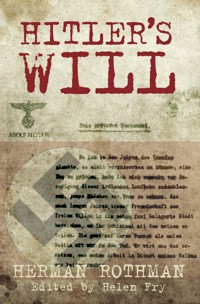
Herman Rothman arrived in Britain from Germany as a Jewish refugee in 1939, on the eve of the Second World War. He volunteered for HM Forces, serving in the Intelligence Corps, and in 1945 was posted to Westertimke and Fallingbostel prisoner of war camps to interrogate high-ranking Nazi war criminals. When papers were discovered sewn into the shoulders of a jacket belonging to Heinz Lorenz, who had been Joseph Goebbels' press secretary, he and a team of four others were charged with translating them under conditions of the deepest secrecy. The documents turned out to be the originals of Hitler's personal and political wills, and Goebbels' addendum. Later, in Rotenburg hospital, Rothman interrogated Hermann Karnau, who had been a police guard in Hitler's bunker, to establish information about the Fuhrer's death. 'Hitler's Will' is the amazing true story of Herman Rothman's remarkable life, including how he managed to escape from Nazi Germany before the War began, and his role in bringing to light Hitler's personal and political testaments.
Sie lesen das E-Book in den Legimi-Apps auf:
Seitenzahl: 361
Veröffentlichungsjahr: 2011
Das E-Book (TTS) können Sie hören im Abo „Legimi Premium” in Legimi-Apps auf:
Ähnliche

















Dedication
This book is dedicated to Herr Belgart,
the police inspector in Berlin who saved my family’s life.
A truly ‘righteous Gentile’
Acknowledgements
My brother and I are only too aware of how much we, our extended family and countless others, owe to the courageous figure of Herr Belgart, a truly ‘righteous Gentile’, to whom I have dedicated this book. Although this book charts part of my life it also refers to his deeds and the effect it had on our lives. Without being over-dramatic, would we have survived without his help?
During my life I was very fortunate to acquire genuine friends like Harold Campbell, Joe and Olive Banks and Dr Wallach, a graduate of Heidelburg University, my landlady. She provided me with home comforts when on leave from the army and, in some instances, acted inloco parentis. Again I pose the question, how much did they shape and influence the pattern of my life and values which I in turn passed on to my children? To the late Mr and Mrs Bergenthal and their son Alec, my everlasting gratitude for their open house and unstinting hospitality extended to me and the ‘boys’.
Since my retirement I have been putting thoughts to paper, but a chance meeting with historian and author Dr Helen Fry encouraged me to collate and write my experiences. Because of her cheerful support and gentle prodding, tolerant and kind disposition, she made my task easier. To her my ever grateful thanks for her editorial skills and work in the production of this book, and with special tribute to her charming family for their love and forbearance. Helen was the catalyst who introduced my idea of the book to Sophie Bradshaw at The History Press. Sophie trusted and accepted her judgement and commissioned me to write this autobiography. Thanks also to Peter Teale for his enthusiastic support and interest in my story. I am grateful to the editorial team at The History Press for publishing my book to such a high standard.
Two other people deserve special thanks in the process of this book: my sincere thanks go to Betty Fifield who transcribed several hours of interviews from discs, and also Alexia Dobinson for typing up hours of material which could not be retrieved from my computer.
My appreciation to the late Mona Drake whose friendship and brotherly love helped us both sustain many times and years of great hardship, and to the late Doris Drake, his first wife, and their children who were and are part of my family. And to Ruth Drake and the late Melvyn Reginald Sheridan (Mendel), whose friendship spanned a lifetime. My everlasting thanks to Shirley and the late Raymond Rudie for their love and friendship. Raymond was my loyal friend, lawyer and tennis partner for over half a century. To my dear friends Audrey and the late Frank Cass, publisher, who over many years of loyal and loving friendship, encouraged me to write my autobiography. He introduced and published the Essex Jewish News, to which I contributed fairly regularly over many years. My thanks to Anne and Jerry Goldstein for their long-standing friendship, loyalty and support. To our lifelong friends, Bernard Pearlstone, artist and tennis partner, and Maureen his wife, for their support and enduring friendship, and to my many other friends who over the years have contributed so much to Shirley and me.
My sister-in-law and brother-in-law, Ruth and Bobby Cohen, and Maxine, Hayley and Andy and Ben Newman, for their unstinting love and loyalty. Also my sister-in-law Molly and brother-in-law Piloo Davicha, and nieces Tina, Heidi and Anna and their children.
My everlasting love to my brother Saul, to his wife Miriam and my nephews Evyatar, Amihud and Noam, their wives and children. My sincere thanks to Saul for providing me with additional material for this book. And to my beloved grandchildren: Hemi, Hanan, Boaz, Zachy, Gabby and Yael, for whom this book is a testament of survival.
My heartfelt love and thanks to my dear children Janice Leberman and Jonathan Rothman, and to my dear son-in-law Jay and daughter-in-law Liza (Elizabeth). Their love, support, patience, humour, help and encouragement have sustained me and Shirley.
With everlasting thanks and gratitude to my dear wife Shirley. I wrote this book with her love, guidance and patience. It took a year of solid work which we completed together, thanks to her typing skills and critical reflections. We laughed and shed tears together in the process. Both Shirley and I are grateful to our parents for providing us with ethics and principles which guided us throughout our lives.
CONTENTS
Title
Dedication
Acknowledgements
Forword by Dr Helen Fry
1.Early Childhood
2.Living Under the Hitler Regime
3.Emigration and a New Life in England
4.Enlisting in the British Army
5.Westertimke and Fallingbostel
6.Hitler’s Will
7.Intelligence and Interrogation Work
8.Civilian Life
9.Perry Broad and the Auschwitz Trial
10.How my Family Survived
Postscript: Learning from History?
Appendix I: Hitler’s Political Will
Appendix II: Hitler’s Personal Will
Appendix III: Goebbels’ Addendum to Hitler’s Will
Bibliography
Plates
Copyright
Foreword
by Dr Helen Fry
The title of Herman Rothman’s autobiography, Hitler’s Will, has a double meaning. It tells the story of Herman (Hermi) Rothman, the last surviving German-speaking interrogator in the British Army who was part of the team that found and translated Hitler’s political and personal Will, along with Goebbels’ addendum. But Hitler’s Will is also about the great fight of a family for survival against Hitler’s will to kill all the Jews, including them. Hermi’s interrogation work at the end of the war meant that he discovered and exposed many of the Nazis’ darkest secrets including the documentation from Perry Broad, a German corporal, who confessed in detail to how the Auschwitz concentration camp was run. The document created and interrogations done by Hermi, as well as his testimony in court at the Auschwitz Trial in 1964, led to the conviction of several SS concentration camp staff. But Hermi’s story goes far deeper than one man’s extraordinary work in Germany with British counter-intelligence at the end of the war. It is a Holocaust memoir of a family separated by the Nazi regime, its survival against all odds, and its reunion after fifteen years.
Hermi was born Hermann Rothman in Berlin in 1924. Less than ten years later, Hitler came to power in Germany. Like all German Jews, Hermi’s family was at risk. In the coming years their future changed beyond their imagination and eventually the whole family had to flee the Nazis. Hermi himself was one of 10,000 children who came to Britain on the Kindertransport just before war broke out in September 1939. When he was old enough to enlist, he volunteered for the British Army and was part of another 10,000 refugees from Nazism (not all Kindertransport) who served in the British forces during the Second World War. The wider background and story about these veterans has been told in detail in my book The King’s Most Loyal Enemy Aliens: Germans who Fought for Britain in the Second World War.
While Hermi had escaped with the Kindertransport, back in Germany his father, mother and brother were forced to go on the run from the Nazis. Woven into this heart-rending tale is the selfless dedication of one family friend, Herr Belgart, a non-Jewish Police Inspector in Berlin, without whom the family would not have survived. At every point, he forewarned them of impending danger and arrest. He informed the family of the imminent deportation of Polish Jews from Berlin in October 1938, and a few weeks later, when Hermi’s father was sent by the Gestapo to Sachsenhausen concentration camp, Herr Belgart spent eight months trying to get him out and eventually secured his release. He then helped Hermi’s father to get out across Germany before the Gestapo had a chance to re-arrest him. Hermi has dedicated his book to Herr Belgart who did not think twice about risking his own life and position to save members of the Rothman family. Without him, they would not have survived the death camps. Sadly, Herr Belgart did not survive the war, but was killed in the Allied bombing of Hamburg in 1943.
The war in Europe officially came to an end on 8 May 1945, VE Day. Hermi had the satisfaction of witnessing the total defeat of the regime that had caused his flight from Germany in 1939 and so much suffering to his family. Germany had accepted unconditional surrender and much of the country lay in ruins. As the Allies were beginning the enormous task of de-Nazifying and rebuilding Germany and Austria, and shaping postwar Europe, Hermi was posted with the 3rd British Counter-Intelligence Section to Westertimke and then Fallingbostel. It was at the German POW camp in Fallingbostel that Hermi’s interesting intelligence work began. He and a handful of fellow German-speaking refugees in the British Army were involved in the interrogation of suspected Nazi war criminals, as well as high-ranking Nazis who had been close to Hitler, including Hermann Karnau. It was at Fallingbostel that one of Hermi’s colleagues found Hitler’s political and personal Will and Goebbels’ addendum sewn into the sleeve-lining of the jacket of POW Heinz Lorenz, who was Goebbels’ press attaché. That discovery led to Hermi’s unit, under Captain Rollo Reid, translating the valuable documents behind closed doors. Coming into close proximity with men suspected of horrendous war crimes was never going to be easy, but returning to Germany in British Army uniform, Hermi was desperate to demonstrate the order of law, to uphold human rights, and show that despite the personal trauma of the Hitler regime, he could be above the lure of revenge. Today, his desire is that we should all learn from history and not repeat the errors of the past. I commend his courage in writing this book, and in so doing confronting some of the most painful parts of his past. I have met frequently with Herman and Shirley and know how deeply the scars remain within. In recording his story for posterity, he has added a vital piece in the jigsaw of Holocaust oral testimony, against those who would deny the Holocaust ever happened or that it was not as horrific as portrayed by Jews today. Hermi is a man of integrity, devoted to his wife and family, whose gentle humility sometimes hides a truly extraordinary person.
1
Early Childhood
Almost from birth I thought I was different from anyone else: neither better nor worse. Just different. Why? It had nothing to do with being Jewish. Were my thought processes dissimilar from others? How could I know at such a young age, but as a child when my parents gave strict orders of ‘do this’, or ‘don’t do that’, I invariably followed them up with the question ‘why?’ Then when I started to analyse and dissect utterances which were common to everyone, I thought this strange. Were my parents unlike everyone else? Yes, in my opinion, totally. Understandably, therefore, this supported my original belief of being different.
My father Eisik (later known as Erich) Rothman was born at the end of the nineteenth century in Przemysl, Galicia, then part of Austria. He came from a large family of successful horse traders. At the outbreak of the First World War in 1914, his elder brother was conscripted into the Austrian army. As was common in those days my father, being the younger son and next in line, took his place. Assigned to the Uhlans he was quickly promoted and became a Zugfuehrer (cavalry officer). I was born Hermann Rothman in Berlin in 1924, ten years after the outbreak of the First World War, but as a young boy I loved hearing about my father’s many colourful and dramatic episodes in his army career during the ‘lost war’, as it was often called. My father always worked hard and unfortunately had little spare time to relate more and more of his rousing stories. Nevertheless, during my childhood, he described his adventures in fits and starts. My mind was gradually filled with these tales of a glamorous cavalry officer saving the Austrian army from defeat. I remember vividly the story about his entry into the cavalry. He was well used to riding a horse without a saddle, such that the change to a more formal military practice presented extreme physical difficulties for him. Getting off a horse was literally ‘a pain in the arse’. He confessed that for some days he was forced to walk bow-legged and suffered from painful saddle sores. He became a temporary figure of fun to both his comrades and his family.
Some of his wartime stories had a human touch. Captured by the Russians and incarcerated in a camp somewhere in Georgia, he told the fascinating story of his escapades as camp dentist. Several fellow prisoners complained of toothache, so he gallantly offered his services as dentist. He acquired a set of ‘instruments’, consisting solely of a pair of pliers, and proceeded to remove the offending teeth. His fame soon spread through the camp and also penetrated the wire to the Russian guards. After that, every morning before daylight a queue of suffering inmates with a variety of dental and orthodontic problems waited for my father. He quickly reduced their pain and suffering with his one and only cure of removing the source of the problem (as he saw it) – by using his valued tool, his pair of pliers, which, I understand, he always plunged into boiling water before attending to the next patient. Payment mainly consisted of food or cigarettes which he shared with his comrades. He soon tired of this and planned his escape.
As he was regarded as the camp dentist, he now had access to the perimeter of the camp and to areas which were formerly out-of-bounds. During this time he secreted the extra food which he had received in payment and hidden it in readiness. Bartering cigarettes and food for civilian clothes, he also acquired a map and other essentials needed for his escape. When the weather turned he changed his clothes, slung his rucksack on his back and walked out of the camp. His main asset, ‘treasure’, was his command of several Central and Eastern European languages which included Russian, Yiddish, Polish, Hungarian, Romanian and his native language German. It was an arduous journey by foot, horse and train, crossing rivers and other difficult terrain. On the journey home he encountered what he called ‘an extraordinary Jewish Community’. It was the Jewish festival of Passover and they invited him to spend the first days of the festival with them. On the eve of the first day of Passover his Jewish hosts re-enacted the exodus from Egypt by wearing Bedouin-style clothing and carrying knapsacks. When they came to the story of the crossing of the Red Sea in the Haggadah (the book containing the narrative of the flight from Egypt), they performed the ritual of crossing the water. Before starting the festive meal, Eisik’s hosts passed the plate containing the matzah (unleavened bread) over the heads of all present. These very hospitable people insisted that he spend the whole week of Passover in their home.
Homeward bound, he eventually made it to the Austro-Russian line where he was assigned to the infantry. The loss of life in the cavalry regiments was excessive and therefore a large number of remaining units were disbanded, including his former Uhlans. Using his own words, ‘life was for a short while uneventful’, except that on one occasion all lines of communication failed and they had to resort to the old methods. My father volunteered. He took off on horseback carrying an important dispatch. Spotted riding through the lines he was shot at with rifles and machine guns but miraculously survived after finding shelter in a glade. He continued his journey but again came under fire, this time being slightly wounded. Eventually reaching safety, he delivered his message. His feat was recognised by the award of a medal. For a time he acted as a courier, but the losses were colossal and again these riders were dispensed with. Fighting in this area was very fierce. The Russians advanced and took further prisoners, among them my father. Once again he was captured and imprisoned in a POW camp. This time he was not quite so adventurous. It was a bleak period. He had had enough of fighting and being confined; he pined for home. His mind was once more preoccupied on escaping. The knowledge of languages again came to his assistance. Within the camp he was given responsibilities as a translator which gave him access again to premises outside the fence. Circumstances were similar to his first internment and he prepared to bid the camp farewell. When the time was ripe, he took his few belongings and set off home.
By now the war had entered its last stages. Like his compatriots my father had lost the fire to continue fighting. He confided to his parents his wish not to return to his regiment. They suggested that he should make his way to Germany where his stepsister’s husband had a lucrative leather manufacturing concern. Decision made, he took his uniform to the River Sarne and threw it in. Even before he jumped on the train, the Armistice had been declared. German and Austrian forces had disintegrated. The victors were setting out demands which would affect the course of European history in ways which could not have been anticipated at the time. In the Treaty of Versailles Germany was forced to pay huge reparations and forbidden to amass armed forces of above 100,000 men. The Rhineland became a de-militarized zone. The economic repercussions of the Treaty of Versailles were to be felt for at least the next decade. Very much later, my father reminisced and said that it could be argued that Austria was made the scapegoat. Austria suffered more than any other nation in this international conflict. The Austro-Hungarian Empire was completely demolished, more children died in childbirth than in any other country and the population suffered poverty and degradation. Recreating Poland and annexing parts of Austria to Poland caused a visible drop in living standards.
My father finally arrived at the Alexanderplatz station in Berlin where he was embraced by his eldest stepsister. She was a slim woman of medium height. She took him to her apartment in the Lothringerstrasse 69, where his brother-in-law Herr Josef Krause was waiting. Herr Krause, a short man with a slight limp, welcomed him into their home. Father never expected charity – what he received he paid back manifold. He stayed with his relatives for a short period and learned the leather-manufacturing business. Often he related his experiences and thoughts when first stepping off the train at Alexanderplatz. Coming originally from a provincial town in Poland to the fashionable cosmopolitan capital of Berlin of nearly four million inhabitants made an overwhelming impression on him. He stepped forward into a new and different era. In the town he had left behind, motorised vehicles were seldom seen. In Berlin they were more numerous. Droshkies (horse-drawn carriages) and horse-drawn trams were the main mode of transport in his hometown. In Berlin, where the roads were much wider and cobbled, there was the odd mixture of motorised vehicles and horse-drawn carriages, which somehow seemed to harmonise. They blended into the general bustling traffic and crowds of people, all of which camouflaged extreme poverty. Still to be seen were disabled ex-soldiers begging for food and searching for employment. The majority of Germans felt despair, compounded by the knowledge of having to repay the victors of the war immeasurable sums in reparations. This hangover persisted during the postwar period and was quoted by many as an excuse for the election of Hitler to power in Germany in January 1933. Has it ever left the German mind and soul?
Unemployment was aggravated by the considerable number of Germans trained purely for the military. No employment could be found and they were thrown on the rubbish heap. The search for ideological answers prompted the increase of Spiritualism, which was not confined to Germany but popular also in the Allied countries.
The relationship between my father (who was in his twenties) and Herr Krause became strained and my father found employment with a firm in a similar trade. Being good-looking, hard-working and conscientious, he soon attracted the boss’s attention who thought he would make a suitable match for his daughter. He introduced him to blue-eyed, dark-haired, fashion-conscious Betty. They said it was love at first sight and within a short period they were married. I was born nine months later on 2 September 1924.
My Opa (grandfather), Samuel Rappaport, a devout Jew, made his new son-in-law a business partner. My father rapidly took over the running of the business, enabling my grandfather to retire with grace. Opa visited us daily and enjoyed baking, and every Friday brought us cholla (the platted bread for the Sabbath). I spent a lot of time with him. He exercised great patience with me playing cards, dominoes and other games. Often he took me to synagogue and when the time came for the priestly blessing to be recited during the service, I remember stepping with him onto the rostrum (central platform) and he lovingly covered me with his long tallis (praying shawl). Because of his age, his beard and his demeanour he was nicknamed the Cohen Gadol (High Priest) and was greatly revered by the community. My Oma (grandmother), Gina, a cultured elegant grand-dame, sadly died when I was five years of age. Mistakenly diagnosed, she was given the wrong medicine and she unexpectedly died. We were all totally shattered by her death.
My parents took up residence in an apartment in a suburb of Berlin: Berlin Lichtenberg. They bought a shop and business premises on the opposite side of the road. We had a live-in maid from Pomerania, who looked after me, cooked and cleaned, while my mother helped my father in the business. My mother Betty, who was born in Leipzig in 1901, had four brothers: Leo, the eldest, was a talented artist who lived nearby. To be an artist was not always lucrative and, at times, he was forced to supplement his income by painting and decorating; Aron, known to everyone as Arthur, was the second brother, the intellectual one who dealt in ball-bearings. At five o’clock in the morning before work he would rise, learn English for an hour and then study philosophy for another hour, particularly Jewish philosophy; Lezer (Eliezer), the next brother, married to Regina, worked as a comptometer operator for Die Juedische Rundschau (the leading Jewish weekly newspaper); and last, but by no means least, came Pinkas who was a teenager, more of a friend than an uncle to me. He reached national standards in Greco-roman wrestling.
I was born in the period shortly after the shocking inflation, which apart from unemployment caused numerous bankruptcies. Somehow or other my father managed to survive. He made Hosentraeger (men’s braces) and he survived. After all, in those days, every man needed braces to hold his trousers up. Aware of being the only child, grandchild and nephew in this extended family, it became very apparent that I was totally spoiled. This I accepted with grace and dignity. My parents decided to buy a car and I had to accompany them to the showroom. Given the honour to choose between a Chrysler Essex or a Chrysler Plymouth, I opted for the Plymouth. Without hesitation my father bought it.
Father, mother and I set off for Colberg, a beautiful and popular spa on the Baltic Sea. After a few days my father had to return home to attend to his business. While my mother and I were having coffee and cake, listening to music at the bandstand, friends of my parents appeared. They mentioned that their six-year-old son was staying for a further week at a special children’s holiday camp. As I knew the boy, my mother suggested that I might like to join him since she had to return home to help my father. Arrangements were made and she left me behind. On reflection, I was totally justified by being devastated and showed great displeasure by crying continuously for two whole days. The management had no option but to phone my parents. ‘Come and collect your distressed child immediately’, they were told. My poor father drove through the night at great speed and arrived tired. I feared he would be cross with me, but the opposite proved the case. Reassuringly he put his arms around me, kissed me and apologised. We drove back leisurely, stopping for my favourite marzipan, ice-cream and chocolate.
Looking back on this episode in later life, I concluded that the psychological effect had never really disappeared. I cannot recollect having left my parents overnight again until two or three months before my departure for England. In mid-July 1939 (in my fourteenth year) I remember well a debate between my parents and me prior to my leaving our home for Britain – whether I would be able to cope and survive by myself without them. I gave them the assurance that by now I was older and wiser, that I would be going with friends and after all, we hoped that it would only be for a short period.
During the difficult economic and political changes of the late 1920s, people were affected in different ways. To some it was shattering, to others bearable; some felt lost, while others modified their political balance depending on the strength and character of the individual. In 1928–9 my father seemed to manage relatively well and was able to adjust to the transition. However, the almost total collapse of the economy, including the Reichsbank a few years later, brought bankruptcy for my father. Almost immediately my parents started up business again in my mother’s name. They worked day and night to keep it afloat.
In 1933 stability returned to Germany and the demand for manufactured goods rapidly increased. We re-employed our former staff and took on new outdoor workers. On one level prospects looked better, but political events in Germany at the start of that year heralded an era that would turn Europe upside down once again, and with it the fate of European Jewry – my family being no exception. Events would overtake us, such that it became a matter of survival. We, as Jews, would be singled out as enemies of the state.
2
Living Under the Hitler Regime
In 1934 there was a new addition to our family with the birth of my brother Sigbert. It had a revolutionary impact on my life. It pulled the rug from under my feet. Relatives, friends and visitors to our home now made a beeline for the baby, totally ignoring the established prince. Gradually, normality returned at home. I entered the Mittleschule (school) in the Grosse Hamburgerstr. I was a keen athlete, played football, continued my violin lessons and spent time with my newly acquired friends. Meanwhile, a different story had been unfolding.
On 30 January 1933, Adolf Hitler came to power in Germany, something which promised stability, restoration of national pride and employment for the masses who had been struggling and had suffered total humiliation in the years following the First World War. But it spelt trouble for Germany’s Jews, and within five or six years for the rest of European Jewry. There is no doubt that the National Socialist Party (NSDAP) was prepared for government a long time before they were elected. This is reflected by the enormous amount of legislation passed immediately after they came to power. On 2 February 1933, two days after Hitler’s election as Chancellor, a law was passed forbidding general demonstrations. It was no longer possible to offer a voice of resistance publicly against the new government. To do so was to risk one’s life. Three weeks later, on 22 February, the Reichstag (German parliament) in Berlin was on fire. Rumours circulated that it was a deliberate plot by Hermann Goering to provide Hitler with an excuse to round up political opponents and ban the communist press. That was never proven, but no matter, political opponents were immediately identified and sent to Dachau, the first of Hitler’s concentration camps, located 7km north-west of Munich. Legislation after legislation subsequently followed; too much to enumerate. On 14 July 1933, all political parties bar one were outlawed. On 22 September the following organisations were set up under the auspices of the Reichskulturkummer (Ministry of Culture): the Reichsschriftums, Reichstheater, Reichsfilm, Reichsmusik and Reichspressekammer. The reaction to all this legislation was at first bewilderment. But Germans need order, and they saw in all this new legislation confirmation that the government was taking concrete steps in this direction. Germany was gradually being turned into a nation of conformity, with civil liberties denied, especially for the Jews, and individuality bound to the ‘glorious Reich’ which controlled everything.
In the early days of Hitlerism people felt uncomfortable but not threatened. Some believed that it would blow over, others watched with concern, with only a small group believing it imperative to ‘get out immediately, if you can, and don’t take a chance’. They had the gift of prophesy. Jew and Gentile clients felt safe to express their political opinions in my father’s premises. Some were extreme and some moderate. My father was always discreet and listened. Even the most innocent comments, my parents agreed, could be subject to interpretation and considered dangerous. Similar rules applied at school. Teachers avoided politics at all costs. It proved difficult and almost impossible, especially in history classes. The unwritten code: ‘Tread carefully but safely’ was adopted by those who taught and those who listened.
Very early in 1933, I was in my father’s workshop where three of my uncles were present. A political discussion took place. Uncle Lezer expressed concern that everyone in the family except him were non-German citizens who held either Polish or stateless passports. Neither my father nor my uncles doubted the extreme anti-Semitism of the National Socialist Party. Uncle Lezer maintained that as a German Jew he would not be affected by outspoken threats against the Jews. He commented: ‘They are directed at stateless [people] and foreigners of “mosaic descent”.’ This was a euphemistic term used frequently by Germans who did not wish to be openly offensive towards Jews. They almost came to blows. In reality, the contrary was maintained. The sufferers would first be the German Jews, followed by the foreign element. No Jew could claim immunity. I listened in silence to the argument but it had an indelible affect on me. After this, there were no more open political discussions. Shortly after this episode, my Uncle Pinkas and his new wife Erna left for Palestine.
Children have enquiring minds and at times an acute sense of logic. They hear authoritative voices proclaim in the press and on the radio Die Juden sind unser Unglueck (the Jews are our misfortune). They see their loving parents, grandparents and extended family around them and cannot understand how this saying relates to them. Questions to this effect were asked in school but the teachers could not answer. They remained stumm (silent). Between the children the code of communication was different. Although automatically we as children adopted and enforced a rulebook of silence, at times, realising we were amongst trusted friends, this rule was broken. Unscripted and free discussion brought the answers to some of the guarded and unspoken problems. Differing circumstances required different answers. Had a family experienced the cruel impact of arrest and imprisonment, then language, behaviour and attitude differed and was controlled. Others, not yet experiencing the full impact of Nazism, were more outspoken. It would not be long before all that changed.
As far as my parents were concerned, their business collapsed in the early 1930s. However, during 1932 and 1933 they were in the process of reviving the firm: suppliers were approached, old customers and the outdoor workers were informed and new premises in the centre of Berlin were acquired. Economically they were once again on the way up. The demand for capital and consumer goods increased rapidly. There was a euphoric atmosphere and it was the start of the fool’s paradise. Here, I wish to relate the story of the leather belt. No one in their right senses could imagine that a man’s leather belt would become a question of politics, economics, ethics and, ultimately, a problem of finance. In our family this was so. Unfortunately, in our case, the Nazis were involved.
Three weeks after Hitler ascended to power the SA, SS and the Stahlheim (Steel Helmet), the Nationalist Ex-Servicemen’s Organisation, were elevated to Hilfspolizei (Special Constabulary). This produced a considerable demand for uniforms and a large range of accessories. An old customer of my father approached him with an order for leather belts. The problem was not the belt but the emblem – the swastika. This had to be placed prominently in the middle of the buckle. How could my father produce such an item? A heated and animated discussion between my parents took place. To refuse the order meant offending and losing the client, and the authorities would perhaps investigate the matter of why the order was refused. It also meant the loss of substantial earnings, not to mention the moral aspect. At that time nobody could assess the course Nazism would take, so my father went ahead and did the initial order. The real problem started when more orders came in. Another discussion took place, this time amongst members of our extended family involving my uncles and grandfather. It generated into a slanging match. The decision was made easier when boycotts started in April 1933 against ‘German Nationals of Jewish persuasion’. Sadly, a negative turned into a positive for us. The problem remained of how to refuse the order. External events came to our help; political laws were passed which indirectly assisted our decision.
The time was 1933 when trade unions were abolished, book-burning took place and the Social Democratic Party (SPD) was banned. In fact, the Nazi Party was the only party allowed. All this now made it impossible for my parents to accept orders for items containing swastikas. My parents had no alternative but to explain this to the client and reject the order. We recommended another manufacturer. In normal circumstances the acceptance or refusal of an order would mainly be a manufacturing or economic problem. However, as said before, who would have thought there would be so many elements to be considered? The world had entered a phase where values were turned upside down. This started an era of insecurity for Jews; insignificant happenings became major or sometimes insurmountable problems.
I soon noticed a decline in the political discussions by my parents. Were they frightened of the consequences? They had a saying: ‘walls have ears’, and this dictated their behaviour, especially when they met outside acquaintances. Despite hard work they maintained their love of the opera, operetta, music and the theatre, and I inhabited this cultural world. But the continuous bombardment by the press and the radio of Jew-baiting oppressed and depressed all of us without exception. The human spirit does not accept enforced restrictions, it needs to break out. The providers of culture who were restricted by the regime turned inwards and provided the same or even more for their own people – the Jews.
My daily life was full: six hours of school and two or three extra of voluntary lessons in the orchestra, choir, learning violin, shorthand and most importantly sport of all kinds. I remember vividly my parents discussing their elder son overdoing it. My mother’s favourite saying was: ‘He has no time for anything – not even food.’ Food is the top priority for most Jews, but in this I did not conform. I was tall and skinny. As an avid reader all my pocket money went on books and chocolates. In schools, sport and a large number of games became part of the daily curriculum by law. The Jewish school which I attended had to follow suit. Physical training became of paramount importance, and Jewish schools were not exempted. During my attendance at the Volks and Mittelsschule I loved this ‘new compulsory addition’. I became Jewish schools sports champion in the high jump, triathlon and sprint relays for my year. For many years I belonged to the Bar Kochba (Jewish sports club) in Berlin. For a time these activities created a protective mechanism for me. It tempered the harshness and realities my fellow Jews suffered.
For many years my father continued to provide a willing ear by being a psychiatrist for those who needed catharsis. Here I must mention a ‘gentleman’ who on and off appeared in our lives, and I mean in good and bad times. ‘K’ was a man my father knew well from his childhood, who turned up unexpectedly from time to time, exceptionally well dressed, fashionably attired, perfumed and manicured. Tall, good-looking, well-mannered – his overcoat always slung over his shoulders. My parents called him affectionately to his face a Hochstapler (conman). He was a raconteur and my parents, and later on I, listened to his glamorous and entertaining stories – often with a pinch of salt. His accounts of incidents and events were always fascinating. Nobody in their wildest dreams would have thought that political and economic events of the early 30s would have affected ‘K’. So when he appeared one day sloppily dressed and the worse for drink it took my parents time to recognise him. After sobering up with strong black coffee he confessed that he had lost everything, including the will to live. My parents realised how the slump had almost destroyed him. He stayed with us for several days, but eventually recovered with some financial help from my parents. After that event he visited us periodically, and appeared fully recovered and back to his old self.
One late evening when the premises were closed there was a bang at the door. When my father opened it he found an unrecognisable man collapsing at his feet. It was ‘K’, again drunk and sobbing. Expecting the same story of financial woes they tried to console him. To their utter surprise, this time there was a wholly different account of what had transpired. He burst out, ‘Edith has left me.’ Here unfolds a different chapter. His relationship with Edith, his wife, did not conform to the character he projected. She was quiet and unassuming and resented the image he portrayed. He lived a schizophrenic life – a real-life Walter Mitty. She despised the way he lived but provided a balance and tempered his excesses. Love knows no bounds but she had had enough and wanted a divorce.
My parents immediately volunteered to be the intermediaries. They calmed him down, put him to bed and the next day spoke to Edith. She gave a factual discourse of what life was like with him and she said she had simply had enough. No surprise to my parents. How can one reconcile the irreconcilable? The problem, as my parents saw it, was whether or not to try to stop the break-up. They needed and sought professional advice. But it became evident after some time that their differences were insoluble and they divorced.
Some years later, after my arrival in England, I had lunch with my then landlady Mrs Wallach, and my very close teenage friends in Queens Drive, North London, with whom I shared the lodgings. During the meal Mrs Wallach glanced out of the window and remarked that a lady appeared to be looking continuously up at our window and that she had noticed her several times before. She enquired whether any of us four boys knew her. For the moment we all answered no. Then I reflected and looked again; it was Edith. For some reason I felt embarrassed. How could I explain and relate the whole episode to Mrs Wallach, who was such a refined religious lady? I needed time to think. I admitted that the lady looked familiar and said I would go down and perhaps be able to identify her. We lived on the second floor and it took some time to reach the ground floor. When I looked outside she had gone and so had my problem. Looking back on this incident I feel a sadness that I did not speak to her or make contact. After all, she was a connection with the past and with my family. At the end of the 1950s my parents mentioned that ‘K’ had escaped to South America and contacted my Uncle Leo, who had found sanctuary in Buenos Aires. ‘K’ had married again and had a family. He had not changed. He was still debonair and knew all the ‘top-knobs’. Eventually, settling in Chile, he dined with the president and led a lavish life.
All of us liked and enjoyed our Chrysler Plymouth and everybody using the car exercised great care. One day Uncle Leo approached my father to borrow the car for an outing. This was during one of Leo’s lean periods as an artist. With some reluctance my father agreed. On a business trip to the centre of Berlin he saw a vehicle pass by with a large ladder sticking out of a window. It looked familiar. He looked at the registration number and recognised his own car. He had a fit. On his return home he confronted Leo who confessed, but said he had been given a decorating job and this was his only means of transport.
My father used the car frequently on business trips and on one occasion a car drove into him. When he got out and confronted the other driver he noticed the smell of alcohol. As is normal they exchanged details and the man accepted liability and agreed to pay compensation. The money was not forthcoming and my father telephoned him demanding payment. Nothing further was heard and my father again telephoned. This time the man was abusive and demanded payment of a sum of money, and if the ‘dirty Jew’ failed to pay he would report the matter to the police. Fortunately, my father had a friend in the police force who telephoned the other driver and obtained payment. This ‘righteous Gentile’ was to come to our aid again by warning us of an imminent pogrom against the country’s Jews by the regime. Discussing the incident of the car with my mother, my father decided that circumstances would not allow him to continue owning a car – it was now too dangerous. With great reluctance he sold it.




