


7,00 €
Mehr erfahren.
- Herausgeber: G2 Rights
- Kategorie: Sachliteratur, Reportagen, Biografien
- Sprache: Englisch
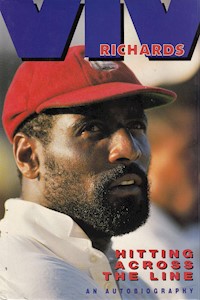
The career of cricket's greatest enigma, Viv Richardsm spans a tumultuous 20 years. Born Isaac Vivian Alexander Richards in Antiqua he made his first-class debut for the leeward Islands in 1971, and his Test debut for the West Indies in 1974. Richards writes about his family, his time at Somerset with his great friend Ian Botham, which ended in 1986 amidst bitter controversy. Hitting Across the Line is the forthright and perceptive autobiography of a cricketing genius
Das E-Book können Sie in Legimi-Apps oder einer beliebigen App lesen, die das folgende Format unterstützen:
Veröffentlichungsjahr: 2016
Ähnliche



















HITTING ACROSS THE LINE
VIV RICHARDS
HITTING ACROSS THE LINE
AN AUTOBIOGRAPHY
MACMILLAN AUSTRALIA
RETRO CLASSICS is a collection of facsimile reproductions of popular bestsellers from the 1980s and 1990s
Hitting Across the Line was first published in hardback in 1991 by Lennard Books in association with Maxi/Hudson Street Cinema Presentations.
Re-issued in 2016 as a Retro Classic by G2 Entertainment in association with Lennard Publishing Windmill Cottage Mackerye End Harpenden Hertfordshire AL5 5DR
Copyright © Vivian Richards 1991
The right of Vivian Richards to be indentified as the author of the work has been asserted in accordance with the Copyright, Designs and Practices Act 1988.
ISBN 978-1-78281-732-1
Cover design by Pocknell & Co
The publishers are grateful to Don Charles for his help in tracing photographs and to the following sources for other illustrations used in this book: Allsport Photographic, Rex Features, Alain Lockyer, Syndication International, David Munden, Patrick Eagar, Eric Coombes of the Somerset County Gazette, The Cricketer
Statistics provided by Richard Lockwood
This book is a facsimile reproduction of the hardback edition of Hitting Across the Line which was originally a bestseller in 1991. No attempt has been made to alter any of the wording with the benefit of hindsight, or to update the book in any way.
CONTENTS
Prologue
The Young Antiguan
Dark Days, Cold Nights
Test Initiation
Fear and Loathing in Australia
The Football Match
Grovel!
Early Days in Somerset
Kerry Packer and Other Eccentrics
All This, and Cricket Too
A Captain’s Manifesto
Champions of the World
The Best of Times
Pride and Prejudice
Up North
The Case for Change
Entertaining Mr Lawton
Reflections from the Patio
Career Record
Acknowledgement
My thanks to Mick Middles who helped to record my thoughts and memories, adding his own observations along the way. Many of the chapters are introduced with his descriptions of the settings within which this book was created.
PROLOGUE
6th March 1991 – Sabina Park, Jamaica Although a day lost to rain has ruined any chance of a result in this first Test against Australia, the West Indian early-order batsmen have made amends for a disappointing first innings. After an opening stand of 114 between Gordon Greenidge and Desmond Haynes, Richie Richardson continues to restore West Indies pride. On the departure of Carl Hooper, he is joined by his captain, Viv Richards, who has earlier queried the wisdom of continuing a ‘dead’ game on a dangerous pitch.
The match may be dead but the crowd is alive with excitement at the prospect of witnessing an historic moment in West Indian cricket history. Viv Richards needs 32 runs to pass Gary Sobers’s record aggregate in Test cricket. Reluctant to be out there at all Viv starts cautiously with little regard for record-breaking. As he nears the required total, Clive Lloyd, in the commentary box, prepares the crowd for the great moment. Almost without seeming to be aware that he is making history Viv Richards passes the record.
The noise around the ground then reminds him of the landmark that he has reached and somewhat as an afterthought he raises his bat in acknowledgement. To Viv the real satisfaction is not as much in becoming the new record-holder as in having provided a reward for those who have stayed to watch the match draw to its inevitable conclusion.
Viv Richards, master batsman, record-breaker and cricketing entertainer, has once again given the crowd their money’s worth and sent them home happy, with a tale to tell.
THE YOUNG ANTIGUAN
November 1990. Darcy’s Bar, St John’s, Antigua. Feet embedded in large white trainers, torso proudly sporting a black Bob Marley T-shirt, the young Rastafarian swaggers along the shop-lined street. To naive tourists, who trickle continuously, if nervously, through the bustle of mid-day St John’s, the Rastafarian might seem rather intimidating. But this is an illusion, be it intentional or otherwise. The Rastafarian is quite blind to tourism, immersed as he is, in the complexities of local society. The tourists, equally, seem rather blind to this web of life. True enough, they like to feel as though they are tasting the culture of the Caribbean, but more often than not they prefer to drift idly about the gift shops and café bars.
As they sit, drinking Red Stripe lager or ostentatious cocktails, Antiguan daylife pulsates all around them. But it is not within their vision, it is in the supermarket next door, or the dilapidated chemist’s shop on the corner, or down in the market. However, although this divide seems, at all times, massive and unbridgable, it is a far from unhappy separation. On the contrary, both sides of the divide co-exist quite harmoniously. Whatever problems, financial, social or political, Antigua may face, the prevailing atmosphere is one of contentment. And if the tourists really do wish to step out of ‘themed Antigua’ to sample genuine local life they are welcomed with open arms.
This crossover is particularly successful if the tourist is prepared to spend endless hours chatting about sport. For sport is the lifeblood of Antigua, especially among the young or young at heart. It permeates everywhere – on street corners, in bars, in taxis. Sporting gossip can bring traffic to a standstill; it can make the participants very late for important meetings; it can cause shop tills to cease ringing. Sport is all important. It crashes through the barriers of race, religion, class and age. Amongst the locals, of course, sporting chat is delivered at great speed and they seem happy for it to remain completely unfathomable to the casual listener from foreign parts. However, this mysterious dialect can be dispensed with instantly if an outsider is to be welcomed into the conversation.
The Rastafarian wanders past the faded pinkness of Darcy’s Bar. The bar is a silent oasis in the centre of this ever lively city. It is patrolled by lizards and seems to attract only those who are in the most desperate throes of thirst. But today this silence is savagely ripped apart by the sudden shriek of a transistor radio. An excitable, disembodied voice snaps through the atmosphere. The bar man shakes his head sadly, as the news from Pakistan begins to register. The West Indies cricket team, on tour in that most difficult of lands, seems to be in all kinds of trouble. Things will improve over the coming weeks but, for the moment, the sports crazy people of the Caribbean are united in thought with the despondent commentator: ‘...and, as the Windies seem to be at their lowest ebb for a decade, it must be said that Viv Richards, who is at home in Antigua recovering from an operation, is more than a little conspicuous by his absence.’
Across the dusty street a Range Rover pulls to a careful halt. From inside, the face of Antigua’s most famous sporting legend, Viv Richards, can be seen casting a reflective glance towards the bar. ‘Man, when I used to work in there, that place was kickin’,’ he states, and his concentration is only broken by the constant car horns and demands for attention which punctuate his every public moment on the island. On noticing this scene, the Rastafarian spins around in delight. His hand rises in acknowledgement, and for once his profound dialect needs no decoding. “HEEY MAASTER BLAASTER!”
Viv Richards is in his natural habitat, happy to be away from the spotlight, if only for a month or so. After which he will reunite with a remarkable career path, heading, hopefully, towards a climactic final three years. But despite being, so many times, at the epicentre of a raging controversy, he has never really taken time out to explain his side of the story. Viv Richards has much to say.
I could not possibly begin this book without immediately talking about my parents. Today I can feel really proud in the knowledge that I had the kind of parents who had the foresight necessary to shape me and prepare me for what turned out to be an extremely unusual kind of lifestyle. They provided me with a very pure upbringing, which may not be all that fashionable today, but I now realise that they made it possible for me to build upon that family base. I owe everything to them.
I was very fortunate in having a mother and father who not only went to, and believed in, the Anglican church but were extremely involved in church activities like Sunday school. I am not saying that I was an angel, far from it in fact, but, in time, I did come to understand the importance of living in such a family. I even sang in the choir at one period.
I grew up very much under the influence of my father. He was a proud man, and a disciplinarian, and it was the sheer power of his presence that initially shaped my approach towards life. He was acting-Superintendent at the local prison in St John’s. It was a tough job which required a good deal of self-control, and I think it is fair to say that he did bring a little of his attitude towards work home with him.
Looking back, I feel that I was extremely fortunate to be subjected to his discipline. I certainly did not lose out because of it even if I did not see it that way at the time. On many occasions I disliked having to buckle down to his way of thinking. I thought he was just too direct, but then I was blind to what he was trying to do.
I suppose, in my childish way, I resented the prison and the effect it had on our everyday life. I am not saying that he was a rough man, but he was an individual who was conditioned to living in a very military kind of way. There were all kinds of little things, details, which he impressed upon me and which I now think were very important. I always had to be tidy, my shoes immaculate, that kind of thing. I am certain that, had he not instilled that discipline in me, I would never have reached as far as I did in life. I will be eternally grateful for that. I think that my father understands and accepts my gratitude.
My mother, equally, was always a great believer in discipline, although she was quieter and always used a more subtle approach. But, in her own way, she was just as strong, just as influential.
We were brought up in a basic Antiguan wooden house. That might sound as if we were poor, but that was never the case. We were not, in any sense, poverty-stricken. My father always had a good job. To be a civil servant, as he was, in those days gave you some form of social standing and provided you with a feeling of security.
They were strange times in Antigua. In areas like ours, you would encounter so many different standards of living. Poverty and wealth seemed to co-exist quite happily. We lived in an area that was pretty much ‘in town’, right at the centre of everything. I can remember having a few fairly hard times, when my father would want to buy something for the house but would not be able to afford it on his civil servant’s salary. But he always made sure that we had the essential things in life. We always had plenty of food – always had cornflakes in the morning. There was never any doubt that we would be able to eat and be comfortable. That might not sound like much, especially these days, but it meant that we had a higher quality of life than many of our neighbours.
I was not particularly successful at school, to say the least. At first I went to St John’s Boys School, which was a basic, honest, open school – no different, really, from junior schools across the world. After that, I attended Antigua Grammar School.
I was only really interested in the sports side of things and, to my delight, my father encouraged me in this. Mind you, he was a sports fanatic himself. He was an excellent footballer and cricketer, and the happiest photographs of him seem to have been taken when he was playing cricket. He was the father of four sons – Mervyn, Donald, David and myself – and took great delight in playing cricket with us. And it was mostly cricket that we played, because our back yard was not big enough for football. All we had was this little strip of land, a yard which became a little cricket pitch of our own.
I think that I was no different from any other kid growing up in Antigua. Everyone of that age seemed to be heavily involved in sport. In a sense it was expected of them. As they grew older, most would draw away from sport and start trying to establish themselves in a career. But sport was where they learned to get along with other people and where they learned some kind of discipline.
I loved those knockabouts with my father. He was a sporting hero of mine. After all, he did play a lot of cricket for Antigua, which did make him something of a local star and he often brought home his bats for us to play with.
I remain very proud of my father’s achievements in cricket. Mainly because I know that my own talent is something that has been passed down. I am always glad when I hear the guys talking who played or watched cricket in his era. What they see in me today, either batting or bowling, they saw in him long ago. It is fascinating to me because they pick out bits of my game which, apparently, are identical to the way my father played. It makes me feel good to know that people still think that highly of him.
He was an unusual character in many ways, and his approach to cricket reflected his individualism. He was an all-rounder, which was not so fashionable in those days, but for him it was natural. He wanted to work hard. He had this tremendous power within him, this massive self-confidence, and felt that he was capable of doing anything and everything. Most cricketers in his day wanted to specialise in one area, and then use the rest of the game to relax a little. But my father wanted to do it all.
At Antigua Grammar, I began to follow in my father’s footsteps. Like him, I had a natural tendency to want to be involved in all aspects of the game. It was very fashionable, even in those days, for a boy to want to become a macho fast bowler, but I bowled slow off-breaks. I did receive a certain amount of criticism for my bowling which was not helped by the very uneven pitches we played on. Eventually I decided to devote more of my time to batting. This was not part of some great plan for the future. At that time, around the age of eleven, I saw myself as no more than an average young cricketer.
We never had any facilities that we could depend on. We had no groundsman. We had to do our own rolling. If we wanted a game, we had to go and prepare our own pitch. Sometimes we had to make one from nothing, the two teams helping out to clear away some patch of waste ground. It could be any piece of land, most of the time we never bothered to check out who the owner was. It was quite hard work, too, preparing a roughly playable cricket pitch in those temperatures.
The night before the game, we would wet the strip and just hope that the cows did not move in overnight. Quite often in the morning we had push them off with our own hands, then shovel up the cow dung and fill in the hoof marks. If we found hoof marks on the wicket, and we often did, we tried to roll them out, but the ball could still bounce anywhere – and I mean anywhere.
At the time we did not know it, but the total unpredictability of those pitches provided us with the best possible cricket training. For a start, we hardly had any protection at all. Much of the time we wore home-made pads, fashioned from cardboard or the like. Sometimes we had no proper bats, and wicket-keepers had to risk all kinds of injuries because they had so little protection.
It was madness in a way, and it was certainly some of the most dangerous cricket I have ever played, but it gave us a real sharpness. Wherever you were playing, you really could not afford to lose concentration for one second.
When I think of young English cricketers, all training on perfect, slow, springy pitches, they are learning a completely different game. We were learning to be sharp, to be attentive in order to survive. It was far more than just a quiet afternoon’s game of cricket. Even in those days the competition was fierce and, as I have stated, the pitches only served to add to the volatile nature of our game.
The player in most danger was the the batsman. He just had to be able to see the ball at a very early stage. The ball would move all over the place. It was full of surprising bounces. It made the batsman instinctively want to go for the big hit, to get rid of the thing. Playing defensively was pretty pointless and just as dangerous, so the batsman might as well try to hit the ball into the surrounding undergrowth. The hook shot was a particular favourite. And there was no point in telling a batsman not to hit across the line, in fact that was the way everyone had to play.
It was not the most beautiful cricket ever played. Sometimes it was far too frantic, but it was certainly exciting. I can’t imagine how a cricketer in, say, England could possibly have received such valuable training. Just think, not only were we playing against the unpredictable bounce but we also had very little protection. It helped us to develop a natural sense of judgment. It gave us an awareness. It made us streetwise and set us apart. If you compare our game with the English game where they cover a young cricketer in all kinds of padding and put him in to bat on a perfectly predictable pitch, there is no way he is going to develop the same degree of skill. We were given this sense of survival. It came from our relative poverty, and it provided us with something that no other young cricketers in the more developed world could possibly experience. It was, and continues to be, the basis of the West Indian cricketing philosophy.
We also played beach cricket, which was a different game altogether. The accent was on fun, and we played to a different set of rules using tennis balls or little sponge balls.
The beach was another great learning ground. The batsman could make the most perfect defensive stroke imaginable, but if the ball bounced once, and the fielder caught it, he was out. So he had to play really cautiously. He had to know just the right time to break his wrists, to stop it dead. Standing up close to him he had a mass of fielders. There were no limits to how many could play beach cricket, and there were times when twenty or more fielders would be hovering around the batsman.
I remember this scene well. It left you with two options. You had to be so cautious. Either you played an immaculate, uncatchable defensive stroke, or you really hit out. You had to make this decision very early in each delivery, and go for one shot or the other. A moment’s hesitation and you were lost. Most times, when you hit out, you tried to hit the ball as far as possible into the surf. Then it was the task of the bowler, not the fielders, to swim out and retrieve it. The problem was that many bowlers just could not swim and the ball, if you really hit it, would be fifty or sixty yards out. More often than not the game would simply halt there and then and dissolve in one big argument. The bowler would scream, ‘Can’t swim!’ To which would come the stinging reply, ‘If you can’t swim, don’t play cricket.’
I became captain of the Antigua Grammar School team at around the age of sixteen. I think it is fair to say that I was a little bit wild, especially as a batsman. I did have a few huge innings, but quite often my recklessness would cause me to be needlessly caught. When I was at the crease I found I had this aggressive urge within me to hit out at everything. It was not easy to contain it. Some people would say that this urge has never left me, has never been fully disciplined. That may be so, but I do not feel it is necessarily a bad thing. At Antigua Grammar I was determined not to listen to the schoolmaster who told me, again and again, not to hit ‘across the line’. I would like to have complied, but I just had to play my natural game.
I had no particularly high opinion of myself. At that time I thought my brother, Mervyn, was a more naturally gifted cricketer than I was. I could never get to play the shots quite as well as him. But he was not so single-minded about sport. He had a lot of different interests and liked to pursue them all.
At one time, for instance, he was representing Antigua at cricket and was also part of a singing group called The Mindreaders. Antigua were playing in Nevis in a Leeward Islands tournament and Mervyn actually wanted to travel home after a day’s cricket so he could sing with the group in the evening then return to Nevis, and the cricket, the next day.
I could not understand how anyone could want to do that. I would never, in a million years, even dream of doing such a thing. I was worried about him wasting his talent and thought he should make his mind up, once and for all, about what he really wanted to do. After all, there were many truly dedicated people who would have given anything to have got a place in that Antiguan team.
Mervyn was also one of the best footballers around. But even though he played well, certainly better than me, he never really had that passion, that single-minded ambition. He wanted fun, and everybody loved him for it, but it meant he was never serious about anything. He was also involved in drama and would have made an excellent television comic. He loved to imitate people, and to this day he has kept his happy-go-lucky nature. He now works as a supervisor for Northern Telecom and still enjoys his life. He is much cleverer than me and much better at practical things. Even when we were boys, if the radio was not working, he would be there with his screwdriver. I was the opposite, I had no interest in such things at all. I was hopeless at them...and still am. While Mervyn can fix anything, I can’t even set the video, or wire a plug. In this sense, there is only one way of saying it. I am bloody hopeless...DIY drives me nutty.
Like Mervyn I also played an awful lot of soccer. I loved the flow and pace of the game and, like most of the kids in Antigua, I quickly became a ‘soccer expert’. Initially I played for the local team, The Ovals, but I did get to play quite seriously and even finished by playing for the Antigua national team in the qualifying rounds of the World Cup. For a while my sporting life was evenly divided between cricket and soccer. I had no idea which one to pursue. Many times I found myself having to pull out of a cricket match because I had a more important soccer game...and many times the opposite would happen. My loyalties were equally divided, and soon a day came when I had to make a big decision, probably the biggest decison of my life. I sat down with all my folks to talk it over.
It was my father who really made the decision. He stated, very simply, that he had never heard the West Indian football team on the radio. If there was a good deal of soccer talent in the Caribbean, which there obviously was, and still is, then something must be very wrong with the soccer system. What happens to all this talent? There are no local football heroes to match the likes of Gary Sobers or Everton Weekes.
I had to agree. There was another aspect to consider. As a kid, I had spent many years being totally mesmerised by the cricket commentaries on the radio. There was a certain magic about cricket that was lacking in soccer, not least because we were not a world force in soccer. I could listen, completely spellbound, to commentaries by John Arlott. As I sat in my room I could really feel the atmosphere and Arlott, through his knowledge and deep love of the game, managed to transmit the utter magic of Test cricket through to me. He was a massive influence. When he described the atmosphere from, say, Lord’s, the Mecca of cricket, it sounded like heaven. Looking back now, it might seem that there was no argument. It had to be cricket over soccer. However, at the time I was very confused.
The strange thing about this debate was that, although we all treated my decision as if it was a matter of the utmost urgency, we did not really see cricket as a future career. We talked about it, but in the family we had other priorities which had to be sorted out.
It was a very unsettled period at home. My father was not happy in the prison service. He was, at all times, a fairly outspoken man. He did not believe in tact. He was very straight and very honest too, but those qualities, however admirable, do not always help a man in his career. His refusal to toe the official line meant that he was moved around a lot. Although he knew more about prison security than anyone around, the authorities sent him off to do the book-keeping at the hospital, or work in the post office, things like that. He was constantly moved on and found this increasingly hard to take. Finally it made him decide to go to America.
It was a decision which I could feel him moving towards and, frankly, the prospect appalled me. Most of our relatives were living in America and he wanted me to go with him. He had this idea that I would be able to develop as an electrical engineer. I knew this was not for me and I was determined not to move. It led to arguments, and we fell out quite badly.
Although he had always encouraged my sport he could not see it as a career. I cannot say I blamed him for this. He, after all, had been a better cricketer than I ever thought I would be. So how could I make a go of it? He always said the same thing. I can hear him now.
‘CRICKET BALLS CAN’T COOK! WHAT ARE YOU GOING TO EAT?’
Although it was quite a sensible statement I thought he was being totally unreasonable. When my parents finally did leave, I stayed behind with my grandmother. I knew that going to America was never going to be my cup of tea. The prospect of living in a land so huge, so alien, terrified me. More importantly, I knew that they did not play cricket in the States.
So I had no doubts about making the decision to stay on the island. Cricket was becoming my life, even though I was not paid for playing. I felt emotionally tied to the sport and it would have broken my heart to leave it. I know it hurt my father, but I had to go with my passion.
There was one other reason for staying. My girlfriend, Miriam. We first met when I was just eight years old, then, as friends, we grew to know and rely upon each other more and more. She knew everything about sport. She grew up with it and had two brothers who were part of the same school soccer team as me. Whenever I went round to her house, the talk was always of sport. She came to the matches and was almost as obsessed and single-minded as we were.
Although I fell in love with Miriam at a very early age, how could I have realised how absolutely perfect she was for me? And how incredibly fortunate I was to have someone so close, someone with whom I could share an extraordinary life, from such an early age. Not only did she understand sport, she grew to understand the demands made on someone who chooses a sporting lifestyle. I could never be big-headed or ‘showy’ with her. There would never be any point. Miriam knew the basic Vivian.
Even though we did not get married until 1981, our relationship is almost lifelong. Throughout this story Miriam’s presence remains a constant if often unmentioned force for good.
However, for a young Antiguan, an inspiring girlfriend and a desire to perform well in sport were not enough. Reluctantly, at the same time as my father was struggling with his own work, I began to try and earn some sort of living. My first job was at Darcy’s Bar in St John’s. It was a really lively little place and, with tips, I would bring home a full ten pounds a week. It made me proud to be able to contribute towards the family upkeep. But even that job had come about as a result of cricket. The owner was a keen cricket supporter and wanted to help me in my game. I think he thought it would benefit my game if I had this safe job where he could keep an eye on me.
I was not a particularly good barman. In fact I spent most of my days dreaming about some legendary innings or other – probably like every other young man in the West Indies. While I was serving cold beer, in my head I would be Gary Sobers. Back in tedious reality, I also toyed with the idea of becoming an apprentice mechanic. A cousin tried to convince me that if I spent time working on cars, I might one day be able to graduate into engineering. Frankly I think I would have made a pretty lousy engineer. I really was not much good at anything non-athletic. I Would always be dreaming of cricket.
It is difficult for me now to remember just how far I saw myself going in cricket. Perhaps I thought that I might just be able to eclipse my father’s achievements in the game. Meanwhile, as time went by, more and more people were saying that one day I would play for the Leeward Islands. The further prospect of playing for the West Indies was something which I did not dare to contemplate too seriously. Deep down, I think I really did believe that it could happen. But doesn’t every young cricketer have similar thoughts? It is natural for all boys who play sport to develop a certain confidence in their abilities. Then they look ahead, and dream about taking it all the way. However, in their own little sporting circle, how can they possibly know how good they really are, or how close they might get to becoming an international sportsman.
It is strange to reflect on these things, on the fates of others and on my own future, then unknown. For myself, as I look back now, part of me thinks that it was all meant to happen. But then, I wonder, how many people there are who have the talent and the ambition, but don’t make it because of some quirk of fate which is no fault of their own. When people charge me with arrogance, they do not really know me at all. Deep down I know that I have been lucky. I know how close I came to settling for a much more mundane kind of life. It could all have been so different.
In the days of my youth, Antigua was a sporting backwater. Nobody expected this little island to produce sportsmen of international standard. It was a dream that may have been in the heads of kids like myself but, other than that, nobody ever entertained such a notion.
At the start of the 1968 season, when I was just seventeen, I played in probably my most important cricket match to that date. It was important because it taught me one mighty lesson and helped to curb my arrogance, which I must admit was pretty rampant at the time. I had become the cricket wonder-boy of the island. Old men in bars would talk about my game, and I suppose I had attained the status of a very minor celebrity. Not because I particularly deserved to be talked about, but because the island was just bonkers about sport. It was the easiest way to make some kind of name for yourself. I was sharp but I was over-confident and felt I could compete against anybody.
Those Leeward Islands Tournament games were very well attended. Even the smaller, local matches drew crowds of about 4,000 and the atmosphere was really intense. We were playing the neighbouring island of St Kitts. The local-derby atmosphere went to my head and I began verbally attacking the St Kitts bowlers. I sauntered out at number three, feeling very cocky indeed. It was one of those moments which many cricketers dream about. I was living my own drama. But, on the very first ball, they appealed for a catch at short-leg. There was no way I had hit that ball, but the umpire gave me out.
I was outraged. For a while I just stared at the umpire. Then I stamped my foot and, very slowly, I thumped my bat on the turf. Then, before walking off, I remained for a few more moments at the crease, in some kind of enraged contemplation. By this time the crowd must have sensed that something was very wrong. After watching my reaction they leapt onto the field and began to demonstrate. Within minutes they were holding placards saying, ‘NO VIV NO MATCH’.
It was a weird situation and all I could do was to keep looking up at the jail, which was next to the ground. I was looking for my father. I knew damn well that he would be there and would be very aware that something had gone wrong. Then something extraordinary happened. The authorities, instead of standing behind the umpire’s decision and ordering the match to continue, as they should have done, asked me to go back in and bat again. In this way, they thought, peace would be restored to the ground.
Had I been a more experienced player, I think I would have refused to go back. But go back I did. Then, the real irony, I was out immediately without scoring. In the second innings, I scored yet another duck. I don’t think there are many people who can boast three ducks in two innings.
After the match, I expected there would be some kind of punishment for me. After all, I had behaved very badly at the crease. On the other hand it was the authorities who had asked me to go back in to bat. What these same authorities did was to ban me for two years. I could not believe it. They did not even have the courtesy to tell me to my face. I heard about the ban on the local radio.
The incident became front-page news in Antigua. Almost immediately I was cast as a bad sportsman and people began to make nasty remarks, not just to me, in fact rarely to me, but to the rest of my family. It was an intense kind of hatred. People shouted abuse at our house from the street.
I went under for a while and refused go out. It was a truly horrible time but I think it explains something about the intensity of passion which is reserved for cricket in the West Indies. It is something that many people in England cannot understand.
I said that it was a very important match for me, and so it was because it helped to build my character. I knew that I had been treated very shoddily and I set out to prove the authorities wrong. I was determined to be seen as a good sportsman and a good cricketer. I was fired with a new-found enthusiasm which I am sure was more healthy than the blind youthful arrogance I had felt before that match. I had to fight to get back to the top. It was not easy to regain the support of the local crowd, but regain it I would. I had become a wiser person and would become a much better player.
DARK DAYS, COLD NIGHTS
Before, as I saw it, blasting my way back into the spotlight of Antiguan cricket, I had to work out my two-year ban. I played basketball, boxed a little, played soccer and, needless to say, more than a little unofficial cricket, on a beach and elsewhere.
When the ban was over I set about getting back into cricket. I had a fierce appetite for the game and it was not long before the men in the bars were once again talking about Viv Richards. This time, as I will explain, I had really given them something to talk about.
In 1972 I went to England for the first time. A voluntary committee in Antigua decided to send me and Andy Roberts, another promising youngster, to a coaching school in England. Andy was a year older than me but we were good friends and had been playing together in the Leeward Islands team in the1971-72 season. The buildup to this trip was a moving experience. The people of Antigua, who had obviously forgiven me, organised many functions such as barbecues and dances to raise the money to send us. This, in itself, helped to increase my determination. When such faith is placed in you, how can you possibly give less than one hundred per cent? And yet, even at this stage, it looked more likely that I would become an engineer, or at least something other than a cricketer. My parents still wanted me to go to New York.
I went to England full of optimism. I had been making lots of runs in Antigua, and to achieve a trip to the magical homeland of cricket was like seeing a dream come true, or so I thought.
Once I had arrived in England the dream soon faded. Suddenly I realised why everyone back home had given me all those clothes – overcoats, jackets and stuff. It was November and from the moment I stepped out of the airport, I could not believe the ferocity of the coldness. It was something that was totally alien to me. The sun had been present all my life and I had never even contemplated what it would be like without it.
I had never felt so depressed in my life. London was a nightmare to me. Everything seemed drab and grey. Midday seemed like midnight. During that six-week stay, I never really became more than partly acclimatised. I immediately lost all my pocket money and, to this day, I’ll swear that the weather was responsible for that. I had my money stuffed in my back pocket but, because of the coldness of my hands, I just couldn’t feel anything. I couldn’t feel the paper as I fumbled for the notes and must have left several pounds on the pavement or the shop floor. It was more than a culture shock, it was like living on a whole new planet.
Andy and I stayed in a guest-house in Putney owned by a lady from New Zealand. At night, before we went to bed, we had to make sure that we had enough ten-pence pieces in order to keep the meter running all night. This was something that I could not understand. We paid our board and lodging and yet we still had to pay to keep warm. It seemed very unfair, and the fear of not having enough coins was a constant worry. I was convinced that here in London, without constant heat, we would die.
It may not have been as bad as my imagination told me, but it was still freezing. I did not dare get up to go to the toilet. I just lay there until morning. It affected my whole constitution and I felt ill just about all the time. It really was a nightmare for two young Antiguans, with no experience of the world. I had never been so miserable in my life. Many times I just wanted to pack up and go home. I could not envisage myself ever living in such a country, let alone playing a full cricket season there. Then, slowly, I came to realise that it was just one more thing that an individual has to get through. You either walk away from such situations or you decide to face them and get stuck in.
After a while things got better. Andy had a sister in Hackney and she took pity on us and invited us to stay at her place. We were much more comfortable there and, believe me, very grateful to be given some good hot Caribbean food. We also began to meet more of our own people and found that they had experienced the same kind of traumas. Suddenly everything did not seem so bad.
I still found it difficult to adapt to English social habits. Drinking was a particular problem. Some of the British we mixed with just seemed to live for the pub. Back in the Caribbean it was always the night-time that was reserved for drinking but some of the English guys would go to the pub, maybe at midday, and get stuck into pints of lager. I could not cope with that. It would destroy me for the rest of the day and yet these guys seemed to just carry on.
I did eventually get used to going to the pub, maybe to have a Ploughman’s Lunch or something, and I began to drink Guinness. I had this notion that Guinness was good for you like the advertisements used to say. I thought to myself, well, if I’ve got to drink it might as well be a drink that helps me play. That was just smother part of my naivety. I don’t think it did an awful lot for my health. It was only good for my wobbly legs.
The main purpose of our visit was to attend the Alf Gover Cricket School. This was not at all what I had expected. Back in Antigua, I had been allowed to nurture my natural game. I was surprised to learn just how raw my cricket was. I accepted this but soon found myself rebelling against the coaching. In the West Indies, we had been lucky. The wickets over there are true and coaches did not really see the need to dismantle the natural flow of a player. In England it seemed that they placed far too much value on the text book. They did not seem to want to allow individuality to flourish.
Suddenly I had all these technical things to learn. Alf, to his credit, did help me with my stance. He saw that I was too open and he worked on tightening up my defensive game. It shook me to have to take so much advice. No one had ever told me how to hold a bat before and I began to resent it happening now.
During our stay Andy and I went to Surrey for a trial. The idea was for them to look at us to see if they thought we could do the business in county cricket. We played in front of one of the old wicket-keepers of that era, the late Arthur McIntyre. He watched us and, from the way he was moving his head from side to side, our prospects did not look too good. It was very disappointing. We had expected an enthusiastic response but we were left with our confidence in tatters.
It was, at last, beginning to dawn on me that the game of cricket was not all that easy. There were a lot of technical things to learn. I felt confused and, for the first time in my short cricket career, filled with self-doubt. To this day I do not know how I managed not to go running home to Antigua with my tail between my legs, hastily seeking a career in engineering. What kept me going was something within me, some instinct which told me not to take too much notice of the coaches. I had a feeling that my natural game was, apart from needing the odd refinement, basically correct.
It was dangerous thinking, all the same. Who was I, this inexperienced and untried lad, to challenge the experts? And yet, I think that if I had listened obediently to everything they told me, instead of being selective, my game might well have been stunted at that point. I was lucky to escape. Somehow I had this insight into the true value of coaching. It was important, I decided, but not all that important.
To back up this view, I could look at all the great players of the world. They always seemed so natural and it was obvious to me that they had not learned their craft by studying textbooks. I was strangely aware that I needed coaching to control my natural ability but I was determined not to let them take my basic feel away. Even to this day, I have the same opinion of coaches. They are only useful when they help a player to enhance his own game. They cannot teach the game.




