


Erhalten Sie Zugang zu diesem und mehr als 300000 Büchern ab EUR 5,99 monatlich.
- Herausgeber: The History Press
- Kategorie: Sachliteratur, Reportagen, Biografien
- Sprache: Englisch
"Her story is adapted to move the compassion of those she visits. She has bad nerves, and seems in great disorder of mind, which she pretends to be owing to the ill usage of her father […] She attempts to borrow money of [sic] waiters, servants, and chaise boys, and offers to leave something in pawn with them to the value. Her name is supposed to be Sarah Wilson." - London Evening-Post, 30 October 1766 Beginning in her late teens, Sarah Wilson travelled alone all over England, living on her wits, inventing new identities, and embroidering stories to fool her victims into providing money and fine clothes. When her crimes eventually caught up with her, she was transported to America – where she reinvented herself in the guise of the Queen's sister and began a new set of adventures at the onset of the American War of Independence. Using original research, newspaper reports and court records, this is the story of 'the greatest Impostress of the present Age': a real-life Moll Flanders who created a remarkable series of lives for herself on both sides of the Atlantic.
Sie lesen das E-Book in den Legimi-Apps auf:
Seitenzahl: 343
Veröffentlichungsjahr: 2019
Das E-Book (TTS) können Sie hören im Abo „Legimi Premium” in Legimi-Apps auf:
Ähnliche



















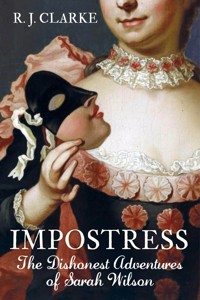
Cover illustration: Eleonora Gustafa Bonde af Björnö, Jakob Björk (Finnish National Gallery/Wikimedia Commons)
First published 2019
The History Press
The Mill, Brimscombe Port
Stroud, Gloucestershire, GL5 2QG
www.thehistorypress.co.uk
© R.J. Clarke, 2019
The right of R. J. Clarke to be identified as the Author of this work has been asserted in accordance with the Copyright, Designs and Patents Act 1988.
All rights reserved. No part of this book may be reprinted or reproduced or utilised in any form or by any electronic, mechanical or other means, now known or hereafter invented, including photocopying and recording, or in any information storage or retrieval system, without the permission in writing from the Publishers.
British Library Cataloguing in Publication Data.
A catalogue record for this book is available from the British Library.
ISBN 978 0 7509 9177 3
Typesetting and origination by The History Press
Printed and bound in Great Britain by TJ International Ltd
eBook converted by Geethik Technologies
CONTENTS
Prelude
1 A Wanderer in England
2 Prison
3 Transportation to America
4 The Atlantic Crossing
5 America: The South
6 America: The North
7 Who Was Sarah?
Appendix 1 Frensham and Headley Parish Records
Appendix 2 Letter to Sarah from Elizabeth Frith’s mother
Appendix 3 Was this Sarah?
Appendix 4 The Aftermath: Myths and Stories
Notes
Select Bibliography
PRELUDE
Frensham
This story begins where the first newspaper account of our heroine begins: in a poor and dangerous area of desolate moorland, wild heaths and dark woods on the Surrey–Hampshire border close to the Devil’s Punchbowl, the haunt of footpads and highwaymen waiting to waylay travellers where the London-to-Portsmouth road crossed those uninhabited wastes.
This was where a sailor travelling along the Portsmouth road was murdered by three men who, ‘with their knives mangled his body in several parts, much too shocking to relate, and then nearly severed his head from his body’. As an indication of how lawless this isolated area was, on the very same day that murder took place, there was another entirely separate incident just 2 miles up the road. Two men attacked a lone traveller, threw him to the ground, stuffed his mouth with sand and robbed him of half a guinea.1 The three men who murdered the sailor were caught, found guilty and executed. Their bodies were hung in chains on Gibbet Hill close to where the murder was committed, their rotting corpses serving as a warning to others.2
Smugglers passed through here on their way to London from the south coast. The wildness of the terrain, with its hills and hollows, rendered it uninviting to strangers and ideal for concealing contraband.3 William Cobbett described it as ‘certainly the most villainous spot that God had ever made’.4 When Arthur Conan Doyle moved into the area many years later, after Hindhead had become fashionable, he used the local landscape as the inspiration for his book The Hound of the Baskervilles.
Thomas Boxall lived with his wife, Flora, and their son, also named Thomas, about a mile from the Devil’s Punchbowl down a rough sandy track on the heathland in an area called Witmore (now Whitmore) in the south of the hamlet of Churt in the parish of Frensham.5 They supplemented their small income from grazing cattle on the poor vegetation by selling brooms that they made from the birch and purple heather that grew nearby.
It was late autumn 1764 when a most surprising visitor arrived at Thomas Boxall’s door. Instead of the rough countryfolk he might have expected to come knocking, his visitor was a young woman in her late teens or early twenties. She was petite and slender. Her jet-black hair contrasted with her pale complexion. The only thing that marred the beauty of her face was a speck or blemish in her right eye.
She was unaccompanied and appeared to have wandered off the main Portsmouth Road, lost and alone. She asked Thomas whether there was anywhere that offered accommodation. There was nowhere nearby, and as it was the time of the year when it got dark early and the nights grew cold, Thomas considered it unsafe to let a young woman wander alone in the dark, so he decided to offer her shelter for that night.
As they sat by the fire the young lady told him her name was Sarah Willsbrowson. She said she was the daughter of a nobleman. She had been forced from her father’s house by ill-treatment and needed a temporary place to stay. This sad story so affected the farmer that he agreed that she could stay longer than the one night if she wished.
The Boxalls grew to enjoy Sarah’s company. She appeared to be a very pleasant and well-spoken young lady. During the course of one of their fireside chats she let slip that she had a fortune of £90,000 that she would be able to get her hands on once she had spoken to the person in London who was holding it on her behalf.
Thomas’s son, at 17, was slightly younger than Sarah, and it seemed that they were growing increasingly fond of each other – although whether his fondness was further aroused by the information about her fortune is unclear. However, one day Sarah told Thomas the elder that the best return she had in her power for the favours she had received in his household would be for her to marry his son if that was agreeable to them both. Both Thomases were overjoyed at the proposal. They arranged for the wedding to be held at St Mary’s church in Frensham village.
The banns were read on three successive Sundays. As no one declared that they knew of any cause or just impediment why they should not be joined together in holy matrimony, Thomas Boxall and Sarah Charlotte Lewsearn Willsbrowson, both of the parish of Frensham, were married at St Mary’s on 17 December 1764. Thomas and Sarah signed their names in the wedding register, although Sarah missed out the ‘ow’ in Willsbrowson and had to add the ‘ow’ above the line. Thomas’s father acted as witness and signed his name with an X.
In line with the practice at the time, the ceremony took place in the morning. As the news of Thomas’s good fortune spread round the neighbourhood, a great crowd of villagers would have been waiting outside the church door, curious to see his bride and ready to throw handfuls of grain over the couple to wish them a fruitful union. It is likely that they used the wedding as an excuse for revelry, with a wedding breakfast, a fiddle player, dancing and sports.
Some days after the wedding, Sarah told her father-in-law that she had great interest at court, and if he could raise money to ‘equip them in a genteel manner’ she could procure a colonel’s commission for her husband and at the same time she would be able to claim her fortune.
Old Thomas mortgaged his little estate for £100. Thomas and Sarah used some of the money to buy some fashionable clothes, probably from Farnham. Once they bought all that they needed for their journey to London, Thomas and Sarah took the rest of the money and set off, accompanied by three of Thomas’s friends.
They arrived at the Bear Inn in the Borough on Christmas Eve, where they lived for about ten days ‘in an expensive manner’. Each morning Sarah went out in a coach saying that she was going to the St James’s end of town, where she was making the arrangements to retrieve her fortune and obtain Thomas’s commission. Each evening when she returned she presumably gave some explanation about why she had to wait a little while further until her money could be released and why there was a delay in the arrangements to get Thomas’s commission. In the evenings Sarah charmed the company; she was ‘not only very sprightly and engaging in conversation, but sung and played the guitar to perfection’.
Whether Sarah went out one day just as the money was running out and never returned, or whether Thomas and his friends discovered by other means that she was an imposter and challenged her with the accusation, the consequence was that Sarah disappeared and Thomas never saw his bride again.
Penniless and in debt to the innkeeper, Thomas and his friends had to sell their horses to pay the bills they and Sarah had racked up. On Saturday 5 January 1765 the four lads left London to walk back to Frensham, with Thomas facing the painful task of explaining to his father what had happened to his money.
According to Sabine Baring-Gould in an 1898 newspaper article entitled The Besom Maker, old Thomas threw good money after bad when he fell into the hands of a lawyer from Portsmouth who undertook to see Sarah prosecuted and the money returned. The only benefit they received was that lawyer apparently managed to establish that Sarah had been married before. Therefore Thomas’s marriage to Sarah was invalid, so he was free to marry again.6
When Alderman John Hewitt, a Coventry magistrate, examined Sarah in 1766 he noted that, in addition to her marriage certificate from Frensham, she had a certificate of another marriage in Whitechapel, where she used the surname Wilbraham.7 However, there is no known record of a marriage for a woman named Wilbraham in the St Mary Whitechapel parish registers. The document that Hewitt saw might have been a forgery. Even so, Thomas’s marriage would still have been invalid as his bride, Sarah Willsbrowson, was a fictional character whom Sarah had invented.
Thomas did get married again (see Appendix 1). He started courting a girl in the next village: Anne Over from Headley. In 1776 Thomas and Anne had their banns read three times in All Saints church, Headley, and no impediment was alleged. However, for some reason they did not go through with the marriage. Whether this was because Anne found it difficult to come to terms with Thomas’s previous relationship with Sarah, or whether there was some antipathy between Anne and Flora, Thomas’s mother, is not known. Nonetheless, by 1779 Anne had moved to Frensham where she gave birth to an illegitimate daughter, also named Anne. Thomas was the father. Little Anne died when she was less than a month old.
Later that year Flora died; she was buried on 14 November. Three weeks later Thomas and Anne had their banns read again, but this time in St Mary’s church, Frensham. After the banns had been read for three successive weeks, Thomas and Anne were married on 20 December 1779. It was as if they had been waiting for Flora to die.
There is no indication of whether old Thomas Boxall managed to retain his estate. Census records show that the Boxalls who were living in Frensham parish in Queen Victoria’s time were mainly broom makers or agricultural labourers, some of whom were living in huts off the Portsmouth Road. Baring-Gould indicated that Thomas lost his freehold, and that his descendants were some of the broom makers who were then squatting in the Devil’s Punchbowl.8
Baring-Gould said that Thomas and Sarah’s story had not been forgotten. It lived on in a ballad, which began:
A cobbler there was, and he lived in a stall,
But Charlotte, my nymph, had no lodging at all;
And at a broom-squire’s, in pitiful plight,
Did pray and beseech for a lodging one night.
She asked for admittance her story to tell,
Of all her misfortunes, and what her befell,
Of her parentage high; but so great was her grief,
She’d never a comfort to give her relief.
Baring-Gould said the song continued ‘through many stanzas devoid of merit’, but the remaining verses have proven elusive.
After Sarah abandoned her ‘husband’ at the Bear Inn, there is a gap in her history through most of 1765 until towards the end of the year, apart from an episode in Westmorland (now Cumbria). However, the newspaper account of her Frensham adventure said that she had ‘for near two years past obtained money, by imposing on the compassion and credulity of different persons in town and country’.9 The papers Alderman Hewitt found on her in June 1766 showed that, by that date, Sarah had wandered through ‘most of the Northern Counties; likewise Gloucestershire, Wiltshire, Somersetshire, Berkshire, Monmouthshire, Staffordshire, and Worcestershire’.10
We do not know what adventures Sarah had before she turned up in Frensham, or what she got up to during most of 1765. A later newspaper report said:
It seems this woman has, for some time past, been travelling through almost all parts of the Kingdom, assuming various titles and characters, at different times and places: she has presented herself to be of high birth and distinction […] making promises of providing, by means of her weight and interest, for the families of […] the lower class of people; unto those of higher rank in life she has represented herself to be in the greatest distress, abandoned and deserted by her parents and friends of considerable family […] always varying the account of herself as she chanced to pick up intelligence of characters and connections of those she intended to deceive and impose upon.11
1
A WANDERER IN ENGLAND
Sarah cuts a recklessly romantic figure. Reckless, because of the disregard for her own safety. Travelling alone on foot was a brave thing to do at a time when the newspapers reported instances of women being robbed on the highway, and in some cases being raped and murdered. Reckless also because of the potential dangers for a young woman knocking on strangers’ doors, and the ever-present danger of being caught and punished for her dishonest activities. But, despite (or possibly because of) her dishonesty, there is something romantic about Sarah – a lonesome traveller living on her wits to obtain free board and lodging, money and clothing; travelling by coach or carrier’s waggon when she managed to dupe some unwary victim into giving her money, otherwise tramping the rough roads of eighteenth-century England wondering where she would be sleeping that night.
Another female adventuress of the eighteenth century, Charlotte Charke, who lived from hand to mouth as a strolling player, travelled around the country by all manner of means. When she had no money, she had to walk unless she could get a lift for some part of her journey by ‘mounting up into a Hay-Cart, or a timely Waggon’.1 On one occasion, she and a companion, being penniless, set off on foot from Devizes, and ‘after a most deplorable, half-starving Journey through intricate Roads and terrible Showers of Rain, in three Days Time, we arrived at Rumsey, having parted from our last Three Half-pence to ride five Miles in a Waggon, to the great Relief of our o’er-tired Legs’.2
At the time when Sarah was wandering around England, the country was undergoing what became known as ‘turnpike mania’. Between 1690 and 1750, only about 150 turnpike trusts had been created, mainly covering the radial roads from London and sections of the great post roads. Between 1751 and 1772 there was a massive burst of speculative activity. During those twenty-one years a further 389 trusts were added, covering some 11,500 miles of road. This was partly the result of a period of low interest rates, which meant that those with money could get a better rate of return by investing in a turnpike than by lending to the government. It was also due to the increasing number of coach and waggon services, which meant that the old arrangements for maintaining the major highways were becoming increasingly untenable.
The existence of a turnpike trust did not necessarily mean that there was an immediate improvement to the roads under its control. There was a period of construction, and before the great road builders of the early nineteenth century came along, individual surveyors had differing ideas about how best to maintain a highway, with mixed results.
Those highways not covered by turnpike trusts were still subject to sixteenth-century legislation. The Highways Act of 1555 placed the burden of the upkeep of the highways on individual parishes. Each parish had to appoint two surveyors of the highways and each householder had to work under the supervision of the surveyors for eight hours a day for four days a year (or pay someone else to do the work), repairing and maintaining those highways within the parish boundaries that ran to market towns. Roads that did not lead directly to market towns were not covered by the act. An act of 1562 extended the period of labour to six days a year, and the better-off inhabitants were obliged to provide carts and draught animals. This system was known as ‘statute labour’.
Statute labour was deeply unpopular and of limited effectiveness; parishioners had no interest in maintaining a road from which they received no benefit. A correspondent to the Gentleman’s Magazine in 1767 complained that:
Teams and labourers coming out for statute work, are generally idle, careless, and under no commands […] They make a holiday of it, lounge about, and trifle away their time. As they are in no danger of being turned out of their work, they stand in no awe of the surveyor.3
During the course of her adventures Sarah travelled great distances. Each journey took her over some roads that had been turnpiked and others that were still maintained by the local parish. In general, the roads were bumpy, rutted and full of potholes. When the potholes grew too deep, it was the practice to throw large stones or rocks in them. In dry weather, the roads became dusty and every time a horse or a coach went by, it raised a great cloud of choking dust. In wet weather the roads became sticky, treacherous swamps, and in the winter they were impassable for wheeled vehicles and slow, filthy and tedious for horse riders and pedestrians.
Before the hedge building that followed the various Enclosure Acts, the minor roads of England were often no more than well-trodden paths across open fields where it was easy for the unwary traveller to get lost. The writer Arthur Young, who travelled all over England at about the same time as Sarah, described one road as ‘going over a common with roads pointing nine ways at once, but no direction-post’. The major roads were furrowed with deep ruts caused by the wheels of heavy carriers’ waggons, and these ruts were full of water in wet weather. On one journey, Arthur Young complained that he was ‘near being swallowed up in a slough’. On the turnpike between Preston and Wigan, Young measured ruts in the road that were 4ft deep.4
In 1727 Jonathan Swift remarked ‘in how few hours, with a swift horse or a strong gale, a man may come among a people as unknown to him as the Antipodes’. By the time Sarah was travelling across England, little had changed. The accents and dialect words spoken by a person in one part of the country would still have been scarcely intelligible to a person living in another. When Sarah met people in her travels who had rarely ventured beyond their parish boundaries, she probably had difficulty trying to make out what they were saying, and what those local words meant.
At some stage during the course of her travels in 1765, Sarah called on Robert Hudson, a lawyer, at his home in the small market town of Brough in Westmorland, on the road from London to Carlisle. Sarah introduced herself as Viscountess Lady Wilbrihammon. It seems that Robert and his family were so honoured to have such a distinguished visitor that they entertained her as their guest for several days. She told them that she was an acquaintance of Lord Albemarle and would be able to procure a lieutenancy in the army for Robert’s son-in-law5 (Lord Albemarle, the great-grandson of Charles II, was lieutenant-general of the 3rd Regiment of Dragoons).
In the eighteenth century, commissions in the armed forces and offices in government were effectively private property, given as patronage and offered for sale. Most commissions in the army were obtained by purchase, and could be re-sold. As far as civil appointments were concerned, the offices were in the gift of the Crown or prime ministers and others acting on behalf of the Crown. Once an office had been granted, usually in return for political favours, it could be sold or bequeathed to heirs when the office holder died. All the offices provided an income for the office holder, either through fees – as in the case of the keepers of the London jails, who purchased their offices in the expectation of making a profit from charging fees from the prisoners – or from a share of revenues, as in the case of tax collectors. Where the office was too onerous, or where the office holder had managed to obtain several appointments, he could pay a deputy to do the work at a fraction of the remuneration he was receiving. Many of the offices were simply sinecures to which no significant duties were attached.
The sale of offices was so established that it even featured in newspaper advertisements. An advertiser in The Times was selling ‘A Genteel Place under Government’ that did ‘not require much attendance’, which came with a salary of £100 a year.6 Another advertisement offered between 1,000 and 2,500 guineas to ‘any Lady or Gentleman who will establish the Advertiser in a permanent Place of adequate Salary in any of the Public Offices under government’.7
These arrangements gave scope for imposters like Sarah to pretend to be in a position to be able to appoint a person to a lucrative post, or arrange for such appointment to be made in return for cash. In 1773 a person calling herself the Honourable Elizabeth Harriet Grieve appeared at the Public Office in Bow Street and was committed to Newgate to await her trial for defrauding a number of people by pretending to obtain various government posts for them.
Mrs Grieve appeared to be in a position to have those places at her disposal. She said she was the first cousin to the prime minister, Lord North; second cousin to the Duke of Grafton; and closely related to Lady Fitzroy.8 She added verisimilitude to those claims by bribing Lord North’s servants to let her park her coach outside his door for hours at a time. Even more convincing was the common sight of the coach belonging to the up-and-coming politician, Charles James Fox, outside her own door. She had befriended Fox, who was financially desperate as a result of incurring gambling debts; she told him that a Miss Phipps, an heiress with a fortune of £90,000 from the West Indies, was anxious to meet him, and ‘was very desirous of a matrimonial connection’.
Mrs Grieve told Fox that a marriage could easily be arranged, but not yet, as Miss Phipps was still on her way from the Caribbean. Just as they were about to meet, their meeting was further delayed by Miss Phipps catching smallpox. Then there was yet another delay because Mrs Grieve told Fox that Miss Phipps preferred men with light-coloured hair, so he must powder his eyebrows.9 When the story of Fox and the imaginary heiress broke, it gave rise to two satirical poems: ‘Female Artifice; or, Charles F-x Outwitted’, published in February 1774; and ‘An Heroic and Elegiac Epistle from Mrs Grieve in Newgate, to Mr C- F-’, which was printed in the March 1774 issue of the Westminster Magazine.
It turned out that Mrs Grieve’s victims included the following:
William Kidwell, who paid her £30 on pretence of obtaining for him the appointment of Clerk of the Dry Stores in the Victualling Office;
William Kent of Streatley in Berkshire, who charged her with defrauding him of £30 in cash and a conditional bond for £230 on pretence of procuring the office of a Coast Waiter. Kent left his business in Berkshire and moved his wife and three children to London in anticipation of starting his new career;
Elizabeth Cooper, who charged her with defrauding her husband of £62 on a similar pretence ‘in Consequence of which he died of a broken Heart’.10
Another of her victims was a Mr Greenleaf, a Quaker of Ipswich, who said he gave her £50 and a bond for £1,350 which was to be the consideration money for being appointed as a Commissioner of the Stamp Duties. According to the newspapers: ‘The Impudence of this Woman was astonishing. She gave as a Reason why she did not procure him the Place, that he had three Bastards by his Servant Girl, and had been expelled [from] the Meeting-House to which he belonged.’11
At her trial on 27 October 1774, Mrs Grieve was found guilty of fraud and sentenced to be transported for seven years.12 At eight o’clock in the morning, on 29 November 1774, she walked from Newgate to Blackfriars Bridge with her fellow convicts, including a Miss Roach, who was transported for receiving a watch from the highwayman Sixteen String Jack. She was put on board a lighter to travel down to Blackwall as the start of her journey across the Atlantic. She sailed to America on the Thornton convict ship, a vessel we will encounter later in this story.13
We know that Sarah was in London towards the end of 1765. It may be that Robert Hudson paid for her to travel to London, ostensibly to obtain the lieutenancy, possibly by the stagecoach that left the White Lion at Kendal. The coach took two nights and three days to complete the journey from Kendal and cost £3 7s for an inside seat.14 Adding the cost of refreshments and other expenses on the road, the overall cost of the trip to London would not have been far short of £5.
It was not uncommon for women to travel alone by stagecoach. Parson Woodforde sometimes found that one of his fellow passengers was an unaccompanied woman.15 In order to travel great distances at the usual speed of between 5 and 7 miles an hour in summer – slower in winter – the coaches had to leave their inns in the early hours of the morning and not arrive at their destination until late at night. Travelling by coach forced passengers to socialise with each other; four strangers who were thrust together in the confines of a coach for up to 18 hours at a time, with breaks to share meals at roadside inns, generally found it easier to talk to each other than to endure awkward silences. When Sarah travelled by coach, she was probably able to pick up information from her new-found travelling companions about the wealth, political views and religious leanings of individuals in a particular district and other gossip that might point her in the direction of a potential new target.
As can be seen from the cost of the trip from Kendal to London, travelling by coach was not cheap. One way of saving money journeying by coach was to travel half-price as an outside passenger. Until much after Sarah’s time when seats were fitted on the roofs of coaches, travelling as an outside passenger was not for the faint-hearted. You either had the choice of sitting on the curved roof of the coach with only a handle to hold on to as the coach bounced over the uneven roads, or travelling in the basket at the back of the coach, sharing the space with loose and heavy iron-nailed and sharp-cornered luggage as the coach hurtled downhill. Whichever option was taken, there was no protection from the weather.
A much safer way of travelling cheaply was to travel by waggon. This is a method that Sarah may have used for some of her journeys. As well as carrying goods, the covered waggons usually had planks or benches for passengers. The waggons were large carts covered by a canvas hood, pulled by up to eight strong horses. Waggons had the advantage that the passenger fares worked out at about only a penny a mile and were less attractive to highwaymen than coaches or chaises because of the imagined poverty of the passengers. However, the waggons usually travelled at walking pace and covered no more than 30 miles a day.
London
The London Sarah knew in the 1760s was a filthy, stinking, noisy, dangerous city that covered the 5 miles east to west from Limehouse to Hyde Park Corner and about 2½ miles north to south from Shoreditch to the last buildings in Blackman Street, Southwark. Into that space was crammed a population estimated at around 750,000 (at a time when the next largest town in England, Bristol, had a population of about 50,000).16
As her coach drew near to London, Sarah would almost certainly have smelled London before she saw it, surrounded as it was by a chain of smoking brick kilns, pig farms, rubbish heaps and laystalls.
The laystalls were great mounds of human waste mixed with cartloads of animal dung and other filth that had been shovelled off the streets. Night-soil men, otherwise known as rakers, collected the shit in buckets from the bog-houses of buildings with gardens and from the cesspits in the basements of buildings without gardens. They emptied their buckets into carts and drove to the outskirts of town to dump their load.
The (very) minor poet, Charles Jenner, feigning frustration in his search for pastoral bliss in the countryside surrounding London, wrote:
Alas for me! What prospects can I find
To raise poetic ardour in my mind?
Where’er around I cast my wand’ring eyes,
Long burning rows of fetid bricks arise,
And nauseous dunghills swell in mould’ring heaps,
While the fat sow beneath their covert sleeps.17
The smells of the brick kilns, the hogs and the laystalls that circled the town were supplemented by the smells of London itself. The stink of sea-coal smoke combined with the other city smells and the stench of the Thames, which was an open sewer, meant that when the wind was in the right direction, people could smell London from several miles away.
The French travel writer Pierre-Jean Grosley was also in London when Sarah was there in 1765. He said there was a constant fog covering London that was caused by smoke from:
The sea-coals made use of in kitchens, apartments, and even the halls of grand houses; and by coals burnt in glass-houses, in houses where earthenware is manufactured, in blacksmiths and gunsmiths shops, in dyers yards, &c. all which trades and manufactures are established in the very heart of London […] This smoke, being loaded with terrestrial particles, and rolling in a thick, heavy atmosphere, forms a cloud, which envelops London like a mantle; a cloud which the sun pervades but rarely […] The vapours, fogs, and rains, with which the atmosphere of London is loaded, drag with them in their fall the heaviest particles of the smoke; this forms black rains, and produces all the ill effects that may justly be expected from it upon the cloaths of those who are exposed to it.18
The Kendal coaches set down at the Bell in Wood Street.19 The Bell was one of the inns that served the coaches and carriers from the north of England. The first plate of Hogarth’s Harlot’s Progress shows Moll Hackabout alighting from the York Waggon outside the Bell and being greeted by the brothelkeeper, Mother Needham.
If we were to try to imagine the things that Sarah saw, heard and experienced in London after she left her coach at the Bell by walking in her shoes, we would have had to tread carefully. The streets were shared between pedestrians and vehicles, and where there were pavements, pedestrians had to avoid being jostled by porters carrying goods unloaded from the river, and move aside to avoid being knocked down by burly chairmen rushing past carrying sedan chairs. The pavements were obstructed by shopkeepers’ stalls, unloaded goods and cellar doors projecting into the street, forcing people into the road. The streets and the pavements were often covered in filth:
Fishmongers and Butchers do not hesitate to throw out Quantities of offensive Offal; Oyster Women throw out their shells, which in a few hours are ground to mud; Grocers, Cheesemongers, and many others, sweep the Saw-dust and Rubbish of their Shops into the Streets […] Scavengers Carts filled to the Brim, and with the Jolts of bad Pavements are usually half emptied again before they reach the Lay-stalls.20
That last comment echoed an observation the philanthropist and reformer Jonas Hanway made back in 1754 that the night-soil men, by the motions of their carts:
Not only drop near a quarter part of their dirt, and render a street, already cleaned, in many spots very filthy, but it subjects every coach, and every passenger, of what quality soever, to be overwhelmed with whole cakes of dirt, with every jolt of the cart; of which many have had a most filthy experience.21
Sarah would also have had to make her way past the dunghills that stood in many corners of the streets. There were dunghills in Fleet Market, Fleet Bridge and around Temple Bar. The stand of coaches at Temple Bar filled the street with ‘horse-dung and litter, which I am sorry to see now and then encreased with ashes and filth thrown out by the inhabitants’.22 In 1762 the dismembered remains of a woman and eight infants were found in a dunghill at the foot of Westminster Bridge.23 A letter to the Gazetteer warned that ‘in hot weather the effluvia of […] the lay-stalls for night-soil which are established in almost every corner of the town […] may insensibly be an assistant cause of diseases amongst us’.24
Night soil was not the only problem. In 1765 a correspondent objected to the people who ‘make water under the Gate-way at St James’s, as it is not only indecent, but offensive to many of the Courtiers, it being the very Place where Carriages stop to set them down’.25 Another person wrote about the ‘horrid Stench of Urine at the Horse-guards, and in every Avenue leading to it [and] the Puddles and Ponds of stagnated stinking Water’.26 Grosley commented that:
In the most beautiful part of the Strand and near St Clement’s Church, I have during my whole stay in London, seen the middle of the street constantly foul with a dirty puddle to the height of three or four inches; a puddle where splashings cover those who walk on foot, fill coaches when their windows happen not to be up, and bedawb all the lower parts of such houses as are exposed to it.27
The dead added to the smells of the city. In August 1765 a person living in St Martin’s Lane wrote to the Public Advertiser that in the churchyard behind his house:
Are daily brought several dead Bodies, which are there left in the Ground […] as close as they can possibly be laid to each other, with no other Covering than a few Boards placed over the Mouth of the Grave, neither Dust or Earth being thrown over them […] A Nusance this of the most shameful Nature, considering what an intolerable Stench must necessarily arise, this hot Weather, from such a number of Corpses, yet green and festering in their Shrouds.28
These burial pits, known as poor holes, were a feature of many London churchyards and were said to be ‘one of the great sources of putrid disorders […] so offensive, as frequently to oblige the Ministers and others, upon funeral duty, to stand at a considerable distance, to avoid the horrid stench arising from them’.29 A person wrote to Lloyd’s Evening Post pointing out that in a lane near Cavendish Square there were ‘many carcases of horses which lie unburied in a state of putrefaction, insomuch that it is a real nuisance to every one passing that way’.30
The droppings from the herds of cattle that were driven through the streets on their way to Smithfield added to the stench of the streets. The cattle also increased the dangers of walking in London: scarcely a week went by without reports of horned beasts running wild in the streets tossing and goring pedestrians. No part of the city was safe from them. In 1765 the incidents included an ‘over-drove ox’ which ‘did great damage in Hosier-lane, West Smithfield, and gored a shoemaker’s apprentice so dangerously in the belly, that he was carried off for dead’; a woman killed by an ‘over-drove bullock’ in Chick Lane; an over-drove ox which ‘ran furiously up Snow-Hill, and terribly gored a Youth [and] afterwards ran down the Little Old Baily, and into the Session’s-House Yard, at which the People attending the Session, were greatly alarmed; from thence he ran into a Coffee-house, and did considerable Damage’; a lad was tossed and killed by an ox in Fleet Street; a bullock tossed several persons in Charing Cross; on a separate occasion a bullock ran down the Strand and injured several people before goring a man’s eye out at Charing Cross; a pregnant woman from Aldersgate Street was killed by an ox; an ox gored a woman in Berkeley Square; a drover was gored to death by an ox in Monmouth Street; a bullock tossed a woman in Gray’s Inn Lane; a man was gored by an ox in St James’s Street; an ox killed a woman in Holborn; and a bullock tossed several people on Oxford Road (now Oxford Street).31 Mad dogs running loose on the streets were another hazard.
The roads and the lanes were crammed with hackney coaches, private coaches, stagecoaches, drays and other waggons. To deal with the volume of traffic moving in and out of the city, there were at least seventy-five coaching and carrying inns within London.32 As an indication of the amount of traffic arriving and departing for the country, if we take just those timetabled coaches and carrier’s waggons that left London every week for Coventry, we find that the Flying Machine left the Castle and Falcon, Aldersgate Street, on Mondays, Wednesdays and Fridays at ten o’clock at night, and the ordinary coach left the Swan with Two Necks, Lad Lane, on Mondays, Wednesdays and Thursdays at three o’clock in the morning. Coventry waggons left the George and White Hart, Aldersgate Street, on Mondays, Tuesdays, Thursdays and Saturdays at noon; the Saracen’s Head, Snow Hill, at ten o’clock on Saturday mornings and another at six o’clock in the evening; the Ram, Smithfield, on Wednesdays at nine o’clock at night; the Bell, Smithfield, on Mondays, Tuesdays, Thursdays and Saturdays at ten o’clock in the morning; the George, Smithfield, on Mondays and Saturdays at noon; the Castle and Falcon, Aldersgate Street, on Mondays, Tuesdays, Thursdays and Saturdays at ten o’clock in the morning; and the White Horse, Friday Street, on Mondays, Tuesdays, Thursdays and Saturdays at noon.33 These do not include the coaches and waggons that passed through Coventry on their way from London to further destinations such as Chester, Holyhead, Shrewsbury, Liverpool, Whitehaven and Carlisle.
It is difficult to imagine just how noisy London was. The multitudes of street sellers hawking their fruit, milk, hot pies, newspapers and other goods needed strong and penetrating voices to make themselves heard above the cries of London from their competitors, the rumble of carts and coaches rattling over the cobbled streets, the ballad singers and street musicians, the clangour of bells, the piercing shriek of the knife grinder’s wheel and the hammering of the metal-bashing trades. It is little wonder that Sarah frequently escaped to the country to pursue her adventures.
‘I Suppose, Madam, Miss Can Sing Too’
While she was in London, Sarah visited George Jackson, the Secretary to the Navy Board. Shortly before Mr and Mrs Jackson were due to have their dinner, a hackney coach drove up to their door; the coachman knocked and told the servant that a lady in the coach wanted to speak to Mr Jackson. The servant replied that his master was out. Sarah then called out asking whether Mrs Jackson was in. The servant tried to get rid of her by saying that Mrs Jackson was also not at home. Sarah then ordered the coachman to tell the servant that she was ill and to beg the favour that she might come in for a minute or two.
The servant let her in and, pretending to be in a weak state, Sarah asked to be allowed to sit down. Mrs Jackson came to see her. Mrs Jackson noticed that her visitor had a speck in her eye. Sarah told Mrs Jackson that she was the Honourable Miss Mollineux, a daughter of Lord Mollineux, and a near relation of Lord Derby. She said she believed that Captain Jackson of the India Company was related to Mr Jackson and that Captain Jackson had been a particular friend of her late mother. She said that she was in a distressed state because her father had treated her cruelly and forced her to leave home. She was sure that if she could see the captain, he would be willing to help her for the sake of his former friendship with her late mother.




