


Erhalten Sie Zugang zu diesem und mehr als 300000 Büchern ab EUR 5,99 monatlich.
- Herausgeber: Parthian Books
- Kategorie: Sachliteratur, Reportagen, Biografien
- Sprache: Englisch
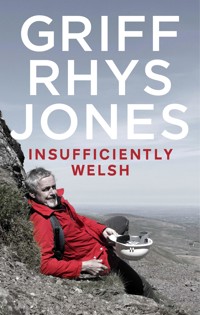
Griff Rhys Jones is searching for that Welsh part of himself that he has felt ever since being forced to sing in the choir in church and pack down forthe school first XV, all in suburban Essex. Join Griff on his journey through Snowdonia, Anglesey, the Gower, mid Wales, Brecon, Pembrokeshire, north Wales and Monmouthshire. Packed with all manners of weird, wonderful and enlightening facts, you'll learn as much about Wales as you do Griff. 'I am going out on the road to search for my Celtic roots and explore 'the land of my aunties'. The language, the landscape, rugby, dogs, legends, botany, wildlife, furniture and a bit more on the side: I looked into them all and here are the results...' But is Griff Rhys Jones Insufficiently Welsh?
Sie lesen das E-Book in den Legimi-Apps auf:
Seitenzahl: 289
Veröffentlichungsjahr: 2014
Das E-Book (TTS) können Sie hören im Abo „Legimi Premium” in Legimi-Apps auf:
Ähnliche


















Introduction
–1–MONMOUTHSHIRETHE GREAT BARRIER
–2–BEACONSINTO THE GREEN
–3–GOWERWILD RUGBY FOOD
–4–PEMBROKESHIRETHE NATIONAL DOG
–5–MID WALESA LEGEND IN THE MAKING
–6–SNOWDONIAA LILY IN THE VALLEY
–7–ANGLESEYWILDLIFE
–8–CONWYTHAT RIVIERA TOUCH
THIS IS THE END
–INTRODUCTION–
Over the years I have learned to “swallow the toad”. It’s not a Welsh expression. Nice if it was. I got it from Sicily, via Norman Lewis, the master travel writer (Welsh himself, actually, now I come to think of it).
Was Lewis perhaps a little prone to “embroidery”? Is that perhaps a Welsh romantic trait? I am getting ahead of myself. I can’t start off with wild racial generalisations; there’s plenty of time for that later. I just like the phrase. It has resonance.
For my part, the toads I have gulped down, straight-faced, include the rejection of virtually every programme idea I have ever proposed to television executives since 1990. I have ingested Catanian swamps of wart-ridden amphibious reptiles, in brown offices in ugly buildings. But this one lingers. It was my “Monkey Tennis”. Ten years ago, I went to a BBC Wales “commissioner” and proposed a televisual entertainment featuring a well-known British television star. I thought this celebrity would add some lustre to BBC Wales’s output – and I could get him cheap.
There was a sickly pause. I detected what might best be described as a shudder. “No…” he opined, with a wonderful Welsh open-vowelled negative. He was about to present a toad for my delectation, I could tell. “Not him. No. I am afraid he would be insufficiently Welsh.”
My face was a standing stone. It was useless to point out that my presenter was funny, beloved, celebrated and starry – and a personal friend of mine as well. Pointless to enquire whether Welsh television viewers might enjoy a less parochial presenter. Silly to point out that Wales can cope with outsiders, just as the English embrace Terry Wogan, Gavin Esler and er… Huw Edwards.
I swallowed manfully. “Yes, of course,” I said.
Something dark flopped into my belly.
I realised, however, as I stared into the glassy eye of my interlocutor, that there was a subtext to our conversation. You see, it was not really my proposal that was insufficiently Welsh, or my mate. It was something else. The commissioner was gazing steadily at Griffith Rhys Jones, son of Elwyn and Gwynneth, scion of Megan and Ieuan and Evan, spawn of Betws-y-Coed, Penmachno and the Rhondda, Cardiff-born, dark of hair, thick-thighed and round-faced. And I suspected that he thought that it was me who was insufficiently Welsh.
Having been brought up in London (founded by a Welshman, according to legend), one of the Essex Boyos, a white-wellington booted Dragon at the end of the Central line and having missed the cultural communal Celtic after-game warm bath of Cymric fellow-feeling, who did I think I was, returning to Cardiff and pretending to have connections?
So, am I insufficiently Welsh? It’s time to find out. That is what this book is all about. I am going out on the road to search for my Celtic roots and explore “the land of my aunties”. Language, the landscape, rugby, dogs, legends, botany, wildlife, furniture and a few more bits on the side: I looked into them all and here are the results.
***
Just to book-end here, though: a little while later I had another suggestion for BBC Wales. This time they were looking for a satirical show. I have made a few anarchic sallies in the past. A prominent politician had become annoyed with the election results in the principality and vented his frustration in public. We suggested a hard-hitting riposte called “The Fucking Welsh”.
We didn’t even get asked to an interview on that one.
–A BIT OF BACKGROUND–
My father used the telephone as if announcing a concert party on a pre-war radio. If he could ever be persuaded to answer the thing, and then only in the absence of my mother, whose delegated task this normally was, he lifted the heavy, black, Bakelite lump from its cradle in the hallway, straightened his back and addressed the caller as if from the other side of a canyon. “Hellooo?” He would declare. “Who am I speaking with?”
His usual faux home-counties tones would swoop into a musical lilt. (And he was no musician.) There was immediately a pronounced fruitiness to his vocal chords. We were back in the Valleys. My father became Welsh on the telephone, God bless him.
“The Valleys”? Ah, but here I show my own ignorance. We were Welsh alright. My mother came from Ferndale, in the Rhondda – which is, I believe, a proper valley. My father emerged from a gloomy red house in the suburbs of Cardiff. (This was more of “a slight hill” than a valley.) Every single relative I have seems to have been vehemently Welsh, but I do not mean that they came from “the Valleys”. I am making wild, clichéd outsider generalities already.
Elwyn’s was the posh voice of the Cardiff suburbs, of the lawyers and physicians of the great coal port. Their inclination was to be Saxon in their manners. I was born in Cardiff but we moved away when I was six months old. I left a legion of aunties and great aunties, grannies and nans encamped across the lower west from Tonypandy to Pontypridd. It gave us our identity, in English Epping. We had to watch the rugby. I was dragooned into the choir. Sometimes we went to Dagenham to visit fellow Welsh exile doctors, who smoked and cackled a lot and had an easy, soppy familiarity that I came to associate with proper comfortable Welshness.
My granny and grandpa moved to join us. He had been a miner and wore a cloth cap and swore impressively in pidgin Welsh, as he levered his wheezing and arthritic body into the Morris Traveller. (“Duw, duw, oh fucky!” - “Grandpa!! The children!!”) Granny wrote letters in Welsh to Aunty Betty. There were Megans and Ieuans, Wyns, Gwens, Gwynneths, Gwyns and Evanses all over the Christmas card list.
“You must have experienced a lot of racial prejudice, growing up in Epping.” One Welsh actor had taken me aside, when we worked together on Russell T Davies’sMine all Minefor ITV drama.
I wondered what he was on about. “No, not really,” I started carefully. “Nobody ever really noticed I was Welsh.”
He nodded sagely. “That’s exactly what I mean.” He looked sorrowful. “They don’t care about the Welsh, you see – the English.”
In all honesty, nobody did care that I was Welsh. I am not really included in Wales by the Welsh. How could I be, with my weird part Essex tough junior school, part posh Sussex kindergarten accent? Mavis Nicholson once disparaged me to my face for speaking with a “pretentious” voice. (Oh, for your common touch, Mavis, love.)
I often went to Wales when I was tiny, by the long one-way system that went through every traffic light in Britain. In Cardiff we stayed with the forbidding Nain (North Walian Welsh for Nan). She was a tall woman with a shock of long, long white hair, tied up in a bun, attended throughout her life by my spinster Auntie Megan, who had big teeth and spaniel eyes. They had no idea when we might arrive, so they never cooked. Wales meant imprisonment for hours in that Morris Traveller and then salad: ham and hard-boiled eggs, and I hated salad. Cardiff meant the arcades (“What’s so good about them, Granny?”). It meant walking with excruciatingly slow ancient people. It meant loud ticking clocks in dark drawing rooms, and being on my best behaviour.
As I grew older, I kept away. The relatives all died. I went to visit my elderly uncle, who dressed like Edward VIII, spent a great deal of time in the South of France and was the only person I ever met who said “…what?” at the end of sentences, like a character in a Wodehouse story. (“Splendid day, what?”) But even he once sat me down in his pink wallpapered modern house near Radyr golf course and gently upbraided me. “You don’t want to make fun of Wales in those sketches of yours, what?”
Yes, even this dandy, with his Mr. Fish shirts and his Meissen candlesticks and his sports cars and snuffly pug dogs was a patriotic, full-blooded Welshman under the plus fours. (I still have those plus fours. He really wore them.)
The realisation took me aback. Because, like all of us, I have been fed the clichés. I know the Welshness of coal mines and choirs. What Londoner does not? But Wales is surely much more than truncated witches’ hats and bardic chairs, though even those have their fascination. (And indeed for years we had a proper Welsh hat in a box in a proper Welsh coffer in our Epping front room.)
When I threw off the shackles of my yearly sketch show and was given a new life in television, as a middle-aged man going “Oh, how beautiful” in scenic travelogues, I was taken beyond Cardiff. I started to range about the Principality. I climbed mountains and I canoed rivers, I walked sea fronts, and plunged into valleys, I went from the noisy, crowded cities to what, I finally understood, were the most remote and beautiful places in Britain.
I got to further understand Wales’s geography and its size, but always in hurried, speedy chunks, as we rattled from Conwy to Fishguard, or into the Black Hills for a quick photo opportunity.Restorationtook me to look at some extraordinary houses.Who Do you Think You Aresat me down in Carmarthen High Court.Mine All Mineshowed me Gower. Eventually, I became totally rootsy and bought a small patch of land and a ruined farmhouse on the wild and unearthly coast of Pembrokeshire.
But it is time to take stock. There is no one totality called Wales. There are many distinct regions in this small country. There are huge variations in geography and landscape. There are hidden wonders and strange attractions. There are unexpected cosmopolitan touches and eccentric ambitions.
Instead of waking up to eat salad and then going straight to bed, on this visit to Wales I intend to linger and explore and find out what is distinctive, so I am visiting eight separate regions and looking around – not to be comprehensive (the journeys are often deliberately small-scale) – but to get closer. And for each separate chapter in this odyssey I am tying together a loose knot. I have a mission to fulfil, a quest to pursue. Like an errant knight I have a given goal. It is designed to release the Welshness in me. Will I get closer to Cymru through my “challenges”? I hope so.
–1–MONMOUTHSHIRETHEGREAT BARRIER
–BORDERING ON THE RIDICULOUS–
Have I ever been this way before?
The thought came to me as we walked down through a reed bed, at the end of a deserted roadway, towards salt marshes and a muddy foreshore, to confront the remnants of a former passenger terminal in a crumbling block overgrown with brambles. It smelled, in that suspicious way that abandoned breeze-block buildings do, but the turnstiles were rusted up so we climbed through a hole in the fence.
Ahead was the mighty Severn, like a wide, flat, grey sinister pond. Downstream, towards the sea-horizon, (which I have never seen blue, only muddy and dismal) was the new bridge, soaring into the air between its lengthy jetties. Upstream was its far more handsome older brother. This elegant, white, full-span crossing was built in the early sixties. It put to an end the business of the ferry point where I was now standing.
From 1926 the Aust ferry had been the old posh car route. For a car and driver in 1955, it cost four shillings to cross into Wales. It had to be profitable for the owners; so much so, that it is said that a hearse using the crossing was invoiced a further one shilling and six pence for the coffin.
The kids from the village used to gather to watch the popstars go through. The famous photograph of Bob Dylan (and that Phantom Rolls Royce as black as his hair) was taken, not in some Mississippi Delta, but right here on this foreshore, when those shaggy stumps in front of me supported wooden planks that made a landing stage. The Aust crossing was notorious. Daniel Defoe, the author ofRobinson Crusoe, was deterred from using it because of the risk, describing it as “an ugly, dangerous, and very inconvenient ferry”.
I rang my mother. “Did we ever come this way?” I asked. I reckoned that by 1960 I was seven. I was living in Sussex. And we might have got to Cardiff via this route, but she quickly dashed that fantasy.
“No, we never took a ferry,” she told me. “We must have gone via Gloucester.”
“Or Chepstow?” I suggested.
“Possibly. I can’t remember, darling.”
I was already more sentimental about Wales and my Welshness than my mother ever wanted to be. At 89, Gwynneth has no nostalgia for the land of her fathers. I was the one floundering in the past.
But as I turned to go the land of my fathers went with me. My “challenge”, my quest (what I had to do this section of the trip), had been stuck in a cleft in a particularly soggy rotten jetty post on the other side of an eel-grass bog. I took my new suede walking boots for a trial in the estuary mud and ended up clutching an instruction. It was “to perform the National Anthem in Welsh”.
Fair enough. I might seek to avoid an incipient John Redwood catastrophe. No miming for me. I knew the tune. I knew the sentiment and, indeed most of the words in English, but the Welsh element would be a definite step up.
Germaine Greer (if I can just name-drop indiscriminately and, I think, impressively) once explained to me that the reason we English speakers struggle with Welsh is its orthography. Sixth-century Welsh documents use Latin characters, but there are many extra sounds to cope with. These were already represented by new letters in the alphabet. This means there are 28 letters in the Welsh alphabet, which comprises of seven vowels and twenty one consonants. “Ll” is one letter in Welsh and two in English. So there are six letters in Llanelli, if you are Welsh, and eight if you are English. Early transcribers of the language needed to represent a greater range of sounds. “W”s become “oos”. “U”s are in fact like double “i”s. “F” is a “v” and so forth. The “ch” sound was originally represented by a “k”, but the printers of the Welsh Bible didn’t have enough “k”s so they moved on to “c”s and the “k” fell out of use altogether.
Welsh was the first language of us Britons. You are reading here, on this page, a more recent immigrant, bastard hybrid – English. Welsh is one of the oldest languages still spoken in Europe and until 1911 Welsh was still the majority language in Wales. Today about half a million people in Wales can speak Welsh. In 1911 it was nearly double that.
The river that I was now skirting was defined as a barrier during the reign of Athelstan in 926, who ordered that the Britons, the older inhabitants of these islands, should stay to the west and the Saxons to the east. Matters of a national and patriarchal identity have been an issue for over a thousand years, especially at this very gateway to Wales. But I wonder if language is the real barrier. And the real identity of Wales.
I tried to master some Welsh a few years back. I was renovating a house in Pembrokeshire and I thought I would need the Welsh language to banter with the builders. Alas, it transpired they all came from Essex, like me. Although several surveys commissioned by S4C (the Welsh-language TV channel) have suggested that there are around 200,000 Welsh speakers living in England, none of the builders were part of this so I left it.
It is superficially difficult. Double “d”s, double “l”s, guttural noises and consonants are yoked together to make distinct and seemingly unnatural traps for the English speaker. But everybody tells me that it is easy. “At least Welsh is spelled as it is pronounced,” I was told. “You just have to speak the letters as they appear.”
So I wanted to start with something simple and the anthem seemed a good choice. I had after ten years mastered road instructions.Araf, (with a v sound at the end). That meant slow.Parciomeant “parking”. When I first crossed the Severn Bridge with my wife, I pointed out that the Welsh began straightaway. “Look there,” I said, pointing to a toll sign. “Manned!” I pronounced it as “manneth”. What does that mean?
“It means there’s a man to serve you in that booth. It’s in English.”
–FOOTBRIDGE–
There wasn’t a booth to get onto the bridge if you were walking. Three hundred million cars have driven over since it was opened; at least half as many seemed to be thundering past now.
It took three-and-a-half years to build the thing, at a cost of £8 million. Upon opening it in 1966, the Queen hailed it as “the dawn of a new economic era for south Wales” and it was far more emphatic and sculptural than the later rival, further south, which wanders out on a raised platform across the shallows for several miles before it deigns to raise towers and hang a short traverse. White, pure, simple, elegant: the original Severn Bridge is a confident, sixties, geometric design. Like a piece of origami, or a white plastic egg chair, it epitomises groovy pop Britain and now has Grade I listed status.
Each section of deck was made in Chepstow and floated into position, before being hauled into the sky. Seen close up, however, like many roadways or bits of plant, it seemed gritty, noisy and alien. Solitary human beings are not meant to grapple with this sort of engineering. We had to invent superheroes to hold on to broken cables or fly underneath suspension bridges, or tip cars into the river. It is not for mere mortals.
As I strolled along, first one bicycle whizzed by and then another. Theylooked surprised to see me walking there at all. I had noticed dozens of cars parked haphazardly up on verges in the bushy lanes surrounding the approachroad. “They park on one side or the other,” a bridge engineer called Paul told me.“Six quid toll. It mounts up every day, so they bike across for free.”
The toll is collected “on the English side,” as the old complaint has it. It’s free to get out of Wales. You pay to go in. (Quite right too, because from the very outset Wales offers up her beauties. We should pay. I mean you should pay.)
Paul and I took a lift up, through the box structure, to the top of the tower, to get a look into the Welsh heartland from a superlative viewing platform. The prospect defined Wales, because even from a height of 445 feet my view ahead was already blocked by rising hills. The Land of my Fathers becomes the Hillside that keeps a Welcome and the Valley that is unquestionably Green almost immediately.
My eyes, however, were hardly fixed on the distant horizon; they kept being drawn back to what lies beneath. The car deck had shrunk to become a sliver of road, traversed by models. Below that, a swathe of dirty water spread in the feathered patterns of great tidal movements. We felt high: too high not to automatically reach for a handrail for security.
“This first bridge was the more expensive bridge,” Paul was explaining as he leaned down and started to tackle me up. “It was aerodynamically designed and no expense was spared.” He was reaching around under my arms and attaching a colossal safety belt. “But the other one was safer. Eleven men died building this thing. One fell off into the concrete mixer and they never got him out, so now we take safety very seriously indeed.”
Soon there were four supports dangling from my harness. Two were long, two short and all of them ended in a big clip shackle. The thing felt as cumbersome as a suit of armour.
“Of course, the oldest crossing is the tunnel. That runs out there.” He pointed to the water by the other bridge as he took me by the arm. “That was Brunel’s great achievement. It remains in use but it still floods. They hit a spring and they had to pump out the water. They still do. It’s used to make beer.”
We were now standing by the northern cable. The bridge is literally suspended. The main cables are each made up of 8,322 individual 5mm wires. It needs constant monitoring by a team of experts who simply walk out onto it to make their inspections.
“It’s steepest up here and gets flatter as you go along. You might basically continue your walk right the way down it and into Wales,” Paul laughed. “Except you wouldn’t be in Wales at all. Despite having crossed the Severn Bridge, you are still in England.” He pointed to another smaller suspension bridge that finished the crossing. “That’s the Wye Bridge,” he explained.
And for the first time, despite having travelled both the Wye and the Severn, I realised that the bridge actually crossed both rivers just before they join together. Ironically, these rivers begin life within a hundred yards of each other up in the Plynlimon Mountains behind Aberystwyth. They take widely separate trajectories to meet again in tidal waters.
Paul was joking about the walk down, but he was not joking about a stroll on the cable. My task now was to saunter out and follow some of the engineers on an inspection.
I have no particular fear of heights. I have abseiled off skyscrapers, my dears. Only three times in my life have I ever been overcome by vertigo. The first time was when I was hauled up a ship’s mast. The second time was on a snow-covered ridge on Suilven, in the far north of Scotland. This was the third.
My guide went ahead and I was invited to follow. There were two hand rails. My shackles and supporting lines were attached to rails on both sides. But the cable, on which I tentatively put my foot, was spherical, encased as it was in a metal protective sheath. I immediately felt that I might slip off it. But I couldn’t slip. I mustn’t slip.
This sheathing seemed insecure as a footfall. There was no reason forthat insecurity. It was a big, fat, round thing, about three foot across I reckoned.But that made it worse. And it sloped down. That made it untenable.
I was wearing my new walking boots, still flecked with estuary mud. They seemed clod-hopping and clumsy. My feet now shrank inside them to become amoeba feet. They felt unable to connect with any surface. I stared at them, willing them to move on, but the problem was clear. Beyond my feet I was looking directly downwards onto the miniature deck, hundreds of feet below, swarming with hurrying, tiny cars, and below that, to compound the sense of height, the tide itself, swirling and gyrating.
Oh God. I was far less at risk than if I had stood on a coffee table. If I slipped, the support belts would certainly hold me, but I could not seem to convince my brain, my subconscious or my mortal self of that fact.
The idea was that I would help carry out an inspection by squatting down and unscrewing a plate. Now I was talking slowly and they could all hear the hollow cadence in my voice.
I looked up. My guide had a puzzled frown. It wasn’t lifting the inspection hatch that concerned him. He was wondering what he would do if I froze into a blob of iced panic jelly. So I laughed. A big mistake, because now I sounded positively maniacal too, and I stepped forward. That felt terrible. It got no better. The cable was steady. The wind was light. I was terrified.
We probably went no further than ten yards down and out, over yawning space. I pretended to be interested in the inspection hatch. Then they turned me around, by releasing each of my retention straps and re-connecting them one by one. I mechanically forced my arm to twist over and grip the other side of the rail before I tiptoed my way back to the platform.
Having got there and gripped the railing I turned and smiled wanly at the guys who gambolled about on that tube on a daily basis.
They smiled back.
–DYKE STUFF–
The bridges and tunnels are a modern gateway to Wales: a conquest of the muddy sluice of the Severn. A little way up the west bank, however, but still in England, I went in search of older, longer and cruder civil engineering: a monument to something far more mysterious – vanity, power or paranoia: you choose. I was startled to find that we don’t really know what Offa’s Dyke really is.
For a start it is less a dyke than a rampart.
Beginning in a little grove of trees, on the top of a cliff, a substantial wall of earth (with a well-trodden path on top of it) snaked away to the north. I have walked in “Boudicca’s encampment” in the middle of Epping Forest. I have stood on the raised humps of many Iron Age forts. Though dating from a similarly foggy period, this was a bigger deal than any of those minor wrinkles in the carpet.
Jim Saunders, the Offa’s Dyke path officer for nearly 20 years, joined me some ten feet above the surrounding fields. Had we wanted to, we could have followed the rampart for about 150 miles to Prestatyn (or perhaps to the Dee Estuary). There is some dispute as to whether the whole ditch and wall should be attributed to Offa, and archaeologists have argued about which bit of dyke was built when, but it is indisputable that here is the longest ancient monument in Britain and possibly even Europe, and one about which almost nothing can be ascertained.
Offa, a “vigorous” powerful Christian king, ruled most of southern England between 757 and 796AD. He seems to have subdued East Anglia and sorted out Kent. There are fine coins with his bulbous face on them. George Borrow, in his classic,Wild Wales, noted that at one time “it was customary for the English to cut off the ears of every Welshman who was found to the east of the dyke, and for the Welsh to hang every Englishman whom they found to the west of it”. These are most likely fictions, but this rampart certainly has its ditch on the Welsh side. It also skirts around the western side of any hills, so it seems that people on the wall were able to look out into Wales… for what purpose? Welsh marauders, invaders or sheep-stealers, one supposes, possibly erroneously.
Offa certainly fought campaigns against the Welsh in 778, 784 and 796. But revisionist historians have decided that the dyke might be a giant vanity project. “You want to know how big and powerful a king I am, then look on my mighty mud heap and despair.”
As Jim and I lumbered up hills and down into valleys, watched by curious cows, warbling birds and a camera crew, I could only marvel at this manmade lump. I know from bitter personal experience that the most expensive hobby in the world is neither horse racing nor yachting but landscaping.
They planned to build the Severn Bridge just after the war and finally got it done twenty years later. By all accounts, or, let’s be strictly accurate, by one account, given by Asser and written 200 years after the event in his “History of Alfred the Great”, they knocked this wall up in a similar stretch of time, using leather buckets, 1300 years ago.
Or maybe not. My mind was already more boggled by this ditch than it had been by the view from the top of the bridge. And now I wanted to follow it all the way to Prestatyn, crossing back and forth with it in and out of Wales as we went. But I had to leave. I was supposed to be exploring the Land of My Fathers (and singing it), and I hadn’t even got into the country yet.
–WELSH CHEPSTOW–
I took the fine 1816 cast-iron bridge and crossed into Chepstow and thus into Wales, wondering how Welsh this border town really could be. “Welsh enough for the inhabitants to pass the other way to get a drink in England on Sunday nights not so long ago,” I was told by Ivor, whom I met on the waterfront.
What a strange outlook we had too. We sat on a bench on the quayside, gazing across at an English limestone cliff with a Union Jack painted, provocatively, halfway up a stone face, next to a reputed smuggler’s cave. Ivor pointed out that it was now occupied as a vantage point by a pair of breeding ospreys, who sat watching us watching them. The River Wye trickled along somewhere deep below us in a gut, waiting for the tide to rise in a mad bath of muddy water and bring its surface up to where we were sitting.
Despite the empty channel, Chepstow was the biggest port in Wales in medieval times, renowned for the importation of wine and the exportation of timber and bark from the nearby Wye valley and the Forest of Dean. Clinging to the pinnacle of another cliff to the left was William FitzOsbern’s castle: an English toehold in Wales and often cited as the oldest surviving stone castle in Britain. It is a symbol of the Norman appetite for conquest. This was “Marcher” country. The threat of “border trouble” meant that extra powers were given to families like the Bigods, who then became so mighty that it took centuries to bring them back under control.
Monmouthshire became a non-partisan land. It was left out of Henry VIII’s reforming laws of Wales so it remained partly attached to England. When they required higher justice, its inhabitants had to appeal to the Old Bailey, not to Carmarthen, and it was only as recently as 1974 that it officially became part of Wales. So one might assume that its population would gravitate towards England. Apparently not. They fall to Wales. In Chepstow people take their Welshness seriously, including the language. Ivor himself was learning Welsh.
He took me along to his class, meeting in the gatehouse of the town and attended by people of all ages and sexes. Perhaps I would be able to sort out some of my difficulties with the National Anthem.
–LAND OF MY DIPTHONGS–
“Chhh!” We began with sounds. My Aunty Megan used to chide me for saying Welsh was difficult. “Bach” with that extra “ccchhh”. Like hawking. My Dad called me “Griffith Bach” when I frustrated him, as I so often did. It has that guttural noise that we Saxon-educated outsiders can’t get used to.
In fact everybody Welsh seems to chide me for finding it difficult. Tudor, the cameraman, and Brian on sound chided me for finding it difficult. Celyn, the assistant producer, chided me and it was her mother Heulwen doing the teaching now.
“Stick your tongue up against your teeth and blow through it.”
“Lllll.”
“Now you can say Llanelli”.
And I could. In 1977 the Voyager satellite was sent up to space in search of intelligent life with greetings in 55 different languages, one of which was Welsh.
Research suggests that there are as many as 750,000 Welsh speakers in the world. I am not even close.
I once went to Conwy to round up some wild ponies and the farmer greeted me with enthusiasm. “Well, Griffith Rhys” he said, “I’m a Rhys myself. Don’t you just hate it when people pronounce your name wrong.” I nodded vacantly, suddenly conscious that I must have been pronouncing my own name wrong for my entire life.
There is an “h” in there, you see, and the Welsh hit every part of the true spelling, so that it can be heard. It’s not Rees or Rice, it’s R-hees. I spend hours trying to master the right rolling “arr” followed by the distinct click of the “h” and I never managed it without stumbling over my own teeth.
But here I am again, willing, but frankly too old to turn on the sixpence in my own gob. “Gwlad…” we sing in the anthem. “In fact we sing it again, to give it extra emphasis. “Gwlad”.
“And its not a “you” or a “double you”, it’s an “oo”, but hatefully it looks like “glad” so my fuzzy brain still keeps trying to make it sound like that. I have a long way to go. And I feel dismal. At my age, did I have the capacity to learn the language of my fathers? That could be discovered. But did I have the will? That was a more complicated proposition.
–WITH A PADDLE–
Canoeing was an easier skill to master, but we had to catch the tide. The brown sludge at the base of the canyon, beneath the flange of mud, below the bank of bilious salt marsh, had started boiling and frothing northwards just after lunch. With almost 50 feet of tidal difference between low and high tide, that flood had once brought old sailing ships shooting up the estuary (and beyond for another five miles) and we needed to catch it.
I have canoed on the Wye before. (Here we are, going round in circles again.) In the programme “Rivers”, we came south on what was voted the nation’s favorite river in 2010. I learned to kayak and shoot rapids near Ross. Now we formed a posse intent on going the other way.
We manhandled the long canoes over the wall at the edge of the quay, slid them down the grab-rails on top of a bridge to a pontoon and plopped them into the water.
“Avoid the buoys,” Graham told me. He pointed. The flow was so strong that it dragged these obstacles half-under and rendered them almost invisible. We were four in separate vessels. I knelt forward on my haunches, wedged my bum against the little rattan seat and pushed out into the coffee-coloured stream.
We were quickly swept away. The tide shot us under the bridge and past the castle and soon we were following what had once been Britain’s first tourist route.
Excited by the renown of the scenery and the philosophy of “the picturesque”, packages of eighteenth-century aesthetes had followed a trail of wonders identified for them by William Gilpin. Their routes were carefully organised to allow them to see specific sites, sites which, if caught at exactly the right angle, even contained within portable frames, presented the composition and proportions of a proper picture. That was the point. Nature was at its best if organised. We were less fussy. We just paddled and gawped.




