


14,99 €
Mehr erfahren.
- Herausgeber: Parkstone International
- Kategorie: Geisteswissenschaft
- Sprache: Englisch
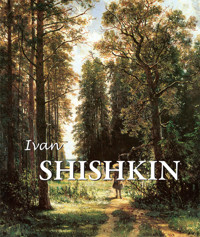
Russian countryside is some of the world’s most lovely, from the celebrated explosions of wild flowers that fill its forests in the spring, to the icy winter tundra that defeated the advances of Napoleon and Hitler, and provided the backdrop for the drama of many of Russian literature’s celebrated scenes. And no one immortalized it better than Ivan Shishkin (1832-1898), a Russian landscape painter. In this comprehensive work of scholarship, Irina Shuvalova and Victoria Charles make a thorough examination of Shishkin’s work.
Das E-Book können Sie in Legimi-Apps oder einer beliebigen App lesen, die das folgende Format unterstützen:
Seitenzahl: 119
Veröffentlichungsjahr: 2014
Ähnliche
Authors: Victoria Charles and Irina Shuvalova
Layout:
Baseline Co. Ltd
61A-63A Vo Van Tan Street
4thFloor
District 3, Ho Chi Minh City
Vietnam
Library of Congress Cataloging-in-Publication Data
Ivan Shishkin (Parkstone International (Firm))
Ivan Shishkin / Victoria Charles [editor] and Irina Shuvalova.
pages cm
“Victoria Charles, editor. Irina Shuvalova and Peter Leek, authors. Related to ‘Ivan Shishkin’ and ‘Russian painting’”--Provided by publisher.
Includes bibliographical references and index.
1. Shishkin, Ivan Ivanovich, 1832-1898. I. Shuvalova, Irina Nikolaevna. Ivan Shishkin. II. Leek, Peter. Russian painting. Selections. III. Title.
N6999.S53A4 2013
759.7--dc23
2013033091
© Confidential Concepts, worldwide, USA
© Parkstone Press International, New York, USA
Image-Barwww.image-bar.com
All rights reserved.
No part of this publication may be reproduced or adapted without the permission of the copyright holder, throughout the world. Unless otherwise specified, copyright on the works reproduced lies with the respective photographers, artists, heirs or estates. Despite intensive research, it has not always been possible to establish copyright ownership. Where this is the case, we would appreciate notification.
Victoria Charles and Irina Shuvalova
Content
Ivan Shishkin and Russian Landscape Painting
From the 18th Century to the 1860s
From the 1860s to the 1890s
From the 1890s to the Post-Revolutionary Period
Ivan Shishkin and the Itinerants
The History of the Society for Itinerant Art Exhibitions
The Life and Times of Ivan Shishkin
Of the Landscape Painter Ivan Shishkin
The Forest and the Steppe and Selected Poems
Excerpt from Annals of a Sportsman by Ivan Turgenev
Give Me the Splendid, Silent Sun
The Rain in the Pinewood
Graphic Works Of Ivan Shishkin
Biography and Photographic Archives
Self-Portrait, 1886.
Etching, 24x17cm.
The State Hermitage Museum,
St Petersburg.
Boulders in a Forest. Valaam (study), c. 1858.
Oil on canvas, 32x43cm.
The State Hermitage Museum, St Petersburg.
From the 18th Century to the 1860s
It was only in the last quarter of the 18th century and during the first part of the 19th century that landscape painting in Russia emerged as a separate genre. Artists such as Fyodor Alexeyev (1753-1824), Fyodor Matveyev (1758-1826), Maxim Vorobiev (1787-1855), and Sylvester Shchedrin (1791-1830) produced masterpieces of landscape painting, although their work was heavily influenced by the Latin tradition – by painters such as Claude Lorrain, Nicolas Poussin, and Canaletto – it is in the work of Venetsianov and his followers (for example, in his Summer: Harvest Time and Spring: Ploughing) that landscape with a truly Russian character makes its first appearance.
Two of Venetsianov’s most promising pupils were Nikifor Krylov (1802-1831) and Grigory Soroka (1823-1864). Despite the brief span of their working lives, both of these artists were to have a considerable influence on the painters who came after them. The countryside in Kryiov’s best-known picture, Winter Landscape (1827), is unmistakably Russian, as are the people that enliven it. In order to paint the scene realistically, he had a simple wooden studio erected, looking out over the snow-covered plain to the woodlands visible in the distance. Krylov’s artistic career had barely begun when, at the age of twenty-nine, he succumbed to cholera. Only a small number of his works have survived.
Soroka died in even more tragic circumstances. He was one of the serfs belonging to a landowner named Miliukov whose estate, Ostrovki, was close to Venetsianov’s. Conscious of Soroka’s talent, Venetsianov tried to persuade Miliukov to set the young painter free, but without success. (True to his humanitarian ideals, Venetsianov pleaded for the freedom of other talented serf artists and in some cases purchased their liberty himself.) Later, in 1864, Soroka was arrested for his part in local agitation for land reforms and sentenced to be flogged. Before the punishment could be carried out, he committed suicide. One of his most representative paintings is Fishermen: View of Lake Moldino (late 1840s), which is remarkable for the way it captures the silence and stillness of the lake.
For a period of thirty or forty years most of the leading Russian landscape painters were taught by Maxim Vorobiev, who became a teacher at the Academy in 1815 and continued to teach there – except for long trips abroad, including an extended stay in Italy – almost up to the time of his death. Vorobiev and Sylvester Shchedrin were chiefly responsible for introducing the spirit of Romanticism into Russian landscape painting, while remaining faithful to the principles of classical art. Especially during the last decade of his life, Shchedrin favoured dramatic settings. Vorobiev went through a phase in which he was attracted by landscapes shrouded in mist or lashed by storms, and both he and Shchedrin delighted in Romantic sunsets and moonlit scenes.
View near St Petersburg, 1853.
Oil on canvas, 66.5x96cm.
The State Hermitage Museum,
St Petersburg.
View of Valaam Island. Kukko, 1859-1860.
Oil on canvas, 69x87.1cm.
The State Russian Museum, St Petersburg.
Among Vorobiev’s most talented pupils were Mikhaïl Lebedev (1811-1837) — whose landscapes are less overtly Romantic than either Vorobiev’s or Shchedrin’s – and Ivan Aivazovsky (1817-1900), one of the most popular scenic painters of his time and certainly the most prolific. Indeed, those who reach such fame in their lifetime are rare. Barely finished with his studies, his name was already circulating throughout Russia. His learning years were situated, in effect, at a critical time. If academic rules were still in force, Romanticism was growing and each and everyone had Karl Briullov’s fabulous The Last Day of Pompeii on their minds. This painting had a great effect on Aivazovsky’s inspiration. He was further taught by Vorobiov, whose teaching was influenced by the Romantic spirit. Aivazovsky remained faithful to this movement all his life, even though he oriented his work towards the realist genre. In October 1837, he finished his studies at the Academy and received a gold medal, synonymous with a trip to foreign countries at the cost of the Academy. But Aivazovsky’s gifts were such that the Council made an unusual decision: he was to spend two summers in the Crimean painting views of southern towns, present them to the Academy, and, after that, leave for Italy. The echo of the success of his Italian exhibitions was even heard in Russia. The Khoudojestvennaïa Gazeta wrote
“In Rome, Aivazovsky’s paintings presented at the art exhibition won first prize. Neapolitan Night, Chaos… made such an impression in the capital of fine arts that aristocratic salons, public gatherings, and painters’ studios resound with the glory of the new Russian landscape artist. Newspapers dedicate laudatory lines to him and everyone says and writes that before Aivazovsky no one had shown light, water, and air with such realism and life. Pope Gregory XVI bought Chaos and hung it in the Vatican where only paintings by world-famous painters have the honour of hanging.”
Whilst in Paris, he received the gold medal of the Council of the Academy of Paris and was made Knight of the Legion of Honour in 1857!
Influenced to some extent by J.M.W. Turner, he created magnificent seascapes, such as Moonlit Night in the Crimea, View of the Sea and Mountains at Sunset, and The Creation of the World. One of Aivazovsky’s most famous works, The Ninth Wave (1850), owes its title to the superstition among Russian sailors that in any sequence of waves, the ninth is the most violent. Like many of his paintings, it bears the imprint of Romanticism: the sea and sky convey the power and grandeur of nature, whilst in the foreground, the survivors of a shipwreck embody human hopes and fears. Although the sea is the dominant theme in the majority of the 6,000 paintings that Aivazovsky produced, he also painted views of the coast and countryside, both in Russia (especially in the Ukraine and Crimea) and during travels abroad.
The enthusiasm for all things French that had been so prevalent in Russia during the 18th century diminished following the Napoleonic Wars – which is one reason that Russian painters, in common with European artists and writers generally, began to transfer their allegiance to Italy.
An Old House on the Edge of a Pond, 1860s.
Sepia on paper, 33x26.5cm.
Kiev National Museum of Russian Art, Kiev.
Beech Forest in Switzerland, 1863.
Oil on canvas, 51x61cm.
The State Russian Museum, St Petersburg.
View in the Vicinity of Düsseldorf, 1865.
Oil on canvas, 105.9x150.8cm.
The State Russian Museum, St Petersburg.
Herd in the Forest, 1864.
Oil on canvas, 105x140cm.
Picture Gallery of Armenia, Yerevan.
This trend was reinforced by the Academy’s veneration of antiquity and the Italian Renaissance, and also by the first stirrings of the Romantic movement. Fyodor Matveyev painted little else besides Italian architecture and landscapes. Both Sylvester Shchedrin (who spent the last twelve years of his life in Italy) and Mikhaïl Lebedev delighted in idyllic fishing scenes and tableaux of Italian peasant life. Aivazovsky painted views of Venice and Naples (many of them bathed in moonlight), and Fyodor Alexeyev actually became known as “the Russian Canaletto”.
Sylvester Shchedrin entered the Academy of the Arts in Saint Petersburg in the landscape department. He received the gold medal to crown his graduation. The Academy offered him a trip abroad. He left for Italy, but only in 1818, because of the Neapolitan invasion. The most famous work of this period is undoubtedly New Rome, the Castle of the Holy Angel. Indeed, this painting was a great success and Shchedrin had to fill several orders and made several replicas of the painting from different angles. He lived in Rome and then in Naples. Orders were abundant and Italy was a constant source of inspiration. He worked outdoors, drawing nature, bays, hills, villages, fishermen, etc. Among his works, we can point out View of Serrento (1826) and Terrace on a Seashore (1828). He liked drawing hillsides of vineyards overlooking the sea. His numerous terraces were very well received as, for him, they represented the harmony between people’s lives and nature. After the 1820s, he began drawing night landscapes filled with a tone of anxiety. As he had fallen ill, this certainly explains the change. Most of his works belong to private collectors throughout the world.
During the first half of the 19th century a steady stream of Russian painters travelled to Italy or took up residence there – among them the Chernetsov brothers (who also travelled to Egypt, Turkey, and Palestine) and such influential painters as Briullov, Kiprensky, and Alexander Ivanov, whose Appian Way at Sunset and Water and Stones near Pallazzuolo have an almost Pre-Raphaelite quality. In 1846, Nestor Kukolnik – a fashionable poet and aesthete whose portrait was painted by Briullov – declared that Russian painting had virtually become a “continuation of the Italian school”.
The architecture of their own country also caught the imagination of Russian painters. Both Fyodor Alexeyev and Vorobiev (who had been one of Alexeyev’s pupils) produced numerous paintings of the buildings, streets, and squares of Saint Petersburg and Moscow. So did Semion Shchedrin (1745-1804), Sylvester’s uncle. Professor of landscape painting at the Academy from 1776 until his death, he painted charming, sensitive views of the parks and gardens of the Imperial residences near Saint Petersburg – such as Stone Bridge at Gatchina, one of a series of decorative panels that he produced between 1799 and 1801.
Alexeyev’s images of the city created by Peter the Great are much more than topographical records. They are executed with a harmony and appreciation of beauty that became a mark of Russian landscape painting throughout the 19th century.
Landscape with a Hunter. Valaam Island, 1867.
Oil on canvas, 36.5x60cm.
The State Russian Museum, St Petersburg.
The skilful handling of complicated effects of chiaroscuro, both in terms of brushwork and perspective, coupled with the wealth of observation of city life and the detail of the buildings, give his work enduring artistic and historical value.
Andreï Martynov (1768-1826) and Stepan Galaktionov (1778-1854) were nicknamed “the poets of Saint Petersburg”. Martynov, who was a pupil of Semion Shchedrin, painted atmospheric views of the avenues of elegant houses, the gardens of Monplaisir, the quays along the Neva lined by palaces and the Smolny Convent, seen from a distance, dissolving into the evening sky. Like Vorobiev and Aivazovsky, he managed to travel widely, and painted in Siberia, Mongolia, and China. Galaktionov (another of Semion Shchedrin’s pupils) was a lithographer and engraver as well as a painter, which is reflected in the careful, detailed character of his work.
From the 1860s to the 1890s
With the Itinerants, the status of landscape painting was greatly enhanced. Even artists like Vasily Perov (1833-1882), who were primarily concerned with people rather than landscape, regarded the countryside as something more than a convenient background for portraits and genre paintings. Perov’s The Last Tavern at the City Gates, painted in 1868, is enormously evocative, with its wintry light and the snow-covered road stretching into the distance. Three years later, Fyodor Vassilyev’s The Thaw and Alexeï Savrasov’s The Rooks Have Returned were among the highlights of the Itinerants’ first exhibition. These three paintings in effect mark the watershed between academic Romanticism and a more realistic representation of nature.
Ivan Shishkin and Alexander Guinet in a Studio on Valaam Island (study), 1860.
Oil on paper, 29x36.5cm.
The State Russian Museum, St Petersburg.
A mild-mannered and extraordinarily patient teacher, Savrasov exerted a far-reaching influence on Russian landscape painting. From 1857 to 1882 he was in charge of the landscape studio at the Moscow College of Painting, Sculpture, and Architecture, where Levitan, Korovin, and Nesterov were among his pupils.The Rooks Have Returnedbrilliantly evokes the reawakening of the Russian countryside after the winter.
Ivan Shishkin was dubbed the“Tsar of the Forest”




