


18,49 €
Mehr erfahren.
- Herausgeber: The History Press
- Kategorie: Sachliteratur, Reportagen, Biografien
- Sprache: Englisch
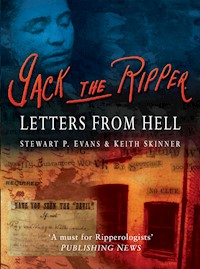
Between August and November 1888 six women were found murdered and mutilated in London's East End and Aldgate. All were prostitutes; five were found in the street and the sixth in a house. The murders provoked massive interest in the press and dozens of letters quickly appeared, claiming to have been written by the killer. The origin of the name Jack the Ripper itself was a letter, famously written to 'Dear Boss', the head of the Central News Agency. Certain letters have been reproduced or quoted in previous books but Stewart Evans and Keith Skinner are the first to have read and examined every one. This book reproduces and transcibes all the letters, including the 'Dear Boss' correspondence and the horrific letter sent to the chairman of the Whitechapel Vigilance Committee together with a piece of human kidney. The authors relate the letters to the complete story of the Whitechapel murders, tracing the hysteria and misconceptions that dogged both the police and Fleet Street during 1888-9 and providing valuable and revealing insights into the Victorian psyche. For the first time the cases of three people arrested by the police for sending 'Jack the Ripper' letters are explored, including that of Maria Coroner, the attractive 21-year-old Bradford girl. Evans and Skinner also examine the letters of seven suspects, including Dr Roslyn D'Onston Stephenson and Nikaner Benelius. An original and responsible look at a case which has been hackneyed by so many authors, the story of the Ripper letters ends by posing a controversial question: was 'Jack the Ripper' merely a press invention?
Das E-Book können Sie in Legimi-Apps oder einer beliebigen App lesen, die das folgende Format unterstützen:
Veröffentlichungsjahr: 1997
Ähnliche


















For Johnny Depp
Address side of postcard of 3 October 1888 sent to ‘Sir James Fraser, City Police, London, E.C.’
Postcard of 3 October 1888 sent to the City Police from ‘Jack the Ripper’ threatens more murders in the West of London.
Acknowledgements
The invaluable help of the staff at the Public Record Office, Kew, the Corporation of London Record Office, the Guildhall Library, the Archive and Museum Departments of the Metropolitan Police, the Metropolitan Police Library, The Royal London Hospital Archives and Museum, City of London Police Museum, British Library Newspaper Library, West Sussex Record Office, Post Office Archives, and the National Archives of Scotland, is gratefully acknowledged. Acknowledgement is also made to the Controller of Her Majesty’s Stationery Office, via the above offices.
Both authors would like to thank the following individuals for their support and generosity in the compilation of this work: Andy Aliffe, Coral Atkins, Paul Begg, Maggie Bird, Andrew Brown, Stephen Butt, Galla Cassettari, Martin Childs, Richard J. Childs, Alex Chisholm, Nick Connell, Roy Deeley, Kumari Dharmeratnam, Christopher-Michael DiGrazia, R. Dixon Smith, Heather Edwards, Jonathan Evans, Paul Feldman, Martin Fido, Seren Fisher, A. Dylan Gable, Christopher T. George, Melvin Harris, Rosemarie Howell, Albert and Allen Hughes, Sue Iremonger, Timothy J. McCann, Jessica Newton, Adrian Phypers, Julian Rixer, Donald Rumbelow, Stephen P. Ryder, Jim Sewell, Richard (‘Supreme Being’) Sharp, Robert Smith, Phil Sugden, Jim Swanson, Christine Thomas, Julia Todd, Tom Wescott, Molly Whittington-Egan, Richard Whittington-Egan, and Jane Crompton and Sarah Moore of Sutton Publishing for their wise counsel and invaluable guidance.
And our thanks to Bruce Robinson for his special contribution to, and interest in, this work.
Contents
Title
Dedication
Acknowledgements
Foreword
Introduction
PART ONE
1. ‘Fifteen more and I give myself up’
2. ‘Yours truly, Jack the Ripper’
3. ‘The Writing on the Wall’
4. ‘Ripperism’
5. The ‘Enterprising’ London Journalists
6. A Letter ‘From hell’
7. ‘Most unwomanly … ’
8. ‘I will rip a few more’
9. ‘I’m still knocking about Down Whitechapel’
10. ‘Good Bye old fellow til i return’
11. ‘They summoned the spirit’
12. The City Letters
13. The Alienist
14. A View from Fleet Street
15. The Mysteries of McCormick
16. ‘A secret diary of Dr. Thomas Dutton’
17. ‘I’m Jack’
18. Suspects
PART TWO
The Letters
Bibliography
Copyright
Foreword by Martin Fido
BETWEEN 1958 and 1965 Donald McCormick, Tom Cullen and Robin Odell wrote the three books that determined the popular view of the Whitechapel murders for the next thirty years. They offered different suspects as the real Jack the Ripper: Dr Alexandr Pedachenko, Montague John Druitt, and an unknown Jewish shochet, or ritual butcher. The common reader like myself found each identification quite convincing as he read it, and kept changing his mind about which was the Ripper. And their overall picture of the case was not seriously challenged until Donald Rumbelow’s The Complete Jack the Ripper appeared in 1975. By accessing the Scotland Yard files denied to McCormick, Cullen and Odell, Rumbelow was able to correct some of their misconceptions.
High among these was the conviction that the Whitechapel murderer himself wrote many of the letters confessing to the crimes that reached Scotland Yard. In particular, he wrote the famous ‘Dear Boss’ letter and ‘Saucy Jacky’ postcard addressed to ‘the Boss’ at the Central News Agency and signed ‘Jack the Ripper’, which gave the killer a nickname and the world an icon of horror. To this day one is likely to read as ‘fact’ that Jack the Ripper wrote to the police, taunting them; that he named himself; and that this represents a common practice of multiple murderers.
Actually, despite some high-profile cases like David Berkowitz ‘the Son of Sam’, the undetected ‘Zodiac killer’, and the Conn Edison and Una-bombers, it is not especially common for such men to inject themselves into their cases by correspondence. But the historical interest of the cache of Ripper letters held by the Metropolitan and City of London police forces is undiminished. And here, thanks to Stewart Evans and Keith Skinner, who have already given the world of Ripper studies the absolutely indispensable Ultimate Source Book, the entire collection is made available to the general reader, with full-colour reproductions of the most important of them, and the best long essay that has ever been written on the Ripper letters.
The general reader will have the opportunity to study facsimiles of the originals, and come to his or her own conclusion as to whether the ‘Moab and Midian’ letter forwarded by the Central News Agency to Scotland Yard really was (as document examiner Sue Iremonger believed) in the same hand as the ‘Dear Boss’ letter, and whether the handwriting suggests that Tom Bulling, the journalist who sent the cover letter, could have been the actual author of both. He or she will be able to scrutinise for him- or herself the red ink dots in the ‘Dear Boss’, and come to whatever conclusions seem appropriate concerning its perfect spelling and adequate grammar, but variously missing or unnecessary punctuation. Stewart Evans’ brilliant observation can be confirmed by examination: that the so-called ‘Lees’ letter, long believed to show some contemporary awareness of the spiritualist medium R.J. Lees’ pretended involvement in the case, is actually a ‘tecs’ letter, making no reference to Lees at all.
The true crime buff may find his attention grabbed by the end of the book, seeing the letter apparently claiming that Mrs Phoebe Hogg was killed by Jack the Ripper, and not by her husband’s lover Mary Eleanor Pearcey (who was sometimes herself accused of the Whitechapel murders by those who thought Jack the Ripper might really be Jill). He may be fascinated to see the charge that ‘Wainwright’s grandson’ was one of the Ripper’s gang of three, recalling the Whitechapel murderer Henry Wainwright (who cut up and buried his mistress in his warehouse, and then in 1875 had to transport her parcelled-up remains to Southwark by cab when he was evicted for bankruptcy). He will read with fascination the long doggerel poem attacking ‘Funk [or ‘Flunk’], stupid fool’ which seems to be aimed at the self-important lawyer-asylum keeper L. Forbes Winslow for his insistence that the murderer must be a lunatic connected with Finsbury, and that Winslow had taken possession of his boots. And the dedicated Ripper expert will be fascinated by the absent poems. Of all the famous rhymes ascribed to the Ripper, only one has been found on the files:
O have you seen the devle
with his mikerscope and scalpul
a lookin at a Kidney
With a slide cocked up.
The East End murders featured in periodicals of the day. Here members of the Whitechapel Vigilance Committee are depicted on the lookout for suspicious characters, as published in the Illustrated London News of 13 October 1888.
NOT even the likeliest (and by far the best written, best rhyming and best scanning) of the others, the rhyme quoted by Chief Constable Sir Melville Macnaghten, is to be found:
I’m not a butcher, I’m not a Yid,
Nor yet a foreign skipper,
But I’m your own light-hearted friend,
Yours truly, Jack the Ripper.
But then, given Macnaghten’s suspected propensity for retaining sensational documents as souvenirs, he might well have absconded permanently with any Ripper letter if it were addressed directly to him or his office.
And all categories of reader should enjoy the coarse forgotten nickname ‘Bill the Boweller’ that one writer offered as a substitute for Jack the Ripper.
The dedicated Ripper enthusiast who follows debates on the internet will probably regret the courtesy with which Keith Skinner has effaced himself from chapters 15 and 16, while Stewart Evans has carefully refrained from saying anything to which Keith might take exception. For it could have been illuminating to read their apparent disagreement over the vexed question of the late Donald McCormick’s sources.
McCormick, the first of the postwar writers on the Ripper, was also the one to give the strongest boost to the Ripper letters. He averred that Dr Thomas Dutton had established by microphotography (and nobody disputes that the intended process must have been what is now called photomicrography: the enlargement rather than the diminution of images by many magnifications) that at least thirty-four of the Ripper letters, including the ‘Dear Boss’, were in the same hand as the chalk graffiti found on a doorway in Goulston Street over a portion of victim Katherine Eddowes’ apron, and long believed to be the work of the murderer. McCormick claimed that many facts he offered were verified by Dr Dutton’s handwritten ‘Chronicles of Crime’, from which Dutton had allowed him to take notes in 1932. And he cited as one of several previously unprinted ‘Ripper’ rhymes and writings, a piece of doggerel beginning:
Eight little whores, with no hope of heaven,
Gladstone may save one, then there’ll be seven.
Now it is easy to demonstrate from the successive editions of McCormick’s book that he was an utterly unreliable writer, who fudged or fabricated his ‘evidence’ to fit other people’s new discoveries when it suited him. It is not without interest that one of McCormick’s own books discussed Gladstone’s personal ‘mission’ to convert streetwalkers. The only living writer to have succeeded in wresting an interview on the Ripper with McCormick came away persuaded that the Dutton ‘Chronicles’ were at the least misquoted, and may well have been effectively invented by McCormick as a fake source for his own speculations and inventions. He suggested that McCormick might himself have placed the entries in the press which appear to confirm that the ‘Chronicles’ existed at the time of Dutton’s death in 1935. He formed the impression that McCormick had in essence confessed to him that ‘Eight little whores’ was not a genuine survival from 1888, and he has suggested that it was really written by McCormick’s friend Ian Fleming. But the more he has been pressed for clarification on exactly how much McCormick explicitly admitted, the more it has seemed that a good many of his own conclusions rest on highly subjective deductions from McCormick’s evasive replies.
Evidently Stewart and Keith differ as to how completely McCormick has been debunked, or, perhaps more precisely, what degree of credit may be given to ideas supposedly deriving from Dr Dutton’s lost ‘Chronicles’. One can only regret that the two researchers who know more than anybody else about the letters, both on file and as recorded in books, have put consideration for each other above the relentless pursuit of truth through debate. At the same time, one can only applaud their good manners and delicacy.
This whole question of confessions and sensational information springing up around notorious murders is by no means a matter buried in the past. As the manuscript of Letters From Hell reached me, I was in the process of sorting my files following a move, and I had just turned up a forgotten letter that LBC Radio passed on to me a few years ago. It opens:
In regards to Lee Harvey, Oswald the assassin, I would like to put your friend Martin Fido right on some things that seems to be troubling him. I first met Lee here in London outside the House where he shared a flat With wife, JACK RUBY, and a young chap named RAY, He introduced Jack Ruby as his best buddy in the world, better even than his Brother.
The writer gives his address and signs his name. But the crude insensitivity with which he tries to inflate his own importance by purveying a pack of lies linking Oswald, Oswald’s own killer, and Martin Luther King’s murderer in a plot to kill Kennedy might just as well have been datelined ‘From Hell’, and signed, JACK the RIPPER.
Introduction
IN November 1987 a large brown envelope was sent anonymously to New Scotland Yard. It bore a Croydon postmark. Fingerprint tests were carried out but they did not lead to the identification of the sender. The envelope contained old documents relating to the Dr Crippen case and the ‘Jack the Ripper’ murders. Included was a letter written in red ink, together with its envelope and original police mounting sheet. The letter was creased, a piece was missing from one side, and the ink had bled into the rather poor-quality paper. For many years this infamous document, with its now almost illegible postscript, had been missing from Scotland Yard’s files, believed taken as a souvenir by a senior police officer. The public announcement about the return of the documents was not made until August 1988 when it received considerable press coverage and the Deputy Commissioner, John Dellow, gave interviews to reporters. The ‘Dear Boss’ letter had hit the news again almost a century after its first exposure. A headline in the Sun of Friday 19 August 1988 said it all: ‘Ripper Taunts Police Again 100 Years On’.
This book includes an examination of that letter and many others. They represent a large body of frequently overlooked primary source material in the official Metropolitan Police files and the City of London Police papers: the correspondence generated by the Whitechapel Murders of 1888–91 and purporting to have been sent by the killer. Other authors have surveyed these documents, of course, but our work has involved examining and transcribing the original letters in the archives. This, we believe, is the only way to fully understand how the correspondence impacted on the case, and to appreciate, almost marvel, at the striking visual impact of some of the letters. Their historical importance lies in their huge social relevance; they reveal not only the thinking of the time, but also the profound effect that the murders had on some individuals and on the Victorian newspapers.
Postcard of 5 October to the Hackney Standard (seehere).
Letter dated 12 November 1888 and posted in London WC. It includes a self-portrait of the writer who claims to be ‘Jack the Ripper’.
Some of the letters have deteriorated little over the years. Others have fared less well. Much depends on the quality of the paper used. Some are friable, others robust, but at least now they are all properly conserved. The envelopes preserved with some of the letters in the Metropolitan Police files at the Public Record Office (PRO) appear to have suffered the attention of a keen philatelist at some time. Many never bore a postage stamp and are stamped with the Post Office’s 2d charge as a result, but most of those that did have a postage stamp have not survived intact. Presumably prior to their deposit in the PRO someone tore off most of the postage stamps thus damaging these valuable historical documents and removing the information that was carried by their postmarks.
We have not attempted a psychological assessment of these letters, which is beyond the scope of this book and certainly beyond the capability of both authors! But we have been struck by how charged some of them are with emotional energy and personality. A closer study and analysis of them may reveal facets and themes worth exploring or developing. We have merely presented the preserved scripts, thus making them readily available for the first time. What we may be certain of, however, is that the legend of ‘Jack the Ripper’ resulted from and has endured because of this correspondence. Experts on the case are divided over the status of the documents. We know for certain that some series murderers do write letters to the police, so the possibility can never be excluded that within this material there is an actual letter, or letters, from the real ‘Jack the Ripper’.
Part One
Middlesex Street (Petticoat Lane) was at the heart of ‘Ripper’ territory and was the ‘old clothes’ district of the East End where the main market commodity was clothing. It was the centre of the Jewish quarter. This photograph, taken in the 1890s, shows the busy Sunday market.
A London street scene from the 1880s – a lost child is spoken to by a police officer. (From the Illustrated London News)
One
‘Fifteen more and I give myself up … ’
THE setting for the so-called Whitechapel murders was the Metropolitan Police-patrolled East End of London and the eastern limits of the City Police area around Aldgate and Bishopsgate. In the late 1880s this was the very poorest area of London and the location of the capital’s most squalid and shameful slums. American author Jack London later appropriately called it ‘The Abyss’. London was the greatest city in the world in 1888, but the East End was a festering sore on that greatness. A confidential police report to the Home Office of 25 October 1888 stated:
… there has been no return hitherto of the probable numbers of brothels in London, but during the last few months I have been tabulating the observations of Constables on their beats, and have come to the conclusion that there are 62 houses known to be brothels on the H or Whitechapel Divn and probably a great number of other houses which are more or less intermitently [sic] used for such purposes.
The number of C.L.Hs. [Common Lodging Houses] is 233, accommodating 8,530 persons, we have no means of ascertaining what women are prostitutes and who are not, but there is an impression that there are about 1200 prostitutes, mostly of a very low condition …
The lower class of C.L.Hs. is naturally frequented by prostitutes, thieves & tramps as there is nowhere else for them to go, & no law to prevent their congregating there.
I fear that in driving the Brothel keepers away from certain neighbourhoods much is being done to demoralise London generally, it is impossible to stop the supply while the demand exists …
[MEPO 3/141 ff. 158–63]
Our story begins on 3 April 1888, when a gang of three ruffians, one aged only about nineteen, attacked a prostitute named Emma Smith in the street in Whitechapel. She was fearfully injured when a blunt instrument was thrust into her vagina and she died of peritonitis the morning of the following day at the London Hospital in Whitechapel Road. Robbery was the probable motive and her attackers were never identified. This was later to become known, officially, as the first Whitechapel murder.
PC Neil discovering the body of Mary Ann Nichols in Buck’s Row, Whitechapel, 31 August 1888.
On Tuesday 7 August 1888, the body of a second prostitute, Martha Tabram (or Turner), was discovered on the first-floor landing of tenement dwellings called George Yard Buildings in George Yard, Whitechapel. She had been violently stabbed thirty-nine times, one wound penetrating the sternum. Her assailant was never discovered. The press commented on the brutality of this attack, but it was not accorded any great significance. The local CID Inspector, Edmund Reid, carried out a thorough investigation but, again, no offender was identified. No connection was made with the previous murder, and with good reason; undoubtedly the two attacks were unrelated. Tabram had, in all probability, fallen victim to one of her own clients, a risk that all prostitutes take.
When a third prostitute, Mary Ann Nichols, fell to a murderer’s knife in Buck’s Row, Whitechapel, on Friday 31 August the police, press and public became alarmed. Nichols had been killed in the street, her throat deeply cut, and mutilations inflicted on her abdomen and genital area. Indeed, so deep were her wounds that her viscera protruded from the abdominal cuts. A third unsolved prostitute murder had now occurred in the same geographic area, and was of a similar brutal nature. Past history showed that although this was a violent area of London, murder was not common in the district. The three Whitechapel murders were immediately identified as a ‘series’ and the press proclaimed that a homicidal maniac was on the loose. The ‘fiend’, as yet unidentified, had been born, but remained unnamed. ‘The Whitechapel Murderer’ seemed the most logical title to give him, as no other was known. Even though the name ‘Jack the Ripper’ had yet to be invented, the legend quickly began to take shape.
Hardly had the excitement over the Nichols’ murder subsided when the worst fears seemed to be confirmed. The body of a fourth prostitute, Annie Chapman, was found on the morning of Saturday 8 September in the back yard of 29 Hanbury Street, Spitalfields. The throat had been cut, too, almost to the point of decapitation, and the poor woman had been disembowelled. To heap horror upon horror, the doctor’s examination revealed that the killer had removed and taken away her uterus and part of her bladder and vagina. There were two cheap rings missing from one of her fingers. The police could find no clue to the identity of the murderer but as a result of questioning of East End prostitutes the name of a suspect had emerged, ‘Leather Apron’. This nickname had been bestowed upon a Jewish slipper-maker called John Pizer who wore the garment that provided his appellation as part of his trade clothing. It was claimed that he extorted money from the prostitutes and bullied them. The nickname was a gift for the sensational press but Pizer’s eventual arrest and appearance at Chapman’s inquest resulted in his elimination from the police inquiry.
It was in connection with the Chapman murder that there was an early press suggestion of a communication from the murderer. The Times of Monday 10 September carried the following report:
An atmospheric illustration from 1888 showing a Victorian pillar-box and street scene. (Punch)
The police, however, have been unable to discover any person who saw the deceased alive after 2 a.m., about which time she left the lodging-house at 35, Dorset-street, because she had not 4d. to pay for her bed. No corroboration of the reported statement that she was served in a public house at Spitalfields Market on it opening at 5 a.m. could be gained, nor of the sensational report that the murderer left a message on the wall in the yard, which was made out to read, “Five; 15 more and then I give myself up.” Nevertheless, the police express a strong opinion that more murders of the kind will be committed before the miscreant is apprehended.
The Daily Telegraph of the same date carried a similar report, with an additional angle to the story:
A number of sensational stories are altogether without corroboration, such, for instance, as the tale that writing was seen on the wall of No. 29: “I have now done three, and intend to do nine more and give myself up.” One version says some such threat as “Five – Fifteen more and I give myself up,” was written upon a piece of paper that was picked up …
Although this ‘writing on the wall’ and ‘piece of paper’ were totally apocryphal, as far as can be ascertained, the image of the unknown murderer was being developed and the scene set for future alleged communications from the killer, including graffiti.
One of the early theorists spawned by this series of murders wrote to The Times and his letter was published on Wednesday 12 September. He was the alienist Dr Lyttleton Stewart Forbes Winslow, who had long experience in dealing with the mentally afflicted:
TO THE EDITOR OF THE TIMES.
Sir, – My theory having been circulated far and wide with reference to an opinion given to the authorities of the Criminal Investigation Department, I would like to qualify such statements in your columns.
That the murderer of the three victims in Whitechapel is one and the same person I have no doubt.
The whole affair is that of a lunatic, and as there is “a method in madness,” so there was method shown in the crime and in the gradual dissection of the body of the latest victim. It is not the work of a responsible person. It is a well-known and accepted fact that homicidal mania is incurable, but difficult of detection, as it frequently lies latent. It is incurable, and those who have been the subject of it should never be let loose on society.
I think that the murderer is not of the class of which ‘Leather Apron’ belongs, but is of the upper class of society, and I still think that my opinion given to the authorities is the correct one – viz., that the murders have been committed by a lunatic lately discharged from some asylum, or by one who has escaped. If the former, doubtless one who, though suffering from the effects of homicidal mania, is apparently sane on the surface, and consequently has been liberated, and is following out the inclinations of his morbid imaginations by wholesale homicide. I think the advice given by me a sound one – to apply for an immediate return from all asylums who have discharged such individuals, with a view of ascertaining their whereabouts. I am your obedient servant,
L. FORBESWINSLOW, M.B. Camb., D.C.L. Oxon.
70, Wimpole-street, Cavendish-square, W., Sept. 11.
The Illustrated Police News of 15 September carried lurid drawings featuring the murders. The images here relate to the murders of Emma Smith, Martha Tabram, Mary Ann Nichols and Annie Chapman.
It was the era of the ‘new journalism’ and the result of all the high-profile press coverage of the murders, the inquests and the arrest of suspects led to great public excitement, fear and curiosity. The story was selling newspapers on an unprecedented scale. The tabloid press was quick to exploit the tragedies and interest was international. Unknown to the press at the time, a letter was sent, its envelope addressed in a fairly neat hand, to ‘Sir Charles Warren, commissioner of police, Scotland Yard’. There was no stamp on the envelope and written across the top was ‘on her majesterys service’. The postmark was ‘LONDON S.E.’ and it was dated ‘SP 24 88’; 24 September was the closing day of the Chapman inquest and there was wide coverage in the papers. The letter was received by the Criminal Investigation Department of the Metropolitan Police on 25 September. It read:
Sep 24 1888
Dear sir
I do wish to give myself up I am in misery with nightmare I am the man who committed all these murders in the last six months my name is so [silhouette of coffin] and so I am a horse slauterer and work at Name [blocked out] address [blocked out] I have found the woman I wanted that is chapman and I done what I called slautered her but if any one comes I will surrender but I am not going to walk to the station by myself so I am yours truly
[second page] keep the Boro road clear or I might take a trip up there
photo [silhouette of a knife] knife
this is the knife that I done these murders with it is a small handle with a large long blade sharpe both sides
The writer of this letter cannot have realised it, but he was to be the forerunner of many who were to plague the police with such communications. In fact, this letter heralded the arrival of its more famous contemporary two days later. The writer also introduced themes that were to recur in later correspondence. He revealed that he was following the press reports by picking up on suspects such as three horse slaughterers (in the Nichols case) and by describing his knife – a description the doctors had ventured at the inquest hearings. Slaughterers, and butchers, were to remain popular as suspects throughout the story of the murders.
This letter did not contain anything that the police could say was known only to the killer, and there is nothing to suggest that they took it seriously. Indeed, the police often received hoax and crank letters in relation to high-profile murder cases that were reported in the newspapers. The motives of the authors of such letters were as diverse as the writers themselves. They included the purely malicious taking the opportunity to ridicule the hated police, the jokers hoping to see their work cause consternation, the grudge-bearers seeking to place false blame for the murders, and those merely hoping to see their misguided writings published.
Such letters may have been easily set aside by the police for what they were, but others seriously misled them and wasted valuable time in the hunt for the murderer. It had been seen before and would be seen again. However, in this case letter-writing was to become a true sensation spawning a deluge of postal communications the like of which had never before been experienced, a deluge that would continue for almost two years before dwindling to a trickle.
Envelope and letter of 24 September 1888, the first anonymous correspondence allegedly from the Whitechapel murderer. It pre-dates the famous ‘Dear Boss’ letter.
Stamping letters by hand.
Another worrying aspect of such letter-writers, regardless of the case, is that they are rarely identified, let alone prosecuted. To browse through the dozens of communications preserved in the Metropolitan Police MEPO 3/142 file held at the Public Record Office is a daunting task – there are some 210 of them, not even chronologically arranged. They vary from the barely literate to the respectable and articulate. Among them are some of great interest, and, for all we know, possibly even one or more from the killer himself. It is this possibility that has encouraged past writers and researchers to examine many of the letters carefully in the hope that they may contain some sort of clue or support for a particular theory or suspect.
The General Post Office of 1888 was a well-established government postal service and enjoyed a high reputation for efficiency and security. It was the most popular of the government departments. According to the Postmaster-General, 1,700 million letters and postcards were received per annum, of which nearly a third were delivered in London. The sorting of the letters was quite sophisticated and was done in batches of fifty, the fifty-first stamp being placed in each case on a strip of paper instead of on a letter, so that the number of stamps on the strip gave a tally of the number of fifties that had passed through the operator’s hands. In each gallery an officer in charge of a rack changed the stamps with every mail. Each stamper had to get his stamp from the rack and sign for it in a book. The postmark on the letter thus showed not only the office from which the letter was despatched, but the mail by which it was sent, and the person by whom the impression was made.*
The General Post Office’s great stone building at St Martin’s-le-Grand in the City of London. It was the headquarters of the exceedingly efficient Victorian postal service.
The initials of the London postal districts were added to addresses on letters to guarantee increased security against misdelivery or delay, and ensured increased postal efficiency. Within the EC district there were twelve daily deliveries, and in the other districts eleven. The first commenced about 7 a.m. and, except on Mondays and busy days when there were large arrivals of foreign post, was generally completed throughout London by 9 a.m. In the EC district the second delivery began at about 8.30 a.m. and included the correspondence received by night mail from Ireland and the north mails which arrived at 8 a.m. The third delivery in the EC area corresponded with the second delivery in other districts and began at about 10 a.m. It included the letters collected in London generally at 8.45 a.m. and the correspondence from the ‘Scotch mail’, which arrived at about 9 a.m. The following nine deliveries were made in every district hourly, and included all letters reaching the General Post Office, or the district post offices, in time for each despatch. The last delivery, extending to all districts, began at 7.45 p.m. Each took about an hour.
The collection of mail was regular and efficient. The latest times for posting letters at the chief district offices, branch offices, receiving houses and pillar-boxes for the London and suburban despatches, and for the inland, colonial and foreign mails were listed in published tables. In the town districts generally, and in certain suburbs where there was a collection from pillar-boxes at 3 a.m., the receiving office letter-boxes were closed during the night and on Sundays. This was so that letters could not be posted there, but had to be put into pillar-boxes and so had the advantage of the early collection. The main General Post Office was situated at St Martin’s-le-Grand. The main district offices were Holborn (WC), Islington (N), Commercial Road East (E), Blackman Street Borough (SE), Buckingham Gate (SW), Vere Street (W), and Eversholt Street (NW). A fine example of a Victorian pillar-box can still be seen in the High Street, Kensington; it is one of the oldest in London.
On Sundays all post offices in the London district were closed, with the exception of those open for the receipt and despatch of telegrams during stated hours. Letters posted on Sundays in pillar-boxes within London’s limits, and in some of the nearer suburbs, were collected early on Monday morning in time for the general day mails, and for the first London district delivery.*
Old documents, such as letters, have always held a fascination for historians, researchers and collectors alike. In their yellowing pages many secrets may be found, as well as previously unknown snippets of information; and this is particularly so in connection with an historical murder mystery such as the Ripper case. What is very evident from an examination of the contemporary press and police files, is that the correspondence had an extraordinary and lasting effect on this case. It started a legend that was not to die. It ensured the creation of a ‘Ripper’-based industry that thrives today, over 100 years after the event. It also created a super-villain, an enduring bogeyman whose name would figure larger in the annals of crime than any other murderer. And his real name is still unknown.
The famous Victorian journalist, author, playwright and criminologist, George R. Sims (1847–1922), closely followed the murders and provided an informed commentary on the developing story and its great relevance to the press of the day. His regular contributions to the Sunday newspaper the Referee appeared under the heading ‘Mustard and Cress’, and he wrote using the nom de plume ‘Dagonet’ (Dagonet was King Arthur’s fool in Malory’s Morte d’Arthur). Sims was quick to recognise the significance of the crimes. In the Referee of 9 September 1888, he wrote:
The Whitechapel murders, which have come to the relief of newspaper editors in search of a sensation, are not the kind of murders which pay best. The element of romance is altogether lacking, and they are crimes of the coarsest and most vulgar brutality – not the sort of murders that can be discussed in the drawing-room and the nursery with any amount of pleasure. The best element in the cases for newspaper purposes is that they are similar to a murder which was committed near the same spot some time previously, and this enables the talented journalist to start the idea that the four crimes are by the same hand. Given this idea, and “the maniac who lures women into lonely spots and cuts them up” speedily assumes a definite shape. If only the women had belonged to another class, or been in more comfortable circumstances, there might, with skilful manipulation, have been worked up an excitement almost equal to the Marr and Williamson sensation [the so-called Ratcliffe Highway murders of 1811 when two East End families, the Marrs and the Williamsons, were murdered by John Williams].
George R. Sims, the Victorian journalist, author, playwright and criminologist who was intensely interested in the Ripper murders and wrote extensively on them in the Referee.
The murder of the Marrs created such a widespread panic that it led to a great reform in the police administration of the metropolis. The old Charley was voted an anachronism, and he gave way to a corps of civilian guards, who have since developed into our helmeted Roberts. The Whitechapel murder looks like causing the question of inadequate police protection to be trotted out again. As a matter of fact the London police force is utterly inadequate to the growing needs of the rapidly increasing metropolis. The wonder is, not that so many attacks on life and property are made with impunity, but that there are so few. If the criminal classes had anything like organisation, London would be at their mercy.
The police up to the moment of writing are still at sea as to the series of Whitechapel murders – a series with such a strong family likeness as to point conclusively to one assassin or firm of assassins. The detective force is singularly lacking in the smartness and variety of resource which the most ordinary detective displays in the shilling shocker. As a rule, your modern detective waits for “information,” instead of making a clue for himself by joining together the links of circumstantial evidence. In the Whitechapel cases the theory is that there is either a maniac at the bottom of them, or that they are the work of a “High Rip” gang. That theory should be followed up until it is proved to be a false one. The decoy system might very well be tried. Decoys could be sent out all over the neighbourhood, and the chances are the bird would be caught by one of them. If a number of old gentlemen had been knocked down and robbed of their gold chains in a certain neighbourhood, the best thing would be to dress up a police agent as an old gentleman, give him a chain, and tell him to expose himself to danger. Directly the thief came he could give the signal, and his confederates in the force would close in, and the thief would be caught. Scotland-yard ought to be able to put temptation in the way of the Whitechapel ruffian (if he is an habitual woman murderer) to make him walk into the trap.
The astute Sims had identified, even at this early stage, its huge potential for the press. His words are at once very colourful and of the greatest importance. Public interest was aroused; the papers were selling as never before. And the missing key to the development of the sensation had been provided. The unknown killer, as we have seen, now had a name – ‘Leather Apron’. On 16 September, Sims wrote in the Referee:
Room for Leather Apron! …
It is only the careful observer, the close student of our insular everyday life, the professional expert, who can thoroughly gauge the extent to which Leather Apron has impressed himself upon the public mind. Up to a few days ago the mere mention of Leather Apron’s name was sufficient to cause a panic. All England was murmuring his name with bated breath. In one instance, which is duly recorded in the police reports, a man merely went into a public-house and said that he knew Leather Apron, and the customers, leaving their drinks unfinished, fled en masse, while the landlady, speechless with terror, bolted out of a back door and ran to the police-station, leaving the grim humourist in sole possession of the establishment, till and all. Never since the days of Burke and Hare has a name borne such a fearful significance.
… It is astonishing how eagerly the Press seized upon the mere mention of a person with this ordinary nickname, and worked it up into a blood-curdling sensation. The name of Leather Apron has been flashed from pole to pole. It is to-day as much a byword on Greenland’s icy mountains and on India’s coral strand as it is in Whitechapel and at Scotland-yard. And why? Primarily because there was something in the sound which suggested a big catch-on. It is possible that the harmless individual who was arrested as Leather Apron, and discharged because there wasn’t enough evidence against him to convict a bluebottle of buzzing, may not lose his celebrity for a generation. He has been written up with such a vengeance that he will be a famous man to the end of his days.
The booming of Leather Apron in connection with the Whitechapel murders illustrates the bungling way in which the business is being conducted by the police. It is a million to one that when (O that all-important when!) the bona-fide murderer (bona-fide murderer is good!) is arrested he will be found to be someone who never heard of a leather apron in his life. The police may be playing a game of spoof, but the fact remains that in no suggestion made by the authorities up to the present is the slightest technical knowledge of the “speciality” of the Whitechapel atrocities shown.
Sims’ ‘Mustard and Cress’ column of 16 September made mention of the nickname ‘Leather Apron’ before the more infamous ‘Jack the Ripper’ was invented later that month.
Sims was very critical of the police and their lack of success in the investigation. The police cause was not helped by the fact that the head of the CID, James Monro, had resigned in August 1888 after many clashes with Commissioner Sir Charles Warren. The new head of the detectives, Dr Robert Anderson, took up his duties at Scotland Yard at the beginning of September but almost immediately went on sick leave, departing the country for Switzerland on the day of the Chapman murder and not returning until early October. Some of the criticism may have been unfair, but it was to be found in many of the newspapers of the day. This was a big story and it became bigger and more sensational week by week. It was obviously in the interests of the press to boost reports by whatever means they could. The name ‘Leather Apron’ had provided a means for doing this, but after the arrest and release of Pizer the nickname was no longer of any use in selling papers and promoting the story of the unsolved murders. Most reports reverted to calling the unknown killer ‘the Whitechapel Murderer’, but this seemed altogether too mundane and lacked the impact of a catchy sobriquet. Reports on the inquests and the investigation of various suspects kept the topic alive, but there was no telling name to give the story an edge. What was needed was a nom de guerre for the unknown and phantom-like stalker of East End prostitutes.
NOTES
* W.J. Gordon, How London Lives (The Religious Tract Society, c. 1890).
*Dickens’s Dictionary of London 1888 (Moretonhampstead, Old House Books, reprint).
Two
‘Yours truly, Jack the Ripper’
THE Central News Agency was founded in 1870 by William Saunders MP, a philanthropist, social reformer and businessman. It opened two years after the Press Association, and was a media service that collected reports by telegraph from correspondents throughout the United Kingdom and abroad. It was turned into a limited liability company ten years after its foundation and swiftly built a reputation for securing scoops, often beating all the other media sources to the big stories. The Central News was twelve hours ahead of everybody else with news of the fall of Khartoum and the death of General Gordon. It telegraphed important events, parliamentary reports, Stock Exchange and market reports, law cases, racing results and other newsworthy items to newspapers, exchanges, clubs and newsrooms. Communications intended for general publication were forwarded to the Central News by messenger or telegraph. In short news was the company’s lifeblood and a marketable commodity that would be certain to reach many newspapers.
The Central News Agency enjoyed a good relationship with the London police forces and there is a letter on file in the Corporation of London Record Office from John Moore, manager of the Agency, to Major Smith, Assistant Commissioner of the City of London Police. Dated 19 September 1888, it reads:
Dear Sir,
Will it be agreeable to you to let us have copies of the Bills which are sent out to the various Police Stations for posting? If you can see your way to doing this you will much oblige.
Yours faithfully,
John Moore
Manager
[CLRO, Police Box 3.21, No. 309]
Letter written by John Moore, manager of the Central News Agency, on 19 September 1888 to the City Police asking for bills about the murder. (CLRO Police Box 3.21, No. 309)
New Bridge Street, City of London, looking towards Ludgate Circus and Farringdon Street. The Central News office at 5 New Bridge Street is the lighter-coloured building with a portico, on the left.
The ‘Dear Boss’ envelope and letter (right and opposite) dated 25 September 1888 and sent to the Central News Agency. This letter was the origin of the name ‘Jack the Ripper’.
This letter was marked ‘Approved. H.S. [Henry Smith, Assistant Commissioner] for Commr.’ and ‘2 Posters sent 3.10.88’ was recorded at the top of the letter. It is not clear to which posters this refers, but we can but assume that they must have related to the Whitechapel murders in the Metropolitan Police area for Moore’s letter was sent before a murder had occurred in the City police area.
About the time the police received the first letter another anonymous writer was sitting down and composing a communication, his pen charged with red ink. This time it was not to be posted to the police, nor did the writer fail to supply a signature. He dated the letter 25 September 1888, and his message, if it were true, was very clear. The letter was stated to have been received by the Central News Agency at 5 New Bridge Street, Ludgate Circus, on Thursday 27 September 1888 and according to the company, was initially ‘treated as a joke’. This letter and its envelope are preserved at the Public Record Office. It bore a penny lilac stamp postmarked ‘LONDON E.C. 3 – SP 27 88 – P’ and was addressed to ‘The Boss Central News Office London City’. The letter ran as follows:
Dear Boss,
I keep on hearing the police have caught me but they wont fix me just yet. I have laughed when they look so clever and talk about being on the right track. That joke about Leather Apron gave me real fits. I am down on whores and I shant quit ripping them till I do get buckled. Grand work the last job was. I gave the lady no time to squeal. How can they catch me now. I love my work and want to start again. You will soon hear of me with my funny little games. I saved some of the proper red stuff in a ginger beer bottle over the last job to write with but it went thick like glue and I cant use it. Red ink is fit enough I hope ha.ha. The next job I do I shall clip the lady s ears off and send to the
[second page] police officers just for jolly wouldn’t you. Keep this letter back till I do a bit more work . then give it out straight. My knife’s so nice and sharp I want to get to work right away if I get a chance. Good luck.
yours truly
Jack the Ripper
Dont mind me giving the trade name
Then written at right angles below this:




