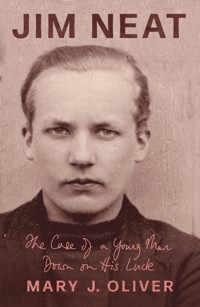
JIM NEAT
For his great grandchildren
Lena, Becca, Tommy and Peter
Seren is the book imprint of
Poetry Wales Press Ltd
57 Nolton Street, Bridgend, Wales, CF31 3AE
www.serenbooks.com
Facebook: facebook.com/SerenBooks
Twitter: @SerenBooks
© Mary J. Oliver.
The right of Mary J. Oliver to be identified as
the author of this work has been asserted in accordance
with the Copyright, Designs and Patents Act, 1988.
ISBN: 978-178-172-514-6
A CIP record for this title is available from the British Library.
All rights reserved. No part of this publication may be reproduced,
stored in a retrieval system, or transmitted at any time or by any means,
electronic, mechanical, photocopying, recording or otherwise without
the prior permission of the copyright holder.
The publisher acknowledges the financial assistance of the Welsh Books Council.
Cover: Southampton City Archives, Received Set, Britain, Merchant Seamen,1921.
Printed by Latimer Trend & Company, Plymouth.
Contents
PART I – INMATE
PART II – WAR
PART III – FOUND
TORONTO GAOL
CORRESPONDENCE
to refer to family matters only
PARCELS
containing tobacco and food prohibited
MAGAZINES/BOOKS
with gun stories strictly forbidden
VISITS AND LETTERS
Remanded inmates: two visits/two letters weekly
Sentenced inmates: one visit/one letter weekly
VISITING HOURS
Daily except Saturday, Sunday and Holidays:
From 9.30 – 11 a.m.
INMATE’S LETTER TO BE WRITTEN ON REVERSE
Nov 19th 1935
Dearest Baby Queen
I’m sorry, but this is where I am. I’ve committed no felony but have
gone to the dogs. Lizbietta is dead. I can hardly remember what’s
happened since then. I ended up in Toronto, taking narcotics again.You
can imagine the results. I’ve been and still am going through absolute
hell, in and out of this place more times than I can count.
It will be hard for you to understand how tough a place this country
can be. Please keep this from Dad. Outside of that, I need no help.
Your loving brother
Jim
INMATES TO USE THIS SIDE OF THE PAPER ONLY
INMATE
WHITBY HOSPITAL, ONTARIO
CASE-NOTES
Admission of:
James William Spencer Neat, known as Jim
Date:
Saturday 23rd November 1935, 5.25 pm
Age:
31
Address:
Vagrant
Place/Date of Birth:
Penge, England, 1904
Condition on arrival:
Comatose. Skin bluish, moist. Breathing depressed.Temperature 94.8 F
Diagnosis:
Heroin/opium overdose / addiction?
Suspected suicide attempt?
Duodenal / peptic ulcer?
Prescribed Treatment:
Hot bath. Physical rest. Neutralization of acid. Regular meals. Bland
food. Licorice sweets. Camomile tea.
Comments:
Patient seriously unkempt. Would appear to have been homeless for
many months. Rousable 2 hours after admission but unwilling to
discuss circumstances. Appears to be in a state of physical and spiritual
breakdown. Keep on Admissions Ward for observation.
Admitting Officer:
D. Fletcher, M.D. Superintendent
11
Saturday 30th November 1935
Since Mr Neat was admitted a week ago he has been withdrawn and at
some risk to himself. I feel strongly that he should not be given insulin
shock treatment. In my opinion he has suffered severe trauma and until
we discover what that was I have no intention of treating him as insane.
He is to be prescribed conservatively with warm baths, good food,
a peaceful environment and the opportunity to talk.
The discomfort of his overdose/withdrawal is now passing and I am
optimistic that we will soon learn more.
D. Fletcher
Monday 2nd December 1935
I have arranged for Jim Neat to be moved to Cottage 11, in the hope
that the view of the lake from his bed and the proximity of the garden
will restore his interest in living.
That our distinguished patient Professor Schofield resides there will
be advantageous to them both. Frank suffered a severe breakdown, was
forced to take sick leave from the Ontario Veterinary College, where
he is Professor of Bacteriology, to recuperate away from both work
and family. When first admitted six months ago, he talked at length to
me about his loss of faith, and about his son, whom he raised alone
after his wife died. He felt that he had not been a good father; that he
had been too wedded to his work. Since the son left home last year to
attend university in Toronto, he has cut off all contact with his father.
Easy to understand how this brought about a total spiritual collapse in
Frank.
Although I do not yet know what reduced Jim to his parlous state, I
am confident the two will get on.
D. Fletcher
12
Monday 9th December 1935
He agreed to attend Mrs MacTaggart’s writing class, but on the first
occasion covered his sheet of paper with blasphemous obscenities. He
returned the next day to apologise, overcome with embarrassment.
Mrs MacTaggart told him he would get one more chance.
She then encouraged him to write in the present tense, to use a free,
creative form, including imaginary postcards he might have sent home,
revealing difficulties he faced on arrival in Canada.
(See attached papers).
D. Fletcher
13
A Squirrel Scorched
Canada, April 1926
I lie on my bunk in the detention centre, over-hear a
conversation.
‘Did you hear about the squirrel that scorched itself on a
power cable? Set fire to the stables of the Winnipeg Race
Track? Eleven thoroughbreds stampeded into The Red River
and froze to death. Their heads are still sticking out the ice,
like tombstones. And now teenage lovers are having sex for all
to see between the blackened skulls, their frosted britches
draped over handy jawbones. Didn’t you hear about it?’
I curse this country where I’d hoped to find work and a wife –
and dream of her.
Signed Jim Neat
14
Imaginary Widow
Lumber Camp, North Saskatchewan, December, 1926
Electro-chainsaws
arrived last week
from Germany.
‘Job’ll be kids’ stuff now’
boss said.
A lie.
My mate was killed
the first day –
a dead branch
Signed Jim Neat
15
fell
out of the tree
he was ripping into.
Widow-makers they’re called.
How I long
for the woman
who’ll be widowed
if one falls
on me.
Unsent Postcards
1926
February, a North Saskatchewan lumber-camp, Dearest Baby
Queen, Temperature dropped by 20 degrees in two hours.
Boss says, ‘Bring the horses in, their eyeballs freeze at 40.’ Too
late. We drag six blind cart-horses into the bunkhouse; lucky
bastards, get fed and blanketed damned sight better than we
do. Driven out by the stink of their shit.Your ever-loving
brother, Jim
1926
August, Alberta, Dearest Baby Queen, Eking out a living
weeding dandelions from between slabs on the sidewalks.
With no place to hide from the sun, wind or dust, I see red,
use the knife meant for hoicking out tap roots for something
else.Your ever-loving brother, Jim
1927
December, Prince Albert Jail. Shovelling snow from one end
of the compound to the other. When I’ve finished, I have to
sweep it back again. Three thousand inmates here, they say.
Ropes slung across corridors are for us to hang over after
dark. Both index fingers gone. Don’t tell Dad.Your
ever-loving brother, Jim
Signed Jim Neat
16
CASE-NOTES (cont.)
Monday 16th December 1935
When asked about significant scar tissue in the Achilles tendon area,
Jim explained that he underwent many operations for a club foot
during the first five years of his life. Although this remained
problematic throughout his youth, it appears to have healed well and
affects him only slightly now.
He also suffered seriously from asthma, but reports that it improved
as soon as he ran away to sea, aged fifteen.
He travelled extensively round the world before emigrating to Canada
ten years ago. He had high expectations but, due to the economic
conditions of our time, drifted into bad habits and has been forced to
live a nomadic life.
Unemployed for the last six months, he has gone hungry on many
occasions, resulting in a suspected duodenal ulcer, exacerbated by
sporadic drug use.
During the fall, he was living rough in Toronto and arrested on many
occasions, leading to frequent short prison sentences. I have acquired
his jail records; he was convicted of vagrancy or drunkenness seven
times within a space of four months. His last arrest was deliberately
engineered, when he ordered and ate a full meal in a good
down-town restaurant, then asked the waiter to call the police, as he
was unable to pay. A day after he had served his sentence for this
crime, he over-dosed on impure heroin. Found by police on a
sidewalk in freezing temperatures in a very poor state, he was brought
here.
He is still unable to speak of the circumstances that led him to such
depths. I am familiar with the hobo’s need to find a roof over his head
during the winter and his willingness to break the law to achieve this
17
end. I have a strong feeling in this case that something else triggered
Jim’s collapse, but I cannot put my finger on it.
He continues to attend Mrs MacTaggart’s classes, slowly revealing the
deteriorating circumstances that brought him here. She says he still
destroys much of his writing, or crosses out the most painful
recollections. (See attached)
D. Fletcher
18
Mam Died
January 1927
I’ve saved enough to send Mam a hundred dollars for
Christmas: ‘Don’t worry about me,’ I write to her, ‘You
should see my muscles! And I sleep like a log!’
A letter from dad two months later: ‘ Your mam lived to read
your letter and was so proud of the dollars you sent, she
declared she’d never spend them. But, it pains me to tell you,
dear boy, she died soon after.
‘We helped her bear her kidney pain but at the end her there
was nothing we could do to help her breathe. The saddest
moment of my life when, gasping for air, she looked at me and
said, “I will miss you so much Ruben, my love”’.
I cry like a boy. Mam’s death? Dad’s sadness? My failures?
Confusion leaves me empty,
depleted of any knowledge of who I am, what I’m doing.
’
Signed Jim Neat
19
East West
1928
Freight train heading west
is shunted into town.
I shove, am shoved.
Bulls
*
order the driver on.
I slink away
alongside the trucks
co-ordinate speed to perfection
grab an arm, am hauled
on board.
Talk is ofVancouver
warmer, logging, work-camps.
Squashed into a space
the size of Mam’s scullery
we play harmonicas
sing Spivanky, O Canada
God save the King.
Almost happy.
Rockies erupt
blot out the sky
vanish.
Stench of faeces and vomit
hangs in the bitter air.
We pass a train two miles long
going east
men riding the rods
or clinging to the roof
men who didn’t get work
where we’re headed
Signed Jim Neat
*
the railroad police, known for their brutality to hobos.
20
Undressing the Dead
Vancouver 1929
Men of the Jungle, we sit in silence on the shore of Burrard
Isle. Too weary to protest we groan about the mess Prime
Minister Bennett’s made, how we’d manage the affairs of state
a bloody sight better if we had his millions, his private
education.
We sit poking small fires, sharing stews and narcotics to numb
the pain. I must escape this brotherhood of ailing flesh. But I
need a coat. I root through a bundle of clothes in a trailer. It’s
solid … a man, already dead. I undress him.
Signed Jim Neat
21
West East
Vancouver to Saskatoon, March, 1930
In the middle of the night I slip out of that inhospitable city
(three months, without a roof over my head), head for the
railroad station. Rumours of farm work in Calgary. I ditch
Dickens, hang onto Conrad. Stuff pockets with tobacco, a
piece of soap, razor, pencil, knife, tin cup, a bag of sugar,
stolen.
Come out from my hiding place through a hole in the fence,
just as the train starts to roll out of the station heading east, I
run alongside, keep my feet as far from the rails as I can, catch
hold of the vertical steel door handle, heave myself sideways
onto the ladder, climb up on top. High risk, riding the rods in
winter. Try not to breathe going through the tunnels. Can’t
get relief at Jaspar, stay hidden, platform heaving with Bulls.
Don’t think about tomorrow.
After two days, body aching, longing for stillness more than
anything on earth, the mountains drop suddenly away, the
temperature rises, I’m enveloped in warm soft prairie
sunshine.
Jump down when the train stops, move around, relieve
myself, try and find water.
Edmonton, at last. But it’s all lies, there is no work. We’re
rounded up, herded off to another work-camp. Sometimes
there’s opium, in exchange for food. My mind black as soot.
One day, I drift away, not caring what the mounted police