


9,99 €
Mehr erfahren.
- Herausgeber: The History Press
- Kategorie: Sachliteratur, Reportagen, Biografien
- Sprache: Englisch
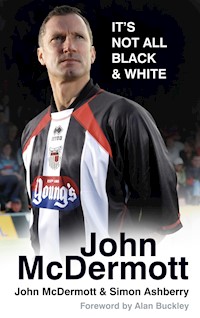
When John McDermott received the annual PFA Merit Award, in recognition of his record-breaking career at Grimsby Town, he joined an elite group of footballers made up of the likes of Sir Bobby Charlton, Pelé and George Best. McDermott was added to the distinguished list of recipients in recognition of his record-breaking career at Grimsby Town. He played an incredible 754 games overall for the Mariners and is one of only seventeen players in the history of English football to play more than 600 Football League matches for the same. Now McDermott is lifting the lid for the first time on the career that made him one of the most respected defenders in the Football League for two decades and secured him legendary status among the fans at Blundell Park. He gives a humorous and revealing insight into what went on behind the scenes as the Mariners marched to back-to-back promotions to the second tier of English football and also muses on the pitfalls of staying loyal to a single club.
Das E-Book können Sie in Legimi-Apps oder einer beliebigen App lesen, die das folgende Format unterstützen:
Veröffentlichungsjahr: 2013
Ähnliche



















I would like to dedicate this book to my sister Ann, who died of breast cancer when she was 40.
I have such admiration for her. People often wrongly talk about bravery in football – she really was the bravest person I have ever known. Ann was always proud of what I had achieved in football and, despite what she was going through, she came to both Wembley games because she wanted to be there for me.
When she was undergoing treatment for her illness, Ann suffered hair loss and had blisters on her hands so her skin became red raw but you would never hear her complain – she was always laughing despite everything.
John McDermott
Acknowledgements
I would like to thank the following people:
My wife Dawn and her family Allan, Ann, Ashley and Lesley; my kids Ryan, Lauren, Charlie and Harry; my mam and dad, sisters Michelle and Marie and their families for backing me from day one. Not bad for a lad from Joe Wallies, eh?
John, Nicky, Scott and Craig Fraser for looking after me so well in those early years – not only me but my whole family. You are my second family. John, I owe you everything so thank you mate. Good memories.
Marcus Newell, his brother Dave, mum Veronica, dad Dave and sister Dawn – without you I would have gone back to Boro in the first year I was here. Marcus, not only my best man but a true friend.
Lee Stephens for looking after me from 16 to now. You gave me a start after football. You are a legend mate, I know you will always be there for me.
Dave Moore, my youth coach. Thanks Dave just for being you. Without you all this wouldn’t have happened. A true Mariner. His brother Kev died aged just 55 while I was writing this book. Kev was a true pro and a role model for all us YTS lads. He looked after us and was a hero to us all. A true Grimsby legend, it was an honour to play in the team as him.
Simon Ashberry – thanks Simon for all the tireless work you have done, all the hours you have put in, the running around chasing people up. I am very grateful to you and really enjoyed working with you. My round next! Also a big thank you to your family as I know what it’s like when you’re not around spending family time. Cheers mate.
And most of all the people of Grimsby, not just the fans but the whole of the Grimsby public. You have always supported me from when I was young to now. You have given me and my family a great life and great memories for which I will always be in your debt. I am not just an ex-player but a fan of Grimsby for life. I cannot put it into words how grateful I am. I hope you enjoy the book and thank you all once again. UTM (Up The Mariners!).
Macca
The authors would like to thank the Grimsby Telegraph, the Press Association and the Professional Footballers’ Association for kindly giving permission for several photographs to be reproduced in this book.
Contents
Title
Dedication
Acknowledgements
Foreword
1 The Longest Arms In Town
2 A Saveloy For A Nose
3 Bullies
4 Morning, Sergeant Major
5 A Clean Pair Of Shorts
6 Harry The Haddock
7 Up The Football League We Go
8 Boiled Eggs And Peach Schnapps
9 It’s Only A Scratch
10 Not So Mickey Mouse
11 You’ll Need A Lifejacket, Son
12 Ali Bomaye!
13 Bombing On
14 Crazy Creatine Gang
15 Paying Peanuts
16 Bursting The Boil
17 The Final Curtain
18 Twelve-Inch Elvis Quiff
19 Frozen Out
20 Excuse Me But It’s His Do
21 Learning Curve
Appendix – Macca’s Choice
Plates
Copyright
Foreword
When I first joined Grimsby Town in 1988 there were only about seven experienced players registered and one or two youngsters, one of whom was a 19-year-old John McDermott.
I was told he could play two or three positions. He had been tried on the left wing and even as a centre-forward.
I looked at his main attributes, which were his pace and athleticism, and thought I would play him at right-back. And the biggest accolade I can give to Macca as a player is that through all the many years that I was at the club, I replaced strikers, midfield players, centre-halves, goalkeepers and wingers but I never ever had to look for another right-back.
Nobody ever used to beat Macca for pace. People used to play on his size on the back post but he was so athletic and had a really good spring that he was very rarely beaten in the air. His recovery was first class because of his pace and as the club progressed, his link-up play with wide-men and front players improved beyond all recognition. He was such a good all-round full-back, both defensively but also joining in attacks. You would have to go a long way to find one better in Grimsby Town’s history.
He was also a model of consistency. Whenever he was fit, he played. You never had to think about dropping Macca because he never had a bad game.
Of all the successes that we had together, one of the most memorable was when I came back for my second spell and we went to Wembley twice. It was the first time in the club’s history that Grimsby had been to Wembley and it was fitting that in the Auto Windscreens Shield final he won the man of the match award. I even remember him having a couple of shots that day, which was unlike him!
To have played so many games for a single club is a great achievement, almost a one-off these days. The thing about Macca was that from an early age he was clearly going to develop into a player who would be far, far better than the standard of the old Fourth Division. Luckily for the club we were promoted twice within two or three years. If we had been stuck in the Fourth Division Macca’s ability would have been too good to stay there and I think he would have moved on. But as we moved up the divisions and found ourselves playing at a really good level against good teams, he was happy with that and felt he was playing at the level he deserved to be at.
During my time at Grimsby, the club was a fantastic place to be, particularly the first two spells. The dressing room was brilliant. Macca always seemed to be at the periphery of all the fooling around that used to go on although I think he was actually more involved in it than he used to let on. He was such a good lad, so polite and unspoilt, he never seemed to be any trouble at all.
He was a big mate of Mark Lever, they were always palling about together even though they looked like The Odd Couple because Mark was 6ft 3in and Macca was 5ft 7in. They went through the age groups as friends from the youths and reserves into the first team and played together for many years.
Macca was really keen on the coaching aspect of things, particularly in my last spell, as his playing career was coming to an end. He used to like to have a chat with me about things in training so he could learn the ropes. After over 700 games he has got so much to offer and it is good that he has found a niche to put that experience to good use. Eventually he’ll want to go on to bigger and better things should the opportunity arise.
He made me feel very proud when he won the PFA Merit Award. I must have been one of the first people he rang to ask to go down to the ceremony and be one of his guests. When he received the award and Jeff Stelling asked him who had been the biggest influence on his career, he just looked at me and said, ‘Well, he’s sitting down there.’
I do still keep in touch with Macca a lot and I know he would dearly like the opportunity to manage Grimsby Town one day. Quite a few things have got to fall into place for it to happen but I would love to see Macca given the chance to have a crack at it.
Alan Buckley
Grimsby Town manager 1988–94,
1997–2000 and 2006–08
The Professional Footballers’ Association Merit Award is the true Football Hall of Fame and the recipient is chosen by all the players on the Management Committee of the PFA.
The PFA Awards have been in existence since 1974 and recipients have included worldwide icons such as Pele and Eusebio and great managers such as Sir Alex Ferguson, Bill Shankly, Bob Paisley and Bill Nicholson; great players from these islands such as Sir Tom Finney, Sir Bobby Charlton; and great players who have become great managers such as Sir Bobby Robson, but the PFA has always been very keen to acknowledge those heroes who provide the backbone of the game and who have given magnificent service to their clubs often from outside of the top division and in so doing have shown not only supreme dedication, fitness, longevity and skill but also great loyalty to their clubs and above all to their profession.
Such recipients have included John Trollope, Tony Ford and Graham Alexander and in 2009 the Management Committee were delighted for the award to be presented to John McDermott who spent his entire twenty-year playing career at Grimsby Town FC from 1987 to 2007, covering three decades and holding the club’s all-time appearance record, and becoming one of only seventeen players in the history of English football to play more than 600 Football League matches for a single club.
Throughout his twenty-year career John experienced promotion or relegation nine times, had two testimonials and was considered one of the top fifty players outside of the Premier League. He also won the man of the match award in Grimsby Town’s Auto Windscreens Shield victory in 1998.
The very high regard in which he is held by fellow professionals and the football public showed itself in his final Football League game for Grimsby Town away to Shrewsbury Town when John was substituted in the 73rd minute and upon him leaving the field, play stopped briefly with both sets of fans applauding him off the field.
His place with the good and the great of football in the PFA’s Hall of Fame is thoroughly deserved and he really is a ‘true local hero’. It is a real privilege to be able to speak about someone who has given so much to the game they love and I am equally sure that all readers of this book who are genuine football lovers will more than appreciate a real player and a true role model.
Gordon Taylor OBE
Chief Executive
Professional Footballers’ Association
John was one of the senior players when I went to Grimsby in 2000 – in fact he had already been playing for the first team for something like thirteen years.
Goodness knows how many managers he must have played under by the time he retired. But he was still going strong when I arrived and carried on playing for several more seasons after I left. Not many players get to have two testimonials at the same club – that’s a real tribute to him.
In my time at the club, he was always a good pro who never let you down. You never had to consider playing anybody else at right-back, it was his position. John knew the game and he knew the position inside out.
He was enthusiastic, had a good sense of humour and was never any trouble. He just got on with it. In fact, John was exactly the sort of player any manager would want in their team, especially if it came down to a battle, he was just what the doctor ordered.
At his best John was a good Championship right-back and at his peak he would have counted himself a little bit unfortunate not to have played in the top flight.
One of the impressive things about John was that even after all those years playing he was still very receptive to new ideas. I brought in a lot of sports science to the club. It was when sports science was just starting to get cracking and he took it all on board even though he had been around for so long.
I had a great year at Grimsby, we stayed in the First Division (as it was then) and John was a big part of that. It was a terrific effort by all concerned to keep a club like Grimsby in that league against the odds. I brought in four or five foreign players but I also relied heavily on a small nucleus of really dependable players, of whom John was one.
I always thought he might become a manager one day because he knew the game, he knew what he wanted and he was well respected. I helped him get started with his coaching and it is good to see he has found himself a niche in the game after retiring from playing.
Mind you, he must have been disappointed that he wasn’t given a go on the staff at Grimsby in some capacity.
When I was his manager, I knew John would go on playing as long as he possibly could and winning the PFA Merit Award in recognition for the length of his career at Grimsby was a very worthy honour for him.
John was always a big favourite with the fans because of his consistency and loyalty to the club. During my time at Grimsby we had a great League Cup win when we beat Liverpool at Anfield. John couldn’t play that night because he was injured but he went to the game and sat in the crowd with the Grimsby fans. That sums him up more than anything else.
Lennie Lawrence
Grimsby Town manager, 2000–01
1
The Longest Arms In Town
Grimsby has been my home for more than half my life now but my story starts in Middlesbrough. That is where I was born and bred, in a town that has always been a hotbed for football.
In recent years there have been internationals like Jonathan Woodgate and Stewart Downing but there has also been a long line of players from the town going right back to Wilf Mannion, who was a Boro legend either side of the Second World War. He was known as the Golden Boy because of his blond hair and there is a statue of him at Middlesbrough’s ground.
In between, Middlesbrough has also produced the likes of Brian Clough, Don Revie, Chris Kamara and Peter Beagrie.
When you are brought up with that sort of history, it’s easy to get caught up in the excitement of playing football from a very early age – and that’s certainly what happened with me.
I went to a junior school in Middlesbrough called St Pius where the school team had a really good reputation.
The school team was only really for fourth years as we called them in those days, the oldest lads at St Pius before they moved up to senior school. You pretty much had to be in that top year to have a chance of playing in the school team and as we didn’t have any other teams for the younger kids that was your only chance of playing in a proper match.
When I was younger I started to go and watch them play and I was determined to be out on that pitch. I would think to myself, ‘I’m good at footie. I want to be in that team.’ At that stage, they were still three years older than me and I was only small so there was no chance.
But the next year, when I was still two years younger than all these bigger lads, I managed to force my way into the team. It was unheard of. You never normally got in to the school team when you were only a second year, no way.
I remember getting the kit – even that was really exciting although it was massive and didn’t fit me properly! The other lads playing seemed massive too but it didn’t bother me.
The day before the first game I was so excited I couldn’t really think about anything else all day and I ended up wearing my football kit to bed. I was really worried that I might lose it or forget to put it in my bag so I thought the best thing to do was just not to take it off at all. So I had my boots on and everything in bed – my mam wasn’t very happy about that but it was the best way of not forgetting anything as far as I was concerned.
We used to go straight to matches after lessons so you had to bring your kit and your boots and shin pads with you into school. But on one occasion I forgot my pads. There was no way I was going to have time to get back home after school to fetch them so I nicked out of class.
Now this was a junior school, remember – kids are always doing that sort of thing in seniors but that’s not what generally goes on in junior school. Certainly not back in the 1970s. I knew that my house was only ten minutes away and thought no one would miss me so I bombed there and bombed back.
But the teacher who ran the football team found out that I had missed lessons and asked me where I had been. I told him straight, ‘I had to go home and get my pads for tonight, sir.’ I thought he would be pleased that I was so keen to play.
But he was furious. Instead, he decided that I needed to be taught a lesson for skipping school so he just dropped me from the team there and then and told me I wasn’t playing.
I was absolutely mortified. And ever since that day I hate being late for anything, for any meeting, any game. In fact, I’ll often get there half an hour early – and it all goes back to that day at junior school.
What made it even worse on that occasion when I bunked off to fetch my shin pads was that my mate got picked to play instead of me. I was so gutted I spent the whole game wishing he had a stinker so I could get back into the team the following week.
Eventually I did start playing for the school team again and the following year we won a five-a-side tournament. It was the first trophy I had ever won and it meant a lot to me even though it was only a tiny little thing, six inches high.
We had some really good players in that side. There was a lad called Michael Shildrick, who was our Dennis Bergkamp – he should have really made it as a footballer but didn’t. And we had a lad in goal called Patrick McElwee who was a bit like the Sylvester Stallone character in Escape to Victory. He had never really been in goal before but ended up playing there for us and he was brilliant – he was like a cat! He was as hard as nails and used to threaten anyone who came near him, a great character to have in the team.
When it came to having the team picture taken with the trophy, the photographer said to me, ‘Lean in, son, you don’t want to miss out being on the picture.’ But I must have got flustered and ended up leaning the wrong way! When you look at that photo now, I look a mess. Everyone is normal apart from me – I’m leaning so far over it looks like I have had a stroke and am about to collapse.
It was the first team photo I had ever been part of but our strip was like Sunderland’s, red and white stripes. As a Boro fan I hated wearing it, as you can imagine. As far as I was concerned, red and white stripes were rubbish.
That was the age when you absolutely loved playing football. For some reason the teachers used to not want you to play if it had been raining. But we were always desperate to play, whatever the weather. I can remember getting the school caretaker’s brush to try to sweep away the puddles off the pitch so we could play. In fact we used to love it after it had been raining – at that age, we all felt it was even better when it was muddy and you could do slide tackles.
In my junior school days I played midfield and I used to score goals for fun. Even though I was small, I used to love a tackle. It didn’t bother me how big the opposition were. In fact, my thinking was that if I hit the biggest one first then the rest would be scared of me – so I used to go flying into them.
We did have some really good players at St Pius. A few of these lads were playing for Middlesbrough Boys and went on to play for the county. I am certain some of them had trials as well. Middlesbrough seemed to be filled with these good players, that talent was different class.
Some of the lads who were a year older than me went to play for a Sunday League team called the Priory. One day my auntie came back from one of their presentation evenings and started telling me about how massive the trophies were. I am a sucker for a big trophy so that was enough for me – I immediately wanted to know where to sign up for them.
By this time I had moved up to senior school and was playing in the school team there but the idea of playing Sunday league football was totally new to me. I didn’t even know pubs had football teams. As far as I was concerned, the idea of playing for two teams – the school team and the Sunday league team – was brilliant. That meant even more chance of winning more trophies, the bigger the better. I really was a trophy-hunter, me!
My secondary school was St Anthony’s, which was on its own campus with three other schools below us. We used to always end up fighting with the kids from there – they used to come up the hill and we would chase them off.
For a Catholic school it had more than its fair share of bad lads. In fact, at registration the teacher would go through all the names and sometimes it was a case of, ‘He’s not here, sir, he’s on remand … no, he’s not here either, he’s in Borstal.’ The teachers were tough too – they used to box your ears for fun. But if you were a decent footballer you would get away with it much more so that was great for me.
To try to get a game for the Priory, I had to meet the guy who ran the team at a place called Saltersgill, which was an estate that felt in my small world like it was about three days away from where I lived.
My dad didn’t have a car and there were no buses that went that way so I had to walk. It was a real trek but when I got to the pitch there was no one else there. Not to mention the fact the grass was six inches high, which didn’t impress me.
I rang him later and asked him why he had sent me to a pitch with cows on it.
But of course, it was me who had gone to the wrong pitch. They had a game without me, which he told me about in no uncertain terms in his broad Scottish accent. I could barely understand a word he was saying – he was the first of many Scots I have encountered in my football career.
He asked where I lived and what my name was. It might even have been the fact that McDermott was Scottish-sounding that swung it but this giant of a man later came round to my house.
One of the things he asked me was, ‘What’s your favourite Scottish team, son?’ I had to say Celtic because my dad was Celtic-mad. And I sat there praying he wasn’t a Rangers fan because if he was I figured that my chances of playing for Priory were gone before I had even kicked a ball.
‘Good lad!’ he said. ‘You’ll sign for me – we play in Celtic kit.’
It felt good to play in those green and white hoops. The away kit was all white like Real Madrid because he believed in the idea that it helped you to pick players out more easily.
I got invited down for a trial match the following Sunday at the same place. There was another lad there called Danny Brown who became a good mate of mine over the years. We won something like 4–0 and I think we scored two each so we both got signed up.
Soon we started to sign up various other good players from my school and one or two other schools and before you knew it we had pretty much the best of Middlesbrough Boys.
He really did have a good side. And when we signed Steve Livingstone and his twin brother Andrew we knew we were going to have a great side. They were part of a famous Middlesbrough footballing family because their dad Joe had played for Boro and was Brian Clough’s understudy at one time.
We won the league and just about every cup we entered. It was a fantastic time for all of us and the great thing was we stayed together until we were 16- and 17-year-olds.
The players hardly ever changed over that time although the club itself did change. It became part of Marton FC which has gone on to produce all kinds of top players like Jonathan Woodgate, David Wheater, Lee Cattermole and Stewart Downing.
People talk about Wallsend Boys’ Club in Newcastle and the number of players they have brought through over the years but I think we produced just as many – when you think of players like Phil Stamp and Stuart Parnaby as well, there has been a real production line of talent from Marton FC.
Steve Livingstone went from our club to sign for Coventry as a teenager and then he went on to Blackburn and Chelsea. In the end he came to Grimsby and stayed with us for ten years. When Grimsby first came in for him there were plenty of other clubs interested but I think what swung it for him was the fact that I was there and we were best mates who had gone back so many years.
Two school friends playing together for the same professional team, we just knew it was going to be a great craic – it was bound to be because we had a fantastic time when we started out playing together as kids in Middlesbrough.
One year, the best players from the Teesside Junior Alliance, which was the league we played in, got chosen to go to Holland for a tournament. It was an amazing experience for us because we flew there – in an actual aeroplane!
I had never even really been on a proper holiday before. For us, if you went to Whitby in a caravan for a fortnight that meant you had made it. Suddenly, here we were on a plane flying from Teesside Airport. You even got a meal during the flight – we couldn’t believe it.
Mind you, it was with Dan-Air, which was one of the more cheap and cheerful airlines in those days. I think it had those propellers where you half expected that you would end up winding up the elastic band yourself so we were bricking it a bit!
In Holland they split us up and we were living with local families. That was strange enough because not only were they feeding us what we thought was dodgy food, but they also put me in with a lad from Stockton who I barely knew so he was almost as much like a stranger to me as the locals were.
The Dutch treated us really well, although they always checked to make sure our hands were clean before we were allowed to sit down for meals, which we thought was really odd.
One day they took us to Ajax Football Club to show us the skills that their lads were practising. Christ almighty, they were doing 1,000 keepie-uppies – and we could only do about three! It was another world, we just didn’t do all the tricks that they were doing.
But when it came to playing them in a proper eleven v eleven game we battered them. They just weren’t used to the more physical, competitive element of the game that we had been brought up on. They had all the techniques but they didn’t really play eleven v eleven games at that age.
Looking back, you can see now that theirs is the right way. We were miles behind in terms of technique, even though we beat them that day. The thinking in this country was that if you were too small, forget it. You almost had to be a man even though you were still a boy if you wanted to get on.
No one worked on your technique unless you were really special and had real ability but even then your ball skills weren’t really properly nurtured. You didn’t get any proper coaching, unfortunately – it was much more a case of ‘let’s put some jumpers down and have a game of eleven v eleven’.
Playing a game of eleven v eleven is exactly what you want to do as a kid but it’s not the way to develop young players and I’m afraid they’re still doing things that way to a certain extent in this country.
In that sort of environment, where the physical approach seemed to hold sway, you had to be tough if you weren’t the biggest, like me. But I had no fear and led by example. I think that’s why I ended up as captain of most teams I played for. I took it upon myself to get stuck in and when the rest of the lads saw that, they thought they had better follow my lead.
I remember playing against Leeds Boys a few times from when I was about 12 onwards and there was a little blond lad playing for them who was a hard little bastard. His shin pads were like mine – they looked huge, like cricket pads.
The thing about him that I noticed was that when they were at home he used to get really stuck in but away from home he didn’t fancy it quite so much. So I always made sure I got at him early on when he was at our place. That usually sorted him out for the rest of the game.
He was a good footballer but he was like me in a lot of ways – because of his small size he knew he had to be hard to make up for it. With him playing for Leeds, it certainly seemed to me like he had a little bit of that Billy Bremner spirit in him.
You might have guessed who I’m talking about – it was David Batty, who went on to play for England at the World Cup so he didn’t do so badly for himself.
The size thing did get to me sometimes. There was one game I played in which was a county trial, Middlesbrough Boys against Langbaurgh Boys, for the chance to play for the Cleveland county team. They had some very good players but we beat them 4–2. Steve Livingstone scored two and I got two.
At the end of the game, they sat us all down and went through the side for Saturday – and I wasn’t in it. I wasn’t standing for that so I piped up, ‘Sorry, but you’ve missed my name off.’
The guy asked my name and went down the list again and said, ‘No, you’re not on it.’ I was furious.
‘Not on it? Are you kidding me? Were you watching the same game? I just scored two goals and virtually won it for you!’
But the coach said, ‘The county team’s about big boys, bigger than these. You’ll struggle. Sorry, but it’s not for you.’
I was so cheesed off, I just went home and cried my eyes out, I did, honestly. It wasn’t so much that I hadn’t been picked but what he had said to me. I was gutted because I started to think this was really going to hold me back in football.
My dad must have seen how upset I was so he screwed a bar across the doorway at home and had me doing stretching exercises! It sounds funny now but I was prepared to try anything to see if it worked. So I would be there hanging from it for ages. I didn’t grow at all but I ended up with the longest arms in town! I looked like a monkey – my arms could reach down to my shins.
I had the bright idea of doing it the other way round hanging off it by my feet but my dad soon pointed out that was no good because the blood would just rush to my head.
We tried everything, all kinds of other ways of trying to get me to grow a bit – stretching exercises up on my tiptoes, drinking stout, eating steaks, you name it. It must have cost my mam and dad a fortune. But nothing worked. I had a metabolism like a greyhound – whatever I ate just went flying straight off me again and I certainly didn’t grow any taller.
It was a big disappointment that I didn’t get in the county team but looking back, none of those lads in that group made it as a pro apart from me and Steve Livingstone. I suppose that shows that your ability does come through in the long run more than the size you are.
Now that I’m coaching, when I pick a side, I make sure I pick the best players regardless of size. People sometimes try to tell me the best players are not always the right players if they’re not big enough but I won’t accept that. No matter how big he is, if he’s good enough, he’ll get in.
It happens in league football even to this day. Teams, especially in the lower divisions, go for brute strength, pace and physique. They often play from back to front and think they can manage without having any football-playing midfielders in the centre of the pitch so they go for powerhouses instead.
That approach to the game was very worrying for me when I was still a schoolboy. And when my mate Steve Livingstone was signed up by Coventry, I was starting to think that my size could really prove to be an obstacle if I wanted to make it in football.
2
A Saveloy For A Nose
One day, our teacher called me in and told me a guy called Jimmy Mann was interested in me. He was the chief scout for Grimsby Town at the time and he was based in Billingham, not far from Middlesbrough. Jimmy was an old guy who looked like Michael Foot, the Labour politician. You couldn’t see his eyes because of his long white hair.
As soon as I found out that they wanted to offer me schoolboy forms, that was it, I wanted to sign straight away. I didn’t care where it was – Grimsby might have been Timbuktu for all I cared.
The teacher asked me if I at least wanted to know where Grimsby was but when he told me it was near Hull I was still none the wiser. The next day he showed me on a map where it was but that didn’t really help me either because I didn’t have any idea of the scale of the map. It looked like it was just round the corner, maybe half an hour away.
‘What bus do I need to get then, sir?’ I asked him. He looked amazed.
‘You won’t be getting a bus, son. It’s 130 miles away!’
My dad didn’t drive so he had to get my Uncle Billy to take us down. I remember driving along the M180, which is the motorway that takes you over towards Grimsby, and it sounded like we were on an airport runway. What a racket it made – it was supposed to be a temporary surface but it stayed like that for years and years.
We pulled into a place just outside Grimsby called Weelsby Woods, not knowing that that would be the place where I would end up running my socks off in pre-season every year. My dad turned round and said to me, ‘You can go home, you know. We can just turn round and drive back.’
He must have taken a look at me and thought I was in a bit of a state of shock about doing this. But I just said, ‘Dad, I’ve come to sign. I’m not bothered about going home. I want to stay here.’
I met Dave Booth, the manager, who got me to sign the forms, and I was thrilled. I was so naïve though, I thought I was going to play in the first team that Saturday.
He told me he would show me my digs next – but that was more new territory for me. ‘Digs? What do you mean, digs?’ I asked. That’s how wet behind the ears you are sometimes when you are only a young lad. He rolled his eyes at me and explained that I was going to live with a landlady on the seafront, which sounded good to me.
But when they first took me down there, my first impressions weren’t so great. The sea was so brown it just looked like mud. But then again, I reasoned that it was the same colour as the sea at Redcar so maybe that wasn’t a bad thing.
My digs were absolutely freezing, mind you, even though it was supposedly the summer – I slept in my clothes that first night!
The next day they sent one of the lads from the club to take me down to the ground. He was wearing really tight shorts, as was the fashion in those days; he had a rugby top on and flip-flops. To me, he just looked really cool – all I could think was, ‘I really want to look like that. If that’s what a footballer is, I definitely want to be one.’ Looking back, I now realise he looked like a right plonker.
I was introduced to the assistant manager, Peter Grotier, who was a goalkeeper and would occasionally play in the first team. Pete was one of the funniest guys I have ever met in my life. He could have done stand-up comedy, he was so hilarious. In fact, he reminded me of a white version of Richard Pryor.
He took me into the manager’s office to show me around and it was really impressive to someone like me. It was all wood-panelled and there was a picture of Bill Shankly on the wall. Bill Shankly, the legendary Liverpool manager! He had been Grimsby’s manager back in the 1950s but it was things like that which made it feel to me that this was the big time.
Quite early on I met the physio John Fraser – what was it with these guys with a broad Scottish accent? They seemed to be everywhere in my football career. One day not long after I had arrived, I was in the shower with the lads and he got talking to me but I couldn’t understand a word he was saying. All I did was nod my head – he could have been calling me every name under the sun and I was just agreeing with him.
He realised after a while that I couldn’t make head nor tail of what he was saying so he sent me out to get him some talc – but I even misheard that and came back with a towel!
‘What the hell’s that?!’ he said.
‘It’s a towel, like you asked for.
‘No, I wanted talc!
‘Yes, I know, that’s what you said – a towel!’
I was so nervous that first week I actually hated it. I wasn’t homesick but I was just so in awe of everything. Suddenly I was not only away from home but I was living in a man’s world, with everyone effing and blinding. I had never heard language quite like that before in my life.
Really, that first stint down in Grimsby was too much for me – it was a shock to the system for me at that age. But I sat down and said to myself, ‘Do I really want this?’




