


Erhalten Sie Zugang zu diesem und mehr als 300000 Büchern ab EUR 5,99 monatlich.
- Herausgeber: Atlantic Books
- Kategorie: Sachliteratur, Reportagen, Biografien
- Sprache: Englisch
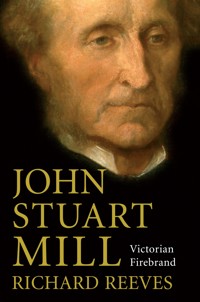
A young activist and highly-educated Cambridge Union debater, Mill would become in time the highest-ranked English thinker of the nineteenth century, the author of the landmark essay On Liberty and one of the most passionate reformers and advocates of his revolutionary, opinionated age. As a journalist he fired off a weekly article on Irish land reform as the people of that nation starved, as an MP he introduced the first vote on women's suffrage, fought to preserve free-speech and opposed slavery, and, in his private life, pursued for two decades a love affair with another man's wife. To understand Mill and his contribution, Richard Reeves explores his life and work in tandem. His book is a riveting and authoritative biography of a man raised to promote happiness, whose life was spent in the pursuit of truth and liberty for all.
Sie lesen das E-Book in den Legimi-Apps auf:
Seitenzahl: 1191
Veröffentlichungsjahr: 2015
Das E-Book (TTS) können Sie hören im Abo „Legimi Premium” in Legimi-Apps auf:
Ähnliche


















John Stuart Mill
Richard Reeves is a leading social and political commentator, writing regularly for the Observer, New Statesman, Guardian and Prospect. He is a former Columnist of the Year and Young Financial Journalist of the Year and has held research fellowships at the Institute for Public Policy Research and the University of London. He lives in Buckinghamshire with his partner and three sons.
‘Mill’s work, especially On Liberty and The Subjection of Women – seems more resonant and provocative than ever these days. . . Richard Reeves is a first time biographer and a first-rate writer.’ Susannah Herbert, Sunday Times
‘In this lucid study, Reeves offers a timely re-evaluation of the father of British Liberalism.’ Marc Lambert, Scotland on Sunday
‘It is a brave biographer who tackles a subject as complex and controversial as J. S. Mill. Richard Reeves has succeeded in doing this with enviable style. I blush to say it so bluntly, but this is the best book I have read for a long time. . . Reeves is a good reader of Mill. He interrogates the texts, teasing out consistent lines of thought from adolescence to old age and highlighting Mill’s changes of tack and intellectual evasions. He is no starry-eyed Millite, as modern liberals can be: he does not let his subject off the hook easily or present him as someone who can give us easy answers. . . Richard Reeves reminds us that in Mill’s life and thought we do not find ways of solving specific problems but values that enrich democracy and personal life.’ Ben Wilson, Literary Review
‘Reeves’ examination of Mill’s thought is meticulously explored in parallel with his life. . . Reeves’ account of Mill’s strange childhood is tremendously moving. His sympathy for his subject becomes even more apparent as we move through the rest of Mill’s life. The epilogue is a poignant farewell, reminding us that Mill was in large part responsible for shaping the world we live in today. . . Speaking of Mill’s lasting influence, Reeves says: “The world he left was unquestionably better for his efforts. It still is.” And we are better off for this book. Though it is a tragedy that a man whose life was dedicated to the pursuit of truth and liberty for all should spend his own in periodic misery, we are fortunate in at last having a biography that does justice to this sacrifice.’ Milo Andreas Wagner, Catholic Herald
‘Timely and readable. . . Reeves tells his stories well, and if he is right we should be looking to Mill for inspiration and enlightenment in our perplexing political times.’ Jonathan Ree, Prospect
‘Beautifully done. . . Reeves is right to devote a lot of space to Mill the activist; by doing so he puts Mill the thinker into context and converts him from a piece of uplifting statuary into a creature of flesh and blood.’ David Marquand, New Statesman
‘A fine new biography. . . A brave and very successful attempt to fit together the biographical details of Mill’s life – his extraordinary childhood and education, his enduring love for Harriet – with the aspects of his philosophical writing which might have relevance today.’ Laurie Taylor, ‘Thinking Allowed’, BBC Radio 4
‘This lucid biography intermingling Mill’s life and an account of his ideas could not have come at a more timely moment – when both socialism and liberalism have lost their way. Any reconstruction of British liberalism will surely need to incorporate Mill’s ideas. This book represents their best contemporary compass.’ Will Hutton
For Beth
First published in Great Britain in 2007 by Atlantic Books, an imprint of Grove Atlantic Ltd.
This paperback edition published in Great Britain in 2008 by Atlantic Books.
Copyright © Richard Reeves 2007
The moral right of Richard Reeves to be identified as the author of this work has been asserted in accordance with the Copyright, Designs and Patents Act of 1988.
All rights reserved. No part of this publication may be reproduced, stored in a retrieval system or transmitted in any form or by any means, electronic, mechanical, photocopying, recording or otherwise, without the prior permission of both the copyright owner and the above publisher of this book.
Every effort has been made to trace or contact all copyright-holders. The publishers will be pleased to make good any omissions or rectify any mistakes brought to their attention at the earliest opportunity.
1 3 5 7 9 8 6 4 2
A CIP catalogue record for this book is available from the British Library.
eISBN 978 1 84354 644 3
Designed by Nicky Barneby @ Barneby Ltd
Set in 11.75/14.75pt Adobe Caslon
Printed in Great Britain
Atlantic Books
An imprint of Grove Atlantic Ltd
Ormond House
26–27 Boswell Street
London WC1N 3JZ
Contents
List of Illustrations Prologue1. An Unusual and Remarkable Education (1806–20)2. A Man Among Men (1820–6)3. Strange Confusion (1826–30)4. This Imperfect Companionship (1830–6)5. Laid Hold of by Wolves: Conservative Influences6. Independence (1836–42)7. Eminence (1843–7)8. French Revolutionary (1848)9. A Dismal Science? (1848–52)10. A Seven-Year Blessing (1852–8)11. On Liberty (1859)12. To Hell I Will Go (1859–65)13. A Short, Bad Parliament (1865–8)14. The Father of Feminism15. Final Years (1868–73) Epilogue Notes Bibliography Index AcknowledgementsList of Illustrations
1.James Mill. Getty Images, 2757773.2.Jeremy Bentham. Mary Evans Picture Library, 10002734.3.Forde Abbey, 1817. Thomas Moore, The History of Devonshire from the earliest period to the present . . . Illustrated by a series of Views, drawn & engraved under the direction of William Deeble, vol. 1, London, 1829–30.4.David Ricardo. Mary Evans Picture Library, 10037449.5.John Arthur Roebuck. Getty Images, 3207249.6.John Sterling. Courtesy of the author.7.William Wordsworth. Mary Evans Picture Library, 10022170.8.John Stuart Mill. Box 10, Mill-Taylor papers, LSE Archives.9.Harriet Taylor. Courtesy of the State Library of South Australia, PRG 101/13.10. John Taylor. Box 4, Mill-Taylor papers, LSE Archives.11.Paris Revolution, 1830. Mary Evans Picture Library, 10197861.12.Samuel Taylor Coleridge. Time & Life Pictures/Getty Images, 50683387.13.Alexis de Tocqueville. Mary Evans Picture Library, 10038006.14.Thomas Carlyle. Getty Images, 3276158.15.Thomas Babington Macaulay. Mary Evans Picture Library, 10079857.16.East India House, c.1850. Guildhall Library, q4025244.17.William Molesworth. Mary Evans Picture Library, 10043224.18.Francois Guizot. Mary Evans Picture Library, 10197452.19.Auguste Comte. Mary Evans Picture Library, 10073295.20.Harriet Taylor Mill. National Portrait Gallery, 5489.21.Charles Kingsley. Mary Evans Picture Library, 10035367.22.Thomas Hare. National Portrait Gallery, 1819.23.Henry Fawcett and Millicent Fawcett, née Garrett. National Portrait Gallery, 1603.24.‘Westminster Election: The Nomination in Covent Garden’. Illustrated London News, 22 July 1865.25.Westminster Parliamentary Constituency. Parliamentary Papers, vol. 10, 1867–8.26.Benjamin Disraeli addressing the Commons. Mary Evans Picture Library, 10047340.27.Reform League Demonstration, July 1866. Mary Evans Picture Library, 10131860.28.‘Miss Mill Joins the Ladies’. Judy, 2 November 1868.29.‘The Westminster Guy’, 1868. Public domain.30.John Stuart Mill in Vanity Fair, 1873. Mary Evans Picture Library, 10039769.31.John Stuart Mill and Helen Taylor. Hulton Archive/Getty Images, 2628338.32.Charles Wentworth Dilke and Emilia Frances Dilke, née Strong. Mary Evans Picture Library, 10024509.33.John Morley. Mary Evans Picture Library, 10076125.34.Mill’s grave in Avignon, France. Archives Municipales d’Avignon.35.Millicent Fawcett’s delegation to Mill’s statue. Hulton Archive/Getty Images, 3335072.36.John Stuart Mill. Hulton Archive/Getty Images, 3321219.Dates of images have been omitted as in many cases it has proven impossible to establish these accurately.
Prologue
Striding across St James’s Park on his way to work, John Stuart Mill noticed a bundle lying beneath a tree. He carefully unpeeled layers of dirty blankets. Within them lay a newborn, newly killed baby. The previous summer’s night had been warm, so those responsible had taken no chances, strangling the infant before discarding it.
Mill reported his find to a watchman, who would not have been surprised: London in 1823 was full of poor families who could not afford another child. Mill, however, was moved to action. With a friend, he toured a working-class district of London distributing a pamphlet which described and advocated contraception. The handbill, written by the campaigner Richard Carlile, contained the following advice: ‘A piece of soft sponge is tied by a bobbin or penny ribbon, and inserted just before the sexual intercourse takes place, and is withdrawn again as soon as it has taken place. Many tie a piece of sponge to each end of the ribbon, and they take care not to use the same sponge again until it has been washed. If the sponge be large enough – that is, as large as a green walnut, or small apple it will prevent conception . . .’1 The pamphleteers were arrested for the promotion of obscenity and duly appeared before the magistrate at Bow Street. Once he realized who was in the dock, the magistrate lost his nerve, and referred the case to the Lord Mayor of London. Despite an eloquent self-defence, John Stuart Mill lost his liberty for a couple of days.2
The youthful criminal – Mill was just seventeen – would subsequently become the highest-ranking philosopher of his century and the foremost public intellectual in British history. To this day he retains his status as the authentic voice of modern liberty. Already by that summer of 1823 he had embarked on a successful career in the East India Company, impressed the members of the Cambridge Union and completed a prodigious course of home schooling which is famous to this day – at the age of eight he had devoured Demosthenes in the original Greek.
Mill’s family and friends, fearing irrevocable damage to his future prospects, worked hard to brush the incident under the carpet. Mill himself worried about the loss of some correspondence which detailed it. The damage limitation exercise was mostly successful: there was no public discussion of these events during Mill’s lifetime, even when his past was raked over during two turbulent election campaigns. But the story was transmitted through the salons and clubs of London by means of doggerel verse, an important Victorian broadcasting device:
There are two Mr M . . ls, too, whom those who like readingWhat’s vastly unreadable, call very clever;And whereas M . . l senior makes war on good breedingM . . l junior makes war on all breeding whatever.
This stanza was reprinted in the obituary of Mill published by The Times fifty years after the incident, as evidence of his foolishness.3 But this adolescent adventure by the ‘boy-philosopher’, as his friend Willliam Christie described him, speaks volumes about the true character of John Stuart Mill.4 Far from being a ‘Saint of Rationalism’, as Gladstone affectionately dubbed him, he was a passionate man of action. John Morley, a Liberal politician and writer, often seen as ‘Mill’s representative on earth’, described him as ‘a man of extreme sensibility and vital heat in things worth waxing hot about’.5 He was a philosopher, but he was a firebrand too.
Mill became an accomplished polemicist, firing off an article a week on Irish land reform throughout 1846, as the people of that nation starved under the inequities of the system he railed against. He was a humane administrator of Indian affairs, coming to hold one of the highest official posts in the East India Company by the time the Indian Mutiny boiled over. Mill was also a passionately engaged politician, fighting to preserve the rights of free speech and demonstration in public parks, ensuring that to this day, a corner of Hyde Park still represents this precious freedom, and attracting almost universal opprobrium for his legal pursuit of a murderous colonial governor. His political activism was lifelong: his last public speech just two months before his death, arguing for a redistribution of land rights, led to his ejection from the free-trade Cobden Club on the grounds of dangerous radicalism. As an enthusiastic botanical collector, Mill was observed, in his later years, with ‘his trousers turned up out of the mud, and armed with the tin insignia of his craft, busily occupied in the search for a marsh-loving rarity in a typical spongy wood on the clay to the north of London’.6 He was similarly unafraid to get his hands dirty in the political arena.
In his own day, Mill was accused of being ‘an acrimonious partisan’ and of ‘descending too easily from the judgement-seat to the arena’, but this was precisely the source of his greatness.7 As an intellectual, Mill was constantly engaging with the problems of the real world. ‘His life was not stimulated by mere intellectual curiosity,’ wrote Morley, ‘but by the resolute purpose of furthering human improvement’.8 Mill was not the kind of philosopher who sat in a silent study, engaged in the painstaking construction of theoretical systems, according to which society should be remoulded; he was not in this sense a ‘systematic’ thinker. Whether this makes him a lesser one is another question: the systems generated by purer philosophers have often been of little use in dealing with the practical issues of real life – or worse, have been the inspiration for some of the most oppressive societies in modern history. Mill himself was dismissive of anyone who was a ‘mere thinker’9 and said that ‘few of the systems of these systematic writers have any value as systems; their value is the value of some of their fragments’.10 Mill’s claim to our attention is not principally based on his treatises on Logic or Political Economy, canonical though they are in the history of Western thought (Thomas Carlyle’s attack on Mill’s economics as ‘a dismal science’ has unfortunately stuck to the discipline ever since). His greatest works are his taut cris de cœur, particularly The Subjection of Women and On Liberty.
In any case, Mill never acquired the necessary restraint of an elevated soothsayer. In political battles he would use all the polemic tools at his disposal; the Tories, for example, were ‘the stupid party’, though he later clarified his view in Parliament: ‘I never meant to say that the Conservatives are generally stupid. I meant to say that stupid people are generally Conservative.’11 Even those who influenced Mill were not immune. The poet-philosopher Samuel Taylor Coleridge, whose work Mill admired, was nevertheless an ‘arrant driveller’ on matters of political economy;12 the Scottish writer Thomas Carlyle a ‘true voice for the Devil’ when addressing the issue of race.13 Thomas Babington Macaulay, the eminent Whig historian, was, according to Mill, ‘an intellectual dwarf, rounded off and stunted, full grown broad and short, without a germ or principle of further growth in his entire being’.14
The received picture of Mill as a bone-dry, formal, humourless Victorian is, then, a gross distortion. But the misrepresentation is partly his fault: his Autobiography presented an aloof portrait, a life, as one reviewer suggested, of ‘monotonous joylessness’.15 Mill’s tone was one of observation, rather than confession, and the Autobiography certainly contained no startling revelations about Mill’s eighteen-year relationship with the married Harriet Taylor, one of the most discussed affairs of the nineteenth century. Indeed, one of the explicit purposes of the book was to present an image of their partnership as a platonic one of intellect and spirit, rather than of a sexual nature. Mill did, in the end, marry Harriet, but he had to wait two decades.
In the course of his extraordinary life of action and reflection, Mill engaged with many of the great thinkers, politicians and writers of his day. William Gladstone was heavily influenced by Mill’s economics; and Alexis de Tocqueville bound Mill’s review of his landmark book De la démocratie en Amerique (Democracy in America) into his own working copy, on the grounds that the two had to be read together for his own work to be fully appreciated.16 Mill made Alfred Tennyson’s reputation, but almost stopped Robert Browning from writing. George Grote, the great Greek historian, was a lifelong friend. Mill duelled with Benjamin Disraeli in Parliament, and drew the young Millicent Fawcett, one of the most successful campaigners for women’s rights in British history, to the hustings in the pursuit of women’s rights – and helped to persuade Florence Nightingale of the same cause. Mill’s much-tested friendship with Thomas Carlyle survived the accidental burning by Mill’s maid of the only copy of the first volume of Carlyle’s monumental history of the French revolution.
While Carlyle railed against almost all the changes of the modern world – for him, the 1867 Reform Act, which gave some of the working class the vote, represented ‘the end of our poor old England’17 – Mill assisted in the triumph of the idea of progress. Despite his many concerns about the future, he retained a progressive conviction that people, nations, cities and institutions could all, by the application of sound moral principles and robust social science, be made better. It was the self-declared duty of ‘public moralists’, such as Matthew Arnold, Walter Bagehot, John Morley and Henry Fawcett, to work tirelessly for the betterment of humankind.18 But Mill stood above them all, with his unique combination of intellectual muscularity, forensic prose and personal passion.
Mill was raised by his father, James Mill, the historian of India – who was actively assisted in the task by the philosopher Jeremy Bentham – to be an apostle for utilitarianism, the rationalist philosophy founded on the scientific promotion of ‘the greatest happiness to the greatest number’. For a few years, the utilitarian torch burned brightly in the young Mill’s hands. After a self-described ‘mental crisis’, effectively a mid-life crisis at the age of twenty, Mill fell under the spell of poetry – famously dismissed by Bentham as merely lines that fell short of the margin – and began his journey away from the starker versions of utilitarianism towards a profound belief in the inalienable value of individual liberty. Mill was raised to promote ‘happiness for the greatest number’, but came to see that freedom was both necessary for and superior to happiness.
The animating idea at the heart of Mill’s life and work is individual liberty. His image of a good society was one in which every man (and, he would add, every woman) can shape the course of their own life. This is not to say that Mill’s liberalism was of the anything-goes, morally neutral, laissez-faire variety. He certainly considered that people should be free to live as they saw fit, as long as they did not harm others. But at the heart of his liberalism was a clearly and repeatedly articulated vision of a flourishing human life – self-improving, passionate, truth-seeking, engaged and colourful – which it was the job of individuals to cultivate, and the duty of society to promote. Mill wanted our lives to be free, but he also wanted them to be good.
For Mill, the principal enemy of individual freedom was not the law, but the attitudes of society. He argued presciently that the ‘despotism of custom’ could be as threatening to liberty as the tyranny of the state. Mill feared the stifling effects of public opinion, and heaped praise on eccentricity, individualism and ‘experiments in living’. For Mill, to take a course of action simply because it was ‘the thing to do’ was to make no choice at all. His liberalism similarly fuelled his support for freedom of speech. He had a lifelong thirst for dissent, heterodoxy, and for the collision of opposing views. It was in the competition between and subsequent fusing together of opposing arguments, each usually containing a ‘half-truth’, that Mill believed the whole truth was to be found.
His liberalism was also at the heart of his support for gender equality. With typical pungency Mill wrote that in England ‘there remain no legal slaves except the mistress of every house’.19 In Mill’s time, married women had no formal legal status regarding their property or their own children; and of course women had no vote. Mill was the first MP to put down legislation to give women the vote, winning seventy-four votes to his side, and was the moving spirit in the National Society for Women’s Suffrage. Millicent Fawcett described him as the ‘principal originator of the women’s movement’.20 In fact his support for women’s rights provoked more hostility than any other position; but his liberalism could have led him nowhere else. For Mill, every individual, black or white, Christian or Hindu, male or female, must have the necessary liberties and resources to lead lives of their own construction. British feminism has many mothers, but only one father.
Mill, like Tocqueville, had deep reservations about democracy, however, stemming from a fear of the tyranny of the majority, especially an uneducated, easily-led majority. In the end, he was persuaded by experience that a broader franchise posed little threat; and consistently supported reform. Nevertheless it is quite clear that universal suffrage was very much less important to Mill than universal liberty. Even while supporting electoral reform, he opposed the secret ballot – seen as essential by all ‘true’ democrats – on the grounds that everybody should be willing to stand up publicly for their views. In this he was undoubtedly being idealistic; but it was a thoroughly liberal ideal.
It was Mill’s liberalism which shaped his response to socialism, too. He was vehemently opposed to centralized state control of the economy, but was a strong supporter of socialism in the form of collective ownership of individual enterprises, competing in a market economy. In the final analysis, the best system was the one which provided for the ‘greatest amount of human liberty and spontaneity’. For him, the value of economic, social and political arrangements was always to be measured by their liberating qualities. Mill was a liberal, a democrat and a socialist – in that order.
During the twentieth century Mill’s importance was somewhat obscured by the bitter ideological struggle between Western capitalism and state socialism. Given the choice between the two it is quite clear which side Mill would have been on – but also, of course, quite irrelevant. Now that the clouds are clearing, Mill’s true value can be seen once again. For one thing, in countless topical areas of policy, he remains instructive: the regulation of gambling, smoking, drinking and prostitution; modes of education provision; House of Lords reform; the grounds for foreign intervention by liberal states; women’s rights; and models of capitalism, among others. But Mill demands our attention for a deeper reason too. The challenges facing affluent societies now are how to balance individual freedom with collective action; how to build democratic and civic institutions which ‘empower’ – in other words, build the characters of – citizens; how to cultivate national cohesion alongside diversity; how to honour authority while encouraging dissent. These were also the issues with which Mill grappled. His life’s work was a sustained effort to make liberal democracy better, to infuse it with more truth, energy and freedom.
To understand Mill and his contribution, not only to his own century but to ours, his life and work must be viewed together. Mill was an intensely autobiographical thinker: for him the political and personal were inseparable. While his ideas still retain much of their original resonance, his legacy is also found in the example of his own life. In what follows, then, Mill’s thought and life are essentially treated as one, each reflecting the other. Four of Mill’s major intellectual engagements – with conservative philosophies, French thought and politics, liberalism, and feminism – are also given a more direct treatment.
Politically, Mill has been claimed, and continues to be claimed, by pretty much everyone, from the ethical socialist left to the laissez-faire, libertarian right – and at various points by every major political party. Today, two centuries after his birth, Mill’s stamp of approval is still sought. It is difficult, however, to size up Mill using the measuring tools of twentieth-century thought. Was he left-wing or right-wing? A progressive or a conservative? For or against state action? An imperialist or anti-colonialist? Elitist or democrat? Free marketer or socialist? Take your pick – there is evidence to support every answer. The point is that they are the wrong questions. If Mill sometimes looks inconsistent to modern eyes, it is usually because we use the wrong lenses. He wanted a society in which individuals had the freedom and strength to pursue their own goals, along with the virtue and character necessary to sustain collective life. ‘The worth of a State, in the long run, is the worth of the individuals composing it,’ wrote Mill in the final paragraph of the ‘gospel’ of freedom, On Liberty. ‘A State which dwarfs its men, in order that they may be more docile instruments in its hands even for beneficial purposes – will find that with small men no great thing can really be accomplished.’21
CHAPTER ONE
An Unusual and Remarkable Education (1806–20)
John Stuart Mill was born on 20 May 1806, the first child of James Mill, a struggling writer, and his wife Harriet, the daughter of a widowed lunatic asylum owner. Their home, 12 Rodney Terrace, Pentonville, London, was a wedding gift from Harriet’s mother. Writing to another new father, James Mill proposed ‘to run a fair race with you in the education of a son. Let us have a well-disputed trial which of us twenty years hence can exhibit the most accomplished and virtuous young man.’1 It would be a trial for young John, too.
A couple of years after John’s birth, James Mill befriended and formed a lifelong alliance with the radical philosopher Jeremy Bentham, who was also to have a considerable influence on the young John Stuart’s future. When James Mill fell ill four years later, Bentham even offered to take care of his son if the illness became fatal, to ensure that the boy was properly raised to ‘make Codes and Encyclopedias’.2 James Mill reassured his mentor that he was ‘not going to die, notwithstanding your zeal to come in for a legacy’. But he agreed to the legal guardianship, explaining that in the event of his early death, one of his greatest regrets would be to have ‘left his [John’s] mind unmade to the degree of excellence to which I hope to make it’.3 Considerable hopes were already riding on a six-year-old pair of shoulders.
John Stuart Mill was a test case for his father’s and Bentham’s theory that every person is born as a tabula rasa – a clean slate – whose mind is shaped entirely by life experiences, especially those of childhood. Mill was raised in an intellectual Petri dish, explicitly designed to produce an ideal standard-bearer for radicalism, rationalism and reform. Raised to be a ‘worthy successor’ to both his father and his potential guardian, Mill was given a home education which has been a source of wonderment and condemnation ever since. The experiment was, as the twentieth-century philosopher Isaiah Berlin wrote, ‘an appalling success’.4 By the age of six Mill had written a history of Rome; by seven he was reading Plato in Greek; at eight soaking up Sophocles, Thucydides and Demosthenes; at nine enjoying Pope’s translation of The Iliad, reading it ‘twenty or thirty times’.5 By the age of eleven he was devouring Aristotle’s works on logic, before being moved on at twelve to political economy. Nor were these labours reluctantly undertaken: Mill recalled later that ‘I never remember being so wrapt up in any book as I was in Joyce’s Scientific Dialogues’.6
This extraordinary emphasis on education was also a reflection of James Mill’s life story. He had read his way out of the poverty of Logie Pert, a Scottish town of mud-shacks, at the insistence of a mother sufficiently motivated by the prospect of advancement to change the name of the family from ‘Milne’ to the less common, and more anglophone, ‘Mill’.7 James had also received vital assistance from a wealthy patron, Sir John Stuart – after whom his first son would be named. As a young man, James tutored the beautiful Stuart daughter, Wilhelmina, and fell hopelessly in love with her. (He was in good company: Sir Walter Scott later fell hard for her, too.) Edinburgh University and a short-lived preaching career followed, before he decided to live by his pen in London. He never talked about his childhood, at least not in front of his family.8
As he had assured Bentham, James Mill survived his 1812 attack of gout. But Bentham would none the less be a significant figure for the Mill family in general, and John Stuart in particular. In 1815, Bentham helped to keep the growing Mill family out of poverty by installing them in the house next door to his own, in Queen’s Square, Westminster, and charging them less than the market rent for the first five years of their occupancy. This was vital assistance at a time when James was earning next to nothing from journalism, breeding at an alarming rate for a professed Malthusian – by 1814 there were five children, including one somewhat tactlessly named Wilhelmina – and spending most of his energies on the colossal work that would make his name, The History of British India (1826).
Bentham decided that everyone would benefit from some time in the countryside, and successively leased two country houses for the Mill-Bentham clan. The grandest of these, Forde Abbey in Somerset, was the family home for six months of the year until John was twelve. In his famous Autobiography, completed towards the end of his life and published after his death, Mill described his time in the Abbey as ‘an important circumstance’ in his education:
Nothing contributes more to nourish elevation of sentiments in a people than the large and free character of their habitations. The middle-age architecture, the baronial hall, and the spacious and lofty rooms, of this fine old place, so unlike the mean and cramped externals of English middle class life, gave the sentiment of a larger and freer existence, and were to me a sort of poetic cultivation.9
Although Mill would spend much of his life railing against the aristocracy, he always appreciated the grandeur, space and beauty of their homes.
James Mill was understandably proud of his experiment. In a letter to the self-made tailor and political radical, Francis Place, he wrote: ‘John is now an adept in the first six books of Euclid and in Algebra . . . while in Greek he has read . . . the last half of Thucydides, one play of Euripedes [sic] and one of Sophocles, two of Aristophanes and the treatise of Plutarch on education . . . His historical and other reading never stands still, he is at it whenever he has any time to spare. This looks like bragging . . .’10 It certainly does. But there was plenty to brag about. Mill was not the only example of youthful achievement; by the age of twelve, Macaulay had produced a sizeable and serious compendium of history and Tennyson had written an epic 6,000-line poem. But for the sheer range and depth of his reading and learning, from the classics through logic to political economy, the first fourteen years of Mill’s life surely stand alone.
Mill paid a heavy price for his education, not least in acute loneliness. He was aloof from his siblings, he had no friends, no toys, and few childish diversions. Again, he was not the only one: John Ruskin was only allowed to play with keys and bricks and ate only cold food on Sundays.11 Mill did enjoy Robinson Crusoe, and his father procured Arabian Nights and Don Quixote for his amusement. He was especially keen on stories of brave, fiercely independent adventurers and, passing through the patriotic phase typical of most boys, supported the British against the American colonists: his father, of course, soon put him right. ‘As I had no boy companions, my amusements,’ he recalled, ‘which were mostly solitary, were in general of a quiet, if not a bookish turn.’12 His greatest loneliness stemmed from the absence of a confidante; he could talk to his father about cerebral matters, but never emotional ones. Mill’s mother does not feature in the final version of his Autobiography at all; but in earlier, discarded drafts, he ponders how different life might have been if he had been blessed with ‘that rarity in England, a really warm-hearted mother’. He believed it would have made ‘his father a totally different being . . . and would have made the children grow up loving and being loved’.13
There is no question here that Mill is being unfair. By the time he was writing these passages, he had turned away from his family because of a perceived slight against his new wife. A visitor recorded that in his early twenties, Mill ‘was evidently very fond of his mother and sisters, and they of him’.14 John, though, was close to neither parent: ‘I had no one to whom I desired to express everything which I felt; and the only person I was in communication with, to whom I looked up, I had too much fear of . . .’15 As Mill’s sister Harriet later wrote, their parents were ‘living as far apart, under the same roof, as the north pole from the south’.16 One contemporary said that James Mill treated his wife as a ‘squah’ [sic].17 Perhaps John enjoyed his summers at his guardian’s Somerset estate as a partial escape from the loveless, ascetic atmosphere at home. The ageing Bentham – he was sixty when John was born – was a colourful character, with long golden locks, a walking stick named ‘Dapple’ and a chaotic working style, pinning notes all over his curtains. Every day, between twelve and one he would play the organ. At Forde Abbey there were games of ‘battledore’ and shuttlecock, walks, fishing for eels – and even occasional dances.
For a supposed ultra-rationalist, Bentham held some eccentric views. He did not believe in ghosts on the grounds that it was impossible to imagine spectral clothes, and yet no one ever saw a naked ghost. He did, however, retain a sufficient fear of goblins, acquired as a child, to be unable to sleep alone. His assistants were made to sleep in the same room as their master – a noisy duty, for as one of them remarked ‘if Jeremy Bentham does not snore, he is not legitimate’.18 Bentham also suggested that people should make memorial ornaments, or ‘auto-icons’, out of the corpses of their dead relatives. His own auto-icon, along with Dapple, is in the foyer of University College, London.
Visitors to the Bentham-Mill household were variously struck by the children’s precociousness and otherworldliness. Francis Place, who spent a month at Forde Abbey in 1817, was impressed by James Mill’s commitment to his children’s education: he spent at least three or four hours a day with them as well as completing his own work ‘without a moment’s relaxation’. The days were organized with a military precision: James and eleven-year-old John were up at 5 a.m. to work on the proofs of the Indian history. Place also thought James Mill ‘excessively severe’ for depriving the children of their lunch because of a mistake of just one word in their translations. John, by now undertaking much of the education of his younger siblings, would go hungry for their mistakes, too. Of John, Place wrote that he was ‘truly a prodigy, a most wonderful fellow; and when his Logic, his Languages, his Mathematics, his Philosophy will be combined with a general knowledge of mankind and the affairs of the world, he will be a truly astonishing man’.19 Place saw the benefits of the regime, but it greatly unsettled Anne Romilly, wife of Sir Samuel Romilly, a legal reformer: ‘They are all nice well-behaved children, but they are literally cram’d with knowledge, and I should fear that much of it may turn to indigestion rather than healthy nourishment.’20
This fear was unfounded, at least in the case of the eldest son. While the prodigious reading lists do give the impression that information was being swallowed at an alarming rate, John emphatically denied, later, that his education had been one of ‘cram’ and insisted that his father ‘never permitted anything to degenerate . . . into a mere exercise of memory’. He was taught to discover answers for himself, rather than being provided with them. Skills, rather than knowledge, were the most important fruits of his education. Mill learnt to interrogate every point of view and how to form and test his own ideas. ‘My father,’ he wrote later, ‘strove to make the understanding not only go along with every step of the teaching, but if possible, precede it. Anything which could be found out by thinking, I was never told, until I had exhausted my efforts to find it for myself’.21
Like his father, the young Mill was greatly influenced by the Socratic method of constant questioning, which, he said, ‘became part of [his] own mind . . . The close, searching elenchus by which a man of vague generalities is constrained either to express his meaning to himself in definite terms, or to confess that he does not know what he is talking about . . .’22 He was taught to dissect bad arguments forensically, as well as to generate and defend his own views, recounting that ‘the first intellectual operation in which I arrived at any proficiency, was dissecting a bad argument, and finding in what part the fallacy lay’.23 His contemporary Leslie Stephen described John’s education as a ‘course of strenuous mental gymnastics . . . he had been trained to argue closely; to test conclusions rather than receive them passively . . .’24 What James Mill could not foresee is that these talents would later be turned against his own work, and that he was in fact equipping his son for a journey away from him.
James Mill recorded an incident that illuminates the child prodigy as a true thinker, rather than a walking encyclopaedia. In 1818 a professor from the Royal Military College in Bagshot called on the Mill household. Finding James Mill out, he fell into conversation with the twelve-year-old John and asked him to describe his studies. Hearing the answer, the professor suspected John of being either a ‘folly or a cheat’, and thought James Mill ‘was either fool enough to let the boy pass over a multitude of things without knowing them, or . . . making the semblance of knowledge in him pass for the reality’. The sceptical professor returned with some colleagues and subjected John to what they considered a ‘rigid examination’, but which was almost certainly no more unnerving than his daily encounters with his own father. Convinced of the boy’s genius, the College issued an unprecedented invitation to John to attend a series of chemistry lectures. The Governor of the College begged John to visit his home as much as possible and spend time with his own sons, in the hope that some of his learning might magically rub off. However, James Mill rushed his son back to London the moment the lectures finished, ‘unwilling to leave him to the spoiling of the notice he is receiving’.25
John reported that his father’s Socratic moral inculcations were ‘justice, temperance (to which he gave a very extended application), veracity, perseverance, readiness to encounter pain and especially labour, regard for the public good; estimation of persons according to their merits, and of things according to their intrinsic usefulness; a life of exertion, in contradiction to one of self-indulgent sloth’.26 James Mill expected the same virtues from his children – especially John – and was constantly on the lookout for any ‘spoiling’ or ‘corrupting’ influences, either of a moral or educational nature. He wanted to keep the intellectual air as pure as possible, to ensure that his tender plant did not grow awry.
Along with a formidable intellectual confidence, James Mill instilled in his eldest son a blend of Aristotelian virtue and protestant work ethic, largely by example. John worked at the same table as his father throughout his childhood; and when they were at Forde Abbey, both of the Mills and Bentham worked in the same room, even though they could have taken a room each.27 John was directly provided with a very specific notion of what men did: they worked hard, with that work consisting of reading and writing. One of Mill’s sisters said that John, uniquely among the children, had benefited from ‘teaching by companionship’, and there was certainly a strongly collegiate feel to John’s working environment, one which he would replicate in adult life around a different table with the only woman he ever loved, Harriet Taylor.28
While the indoctrination into what would today probably be called workaholism was absorbed across the table, the lessons in virtue were more direct. Mill would later recollect the force with which his father impressed the message of the ‘Choice of Hercules’, a story in which the hero is forced to choose between two beautiful women, one flashing her cleavage and promising pleasure, the other demure and offering lifelong virtuous nobility.29 It is not surprising that Mill’s conscience always spoke to him ‘in his father’s voice’.30 (Goethe, who Mill came to admire, had his Hercules solve the problem by grabbing one under each arm.)31
In the Mill household, then, discipline was tight, learning was given priority over play, and love was rationed. ‘They are unlike other children. They do not know what a game of Play is,’ lamented Mrs Romilly. For James Mill, pleasure was at best a distraction from the more important tasks of the mind, and at worst a positive evil. No holidays were ever allowed, as John recorded, ‘lest the habit of work should be broken, and a taste for idleness acquired’.32 One of the very few non-intellectual activities prescribed for the Mill boys was marching drill and sword practice under the tutelage of a sergeant from a nearby barracks.33 But Mill would never be a swordsman: his pen was mightier.
John himself confessed that whatever the elegance and rigour of his mind, his body was ill-coordinated and clumsy. He was grateful that his father had ‘saved’ him from ‘the demoralizing effects of school life’, but was disappointed that ‘he made no effort to provide me with any sufficient substitute for its practicalizing influences’. To his dying day John struggled to tie a cravat. And while he would become a dedicated long-distance walker – including multiple ascents of Mont Ventoux in his final years – games and sport were never part of his life. ‘I never was a boy,’ he told a friend decades later, ‘never played at cricket: it is better to let Nature have her way’.34
If play was scorned by James Mill, so too was passion. Mill recorded that his father ‘professed the greatest contempt . . . for passionate emotions of all sorts, and for everything which has been said or written in exaltation of them . . . the greatest number of miscarriages in life, he considered to be attributable to the overvaluing of pleasures’.35 Stuck in a loveless marriage, James Mill chose to seal up his emotional side – and expected the same of his children. Harriet Grote, wife of George Grote, the historian of Greece and a friend of the adult Mill, described James Mill as ‘the prototype of the Utilitarian character, almost to the point of caricature: self-made, manly, independent, rationally controlled (especially in the areas of sex and work), not giving way to feelings of any kind (especially of love)’.36 Her analysis of the result on his eldest son was sharp. ‘If anything could make intellectual culture odious and terrible, it is the ensample of that overstrained infant,’ she wrote. ‘One set of faculties is wrought up by artificial processes to preternatural acuity, leaving the physical side to shift for itself, all with the minimum of guidance from his guardians – the emotions being regarded as of no account, or noticed only with reprobation.’37
From a modern perspective, James Mill’s anti-emotional regime seems cruel. Because he was his father’s project, John also appears to have formed a weak attachment to his mother, who might otherwise have filled some of the void. As it was, John would have to learn for himself – the hard way – that feelings were as valuable as thoughts. In his notes for an 1829 debate on the relative merits of Wordsworth and Byron, Mill wrote: ‘Education is 1. the education of the intellect. 2. that of the feelings. Folly of supposing that the first suffices without the last.’38
One of the main casualties of the elder Mill’s aversion to pleasure was, according to his son, poetry, and particularly contemporary verse. Poetry held a special place in utilitarian demonology. For Bentham, ‘all poetry was misrepresentation’, on the grounds that it exaggerated for effect and used feelings to persuade. Mill would later point out, in a parricidal essay on Bentham, that poetry was far from alone in this respect – all good oratory does the same thing – and that in any case the quality of argument was improved as a result. While reading poetry was clearly not high on James Mill’s list, his son was not entirely starved of verse. He read most of the ancient Greek and Roman poets, in original and translation. Milton’s old damp cottage in Bentham’s garden was briefly, and disastrously, home to the Mill family in 1810 and the poet remained a firm favourite of his father’s. Mill, by contrast, would later come to accuse Milton of having ‘the soul of a fanatic a despot & a tyrant’.39
He was also introduced by his father to the poems of Goldsmith, Burns, Gray, Cowper, James Beattie, Scott and Dryden. James Mill read the first book of Edmund Spenser’s The Faerie Queene out loud to his son, showing at least that his austerity could relent now and again. It is true, however, that contemporary poetry never made it on to the Mill bookshelves: John would have to discover Coleridge, Wordsworth and Tennyson for himself. Before his later crisis opened his eyes to the potential of poetry, ‘the correct statement would be not that I disliked poetry,’ he said, ‘but that I was theoretically indifferent to it.’40
Nevertheless John was made to write poetry, which he described as ‘one of the most disagreeable of my tasks’.41 His friend, and first biographer, Alexander Bain would write that Mill ‘was born to read, not to write, poetry’.42 It seems odd that James Mill, arch-utilitarian, would make his son write verse. But he did so for the precise reasons that Bentham attacked it: poetry was a better medium for communicating some messages, James Mill believed, because ‘people in general attached more value to verse than it deserved’. There was perhaps no better illustration of the fact that James Mill was consciously preparing his son for a life of persuasion and activism, rather than for the ivory tower of pure philosophical thought. In an ideal utilitarian world, poetry would not be so valued, but given that it currently was, John should be equipped to use it in the interest of reform. As it turned out, almost certainly to the benefit of his reputation, Mill made no further attempts at poetry, at least in formal terms. A poetic spirit does however breathe through much of his writing, giving some of his prose the impact which his father and Bentham attributed to poetry. And poets and poetry – especially Wordsworth and Coleridge – would come to play a significant role in his life, intellectually as well as emotionally.
In discarded drafts of his Autobiography, John aired his childhood grievances against his father, reporting that ‘both as a boy and as a youth I was incessantly smarting under his severe admonitions’, and recounted that he was ‘perpetually losing his temper’ over mistakes, and described him as ‘one of the most impatient of men’. James Mill clearly often expected far too much. His son recalled using the word ‘idea’ in a discussion and was asked to define the term, not to his stern father’s satisfaction: Mill was thirteen. He recalled that he had been educated ‘in the absence of love and in the presence of fear’.43 But perhaps the level of fear should not be overstated. It was the absences in John’s childhood that were most damaging, especially in the long run. When he complained of having been left ‘morally stunted’ as a result of his upbringing, Mill was referring to his emotional underdevelopment. Intimate relationships would never come easily to him. By the time he left home for the first time, at the age of fourteen, Mill had the education and intellect of a mature man, but his emotional vocabulary was that of a young child.
James Mill must bear much of the responsibility for his son’s lack of emotional cultivation – and for the ‘crisis’ it would subsequently precipitate. But to be fair, he was in some ways an enlightened father for the age. While the Mill children certainly missed lunch, and were occasionally cuffed, ‘flogger’ John Keate, headmaster of Eton, was beating his charges black and blue. While most middle-class Victorian children were expected to be seen and not heard, the Mill children often had the audacity to argue with adult guests, seemingly encouraged in this by their ‘schoolmaster’. Many children of their time barely knew their father, but the Mill children spent hours each day with theirs. Mill himself reported that his siblings loved their father ‘tenderly’, before adding the melancholy qualification that, ‘if I cannot say so much of myself, I was always loyally devoted to him’.44
Mill’s moral sense, however, was well developed. When, as a sixteen-year-old, he lost his watch during a holiday with family friends, he wrote to his father to confess, pointing out that ‘it was lost while I was out of doors, but it is impossible that it should have been stolen from my pocket. It must therefore be my own fault.’45 It seems his father was forgiving on this occasion. If the young philosopher had been tempted to lie – and few sixteen-year-olds would not have been – he was clearly able to resist. Mill was to remain a more honest man than most, even on those occasions, especially during his years as a politician, when his candour made life more difficult for him.
By the age of twelve, Mill had acquired much of the intellectual equipment required for his extraordinary career as a political thinker and activist, through a deep immersion in classical history and philosophy and the example of his father’s working habits. He assisted in the production of James Mill’s History of British India, reading proofs out loud while his father checked them against his original drafts. The working knowledge of Indian affairs he thereby acquired would be useful to him during his own lifelong career with the East India Company. Mill also delved into Roman history, writing for his own ‘amusement’ a history of Roman government up to the introduction of the Licinian laws, drawing mostly on Livy and Dionysius. ‘It was, in fact,’ he said, ‘an account of the struggles between the patricians and the plebians’, a struggle which he saw as continuing in nineteenth-century England, and in which he would play a significant part. James Mill encouraged his son in these ‘useful amusements’ but never asked to see the results, for which John was grateful, because it allowed him to write without the ‘chilling sensation of being under a critical eye’.46
Current affairs, however, was one blind spot in Mill’s education – he learned nothing, for example, about the French Revolution – even though Europe was in a period of turmoil and transition throughout John’s childhood. Mill was born in war-time, but came of age in peace. While he read Homer’s Odyssey and Ovid’s Metamorphoses, the European powers were carving up the continent at the 1815 Congress of Vienna, to the soundtrack of Beethoven’s specially written cantata, Der glorreiche Augenblick (‘The Glorious Moment’).47 According to the historian Paul Johnson, the period 1815 to 1830 – the years in which Mill went from boy to man – were ‘the birth of the modern . . . In 1815 reaction seemed triumphant everywhere; by 1830 the demos was plainly on its way’.48 Mill himself would go on to become one of democracy’s most important analysts.
As he approached his teenage years, Mill’s education changed direction. Logic, argument and political economy dominated the curriculum, starting with Aristotle’s Organon. The focus was now on developing reasoning ability: ‘From about the age of twelve,’ he recalled later, ‘I entered into another and more advanced stage in my course of instruction; in which the main object was no longer the aids and appliances of thought, but the thoughts themselves.’49
At the same time, John was being schooled in the persuasive arts, predictably enough using the classical orators as case studies. The adolescent Mill was especially interested in the way in which ‘everything important to his [the orator’s] purpose was said at the exact moment when he had brought the minds of his audience into the state most fitted to receive it; how he made steal into their minds, gradually and by insinuation, thoughts which if expressed in a more direct manner would have roused their opposition.’50 It was none the less a largely silent exercise. While the young William Pitt had been taught by reading out loud in a number of languages, with an emphasis on melodious delivery, John Stuart Mill’s education was almost always focused on the written word; the only exception being that he was made to read Plato and Demosthenes out loud, a task he described as ‘painful’.51 John would never be a great orator, having never learnt to vary his tone and pitch to good effect, and he struggled to pronounce the letter ‘r’ correctly until the age of sixteen.52 Only when he lost his temper – as he would, for example, over Ireland in 1868 – could he raise the roof. The written word remained his most effective weapon.
Yet the lesson about both the tone and timing in argument would stay with the adult Mill. His writing always reflected the politics and interests of the reading audience. There was a palpable difference, for example, between his articles for the Westminster Review, a partisan radical journal, which for a while he both edited and owned, and the Edinburgh, a moderate Whig publication. Mill frequently held his fire on a subject until he judged that the time was ripe – examples include his support for the North in the American Civil War and for the emancipation of women. A shrewd tactician, Mill understood from an early age that in public debate, timing is often everything.
The year 1819 was an important one for the family, as James Mill secured his first regular salary as an examiner at the East India Company, cutting a path which his son would soon follow. It was also the year in which the thirteen-year-old John Stuart Mill undertook ‘a complete course in political economy’ and the point at which he emerged as a thinker in his own right.53 James Mill had befriended the economist David Ricardo, and played a significant role in cajoling him into publishing his famous Principles of Political Economy and Taxation (1817), one of the founding works of classical economics. Ricardo’s ideas on economics were similar to those of Adam Smith. He agreed that three principal forms of income – rent, interest and wages – accrued to three groups: landlords, capitalists and workers. But Ricardo added a strongly political twist. The chief obstacle to economic harmony and growth, he argued, was the protectionism of the landlords, which drove up the cost of living, and in turn was made possible by the political domination of the landowning classes. The prospects for economic progress were therefore contingent on some radical reallocation of political power.
It was an appropriate time for Mill to be learning about the connections between economic theory and social consequences: in August 1819, economic distress had driven thousands of Lancashire weavers on to the streets of Manchester, where they were cut down by the army in the ‘Peterloo massacre’: eleven dead and more than a hundred injured. The protectionist Corn Laws, which secured landowners’ profits but made bread expensive, had been causing hardship and provoking riots – especially in 1812 and 1815 – for years before the Manchester eruption.54 The years 1819 and 1820 would also demonstrate to Mill the essentially non-revolutionary nature of the English: an economic upturn and a royal scandal were enough to snuff out any further trouble in the following year. None the less, Mill would spend his life battling against the landlords and their ‘unearned’ incomes and insisting that the ‘science’ of economics was not a set of abstract laws, but was profoundly shaped by human institutions and interventions. Poverty was never, for Mill, a necessary price for progress.
James Mill had already seen the political implications of Ricardo’s analysis, and was determined to publish his own treatise, intended to popularize Ricardo’s insights. John did most of the groundwork for this book, published as Elements of Political Economy in 1826, and, he says, ‘thought for myself almost from the first’.55 He disagreed with his father on some points, and reported that on a few occasions his own view prevailed, which he rightly said was to his father’s credit. The young Mill, probably fairly desperate for some affection, was also very taken by Ricardo on a personal level, writing later that ‘by his benevolent countenance, and kindliness of manner, [he] was very attractive to young persons’ and records his pleasure at being invited to Ricardo’s house or to walk with him.56 His death in 1823 was a blow to both father and son, but when James Mill bequeathed to his son a watch that Ricardo had left to him, John – perhaps remembering the traumatic watch loss of fourteen years earlier – insisted it went to his brother Henry.57 Political economy would remain one of Mill’s lifelong preoccupations and his own Principles would eclipse those of both his father and Ricardo, with Walter Bagehot later describing his position with regard to economics in the mid-century as ‘monarchical’.
As an adult, Mill was acutely aware of the influence of what he described as an ‘unusual and remarkable’ education on his subsequent life. In his Autobiography (rightly regarded as a classic and still in print), he devoted as many pages to his first seventeen years as he did to his last thirty-three – the period in which all his major works were published, he married and became a widower, moved to France and served as an MP. His education was in fact one of the two motivations for writing the Autobiography; the other being the posthumous elevation and defence of his wife, Harriet. Mill’s characteristically balanced assessment of his education included the recognition that it was an essential foundation for his subsequent success: ‘If I have achieved anything, I owe it, among other fortunate circumstances, to the fact that through the early training bestowed on me by my father, I started, I may fairly say, with an advantage of a quarter of a century over my contemporaries.’58
Mill also believed that his education was proof of the capacity of very young children to learn much more than was typically believed at the time. He insisted that his achievements were no reflection on his abilities: ‘If I had been by nature extremely quick of apprehension, or had possessed a very accurate and retentive memory, or were of a remarkably active and energetic character, the trial would not be conclusive; but in all these natural gifts I am rather below than above par.’59




