


Erhalten Sie Zugang zu diesem und mehr als 300000 Büchern ab EUR 5,99 monatlich.
- Herausgeber: The History Press
- Kategorie: Sachliteratur, Reportagen, Biografien
- Sprache: Englisch
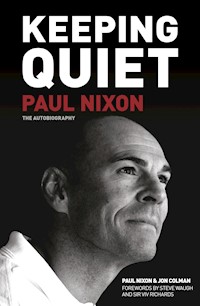
From Gower to Flintoff, Waugh to Vaughan, Cronje to Pietersen, Paul Nixon has shared a dressing room with some of the most evocative names in international and domestic cricket – and often enraged them on the field of play. The wicketkeeper, known as his sport's most prolific 'sledger', has amassed more than 20 years of stories from his career at the heart of the game and now reveals them in typically outspoken style. From 'Fredalo' to match-fixing, Nixon has experienced some of the most notorious episodes in cricket history, possesses strident opinions on the game and has a track record of success in the English first-class game and the Twenty20 revolution. With an accent on off-the-field anecdotes, Nixon also lays bare the personality that led the Australian legend Steve Waugh to compare him to: 'a mosquito buzzing around in the night, that needs to be swatted but always escapes.'
Sie lesen das E-Book in den Legimi-Apps auf:
Seitenzahl: 526
Veröffentlichungsjahr: 2012
Das E-Book (TTS) können Sie hören im Abo „Legimi Premium” in Legimi-Apps auf:
Ähnliche


















To Jen and Isabella.You are my heart and my soul. You’re both amazing.
ACKNOWLEDGEMENTS
It was in January of 2007, just as Paul Nixon’s cricketing dreams were about to come true, that we first talked about a book. Well, I did. The setting was the practice nets at Sydney Cricket Ground, the sun was purest Australian gold, and the man was cheerfully noncommittal.
‘Yeah,’ he said, eventually, when I suggested he should consider putting his story between hard covers. ‘It’s something I’ve thought about. I think I’ve got some tales to tell.’
I left, twenty minutes later, with a handshake and a lively interview on my notepad, but also a sense that he had been nothing more than incredibly polite to the impertinent journalist who had suggested he might be entrusted with the account of his life’s work.
The idea was left to bake, slowly. In the shorter term, the fact that the conversation had taken place at all said something about Paul, who had persuaded the stadium’s security staff to allow an optimistic, holidaying reporter he barely knew (and his friend, posing as a freelance photographer) into his working environment. That day he seemed to me as he appears to everyone: an open door, with a smiling attitude that says nothing is too much trouble. He seemed as happy as it was possible for a 36-year-old man to be and was keen to share his joy with anyone who crossed his path. Already, in his upbeat bearing, I felt I had the essence of the man.
By 2010, after many more calls and conversations, I had persuaded him to allow me to tell his tales. When, over coffee in the Leicester Marriott (where else?), he confided that he had recently been offered ‘serious money’ to fix a cricket match, I nearly launched my drink over him in excitement. I drove back to Carlisle that day convinced that the book had its headline-grabbing hook, and that the rest of the story would flow simply from there.
It was only when the interviews started in earnest that the real narrative began to unfold. I knew something of Paul’s dyslexia and his commitment to sports psychology, not to mention his maverick nature, but there were further depths to the man I had not imagined. As a sportswriter you go into the trade expecting to describe goals and wickets, triumphs and failures, and perhaps to point the finger at a villain or two. What you do not anticipate is to sit in an international cricketer’s kitchen and ask him some seriously strange questions …
‘This might sound daft, but … do you think you could draw him?’
‘Yeah, I can.’
I still don’t know who the little negative man is, exactly, but I feel grateful to have been introduced.
Another thing Paul said in the Marriott that summer was that the book should be ‘honest’. Throughout the last couple of years he has held onto that principle. Without his commitment to openness this book would be different and duller. Thanks, Paul, for not keeping quiet.
There are too many other people to thank than this space can possibly contain but some have gone above and beyond since the idea started to develop. Michelle Tilling at The History Press believed in the book from the outset and has been wonderfully supportive throughout. At some stage in the future I’ll run out of questions to ask her, she probably hopes.
Before a word was written, Chris Bascombe of the Daily Telegraph gave me some useful pointers in the art of ghostwriting, while Roger Lytollis, at Cumbrian Newspapers, has offered invaluable help, support and advice at every painstaking stage. His brilliant book, One Hit Wonder: The Jimmy Glass Story is the best you will read about an accidental sporting hero.
Chris Goddard, doyen of the Leicester Mercury sportsdesk for many years, helped with the detail of Leicestershire’s annus horribilis; his knowledge and time is appreciated. Thanks for memory-jogging and anecdote excavation are also due to Scott Boswell, Darren Maddy and James Whitaker.
John Holliday’s guided tour of Langwathby in the wind and rain was better than any of his performances for Carlisle United (sorry, John, but it was either that or I called you an inspiration again), while I have lost count of the friends who have urged me along the way. I would love to name them all, but Phil Houghton and Paul Morris are two who have been there from start to finish. Thanks to them, to the good men of Ingol CC, and to the Bowland Old Boys.
I’m extremely grateful to my employers and colleagues at Cumbrian Newspapers for their understanding while this book has been in the making, and for permission to reproduce photos. Stewart Blair, the picture editor, has my thanks. Likewise Barry Hollis at the Kent Messenger Group, and the indefatigable Lynda Smart at the Leicester Mercury. Just one more request, Lynda …
Before the writing began in earnest, Brian Nixon was kind enough to throw some light on Paul’s youth and in the process unearthed some fantastic memories. Sylvia Nixon and Christine Young helped immeasurably with family photos, while Jen Nixon’s eagle eye at a late stage in the process helped keep this book off the fiction shelves; and her friendliness and warmth during my many visits, often at short notice, never wavered. And Izzy, the strange man with the silly hair won’t be calling by so often now. You can have your old man back.
I have still yet to meet Marcus Charman but I can say for sure that the man is a marvel. Along with Ed Melia’s superb photographic skills he has produced a wonderful jacket design, but that is only one part of his contribution. Along the way he has also been a priceless confidant, and possesses the precious skill of saying something encouraging when it is most needed. Thanks, mate.
Mam and Dad, Jeff and Noreen Colman, have tolerated my grumpiness and failures to answer the phone more than anyone over the past year, and in return I have received only love, encouragement and the best sanctuary for writing and relaxing in all of Cumbria. Clark Colman’s spare bed and port supplies have been other essential features of the journey, and, more importantly, his brotherly advice and care have never wavered. I can’t thank him, or his fiancée Claire, enough. Tess Worden, meanwhile, doesn’t seem to appreciate how special she is, but now it’s down in print she is just going to have to believe it.
Jon Colman, June 2012
Over recent years I have been fortunate to have several people chat to me about writing my book. They have all been wonderful people and quality writers, but happily one man stood out head and shoulders above everyone else. It’s hard to do justice to the quality of the man, and that’s not just because it takes me three weeks to type out a paragraph using modern technology, never mind several of them!
To make a dyslexic Cumbrian farmer’s son enormously proud of writing an open, honest account of his life, all 41 years of it, is beyond belief and exceedingly heart-warming. Throughout our journey Jon Colman has been awesome. The drive, commitment, structure and sheer man-hours he has given to our cause have blown my mind. The late nights – many after long days away watching our beloved Carlisle United – must have pushed him to the edge, I’m sure.
Without Jon’s passion and direction, this book would never have happened. The late-night chats, the tweets, the e-mails and the calls have all been worth it. At times it’s been like finding that needle in a haystack, with my memory, but Jon really dug deep and has pulled out the stories from friends and colleagues far and wide across the globe. In fact, Jon should be a private detective. With that haircut and dodgy jacket, there’s every chance he could be the new Sherlock Holmes!
It’s been a pleasure getting to know you, Jon – you were the best man for the job and you deserve a bestseller, as good things happen to good people.
Thank you for everything, bud.
Nico
CONTENTS
Title
Dedication
Acknowledgements
Foreword by Steve Waugh
Foreword by Sir Vivian Richards
1. Home Alone
2. The Catch
3. Little Man
4. Snagging
5. Blues
6. Whitewash
7. Shit Pit
8. Surgery
9. Dope
10. Brandy Time
11. David May
12. Limbo
13. Battery
14. Margaret
15. Bounce
16. Reverse
17. New Beginnings
18. Storms
19. Turmoil
20. The Offer
21. Last Summer
22. Bat On
Epilogue
Plates
Copyright
FOREWORD
BY STEVE WAUGH
I first became aware of Paul Nixon when I walked out to bat and scratched a line indicating centre stump in the moist pitch at Grace Road, when playing for the touring Australian team versus Leicestershire.
I didn’t see him, but I heard him.
It was like I had gatecrashed his party and was an unwelcome visitor. Not long into my innings I thought to myself, ‘Who does this Pommie so-and-so think he is, talking with his barely recognisable accent and mimicking the way that we bloody well play the game?’ But I instantly liked him and knew he was a leader of men, and one that could lift a team with his body language, enthusiasm and spirit.
More than a decade later, I had the opportunity to play alongside Nico – or, to use his more appropriate nickname, the Badger – at Kent where he was trying to kickstart the second half of his career. Nothing had changed; he was still like a tetanus injection (a pain in the backside), with the alertness of a man who had skulled half-a-dozen Red Bulls and the enthusiasm of a kid with a twenty-minute free pass in a candy store. His presence had its fingerprints all over the changing room and on the playing field, for he was always trying to keep things upbeat, striving to self-improve and desperate for the team to be competitive.
I was amazed that England never recognised his qualities until the twilight of his career. He was a batsman who lifted in pressure situations and a keeper who compared favourably to all of his compatriots, and perhaps most importantly, his combative nature and never-say-die attitude ensured that every team he was a part of had spirit and life. He was the heartbeat of the team.
Nico was from the ‘old school’, who loved to share his thoughts on the day’s play and life in general after stumps were drawn, and it is here that perhaps his greatest legacy will be left. He was street-smart and savvy, a wolf in sheep’s clothing, but above all he was a bloody good cricketer and a great bloke.
I’m sure you will enjoy his honesty and insight into what was a fascinating journey, and I look forward to catching up and hearing about what I’m sure will be the next successful phase in his life after cricket.
Always 100%.
Steve Waugh, 2012
FOREWORD
BY SIR VIVIAN RICHARDS
It is indeed a great pleasure to be asked to write a few words about Paul Nixon. I first met this young man when he was a member of the Lord’s groundstaff during the 1980s. Back then, one of the duties of the groundstaff was to lend a hand to any touring team engaged in practice at the Nursery Ground. One of the young men that immediately grabbed my attention was Paul.
Why, you may ask? It was simply because he was always engaged in the game that he wanted to pursue as a profession. He was always willing to do anything for the game he loved and respected. We all know that not only was he one of the best wicketkeepers in England, but also a fierce competitor.
Paul was the best ‘throw-down guy’ in the business and I can remember always seeking him out for practice, because he was consistently professional in his duties. A little secret I will share with you is that whenever we played at Lord’s and Paul gave me my throw-downs, I would register a century.
I am eternally grateful to him for helping me prepare for some of the best innings I played at Lord’s, and that is why, when he was given his first cap for his country, I really felt the joy for something he truly deserved.
I would like to take this opportunity to wish Paul and his family the very best and God’s guidance.
Sir Vivian Richards, 2012
one
HOME ALONE
Friday 3 February 2012.
… thanks [compère’s name] … Hello everyone … I’m very honoured to be here tonight, but I have to say I was a bit put out that I was only second choice. You actually wanted a legend, a knight of the realm, the star of Strictly Come Dancing – Sir Bruce Forsyth! But sadly he couldn’t make it, because he has to attend the birth of his next wife …
The words coming slowly together on the page in front of me will be delivered tonight to the lucky people of Coventry & North Warwickshire Cricket Club. I am writing a speech, but I’m running against the clock. And the hangover isn’t helping.
… now, [compère’s name] is such an honest bloke and I’d like to thank him for entrusting me with his problem. He’s addicted to drinking brake fluid, you see, but he assures me he can stop at any time …
The jokes are the easy part. The first one is the property of Roger Dakin, the former England hockey player, and the second is Macca’s. Macca is Paul McKeown, my brother-in-law. He has a rich supply and tells them better than me, but I’m improving all the time and – most importantly – I’m a willing learner. That isn’t something I would have said thirty years ago.
Sometimes I allow myself a laugh when I think how I’ve changed. If someone had told me, in the beginning, that I would end up writing speeches and delivering them (and being paid for the privilege!) – I would have presumed they had the wrong man.
But I do it and I usually enjoy it, from beginning to end. As long as I can shut myself away from background noise, and create a little framework of what I want to say, I can drive to any venue and perform comfortably. It might not be so comfortable today, though; my head is still fogged up, and concentrating is hard. The words are going down, but they are landing in slow motion and I’m not even certain they are the right words, or in the right order.
Why do we do it? Why do we batter our bodies with alcohol, put ourselves through the same old cycle and then go back for more? I would love to know. Last night I went out in Leicester with some friends, gave it the big one and, as usual, it is coming back to haunt me in a big way. Hangovers absolutely ruin me. There are rashes and sores on my skin, my eyes have dried up, and I’m not feeling especially positive about the world.
This morning, after breakfast, I sat down to write an e-mail to a friend in the City of London. Any time I type something on the laptop I challenge myself to avoid the little red line that signifies a misspelt word. I think I’m getting better at that, too, but today? You couldn’t move for red. It was absolute carnage on the screen, and things haven’t got a great deal better this afternoon with a pen in my hand.
OK, ladies and gentlemen …
I put the pen down and stare at the page. The back of my neck is itching like mad. I sit up straight, give it a vigorous rub, and then, a few more blank seconds later, I reach for my phone.
Paul Nixon @Paulnico199
Minus 7!!!!!!!!!!!!!!!!!!! Outside now!
Jordan Carrigan @JordanCarrigan
@Paulnico199 umust be garn soft nico! It’s been -9 the past few nights in gods garden Cumbria.
There is a game I often play whenever I drive back to the promised land with Jen and Izzy. It’s called ‘Who can be the first one back to Cumbria?’, and I always win. When the sign for my home county appears beside the motorway, I wind the window down, put my right hand outside and reach forward; I then turn around to my passengers and declare my victory. It’s a daft little thing, but I love it.
I’ve been thinking about home a lot lately. Leicester is where I live and where I call home most days of the year; it’s a wonderful city whose people have embraced me. But there’s no place on earth that will ever draw me back quite like Cumbria. Returning to my home county has never failed to make me feel good about life – whether as a teenage hopeful or as a veteran with dodgy knees, the warmth I received from people there during my career was priceless. When I played for England Under-15s, I would return to backslaps and ‘keep goings’; when I started pushing through the ranks at Leicestershire, I would go home to ‘well done lad’s and ‘we’re all behind you’s; when I won trophies, and played for England, the same. People from Cumbria have written me countless letters over the years, even during the times when I wasn’t doing so well. You have no idea how much that matters.
Jen, my wife, is a home-bird and feels the same pull. Isabella, my three-year-old daughter, seems to share in the excitement any time we point the car north and set off for Langwathby. For Izzy, Cumbria means fresh air and the chance to play with her cousins. For Jen, it is valuable time with her mum and her sister. For me, it means a living nightmare trying to get an internet signal on my iPad, and wondering why I have to do all the visiting when it’s me who has just driven 200 miles (‘why can’t they come to me, just for once?’) but mainly, it’s a happy place for all of us.
Now I’m retired I should head up there more often, but I seem to be busier than at any time in my life. The other day was typical: in the morning, I spent two hours at a coaching school, and then drove home to do a radio interview over the phone. After lunch I sat through a meeting about a business interest, before embarking on an endless slog through London’s charmless traffic for a charity dinner. I finally got back home shortly before 11.00 p.m., in time for a late meal – a chicken wrap with cranberry sauce – and then an hour on the phone to my ghostwriter. Jen? Not for the first time, my wife was at the back of the queue. I barely had time to catch up on her day before the yawning kicked in and it was time for bed.
But I will do it; I will visit home more frequently, now there is one fewer excuse.
Of course! I should introduce myself. My name is Paul Andrew Nixon, I am 41 years old, and if you haven’t seen me by now, chances are you will have heard me. I played cricket for Leicestershire, Kent and my country; and all three – there is no point pretending otherwise – at a decent volume. That much you probably know, but there are some things you probably don’t. Stories: yes; tales of a chatterbox wicketkeeper: yes; but there’s more to my life than just anecdotes. Don’t worry, it took me decades to learn certain things about myself – some good, some not so good, some downright strange and some I kept quiet – but we should be able to get there a little quicker.
A text arrives from Josh:
Gym tomorrow?
My reply:
Too bloody right!!
Josh is Josh Cobb, Leicestershire’s 22-year-old batsman and our man of the match in last summer’s Twenty20 final. Josh is a great kid. His father, Russell, was an old team-mate and a great friend, and I can remember holding baby Josh in my arms when he came to visit us on the farm. When I found myself batting with him twenty years later it made me feel very old.
At Grace Road, pre-season is under way. How do I know this? How could I ever forget? I lead a non-stop life but it’s hard not to miss the thrill of a new pre-season. Even though my career was longer than many, even though I had a better swansong than most, and even though my diary is now fit to burst … nothing quite replaces the buzz of strapping on the pads, stuffing a box into place, pulling on the gloves and then getting down to it in the nets. The trick, I suppose, is not to miss it too much. It’s one of the reasons why I refuse to sit still.
In these early days of retirement, the benefits of being an ex-cricketer are few. A little more time with the family is a blessing, and devoting my energy to different goals is exciting, but if you put a gun to my head and forced me to pick one obvious advantage above all the others, I suppose it would have to be the pain. From morning to night, things don’t hurt quite as much now.
Cricket is the best game in the world but when you’ve played it for more than twenty years and squatted more than a million times (I’ve worked it out, don’t worry), you find yourself creaking as you approach the end. In the final days of my career, pain was – Jen and Izzy aside – my most faithful companion. It was there when I came down the stairs in the morning and when I drove to Grace Road. It was there any time I sat down and any time I stood up. It was there when I went for a lie down, there when the temperature dropped and there when I turned around.
When I ran, when I jogged, when I walked and when I stopped – it was always there.
Let me count the aches. When I wore cricket spikes, the soles of my feet would get sore and stiff. If I went for a 2-mile run without first undertaking lengthy calf exercises, that muscle would be pulled in no time, and at night I would need to ice away the hurt. When I drove my car, my knees ached, and when I walked downstairs it felt like my legs could buckle at any time; as a result, the daily descent became a slow motion, sideways shuffle. The squatting has also taken its toll on my back, which isn’t as flexible as it used to be; when I sit on the sofa for any length of time, I can only describe the resulting sensation as a kind of indigestion around the spine.
Towards the end, any time I turned my head to the side it would cause my neck to twinge badly. This obliged me to rotate like a robot, using my entire upper body, rather than just my head. And then we come to the battered old hands; during my last, unforgettable summer, any time I caught a cricket ball it felt like the force of twenty was hammering into the gloves, and in cold weather my thumbs would start to ache.
Before retirement, my life had become one of ice baths, hot water bottles, stretches, and so many other methods designed to keep pain at bay. Putting myself through the various contortions of Bikram Yoga sometimes helped, and I also bought something called a Compex machine: a piece of kit the size of an old cassette player, which you attach to yourself and allow electrodes to stimulate the muscles and get rid of lactic acid. You aren’t supposed to use it while driving, but I did.
A good, old-fashioned gym workout would occasionally do some good. Lifting weights and developing a sweat seemed to balance the body and take away the aches. But only for a while, on most days, the contract had to be signed with pain. Year after year, month after month, you keep doing the deal until it finally becomes too much. Last summer, it became too much, and I knew for certain that it was time to make way.
I’ve not gone cold turkey since retiring – far from it. I couldn’t. I still get the urge for the gym and I am a nightmare if I go for too long without a run. But it’s different now; the worst of the pain has slowly subsided. The other stuff? Well, that’s a little more complicated.
Outside, Leicester is Siberia for the day. Sub-zero temperatures are not exactly ideal when you haven’t long been home from South Africa. The heating is on but I’m sitting here, at the table, wearing two jumpers. Jen, meanwhile, has gone to collect Izzy from playschool. Izzy, who has inherited her father’s energy and was up at four o’clock yesterday morning demanding entertainment; Izzy, who has an incredible knack for finding buttons on the iPad that I didn’t know existed, causing it to freeze or go dead; Izzy, who has a flower named after her in our garden (the Isabella Rose); Izzy, the apple of her old man’s eye. Izzy … there’s a story there, too.
My mobile phone trills with more tweets. I grab it, again, and run my finger across the screen to unlock it.
I love Twitter; it’s right up my street. A couple of presses and you are interacting with people from all over the country and the world. When we were on holiday in Cape Town we promised ourselves one night out, Jen and me, just the two of us, so we left Izzy with the childminder, went for dinner and planned to do nothing but talk and catch up on life without any distractions. What actually happened? People started responding to my invitation to come up with a title for the book and we spent the evening roaring with laughter at some of their tweeted suggestions (More Sledge Than Santa was one of my favourites, and I was disappointed to learn that The Bald Truth had already been taken by a rugby league player).
People often ask me for a ‘retweet’ and I try to oblige them all. It’s the simplest thing in the world, and if you can make someone happier for a few seconds just by prodding a screen, then I firmly believe you should. Mainly, though, I love it because you are never isolated with Twitter. If I am on my own for any length of time, like today, I cannot help picking up the phone and checking the latest. It’s like a reflex action, as natural as anything, and sometimes it’s much more preferable to being at home, alone, with just my mind for company. As I’ll explain, we haven’t always got along.
The speech is going nowhere fast. I gaze at the notepad and try to switch back on. If I can’t finish it now I will have to write the final few lines at the dinner table.
Underlining a few words sometimes helps – that will restore my focus. The ruler, I think, is in my office room. I push my chair back, stand up and walk briskly towards the stairs.
two
THE CATCH
karl green @karlgreen3
@Paulnico199 just seen skysports catch of 2011 & your not in it??? #worldsgonemad
Aside from the trip to Cumbria, there is one journey I love to make more than any other. All it takes is a single tweet to provoke the memory and I am on my merry way again, to Edgbaston, Warwickshire County Cricket Club, on Saturday 27 August 2011. The occasion? It’s the Friends Life t20 final, no less. The contest? Leicestershire Foxes versus Somerset Sabres. The significance? It’s only my last competitive match in England! The problem? That would be the 6ft 5in of West Indian danger arriving at the crease.
Kieron Pollard is the kind of player who can take a game away from you in the blink of an eye. The kind of batsman so stupidly powerful he can mishit the ball for six. The kind whose wicket you want early, if at all possible.
Somerset are in reasonable shape when he comes in to bat, so it feels like a few early words are necessary.
He is walking out without a helmet. That will do for starters.
‘Look at you, with no helmet!’ I exclaim. ‘Our quick bowlers are going to come on in a minute and we know you’re scared of it, big lad.’
No response.
Pollard takes a single off Josh’s off-spin and disappears to the other end. Peter Trego works another off the last ball of the over and keeps the strike.
Matthew Hoggard, our captain, then brings on Wayne White. Pollard requests his helmet and then reappears at the striker’s end a couple of balls later. Ding-ding – Round Two.
‘Look at you, calling for your helmet! You’re shit scared of it. Are you not embarrassed about being scared of it? We’re all laughing at you out here.’
Nothing, again.
Pollard sets himself for a bouncer. Chalky runs in and bowls a shade fuller than the Trinidadian expects. He gives himself room and has a waft. No contact. Into the gloves. Lovely.
‘Look at you, backing away, you big girl’s blouse! Do you not fancy this? What’s wrong with you? Everyone’s laughing, you know.’
Standard verbals, really. You’re not necessarily searching for a bite; just trying to drip a little doubt into the batsman’s mind – get him out of his comfort zone. Sometimes it works like a dream, sometimes it backfires. You have to pick your moments, choose your targets.
Pollard still isn’t giving much away. I walk back to my position for the next ball … The next ball, the next ball. A wicketkeeper’s life is about the next ball. It could happen at any time, so you always have to be ready. The opportunity to take your ultimate catch – your full-stretch, diving showstopper – could be around the next corner.
When I was with England, Duncan Fletcher used to love trying to give me one of those in morning practice. Eventually he would nick it in just the right place, and I’d spring to my right and keep hold. He’d do the same with Paul Collingwood at gully and Andrew Strauss in the slips. Perfectionists to a man.
When the seamers are bowling, you visualise your ultimate catch before every delivery, but the truth is you only get three or four in your entire career. It’s such a rare feeling, and, by the summer of 2011, even rarer for me.
Sometimes the truth slaps you in the face, sometimes it creeps up with stealth. In our quarter-final, against Kent, Rob Key edged one of the first balls of the innings from Harry Gurney. It dipped and swung away from me at the last second, and I just hadn’t been able to get there. When I viewed the video later, it looked catchable, which was strange. It hadn’t felt remotely catchable at the time.
This, on reflection, had been a message from my 40-year-old limbs and muscles – it was finally getting too hard. Too much of the game was disappearing out of my reach, and the old bones were starting to let myself and the boys down. The End was knocking on my door.
White runs in for the fourth ball of the fourteenth over. Pollard, again, gives himself room and has another big whoosh.
Some edges, when they come early in an innings, can catch you out. This one I see from the moment he swings his blade. To the untrained eye such a chance passes in a flash but as soon as bat connects with ball I know I am going to get there.
The nick has taken a touch of pace off the ball. It veers away slightly, but comes through at a decent height. I dive, arm outstretched, and it slaps into the bread-basket of my right hand – just below the creases of the knuckles, so that I can wrap my fingers over the top of the ball and hold on.
Get in there! My ultimate catch! In the final! And Pollard the victim!
Before I hit the ground I feel goosepimples rise on the back of my neck.
Even now, I have barely had time to watch the footage of the best split-second of my life, so it’s a good thing the film reel in my head is working.
I walk into the kitchen and prepare a protein drink. Into the mixer goes some milk, followed by a generous scoop of powder, and then a teaspoon of olive oil. I clip on the cap, give it a vigorous shake, unclip and then knock back the mixture with gusto. How many times have I done this?
As the good stuff slides down, I rewind and indulge myself a little further.
Finals Day … in the build-up, while others are outwardly nervous, I just feel hungry, keen, desperate for it. Maybe it is an age thing, but I don’t harbour any butterflies or any doubt. And a sportsman free from doubt is a very dangerous animal. I should know.
In our epic, rain-affected semi-final, we beat Lancashire in a ‘super-over’, thanks to Will Jefferson’s mammoth hitting, and when the chaos and the celebrations die down I head back to the team hotel, feeling tired and drained. I slump on the bed and lie down on my front. Texts and tweets are coming in by the bucketload but I’ll look at those later. I enjoy a few precious minutes of calm, until, on cue, my left leg cramps up. Brilliant. I glug down some water, take some electrolyte drops and set off back to the ground for a massage.
One notable feature of Finals Day is that four teams occupy the ground, instead of the normal two. This means that we have to walk past Hampshire’s viewing gallery on our way to the changing room. During their semi-final defeat to Somerset I see Shahid Afridi, Hants’ Pakistani talisman, sitting on a chair not long after his dismissal, with his head in his hands. I leave him to his thoughts and walk past without speaking. Minutes later, I return to find him in exactly the same position. This time I offer a consoling word, but he remains motionless. Not even a flicker.
We watch the last few balls of Somerset’s victory and then it is time for us to get out into the mixer for the final. The crowd is getting warmed up, the beers are clearly flowing, and we are up for it. Massively up for it. Abdul Razzaq and Will get us going, and I come in at number five, to try to work the spinners.
First rule of Twenty20: expect the unexpected. I am facing seam, not spin – Craig Meschede is the name, and I’ve never seen him before in my life. He bowls me a beauty first up, which I just about survive, and four balls later I hit one like a tracer bullet to Pollard at long-off. He fumbles it a few times before bringing it under control.
I shuffle off to a surge of noise and look up to see thousands of pairs of hands clapping. The lads hug me as I walk in but I quickly disentangle myself and rush into the dressing room to get some fluid on board.
We make 145-6, and when later we jog back out to begin our defence, it is my job – as usual – to start the trickling of uncertainty into a few Somerset heads – make a little mischief, if you will.
First – Marcus Trescothick, perhaps the finest batsman in county cricket. Tres is a really technical thinker. In the early stages he is struggling to get Hoggy away.
‘Hey, Tres, why are your hips so open?’ I enquire. ‘I’ve never seen your hips this open.’
Drip, drip.
Craig Kieswetter, another dangerous customer. Craig has recently been working on his wicketkeeping with his England coach, Bruce French. Bruce was a fine keeper in his day but never boasted a formidable batting record.
‘Hey, Craig, I didn’t realise Frenchy was your batting coach these days. I thought he was supposed to be working on your keeping, not your batting?’
Drip, drip.
Those two depart for not very many. In at three – Peter Trego. A somewhat different challenge, in that he is a big, muscular, tattooed hitter whose major strength is that he always seems to play without fear. Well, we can’t be having that!
‘Tregs, mate, have you lost a bit of weight? You look a bit skinny. Are you not lifting weights any more? Is that bat turning in your hand because it’s too heavy for you?’
He glances around, just for a split-second, but long enough for me to see him chuckling.
That means he is listening.
Drip, drip.
At the other end is James Hildreth. This is a guy we are concerned about, mainly because of his ability to sweep and reverse-sweep. But Claude Henderson rarely misses a trick, and instantly puts two men behind square. Hildreth goes up the wicket to his first ball and has to kick the ball to stop himself being stumped.
Classic.
‘What are you doing, man?! That’s a terrible shot on this wicket. The next ball, we know you’ll want to sweep, and Claude’s going to bowl a slider and get you lbw. At the most I’ll give you four balls against Claude. Four balls.’
Drip, drip.
Hildreth blocks the next one. He isn’t sticking to his game. The pressure builds. He hangs around for a while, but isn’t hitting boundaries. He duly gets out. Then it is Pollard. And the catch.
The moment I hit the turf with the ball in my glove, it is as though someone has connected mains electricity to my body. I throw the ball as high as I can, and roar. In a flash, James Taylor rushes in and leaps on me. Team-mates are flying in from all directions.
The commotion eventually dies. Jos Buttler walks in to replace Pollard. By now I am absolutely flying …
‘Now then big lad, it’s up to you …’
He hits the first ball for four. Not a bad response, considering. He gets himself in and plays a few more shots, but Somerset need boundaries in bulk, and they aren’t quite coming.
It is at this point that I pull out my trump card.
‘Eh, Jos, all the Somerrrset farrrmerrs will be puttin’ theirr comboine ’arrvesters away forr the winterr, saying, “That Buttlerr went and lost us anotherrr game”.’
He declines to respond to my dreadful West Country accent, but Josh is by now bowling a great little spell, with Claude whispering wisdom into his ear. The shackles are on.
Buttler eventually goes for a big shot and is taken on the boundary by Matthew Boyce, who is on as a substitute fielder and will catch pigeons for us down there all night. The crowd erupts, and we know the job is as good as done.
Our bowlers diligently work their way through the remaining overs, but it is candy-from-a-baby time. As Andrew McDonald sends the last couple of balls down, I feel my eyes begin to well up. Somerset splutter apologetically to 127-9 and then expire. Another roar goes up. Victory!
There is no better feeling, no sweeter sensation. And no better painkiller.
On the field, with a stump in one hand and champagne bottle in the other, I walk to the boundary to share the joy. I find Dad, who is beaming, and we hug.
‘Bloody hell son, what a game,’ he shouts into my ear. ‘It’s a fairytale. A proud day.’ Something like that, anyway. ‘Just get this down you,’ I say, extending the bottle. He takes a swig and I eventually walk on.
The cameras follow me as I come to Jen. Embracing my wife at the end of this incredible journey feels like a special moment – we’ve been through so much! Unfortunately for Jen, the moment loses some of its magic when she knocks back a big gulp of champagne too quickly and it surges back out of her mouth, all on live television. She won’t live that one down. Around the boundary there are Leicestershire people dancing around, joining in the mayhem, supporters who have followed us through the occasional ups and considerable downs. Players like Harry Gurney, who missed out through injury, and other young lads, whose days are yet to come, as well as backroom staff who’ve helped us in countless ways.
After the presentation and the interviews, during which Hoggy has a nice little dig at the media for writing us off, I finally get back into the dressing room, where another pleasant surprise lies in wait. Ah, the painstaking, box-ticking monotony of the random drugs test, how I will miss you! Here, in Leicestershire’s moment of glory, in the hour of my glorious swansong, I am instructed to enter a toilet cubicle, piss in a bottle under observation, and then fill out the necessary forms. The testers write down their numbers, put stickers on the bottles, note down which supplements I have taken and conduct various other little tasks. It seems to take ages, but at least it’s not my worst. Once, after an attack of stage fright at Swansea, I was a prisoner of the drugs test for more than three hours – three hours of drinking pints of lager, three hours of standing under the shower, three hours of repeatedly flushing the toilet, three hours of trying anything, anything at all, to activate the waterworks. Luckily, the taps work swiftly on this occasion and after forty-five minutes I am allowed to escape.
The Hampshire players are waiting for us as we filter into the hotel bar. They greet us with a standing ovation and seem particularly chuffed that we have beaten Somerset. We sing and dance for hours, before the younger boys sneak off to a nightclub. The rest of us, umpires included, remain in the bar and proceed to get nicely lashed. It must be after 2.00 a.m. when somebody notices the highlights on TV. We form a horseshoe around the screen as my dismissal is shown. You lucky bastard, Pollard! When footage of the standing ovation follows, I notice Jen dabbing at a few tears. I pull her in for a hug.
Three hours later, or maybe longer, I am forced to admit defeat. I down my last pint, am dragged up to my room by Jen, and within seconds I am gone.
After three hours’ kip we are up and away again. Our house in Leicester is on the market and some people are coming to view it at midday. So much for enjoying the spoils of victory. I greet our prospective buyers with a rotten hangover and a smell of stale ale; I don’t expect them to make us an offer. Down at Grace Road, meanwhile, camera crews and journalists are waiting. On Monday we are due to host India in a Twenty20 game. I climb into the car, still fuzzy-headed, and drive to the ground. Rahul Dravid, my old Kent team-mate, is first to greet me. Lovely to see Rahul – one of the good guys.
The interviews commence. There must be thirty Asian journalists here. Thirty journalists, all with a single, favourite line.
‘Just one more question …’
‘One more question, please …’
‘Can I just ask one more …’
Two hours after their umpteenth ‘one more question’, I am still talking. When the inquisition finally ends, somebody hands me a copy of The Times.
‘Have you seen this?’
I accept the paper, which has been opened onto the report of Finals Day. It seems that Mike Atherton, The Times’ chief cricket correspondent, has not been entirely keen to share in our success …
Any sentimentality, though, should not blind us to the unacceptable levels of sledging Nixon engaged in from behind the stumps as the match reached its climax. Buttler, a player of enormous promise, who earlier in the day gave everyone a sharp reminder of his hitting ability when taking the Hampshire attack apart, was visibly upset at the close and refused Nixon’s placatory offer of a conversation …
Come on, Athers, you’re better than that! I always thought the first rule of journalism was to present both sides of the story? If you had asked me – and what was stopping you? – I would have explained everything.
The truth is that, as we had walked off the Edgbaston outfield, removed our caps and greeted the Somerset players, Jos Buttler was sixth in line. When I made to shake his hand, he didn’t look at me. I told him he was better than that, that we play hard on the pitch and have a beer off it. ‘Yeah, yeah, sure,’ he said, half-heartedly. Later, because of the drugs test, I had been the last out of our changing room. Coincidentally, so was Jos from theirs. I bumped into him at the bottom of the lift. We approached each other and high-fived.
‘Sorry about that earlier, Nico,’ he said. ‘I was just gutted we didn’t win.’
‘Hey, don’t worry bud,’ I replied. ‘Just make sure you go and smash it for England, yeah?’
He said well done, I said good luck. We left on decent terms.
A couple of days later, I head for Old Trafford to watch England’s Twenty20 international against India. As I am being interviewed by BBC 5Live, Athers and Nasser Hussain walk past.
Athers smiles, nods, puts his hand out and I shake it. I feel like saying something, but I don’t. They walk on.
Later that afternoon, I get a call from Paul Haywood, our chairman at Leicestershire.
‘Nico, just to let you know, something has been picked up from the stump mic on Finals Day,’ Paul says.
‘What do you mean?’ I enquire.
‘Well, apparently you have abused Jos Buttler and said something derogatory about his mum.’
‘His mum? No way. That’s news to me.’
‘Mike [Siddall, our chief executive] is at Lord’s now and he’s going to speak to the ECB.’
It is, of course, absolute rubbish. I have given out plenty from behind the stumps, but I’d never talk about someone’s family like that. I ring Trescothick straight away.
‘Tres, they’re saying I said something about Jos’s mum last night. The ECB are onto it. It’s absolute bollocks. You know that’s not me, bud.’
‘Let me speak to Jos.’
When Marcus calls back a few minutes later, he confirms that Buttler had heard nothing derogatory. So where has all this come from? And there is more. Two days later, on 2 September, a letter lands on the mat at home. I open it and unfold the contents. At the top of the creased A4 page is the England and Wales Cricket Board (ECB) logo. I used to ache to see that logo. This time …
Dear Paul,
I write further to your conduct in the Friends Life t20 final last Saturday.
Your persistent verbal behaviour directed to the opposition (sledging) was totally unacceptable.
Whilst this has not, as yet, drawn any official complaint from any party, it is important that you are aware that it has been noted and placed on your record.
It continues with a fairly severe warning that ‘any further misconduct’ will result in ‘positive action being taken’, should I take up ‘any role in cricket’ in the future. I stare at this briefly and then my eyes shoot to the bottom of the page.
Yours sincerely,
Alan Fordham
Head of Operations, First Class Cricket
cc Mike Siddall
Well, a simple ‘Happy retirement, Paul’ would have sufficed. What the fuck is this? Persistent verbal behaviour? Misconduct? I know Alan from my time coaching in South Africa in the 1990s, so I call him. When I get through, he explains that ‘someone’ on the committee thought I had said something over the top to Buttler, and they are giving me a slap on the wrist.
‘Hold on,’ I say. ‘So there has been no complaint from any party who was involved on the day? Somerset and the umpires have said nothing and I am still getting done? If nobody has complained, why is it an issue?’
His response is a bit woolly. I can’t get to the bottom of who has actually complained. Alan repeats the line about ‘persistent verbal behaviour’. I tell him that I saw Trego laugh, and I’m sure I saw Tres smirking, too – hardly the actions of people who were upset. And Buttler, the supposed target, has also exonerated me.
In the days that follow, I fish around for explanations. Had the stump mic not been very clear? Had my words sounded like something else? Had they read Athers’ piece, and reacted to that?
No answers are forthcoming, and it continues to bug me. Is there somebody out there with an axe to grind? Someone who has mistakenly – or wilfully – confused a little bit of passion with unacceptable abuse? Someone in a suit who has never been out there in the arena themselves and committed the blood, the sweat and the tears to the winning cause?
I stew on this for a while, and eventually come to a satisfying conclusion. Fuck them. And, today, as I stand here in my kitchen reliving the whole experience one more time, that’s still what I think. Fuck them. Leave them to it. Did this mystery individual or individuals honestly think they were going to spoil it all? Did they anticipate that my memories of Saturday 27 August 2011 were going to be tarnished by lies and smears?
Did they believe that I was going to allow the million positives – the standing ovation, the golden stump, the hug with Dad, the champagne-spewing from Jen, the singing, the dancing, the drugs test, the umpteen other things (ok, maybe not the drugs test) and, of course, the catch, that priceless moment when the body obeyed the brain and the result was almost too good for words – to be overridden by one pathetic little negative? Really?
Me?
They did not understand the half of it.
three
LITTLE MAN
Here is wicket-keeper Paul Nixon on playing in the aftermath of Friday’s drinking furore: ‘When I’m working my processes, my self-talk in my own mind is about my cricket and my focus, and the negativity is behind us.’ Read that line again if you need to. I could be asking questions at the end of this piece.
(Martin Gough, BBC Sport website, Thursday 22 March 2007)
I did it again the other day while being interviewed about England’s One-Day International prospects. I said it, and, as usual, they didn’t ask.
I must have given thousands of interviews over the years. Press, radio, TV, websites, you name it. I don’t like to say no, I don’t see the harm in being open, I prefer to help when I can, and you might already have gathered that I am fond of talking. Sometimes I say too much, but I can’t help it.
There’s one thing, though, that I would like to know. Why did nobody ask?
Let me explain. When people in the media invite me to discuss my approach to batting or keeping wicket, I invariably reply by speaking about mental processes, about routines, about positive self-talk. ‘It’s all about keeping that little negative man out of your head,’ I commonly assert.
Nobody ever dug deeper.
Nobody ever asked about the little negative man.
Pour yourself a drink and pull up a chair. This one could take a while.
1.
I am in Cumbria, preparing for a game at my first club, Edenhall. I recently played for England Under-15s, and in the pavilion they have put up a framed picture of me. I look at myself, smiling proudly in my England blazer, and think, ‘That’s me – I’m the man now.’
And then – ‘I’ve got to win this game for us.’
The game, against Cockermouth, begins. I am batting nicely, totting up runs without much effort, and then all of a sudden I’m up against a bowler called Malcolm Huddart.
Malcolm is known as a tricky customer in the Cumbrian leagues. He is bowling great big away-swingers and I’m struggling to lay a bat on them. After a couple of overs of this, I come to the obvious conclusion: I simply cannot bat against Malcolm Huddart. I don’t like facing him and I don’t even know what I am doing out here today. I begin to over-analyse. I start thinking and worrying, thinking and worrying. Before much longer, I get myself out, badly.
Nixon, caught Nixon, bowled Nixon. All my fault.
2.
I’m playing for Cumbria Schools at Humberside. I’m our best player, capable of scoring big hundreds. I have reached fifty without any trouble, and then the next ball comes down. I grope for it, fail to connect, and it slaps into the wicketkeeper’s gloves. That is all the trigger my mind needs.
Why didn’t I pick that one up? Was it because of something in the background, behind the bowler? Did something get in my line of vision? Was it that red brick in the wall?
Suddenly I am fixated by the wall, in the distance. I can’t take my mind off that little red brick.
That thing is going to fuck me up here. That red brick is going to get in the way. And this lad is going to get me out.
The dialogue in my head starts getting faster and faster. Then, in the corner of my eye, I see one of the cover fielders walking in.
He shouldn’t be that close. What’s he doing there?
I’ve heard something else, further away. I follow the sound – it’s a train, and it draws my eye like a magnet.
I wonder where that train is going? Where could it be coming from, and heading to, at this time of day? I wonder if it’s busy, if it’s comfortable, if it’s an enjoyable journey for the people on that train? God, I’d really like to be on that train right now.
I’m still thinking about the bloody train when the bowler is running in. You know what happens next.
3.
With Cumbria Schools again. On the bus to Christ College, Cambridge University. On tour.
I’m one of the youngest in the group and I have been subjected to the regular ritual of being dragged to the back of the bus by the older lads, and given a hearty pummelling. My shirt is ripped, my tie is frayed and I am the proud new owner of dead legs and arms. Thanks, boys!
I’m now relieved to be back in my seat, free from further treatment. Safe. But it’s a long way to Cambridge from Cumbria, especially on this rickety old bus, which we have mockingly christened ‘Stephenson’s Rocket’.
Too long not to think.
I know I’m going to be relied upon to win the game. I don’t want to let anybody down. And I want to show I can stand out. Really stand out.
So, what could possibly go wrong? Nothing, really, unless… .
What if my bat breaks? What if it breaks, and I can’t use it? Fuck, what if that actually happened? What would I do then? And what about my pads? Imagine if they got ripped? Imagine if they got so badly torn that they weren’t fit for purpose? Which pads would I wear then? Would it feel strange wearing different pads?
By the time I come to the game, my mind is littered with this nonsense. As a result I don’t do myself any justice whatsoever with the bat or the gloves. Another opportunity vanishes down the drain.
4.
I’m playing for Middlesex Seconds at the Lensbury Club in Teddington, having been temporarily promoted from the MCC groundstaff at Lord’s. The game, against Leicestershire, should be right up my street. It’s a nice, flat pitch, brilliant to play on, easy to read and full of runs, so why am I looking at the tennis players over there?
They are the world’s best, practicing for Wimbledon. One of them is Steffi Graf, the German goddess with legs to die for. I am transfixed by Graf, and the others, as they serve and as they return. I marvel at how high they throw the ball, how they fizz back returns at shoulder height, how they read the bounce and the spin, how they take pace off the ball, how they stay in control of the point, how they …
Once again, I want to be there, not here. In my distracted mind, it has almost become irrelevant that there is a cricket match going on, and that I am batting.
On this dream of a track, this batting Utopia, Leicestershire’s spinner tosses one up. I come forward and am caught at bat-pad.
5.
The month is September 1990. I am batting at number eight for Leicestershire against Derbyshire, and have made seventeen tough runs against their useful attack.
When they bring on their top guy, the West Indies fast bowler called Bishop, I think: ‘Bring it on.’ Toe-to-toe with a proper Caribbean quick. I like pace on the ball and I’m up for the scrap. The adrenalin is flowing and I meet his early deliveries with a straight bat and a square jaw. It feels like I could go on for a good while.
It is as Bishop walks back to his mark that he chooses to rear his head.
Now, how’s the field, Nico? Where are your areas? Ooh, look – there’s some nice space past mid-on. What’s that fielder doing there, though? Is he in the right place? Looks like he’s not sure. Is he going to settle there? See him. Avoid him, if you can. Play to your areas. Where are your areas again?
Slow down, man, slow down. Let’s start again. Let’s …
Look, now he’s approaching. Lovely run-up. Just look at that perfect rhythm. Hello, he’s got a short-leg in now. Must be planning to bounce you. How are you going to deal with that? What are your plans?
Well, I …
Now, look at that short-leg. Is he going to be close enough? Have they got that one quite right? And … hang on, look at his head! What on earth is he wearing? A pink helmet? That can’t be right! Wrong colour, surely. Shouldn’t it be brown for Derbyshire? Look at him, over there – he’s wearing a brown cap. So is he. Don’t their batters have brown helmets? So why is the short-leg wearing pink? A pink helmet – that’s crazy! Must have been a cock-up in the dressing room. Maybe … Ah, well. Looks odd, that’s all. Sticks out a mile.
Er …
Shit, now Bishop’s in. Forget the bloody helmet. Now, where are you? Go back and across … But what’s he doing with it? No, wait – look for the drive. Look for the drive. Mid-on’s come up. Think of your areas. Where’s this going? Here it comes …
I am heading back to the pavilion, having played a total mess of a shot and been caught.
I march off quickly, keeping my head down as I enter the dressing room, where I kick off my pads and tear off my gloves. I put on a t-shirt and shorts, lace up my trainers and bound out of the ground in the direction of the racecourse.
6.
Grace Road, 12 August 1998. It’s the NatWest Trophy semi-final against Derbyshire, and we’re down to the most crucial couple of minutes of our run-chase.




