


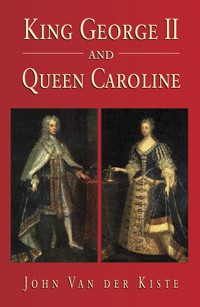
Erhalten Sie Zugang zu diesem und mehr als 300000 Büchern ab EUR 5,99 monatlich.
- Herausgeber: The History Press
- Kategorie: Sachliteratur, Reportagen, Biografien
- Sprache: Englisch
This biography of the last king to lead British troops into battle and his able wife provides intriguing insight into 18th century war and politics. Often derided as the buffoon who "hated all poets and painters", George II was fortunate to be served by Prime Ministers Sir Robert Walpole and William Pitt, and was wise enough to leave the business of government to them. His wife, generally regarded as the ablest of British queens between Elizabeth I and Queen Victoria, used her influence in politics and patronage so that she and Walpole effectively ruled the kingdom between them. Her death in 1737 was seen as a national calamity. Illustrated throughout, this new biography provides a much-needed reevaluation of these monarchs and the times in which they ruled.
Sie lesen das E-Book in den Legimi-Apps auf:
Seitenzahl: 517
Veröffentlichungsjahr: 2013
Das E-Book (TTS) können Sie hören im Abo „Legimi Premium” in Legimi-Apps auf:
Ähnliche










KING GEORGE II
QUEEN CAROLINE
ALSO BY JOHN VAN DER KISTE
Published by Sutton Publishing unless stated otherwise
Frederick III, German Emperor 1888 (1981)
Queen Victoria’s family: a select bibliography (Clover, 1982)
Dearest Affie: Alfred, Duke of Edinburgh, Queen Victoria’s second son, 1844–1900 [with Bee Jordaan] (1984, n.e. 1995)
Queen Victoria’s children (1986; large print edition, ISIS, 1987)
Windsor and Habsburg: the British and Austrian reigning houses 1848–1922 (1987)
Edward VII’s children (1989)
Princess Victoria Melita, Grand Duchess Cyril of Russia, 1876–1936 (1991, n.e. 1994)
George V’s children (1991)
George III’s children (1992)
Crowns in a changing world: the British and European monarchies 1901–36 (1993)
Kings of the Hellenes: the Greek Kings 1863–1974 (1994)
Childhood at court 1819–1914 (1995)
Northern Crowns: the Kings of modern Scandinavia (1996)
KING GEORGE II
QUEEN CAROLINE
JOHN VANDER KISTE
First published in 1997 by Sutton Publishing Limited
The History Press
The Mill, Brimscombe Port
Stroud, Gloucestershire, GL5 2QG
www.thehistorypress.co.uk
This ebook edition first published in 2013
All rights reserved
©John Van der Kiste, 1997, 2013
The right of John Van der Kiste to be identified as the Author of this work has been asserted in accordance with the Copyright, Designs and Patents Act 1988.
This ebook is copyright material and must not be copied, reproduced, transferred, distributed, leased, licensed or publicly performed or used in any way except as specifically permitted in writing by the publishers, as allowed under the terms and conditions under which it was purchased or as strictly permitted by applicable copyright law. Any unauthorised distribution or use of this text may be a direct infringement of the author’s and publisher’s rights, and those responsible may be liable in law accordingly.
EPUB ISBN 978 0 7509 5448 8
Original typesetting by The History Press
Contents
List of Illustrations
Preface
PART ONE: 1683–1714
1Prince George Augustus
2Princess Caroline
3‘Young Hanover brave’
4‘I cling to the hope’
PART TWO: 1714–27
5‘He thought his opposers impudent rebels’
6‘Not one drop of blood in my veins dat is not English’
7Guardian of the Realm
8‘I shall find you out’
9‘You English are none of you well bred’
PART THREE: 1727–37
10‘The right sow by the ear’
11‘You may strut, dapper George’
12‘The knowledge of my dear parents’ goodness’
13‘Something mean and below him’
14‘There is baboon enough for you’
15‘As great a political coward as ever wore a crown’
16‘How is the wind today for the King?’
17‘I never yet saw a woman fit to buckle her shoe’
PART FOUR: 1738–60
18‘The boldest man I ever saw’
19‘Je sens la mort’
20‘Now I shall have no more peace’
21‘In perfect tranquillity at home’
Genealogical Tables
Notes
Bibliography
Illustrations
1King George II
2Caroline, Princess of Wales
3Hampton Court Palace
4Queen Caroline and William, Duke of Cumberland, c. 1730
5Royal family silver medallion
6King George II, pottery mug
7Sir Robert Walpole
8Princess Mary of Hesse-Cassel
9Queen Louisa of Denmark
10Augusta, Princess of Wales
11King George II, statue
Preface
If the number of existing biographies is taken as a convenient yardstick, then King George II must be reckoned as the least-known of our monarchs since the Middle Ages. He reigned for thirty-three years and lived to the age of seventy-six, an age unsurpassed by any reigning British monarch until his successor and grandson, King George III, and his grandson’s granddaughter, Queen Victoria, both reached their eighties. Yet apart from George II and his Ministers, by Reginald Lucas (1910), which as its title suggests is predominantly political in tenor, A King in Toils, by J.D. Griffith Davies (1938), which the author calls ‘not a biography, but rather a record of “relationships” in the life of George II’, and a life by Charles Chevenix Trench (1973), literature has been extremely sparing in its celebration of the second Hanoverian King of Great Britain. He is the only crowned monarch since the Tudor age to be omitted from the Weidenfeld & Nicolson ‘Life and Times’ series on British Kings and Queens, published in the 1970s and 1980s. For the most part the King, ‘the strutting Turkey-cock of Herrenhausen’ in Thackeray’s elegant phrase, remains an ill-defined caricature known for hating ‘boets and bainters’, loathing his eldest son and heir even more, and for being the last King of Britain to lead his army on the battlefield – but little more.
Queen Caroline has scarcely fared better. Yet at least she has been vividly portrayed in print by W.H. Wilkins (1901), R.L. Arkell and Peter Quennell (both 1939), all of whom have recognized that she was a remarkable woman and eclipsed the consorts of the other Hanoverian Georges in talent and intellect rather than notoriety. To take a comparatively recent verdict, that of J.H. Plumb and Huw Wheldon in Royal Heritage (1977), she was ‘by far the ablest of our Queens between the reigns of Elizabeth I and Victoria, and she has been greatly undervalued.’
Contemporaries have left their accounts of the King and Queen to posterity, but the most extensive memoirs, those of Lord Hervey, are the least reliable. Hervey greatly admired the Queen and their third daughter Princess Caroline, but neither liked nor respected the King, or indeed most other people with whom he came into contact. The other great contemporary diarist of the period, Horace Walpole, was a considerably more gifted writer and his court reminiscences have never lost their appeal, but while he was more even-handed and less reluctant to give praise where it was due, he was not always the most objective of witnesses either. Their thoroughly readable but frequently waspish writings have inevitably formed history in the absence of any other alternative. It is surely no more than mild exaggeration to suggest that Hervey and Walpole were to the King’s reign what tabloid journalism has been to the closing decades of the twentieth century. The more kindly if less well-known memoirs of Lords Egmont, Chesterfield and Waldegrave have done something to redress the balance; but with personalities who died over two centuries ago, inevitably, fact and fiction are difficult to separate.
All too often, biographies of one character are written ‘at the expense of another’. Wilkins’s life of Queen Caroline, for instance, belittles King George II as a small-minded, stupid nonentity with few redeeming qualities, grossly inferior to his father; while most accounts of their eldest son Frederick, Prince of Wales, readily take the side of ‘poor Fred’ against his allegedly cruel and unsympathetic parents. Where does reality finish and colourful legend – or, to borrow that hideously overworked cliché of modern times and the television age, ‘soap opera’ – take over? To choose but one example: it is noted by Arkell, much the most fair of those writers mentioned above, that Queen Caroline sent a message of forgiveness to her eldest son while she lay dying, while the vitriolic pen of Hervey would rather have us believe that her last words on Prince Frederick were: ‘At least I shall have one comfort in having my eyes eternally closed. I shall never see that monster again.’ Under the circumstances, readers might appreciate that from time to time in this book, presented with such a divergence of source material, I have chosen to err on the side of charity.
Continuing on a similar theme, reference must be made to Ragnhild Hatton’s biography of King George I (1978). Although it only deals with the early lives of his son and daughter-in-law and not beyond, its exhaustive modern research has gone some way towards correcting the traditional, often inaccurate portrayal of the first two Georges, particularly with regard to their mutual antipathy. I have not sought to hide the fact that such ill-feeling existed, or indeed deny that it played a major part in the history of the dynasty; but I have echoed Hatton’s well-supported contention that it has been exaggerated in the interests of making a good story.
One should also consider the brief but excellent, incisive character studies that comprise J.H. Plumb’s The First Four Georges (1956). With these in mind, the time is ripe for a fuller reappraisal.
The reform of the calendar, as introduced in 1582 by Pope Gregory XIII, was adopted in Hanover by the Elector in 1700, when he decreed that eleven days should be subtracted from the month of February. As from 1 March that year the electorate used the New Style (NS) calendar, which had already been adopted by most of Europe. England retained the Old Style (OS) until September 1752, when eleven days were removed in order to bring the country into line with the rest of Europe. I have therefore followed Hatton’s principle of giving OS dates for Hanoverian events up to 1700 and English events to 1752, but NS dates for other events. Both are given in a few cases where confusion might arise.
In conclusion I would like to acknowledge the efforts of my friends Roman Golicz, Robin Piguet, and Karen Roth, for assistance with or the supply of information; the staff of Kensington and Chelsea Libraries, for regular access to their basement garden of bibliographical delights, in the form of the reserve collection of biographies; my parents, Wing Commander Guy and Kate Van der Kiste, for their encouragement and for reading through the manuscript in draft form; and my editors, Sarah Bragginton and Jaqueline Mitchell, for their hard work in seeing the work through to publication.
PART ONE
1683–1714
CHAPTER ONE
Prince George Augustus
Hanover, one of the most northerly German states, took its name from its capital, a town set on the banks of the River Leine. In the late seventeenth century it flourished under the rule of a benevolent despot. Absolute power lay with the Duke of Brunswick–Lüneburg, who was granted the title of Elector* in 1692, though the full electoral dignity was not conferred on him until the state was admitted as the ninth electorate of the Holy Roman Empire in 1699. He appointed and dismissed all ministers; any decisions concerning home or foreign affairs had to be referred to him; he was required to approve any significant expenditure, and to initiate the proceedings of any major criminal prosecution. As Commander-in-Chief of the Hanoverian army, his approval was required before his troops could be sent to fight with or under other European rulers. The state was reasonably prosperous, with a fair share of rich farming land, a flourishing woollen and linen trade, and plentiful mineral resources, including silver mines in the Hartz mountains. Poverty, political dissent, and parliamentary government were almost unknown.
There were three palaces in the town, namely the small Alte Palais; the barrack-like Leine Schloss; and the home of the Court, the far grander Herrenhausen, its foundations and gardens modelled on those of Versailles. A deep-rooted dislike of the French as a people and a nation did not prevent the Germans from copying their architecture and sense of style. The gardens had been planned and laid out by the younger Martin Charbonnier, whose father had been a pupil of one of King Louis XIV’s landscape gardeners, and by the end of the seventeenth century Herrenhausen was one of the most splendid of all German courts, boasting acres of parkland and intricate formal gardens containing carefully arranged walks lined with lime trees or neatly trimmed low hedges, dotted with artificial waterfalls, and well-stocked pike ponds. Adding the classical touch were busts of Roman emperors, imported from Paris. The stables, with room for over six hundred horses, were surrounded by coach houses accommodating an extensive collection of carriages and chaises. An open-air theatre with court players, again brought from Paris, performed for the entertainment of the electoral family. Most impressive of all, especially to foreign visitors, was the Herrenhausen orangery, one of the largest of its kind in Europe. It had its own heating system to help the fruit grow and ripen in the cold northerly Hanoverian climate. According to the much-travelled English church minister and classical scholar John Toland, the Hanoverian Court was ‘accounted the best both for Civility and Decorum’ in Germany.
All this was a world apart from England, soon to become the kingdom of the Elector of Hanover. To the electoral family, the island territory across the North Sea was merely a nation of ‘King-killers and republicans’. After the overthrow and execution of King Charles I in January 1649, an eleven-year republican interlude under Oliver Cromwell and his less capable son Richard as Lord Protectors had come to an end with the restoration of the Stuart monarchy under King Charles II in May 1660. That same year – in fact, almost that same week – Prince George Lewis of Hanover was born.
In 1680 he visited England, the country over which he would reign some three decades hence. The plan was to create an alliance between Hanover and England by marrying Princess Anne, second daughter of the heir apparent James, Duke of York, and third in line of succession to the throne herself. How seriously the match was considered is open to doubt. Apparently George Lewis took a dislike to Anne and she thereafter bore a grudge against the house of Hanover; but the feeling was probably mutual, as it was said that she refused to consider marrying the ‘stuffy little German’. Yet such personal differences counted for little in the world of seventeenth-century matrimonial alliances, where political reasons required princes and princesses from different nations to set personal feelings on one side and walk up the aisle together. Another theory suggested that George was snubbed or slighted at court during his visit, and never forgave the British. Yet another, and probably the most plausible, was that a matrimonial alliance was only tentative. At any rate, if the elder generation were contemplating the scheme, he had not been taken fully into his parents’ confidence before leaving for England.
A betrothal between the Electoral Prince and his cousin, Princess Sophie Dorothea of Celle, had already been considered. This would be just as advantageous as the Anglo–Hanoverian match, if not more so, for both parties. In the summer of 1682 her parents the Duke and Duchess of Celle visited the court at Herrenhausen to settle the terms of a marriage agreement. A dowry was handed to Prince George Lewis in person, so that his young wife would be completely dependent on him; and on the death of her parents, all their revenues and possessions would become his property.
On 21 November 1682 the Prince and Princess were married. He was aged twenty-two; she was sixteen. The wedding took place in the Princess’s apartments with a minimum of ceremony. Ten days later the young couple entered Hanover to the sound of trumpet fanfares attended by a glittering parade of cavalry. Their carriage was at the centre of a triumphant procession consisting of a hundred state coaches, each drawn by eight horses decorated with red velvet trappings and red twisted silk reins, accompanied by footmen dressed in red and blue uniforms with silver buttons.
The marriage was very much a political arrangement in which the private views of bride and groom about each other counted for nothing. The Prince’s father Ernest Augustus, Duke of Brunswick–Lüneburg, ruling Duke of Hanover from 1679, intended to strengthen the position of Hanover by assimilating the duchy of Kalenberg, the domain of his brother, the Duke of Celle, on the latter’s death. Prince George Lewis was seemingly indifferent towards his young bride, who was still a child. As cousins they had known each other for several years and their mutual dislike was deep-rooted. It was said that when she was told what was in store for her just before the betrothal, Princess Sophie Dorothea swore that she would have to be dragged to the altar, and when presented with a diamond-studded miniature of Prince George, she threw it angrily against the wall. She was half-French; her father George William, Duke of Celle, had morganatically married a Frenchwoman, Eleanor d’Olbreuse. Their daughter had blossomed into an attractive, high-spirited girl, who was more French than German in temperament and sympathies.
Her husband was German through and through. His interests were restricted largely to military matters, hunting and fine horses, good food, and cards for low stakes. While he spoke and wrote French easily, he shared the prevalent Teutonic dislike and distrust of France as a nation. In spite of his naturally cold, somewhat shy manner, he was probably prepared to make a success of the marriage – but on his own terms, not those of his wife. Political considerations had raised her to her position, and her duty was to provide him with an heir. A wedding ring would certainly not keep him from his mistresses.
At sixteen, however, Princess Sophie Dorothea was still too immature and too undisciplined at heart. Any dormant dislike which her husband may have had for his childish young cousin from earlier days soon reasserted itself. He did his princely duty, and by the time he left her for military service under the banner of Emperor Leopold, fighting against the Turks, she was expecting a child. On 30 October (OS)/9 November (NS) 1683 she gave birth to a boy, christened George Augustus. Five years later came a daughter, named after her mother.
By then husband and wife, never close, had grown apart. Perhaps the most to blame was the Elector’s conniving mistress, Countess Platen. Anxious to ensure her future security should the Elector suddenly die, she had encouraged the young, unmarried Prince George Lewis to take mistresses. There is no evidence for the oft-made but unsubstantiated remark that he had enjoyed an incestuous relationship with her daughter by the Elector, the future Baroness von Kielmansegge. Yet the appearance of Princess Sophie Dorothea came as something of a threat to the Countess, who was jealous of the younger, charming and much prettier girl. Sophie Dorothea had always been liked by her father-in-law, but her mother-in-law despised her French blood and parents’ morganatic marriage. The more affection the Duke showed the young woman, the more his wife resented her.
Prince George Lewis was away on military service much of the time, and his wife soon became bored. A visit to Venice and Rome with her father-in-law in 1685 provided her with a brief respite, for the social life of both cities provided her with the amusement she never found in Hanover. On her return home she chafed more than ever. Adding to her misery was the discovery that Prince George Lewis, back from the war, had installed a new mistress in another apartment at the palace. Melusine von Schulenburg, seven years younger than him, had entered royal service as a Hoffraulein to the Electress of Hanover, and in January 1692 she bore Prince George Lewis the first of three daughters.
Most princesses would have accepted such a situation resignedly. But Sophie Dorothea’s boredom soon progressed to tantrums and scenes with her husband. Not particularly maternal by nature, she put up no resistance to the unwritten law that her children’s upbringing should be left to governesses. That they always remained loyal to her memory suggests that she must have shown them some tenderness, unless it can be put down simply to detestation of their father. Yet by the time baby Sophie Dorothea was born, her mother was desperate to leave Hanover and return to her parents.
Recklessly she followed her husband’s example in looking elsewhere to satisfy the passions which married life could not fulfil. What started out as a casual friendship with Count Philip Christopher von Königsmarck, a Swedish nobleman and Colonel of the Hanoverian army, led to the exchange of secret letters and flirtation, and by 1692 they were lovers. In July 1694 the Count was ambushed while on his way to her apartments and probably murdered. Though it might have been merely the intention to arrest him, some courtiers evidently had execution on their mind, and he was never seen alive again. The Princess’s apartments were searched and incriminating letters were found. The Elector of Hanover and the Duke of Celle agreed that the only solution was to arrange a divorce which suppressed the name of Königsmarck altogether, citing the Princess’s refusal to cohabit with her husband as the reason. Initially unaware of Königsmarck’s fate, she was more than willing to divorce her uncongenial husband, and refused all attempts by Hanoverian and Celle jurists to arrange a reconciliation. On 28 December 1694 the marriage was dissolved.
As the guilty party Princess Sophie Dorothea was forbidden to remarry, but not her ex-husband. According to one of their granddaughters, Melusine von Schulenburg later became the morganatic wife of Prince George Lewis. Nonetheless Ragnhild Hatton, his most recent biographer, maintains that the then English church law, which precluded marriage while the divorced spouse was alive, deterred King George I, both before and after his accession as King in 1714, from making their union a formal one.1 The Princess spent her remaining years as a virtual prisoner at Ahlden, in Celle territory. Forbidden access to her children, she was ostracized by her father, who felt that she had let the good name of the family down.
Her imprisonment was not so harsh as has been commonly supposed. She was allowed to live in comfort, and her husband promised her father in writing that the terms of her confinement and financial support would not be made stricter on his death. She had access to financial advisers and was permitted to keep all income from land held by her father after his death in 1705; and her widowed mother was given financial assistance to move from her house in Lüneburg to the castle of Celle to make it easier for her to visit. After a time her husband relaxed the censoring of her corres-pondence, and made it easier for her to receive visitors. All the same, in her enforced isolation she paid a heavy price for her dalliance.
Prince George Augustus, only son of this disastrous marriage, was eleven years old at the time of his parents’ divorce. He probably never saw his mother again. An unsubstantiated story tells of his hunting in the woods nearby as a boy, stealing away from the rest of the party to ride at full speed in the direction of Ahlden, before he was caught by his suite in a wood about four miles from the castle. Another version suggests that he reached Ahlden and waved to his mother at the window, and when the governor of the castle refused him admission he tried to swim across the moat before he was recaptured.
His father took no interest in his children’s upbringing. Any mention of their mother, or the mere word ‘divorce’, would always remain a forbidden subject between them. The dominant figure of their formative years was that of their paternal grandmother, the Electress Sophie. She and the Elector became their legal guardians after their mother’s disgrace. Born in Holland in 1630, daughter of the former Princess Elizabeth of England, the ‘Winter Queen’ of Bohemia, and thus a granddaughter of King James I of England, the Electress Sophie was much more English than German in her tastes and habits. Proud of her Stuart blood, she kept a portrait of Prince James Edward, the Pretender, son of King James II, in her room, though she was careful to remove it whenever an English envoy called. She spoke English perfectly, and although she never set foot on British soil, throughout her life she took the keenest interest in events in ‘her country’, as she always called it. ‘I care not when I die,’ she would say, ‘if on my tomb it be written that I was Queen of England.’ She liked her friends to call her the Princess of Wales, though she had no official right to the title. Tall, formidable to those who scarcely knew her, her vitality was remarkable. Striding through Herrenhausen gardens she kept the gardeners working hard, examined every plant devotedly, fed her canaries, talking all the time and leaving ladies-in-waiting half her age virtually exhausted. Even at eighty she could still do fine embroidery without needing spectacles.
In January 1698 Elector Ernest Augustus died. From Ahlden Sophie Dorothea wrote to her former husband to condole with him, at the same time begging forgiveness: ‘The sincerity of my repentance should move Your Highness to pardon me, and if, to crown your kindness, you would allow me to see you and embrace our dear children, my gratitude for such highly-desired favours would know no bounds.’2 Her words fell on deaf ears.
From time to time the young Prince and Princess visited their other grandparents at Celle. More than her husband, who accepted that the flighty young girl had brought disgrace on herself and the family, the Duchess of Celle strongly resented her daughter’s treatment, and did not hesitate to make her feelings clear to her grandchildren. Therein probably lay the seeds of the antagonism which Prince George Augustus always bore towards his father.
Within the family, the Electress Sophie had readily taken the part of her son against the daughter-in-law whom she had never liked. Nevertheless she was careful not to make it too obvious to young Prince George Augustus, of whom she was always fond. The distance between father and son, a family relationship which would persist throughout the house of Hanover, seems to have had its roots in Prince George Augustus’s devotion to the mother whom he was destined never to see again. The Elector was capable of cruelty and would show no mercy towards those whom he thought had crossed him, and perhaps the subsequent insecurity his son felt played its part in widening the breach.
Another cause of the estrangement between King George I and his son was ‘the tendency of the Electress Sophie to treat her son with jealous reserve and bestow all her favour and encouragement upon the grandson.’3 Another biographer suggests that Prince George Augustus’s ‘small, slender figure, the delicate cut of his features, the lack of self-control demonstrated by blushes and tears’ reminded his father of the prisoner at Ahlden whom he wished to forget. Differences of character also played their part, notably the boy’s exuberance, garrulity and a habit of putting his father in the wrong.4
Prince George Augustus had the customary training and education for German princes of the day. Well grounded in the classics, in addition to his native German he also spoke French, Italian and English, albeit with a heavy accent which he never lost. Maybe the elder generation had some idea of his destiny; maybe they foresaw that Prince George Lewis’s inability to speak good English would put him at a disadvantage in the future. His son also had an excellent memory for dates, genealogy, and details of military history. At nineteen, John Toland noted, the Prince had ‘a winning countenance, speaks gracefully, for his Years a great Master of History, a generous Disposition and virtuous inclinations’.5 Methodically minded, he lacked intellectual curiosity. Literature and art meant nothing to him, but he had a passion for anything to do with the army. He was fascinated by weapons, the minutiae of battlefield tactics and the like, and dazzled by the glitter of military uniforms.
The Electress Sophie had once had plans for educating her other grandson, Crown Prince Frederick William of Prussia, at Herrenhausen with his cousin. Once she invited him to stay, but the experiment was unsuccessful. Prince Frederick William was five years younger than Prince George Augustus, but much larger and stronger. His favourite way of settling arguments had more to do with fists than words, and after giving George Augustus a bleeding nose one day he was sent back in disgrace to Berlin. The childhood antipathy between both cousins, later to become monarchs, would endure until porphyria and excessive drinking wore out the younger man in middle age.
Prince George Augustus was nearing the age of maturity when it became evident that his ultimate destiny lay beyond the duchy of Hanover. In 1701 the Act of Settlement was passed by Parliament at Westminster. The heir to the childless widower King William III was his sister-in-law, Princess Anne. Married to Prince George of Denmark, her seventeen pregnancies had only produced one child who survived infancy. The death of this sickly boy, Prince William, Duke of Gloucester, a few days after his eleventh birthday in the summer of 1700, required the nomination of an heir to succeed her on the throne. According to the Bill of Rights passed by Parliament after the abdication of King James II and the ‘Glorious Revolution’ which had brought his elder daughter Mary and her husband William of Orange to the throne as joint sovereigns, no Roman Catholic could ascend the throne of England.
Of the many surviving Protestant descendants in Europe of King James I, the most eligible was his granddaughter Princess Sophie, Electress and Dowager Duchess of Hanover. The Electress was thirty-five years older than Princess Anne, but although still only aged thirty-six, the latter’s long history of miscarriages, still-births and short-lived infants made her chances of producing a healthy heir remote. In fact, nearly twenty pregnancies had turned her into a virtual invalid, aged beyond her time, and the prospect of another pregnancy was less likely than her premature death.
King William III eagerly endorsed the Hanoverian succession. The electorate had been a devoted standard-bearer of the cause of central Europe against a power-hungry France under the over-mighty King Louis XIV. If the house of Stuart retained the throne after the reign of his sister-in-law Queen Anne, he realized, an alliance with France – such as King Charles II had made – would risk compromising the independence of his beloved Holland. Parliament assented, on several conditions. Firstly, when the Hanoverians ascended the throne, England could not be obliged to go to war in the defence of a foreign country without parliamentary consent, thus ensuring no repeat of the situation when King William had taken England into the war of the League of Augsburg. Secondly, the monarch could not leave England without the approval of Parliament, and no foreigner could sit on the Privy Council or hold office under the crown. These clauses, again, had been drawn up with King William in mind, for he had packed high offices with his Dutch advisers, and left England as frequently as he wanted. Further conditions strengthened the independence of the British judiciary, and limited the individual actions of the monarch and his advisers. The King could no longer dismiss judges, nor protect his favourites from impeachment by the House of Commons or Lords.
Parliament and crown had been almost at war with each other throughout much of the seventeenth century. At the dawn of the eighteenth the Divine Right of Kings, as understood by King James I and his even more headstrong son King Charles I, was effectively about to be consigned to history. A despotic monarch would give way to a despotic Parliament.
Such matters, however, did not concern the electoral family unduly. The Act of Settlement was passed in the same year that Prince George Augustus celebrated his eighteenth birthday. He was third in succession to the throne of England, after his grandmother and mother. It had been little more than half a century since the English Parliament had executed one King, and only thirteen years since they had deposed another. Further parliamentary changes in the succession could be wrought within his lifetime. Meanwhile, there were greater priorities – the ancestral home of Hanover, a career in the army, and perhaps most important of all, the matter of finding a wife.
*The official designation was Elector of Brunswick–Lüneburg, in accordance with the ducal family name. Historical usage has generally preferred the territorial appellation ‘Elector of Hanover’, cited thus in the following pages.
CHAPTER TWO
Princess Caroline
Ansbach was the capital of the small south German state of Brandenburg–Ansbach and the seat of Margrave John Frederick, who ruled from 1667 to 1686. He was a forward-looking if eccentric young man who cared less for military pursuits than for the arts; he wrote romantic novels, and took a keen interest in orchestral music, opera and the theatre. In order to further the state economy he invited foreigners skilled in weaving cloth or making bronzeware to settle in Ansbach, and ordered that his officials were to dress only in uniforms made from locally produced textiles.
The Margrave was twice married. Virtually nothing is known of the first marriage, beyond that it produced two boys and a girl. At the age of twenty-eight he took as his second wife Princess Eleanor, daughter of the Duke of Saxe–Eisenach. Contemporary poets called her ‘the most beautiful princess in Germany’.
On 1 March 1683 she gave birth to a daughter, christened Wilhelmina Caroline, but always known by the second name. Two years later a son, William Frederick, joined her in the nursery. The family was now complete, for in 1686 the Margrave died of smallpox. He was succeeded by George Frederick, one of the sons by his first marriage. As he had never shown any affection for his stepmother or her children, she realized that life would be less unpleasant if she took them back to live with her at her old home, Eisenach, on the edge of the Thuringian Forest. Prince William Frederick was heir-presumptive to the margravate, and later returned to Ansbach under the guardianship of the Elector of Brandenburg.
On a subsequent visit to Berlin the Dowager Margravine became betrothed to the Elector of Saxony, John George IV. They married in 1692, but it brought her no happiness. He had never fully recovered from a blow on the head during his youth. A selfish, brutal man, he cared less for her and his stepchildren than for his mistress, Magdalen Sybil von Röohlitz, a woman whose beauty made up for her lack of education. Her ambitious, intriguing mother had had to write her love letters for her, and it was said that the family was in the pay of the Emperor of Austria, while there was a movement afoot in Saxony to establish closer ties with Brandenburg. The Elector had always treated her as though she was his wife, and denied her nothing. At the time Frederick William, Elector of Brandenburg, was trying to establish an alliance with Saxony, and the Saxon ministers hoped to draw their Elector from the clutches of his mistress and their pro-Austrian leanings.
A betrothal was arranged between the Elector and Eleanor. She was almost destitute, and needed to find a home for herself and her children. As she was largely dependent on the goodwill of the Elector of Brandenburg, whatever her reservations, she had little choice but to comply. But by the time the marriage took place in Leipzig, it was evident that the Elector intended to carry on virtually as though he was married to two women at once, and he made it evident that Magdalen von Röohlitz was his favourite. Soon after Eleanor returned to Dresden with him (or them) as Electress, he promoted his mistress to the rank of Countess, and she declared that she was going to marry him. The rightful Electress soon feared for her life, attempts were made to poison her and the children, and they retreated from the court at Dresden to a dower-house at Pretsch.
Salvation of a kind came in 1694 when the Countess was struck down by smallpox and died. Ignoring all medical precautions, the grief-stricken Elector had stayed by her bedside throughout her illness. Had he been better liked, his ministers and doctors might have persuaded him otherwise for the sake of his health. If they had had a vested interest in the disease carrying him off as well, they did not have long to wait, for he survived her by less than a fortnight. Yet it came too late for the Electress, left widowed for a second time. Her spirits and health were broken by the misery she had endured. The Elector and Electress of Brandenburg realized that they were partly to blame, by encouraging her into this unsuitable second marriage. They promised to look after the young Princess Caroline if anything should happen to her mother.
Perhaps they had foreseen the course of events, for two years later the twice-widowed Electress died. The new Elector of Saxony took no interest in Princess Caroline – he had far too many illegitimate children of his own to bother with her – and she went to Berlin to be brought up by her guardians, the Elector and Electress of Brandenburg. They had only one son, Frederick William, aged eight, and they were glad to treat her as the daughter they never had. The Elector wrote to her, promising that he would ‘never fail as your guardian, to espouse your interests, and to care for you as a loving father, and pray your Highness to have me in the same confidence as your mother always had, which I shall perpetually endeavour to deserve.’1 Soon it was a genuinely royal court, for the Elector and Electress became King and Queen of Prussia in 1701.
Unlike her eldest brother Prince George Lewis, Elector of Hanover, Queen Sophie Charlotte was a woman of considerable personality and lively intellectual interests. Metaphysicians, scientists and free-thinkers would all be assured of a ready welcome at the Palace of Lützenburg, for Sophie Charlotte relished theological argument and discussion. By the standards of the day, she was politically a liberal, and sometimes jestingly referred to as ‘the republican Queen’. Her mentor was Gottfried Wilhelm Leibniz, a philosopher, mathematician and historian, and one of the most scholarly men of the age.
Princess Caroline had inherited her father’s love of learning, and as a girl she had adored reading. Through perseverance she had managed to teach herself much from the printed page of which she would otherwise have remained ignorant, for with her unsettled early life, there had been no tutors or governesses to supervise her education. Her handwriting, punctuation and spelling were and always remained poor, although it was a fault by no means uncommon among learned princesses and other women of the time. Before long she fell under the influence of the Queen of Prussia. The kind-hearted elder woman, who though fifteen years older seemed more like a sister than a mother to her, soon made Caroline feel at home. There was no place, let alone friendship, for her at Ansbach under the rule of her stepbrother. She looked up to Queen Sophie Charlotte, and her admiration led to a remarkable likeness between the two in speech and manner. Caroline was always welcome at Lützenburg, to listen to intellectual discussions between philosophers and intellectuals, sharpen her wits, and learn much from the more progressive minds of the day. The Queen always wanted to know ‘the why of the why’, as others grumbled, and Caroline took after her. She was the Queen’s constant companion, and when Caroline left for occasional visits to her brother, the Queen complained that Lützenburg was ‘a desert’ in her absence.
Even so, it was evident that the elder generation would try to marry her off as soon as they reasonably could. In 1704 she received a proposal of marriage from Archduke Charles of Austria. She turned him down, allegedly as he was a Roman Catholic and she could not change her religion. The Queen of Prussia was loath to part with her, but refrained from expressing an opinion; the Princess must make up her own mind. She would have liked Caroline to marry her son Frederick William, but in her heart of hearts she realized that her uncouth son would hardly suit a girl with such personality and intellect, and if such a marriage turned out badly it would be on her conscience. Although a Protestant himself, the King of Prussia had no sympathy with her religious objections. He pointed out what a splendid match it would be, but in vain. As she was theoretically living on the King’s charity, and as he was not used to having his intentions thwarted, least of all by a woman, her refusal indicated no lack of personality on her part.
Her resolve was strengthened by the Queen of Prussia’s mother, the Dowager Electress Sophie of Hanover. Much impressed by Princess Caroline, the Electress already decided that she would make a perfect wife for her grandson, Prince George Augustus; ‘we at Hanover shall hardly find any one better’. A Jesuit priest tried to persuade Princess Caroline to change her mind, and she agreed to listen to his arguments, but despite threats on the King’s part and tears on hers, her mind was made up. Although poor, orphaned and dependent on the generosity of her guardians, one of whom was strongly in favour of the match, she could not go against the dictates of her conscience, even marrying the Archduke would mean gaining riches and power. Did the young Princess fear more losing her Protestantism or her independence?
By November 1704 her mind was made up. The Electress Sophie wrote with relief to Leibniz: ‘Most people here applaud the Princess of Ansbach’s decision, and I have told the Duke of Celle that he deserves her for his grandson. I think the Prince [George Augustus] likes the idea also, for in talking with him about her, he said, “I am very glad that you desire her for me.”’2
Early the following year, while travelling to visit her mother at Hanover, Queen Sophie Charlotte fell ill. Exhausted by her journey, she had to take to her bed on the way, but she soon rallied, insisting that she would go to Herrenhausen. Within a few days of her arrival she suffered a relapse, and the doctors diagnosed a tumour in the throat; they told her that there was no hope. A French chaplain at Hanover offered his services, but she politely declined, on the grounds that she had devoted twenty years of study to religious questions, and he could tell her nothing she did not already know. ‘Do not pity me,’ she told her lady-in-waiting. ‘I am at last going to satisfy my curiosity about the origin of things, which even Leibniz could never explain to me, to understand space, infinity, being and nothingness; and as for the King, my husband – well, I shall afford him the opportunity of giving me a magnificent funeral, and displaying all the pomp he loves so much.’3 She was only thirty-six and, as she had previously been in good health, her sudden demise gave rise to suspicion. It was rumoured that she had been poisoned with diamond powder by courtiers at Berlin, acting in league with officials who despised her for her liberal views. A post-mortem revealed that ‘her stomach was so worn that you could thrust your fingers through it at any place.’ Hanover would not readily forget that the court at Berlin had possibly murdered one of her daughters. Nevertheless she was deeply mourned by her husband, who renamed Lützenburg Charlottenburg in her memory.
Princess Caroline was desolate at losing the woman who had been her mother, or even her elder sister, in all but name. ‘Heaven, jealous of our happiness, has taken away from us our adored and adorable Queen,’ she wrote to Leibniz in March. ‘The calamity has overwhelmed me with grief and sickness, and it is only the hope that I may soon follow her that consoles me.’4
While she was returning sadly to her brother’s palace at Ansbach, the Dowager Electress Sophie was planning for her future. She was increasingly convinced that her grandson, Prince George Augustus, could have no better wife than his young cousin. As the Princess was almost twenty-two years of age, this jewel was certain to be claimed by one or other of the Protestant courts of Europe before long unless Hanover moved in first. The King of Prussia thought that without his wife to strengthen the young woman’s resolve, he could easily put pressure on her again to reconsider marriage with the Archduke Charles. Fortunately she found another friend and protector in her brother, now Margrave of Brandenburg–Ansbach. He told his sister that he greatly resented the King’s efforts to interfere, and that he fully supported her decision. If she was threatened by her regal guardian in Prussia, she was at liberty to make her home at Ansbach as long as she pleased. As he probably knew, the right marriage would not be long in coming.
Meanwhile the Elector of Hanover decided that his son should visit Ansbach in disguise, under an assumed name, and meet the Princess to see if they were mutually attracted. He knew by bitter experience what misery a state-arranged marriage could bring in its train. Although normally indifferent to the feelings of his family, on this occasion at least he seems to have had the personal interests of his son at heart, in wishing to spare him from the fate he had suffered. There was another reason for secrecy; if the King of Prussia knew what was happening, he would surely try to put a stop to it.
In June 1705, at midnight, three men rode quietly out of Hanover en route for Ansbach. They were Baron von Eltz, a Hanoverian minister and former governor of the Electoral Prince George Augustus, Monsieur de Busch, and his valet de chambre. ‘Monsieur de Busch’ was none other than the Electoral Prince himself. He was travelling incognito as a young Hanoverian nobleman, planning to meet companions at Nuremburg. As they had not arrived, and as he found the city so dull, he told officials, he had decided to come to Ansbach and see the court instead. He and Baron von Eltz presented introductions from the Hanoverian chief minister, Count von Platen, commending them to the Margrave’s good offices. At his summer home, Triesdorf, they were treated with all due hospitality by the Margrave and his sister, invited to supper, and spent the rest of the evening listening to music and playing cards.
‘Monsieur de Busch’ was presented to Princess Caroline, and soon struck up a conversation with her. Later he declared that she had far exceeded all his expectations, and that he fell in love with her at first sight. This brief acquaintance, according to Poley, the British envoy at Hanover, convinced the young suitor that she so completely answered to ‘the good character he had of her that he would not think of anybody else after her.’5 Nevertheless he behaved himself perfectly and kept up the pantomime, being careful not to reveal his identity. If she had been let into the secret, she too kept her counsel to herself. Having decided that Princess Caroline would evidently make a suitable bride, he and Eltz left Ansbach, ostensibly for Nuremburg, but secretly to return to Hanover. He reported to the Elector that he was genuinely pleased with the Princess. The Elector informed Eltz that Prince George Augustus was ‘seized with such an affection and desire for her, that he is most eager to marry her without delay: We therefore should gladly rejoice to see such a union take place, and hope that the Princess may be equally favourably disposed.’6
Baron von Eltz was sent back to Ansbach to seek a private interview with the Princess. He explained the mission and their reasons for such secrecy, asked her if she was ‘free of all other matrimonial engagements’ and in that event whether she was favourably disposed to the Electoral Prince’s suit? The Princess ‘at first seemed surprised and agitated’. As the negotiations between herself and the King of Spain had been broken off, she was entirely free, but ‘she had never flattered herself that any one in Hanover had so much as thought about her.’7 Though she probably knew no more about the personality of the Prince than he knew about hers, their brief acquaintance must have doubtless made it evident to her that he would be preferable to the boorish Crown Prince of Prussia. Moreover Hanover was one of the more prosperous German states, and the Act of Settlement would undoubtedly ensure her a Queen Consort’s crown one day. Once the Margrave had consented to the proposal, a contract of marriage was drawn up.
The news was announced at Herrenhausen just before a Sunday dinner in July. The Elector, Poley reported, ‘declared that there was concluded a treaty of marriage between his son the Electoral Prince and the Princess of Ansbach, and the Prince received the compliments of the court upon it, and at dinner there were many healths drunk to his good success. So that the mystery is now at an end which hath hitherto been concealed with so much care.’8
The Dowager Electress Sophie expressed her surprise that the matter had been kept secret from her, but she was so pleased that her own wishes were to be realized that she soon forgave them. She probably knew why her son had kept her in the dark, for she was a notorious gossip and her wagging tongue could have put all the plans in jeopardy. Others were quick to offer their congratulations, though a predictably sour note was struck by the King of Prussia. Having received a letter from his mother-in-law expressing her pleasure, he replied coldly that he was angry with the family at Hanover for notifying him of the conclusion of the marriage so late, but he was ‘more angry with the Court of Ansbach who are a branch of his family and he a guardian to the Princess’.9 Making light of it, the Electress suggested laughingly that the King really wanted to marry Caroline himself since the prospect of her becoming somebody else’s wife made him so angry. Significantly, Prince George Augustus’s maternal grandfather the Duke of Celle came to Hanover, while the Duchess went to stay with her imprisoned daughter at Ahlden. Her mother’s visit was the only notification that Princess Sophie Dorothea had of the news, and she was not even permitted to write in person to her son or future daughter-in-law.
Wedding preparations were well advanced and Princess Caroline, accompanied by the Margrave, were on their way to Hanover, when they were told that the Duke of Celle had died of a chill caught while hunting. The duchy of Kalenberg therefore passed into the hands of the Elector of Hanover. To postpone the wedding would give Berlin a chance to bring pressure on the bride-to-be with a view to preventing the match. In order to forestall them it was agreed that the wedding should take place as soon as she arrived at court, and mourning for the Duke would be observed afterwards.
On 2 September 1705 the Princess of Ansbach and the Margrave arrived at Hanover. The wedding was solemnized that evening in the chapel at Herrenhausen, and the Electress noted that the bridegroom slept throughout the wedding sermon. ‘What good news for the bride that he should be well rested,’ the Electress’s niece Elizabeth Charlotte, Duchess of Orléans, replied to her letter describing the festivities. A court ball was given the following day. With court mourning deferred, there were ‘the greatest appearances of entire satisfaction on all sides’. Congratulatory letters arrived from Queen Anne to the bride and groom, his father and his grandmother.
All things considered, Prince George Augustus and Princess Caroline might have seemed an ill-matched couple, perhaps no better suited to each other than the Prince’s parents. That they stayed happily married for thirty-two years, until death claimed one of them, was partly a matter of good fortune conspicuously lacking in the marital unions of the other three King Georges of England from the house of Hanover (incompatibility and flagrant infidelity destroying one, severe illness and apparent insanity clouding another, and mutual disgust on first sight damning the last). It was also partly a tribute to the tolerant personality of each.
In the eighteenth century, any quick-witted princess with any claims to being a blue-stocking would be expected to bite her tongue and suppress her personality if her husband wished it. Prince George Augustus of Hanover was a typical German prince, with no pretensions towards intellect, and basically interested in little more than military glory, political power and a wife who would do her duty by providing him with male heirs. A lively-minded wife with a more agile brain than his might put him at a disadvantage; and a wife whose indelicate approach to discussing sex with other men and women might have revolted a less tolerant husband.
CHAPTER THREE
‘Young Hanover brave’
The Electoral Prince and Princess settled in Leine Schloss, in apartments formerly inhabited by the Prince’s mother. If superstitious voices were tempted to suggest that it was a bad omen, the young couple were not disturbed by precedents. For the first few months of their marriage, the Prince could hardly bear to let his wife out of his sight. The Dowager Electress noted approvingly that a happier friendship had never been seen; ‘they seem to have been made for each other.’ They were obviously extremely happy together, though only one cloud marred the Electoral Princess’s happiness – the ill-feeling between her husband and his father. Although he had welcomed the marriage, he resisted all her efforts at friendliness. Charm, tact and apparent submissiveness made her relationships with other male members of the family successful, while good humour with the ladies likewise served her well, but the cold and dour Elector proved immune. At length she had to accept that he did not want to be friends; she probably saw that his jealousy of their happiness was an insuperable barrier. Her father-in-law was to prove the only man whom she could never learn to manage.
Despite their mutual devotion, the Prince soon became restless for the battlefield. Hanoverian contingents were leaving regularly for the theatre of war against France at Flanders or the Upper Rhine. In May 1706 the Elector and his brother went to join the forces. Prince George Augustus was left behind, reviewing troops in Hanover and seething with frustration. He longed to return to a soldier’s or commander’s life, only to be told that ‘the Court is against it and will not give their consent to let him go into the field until he has children.’
By May the Electoral Princess was convinced that she was pregnant, but at length she and her husband realized that their hopes had been premature. Their disappointment was compounded by the behaviour of the Crown Prince of Prussia. Having failed to win the hand of Princess Caroline, he came to the court of Hanover and became betrothed to the Elector’s only daughter, ‘Sophie Dorothea the younger’. It was another match which met with the Dowager Electress’s approval. She hoped that the bullying young Prussian who had behaved so badly towards his elder but smaller cousin had matured and would make a worthy grandson-in-law, although time was to prove that she had been too optimistic by half.
Prince George Augustus was never close to his sister, so the fact that his childhood bête noire was to become his brother-in-law did not disturb him unduly. It rankled less than the Crown Prince’s victory in the race to the battlefield. He was called to fight in the Netherlands, and returned two months later in high spirits. Meanwhile Prince George Augustus had been left at Herrenhausen, green with envy and beside himself with frustration. When Princess Sophie Dorothea was married by proxy at Hanover and left for Berlin later in the year, their relief at her departure was tempered by the well-founded suspicion that the Elector and his mother had always been much more fond of her than of her brother.
By November there was still no child, and Princess Caroline was coming to the despairing conclusion that she had never been expecting at all. She had evidently been ill-prepared for motherhood, and one suspects that the doctors had simply not bothered to give her a little elementary education. The other possibility is that in her condition she was so irritated by persistent enquiries from both sides of the family, and court officials, that when she discovered she was expecting a child she retired into temporary seclusion, cutting herself off from everyone except her closest relations. Either she miscalculated the expected date of birth of her first child, or the baby was born later than expected. On 20 January (OS)/1 February (NS) 1707 she produced a son, christened Frederick Lewis.
The English envoy at Hanover, Lord Howe, reported four days later:
This Court having for some time past almost despaired of the Princess Electoral being brought to bed, and most people apprehensive that her bigness, which has continued for so long, was rather an effect of a distemper than that she was with child, her Highness was taken ill last Friday at dinner, and last night, about seven o’clock, the Countess d’Eke, her lady of the bedchamber, sent me word that the Princess was delivered of a son.1
This great-grandson of the heiress to the throne of England, it was reported, was a large, strong, healthy baby, much admired by the women of the Hanoverian court. After such a long wait, the Dowager Electress Sophie was less than pleased at not being allowed to have a glimpse of the child until the christening ceremony, held in private in the mother’s bedroom. While she wrote with a sense of great-grandmotherly pride to King Frederick of Prussia that the baby ‘has merry big eyes, mouth wide open to such and seems to be a lively little fellow,’ she told Leibniz, adding a little sourly, ‘I hope it will have more sense than his father.’2
The secrecy which surrounded Princess Caroline’s pregnancy, and her reluctance to let others see him at first, gave rise to suspicions which subsequent actions only served to reinforce. Gossips who recalled the birth of King James II of England’s last child and the warming-pan theory wondered if the Electoral Prince and his wife had resorted to similar subterfuge. Had a healthy baby boy been substituted for a sickly girl, a still-born infant? Were they sure that the Princess had really been enceinte and not merely suffering from ‘distemper’? That they should produce a son and heir as soon as possible in order to enhance the chances of the Hanoverian succession to the English throne, which was by no means a foregone conclusion at this stage, was important, and people were only too ready to believe that the electoral family were quite prepared to arrange family circumstances to suit themselves if necessary. The Dowager Electress remarked rather ungraciously that if her second surviving son, Duke Maximilian, had as much power as the English Parliament, he would declare his nephew a spurious child, as none of them were present at his birth.




