


Erhalten Sie Zugang zu diesem und mehr als 300000 Büchern ab EUR 5,99 monatlich.
- Herausgeber: The History Press
- Kategorie: Sachliteratur, Reportagen, Biografien
- Sprache: Englisch
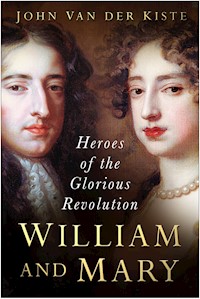
Mary (1662-94), daughter of James, Duke of York, heir to the English throne, then 15, is said to have wept for a day and a half when she was told she was to marry her cousin, William (1650-1702), son of William II of Orange (1626-50), Stadtholder of the Dutch republic, and Mary, eldest daughter of Charles I of England, who was eleven years older than her. In November 1677, on William's 27th birthday, they married in a private ceremony at St James's Palace. William was solemn, James gloomy, Mary in tears, and only King Charles appeared cheerful. This dual biography deals with both the 'life and times' of the monarchs, and with England's place in Europe. Interests of the subjects, outside the constitutional, are dealt with, as well as their personal relationships: William's rumoured homosexuality and Mary's hinted-at lesbianism; Mary's troubled personal relations with her father, James II; and the relationship between Mary and her sister and husband's successor Anne. The book also examines the personal and political relations between William and his uncle Charles II, and between William and Mary and Charles' illegitimate son the Duke of Monmouth.
Sie lesen das E-Book in den Legimi-Apps auf:
Seitenzahl: 515
Veröffentlichungsjahr: 2011
Das E-Book (TTS) können Sie hören im Abo „Legimi Premium” in Legimi-Apps auf:
Ähnliche









WILLIAM
AND
MARY
ALSO BY JOHN VAN DER KISTE
Published by Sutton Publishing or The History Press unless stated otherwise
Frederick III (1981)
Queen Victoria’s Family (Clover, 1982)
Dearest Affie [with Bee Jordaan] (1984, n.e. 1995)
Queen Victoria’s Children (1986; large print ISIS, 1987)
Windsor and Habsburg (1987)
Edward VII’s Children (1989)
Princess Victoria Melita(1991)
George V’s Children (1991)
George III’s Children (1992)
Crowns in a Changing World (1993)
Kings of the Hellenes 1863–1974 (1994)
Childhood at Court 1819–1914 (1995)
Northern Crowns (1996)
King George II and Queen Caroline (1997)
The Romanovs (1998)
Kaiser Wilhelm II (1999)
The Georgian Princesses (2000)
Gilbert & Sullivan’s Christmas (2000)
Dearest Vicky, Darling Fritz (2001)
Royal Visits in Devon and Cornwall (Halsgrove, 2002)
Once a Grand Duchess [with Coryne Hall] (2002)
Emperor Francis Joseph (2005)
Sons, Servants and Statesmen (2006)
Devon Murders (2006)
A Divided Kingdon (2007)
Devonshire's Own (2007)
Cornish Murders [with Nicola Sly] (2007)
Somerset Murders [with Nicola Sly] (2008)
WILLIAM
AND
MARY
JOHN VAN DER KISTE
First published in 2011
The History Press
The Mill, Brimscombe Port
Stroud, Gloucestershire, GL5 2QG
www.thehistorypress.co.uk
This ebook edition first published in 2011
All rights reserved
© John Van der Kiste, 2008, 2011
The right of John Van der Kiste, to be identified as the Author of this work has been asserted in accordance with the Copyrights, Designs and Patents Act 1988.
This ebook is copyright material and must not be copied, reproduced, transferred, distributed, leased, licensed or publicly performed or used in any way except as specifically permitted in writing by the publishers, as allowed under the terms and conditions under which it was purchased or as strictly permitted by applicable copyright law. Any unauthorised distribution or use of this text may be a direct infringement of the author’s and publisher’s rights, and those responsible may be liable in law accordingly.
EPUB ISBN 978 0 7524 7097 9
MOBI ISBN 978 0 7524 7098 6
Original typesetting by The History Press
Contents
Preface
Acknowledgements
1. ‘Piccinion’
2. ‘Mary Clorin’
3. Prince and Princess of Orange
4. Heir and Heiress Presumptive
5. ‘It is no small burden’
6. ‘The title of King was only a pageant’
7. ‘The consequences of such a breach’
8. ‘Two or three small strugglings of nature’
9. ‘This pernicious resolution’
10. ‘You have so little regard for my advice’
11. ‘You can bear me up no longer’
Genealogical Tables
Notes
Bibliography
Preface
In 1677 Lady Mary (by which title she was then known), niece of King Charles II and second in line to the English throne, wept bitterly when told she was going to marry her cousin Prince William of Orange. Their wedding in a private ceremony at St James’s Palace, on William’s twenty-seventh birthday, represented a symbolic union of the English and Dutch in providing resistance to French ambitions and the designs of King Louis XIV. The proceedings were remembered partly for the tearful face of the bride and her unsmiling husband, and partly for the jovial banter of King Charles. As he gave his niece away he urged the officiating Archbishop not to lose any time, lest the heir’s heavily pregnant wife should ‘disappoint’ the marriage by presenting the kingdom with a son; and when the groom turned solemnly to his bride, presenting her with a handful of coins and the assurance that all his worldly goods he thus endowed her, the King told her to pocket them at once ‘for it was all clear gain’.
Despite these inauspicious beginnings, the marriage became a successful partnership in personal and dynastic terms. Though Mary was unable to have children, they soon came to love and respect each other deeply. She was second in line of succession to the throne, and as matters stood he would be only her consort. Yet through her selflessness and also the demands of state, some eleven years later they became the only joint sovereigns ever to occupy the English throne.
Their place in the succession was, however, far from straightforward. Charles II had no legitimate children. Mary’s father, Charles’s only surviving brother James, Duke of York, was already showing signs of the obstinacy and drive towards Catholicism that threatened to make his position as heir untenable. If he and his second wife Princess Mary Beatrice were to have a son, Mary would forfeit her position in the line of succession and in due course would probably be displaced by a Catholic dynasty descended from her half-brother. This was a situation which her husband was anxious to avoid, not merely for reasons of avarice or personal ambition but in order to check the pre-eminence of France throughout Europe.
As had been already suspected by a few far-sighted individuals, once he became king James rapidly alienated what support he had ever had, and the birth of his son James, Prince of Wales – generally believed to be a ‘warming-pan baby’, smuggled in as a substitute for an infant who was born dead or died prematurely, or possibly even as the result of a sham pregnancy – cost him his crown. William was invited to come to England in order to help restore the country’s basic freedoms, and the circumstances in which he and Mary, still the true heir to the throne, became joint sovereigns were and remain unparalleled in English history.
In this biography I have endeavoured to present them as personalities caught up in a remarkable chain of events. This is the story of two very different characters, an outwardly cold, taciturn man and his affectionate, warm-hearted cousin, who married for reasons of state, whose lives – as so often in royal circles – became circumscribed by duty and ceremonial, and who left their home in Holland with some reluctance. Yet they reigned over a short period of significant change, and in the process left the standing of the British monarchy in 1702 in a far better position than it had been in 1688.
Throughout the seventeenth century England used the Julian calendar, which was ten days behind that of Europe, where the calendar reforms introduced by Pope Gregory XIII were observed. This discrepancy increased to eleven days in 1700. In accordance with common practice, I have dated events in England according to the Old Style and those on the continent according to the New Style, with both separated by an oblique stroke in cases where confusion might otherwise result.
Contemporary letters are quoted in the text with their original spelling.
Acknowledgements
My thanks for help, support and advice in various ways throughout the writing of this book are due to my friends, Coryne Hall; Karen Roth; Shirley Stapley; Sue Woolmans; Phil Lindsey-Clark; to the staff of the Kensington and Chelsea Borough Libraries; and to my editors at Sutton, Jaqueline Mitchell and Alison Miles. As ever, my particular thanks and gratitude go to my wife and my mother Kim and Kate Van der Kiste, for their tireless assistance, encouragement, and painstaking reading of the final draft manuscript.
ONE
‘Piccinion’
On 31 October 1650 William II, Prince of Orange, returned from a hunting expedition to his home at Binnenhof Palace, The Hague. He was unwell, but as his wife Mary was expecting their first child in a few days he did not wish to alarm her. Next day he was worse, and that evening his doctors confirmed that he had smallpox. Panic-stricken, she wanted to go to his side immediately, but her attendants told her that she must not jeopardize the life of her unborn infant, and she had to be held back by force. Within a week William, only twenty-four, was dead. His grief-stricken young widow was inconsolable, and the household feared she might follow him to the grave. In her short life she had already lost a husband and a father, for it was less than two years since the latter, King Charles I of England, had been executed.
Her apartments were hung with black, even the bed in which she was to bear her child and the waiting cradle. The confinement was expected at the end of the month, but the shock of her husband’s death caused her to go into labour early. On the evening of 14 November, her nineteenth birthday, a young prince was born. A nurse present at the birth claimed afterwards that, during the first moments of the baby’s life, a draught blew out the candles in the bedchamber, and she saw three circles of light shining round his head. Far beyond the palace walls, the bells of The Hague were rung. Even in the Dutch Republic, it was customary to celebrate such a royal birth as if a future king had been born.
In the seventeenth century the Princes of Orange traditionally held the greatest offices in the Dutch Republic which, after an eighty-year struggle, had won its independence from Spain, then the most powerful nation in Europe, to become a leading maritime and trading nation. The Republic was a federation of seven of the seventeen provinces of the Low Countries under Habsburg rule, the remaining ten still being under Spanish government. Each province had its own law, customs and representative assembly, and sent a delegation to the States-General of the United Provinces.
The Princes of Orange were the Republic’s richest citizens, owning large estates in the Netherlands and Germany. As sovereign princes in their own right, they took their title from the small principality of Orange on the Rhône. Their outlook was more cosmopolitan than that of most Dutchmen, and French was usually spoken at their court. Though exercising semi-royal power, these princes did not hold the title of king. The offices of Stadholder and Captain General were not strictly hereditary, but had always been conferred on the head of the house of Orange. In the seventeenth century some suspected that the Princes of Orange planned to proclaim themselves kings. When Frederick Henry married his son William Henry to Mary Stuart in 1641, he hoped that her father would in due course help him to establish an Orange monarchy. Such plans had been thwarted by his father-in-law’s troubles, culminating in the English civil war, his execution and the declaration of a commonwealth in Britain.
The offices of Stadholder and Captain General lapsed with William II’s death. While most Dutchmen expected his infant son to succeed to them in due course, many regents felt that the two offices, civil and military, conferred too much power and should not be granted to one man. The establishment of a centralized monarchy could jeopardize municipal rights and the traditional liberty and tolerance of Dutch society. Pensionary Johan de Witt, the leading figure in the States of Holland, saw himself as the defender of Dutch liberty and institutions against the aspirations of the house of Orange. Within the next few years the struggles of William and his supporters, who controlled several of the smaller provinces, to secure his elevation to these offices would figure prominently in Dutch politics throughout the early years of his life, and would have a formative influence on his character and political outlook.
By the time the baby prince was three days old, the household were anxious about the young mother who lay distraught and weeping, and about her puny child who seemed to grow weaker by the day. The first nurse chosen for him had been unsuitable, and another foster mother was found. He rallied slowly, but still seemed so delicate that few expected him to survive infancy.
On 21 January 1651 he was christened at the Grote Kerk, The Hague. Mary wanted to call him Charles, after her father and brother, but at the insistence of her mother-in-law Amalia von Solms-Braunfels, he was given the traditional Orange names of William Henry. Denied the right to choose his names, she refused to attend the ceremony. It was an unhappy occasion, for many of the congregation had been waiting for hours in the snowy streets of the city to see their new prince. The presence of a large crowd which grew restive during the long service in the freezing building unnerved the choir, who sang out of tune, and the noise forced the preacher to abandon his sermon.
Since her arrival in the Dutch Republic as a homesick young bride of twelve, Mary Stuart had neither liked the people of her husband’s country, nor regarded it as home. The Dutch found her haughty and arrogant, sensing that she thought herself too good for them. Widowed at nineteen, she felt herself surrounded by enemies, and made no effort to conceal her devotion to England and her favourite brother Charles, an exiled sovereign-in-waiting. As a Stuart she saw it as her duty to help restore him to his rightful position as King of England, and then to persuade him to use his power to have William raised to a suitable position. She regularly lent Charles and James money she could ill afford. When the English Parliament sent their youngest brother Henry, Duke of Gloucester, to Holland, observers thought she treated him with affection in marked contrast to the scant attention she paid her only child.
The closest of her husband’s relatives was her mother-in-law, the Dowager Princess Amalia von Solms-Braunfels, widow of Prince Frederick Henry of Orange. She tried to obtain custody of her grandson, partly as a family duty towards the state, and partly as she sensed her daughter-in-law had little maternal love for the boy. The anti-Orangists, led by Johan de Witt, considered him as a Child of the State, and maintained he should be brought up as a Calvinist and a servant of the Republic. The tendencies of the Netherlands were republican, and William’s close Stuart connection counted against him. But as a race the Dutch were fiercely loyal to the house of Orange, and feeling in his favour was so strong that he was nearly named Captain General of Holland at the age of three. A year later Oliver Cromwell, Lord Protector of England, signed a treaty with the States that neither William nor his descendants should ever be appointed to the chief command of their armies or fleets.
Nicknamed ‘Piccinion’ by his mother,1 William was a weak, undersized child. The Nassaus were a sickly family with a high incidence of fever, tubercular trouble and a generally short life expectancy, and he grew into a pale, thin boy with asthma, a dry cough and a visibly humped back. As an adult he always had to wear a cuirass, a device incorporating a breastplate and backplate fastened together, to help him hold himself up straight on horseback. All his life he had a poor appetite, and would eat little when tired or ill, thus depleting his reserves of strength still further. His tutors had to sit with him at mealtimes to make sure he ate properly, which he did with reluctance. As an adult, of course, there would be no compulsion to follow this necessary but tiresome rule. He went early to bed, a routine to which he would always adhere. His tutors taught him never to trust doctors, which was probably as well in view of the barbaric remedies they normally prescribed. The amount of exercise he took was strictly controlled, as his guardians thought him too weak to be taxed as strongly as other children of his age. He was introduced to tennis and fencing a little later than usual, and perhaps because of this he never really enjoyed them. The only sport he really liked was hunting, which took him out into the open air, gave him relief from his asthma and also brought him a degree of privacy which other sports did not. A natural tendency towards outward coldness, a taciturn demeanour and his firm self-control were reinforced by his lonely, self-contained childhood.
William’s first years were overshadowed by ill-health and by disputes among the older generation who seemed to regard him almost as a trophy. His mother distrusted and feared her mother-inlaw and the machinations of the Dutch government, which saw him as the chief hostage in their efforts to establish their constitution on a firmer footing. To them he was the representative of a great leader of the previous century, William the Silent, and he personified their hopes for the future. His mother secured the appointment of an Englishwoman, Lady Stanhope, as the governess of his first household. Despite Mary’s protests, when William was six Pastor Trigland began to instruct him in the Reformed faith, and thus laid the basis of William’s committed Calvinism.
Around 1656 there were rumours that the Princess of Orange was considering taking a second husband. Her mother Queen Henrietta Maria hoped she might arrange a match for her with the young King Louis XIV, now aged eighteen. Mary was accordingly invited to Paris and, while nothing came of any plans to make her Queen of France by marriage, she showed no inclination to return to Holland before necessary. Eventually she left France after receiving a message that William was seriously ill, but on reaching Bruges she learned that he only had measles and was making a good recovery, so she dallied there for several weeks. There are conflicting accounts of how much or how little she cared for him. Some say that by now she had more or less given up the struggle for control of him, preferring to spend much of her time abroad, and that by the time he reached his ninth year and was enrolled as a student at Leyden University she did not object, as they were already estranged and on formal terms. Others maintain that despite her haughty attitude and quick temper, she was devoted to him and ever keen to do what she could in helping to reclaim ancestral dignities on his behalf.
At the age of eight he formed a lifelong friendship with his cousin Princess Elisabeth Charlotte, or ‘Liselotte’, one year his junior, the niece of Sophie, Duchess of Brunswick and later Electress of Hanover. They both came on a long visit to Binnenhof, and one day at a reception Liselotte became separated from her aunt. Seeing a lady who looked as if she was suffering from a severe cold, she asked William the identity of the woman with ‘the fiery nose’. That, he told her solemnly, was his mother. She looked at him apologetically and he burst into giggles at this childish faux pas. For the rest of her stay they were almost inseparable playmates, and the older generation whispered among themselves that William might have found his future wife.
In November 1659 William was provided with his own establishment at Leiden, in the building which had been the convent of St Barbara. He was looked after by a household including three governors (of whom one, William Frederick of Nassau-Zuylenstein, was a natural son of William’s grandfather Prince William Henry), two young pages, a chamberlain, a physician, two gentlemen-inwaiting and a domestic staff of eleven. Constantine Huygens, a former secretary to his father and grandfather, was appointed his domestic governor, his duties including ensuring that the practical affairs of the household were run with order and efficiency, and that his young charge behaved with the utmost decorum. There was to be no blasphemy, unseemly behaviour or unpleasant conversation; gluttony and drunkenness, it was inculcated in him, were inappropriate to persons of honour. He was to study his Bible regularly, attend church twice on Sundays and answer questions afterwards in front of the servants. As well as English, which he learned from his mother, he spoke French, Dutch, German, Latin and Spanish.
His daily routine was drawn up in some detail. He was to rise between 7 and 8 a.m., and after saying his prayers had a light breakfast. Morning prayers were followed by study for the rest of the morning, divided into short periods for different subjects, including history, mathematics, geography, religious knowledge, philosophy, French, English and Latin. Next came dancing lessons, designed to produce a good carriage and grace of movement, particularly important for a boy who suffered from a hunched back. At dinner Huygens had to ensure that conversation was kept polite and seemly, and directed towards interesting themes. Part of the afternoon was to be spent in walking, riding or driving, followed by another hour or two of study before supper. This was followed by more recreation, perhaps billiards or a similar game, then evening prayers with the household, private devotions and bed between 9 and 10 p.m. Every day he read the Bible, and was required to learn a psalm by heart.
Meanwhile in England the death of Cromwell in September 1658 had given the Stuarts cause for hope. Some twenty months later Charles, who had been de jure king and tacitly acknowledged as such by his supporters since his father’s execution, was recalled from exile to his kingdom. Before he set sail the States-General invited him to Holland, and for a few days the family were partly reunited at The Hague, surrounded by Dutch well-wishers and jubilant English exiles, many of whom would also cross the Channel in due course. At nine William was too young to participate in all the ceremonies, but he was brought from his establishment at Leiden to join in this display of family unity. On the day of his uncle’s state entry into The Hague, amid a fanfare of bells and cannon, he, his mother and uncles James, Duke of York, and Henry, Duke of Gloucester, were among those in the crowded coach, as he perched on James’s knee. That evening a great dinner was held at the Mauritshuis, cannon were fired after every toast, and the festivities and gifts to the new king and his family cost over two million guilders. On 23 May William was part of the company on the shore at Scheveningen and Charles embraced him tenderly before setting sail for England.
Now there was a possibility that, in addition to holding high office in Holland, William might also succeed to the English throne. Mary decided the time had come to introduce him to the people, and several cities invited them as honoured guests. Amsterdam went en fête with arches of laurels and streets hung with flags and tapestries, and they entered the city in a kind of royal progress, to the pealing of bells and the sound of trumpets. Triumphal cars paraded tableaux from Stuart and Nassau history. One showed William as a hero, represented by a figure attended by Hope and Religion, and surrounded by a group of children who offered him symbols of the arts and sciences, while winged figures of the Liberal Arts hovered over them. In front of him an orange tree, bearing a single fruit, shaded an altar from which a phoenix arose from the ashes. Another was less well-judged, showing as it did a realistic representation of the execution of King Charles I. When Mary saw the poised axe, she was so shocked she almost fainted.
William’s few months at Leiden had made him more assured and better mannered, and he took part in the proceedings with a sense of diplomacy and grace which would have done credit to a boy considerably older than nine. On the next day of the visit he made a sightseeing tour of the city on horseback, and then went to see the magnificent yacht which the States-General had prepared as a present for his uncle. On the Sunday William and his mother attended divine service in the Nieuwe Kerk, and the following morning after more festivities they returned to The Hague. There they were welcomed back with due ceremony and enthusiasm, and with what was probably for William the highlight of their tour. As their coach drove up to the Binnenhof, a troop of small boys with wooden swords at their sides and plumes of orange paper in their hats stood to attention, while their leader stepped forward, saluted and greeted William as their general. He accepted this honour with all due gravity, then turned to his mother and asked, ‘Could they all be invited in?’ When given permission, the group of eager small boys swarmed into the palace where they were given drinks and fruit. As they left again in orderly fashion, all smiling, William stood at the door and handed each a gingerbread cake.2
After this short tour William returned to Leiden to study. In September he came back to The Hague to spend a few days with his mother before she left to visit her brother in England. Ever since leaving from Dover in the spring of 1642, a homesick girl of ten, Mary had longed to return to the country of her birth. Now her prayers for her brother’s restoration had been answered, and she meant to go back to England for a while to share in this family triumph. She had made careful provision for William’s well-being in her absence, asking the States to appoint commissioners to supervise his education, in consultation with his guardians, as well as taking care of ‘the being who is dearest to us in the world’.3 To his greataunt Elizabeth, the ‘Winter Queen of Bohemia’, she commended him anxiously. On 29 September mother and son said farewell. Barely had she stepped on board the yacht when she was told that Henry, Duke of Gloucester, had been taken ill and succumbed to smallpox several days earlier. Overwhelmed with misery at the parting from her son and the loss of a brother, she withdrew to her cabin and spoke very little during the voyage.
Grief turned to anger soon after her arrival in England when she learnt that James, now heir to their eldest brother’s throne, had secretly married one of her former maids of honour, Anne Hyde (see p. 30). Already feeling unwell after a dense fog in London that autumn, so unlike the clear air of Holland, she had second thoughts about a plan she had formulated for making her headquarters in England. Their mother Henrietta Maria had also been angered by James’s marriage, and was about to arrive in England either to try to prove the marriage was invalid, or to have it declared thus. She would wait for her mother, Mary insisted, and then she would return to Holland. Mother and daughter fulminated against the union, but in vain. Yet an even greater calamity was to come, when Mary fell ill of the dreaded contagion, took to her bed at Whitehall and died on 24 December 1660. She left a letter to the States-General, begging them to take care of ‘the being who is dearest to us in the world’.4
Elizabeth broke the news to the orphan of ten, and for several days he was bitterly upset. Among those who tried to comfort him was his French tutor, a close personal friend of Mary. Through his tears, the boy looked at him and said, ‘I’m sorry for you too. My mother was a good friend to you, and I’m too young to do very much.’5
Mary had hoped William might become the ward of his uncle Charles. Had he been taken over to England and brought up in the nursery that was soon to be filled with the generally short-lived children of James, Duke of York, his life would have taken a very different course, but it was now inevitable that he would stay in Holland as the jealously guarded treasure of his father’s people.
Early in 1661 he fell seriously ill. A combination of asthma, violent headaches and recurrent fainting fits confined him to bed for some time; at one stage the doctors feared for his life, and a rumour even went out that he had died. There were fears that he would grow up severely deformed, and for a while he had to wear a supporting harness in order to try to prevent deformity. Perhaps the experience of grief, brooding on his loss without playmates of his own age, and surrounded only by members of the elder generation clad in deepest black like the drapes in his rooms, had left its mark on the sensitive young child. Whether it left him with a lifelong disposition to melancholy, or strengthened him and placed an old head on young shoulders is open to question.
By April he was convalescent, and his grandmother decided to take him with her to stay with their Brandenburg relations at Cleves. It was the first time he had been out of Holland, and after such a bleak winter he must have benefited from a change. The Elector, Frederick William, and Electress Louise both treated him with a kindness he would never forget. For six weeks he was to enjoy being part of a normal family unit, somewhat spoiled, allowed to do nothing but play games with his young cousins, and spending much of his time outdoors. He was introduced to the delights of riding, and went hunting for the first time. The Elector found him a remarkable child, and detected an understanding beyond his years. Elizabeth, Queen of Bohemia, called him ‘a verie extraordinarie child and verie good natured’.6 His health improved at once; the Elector’s physicians reported that there was no longer any serious risk of deformity, and gave him a less restricting corselet to wear.
On his way back to Leiden from the holiday which he was reluctant to leave, he spent four days at Utrecht as guest of the provincial States. There was a full programme of official functions, including a parade of the militia, a concert in the Dom Kerk, a long civic banquet and services in the cathedral. After this break, it was back to the routine of studying at Leiden. That winter he was unwell again, but his condition was apparently not life-threatening and the physicians were not alarmed. His grandmother thought he might be outgrowing his strength, so he was brought back to The Hague in June 1662 to live at the palace again. His frail physique did not prevent him from revelling in sports and outdoor activities. He took great pride in his hounds, horses and a flight of falcons, a gift from King Frederik III of Denmark, while he also learnt fencing and tennis and in winter enjoyed skating on the lake.
At the age of thirteen he developed a passion for art, especially books on the cities and wonders of Italy. Jan Mytens, one of the main painters at court, was appointed his agent, and helped him to buy pictures, especially portraits, and golden Chinese caskets. His modest allowance of 200 guilders a month (raised to 400 in 1666 and 600 two years later) was insufficient for a patron of Old Masters. Soon he was in debt and Amalia wrote to Mytens, ordering him to make no more purchases for His Highness without her prior approval. As he was expected to live within his means, personal extravagance was discouraged in dress as well as in collecting art, and on his grandmother’s orders his dress allowance was restricted to 3,500 guilders a year. Though he enjoyed acquiring paintings, he was bored by having to sit still for long periods for his own portrait to be painted, however, with so many relatives requesting them, it was a duty he could not shirk.
Naturally shy and self-effacing, he was taught to be polite and affable to others. In adult life he was phlegmatic and rarely lost his temper in public, though he was not above kicking his servants when in a bad mood. As befitted a man born to be a soldier and ruler, he was given practical instruction in military theory, and was taught to appreciate the greatness and glory of the house of Orange. It was impressed on him that he must put duty before pleasure, and this gave him a strong feeling of his family’s rank and glory and of the rights and obligations that these entailed. Literature and the arts were not considered essential, but in later years he was always interested in fine painting, landscape gardening and architecture. With his connoisseur’s eye for detail, he learnt how to distinguish original paintings and marbles from copies.
By the age of nineteen he was precociously mature and self-possessed. Naturally intelligent, he was a sound judge of character, knew how to hide his feelings and tended to be taciturn while those around him talked freely. Unfailingly calm and polite, he applied himself unstintingly to hard work and business, and above all to managing his interests with skill.
As a young adult he had his own small court. His household kept early hours, with the daily provision of food, fuel and light being comfortable but not lavish. Each day throughout the winter months he was allowed two white wax candles and a night-light in his bedroom, with a turf fire lit morning and evening. By 1665 his personal suite numbered thirty-three, excluding kitchen staff, cleaners and outdoor servants. They met twice daily for common prayer, and ate together in the dining room. There were three tables, with William, Zuylenstein, Bornius and the chief household officers, plus maybe a few distinguished guests at dinner, at the first or high table; the pages, their governor and gentlemen-in-waiting at the second; and lackeys, supervised by the porter, at the third. The high table had a few extra amenities, such as a wider choice of beverages – Rhenish, claret and French wine (the others just had French wine and beer) – and white rolls instead of ordinary bread, but otherwise the same fare was served to all. Breakfast was between 6 and 7 a.m. in summer, an hour later in winter. The first course at dinner consisted of four dishes of potages, including soups, stews and entrées, the second a similar provision of roasts and green vegetables, with dessert consisting of four courses of fruit – fresh, cooked or candied. Supper, on simpler lines, was a family meal without any visitors present.
By now William had outgrown much of the ill-health which had dogged his earlier years. Apart from a chronic cough at times and bouts of asthma, as a young man he was comparatively fit and well. Descriptions of a hunchbacked dwarf, handed down to posterity, seem to be an exaggeration. Though it was ironic that he should eventually marry a woman 4 inches taller than him, as an adult he stood 5ft 6½in, 1½ inches taller than his contemporary King Louis XIV and 6½ inches taller than the diminutive King Charles I.
Now that his mother was dead and his uncle restored to the British throne, Prince William of Orange was a more important figure in the Republic. England was Holland’s greatest commercial rival in Europe, and the regents suspected that William might take after his father and seek English support in trying to declare himself king. Charles II was amenable, perhaps even anxious, to support any move for William’s elevation to the Stadholderate, but not without ulterior motive. The advantages of having a tame sovereign prince ruling a leading rival European power were self-evident.
Ironically, Holland and England would soon find themselves embroiled in conflict. At the behest of his Parliament, eager to check Dutch shipping and trading leadership, a reluctant King Charles declared war on Holland in March 1665. A minor campaign on land, in which Charles’s ally, the Prince-Bishop of Cologne, invaded the eastern provinces, was mirrored in a desultory conflict at sea. There was an indecisive battle in June 1666, and a Dutch attack the next year in which seventeen ships sailed up the Medway, raided Sheerness, hoisted the flag of the United Provinces over the naval dockyards and captured a British flagship as a show of strength. In July an inconclusive peace treaty was signed at Breda, merely confirming the ownership of one or two colonial possessions which had long been taken for granted. The man who was Prince William’s uncle and might regard himself as his guardian had technically been his enemy, though more in theory than in practice.
It made no difference to William’s upbringing. By the age of fourteen he was taking a greater part in general society life, attending evening parties at various great houses in Holland, carefully supervised gatherings where there would be cards, conversation, music and dancing until about 8 p.m. He was regarded as almost adult, and during the new year festivities of 1666 gave his first independent dinner party, attended by about fifty guests. All the older generation spoke well of him, and some distant relatives were beginning to see him as an eligible bridegroom for their marriageable younger princesses. Duchess Sophie of Brunswick had not forgotten the friendly childish encounter between him and Liselotte, and made tentative enquiries. However, William’s political prospects still seemed modest, and Sophie’s husband Duke Ernest did not pursue the scheme.
Another distant kinswoman, Emilia, Princess of Tarentum, visited The Hague in the spring of 1666, accompanied by her daughter Charlotte, who was much the same age as William. The girl was wearing a barette, a head-dress, and in a teasing mood one day William tried to snatch it off. Too quick for him, Charlotte ducked and ran away and he chased after her to try to catch it. Both ran around the room, giggling helplessly, until Emilia winked at her daughter – who promptly feigned breathlessness and let him catch her. Maybe Emilia had hoped that this might be a step towards the boy becoming her son-in-law, but it never was.
In March 1666 Johan de Witt approached the Princess Dowager with new proposals for her grandson’s future. With the war going badly for the Dutch, at a time of impending national crisis it was important to have a figure of importance, and there were growing demands for the raising of the Prince’s status. Zeeland, the most Orangist of the provinces, introduced a proposal in the States-General for giving him a seat in the Council of State, and it was suggested that one of the French marshals, preferably Turenne, should command the land forces, with William given a subordinate command under him. Though he had only reached the tender age of fifteen, such a proposal was natural for the standards of the day, especially as the Prince had a reputation for intelligence and thinking for himself, and would probably make a worthy military officer. It was not to be.
Nevertheless Amalia, the Princess Dowager, saw these proposals as a way to advance her grandson’s dignity. She had always wanted to break his connection with Zuylenstein and here was her chance, especially as she believed she was acting for William’s good. The States had acknowledged that he was a figure of national concern, and they were keen to bring him into public life; and whatever he might ultimately achieve, it would be necessary for him ‘to live in good intelligence with the States’. In April new commissioners were appointed to supervise his education. His household was restructured, with Zuylenstein, Chapuzeau, Trigland and several Dutch and English attendants being dismissed. Bornius was appointed to a post in the Prince’s treasury while the new governor, who replaced Zuylenstein, was Jan van Gent.
Distraught at being deprived of his friends and confidants, William appealed to his grandmother, but in vain. The intelligent, tactful Zuylenstein had become more like an elder brother than a tutor, making him aware of his heritage and potentialities and of the fact that Huygens was trying to recover for him the ancient principality of Orange, then an isolated Protestant stronghold, from the French monarchy. Johan de Witt resented these demonstrations of royalist feeling, and countered them by establishing the Prince under his own eye at The Hague. William was so upset at losing Zuylenstein that he went in tears to beg the French ambassador to plead for his reinstatement, but in vain. William concealed his grief and temper under an austere reserve and dignity; it was useless to protest, and it would not do to harm his prospects or the well-being of his friends by antagonizing those who held power over him. Witt himself took on the job as William’s tutor and saw him regularly. While gaining further experience of hiding his feelings and accepting the new regime with good grace, William also absorbed some of Witt’s learning and patriotism.
While his education continued apace, he took part in various entertainments and ceremonial functions. He was present at reviews of the fleet, military parades and regimental march-pasts. On his birthdays and other occasions of family celebration or mourning, such as births and deaths of close relations, he received the appropriate courtesies from official deputations. In January 1667 he was confirmed in the Groote Kerk, and to mark the occasion he presented a silver chalice to the chapel of a local almshouse and a stained-glass window to the church at Oudshoorn. Later that year he laid the foundation stone of a new village church at Terheyde, where he was presented with a silver trowel and a silver-mounted mallet.
In these years, as the older generation tussled for supremacy, William received Witt’s visits and absorbed his teachings with a respect and courtesy that would have deceived most experienced statesmen. Meanwhile, the older man met his pupil’s carefully planned manoeuvres for his restoration as head of the Republic with an arbitrary exercise of power that would have discouraged a less assertive individual. Even so, William silently resented all efforts to control him, and at length turned the tables. A few years previously the Provincial States of Zeeland had acknowledged him as Premier Noble of the Province, a dignity held by his predecessors. Now that he had reached his majority the Zeelanders asked him to come and take his seat in the Assembly. In September 1668, while Gent (with whom his relations had become increasingly strained) was on leave of absence, William left The Hague, apparently for Breda on a short hunting expedition, taking only a small amount of baggage and a few attendants. Everything had been carefully planned, and on 17 September he made a triumphal entry into Middelburg, Zeeland, escorted in an ornate coach drawn by six horses. Local militia lined the route, and the people roared their welcome. That night he was lodged in the medieval abbey buildings, but the crowds kept up their cheering and singing for several hours, while the city’s great bell rang continuously above them. Next morning he took the oath as Premier Noble, and thanked the Diet of the States of Zeeland in a short speech. After several days of official functions (again, all carefully and secretly planned beforehand) at Zeeland and Breda, he returned to The Hague on 9 October. His old friend and tutor Huygens, who had helped to organize these events and welcomed him in the reception at Middelburg, wrote to the Princess Dowager telling her of his joy at the success of the venture.
The Loevesteiners were furious at having been bested, especially as they were powerless to do anything about it, and complained that he had been received not as Premier Noble or Governor, but as a king. Through gritted teeth, the States politely congratulated him on his elevation. He returned quietly to his studies, and his coming of age in November was marked modestly by a small concert given by the trained bands outside his palace, a small dinner party and callers coming to present their good wishes. More substantial was a gift of fine English hounds sent by King Charles.
Coming of age made no immediate difference to William’s public position, and he was still nominally the ward of the States. His weekly sessions with Witt continued for a while, though the older man realized that his charge had a mind of his own and also enjoyed considerable public support. The increasingly powerless and ineffectual Gent retained his title and salary for another eighteen months or so, but fortunately for William they rarely saw each other except at meals. Thanks to his relatives, he was gradually assuming his responsibilities as sovereign ruler of Orange, as well as taking over management of his household and private estates.
Meanwhile beyond the borders of Holland rival European powers continued to pose a threat. In 1667 Louis XIV had attacked the Spanish Netherlands, with the immediate aim of extending France’s frontiers and with long-term hopes of seizing some if not all of the Spanish empire. The sickly King Carlos II was childless, and Louis’s wife was one of the major claimants to his throne. Suspecting that Carlos would soon die, Louis took advantage of the complex and varied laws of inheritance of the provinces of the Spanish Netherlands by seizing various territories in his wife’s name. This made his frontier more feasible and put him in a better position to seize and hold the remaining provinces when Carlos died. On this occasion Louis’s aggression was held in check by the formation of the Triple Alliance of England, the Dutch and Sweden, but Louis soon persuaded Charles II of the advantages of a joint war against the Dutch. Under the secret Treaty of Dover of 1670, both kings agreed to attack and partition the Republic. Charles hoped to take as much as possible of the Dutch trade and colonial possessions and to avenge what he regarded as his defeat, or rather lack of victory, in the war of 1665–7, while Louis’s motives were more complex. The Dutch had shown in 1668 that they, not the Spanish, were the main obstacle to a French conquest of the Spanish Netherlands, and Louis intended to punish this upstart Calvinist Republic for having opposed him. In addition France wanted to seize and reopen the great port of Antwerp which, he hoped, would lead to the eclipse of both Amsterdam and London as commercial centres.
Charles planned to use William and his supporters to harass the States party, which he regarded as their common enemy. Like his late sister Mary, he looked upon William as an Englishman and a Stuart, and expected him to follow English policy. Expressing an interest in William’s elevation, he invited him to England. William had his own motives for visiting the country, as he wanted his uncle to repay the money he had borrowed from the coffers of the house of Orange, as well as the rest of his late mother’s dowry, much of which had been promised but not yet paid. In addition, he hoped to enlist Charles’s help in his struggle with Witt.
The idea of William’s trip to England was met with dismay by most of those in Holland. Relatives reminded him of the deaths of his mother, of Elizabeth, Queen of Bohemia, and more recently of his aunt Henrietta of Orleans, who had all died within a few months of visiting England. Others viewed with suspicion any closer contact between the houses of England, believing that if he went he would surely never come back. The Duchess of York, they said, would arrange for one of her agents to poison him, as he might displace her daughters in the succession.
Refusing to be dissuaded, William continued with preparations for what was to be his first sea voyage. After a rough crossing he arrived at Margate on 6 November 1670, accompanied by Zuylenstein, Huygens, his lifelong friend Bentinck, Overkirke and a large suite. They stayed for four months, during which time he was royally feasted by the City of London and received honorary degrees from the universities of Oxford and Cambridge. Part of his mother’s dowry was obtained from the treasury, and William was also given vague promises and assurances of loyalty and friendship. At first Charles received him emotionally, embracing him repeatedly with tears in his eyes. After a few days his mood changed, and he declared to William that the Protestant interest in Europe was no more than a factious body. He wished that his nephew would take pains to look at things himself, ‘and not be led by your Dutch blockheads’.7 William was perturbed, but out of respect to family loyalty held his tongue.
There is no evidence that any meeting took place between him and his eight-year-old cousin Mary, then still in the schoolroom, at this stage. Yet some at court were already beginning to suggest that a marriage of state between them would be prudent when she was old enough, and at the same time William was formally acknowledged as successor to the throne after the Duke of York and his children, given precedence over all of them apart from the duke. He was guest of honour at a reception held by the University of Oxford, which he attended wearing a red academic gown, and at which he was made a Doctor of Civil Laws. He accepted these honours politely but unresponsively, refused to commit himself over his marriage and found it difficult to conceal his contempt for the glib chatter and squalid splendour of his uncle’s court.
Some admired his serious, upright demeanour, while others found him gloomy and priggish. Sir William Temple, the ambassador, had nothing but praise for him, finding him:
in earnest a most extreme hopeful Prince, and to speak more plainly, something much better than I expected, and a young man of more parts than ordinary, and of the better sort; that is, not lying in that kind of wit which is neither of use to one’s self nor to any body else, but in good plain sense, with show of application if he had business that deserved it, and that with extreme good agreeable humour and dispositions; and thus far of his way without any vice.8
He was bored by the horse-racing at Newmarket and by his uncles’ endless eating and drinking. King Charles found him reserved, plainly dressed and rather more ‘Dutch’ than he had expected.
Efforts were made to break down his self-possession. At a supper party given by the Duke of Buckingham, the King and his rakes persuaded William to have one glass of wine too many. Normally sober, the Prince of Orange soon became more belligerently merry than the rest of them. To their amazement he broke the windows of the Queen’s maids of honour’s rooms, ‘and had got into some of their apartments had they not been timely rescued’.9 As they were responsible for the ignominious spectacle, his hosts took it in their stride. But William had a hangover for several days, and only a pickme-up of eggs beaten in milk and chocolate, supplied on the orders of a thoughtful King Charles, an expert in such cures, hastened his recovery. He never forgot this embarrassing initiation into the world of English debauchery – indeed, he probably never forgave Charles and his courtiers for it – and the incident only increased his scorn for the dissolute English court.
By early 1672, as King Louis XIV’s military preparations became apparent, events within the Dutch Republic moved towards crisis. The Orangists and their popular supporters, encouraged by English agents, urged that William should be made Captain General so that he could use his influence with Charles to keep England apart from France. Though widely shared, this view took no account of the fickle Charles’s intentions. Witt and the States party resisted William’s elevation, first as they feared that William was ambitious for royal power, and secondly as they believed him to be the pawn of his uncle. There was in fact little substance behind these fears; William himself was unaware of the extent of Charles’s commitment to France, and hoped he could prevail upon his uncle to help him secure the support he believed was his by right. His desire for power increased as the French menace grew, as he felt he needed power to defend his country, a task he believed the States party was either unable or unwilling to do, and he was ready to take risks in order to secure it.
In January 1672 he wrote to King Charles, suggesting that there would never be a better chance for him to obtain from the States whatever he required in the way of support. Should His Majesty be prepared to let him know what he wanted, he [William] was confident that, as long as such aspirations were not directly hostile to the foundations of the Dutch Republic, he would be able to obtain them for him in spite of any hostile designs by Witt and his cabal, who would thereby be worsted while he and his more trustworthy friends took the lead. He ended by assuring the King that, as long as he had any authority in the state, he would be utterly devoted to His Majesty’s interests, as far as his honour and the faith which he owed to his country would allow him. His offer of submission was qualified with an insistence that the foundations of the Republic should be preserved. Though these assurances were not within his power to give, the letter remained secret. It was quite likely that William was treading a fine line by calling Charles’s bluff, staking his safety on the probability that the latter would not be able to deliver.
Meanwhile deadlock between Holland and the other six provinces on the question of William’s elevation paralysed the Republic’s preparations for war. While the navy, mostly provided by Holland, was in good shape and helped to save the Republic, the army was in a bad state. William was at last made Captain General for one year, but after hearing that the mighty French army was making preparations as well, he was unsure of his chances.
Late in April 1672 Louis began his campaign, which soon became less of a war and more of a stately progress, as one garrison after another surrendered without fighting. In May Witt ordered the dykes to be cut, in order to create a last line of defence for the province of Holland. In June William’s little army, now numbering only nine thousand, withdrew behind this ‘waterline’, which was still far from complete, and there seemed little hope of holding it as the French overran the province of Utrecht. If Louis had attacked the waterline at once he would probably have broken through, but he had wasted time overpowering the garrisons in his way, and he probably believed he had already done enough. He did not want to annex the Republic, only to inflict such a heavy defeat on the Dutch that they would no longer be able to hinder French military or commercial expansion. Convinced that the Dutch would have to accept whatever terms he imposed, he pushed his demands higher and higher. By the time the Dutch rejected them and broke off negotiations on 27 June, the waterline had grown stronger and William’s numerically inferior army had grown in size and determination.
Holland was now in a better condition to resist the French, but its internal situation was alarming. With each humiliation, the people’s anger grew and they sought scapegoats among the regents, although Orangists in the army had often showed themselves the most cowardly and defeatist. English and Orangist propaganda insisted that the kindly Charles II had made war only because the selfish regents of Holland had stubbornly refused to give William his rightful offices. The States party, it was alleged, would sooner sell the Republic to the French than accept the ambitious but deserving Prince William as Stadholder. Many believed that once he was elevated to the position, England would join with the Dutch against France. The States of Holland bowed to the pressure; on 24 June William was confirmed as Stadholder and the States-General made him Captain General for life. His powers were mainly advisory rather than sovereign, however, and he would still meet with obstruction and opposition.
To defeat the French, William believed that he needed more effective and unhindered power, and that it was vital for him to break the opposition of the States party. To this end he pursued two distinct policies. First, he continued to try to do a deal with Charles II to take England out of the war and strengthen his position in the Republic. Secondly, he showed himself ready to exploit, even encourage, popular violence against his political opponents. His negotiations with Charles came to nothing, as although the King was ready to help him secure sovereignty over the United Provinces, his price in the form of large territorial and commercial concessions was too high. William was reported to have said that he preferred the title of Stadholder which the States had given him, and that he believed himself under an obligation not to place his interest before his obligations.
As events in the Republic turned more and more in his favour, he realized that he did not need his uncle’s help. William’s reaction to the upsurge of popular violence was mixed. Like most of the rioters, he had no time for democracy and he had no wish to encourage disorder. But the riots had already assisted his elevation and they were directed against his political enemies. The temptation to exploit the disturbances further was great and William yielded to it, doing little to stop the violence or the clamour for the punishment of Witt. He pointedly refused to declare that Witt was innocent of the crimes with which Orangist pamphlets charged him. Witt resigned his post as Grand Pensionary of Holland and was replaced by William’s supporter Gaspar Fagel. In August 1672 a letter from Charles II to William was published, blaming the States party for the war and alleging that Charles’s sole aim in making war had been to secure William’s just rights. William did not directly order the letter’s publication, but he had sent it to Fagel to use as he thought fit, and Fagel had had it read in the States-General and the States of Holland. As one contemporary remarked, those who ordered its publication must have had some intention of bringing the men at the helm into disrepute and abandoning them to mob rule.
Witt’s brother Cornelis was already in prison at The Hague on a trumped-up charge of treason. On 10 August Johan de Witt was lured to the prison by a forged letter which purported to come from his brother. Both were trapped inside and the crowds in the streets nearby broke down the doors, dragged the brothers outside, murdered them and savagely mutilated their bodies. The lynching had clearly been carefully organized. Leading Orangists like Zuylenstein were present, and the local clergy welcomed God’s vengeance on these two sinners. William himself had neither directly authorized nor openly approved of the murders, but he had not discouraged the popular movement and had given it some implicit encouragement. The publication of Charles’s letter was seen as especially provocative. He did nothing to punish those responsible for the outrage, telling a deputy of the States of Holland that he could not proceed as the crime had been committed by some of the leading citizens, and in due course he even appointed some of the ringleaders to government posts.
The Witts’ murder led directly to the removal of the last barriers to William’s seizure of effective power. A week later the States of Holland authorized him to change as many of the members of the town councils as he thought fit. They were encouraged to do so by Fagel’s threat that it was better to forgo a mere formality than to allow the commonalty to impose order. Less than a third of the regents of Holland were dismissed, to be replaced by men of similar social standing. All William’s opponents were removed or silenced, and in many towns the independence and civic spirit of the regents were permanently damaged. His rise to power was now complete. He held the offices of his ancestors, which were made hereditary in 1674, and he had for a time reduced the likelihood of opposition to his direction of war and diplomacy. In 1672 he began to take the offensive against France, and by the end of the following year most of the French troops had left Dutch soil. William had deservedly won for himself the title of Redeemer of the Fatherland.
From then to his dying day thirty years later, his main concern was the containment of France. His primary interests, war and diplomacy, were the main responsibilities of any seventeenth-century prince of senior rank. There was often, however, a difference between the patriotism and integrity of the motives behind his foreign policy and the sometimes unscrupulous methods which he used against opponents at home. He was always passionately convinced of his own right to rule, of the purity of his intentions and of his own rightness, convictions that had their roots partly in his personality and religious faith and partly in his upbringing. They made him intolerant of the opinions of others if those opinions led them to obstruct what he saw as his European mission. Always a statesman rather than a politician, he had little respect for politicians with their wheeling and dealing, their selfish ambitions and their obsession with local and sectional interests, and treated them with the contempt and lack of scruple which he thought they deserved.




