


18,49 €
Mehr erfahren.
- Herausgeber: The History Press
- Kategorie: Sachliteratur, Reportagen, Biografien
- Sprache: Englisch
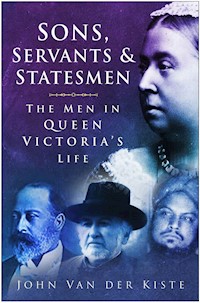
How was Queen Victoria influenced by her closest male ministers, relatives, advisers and servants? John Van der Kiste is the first to explore this aspect of Victoria's life; focusing on four roles - mentors, family, ministers and servants. A soldier's daughter, Victoria lost her father at the age of eight months. Although her uncle Leopold did his best to be a substitute father, the absence of her real father probably influenced her throughout her life, not least in choosing her husband. Her close and faithful relationship with Albert is one of the great royal love stories but her relationships with her sons were much more stormy. However, with most of her heads of government she enjoyed relatively cordial relations - in widowhood she shoed a decided partiality for Disraeli, who acquired for her the title Empress of India, but disliked Gladstone, complaining that he "speaks to me as if I were a public meeting". Queen Victoria's relationships with her servants are also explored, from the liberal influence exerted over the increasingly conservative queen by her private secretary, Ponsonby, to the outspoken John Brown and the Indian Munshi, who both antagonised those around her.
Das E-Book können Sie in Legimi-Apps oder einer beliebigen App lesen, die das folgende Format unterstützen:
Veröffentlichungsjahr: 2011
Ähnliche



SONS,
SERVANTS &
STATESMEN
SONS,
SERVANTS &
STATESMEN
THE MEN IN QUEEN VICTORIA’S LIFE
JOHN VAN DER KISTE
First published in 2006
The History Press The Mill, Brimscombe Port Stroud, Gloucestershire, GL5 2QGwww.thehistorypress.co.uk
This ebook edition first published in 2011
All rights reserved © John Van der Kiste, 2006, 2011
The right of John Van der Kiste, to be identified as the Author of this work has been asserted in accordance with the Copyrights, Designs and Patents Act 1988.
This ebook is copyright material and must not be copied, reproduced, transferred, distributed, leased, licensed or publicly performed or used in any way except as specifically permitted in writing by the publishers, as allowed under the terms and conditions under which it was purchased or as strictly permitted by applicable copyright law. Any unauthorised distribution or use of this text may be a direct infringement of the author’s and publisher’s rights, and those responsible may be liable in law accordingly.
EPUB ISBN 978 0 7524 7198 3MOBI ISBN 978 0 7524 7197 6
Original typesetting by The History Press
Contents
Acknowledgements
Introduction
PART I
FATHER FIGURES
One
‘The daughter of a soldier’
Two
‘My father, my protector, my guide and adviser’
PART II
PRIME MINISTERS
Three
‘I know how to value and appreciate real worth’
Four
‘Such a good man’
Five
‘The kindest of Mistresses’
Six
‘A deluded excited man’
PART III
SERVANTS
seven
‘He is very dependable’
Eight
‘Absolutely fair and lucid’
Nine
‘A sort of pet’
PART IV
SONS AND SONS-IN-LAW
Ten
‘One feels so pinned down’
Eleven
‘We are a very strong family’
Twelve
‘A great three-decker ship sinking’
Genealogical Table
Notes
Bibliography
Acknowledgements
I wish to acknowledge the gracious permission of Her Majesty Queen Elizabeth II to reproduce material which is subject to copyright. All the other illustrations are from private collections.
Several people have assisted greatly in different ways during the writing of this book. Coryne and Colin Hall, Karen Roth, Katrina Warne, Sue and Mike Woolmans, Robin Piguet and Ian Shapiro have been their ever-supportive selves, always ready with information when needed. The staff at the National Archives and the Kensington Public Libraries have also assisted with access to primary sources and published information. As ever, my wife Kim and mother Kate have been a tower of strength, not least in reading the manuscript in draft form and making invaluable suggestions for improvement. Finally, my thanks go to my editors at Sutton Publishing, Jaqueline Mitchell and Anne Bennett, for helping to see the work through to publication.
Introduction
From her early days, Queen Victoria admitted to having ‘very violent feelings of affection’. Her Hanoverian forebears had generally been an emotional family, not afraid to give vent to their feelings in front of others. They had nothing of the stiff-upper-lip quality so often associated with the typical Englishman. At the same time, she clearly had a fondness for masculine company, not in any immoral or amoral sense, but rather because she felt more at ease with the male of the species than with women. One modern biographer has remarked with considerable insight that she was a man’s woman, and the men she liked best were ‘strong and imperturbable men who made her laugh, maybe with a touch of the rascal about them’. Her husband was the exception to the rule, but most of the others she liked fit the description well.
Her dealings with men throughout her life therefore make for an interesting study. How did Her Majesty Queen Victoria of Great Britain, at the height of her nation’s prestige and global preeminence deal and interact with her family, her most favoured servants and her prime ministers? How did a woman, the most renowned sovereign of her age yet at the same time a constitutional monarch who in practice wielded far less political power than her predecessors, reconcile the demands of matriarch and ruler?
Human beings are generally a mass of contradictions, and Queen Victoria was no exception. Sometimes she would complain that she could not defend her country as wholeheartedly as she could have done had she been a king. At the height of the Russo-Turkish war in 1877, she wrote that if only she was a man, she would ‘give those horrid Russians . . . such a beating’. At others, she would admit the limitations imposed on her by her gender. ‘We women are not made for governing,’ she had admitted in 1852, ‘and if we are good women, we must dislike these masculine occupations.’ One day she almost railed at being a woman in a position which by its nature demanded certain masculine qualities, while on another she passively accepted the limitations of femininity, as there was naturally no alternative.
The attitudes she took to the most important men in her life on political and personal levels, her relationships with them and the psychological factors inherent in these are worthy of examination in their own right, and this is what I have endeavoured to do in this book. Her initial admiration for, then detestation of and finally grudging respect towards Lord Palmerston, and her liking of and later passionate hatred of Gladstone are in their way just as fascinating as her controversial and much-debated relationship with John Brown and her ever-changing feelings towards her eldest son and heir, the Prince of Wales.
PART ONE
Father Figures
ONE
‘The daughter of a soldier’
King George III and Queen Charlotte had seven sons who survived to maturity. The fourth is one of the least remembered. Had it not been for marriage late in life, and for the daughter born to him and his wife eight months before he died, Prince Edward Augustus, Duke of Kent, might have been all but forgotten. Yet, though she would say little about her father during her long life, Queen Victoria occasionally referred to herself with pride as the daughter of a soldier. Discussing the armed forces with her ministers in November 1893, she remarked that she ‘was brought up so to speak with the feeling for the Army – being a soldier’s daughter – and not caring about being on the sea I have always had a special feeling for the Army.’1
Prince Edward Augustus was born at Buckingham House on 2 November 1767 and given his first name in memory of his uncle Edward, Duke of York, a dissolute young man who had died at the age of twenty-eight that same week. The circumstances of his birth, he would say self-pityingly, ‘were ominous of the life of gloom and struggle which awaited me’.2 In 1799 he was raised to the peerage, becoming Duke of Kent and Strathearn and Earl of Dublin.
Brought up with his brothers and sisters mostly at Kew Palace, Edward’s early life was not so cheerless as he might have wished others to believe, notwithstanding the harsh regime and discipline at home to which he and his brothers were subjected as small boys. However, like his elder brothers he was quick to react against the frugality of his parents once he reached manhood, and soon found himself deep in debt, a state of affairs which would remain constant to the end of his days. According to one writer of a later generation, he considered that the Royal Mint existed solely for the benefit of royalty,3 though he was not the only member of his family to do so. Wherever he was stationed on military service, be it North America, Gibraltar or Europe, he considered that as a king’s son he had to live in comfort and maintain a certain sense of style. Any house in which he lived, and the gardens which surrounded it, had to be refurbished to the highest standards, with no expense spared. The bills from builders, carpenters, glaziers and gardeners soon rapidly exceeded his parliamentary income and military pay.
In the Army he rose to the rank of field-marshal, but even by the standards of the day he was regarded as a merciless martinet. He thought nothing of sentencing a man to one hundred lashes for a basic offence like leaving a button undone. In 1802 he was appointed Governor of Gibraltar and considered he had been sent to restore order in what had become a rather undisciplined garrison. His conscientious efforts to do so, in particular to curb the drunkenness of the men, soon provoked mutiny, secretly encouraged if not instigated by the second-in-command, who was keen to get rid of him. Within a year he had been recalled to England.
Despite his reputation as a harsh disciplinarian, away from the parade ground some people found him one of the most likeable of the family. With the exception of the Prince Regent, he was probably the most intelligent of the brothers. The Duke of Wellington once said that he never knew any man with more natural eloquence in conversation than the Duke of Kent, ‘always choosing the best topics for each particular person, and expressing them in the happiest language’,4 and the only one of the royal Dukes who could deliver a successful after-dinner speech. This favourable opinion was not shared by his siblings. The Prince of Wales, later Prince Regent and King George IV, so resented his air of righteous self-pity that he called him Simon Pure, and his sisters considered him so hypocritical that they named him Joseph Surface after a character in Sheridan’s The School for Scandal.
Austere where creature comforts were concerned, he rose early in the morning, ate and drank little, and abhorred drunkenness and gambling. He was a close friend of the pioneer socialist Robert Owen, and it has been suggested that the Duke of Kent could claim to be the first patron of socialism,5 at least in the annals of British royalty. He took a keen interest in Owen’s workers’ co-operatives, and in improving education for the working classes, in order that they might be able to better themselves. No slavish adherent to the Church of England, he sometimes attended dissenting services, much to the irritation of Manners Sutton, Archbishop of Canterbury. He actively supported over fifty charities, including a ‘literary fund for distressed authors’ and the Westminster Infirmary.
Despite enjoying a comfortable liaison for twenty-seven years with his mistress, Madame Julie de St Laurent, he was well aware of his royal obligations. Foremost among these was the promise of a generous parliamentary allowance on condition he contracted a suitable marriage in order to provide an heir to the throne. For the spendthrift sons of George III, such financial provision was an absolute necessity. The unexpected death in childbirth of Edward’s niece, Charlotte, daughter of the Prince Regent and only legitimate grandchild of King George III, in November 1817, meant that he and his bachelor brothers – or brothers with mistresses, but without brides recognised by the Royal Marriages Act of 1772 – had to rectify the situation.
Naturally he made it known that he was willing to sacrifice his personal happiness for the sake of his country, subject to adequate remuneration. In May 1818 he married Victoire, Dowager Duchess of Leiningen, a widow of thirty-one with a son, Charles, aged fourteen, and a daughter, Feodora, aged eleven. The Duke and Duchess made their home at Kensington Palace where, on 24 May 1819, she gave birth to a daughter who was christened Alexandrina Victoria.
Because of his radical opinions, the Duke was disliked and feared by the Tories. A member of the Bathurst family, whose nephew Henry Ponsonby later became private secretary to Queen Victoria, dreaded the possibility of his eventually ascending the throne. Though he was no republican, he felt it did not matter ‘much to us Englishmen what sort of men our Kings are, but I should be sorry if the Crown went to that odious and pompous Duke of Kent’.6
The Duke and Duchess planned to spend the winter of 1819–20 in Devon, ostensibly so the Duchess could benefit from the bracing sea air, but in fact to avoid the expense of living in London. He and his suite made arrangements to rent a modest house at Sidmouth on the Devon coast, where they arrived on Christmas Day 1819. It was an exceptionally severe winter, and after catching a heavy cold while out walking a few days later, Edward took to his bed with pneumonia. He had always been one of the healthiest members of the family, boasting that he would surely outlive his brothers, but he had spoken too soon.
Various friends came to Sidmouth to see him and condole with him on his illness, and the Duchess of Kent’s younger brother, Prince Leopold of Saxe-Coburg, brought his doctor, Baron Stockmar. The latter examined the Duke but sadly admitted that he was beyond salvation. Early on the morning of 23 January 1820 he passed away, his wife kneeling beside him holding his hand. Within six days, his father, the blind and deranged King George III, had died as well, and in a nation which mourned its King, the death of the Duke of Kent went almost unnoticed.
As she was only eight months old at the time of his death, Princess Victoria could never remember her father. Brought up to obey the fifth commandment, she paid lip-service to the principle of honouring her parents and would occasionally speak of her ‘beloved father’. Yet when people who had known him commented on how much she resembled him, she said pointedly that she had inherited far more from her mother. She and her father had certain characteristics in common, among them courage, truthfulness, strong powers of observation, and a love of order and punctuality.7 However, as these virtues were shared by many other members of the family, it might be unwise to credit him unduly with passing them on to his daughter.
Some detected other distinct physical resemblances, such as the ‘same frank eyes’ and a ‘proud curve of nostril’. In her later life, comparisons were drawn between their pride of race, sense of dignity, their uncompromising attitude when a certain course of action was decided on, their simple notion of right and wrong and their sharp definition of black and white, with no shading in between. In their private lives, it was considered that they had the same indifference to love and affection if the needs of state demanded any sacrifice. Above all, they were autocrats at heart, but with a genuine sympathy towards the poor.8
In at least three ways, Victoria was the exact opposite of her father. He was a spendthrift who ate but little, while she was as thrifty as her grandfather George III, and in later years she loved her food so much that whatever figure she had had as a young woman paid the price. Moreover, he was a six-foot giant of a man, while she was barely five feet tall.
Widowed a second time at only thirty-three years of age, the Duchess of Kent was very much a stranger in a strange land. It was less than two years since she had come to England, and she could barely speak English. The household was bilingual, and her infant daughter did not begin to speak English until she was three years old. The Duchess could hardly be blamed for contemplating a return to the safety and security of her old German home, Amorbach. But the Duke had left a wish that their daughter, whom he had told his friends to ‘look at’ well, as ‘she will be Queen of England’,9 should be brought up in the country of her birth. Thanks to Prince Leopold, who came to her financial rescue, this was scrupulously observed.
Left fatherless at eight months, with no reassuring male presence in the household at Kensington Palace, the Princess destined to become Queen Victoria would spend much of her life looking for one father-figure after another.10 Her ‘wicked uncles’, King George IV and his brothers, were considered unsuitable mentors. Most of them had once been notorious womanisers or adulterers, even bigamists, excessive spendthrifts, gluttons or drinkers, but now they had little energy for most of these vices. Even so, to the Duchess of Kent they were dissolute old men with whom she did not wish her daughter to be associated. Nevertheless, they took a friendly interest in her welfare, offering her rides in their carriages and sending her presents. However, the Duchess of Kent hated and feared them, convinced that they all regarded her small daughter as something of an interloper, or at best a reminder that her ‘Drina’ was the sovereign of the future whom her in-laws had conspicuously failed to provide. At the back of her mind was the fear that they would not hesitate to kidnap her or have her abducted, or at least attempt some subterfuge which would prevent her from coming to the throne.
The first genuine, or substitute, father-figure was her uncle, Prince Leopold of Saxe-Coburg Saalfeld. Born in December 1790, he was four years younger than his sister, the Duchess of Kent. A nonetoo-affluent German prince, he had distinguished himself during his military career in the Napoleonic wars, rising to the rank of lieutenant-general. In May 1816 he had married Charlotte, daughter of the Prince Regent, and experienced eighteen months of married bliss which were suddenly, tragically, ended when she died in childbirth in November 1817. Having been granted an annuity of £50,000 on his marriage, he could easily afford to be generous to others.
At first, the bereaved Leopold had been unable even to look at his baby niece, who inadvertently brought back bitter memories of his dead wife and the little son who had never lived. It took all his sister’s powers of persuasion before he would set eyes on her, and after one reluctant look he shrank from doing so again for a time. Even to attend her christening required no mean effort on his part, and only when the baby’s father died did he relent. From then on, he became in effect a second father to her. Having heard the sad news he hurried to Sidmouth, and three days after the Duke of Kent’s death he accompanied the bereaved family on their return to Kensington.
Though denied the chance of being the husband of England’s future Queen, Leopold realised that he was the uncle of a likely future one. After the ailing King George IV, the heirs to the throne were Frederick, Duke of York and William, Duke of Clarence. All three were in their fifties, the first two were childless and the Duchess of Clarence seemed sadly unable to bear any children who would live for more than a few months. Barring miracles, it was highly probable that within twenty years or so Victoria would succeed them to the throne.
Leopold became very attached to her, and for the next few years of his life he paid her weekly visits at Kensington. Disliked and distrusted by most of his in-laws in England as a crafty schemer, he had to behave with circumspection, lest he was seen to be playing too influential a part in the little girl’s life. At one stage during this time, he imagined and hoped that he might become regent to her, in the event of her succeeding to the throne before she attained her majority.
The Duke of York died in January 1827, aged sixty-three. Few people expected either King George IV or his new heir, the Duke of Clarence, to outlive Victoria’s eighteenth birthday, and Leopold thought it safe to assume that the government and ministers would prefer him as regent to any other of his niece’s surviving Hanoverian uncles. In particular, the next in line of succession after Clarence and Victoria herself was Ernest, Duke of Cumberland, one of the most hated men in the kingdom. While the scandalous rumours about his private life, among them incest with a sister, murder of a valet and seduction of a friend’s wife, were almost certainly nonsense, his reputation as a reactionary of the deepest dye was enough to put him beyond the pale as far as most members of the Houses of Parliament were concerned.
However, Leopold was aware that it would not do for him to make his case as prospective regent too assertively. Though George IV was Leopold’s father-in-law, the King had never liked the conscientious, yet sanctimonious and avaricious young Coburg prince who had won the hand of his beloved late daughter. The Duke of Clarence, who succeeded his brother George as King William IV in June 1830, cared for Leopold and his Coburg kinsmen even less. They were devoted to Princess Victoria, a feeling which they did not extend to her mother.
It was fortunate for Leopold and his sense of ambition that a greater destiny beckoned. In 1831 he was chosen as king of the newly independent state of Belgium, but he continued to maintain a regular correspondence with his niece. Far-sighted and astute, he had a thorough understanding of the concept of constitutional monarchy, and he was more than ready to impart his knowledge of the subject to his young niece. Each year he wrote her a long birthday letter imparting much affection as well as sound advice.
Her letters to him were very appreciative and similarly affectionate. These were a sorely needed safety valve for her, as she found it easier to be more frank and confiding with him than with anybody at home whom she saw regularly. When King Leopold and his second wife, Queen Louise, came to visit her in September 1835 and she met them at Ramsgate, her delight knew no bounds.
‘He is so clever, so mild, and so prudent;’ she wrote in her journal after one of their conversations; ‘he alone can give me good advice on every thing. His advice is perfect. He is indeed “il mio secondo padre” or rather “solo padre”! for he is indeed like my real father, as I have none, and he is so kind and so good to me, he has ever been so to me.’11
Within three weeks of writing this entry, the bonds between uncle and fatherless daughter had strengthened. ‘He gave me very valuable and important advice,’ she recorded after another talk. ‘I look up to him as a Father, with complete confidence, love and affection. He is the best and kindest adviser I have. He has always treated me as his child and I love him most dearly for it.’12
Leopold’s advice, though Victoria was too young to appreciate it, was even more ‘valuable and important’ than she might have ever thought possible. His liberal attitudes and the fact that he was king of a state that had come into existence as part of a liberal nationalist movement which was spreading through nineteenth-century Europe were in themselves significant. Therefore his liberal outlook and her own adolescent political inclinations, such as they were, helped to make the future Queen Victoria more acceptable to a broader section of public opinion in Britain than would have been the case had she been schooled by her cousins and uncles.13
The moderately progressive views of the popular Augustus, Duke of Sussex and her late father were adequate proof that King George III’s sons were not out-and-out reactionaries; and although he was often derided as a total buffoon, King William IV had his fair share of common sense when it came to overseeing the contentious passage of the Great Reform Bill in 1832. But though he was later to astonish his critics by proving a very successful and just King of Hanover, the much-hated and arch-conservative Ernest, Duke of Cumberland would never have done as a role model for his niece.
King Leopold was well aware of this. Three days before King William IV died in June 1837, the former wrote from Laeken to his niece to prepare her for what lay ahead. Not only would she entrust the Prime Minister, Lord Melbourne, and his ministers with retaining their offices, he told her, but she would ‘do this in that honest and kind way which is quite your own, and say some kind things on the subject’. There was nobody else who could serve her so faithfully, and ‘with the exception of the Duke of Sussex, there is no one in the family that offers them anything like what they can reasonably hope from you, and your immediate successor, with the mustaches [the Duke of Cumberland], is enough to frighten them into the most violent attachment for you’.14 Until she married and produced an heir, next in line to the throne would be the dreaded Duke Ernest.
The other man in loco parentis for much of Victoria’s childhood was Sir John Conroy, the Duchess of Kent’s comptroller. Conroy served his employer faithfully, and she always had the utmost confidence in him. Wagging tongues suggested that they must be lovers. It was said that the Duchess was unsure of her second husband’s fertility and, true to the Coburg sense of ambition, took a lover to ensure that she would have a child who would sit on the English throne,15 and that Conroy might just have been the right man in the right place at the right time. Also current at the time was a story that Victoria had once entered her mother’s bedroom and caught them in a compromising position.
All this was almost certainly exaggeration, but it was beyond doubt that the ever-scheming, manipulative Conroy worked hard to keep the princess from outside influences and make sure she was utterly subservient to her mother. Victoria’s dislike of his arrogance soon turned into hatred, especially when he tried to force his will on her. Soon after King Leopold and Queen Louise returned to Belgium, she took to her bed with a fever, possibly a form of typhoid. Taking advantage of her illness, one day Conroy appeared in her bedroom with a document he had drafted, in which she consented to his appointment as her private secretary on her accession to the throne. He tried to force her to sign, but she stubbornly refused. Baroness Louise Lehzen, her devoted governess and the Duchess of Kent’s lady-in-waiting, came stoutly to her defence, and he had to leave the room without her signature. He did so with bad grace, and from then on he was the Princess’s sworn foe.
King Leopold had never trusted Conroy, and when he heard about the incident he was beside himself with anger. Conroy’s influence over the Duchess of Kent, he told his niece some years later, was ‘so strong that it would once have been called witchcraft’.16 The comptroller’s conduct ‘was madness and must end in his own ruin, and that, although late, there was still time! – but no, he continued in the same way, as the events of 1837 did show’.17 Conroy evidently considered that he was entitled to wield more power than he genuinely did, and his eagerness to take advantage of the Duchess of Kent’s naïveté spurred him on to reckless ambition which, he must have realised, would eventually bring about his downfall.
By 1835 Victoria had been heir apparent for five years. After the deaths of the childless Duke of York in 1827 and King George IV three years later, she was heir to the throne. The kindly, genial King William IV and his warm-hearted consort, Queen Adelaide, were fond of their little niece, but the increasing hostility of the Duchess of Kent and Conroy prevented them from seeing her regularly. It was the ailing King’s dearest wish that he would be spared long enough, until his heiress attained her eighteenth birthday, so that there would be no danger of the Duchess becoming regent – a regency in which ‘King John’ would hold sway.
From Victoria’s earliest years, various members of the older generation were giving constant thought as to who would be her husband, and invitations to come to England were extended to a number of eligible potential candidates. In 1832 the Mensdorff-Pouilly princes, Hugo and Alfonso, sons of the Duchess of Kent’s sister Sophie, had been invited to stay. During the following summer it was the turn of Alexander and Ernest Württemberg, sons of another maternal aunt, Antoinette. Princess Victoria found them handsome and amiable, but no matchmaking plans were ever pursued.
By 1836, as it was increasingly a question of when, and not if, she would be queen regnant, some urgency was applied to the matter. In the spring, two Coburg princes, Ferdinand and Augustus, sons of the Duchess of Kent’s brother Ferdinand, came to stay for several weeks. Victoria liked them both, especially the nineteen-year-old Ferdinand, though he was ineligible, as he had just been married by proxy to Queen Maria Gloria of Portugal and was about to travel there to meet her for the first time. Victoria was very sad when the time came for them to depart, as she enjoyed the companionship of young men, as well as balls and other such entertainments.
In April 1836 King William IV invited the Prince of Orange and his sons William and Alexander to England. This was unwelcome news to King Leopold, especially as Belgium had recently broken away from Holland, and both countries were on distant terms. They arrived in May, and Victoria was invited to a ball at which they were present. Much to King Leopold’s relief, his niece was unimpressed by them: ‘they look heavy, dull and frightened and are not at all prepossessing.’18
That same month, on 18 May, she met her Coburg cousins, sons of Ernest, Duke of Saxe-Coburg, for the first time. On 23 May she wrote to tell King Leopold that she found both ‘very amiable, very kind and good, and extremely merry, just as young people should be’. Albert, she continued, was ‘extremely handsome, which Ernest certainly is not, but he has a most good-natured, honest, and intelligent countenance’.19
After they had gone, she confided in her uncle again, thanking him ‘for the prospect of great happiness you have contributed to give me, in the person of dear Albert’. She was delighted with him, as he ‘possesses every quality that could be desired to render me perfectly happy’, and she hoped and trusted that ‘all will go on prosperously and well on this subject of so much importance to me’.20 He could not equal her zest for living, as he hated late nights and rich food, tended to fall asleep in company and found little pleasure in the dances, parties and entertainments on which she throve. For a high-spirited girl who enjoyed good living and could dance until dawn, this was something of a disappointment. Nevertheless, her Coburg cousin had made a lasting impression on her. She greatly admired him, even though she did not know him well enough to be in love with him.
Early in the morning of 20 June 1837, barely four weeks after Victoria’s eighteenth birthday, King William IV passed away and his niece became queen. For the first two years of her reign, Queen Victoria was an isolated, even lonely, figure. Her ageing, worldly-wise Prime Minister, Lord Melbourne, provided her with the best company she could possibly want at the time, but as a young unmarried sovereign she was severely limited in her friendships. Perhaps she needed a father more than a consort. King Leopold was prudent enough to stay away from England during this period, as he foresaw that the English might think he was coming merely to ‘enslave’ her.21 Yet it was a source of some concern to him that her letters had become increasingly imperious. When she wrote to him on political matters, they were not the outpourings of an eager young woman ready to learn, so much as the thoughts of the Queen of England.
Although she had never known him, maybe she felt more affection somehow for the father whom she never knew, or at least for his memory, than for the mother who had worked so hard, albeit sometimes misguidedly, on her behalf. For during the first two years or so of her reign, relations were extremely strained between Queen Victoria and the Duchess of Kent, and the influence of Lord Melbourne had obviously superseded that of the kingly sage of Laeken. Moreover, she seemed reluctant to marry, and King Leopold saw that if she was to loosen the connections with her Coburg heritage too much, the chance of bringing about the alliance he had worked for might be lost. It was time to expedite plans for the betrothal. One more meeting between her and her cousin Albert, he was sure, would be enough to make her reconsider. He planned to send the young man and his brother Ernest to visit her again in the autumn of 1839.
This put the Queen in a difficult position. Despite all the favourable reports about her cousin’s character, she informed the King that it must be understood there was no engagement between them, and she was not in a position to make any final promise that year, ‘for, at the very earliest, any such event could not take place till two or three years hence’. She might ‘like him as a friend, and as a cousin, and as a brother, but not more; and should this be the case (which is not likely), I am very anxious that it should be understood that I am not guilty of any breach of promise, for I never gave any’.22
If King Leopold feared his niece’s obstinacy, he was wise enough not to show it. A young virgin queen was bound to relish her independence at first, and then probably change her mind. He agreed that she was under no obligation to give any immediate answer, as long as she would allow the visit to take place. First, though, he relied on a little psychology. A few immediate calls from other Coburg relations first would put her in a more receptive frame of mind. Setting the stage for Albert ‘and a renewal of warm Coburg family life’23 would surely help to achieve the object. Her uncle Ferdinand and her cousins Augustus and Leopold, and their sister Victoire, arrived in September 1839, to be followed by another cousin, Alexander Mensdorff-Pouilly, son of Princess Sophie of Saxe-Coburg, soon afterwards. For almost the first time in her life, Queen Victoria could experience something of a happy family existence, with cousins whose jokes, nicknames and friendly teasing she could share as if they were all brothers and sisters. When the time came for their departure, she was as deeply affected as they were.
On 10 October Ernest and Albert reached Windsor Castle after a very rough sea crossing which had left Albert feeling particularly seasick. Nevertheless, the young suitor, who had vowed before leaving Coburg that he intended to win the hand of Queen Victoria or else return with a decision that all must be over between them, made the right impression at once. One sentence from her journal that day will suffice: ‘It was with some emotion that I beheld Albert – who is beautiful.’24
In Albert, Queen Victoria was to find the next father-figure for whom she craved. King Leopold had been less accessible since becoming a sovereign in his own right, and with her new-found self-confidence she was inclined to resent his interference. In December she wrote to Albert of having just received what she thought was ‘an ungracious letter’ from their uncle in Belgium. ‘He appears to me to be nettled because I no longer ask for his advice, but dear Uncle is given to believe that he must rule the roast [sic] everywhere. However, that is not a necessity.’25
The influence of her Prime Minister, Lord Melbourne, who had been such a valued mentor ever since her accession, was beginning to diminish. From their engagement later that week to her death some sixty years later, Albert was and would be the most important figure in her life and her most abiding influence.
From the beginning of their relationship, Albert was made well aware that his wife and monarch initially intended to be the senior partner in the marriage. Just before he left Coburg for the last time as a bachelor, he received a letter from his affianced, firmly rejecting his plan for a honeymoon at Windsor. ‘You forget, my dearest Love, that I am the Sovereign and that business can stop and wait for nothing.’26
A few days later she demonstrated similar single-mindedness, in the face of a united front from Melbourne and the Duchess of Kent, about allowing the bridegroom to sleep under her roof before the wedding. English objections to such an idea, she retorted, were ‘foolish nonsense’. On the night before the ceremony, they spent an hour reading over the Marriage Service and rehearsing with the ring.
The wedding itself took place on 10 February 1840 at the Chapel Royal, St James’s. As she walked up the aisle, it was noticed that she was perfectly composed but unusually pale, her normally red countenance for once a similar colour to that of her satin dress. Moreover, the orange flowers in her wreath were shaking as much as if she was caught in a breeze. Even so, she made her responses firmly, and her promise to ‘obey’ her husband, which was retained at her personal request, rang throughout the chapel.
On the following day, ‘the happiest, happiest Being that ever existed’ poured out her feelings in a letter to King Leopold. Albert, she wrote, ‘is an Angel, and his kindness and affection for me is really touching. To look in those dear eyes, and that dear sunny face, is enough to make me adore him. What I can do to make him happy will be my greatest delight.’27
Yet for some weeks he felt oddly sidelined in his married life. To his friend Prince William zu Löwenstein he complained that he was ‘only the husband, and not the master in the house’.28 He found she had a tendency to be wilful and thoughtless. Though at heart she was kind and good-natured, she still seemed inclined to be moody, sulky, peevish and temperamental at times. In some ways she was an old head on young shoulders, well aware of her responsibilities as Queen of England, yet because she had gone from a sheltered upbringing to becoming theoretically the most powerful woman in the land, she had little experience of dealing with other people. It saddened him that he was at first denied her confidence in anything to do with the running of their households, and that she was disinclined to let him take part in political business. He was not asked into the room when she was talking to the Prime Minister; she never discussed affairs of state with him, she changed the subject whenever he tried to talk to her about political matters and she would not allow him to see any state papers from government departments. When he tried to suggest it, she told him gently but firmly that the English were very jealous of foreigners interfering in the government of their country. She was exercising caution, as initially she had wanted to create him King Consort, only to be warned in no uncertain terms by Lord Melbourne that if the English were allowed into the way of making kings, they might well be got into the way of unmaking them.
Melbourne had considerable sympathy for Albert and the Queen’s reluctance to share authority with anyone – even her husband. ‘My impression’, he wrote to George Anson, ‘is that the chief obstacle in Her Majesty’s mind is the fear of difference of opinion and she thinks that domestic harmony is more likely to follow from avoiding subjects likely to create difference.’29
Moreover, Albert had formidable allies in King Leopold and his confidential adviser, Baron Stockmar, both of whom were determined that he should be her right hand in her constitutional functions. On a visit to Windsor in August 1840, the King declared that the prince ‘ought in business as in everything to be necessary to the Queen, he should be to her a walking dictionary for reference on any point which her own knowledge or education have not enabled her to answer’.30
Albert’s patience, and a gradual recognition of his abilities by others, soon brought about a change for the better. Melbourne had initially been sceptical of this shy, unworldly young German prince. Though deeply devoted to the Queen himself, he was concerned for her future happiness, and never a trace of jealousy entered his soul. He readily knew that it would be to the benefit of all if she was able to find a husband worthy of her and act as her support in governing the kingdom. To the elderly Prime Minister, who knew his political career would soon be over, Albert’s qualities of calm, intelligence and conscientiousness were evident. He began talking political matters with Albert and urged the Queen to do likewise, telling her that he understood everything so well and should be involved more in the regular business of the monarchy. When he left office for the last time in 1841, he advised her to put her trust in her husband.
The advice was well received. Soon Albert was reading despatches, being asked for his advice and making important decisions. He was given the keys to the boxes of confidential state documents. At ministerial meetings he was always by the Queen’s side, ready to make his contribution when asked, and without exception all her prime ministers during his lifetime appreciated and valued his opinions, though at least one – the redoubtable Lord Palmerston – might not have been prepared to admit it, preferring instead to regard him as a royal busybody meddling in affairs beyond his station. When Albert encouraged Victoria to take a greater interest in European affairs and insist on the right to be consulted on them at all times, the ministers might disagree, wondering whether he was exceeding his brief as the consort of a constitutional monarch. But they soon realised that they were dealing with a man of intelligence whose grasp of affairs at home and abroad was always scrupulously well-informed and generally impartial. Before her marriage, she had been a somewhat partisan Whig, until Albert convinced her that it was the duty of the Crown to stand above party politics; she must give allegiance to neither Whigs nor Tories.
Like her Hanoverian predecessors, the Queen did not shrink at first from openly showing her support for ‘our party’. Until then, it had been accepted as common practice that in Windsor the monarch could control the election of members of parliament. Under Stockmar’s tutelage, and with Peel’s ready endorsement, Albert decided that the Queen should no longer do so. There was no question of the Crown withdrawing completely from involvement in political questions; but it was important that the Queen was seen to respect the integrity of the elected government and its party, just as she demanded that they respect her power as sovereign.
Within two months of his wedding, Albert had already formed his own view of the two-party system and the fundamental differences between each. The Whigs, he had decided, sought change ‘before change is required’, and ‘their love of change is their great failing’. The Tories, on the other hand, ‘resist change long after the feeling and temper of the times has loudly demanded it and at last make a virtue of necessity by an ungracious concession’.31
Yet Queen Victoria never completely recognised the limits imposed on a constitutional monarch. At various times throughout her life, she submitted to a change of government with ill-concealed bad grace. Albert may have been better in masking his feelings, but it is doubtful whether he appreciated such limits himself. In this he was taking his lead from Baron Stockmar’s ill-advised opinion that the prime minister of the day was merely the temporary head of the cabinet, with the monarch as ‘permanent premier’.32 Lord John Russell once called the monarch ‘an informal but potent member of all Cabinets’.33 On the fall of his Conservative administration in 1852, Lord Derby recommended that Her Majesty should send for Lord Lansdowne; Lord John Russell maintained that his own claim should be considered; but the Queen chose the more amenable, if ineffectual, Lord Aberdeen instead. In 1858 the Queen and the Prince Consort, on whom this title had been conferred by letters patent the previous year, wanted Lord Granville to head an administration in order to avoid calling Lord Palmerston a second time, but in vain. As will be examined later, their relations with the maverick Palmerston had been very variable, and they opposed his Italian policy at a crucial time for Anglo-European relations, but their reservations about making him head of government counted for little.
Albert initially saw it as his role to broaden his wife’s education and undertake a certain amount of character-forming. She was painfully aware of her intellectual and cultural shortcomings, and she tended to avoid the company of clever people. He encouraged her to take a more intelligent interest in everything around her, introducing her to the wonders of art and science, and encouraging her to read more serious books. With his passion for music, and skill as a musician and composer himself, he extended her interest in and knowledge of music. She had been brought up to enjoy concerts and the ballet, but as in so many other artistic matters, she knew very little about them until he imparted his own grasp of and enthusiasm for the subject, particularly the work of Handel, which until then had never meant anything to her.
Gradually he became the dominant partner, the one who made the decisions. Where he had initially assumed the role of her unofficial secretary, in time the positions became reversed. In effect, she became his deputy in dealings with the ministers.34 After their eldest daughter Victoria, Princess Royal, married Prince Frederick William of Prussia in January 1858, she wrote regularly to her mother about personal matters, but always discussed political business with her father. Such letters were not generally shown to the Queen.
It is unlikely that she would have been more than momentarily piqued if she had known. During the days of Melbourne’s tutelage, her instruction in the matter of politics and government had been very enjoyable. In later years, thanks to Disraeli, the subjects would once again become interesting, in presentation if not in substance. However, while she was married, they were strictly for the male of the species, not for her. ‘Albert grows daily fonder and fonder of politics and business,’ she wrote to King Leopold in 1852, ‘and is so wonderfully fit for both – such perspicacity and such courage – and I grow daily to dislike them both more and more. We women are not made for governing – and if we are good women, we must dislike these masculine occupations; but there are times which force one to take interest in them mal gré bon gré, and I do, of course, intensely.’35 There spoke a reluctant political figure. How she would have viewed the election of women to parliament, let alone a woman prime minister, one can only speculate, but she would probably not have welcomed the concept.
In public and in private, the Queen became more serious and more dignified, less impulsive and impetuous. Before her wedding, she had been a high-spirited young woman, ready to tease and given to outbursts of almost uncontrollable laughter. With marriage to Albert, these high spirits were not extinguished altogether, but they were certainly dampened. In one sense, he taught her to be a queen, by assuming an appropriate sense of regal dignity. More than once, she admitted to him that it was he who ‘entirely formed’ her.
TWO
‘My father, my protector, my guide and adviser’
It has sometimes been argued that Prince Albert was the true architect of Victorianism, rather than the Queen who gave the era its name. Had she lived and reigned as a virgin queen like Elizabeth I, Victoria might have remained true to her Hanoverian instincts – hard-working, but with her virtues of industry tempered somewhat by an easy-going nature, a tendency to self-indulgence and a total lack of prudery. Marriage to the straitlaced, methodical, ever-earnest Albert ensured that the opposite happened.




