


Erhalten Sie Zugang zu diesem und mehr als 300000 Büchern ab EUR 5,99 monatlich.
- Herausgeber: The History Press
- Kategorie: Sachliteratur, Reportagen, Biografien
- Sprache: Englisch
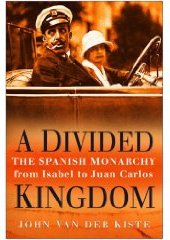
There is little available on the dramatic and colourful history of the Spanish monarchy. Experienced author and historian John Van der Kiste provides a readable and anecdotal look at one of the key European dynasties from the nineteenth century to the present. He begins with the wayward, ill-educated Isabella II, who was forced to marry her nephew. During much of her reign power was in the hands of her generals and her exile and abdication saw the crown of Spain hawked round Europe for two years. It was briefly accepted then refused by Prince Leopold of Hohenzollern-Sigmaringen - thus starting the Franco-Prussian War - and, after a short, unsuccessful stint as a republic, the monarchy was restored when Isabella's son Alfonso XIII was chosen as King. John Van der Kiste leads us through his popular reign, the reign of his son - who married one of Queen Victoria's granddaughters - and the socialist movement in Spain after the Great War which led to the dictatorship of Primo de Rovera. Finishing with the Spanish Civil War, the 'reign' of General Franco and the return of the monarchy with the present King, Juan Carlos, this is a fascinating look at the Spanish Bourbons.
Sie lesen das E-Book in den Legimi-Apps auf:
Seitenzahl: 474
Veröffentlichungsjahr: 2011
Das E-Book (TTS) können Sie hören im Abo „Legimi Premium” in Legimi-Apps auf:
Ähnliche






A DIVIDED KINGDOM
THE SPANISH MONARCHY
from Isabel to Juan Carlos
JOHN VAN DER KISTE
First published in 2007
The History Press
The Mill, Brimscombe Port
Stroud, Gloucestershire, GL5 2QG
www.thehistorypress.co.uk
This ebook edition first published in 2011
All rights reserved
© John Van der Kiste, 2007, 2011
The right of John Van der Kiste, to be identified as the Author of this work has been asserted in accordance with the Copyrights, Designs and Patents Act 1988.
This ebook is copyright material and must not be copied, reproduced, transferred, distributed, leased, licensed or publicly performed or used in any way except as specifically permitted in writing by the publishers, as allowed under the terms and conditions under which it was purchased or as strictly permitted by applicable copyright law. Any unauthorised distribution or use of this text may be a direct infringement of the author’s and publisher’s rights, and those responsible may be liable in law accordingly.
EPUB ISBN 978 0 7524 7083 2
MOBI ISBN 978 0 7524 7084 9
Original typesetting by The History Press
Contents
Introduction
1.
A child queen
2.
‘Destitute of honest and able friends’
3.
Revolution
4.
‘King Macaroni’
5.
‘A young and unprejudiced monarch’
6.
‘He had so longed for a son’
7.
‘The smallest quantity of King’
8.
‘An awful danger’
9.
‘Neutrality was a murderous risk’
10.
‘He tires of everything’
11.
‘Always such a gentleman’
12.
‘Better to be dumb than to stammer’
13.
The last days of the republic
14.
‘We are all monarchists now’
Notes
Bibliography
Introduction
Early in 1931 King Alfonso XIII of Spain asked his Prime Minister, Admiral Aznar, to form a government and prepare the country for new municipal and parliamentary elections. He then went to England for a short holiday. As a cousin by marriage of King George V of England, he was part of the family network of monarchs who could claim a close connection with Queen Victoria and King Edward VII as the grandmother and uncle of Europe respectively.
Spain had recently been through difficult times. Parliamentary government under General Primo de Rivera (‘my Mussolini’, as the King had called him with admiration) had been suspended for several years, and though the largely benevolent despotic regime had brought considerable economic benefits to the nation, it had been unpopular, and culminated in the ailing General’s resignation and death soon afterwards.
The King had hoped to prepare the way for a peaceful return to constitutional government and a reign lasting many more years. When the elections held in April 1931, soon after his return to Spain, showed an unexpected swing towards the socialist and republican parties, especially in the large cities, he was unnerved. It was, he remarked sadly, as if he had gone to make a visit to a friend, and on arriving at the house found that he was dead. Believing that antimonarchist fervour would soon subside, he decided to leave Spain for a while, and consented to a suspension of his powers, while insisting that he would not abdicate.
It was yet another twist in the remarkable saga of the Spanish Bourbons, who had reigned with one brief interruption since the beginning of the eighteenth century. King Alfonso XIII’s grandmother, Queen Isabel, had been driven from the kingdom some sixty years earlier, and a short interregnum had given way to the far from unanimous election of a King from the House of Savoy, followed by the establishment of a republic and the subsequent recall of Isabel’s son, who reigned as King Alfonso XII.
Uniquely among the nations of Europe, King Alfonso XIII’s departure left Spain a republic – or more accurately, as would be confirmed some years later, a monarchy without a king. Some thirty-eight years after the King and Queen went into exile, their grandson was chosen as king-in-waiting, thereby and somewhat controversially bypassing his father who was still alive and in good health, to wait in the wings and succeed General Franco, the head of state, on the latter’s death. After a republican interval of forty-four years, in November 1975 Spain was once again a kingdom.
The aim of this book is to trace the family vicissitudes from the Napoleonic era onwards, through the lives, characters and reigns of the kings, queens and their consorts who reigned over the country and, notwithstanding their faults, never completely forfeited the love and respect of an often volatile but fundamentally generous and forgiving country that always as a whole held the historical tradition of monarchy in high regard.
The names of Spanish royalty require some explanation. Members are not princes or princesses, apart from the heir to the throne, who is Prince or Princess of Asturias; the others are Infantes or Infantas. The title Prince of Asturias, the Spanish Crown Prince, was created in the fourteenth century by King Juan I of Castile. The style of Infante or Infanta or ‘grace’ can be granted by the Spanish monarch to close family members, or members of foreign dynasties who marry into the family.
I wish to acknowledge the gracious permission of Her Majesty The Queen to publish material from the Royal Archives, Windsor. For permission to quote an unpublished letter, I am grateful to Ian Shapiro of Argyll Etkin Ltd. For regular advice, support and the loan of various materials I would like to thank Sue and Mike Woolmans, Coryne Hall, Karen Roth, Robin Piguet, Ricardo Mateo Sainz de Medrano and Art Beéche; and for access to their collections I am indebted to the staff at Kensington and Chelsea Public Libraries. Last but not least, my thanks as ever go to my wife Kim, my mother Kate and my stepdaughter Laura for their constant encouragement and reading through the draft manuscript; and to my editors at Sutton Publishing, Jaqueline Mitchell and Anne Bennett for all their hard work in seeing the project through to completion.
This book is respectfully dedicated to the memory of Gracie Cole Geldard.
ONE
A child queen
By 1808 the star of Napoleon Bonaparte, self-proclaimed Emperor of the French whose mastery over much of Europe had been virtually unchallenged, was beginning to wane. It was the year that he sent troops into Spain, and the British government responded by sending an army into the Iberian peninsula in order to encourage Portuguese and Spanish resistance. In March an uprising in Spain led to the abdication of King Carlos IV, and the throne passed to his son, who ascended as King Ferdinand VII. Within the week Carlos had retracted his abdication, claiming it had been made under duress. Nevertheless Ferdinand was still regarded as the rightful sovereign, until he was forced to abdicate by Napoleon in May, and Carlos was again King. Almost at once Carlos abdicated a second time, surrendering his throne to Napoleon, who proclaimed his brother Joseph King of Spain as José I a month later. Early French victories in the war soon gave way to defeat; after the battle of Vittoria in June 1813 Napoleon was driven out of Spain, and in December that year the Bourbon monarchy was restored with Ferdinand on the throne a second time. With the death of his father in January 1819 he could consider himself secure on the throne at last.
In 1829 Ferdinand lost his third wife, Queen Maria Amelia, born a princess of Saxony. His second wife Isabel, a Portuguese princess, had died in childbirth in 1818, leaving a daughter who lived for only four months. Neither of his first two marriages had produced any surviving children. If he died without issue, the throne would pass to his younger brother Don Carlos. Ferdinand’s cruelty, religious intolerance and despotism had made him unpopular, but his brother was disliked even more. Don Carlos, the Spaniards said, was more Catholic than the Pope, and more royalist than the King.
Nevertheless Carlos had his positive qualities. It was said that he was always honest, the only member of the royal family who never broke his word and always paid his bills, and there were many in Spain who would have liked him to succeed Ferdinand on the throne. In 1825 there was a small but unsuccessful rising in his favour, and two years later a body calling itself the Federation of Pure Royalists issued their own manifesto, calling on him to become King. He kept his distance, letting nobody doubt his loyalty to the Spanish crown, if not to his brother. Perhaps he assumed that as his brother’s heir, he would inherit the throne before long. With a forceful wife who saw herself as the next Queen of Spain, and three young sons, they would surely see that the Bourbon dynasty remained in safe hands.
At forty-four King Ferdinand was in poor health, and seemed older than his years. Nevertheless he was urged to marry a fourth time in order to produce an heir. In December 1829 he married Princess Maria Cristina of Naples, who was some twenty years younger than him. Like most other royal marriages of the time, it was a strictly dynastic arrangement, for neither partner was really in love with the other. She had already lost her heart to Don Fernando Muñoz y Sanchez, a handsome young officer in the Garde du Corps, who had been in the suite which escorted her to Madrid. Nevertheless by spring the next year she was known to be enceinte, and on 10 October 1830 she gave birth to a daughter. When told that the Queen had just produced ‘a robust infanta’, the King turned pale.
As next in succession to the throne the baby was accordingly created Princess of Asturias. Christened Maria Isabel Luisa, she was always known in the family by the second name. Any hopes that a baby brother would soon arrive and thus displace her were dashed with the appearance of another girl, Luisa, born in 1832.
In failing health and increasing pain, King Ferdinand knew he was unlikely to have any more children. Determined to ensure that his elder daughter would assume the throne, in June 1833 he first induced the Cortes to set aside the Salic Law which would have debarred her – and any infanta – from the succession, and then to stage a ceremony at the Church of San Jeronimo in Madrid, at which each member would take an oath of allegiance to her as heiress apparent. The proceedings were boycotted by Don Carlos, who saw it as a personal insult as well as the ultimate frustration of his personal ambitions.
Nobody, least of all the ailing monarch himself, had any doubt that the throne would soon change hands. Though only 48, the consumptive King Ferdinand was becoming progressively weaker. On 29 September 1833, with Queen Maria Cristina beside him, he died after a severe stroke. Three days later his last will and testament was read. The Infanta was immediately proclaimed Queen, and the widowed Queen Maria Cristina was appointed Regent. Queen Isabel II was recognised as the rightful sovereign by the courts of England and France, while at home her supporters included the government in Madrid, the Liberals in the Cortes, and those in the south and centre of Spain. In the meantime her uncle, Don Carlos, was proclaimed Carlos V, King of Spain, and recognised as sovereign by Russia, Austria and the Vatican.
At home his most fervent partisans were to be found in the north of Spain. The family itself was divided, for among those who regarded him as the true monarch were the Regent’s own brother Ferdinand II, King of Naples, who sent him an envoy acknowledging his sovereignty. An uprising in his favour was followed by several small revolts against Queen Isabel throughout the northern provinces. It marked the start of the Carlist wars, which would destabilise the Spanish monarchy for several decades. The First Carlist War lasted over seven years and fighting spanned most of the country at one time or another, although the main conflict centred around the Carlist homelands of the Basque country and Aragon.
In political terms the Spanish Bourbons had split into two opposing factions. The Carlists were the absolutist, legitimist branch, who denied the validity of the Pragmatic Sanction that had abolished the Salic Law; while the Cristinos, the reigning branch, were the constitutional, liberal branch headed by the Queen and her mother. The term liberal, however, was relative, and the Queen’s governments were generally just as reactionary as their opponents. As a constitutional monarch, she was obliged to put her trust in whoever headed her government. Even so, the legitimists would see themselves as liberals, with the Carlists staking their claim as the embodiment of conservative values and an adherence to the traditions of the past. George Villiers, a British minister in Madrid, believed that most of the Spanish people were Carlists at heart, ready to embrace absolutism, and haters of liberal governments and institutions. Queen Isabel’s position was maintained largely through the support of the army, the Cortes, Liberals and Progressives.
Within a few years politicians would regroup into two broad parties, the progresista (progressive) and the moderados (moderate) parties. As their names suggested, the former were more liberal, even radical, and sometimes hostile to the Church, though not republican apart from a few individuals, while the latter were more conservative, comprising largely the landowners and the aristocracy who feared any threat to the established hierarchy.
On 28 December 1833, three months after the death of King Ferdinand, Queen Maria Cristina and Muñoz went through a secret ceremony of marriage, performed by a village priest who was a friend of the groom. The witnesses at the ceremony were afterwards sent away to different parts of the kingdom, with instructions not to reveal what had taken place. Loath to lose Muñoz, yet with too much respect for the sanctity of marriage to take him as a lover, the widowed Queen was intent on marrying him. Having done her duty in taking, or in letting herself be taken by, a husband who needed a wife solely for reasons of state, she felt she deserved some happiness. Nevertheless, under Spanish law she was required to remain a widow in order to retain guardianship of her daughters during their minority. It was therefore imperative for her to keep her second marriage a closely guarded secret, for otherwise she would forfeit her position as Queen Regent, her allowance and her daughters by her first husband.
Muñoz lived in the palace, ostensibly as the Regent’s groom of the bedchamber, and the little white lie of her widowhood was thus maintained. He was also given the title Duke of Riansares. During the next few years two more daughters and two sons were born to the couple, but kept firmly away from the public gaze. All the same, when news of the Regent’s marital union to the low-ranking soldier became public, her standing in Spain diminished accordingly; it undermined her position as Regent and gave rise to concerns that she was not genuinely supportive of her liberal ministers and their policies. Eventually the army, the backbone of Queen Isabel’s support, and the liberal leadership in the Cortes made a joint demand that she should relinquish her position, and in 1840 the army commander-in-chief, General Baldomero Espartero, replaced her as Regent. He was regarded as something of a progressive in political terms, though at the same time incorrigibly lazy. If anything went wrong, said friends and opponents alike, he took to his bed and stayed there; bed was his answer to every crisis.1
After she had made an abortive attempt to reclaim power, Maria Christina retired permanently to exile in France after 1844, and France remained her primary residence for the rest of her life. Espartero remained Regent for only two years, for in 1843 he was turned out by a military and political pronunciamento led by Generals O’Donnell and Narvaez. They formed a cabinet led by Joaquin Maria Lopez, and the government persuaded the Cortes to declare Isabel Queen.
In personality Queen Isabel was a good-natured young girl, precocious in manner if not very clever, impetuous and wilful. Untidy and lazy in general, her table manners were almost nonexistent, and she regularly spilt food down the front of her clothes. As she could scarcely be bothered to dress or undress herself, it took four servants to dress her every morning, a process which normally took over an hour. She could barely read and showed no interest in books, her handwriting was appalling, and her education had been lacking; as her mother once complained, those around her made no effort to induce her to study, lest they should lose her favour.2 It was said that she only liked toys and dogs.3 With her lack of interest in exercise she rapidly put on weight, and from early childhood she suffered from ichthyosis, a skin disease that resulted in her body, especially her head and limbs, being covered with dry, scaly, fish-like skin. It was an affliction which never ceased to trouble her.
All the same, early in life she cultivated an air of queenly dignity, inherited from her mother who impressed on her the importance of deportment. She had a warm smile and a ready laugh which often disarmed people; she was warmhearted and generous by nature, and as she had no idea of the value of money she could be impulsively generous to those in need.
To supervise her and her sister Luisa during their adolescent years and in their mother’s absence, Espartero appointed a governess, Countess Espoz y Mina. Agustin Arguelles became the Queen’s official guardian, and Quintana her tutor. Mina was impressed by the girls’ ‘confiding openness’ and their affectionate nature. Quintana became very fond of them as well, though he found them very young for their age, as nothing had ever occurred to train their attention to any specific subject. They were too easily distracted, he saw; even so, they learned to read and write, and to do simple arithmetic, and could speak, translate and write French to a reasonable standard. They also acquired a rudimentary knowledge of music and geography. ‘Their understanding is clear and unimpeded, without any vice or fault in their faculties; so that when they seek to fix attention, and give their interest to showing what they have really learnt, there is no exercise in which they do not succeed marvellously. But the lack of attention and interest is a grave inconvenience with which we have to struggle at all times.’4
During the first months of Espoz’s appointment occurred what the young Queen would always refer to as ‘that awful night’, 7 October 1841. She was having a singing lesson with her master Valldemosa at the Palacio Real when their peace and quiet was disturbed by the noise of shouting, clashing steel and then a volley of shots from the outer courtyard. Her ladies immediately got up and bolted all the doors and windows of the royal suite. As Countess Espoz ran towards the young sovereign’s apartments, she saw a gang of armed men moving upstairs to attack the police guard drawn up on the landing. Further shots rang out before she reached the apartments where she found the girls, still very upset and bewildered, wanting to know whether the men were rebels, and Queen Isabel screaming, ‘Do they want me?’ After further shooting the commotion died down, as the palace guard managed to hold out against the rebels, who fled during the night.
The man responsible was General Diego de Leon, a partisan of Queen Maria Cristina. An adversary of Espartero, he had decided to kidnap Queen Isabel. There had recently been an uprising in northern Spain on behalf of Queen Maria, and a junta, or political council, had been established in Bilbao in her name. Leon had intended to take the young Queen away to the protection of the junta, and probably to demand the return to Spain of Queen Maria Cristina. He and several of his fellow conspirators were condemned to death, leaving the Regent shocked and in tears. She refused to say whether she had been implicated in the move or not. Leon’s wife, the Marquesa de Zambrano, personally came to see Queen Isabel and begged her to spare her husband’s life. The Queen asked her not to cry, ‘or you will make me cry too’, and assured her that he would be saved. Dismissing the woman, she then sent for Arguelles and asked him to persuade Espartero to pardon Leon. But it was to no avail, for he and five other officers had been shot the previous day.
Espartero was sure that Queen Maria Cristina had been behind the conspiracy. She had already bribed General Narvaez to raise Andalusia against Espartero, but as the rising was a failure he returned her money. When Don Salustiano Olozaga, the Spanish ambassador in Paris, called on the Dowager Queen a few days later and she innocently asked him what was happening in Spain at the time, he told her that he found the question very strange, as he thought that Her Majesty was better informed than anyone else.
In order to strengthen his authority, particularly against those who were still agitating for the Regent’s return, Espartero decided he ought to appear in public more often with the Queen. In 1843 he asked her to open the new session of the Cortes for the first time. She did not make a good impression. Spectators considered that she looked rather gauche, and lacked grace; her movements were too abrupt. She made a less favourable impression than her younger sister, whose smile seemed warmer and less forced, and whose curtsy was far more graceful. Thus Espartero’s position was still vulnerable. After further revolts and instability he decided to dissolve the Cortes, and General Narvaez landed at Valencia with a small force and proceeded to march on Madrid. Espartero fled to England, leaving the way clear for the General.
Nevertheless the people decided that they did not want a military dictatorship. Instead, the Cortes decided to declare Isabel legally of age. On 8 November 1843 the 13-year-old Queen was driven in state to her assembly, and seated on the throne. The President of the Cortes brought her the Bible, and the text of the royal oath. Placing her right hand on the book, she swore by God and the Holy Gospel ‘to preserve the constitution, and cause it to be observed’. It was hardly surprising that at her tender age she looked a little puzzled as she repeated the words, ‘If I should act contrary to what I have sworn, or to any part of it, I ought not to be obeyed.’5
Those who had expected that such action would usher in a period of stability in Spain were to be disappointed. Olozaga was appointed Prime Minister. He shared Espartero’s liberal politics, and was resented by the conservative courtiers surrounding the young Queen. Encouraged by General Narvaez, they decided that Olozaga would have to go. Seven weeks after Isabel had been declared of age, Olozaga decided to dissolve the Cortes. He had foreseen that the conservatives would not look kindly on his programme of reforms. In secret he prepared a decree for the dissolution, and on 28 November he took it to the palace for the Queen to sign. He entered into her presence, she received him alone, and he only stayed for fifteen minutes. According to the halberdiers who saw him leave, when he reappeared he looked rather pleased with himself as he closed the door behind him.
Next morning the Marquesa de Santa Cruz asked the Queen what decrees she had signed the previous night. The Queen replied that she did not remember exactly, but thought it was a decree dissolving the Cortes. With horror, the Marquesa told her that she had just signed the death sentence of the monarchy. The Queen was thoroughly frightened, as the Marquesa went to tell the partisans of Narvaez what had happened. When Olozaga heard that his political enemies were making their way to the palace, he went there too and asked a gentleman-in-waiting, the Duke of Osuna, to send the Queen word that he was bringing her some important despatches. The Duke kept him waiting, then came back to say that the Queen refused to see him. While he waited in the antechamber, he overheard some of the other gentlemen there discussing in a hushed voice what he took to be some interesting rumour, so he told the Duke that it was vital he should be able to see the Queen as a matter of urgency. The Duke left and returned a few minutes later with the message that Her Majesty had just dismissed him as Prime Minister. If he returned to the ministry, he would find her signed decree confirming the matter. He was also asked to return the decree of dissolution she had signed for him the previous night.
However, when Olozaga returned to the ministry he found no such decree, nor indeed any documents from the palace demanding his resignation. He then summoned the cabinet, and was with his ministers when a despatch arrived from the palace, signed by the Queen, stating that she was relieving him from all his duties ‘for grave personal reasons’. When he asked the reasons for his dismissal, he was accused of having obtained her signature by force, and was told that he would be placed on trial. He agreed to submit to such proceedings, but refused to surrender the decree.
At a public enquiry in the middle of December the new Prime Minister read out a statement that had been made by the Queen in the presence of several witnesses. In it, she claimed that Olozaga had presented himself to her with a decree dissolving the Cortes which he wanted her to sign. She told him she was unwilling to sign as the Cortes had declared her of age, but he insisted and she again refused. She turned to the door on the left of her desk and tried to leave the room, but he placed himself between her and the door, which he then bolted. When she tried to leave by another, he did the same once again. Then he took hold of her by her dress, forced her into a chair, took her hand in his and guided it over the document so she had no choice but to sign. After extracting a promise from her never to mention the incident to anyone else, he left.
In the seventeen-day trial he questioned this version of events. He maintained that the Queen’s firm, clear signature on the paper did not look as though it had been obtained by coercion, and he swore that there were no bolts on the doors through which she had tried to leave. But he could hardly accuse his sovereign of lying, though his allies were ready to accuse him of doing so. The most convincing explanation he could provide was that he told her it was her duty as a constitutional monarch to sign the document, and that her disapproving or jealous courtiers, whose political sympathies diverged considerably from his, were using this as an opportunity to force him out of office.
Whatever the truth of the matter, it would hardly do for any politician to dare to hint that his sovereign was wrong, or even that she might have been ill-advised. The proceedings against him were dropped, but he was ordered to leave the country and went to settle in Portugal. Four years later his friends asked Queen Isabel to pardon him, to which she replied that she could not forgive him since he had not offended her. She was never one to hold a grudge and it was said that she forgot easily. Moreover, she was still little more than a child of barely average intelligence. Trying to act the role of a constitutional sovereign while surrounded by unscrupulous self-seeking politicians, unable to trust anybody in her family to tell her the truth about anything or anyone, the best she could do was to try to be as pleasant as possible to those she had to work with. As they were not over-anxious to treat her with respect, it was probably more than they deserved.
In the spring of 1844, soon after Olozaga’s flight, Maria Cristina returned in triumph. The liberals and progressives in the Cortes demanded that she must repay the large sums of money she had taken with her when she left Spain after her abdication as Regent, but this was circumvented when she requested the arrears of her pension, which had been stopped by Espartero after Diego de Leon’s abortive kidnap attempt. A royal decree was passed whereby the arrears of her pension were to be paid, and this proved considerably more than the repayment for which she was being asked.
She was given an enthusiastic reception on her return. As Washington Irving noted, somewhat bemused, when she left the kingdom in 1840 ‘the whole world seemed to be roused against her, and she was followed by clamour and execrations’. What a contrast it was with the scene four years later, when ‘the cities that were then almost in arms against her now receive her with fêtes and rejoicings. Arches of triumph are erected in the streets; Te Deums are chanted in the cathedrals; processions issue forth to escort her; the streets ring with shouts and acclamations; homage and adulation meet her at every step; the meanest village has its ceremonial of respect, and a speech of loyalty from its alcalde.’6
Near the Palace of Aranjuez a large tent had been erected, where Queen Isabel and the Infanta Luisa awaited her arrival, and it was an emotional moment for all three as her carriage drew up, escorted by squadrons of lancers. A decree was drawn up to legitimise the marriage between Queen Maria Cristina and Muñoz, and to dispel any doubts about its validity they went through another wedding ceremony in the palace chapel, conducted by the Bishop of Cordoba.
Maria Cristina’s return brought a new sparkle to the royal court. Almost at once there were magnificent balls, receptions and banquets. Queen Isabel threw herself into this lavish social life with gusto. Still an immature young woman desperately unsure of herself and her sovereign duties, she welcomed the return of her mother, who could not only provide her with some kind of reassuring presence, but would also take a lead in providing the court with enough colour to make it the envy of other countries. It was said that she attended the balls with the gaiety and enthusiasm of a schoolgirl, which in effect was all she really was at heart.
As a sovereign regnant, the unmarried Queen Isabel would soon be perhaps the most eligible woman in Europe for any prince seeking a royal bride. By the time she was fifteen, the time was right for her to find a husband – or to have one found for her. Queen Maria Cristina was keen for both her daughters to marry French princes, a scheme strongly opposed by the British government on the grounds that it contravened the Treaty of Utrecht, which included a clause stating that the crowns of France and Spain could never be united in one person. That both countries had reigning monarchs at that time whose thrones were not based upon the principle of legitimacy made no difference. Any attempt to carry out the Regent’s wishes would meet with opposition from Britain, though it was unlikely that British interests would be supported by any other country, as the other powers did not have the same interest in Spain. Isabel was eager to marry, and as François Guizot told his master King Louis Philippe of France, there was something in the physical exuberance of Spanish infantas that made it possible for them to have an heir before they had a husband. An early marriage for Her Majesty was obviously the only way of preventing such an outcome.
In March 1842 M. de Sainte-Aulaire, French ambassador at the court of St James’s, wrote to Guizot informing him that his emissary M. Pageot, Chargé d’Affaires at Madrid, had arrived in London. They called jointly on Lord Aberdeen at the Foreign Office to assure him that King Louis Philippe intended to withdraw his country’s claims for the hand of the Queen of Spain for one of his own sons. He was well aware that a powerful party in Spain was keen for this union, but at the same time he knew that such a marriage would have ‘exclusive advantages for France’. Nevertheless he expected that the crown of Spain would not go to any prince outside the Bourbon family. There were several branches of that house and several members in each branch, and the Queen’s husband should be chosen from one of them. The King ‘recommends or excludes none of them’.7 He was aware that England was keen for Isabel to marry a prince of the house of Saxe-Coburg, and that Austria would be equally keen to press the claims of a Habsburg archduke.
Aberdeen said he did not understand the declaration, and could not see what right France had to intervene. Was it not up to the Queen of Spain to make her own choice of husband? Sainte-Aulaire replied that he knew perfectly well it would not be the Queen who would decide on such a matter, but her government. Aberdeen insisted that, in the view of the British government, it was a purely domestic matter and did not propose to interfere. In reply Pageot said he would tell the King that, should the Queen want to marry her cousin the Duc d’Aumale, His Majesty’s fourth son, Aberdeen himself would make no objection.
In September 1845 Queen Victoria of England and her husband Prince Albert visited Louis Philippe at the Chateau d’Eu, accompanied by Lord Aberdeen, while King Louis Philippe was attended by Guizot. The question of the Spanish marriage was discussed, as the Queen and Albert wished Isabel to marry one of the Catholic Coburgs, Leopold, the younger brother of Ferdinand who had married the Queen of Portugal. However, Ferdinand’s tyrannical methods had been met with revolution in the country, and prospects of a Catholic Coburg prince for the young sovereign’s hand were not encouraging.
Of all the potential candidates for Isabel’s hand only two were now left, namely Francisco, Duke of Cadiz, and his brother Enrique, Duke of Seville, both children of Francisco, the youngest son of Carlos IV. The British government favoured the Duke of Seville, who was regarded as more liberal than his reactionary brother, and also physically stronger. Aberdeen reported to Sir Robert Peel, the British Prime Minister, that until Queen Isabel was married and had children, they should veto any French marriage for the Infanta Luisa, whom they knew King Louis Philippe regarded as a likely bride for his son the Duc de Montpensier. If the Queen remained childless, her sister Luisa would inherit the Spanish throne, and therefore any children born to her and Montpensier after her death would do likewise. This would be contrary to the Treaty of Utrecht, signed in 1713, which forbade the union of France and Spain, and also debarred the heirs of the Orleans dynasty from ever succeeding to the Spanish throne. As a result, the British and French ministers at Eu agreed that until Queen Isabel had children, her sister should not marry a French prince. At the same time Guizot made it clear that France would oppose a Coburg on the Spanish throne, and Aberdeen was at pains to assure Guizot that despite Queen Victoria’s personal preferences, the British government would not support a Coburg candidature.
When he returned to Paris, Guizot felt he had not done enough to safeguard his country’s interests. On 27 February 1846 he drafted a memorandum including a statement to the effect that if the marriage of Queen Isabel with Prince Leopold of the Belgians (the future King Leopold II), or with any prince other than a descendant of Philip V, became probable, the French government would consider itself free of all its obligations, and thus justified in demanding the hand of the Queen or the Infanta for the Duc de Montpensier. Aberdeen was advised of this, but he could not accept the view that any agreement concerning the Queen’s marriage producing children before the Infanta could marry should be dependent on dismissing the Coburg candidature altogether. All he had consented to was that the British government would not support a Coburg prince, but it could not interfere with Queen Victoria’s freedom to recommend one if she or Prince Albert (actively encouraged by the wily King Leopold of the Belgians) chose to do so.
In June the British Tory government of Sir Robert Peel was defeated, to be succeeded by a Liberal administration with Lord John Russell as Prime Minister and Lord Palmerston as Foreign Secretary. King Louis Philippe and Guizot were convinced that Palmerston intended to place a Coburg prince on the throne of Spain. They were right, for in July the new Foreign Secretary sent the British minister in Spain a despatch in which he denounced the tyranny of conservative rule in Spain, and also recommended that Leopold should be reinstated as a possible husband for Queen Isabel. King Louis Philippe and Guizot both felt they were being tricked by Queen Victoria and her government, and thus felt themselves no longer bound by any of the provisions of the agreement made at Eu the previous year.
Without further discussion the French and Spanish ministers at Madrid arranged matters their own way. On 8 September Queen Marie Amélie of France announced the marriage of her son with the Infanta Luisa in a letter to Queen Victoria. The British sovereign replied civilly enough, saying that it could only cause ‘surprise and very keen regret’. She was more forthright to Palmerston, writing that ‘really the French have behaved so very unhandsomely and unfairly about this – to say the least’,8 while to her uncle Leopold, King of the Belgians, she denounced the settlement of the marriage as ‘infamous’.9
After protracted negotiations for a suitable candidate, on 10 October 1846 Isabel married one of her Spanish Bourbon cousins, Don Maria Ferdinand Francisco de Asis, a nephew of Carlos V. It was a double wedding ceremony, for that same day Luisa married Antoine, Duc de Montpensier, a son of King Louis Philippe. Britain was furious that Spain had reneged on the agreement by not waiting until the Queen had borne any children before her sister’s marriage.
Don Francisco was small and slight, with a shrill voice. In an age when princes were generally expected to be dashing soldiers and incorrigible philistines, he was a peace-loving devotee of the arts. He was also a hopeless hypochondriac who refused to give audiences to anyone suffering from a cold. Throughout the courts of Europe he was known as ‘Paquita’, which translated into English as ‘Fanny’. It was said that when in uniform he looked just like a young girl dressed up as a general.
If Queen Isabel had been looking for a husband who was the personification of manliness, then she was to be sorely disappointed. He was believed to have little interest in consummating their marriage, even if he was capable of doing so. If he did not provide the Queen with any children, the crown of Spain would pass to the descendants of her sister Luisa. To Leopold, King of the Belgians, Queen Victoria railed bitterly about ‘this truly unfortunate and painful Spanish business’, saying that her ‘feelings were and are deeply wounded at the unhandsome and secret manner (so totally, in letter and in meaning, contrary to an entente cordiale) in which this affair was settled, and in which the two marriages were incorporated’.10
The wedding ceremonies were performed in the palace. Queen Isabel wore a white moiré dress covered with diamonds, and the groom the uniform of captain-general. Both burst into tears of emotion when declared husband and wife. An eyewitness at the wedding said that Francisco was neither handsome nor tall, and he did not appear to look healthy. ‘When he was still a student in Paris he had more presence than now. He looks embittered.’11 Nevertheless the celebrations lasted ten days, with bullfights and gala performances at the theatre, a dinner at the palace and a ball given by Bresson at the French academy. On his marriage, the Queen granted her husband the courtesy title of King.
Magnificent as the ceremonies were, few believed that these weddings would bring happiness for the brides and grooms, or security for Spain in her relations with other countries. In London The Times guardedly offered its best wishes, ‘if not our most joyful congratulations’ to the Spanish people. The Queen, it said, was ‘united to a native Prince, who brings in his train no elements of discord, and offers no stormy prospects as the price of his alliance’. He would introduce ‘no foreign influence to injure or insult the people of his country, and his descendants will not be liable to the jealous intervention of neighbouring powers as the unlawful heirs of a forbidden birthright, nor will Spain be taught to regard them as debarred by right from a succession to which they are introduced by blood’.
It was a different matter entirely where the Infanta’s marriage to Montpensier was concerned. In this case the bridegroom was arriving ‘among a people whose detestations of his pretensions can hardly be drowned in the purchased acclamations of noisy crowds well trained and carefully posted on his road’. They would see through the scheming of his family, and know the extent to which he was disqualified by solemn engagements for the position as husband to the heir apparent which he was expected to fill. He was thrust upon them with a deep purpose or with none. If it was the latter, his intrusion was a gratuitous insult to Spain and the Spanish, endangering their relations with friendly Powers which, perhaps less than any other country in Europe, they could ill afford to imperil, and creating nothing but suspicion and discontent. If it was the former, ‘Spain is condemned to a perpetual dread of a detested influence, and to the reflection that the descent of her crown will entail war and bloodshed upon unknown generations’.12
They would prove prophetic words. The Spanish marriages, planned if not connived at in such detail beyond the borders of Spain, would create more problems for those involved than they had solved.
TWO
‘Destitute of honest and able friends’
Now sixteen and newly married, Queen Isabel was developing into a more graceful and assured if not exactly pretty woman. She was never physically attractive, and not even the finest clothes could conceal what the American writer Washington Irving called her ‘rough and somewhat mealy look’. Yet with maturity, the childhood surliness of expression had given way to a greater affability. The pressures of growing up as a child-sovereign, unloved and a stranger to affection, still only a schoolgirl yet in theory the most powerful woman in the kingdom, who must be obeyed by everyone as she was the Queen, were starting to ease. Most observers thought she seemed more self-confident, less petulant, appropriately regal when the occasion demanded, but equally spontaneous and good-humoured. A few were critical enough to consider her self-willed, frivolous, even impossible, but in the case of a young woman who had had no chance to grow up under a normal upbringing, it was perhaps only to be expected. However, even Irving admitted that she conducted herself with ‘dignified yet simple grace’.1
Isabel’s love of social events was legendary. She had discovered the diversions of a life of pleasure, and after a miserable childhood she could hardly be blamed for finding some form of release from the formality which her status demanded of her. For her there would be no drudgery of early to bed and early to rise; her balls at court lasted well into the early hours of the morning, before she retired to bed at around dawn and got up in the middle of the afternoon. After a very late breakfast, still wearing her nightclothes and slippers, she would give audiences to diplomats, listen to music, look at the newspapers, paying particular attention to any reports of proceedings of the Cortes, and perhaps have a game of shuttlecock with her ministers or maids of honour. At about 5 p.m. she would dress and go for a drive in the Pardo in her small pony phaeton, accompanied by her cousin Infanta Josepha and her uncle Don Francisco de Paula, never attended by a full military escort, only an outrider and one or two servants. She would alight from her carriage and walk for up to an hour, leaning on the arm of her uncle or her cousin, followed at some distance by the servant in royal livery, in the midst of her people. They would return to the palace between 7 and 7.30 for dinner, after which she would spend two or three hours dancing. On nights when she was not hosting a ball, she would generally go to the theatre, this being followed by supper in the private room of one of the capital’s finest restaurants.
The King would wait until after she was gone from the palace before he himself left, generally in a closed carriage. He would go in the opposite direction to the Pardo, and return about an hour later. That their routines diverged so much, and that they seemed determined to lead separate lives, did not go unnoticed. It was evident that they disliked each other, and that they had been incompatible from the start. As The Times commented, ‘Where the parties most interested in each others’ happiness were originally unblamable – where neither was in fault – what terms ought to be applied to the unprincipled and heartless men who have made them miserable for life?’2
Isabel was unfailingly generous, though such a characteristic was by no means rare among royalty who had no idea of the value of money. Often she visited the sick, gave large sums of money to the Church, and would climb down from her carriage so that her place might be taken by a priest taking the sacrament to a man dying in the slums. She flung herself enthusiastically into Spanish ceremonies such as the washing of the feet of the poor at Easter. Sometimes she would remove the bracelets from her arms to hand to beggars at the palace gates. When the daughters of ministers or generals were betrothed, she would present them with magnificent dowries.
Had she been no more than an idle pleasure-loving monarch, she might have been deeply resented by her subjects. But with her legendary love of the good life being matched by her innate kindness, she was liked if not adored. On at least one of her drives in Madrid she was shot at but uninjured, and the next time her carriage was seen in the streets, her courage and defiance were applauded.
Forced into the most transparent of arranged marriages at the age of sixteen, Queen Isabel was prepared to take this thoroughly unsuitable husband in her stride. What, she would remark with a shrug of her shoulders, was there to say of a man who on his wedding night wore more lace than she did?3 She had been a pawn in the hands of an avaricious mother, power-mad Spanish politicians and heartless European courts, who rarely if ever stopped to consider her personal interests and happiness. Had her elders if not betters procured her a more virile young man, maybe she would not have found it necessary to seek her gratification elsewhere.
Some consideration needs to be given to the assumption that King Francisco was homosexual or bisexual. His effeminate manner was remarked on by several contemporaries, and for years his homosexuality was taken for granted, though not always spoken of too openly. More recent schools of thought have suggested that this was an over-simplification, and that he may have been one of those reserved men who found it difficult to show his wife much passion, or perhaps he found her too ardent and hot-blooded a lover. It is all too tempting to conjure up comic visions of a nervous young gentleman taking to his heels in terror from the embraces of an oversexed bride (perhaps the reverse of those tales of innocent virgin brides fleeing from their virile husbands), but in this case such a story might contain more than a germ of truth.
Perhaps he resembled in personality his contemporary and fellow-consort, Prince Albert of Saxe-Coburg Gotha, husband of Queen Victoria of England. Victoria and Albert had nine children, but Albert had been psychologically scarred by his parents’ divorce and, unlike his brother Ernest, was the one puritan in a family which had more than its fair share of rakes and philanderers. His attitude towards sex was that it was a duty to procreate, but certainly not recreational – a view which contrasted with that of his fun-loving wife and her Hanoverian forebears, something which even the heavily censored version of her journals which survives today cannot entirely conceal.
If Francisco and Albert had certain characteristics in common, so did Isabel and Victoria. Both princesses had lost their fathers when they were very small, and both were passionate, high-spirited characters who needed firm, steady guidance as well as affection. Victoria was extremely fortunate in her mentors throughout adolescence, not least her Prime Minister Lord Melbourne, whose superior knowledge and years of experience she had the common sense to respect and learn from. She was even more felicitous in her marriage, to a cousin who became her best friend and political adviser as well as husband. Isabel had no such advantages. A sovereign from childhood, she was constantly at the mercy of opposing bitter factions in Spanish politics, poorly educated, surrounded by flatterers instead of disinterested, sensible advisers, and forced into an unsuitable marriage while still a child with a cousin who eventually became a friend but could never become her lover. If she was a bad Queen, it was because she had little chance to become a good one. Her morals may have been open to question, but this did not make her a bad woman.
If Francisco de Asis, King of Spain, was unable or unwilling to consummate the marriage and provide her with children, said the cynics, she would undoubtedly find others who could. She seemed to think, or was led to believe, that her husband would be happy enough with the title of King Consort and a generous allowance from the civil list for his own use. She was soon informed otherwise. Her husband declared his intention to control her private life, and to assume what he considered a fitting role in the government of the country.
Despising and disregarding her husband, Isabel soon found what she wanted in the arms of other men. One of the first was General Francisco Serrano y Dominguez, a handsome dashing courtier whom she had known before her marriage. Twenty-two years older than the Queen, he had followed a military career and rose in rank from captain to brigadier-general in the Carlist wars, then went into politics and became a member of the Cortes. In 1840 he had helped Espartero to overthrow Queen Maria Cristina, and for his efforts was rewarded with the post of minister for war in Olozaga’s government.
Queen Maria Cristina held strong views on the sanctity of marriage, and would probably have briskly dispelled any notions her pleasure-loving elder daughter might have had about allowing the General to share her bed. Yet Isabel was now confident enough to refuse to be dictated to by her mother, and within a few weeks of her wedding it was an open secret that Serrano was her lover.
If Francisco was forced to accept this state of affairs – and if he was less fond of women than men, his being excused from marital duties to such a full-blooded woman as Queen Isabel may have come as a relief – then he would find compensations of a different kind. She was the most powerful woman in Spain, and as her husband he was surely the most powerful man. Some of her more reactionary courtiers, ready to curry favour, began to attach themselves to him. They doubtless suspected that should there be a palace coup on his behalf against her, they would be poised to reap the reward. Others were probably motivated more by hatred of Serrano, whom they might have seen as a king in all but name.
Francisco resented Serrano, not as a rival for his wife’s attentions and voracious sexual appetite, but as someone who would easily supplant his own influence. When he spoke sharply to the Queen about the over-mighty General, she told him sharply that it was none of his business. He asked the Prime Minister to convene a council to order an inquiry into her infidelities, but the wily politician refused. To do otherwise would have meant instant dismissal by the Queen, and he probably took the common-sense view that there was no point in wasting time enquiring into something which was common knowledge. Much as she privately sympathised with her young son-inlaw, Queen Maria Cristina had little patience with this washing of dirty linen in public. She told Francisco indignantly, with a sense of irony that doubtless escaped her, that he was not worthy to lie in her daughter’s bed. In fact Francisco had his own separate bed. It had been put in the Queen’s bedchamber, but he so disliked even sharing the room with her that he had it taken to another room in the palace.
Weary of a situation which she was powerless to control, the former Regent took herself back to France. Freed from her mother’s censorious gaze, Queen Isabel flaunted her liaison even less shamelessly. Her affection for Serrano was an open secret throughout Madrid. In the theatre he usually sat in a box opposite the royal box, and she never took her eyes off him. After the play was over she met him secretly in a private room in a nearby restaurant. Meanwhile her husband asked Pacheco, the new Prime Minister, to do something about Serrano. The King’s friends had suggested he take a pistol to the man, but he thought better of it and preferred to deal with the situation by more legal means. Pacheco persuaded Serrano to leave Madrid, but he went only as far as Aranjuez, where the Queen soon joined him and there they spent the summer of 1847.
While leaving for her new temporary home in a phaeton, the Queen experienced the first attempt on her life, when Angel de la Riva, a journalist and lawyer, fired a pistol at her. Nobody was hurt and the would-be assassin was arrested and sentenced to death; Isabel, however, commuted the penalty to four years’ exclusion from Madrid, Aranjuez and the other royal residences. Meanwhile Francisco settled at the palace of El Pardo.
Within six months of their wedding it was common knowledge that the Queen and her King Consort thoroughly disliked each other. Sir Henry Bulwer, who had been British ambassador at Madrid since 1843, feared it was only a matter of time before the Queen’s marriage was over. In the last week of April one of Francisco’s friends (exactly who was never revealed) asked him to resume friendly relations with the Queen. He agreed to do so, on condition that he would be allowed a separate establishment, a voice in affairs of state and the right to intervene in matters of government. An ultimatum was sent to the Queen, Francisco warning her that if she refused to accede to his terms, he might appeal to the sympathies of the army and also issue a manifesto to the nation. As he was far less popular in the country than his wife, he would almost certainly have met with little response, but the fact that he was prepared to make such threats alarmed the ministers.




