


9,99 €
Mehr erfahren.
- Herausgeber: The History Press
- Kategorie: Sachliteratur, Reportagen, Biografien
- Sprache: Englisch
Queen Victoria and Albert, Prince Consort had nine children who despite their very different characters, remained a close-knit family. Inevitably, as they married into European royal families their loyalties were divided and their lives dominated by political controversy. This is not only the story of their lives in terms of world impact, but also of their own personal achievements, their individual contributions to public life in Britain and overseas and in their roles as the children of Queen Victoria and the Prince Consort.
Das E-Book können Sie in Legimi-Apps oder einer beliebigen App lesen, die das folgende Format unterstützen:
Veröffentlichungsjahr: 2011
Ähnliche



QUEEN VICTORIA’S CHILDREN
ALSO BY JOHN VAN DER KISTE
Frederick III (1981)
Dearest Affie [with Bee Jordaan] (1984)
Queen Victoria’s Children (1986)
Windsor and Habsburg (1987)
Edward VII’s Children (1989)
Princess Victoria Melita (1991)
George V’s Children (1991)
George III’s Children (1992)
Crowns in a Changing World (1993)
Kings of the Hellenes (1994)
Childhood at Court 1819–1914 (1995)
Northern Crowns (1996)
King George II and Queen Caroline (1997)
The Romanovs 1818–1959 (1998)
Kaiser Wilhelm II (1999)
The Georgian Princesses (2000)
Gilbert & Sullivan’s Christmas (2000)
Dearest Vicky, Darling Fritz (2001)
Once a Grand Duchess [with Coryne Hall] (2002)
William and Mary (2003)
Emperor Francis Joseph (2005)
Sons, Servants and Statesmen (2006)
A Divided Kingdom (2007)
QUEEN VICTORIA’S CHILDREN
JOHN VAN DER KISTE
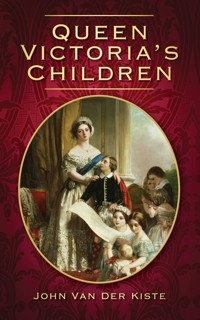
Cover illustration: Queen Victoria and her Children by John Callcot Horsley
(1817–1903) (Forbes Magazine Collection/ The Bridgeman Art Library).
First published in 1986
This edition published 2009
The History Press
The Mill, Brimscombe Port
Stroud, Gloucestershire, GL5 2QG
www.thehistorypress.co.uk
This ebook edition first published in 2011
All rights reserved
© John Van der Kiste, 1986, 2003, 2004, 2009, 2011
The right of John Van der Kiste, to be identified as the Author of this work has been asserted in accordance with the Copyrights, Designs and Patents Act 1988.
This ebook is copyright material and must not be copied, reproduced, transferred, distributed, leased, licensed or publicly performed or used in any way except as specifically permitted in writing by the publishers, as allowed under the terms and conditions under which it was purchased or as strictly permitted by applicable copyright law. Any unauthorised distribution or use of this text may be a direct infringement of the author’s and publisher’s rights, and those responsible may be liable in law accordingly.
EPUB ISBN 978 0 7524 7324 6
MOBI ISBN 978 0 7524 7323 9
Original typesetting by The History Press
Contents
Preface to Second Edition
Foreword
Prologue
1 A Family of Eleven 1840–61
2 ‘Every family feeling rent asunder’ 1861–72
3 ‘Fresh blood’ 1872–86
4 Victorian Sunset 1887–1901
5 The Twentieth Century 1901–44
Genealogical Tables
Queen Victoria’s Children and Grandchildren
Reference Notes
Bibliography
Preface to Second Edition
Queen Victoria’s Children was first published in 1986, and minor revisions were made to the first paperback edition in 1990. Since then our knowledge of Queen Victoria’s children has been added to immeasurably by further biographies and selections of letters. In addition to long-awaited comprehensive lives of Princess Louise, Prince Arthur and Prince Leopold, there has also been another major study of Princess Victoria, and the final volume in the series of letters between this eldest daughter and her mother. Add to these four major works on Queen Victoria herself, one taking the story up to 1861, the other three her complete life, and also a biography of her physician, Sir James Reid, and the sum total speaks for itself.
I have taken this opportunity to add to my text from these and other more recently published volumes, make a few small corrections, and undertake a thorough revision of the reference notes and bibliography.
In conclusion, I would like to dedicate this volume to Kim.
Foreword
Queen Victoria’s children have been the subject, individually and collectively, of substantial biographical attention. The two eldest, the Princess Royal (later the German Empress Frederick) and King Edward VII, have been dealt with adequately by several writers from personal and political angles, and most of the seven younger princes and princesses have been accorded at least one biography each. In addition there are various works on Queen Victoria’s family and children, even two on the Queen and her daughters.
Our knowledge of the children as individuals, however, is inevitably uneven. Queen Victoria and the Empress Frederick were among the most tireless correspondents and journal-writers of their time,* and it is largely thanks to the publication of so many of their letters that so much is known of their personalities, their likes and dislikes, their attitudes and relationships with the family. The Queen’s other children did not inherit these literary gifts in such measure. Moreover, some of them are known to have left instructions that much of their correspondence was to be burnt after their death. King Edward VII ordered the destruction of vast quantities of private letters from the Queen to Disraeli, describing her family; Princess Beatrice transcribed her mother’s journals, destroying the original manuscript as she went along. Many more letters – one can only guess at the quantity – are still sealed at present and may be made available in future years.
Most of the Queen’s surviving correspondence has already been made available in some form, and the history of the family during her lifetime is thus reasonably well-documented. After 1901, the year in which she and the Empress Frederick died, there are still considerable gaps, and it is chiefly for this reason that Queen Victoria’s longest-lived children have been comparatively little written about. The aim of this book is to examine the relationships between her, her sons and her daughters, and between each other after her death, as clearly as available material will permit.
My thanks for help, advice and information are due to Theo Aronson; Bee Jordaan; John May; Shirley Stapley; and in particular my parents, Wing Commander Guy and Nancy Van der Kiste, for their assistance with reading the manuscript and checking proofs.
I am indebted to the following copyright holders for permission to quote from published works: Bell & Hyman Ltd (Dearest Child, Dearest Mama, Your Dear Letter, Darling Child, Beloved Mama, all edited by Roger Fulford); John Murray Ltd (King Edward the Seventh, by Philip Magnus; The letters of Queen Victoria); and Weidenfeld & Nicolson Ltd (Victoria R.I., by Elizabeth Longford; Victoria and her Daughters, by Nina Epton).
*When Conte Egon Caesar Corti was researching and writing his biography of the empress, an abridged English translation of which was published as The English Empress in 1957, he counted 4,161 letters from the empress to the Queen, in the Royal Archives at Windsor, and 3,777 from the Queen to her daughter, in the Kronberg Archives, all spanning the years 1858 to 1901.
Prologue
Queen Victoria’s grandparents, King George III and Queen Charlotte, had fifteen children, of whom twelve attained their majority. The five princesses were spinsters or childless. Of their seven brothers, only three were married in the eyes of the royal act of succession, passed by the King in 1772 as a safeguard against unsuitable alliances. Between them, they could only boast one legitimate or officially recognized grandchild – Princess Charlotte of Wales, offspring of the tempestuous marriage of the Prince Regent and his wife Caroline.
In May 1816 Charlotte married the good-looking, earnest Prince Leopold of Saxe-Coburg Saalfeld. The match was popular, for Leopold made an agreeable change from his wife’s ageing, dissolute uncles, but their happiness was destined to be tragically brief. Within eighteen months she gave birth to a stillborn son, and died herself.
Rarely had the country grieved so unanimously for a royal death. The large family of King George III, now a blind and deranged shadow, was apparently heading for extinction. There was no chance of the Prince Regent and his wife having further children, and the Dukes of York and Cumberland were validly married but still childless. Tempted by the prospect of generous parliamentary allowances in return for performing their dynastic duties, three of the other dukes were prepared to jettison their mistresses and seek suitable wives.
In July 1818 Edward, Duke of Kent, married Leopold’s elder sister Victoire, widowed Princess of Leiningen. The Dukes of Clarence and Cambridge likewise wedded German princesses that year, and in 1819 there were four royal births. All three duchesses, and the Duchess of Cumberland, presented their husbands with children that spring. In March Princess Charlotte of Clarence was born, but lived only a few hours. By contrast Prince George of Cambridge was a healthy infant who would live to the ripe old age of eighty-five. These births were followed by two in May. The second of these was Prince George of Cumberland, a delicate child later smitten with blindness, destined to be the last King of Hanover.
Three days earlier, on 24 May, Princess Alexandria Victoria of Kent had been born at Kensington Palace.
Like her cousin Charlotte, Victoria was to be an only child. The penniless Duke and Duchess of Kent wintered that year at the seaside town of Sidmouth in Devon, where the cost of living was considerably less than in London. Ironically the Duke was solicitous about his family’s health, but neglected his own. A cold turned to pneumonia shortly after their arrival in Devon. The prince who had frequently boasted he would outlive his brothers died on 23 January 1820, aged fifty-two. Six days later, King George III followed him to the grave.
The Prince Regent ascended the throne as King George IV. His heir was Frederick, Duke of York, whose wife died later that year. Second in line was William, Duke of Clarence. It was assumed that his wife Adelaide would present him with heirs in due course, for he was already the father of ten healthy children by his mistress, the late actress Dorothy Jordan. Sadly for the Clarences, none of their children survived infancy. In 1825, therefore, parliament acknowledged that Princess Victoria would almost certainly succeed Clarence on the throne, and voted the Duchess of Kent an annuity of £6,000 for the maintenance and education of her daughter.
In 1827, Victoria came one step nearer to the throne on the death of the Duke of York. Three years later, King George IV died and was succeeded by the Duke of Clarence as King William IV.
Princess Victoria’s childhood was a lonely one, with few even remotely contemporary companions. Her half-sister Feodora, twelve years her senior, married Prince Ernest of Hohenlohe-Langenburg in 1828 and went to live in Germany. After this her only constant playmate was Victoire Conroy, daughter of the Duchess of Kent’s controller. Yet this friendship was strained by Sir John Conroy’s unprincipled behavior. His loyalty to the Duchess, it was widely believed – and perhaps even suspected by Princess Victoria herself – verged on the excessively familiar. It is unlikely that the two were ever lovers, but the ambitious Sir John certainly overreached himself in another direction. At the age of sixteen Victoria fell seriously ill with typhoid. While she was still convalescent, he attempted to force her to sign a document promising that she would appoint him her private secretary when she became Queen. Appalled that he and her mother should take advantage of her ill health to make such peremptory demands, she refused in no uncertain terms. The episode did incalculable harm to her relationship with her mother.
Victoria’s only real friend during her formative years was Louise Lehzen, who had initially come to England as Feodora’s governess. In 1824 she was appointed Victoria’s governess as well, and six years later she became the Duchess of Kent’s lady-in-waiting. The princess respected Lehzen as a trusted confidante, especially after Conroy’s attempts at coercion made her life more troubled still. In her childhood journal – admittedly written for her mother’s regular inspection, and therefore expressed in guarded terms – there were many more references to ‘dear Lehzen’ than to ‘dear Mama’.
The only constant male influence was that of her uncle Leopold. Though he married a second time, to Louise, daughter of King Louis Philippe of France, and had been elected King of the Belgians in 1831, he maintained a regular correspondence with his twice-widowed sister and young niece. Each year he wrote her a long birthday letter of affection and sound avuncular if rather pompously expressed advice. When he visited England with Queen Louise in September 1835, the princess’s delight knew no bounds: ‘What happiness it was for me to throw myself in the arms of that dearest of uncles who has always been to me like a father and whom I love so very dearly.’1
That the princess enjoyed no real relationship with the eccentric but kindly King William and Queen Adelaide was not the fault of either. The Duchess of Kent and Conroy ostentatiously kept her from court as much as possible, apparently because they did not want her to associate with a monarch who had so many illegitimate children. Throughout the King’s reign, Conroy organised a series of unofficial tours in which Princess Victoria could be formally presented to her future subjects. King William’s permission was not asked, and he was infuriated at this setting up of what amounted to a rival court. Though these expeditions were useful to Victoria in giving her some first-hand knowledge of her country, she was undoubtedly embarrassed at knowing of the ill-feeling they caused.
This feud came to a head in the summer of 1836. The King invited his sister-in-law and the princess to Windsor for the Queen’s birthday on 13 August, requesting them to stay for his birthday on 21 August and a celebration dinner next day. The Duchess ignored Queen Adelaide’s birthday and sent word that she would arrive on 20 August. He was furious at this slight to his wife, and after his health had been drunk at his own dinner he rose to his feet and made an angry speech announcing his wish to be spared nine months longer, so that no regency would take place. He would then have the satisfaction of ‘leaving the royal authority to the personal exercise of that young lady (pointing to his niece) . . . and not in the hands of a person now near me who is surrounded by evil advisers and who is herself incompetent to act with propriety in the station in which she would be placed.’2 Having declared vehemently that the same person had continually insulted him and that he was determined his authority would be respected in future, he ended on a more affectionate note, but the damage was done. Queen Adelaide was embarrassed, Princess Victoria burst into tears, and the stony-faced Duchess remained silent. After dinner she collected her daughter and announced their immediate departure.
Despite failing health, the King’s wish was granted. Victoria attained her majority on 24 May 1837, and with it went the prospect of a regency. King William offered her an annual income of £10,000 and an establishment independent of her mother. The Duchess and Conroy made a last desperate attempt to provide for a regency until she was twenty-one, on the grounds that she was too young, inexperienced and mentally unstable to rule. Further attempts to make the princess agree ‘voluntarily’ resulted in her refusing to speak to her mother for a while. Foolishly, they tried to secure Leopold’s support for the scheme. Aware that some kind of conspiracy was afoot, he sent his confidential adviser Baron Stockmar to London. The baron spoke to both parties and saw at once that the princess was being bullied. Arguments and plots continued for nearly a month, with Conroy vainly trying to enlist senior members of parliament in his cause. Almost without exception, they sided with Stockmar and the future Queen herself.
On 20 June, shortly after two o’clock in the morning, King William IV died at Windsor Castle. The archbishop of Canterbury and the lord chamberlain, Lord Conyngham, drove to Kensington Palace, demanding to see ‘the Queen’. Victoria was aroused from her sleep, and received the news in a hastily donned dressing gown.
The pressures of a difficult adolescence had left their mark on the young Queen Victoria, and overshadowed the first two years of her reign. ‘Mama’ and daughter appeared together at state occasions, but in private they had as little contact as possible. As confidantes she still had the devoted support of Lehzen and Stockmar, who had become a regular emissary from King Leopold, though these were soon surpassed by her relationship with her prime minister, Lord Melbourne. The cynical yet charming old aristocrat had led a tragic private life, blighted by the wild behaviour of his deranged wife and the epilepsy of their only son, both of whom had predeceased him. He and the young Queen, both starved of affection, found each other excellent company, and many happy hours were spent in long evenings of friendly conversation at Windsor Castle. On the day of her coronation, 28 June 1838, his support and encouragement were invaluable to her. Such solicitude was in marked contrast to the Duchess of Kent’s endless fussing about her own precedence in the coronation procession.
By 1839 Queen Victoria, still not yet aged twenty, was suffering from a reaction to the first eighteen months of her reign. Excitement and dedication to duty were taking their toll; and this, added to persistent unpleasantness with her mother and Conroy, led to two errors of judgement, one almost disastrous.
Melbourne resigned in May after defeat in parliament, and much against her will Queen Victoria summoned the Conservative leader Sir Robert Peel to form a government. He requested politely that she replace her Whig ladies of the bedchamber; she angrily refused. When he answered with regret that he could not therefore assume office, she triumphantly recalled Melbourne. The ‘bedchamber crisis’ had been a victory for the Queen, but at the risk of identifying the crown overwhelmingly with one political party.
Had this incident occurred in isolation, little harm would have been done to her reputation. Unfortunately it happened at the same time as the Lady Flora Hastings affair. Lady Flora was one of the Duchess of Kent’s ladies, and as such a close friend of Conroy and bitter enemy of Lehzen. Early in the new year, after returning to London from Scotland in a railway coach with Conroy, she complained of feeling unwell. Rumours began to circulate that she was pregnant. The Queen and Lehzen were only too ready to believe the worst, and Melbourne did nothing to discourage them. Bravely Lady Flora submitted to a medical examination by the royal physicians, proving that she was still a virgin. A cancerous tumour of the stomach was diagnosed, and though the conscience-stricken young Queen sought to do what she could for ‘poor Lady Flora’, she died in July. The Queen’s popularity plummeted, and a carriage she sent to the funeral was stoned by angry crowds.
After her crisis-ridden summer, Queen Victoria was temporarily exhausted. Late in July, she told Melbourne petulantly that the very subject of marriage was odious to her, and that if possible she would prefer never to marry at all.
Nonetheless it was not a problem to be put off indefinitely. The Queen was twenty years of age, and she was expected to marry and have heirs, no less than her father and uncles had been bidden to barely a generation earlier. At present her heir was Ernest Augustus, King of Hanover.* As Duke of Cumberland, he had been by far the most unpopular member of the family. Rumours that he was guilty of incest with his sister Sophie and had murdered his valet were certainly false, not to say libellous. But his violent temper, battle-scarred face, and reactionary politics had long made the British dread the possibility of King Ernest Augustus reigning over them as well as over his ancestral home.
There were also personal factors which made the contemplation of matrimony advisable. Inevitably Queen Victoria was beginning to find Lord Melbourne’s company dull, and his flippancy mildly offensive. Starved of company of other young people throughout childhood, as she was later to admit, she had ‘no scope for my very violent feelings of affection.’ A visit to Windsor that summer by Alexander, Grand Duke of Russia,+ had delighted her, and she sorely missed him after he had gone. Her sudden transition from nursery to throne had been a joy at first, but the loneliness of her newly-found independence was beginning to take its toll. It would be much to the benefit of all if Her Majesty was to marry soon.
Princess Victoria had been delivered by the midwife Fraulein Charlotte Siebold, who left Kensington for Germany shortly after the Duchess of Kent’s accouchement. The Duchess’s sister-in-law Louise, Duchess of Saxe-Coburg Saalfeld, was expecting her second child. She and Duke Ernest already had one son, also called Ernest, destined to inherit his father’s Dukedom. On 26 August 1819 she was delivered of another son, Albert.
Like Victoria, Albert had an unhappy childhood. His parents were an ill-matched couple. Ernest was seventeen years older than his wife, and by the time he had succeeded to the Dukedom in 1826 they had drifted apart. Both found consolation in extramarital affairs, and they divorced by mutual consent in 1824. Louise was bitterly distressed at parting with her children, whom she never saw again, and Albert was far more deeply affected than his brother. He never forgot his mother, who made a second marriage but died of cancer in 1831. After her death Duke Ernest married his niece Princess Marie of Württemberg. The boys were therefore without a mother for the greater part of their boyhood, and the greatest influences on their formative years were those of their grandmothers and their tutor, Herr Rath Florschutz.
Ernest and Albert were almost inseparable. They were, however, to grow up markedly different, the extrovert Ernest taking after his disagreeable father in his dissolute behaviour and spendthrift habits, sensitive Albert the complete opposite apart from a passion for practical jokes and mimicry. Yet nothing ever destroyed the fraternal bond between them, although Albert was later to become exasperated by Ernest’s self-indulgence and marital infidelity.
Almost from his birth, the family intended that Albert should be the husband of Princess Victoria of Kent. When he was aged two their grandmother, Dowager Duchess Augusta of Saxe-Coburg, wrote to the Duchess of Kent that Albert was the ‘pendant to the pretty cousin’. It was a scheme which the Duchess and King Leopold of the Belgians soon came to share, especially after it became clear that King William and Queen Adelaide would leave no surviving heir or heiress. Albert himself was aware of the plan from an early age, and Victoria knew before she became Queen.
The cousins met for the first time in May 1836, when Duke Ernest brought them to England for a short visit. Albert, it was immediately apparent, did not share Victoria’s love of late hours. Perhaps nervousness had affected him as well, for he was ill on the eve of her birthday. He bravely attended a ball at St James’s Palace with her the following night, but almost fainted and was sent to bed. Otherwise he made a good impression on her. Though she liked both brothers, finding them ‘so very very merry and gay and happy, like young people ought to be,’3 Albert’s good looks, musical and artistic talents and witty conversation at the breakfast table, gave him a modest advantage over Ernest. After their departure she wrote prosaically to King Leopold that he possessed ‘every quality that could be desired to make me perfectly happy.’4
Melbourne was distinctly unenthusiastic about the idea of a Victoria-Albert marriage, warning her of the unpopularity of foreigners in England. But he had to agree that there seemed to be nobody else suitable. For her to marry a British subject would lead to jealousy and problems of precedence. Tacitly they agreed that there was no need for a firm decision for perhaps another four years at least.
Yet King Leopold was not prepared to let the matter rest indefinitely. To see his scheme have any hope of success required careful handling. If he pressed it too strongly, he realised, Victoria’s antipathy to marriage would prove an insuperable barrier. Not to do anything would be grossly unfair on Albert. The young man had dutifully consented to be patient as long as Queen Victoria agreed to marry him in the end, but if she delayed too long and turned him down in the end, his chances of finding an eligible princess as his wife would be slender.
In July 1839 she confessed to King Leopold to her ‘great repugnance’ of changing her present position as a single woman, and believed there to be no great anxiety in the country for her marriage. Did Albert realise that there was no engagement between them? Despite the favourable reports she had of him, ‘I may like him as a friend, and as a cousin, and as a brother, but not more; and should this be the case (which is not likely), I am very anxious that it should be understood that I am not guilty of any breach of promise, for I never gave any.’5
It was with some trepidation that Queen and prince awaited the crucial meeting on 10 October 1839. She had been nervous at the prospect, evidently under strain. For his part, Albert had been warned of Victoria’s stubbornness, and he was uncomfortable at being regarded as a future husband on approval. Yet as they met on the stairs at Windsor, she was immediately struck by the change in him since their last meeting. He had grown much taller and altogether more imposing. Though he had not quite recovered from a rough crossing, he still exuded a sense of confidence and charm.
‘It was with some emotion that I beheld Albert – who is beautiful,’6 she wrote in her journal that night. There was no mention of Ernest, who had accompanied him. Though she later acknowledged the elder brother in references to ‘my two dear cousins,’ it was clear that she only had eyes for Albert. When Melbourne praised Ernest’s brains, she snapped that Albert was far more clever. The two went riding by day and dancing at court balls in the evening. On 15 October, she told him shyly that it would make her ‘too happy’ if he consented to marry her, and both embraced warmly. After the tension of the previous week, it was a relief for them to have decided on the outcome which their families had eagerly awaited. Albert and Ernest stayed in England another four blissful weeks, leaving on 14 November.
The three months before their wedding were filled with problems. King Leopold wanted Albert to be made a peer, thinking it inappropriate for Her Majesty’s husband to have a foreign title, while she wished him to be King consort. Thanks to Melbourne’s prudent advice that they should not act hastily, nothing was done. The Queen’s declaration of marriage, made on 23 November to the privy council, nearly caused an uproar. No reference was made to Prince Albert’s religion, and rumour spread that he was a Roman Catholic. The Queen’s anger at these two tiresome disagreements paled beside her fury when the annual allowance of £50,000 generally voted to a reigning Queen’s consort, and proposed by Melbourne’s administration, was reduced in parliament to £30,000. She felt bitterly that the Tory opposition was making a scapegoat of him because of his foreign birth. If she had been betrothed to her ‘odious’ cousin Prince George of Cambridge, she declared coldly, he would have been granted the full amount without a murmur.
Albert bowed to his humiliation with good grace. He found it unreasonable, however, of his future wife to thwart some of his wishes herself. Ever mindful of his instruction from Stockmar that the British royal household should be above politics, and aware of harm done by the bedchamber crisis and Lady Flora Hastings scandal, he wanted his personal staff to be composed of Whigs and Tories in equal measure, and in order to help him assuage his loneliness in a new country, he pleaded for the inclusion of non-political Germans in key posts. Primed by Melbourne and his reminders of ‘unpopular foreigners,’ she would not be swayed. She was equally adamant that they could not spend a long honeymoon at Windsor, telling him bluntly that she was the sovereign, ‘and that business can stop and wait for nothing.’
Albert arrived at Buckingham Palace from Coburg on 8 February 1840, and the wedding took place two days later at the Chapel Royal, St James’s. At the ceremony, it was remarked that Queen Victoria’s eyes were ‘much swollen with tears, but great happiness in her countenance,’ while His Royal Highness Prince Albert seemed very awkward, embarrassed and ‘agitated in his responses’.
Back at Windsor, reaction to her nervous excitement and the bustle of the last few days set in, and the Queen had such a headache that she retired to her sofa, unable to eat any dinner; ‘but ill or not, I NEVER NEVER spent such an evening!!! My DEAREST DEAREST DEAR Albert sat on a footstool by my side, and his excessive love and affection gave me feelings of heavenly love and happiness, I never could have hoped to have felt before!’7
Early next morning, Victoria and Albert were out walking in the park, the Queen almost breathless as she kept pace with her husband’s brisk long strides. Watching them, the Duchess of Bedford thought Her Majesty was ‘excessively in love with him, but he not a bit with her.’ The cynical diarist Charles Greville thought it ‘strange that a bridal night should be so short,’ and this ‘was not the way to provide us with a Prince of Wales.’
The Queen intended to take her time over the latter. She hated and dreaded the idea of childbearing, and wanted at least one year of ‘happy enjoyment’ with Albert. Yet providence had other ideas. Within weeks she was enceinte. The tragedy of Princess Charlotte was still fresh in the public mind, and a visit by Queen Victoria to Claremont soon after her condition was known gave rise to macabre rumours. The Queen believed she too would succumb in childbirth, it was whispered, and she was furnishing Charlotte’s bedroom as it had been on that melancholy occasion in 1817. Victoria was mindful of her cousin’s fate, but her doctors and Melbourne assured her that the late princess had been kept ‘too low’ on a starvation diet, lack of exercise and unnecessary blood-letting. They told her the Hanoverians needed plenty of food and wine. Her hearty appetite would surely preserve her health, and Albert became anxious at her exuberant craving for exercise and walks.
Just as the events of summer 1839 had plunged the crown into deep unpopularity, so did an episode in June 1840 raise the newly-married Queen’s stock even higher. She and Albert were leaving Buckingham Palace for a carriage drive up Constitution Hill, when two shots rang out and narrowly missed them. The would-be assassin, a mentally defective lad of eighteen named Edward Oxford, was apprehended and confined to an asylum. Almost ready to believe wild theories that King Ernest Augustus of Hanover was the eminence grise behind this dastardly attempt on their pregnant sovereign, the nation was deeply grateful for her escape. But the grim lesson was learnt that there were other hazards than childbirth which could take her life. In July parliament passed a bill in which Albert was to be appointed regent in the event of her premature death.
The Queen’s confinement was expected in December. She was revolted by the never-ending precautions necessary, resented her increasing girth being the subject of so much attention at drawing rooms and levees, and complained bitterly at having to forego her pleasures of dancing and riding. Yet Albert’s attention to her every need was beyond reproach. He was always there, ready to lift her from bed to sofa, wheel her from one room to another, or write her letters and read to her in a darkened room, lest she found the light too dazzling.
On 21 November, three weeks prematurely, she went into labour. Albert, the Duchess of Kent and the Queen’s medical attendants were all present in the same room, while in an adjoining room were the councillors, including Melbourne, Palmerston and Lord John Russell. The Queen described the birth in a letter to Feodora some three weeks later: ‘the last pains which are generally thought the worst I thought nothing of, they began at half past twelve and lasted till ten minutes to two when the young lady appeared . . . I never had any pain, nor any fever.’8
‘Oh, Madam, it is a princess,’ the doctor announced gravely. ‘Never mind,’ she answered, ‘the next will be a Prince.’9
* Women were barred from the Hanoverian throne. With the death of King William IV, the link between Britain and Hanover had been broken.
+ Later Tsar Alexander II.




