


Erhalten Sie Zugang zu diesem und mehr als 300000 Büchern ab EUR 5,99 monatlich.
- Herausgeber: The History Press
- Kategorie: Sachliteratur, Reportagen, Biografien
- Sprache: Englisch
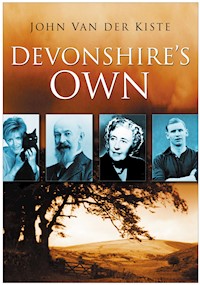
Eighth-century martyr St Boniface, tennis player and TV presenter Sue Barker, painter Sir Joshua Reynolds, scholar Sir Thomas Bodley, actor Sir Donald Sinden, Boer War commander Sir Redvers Buller, radio and TV presenter Ed Stewart and round-the-world yachtsman Sir Francis Chichester are among personalities through the ages who have been born in Devon. The county can claim many more who were either born or lived here for a major part of their lives, including Scott of the Antarctica, Agatha Christie, Parson Jack Russell (of terrier fame) and Wayne Sleep. The Elizabethan explorers Sir Francis Drake, Sir Humphrey Gilbert and Sir Walter Raleigh were all Devonians, as were party leaders Michael Foot and David Owen. This book, by renowned local author John Van der Kiste, features mini-biographies of all these and many more.
Sie lesen das E-Book in den Legimi-Apps auf:
Seitenzahl: 308
Veröffentlichungsjahr: 2007
Das E-Book (TTS) können Sie hören im Abo „Legimi Premium” in Legimi-Apps auf:
Ähnliche

DEVONSHIRE’S
OWN
JOHN VAN DER KISTE
First published in 2007 by Sutton Publishing
The History Press
The Mill, Brimscombe Port
Stroud, Gloucestershire, GL5 2QG
www.thehistorypress.co.uk
This ebook edition first published in 2013
All rights reserved
© John Van der Kiste, 2007, 2013
The right of John Van der Kiste to be identified as the Author of this work has been asserted in accordance with the Copyright, Designs and Patents Act 1988.
This ebook is copyright material and must not be copied, reproduced, transferred, distributed, leased, licensed or publicly performed or used in any way except as specifically permitted in writing by the publishers, as allowed under the terms and conditions under which it was purchased or as strictly permitted by applicable copyright law. Any unauthorised distribution or use of this text may be a direct infringement of the author’s and publisher’s rights, and those responsible may be liable in law accordingly.
EPUB ISBN 978 0 7524 9366 4
Original typesetting by The History Press
CONTENTS
Preface and Acknowledgements
Sir George Arthur
Nancy Astor
John Avery
Charles Babbage
W.N.P. Barbellion
Sabine Baring-Gould
Sue Barker
Cliff Bastin
Charles Bate
George Parker Bidder
R.D. Blackmore
Sir Thomas Bodley
St Boniface
William Browne
Sir Redvers Buller
Tony Burrows
Edward Calvert
Victor Canning
Bampfylde Moore Carew
Richard Carlile
William Benjamin Carpenter
Beatrice Chase
Sir Francis Chichester
Agatha Christie
Eleanor Coade
Bernard Coleridge
Samuel Taylor Coleridge
Robert Collier
Paul Collings
Sir Arthur Conan Doyle
Beryl Cook
Peter Cook
William Cookworthy
Richard Cosway
Hannah Cowley
William Crossing
William Knox D’Arcy
Sharron Davies
Roger Deakins
R.F. Delderfield
Sir Francis Drake
Julius Drewe
John Dunning
Sir Charles Lock Eastlake
Noel Edmonds
The Foot Family
John Ford
Thomas Fowler
Trevor Francis
John Gay
Stanley Gibbons
Sir Humphrey Gilbert
Ron Goodwin
Sir Richard Grenville
William Best Harris
Sir William Snow Harris
Sir John Hawkins
Benjamin Robert Haydon
Robert Herrick
Richard Hext
Dave Hill
Nicholas Hilliard
Richard Hooker
Leslie Hore-Belisha
W.G. Hoskins
Thomas Hudson
Ozias Humphry
H.G. Hurrell
William Jackson
Fred Karno
Rachel Kempson
Richard John King
Charles Kingsley
Charles Lawrence
William Elford Leach
Frederick Richard Lee
John ‘Babbacombe’ Lee
Robert Lenkiewicz
Thomas Newcomen & Thomas Savery
James Northcote
Dr David Owen
Elias Parish-Alvars
Richard Parker
Cora Pearl
Eden Phillpotts
Samuel Prout
George Prynne
Peter Quaife
Sir Walter Raleigh
James Rennell
Sir Joshua Reynolds
Parson Jack Russell
Sir Robert Falcon Scott
Sir Donald Sinden
Wayne Sleep
Joanna Southcott
Judi Spiers
Sir J.C. Squire
Ed Stewart
Nicholas Stone
L.A.G. Strong
Henrietta Anne Stuart
Martin Turner
Sir Thomas Tyrwhitt
Captain Frederick John Walker
Sir William White
Frederick John Widgery
Marcia Willett
Henry Williamson
William John Wills
R.N. & R.H. Worth
Picture Credits
Also by John Van der Kiste
PREFACE &ACKNOWLEDGEMENTS
To select a definitive list of ‘Devonshire’s own’ worthies would be impossible. In this book I have set out to restrict myself to famous (and occasionally infamous) men and women born in the county, and also adoptive Devonians who have left their mark on the history and public life of the county. In chronological terms, the earliest is St Boniface and the most recent Sharron Davies. Some readers will regret the exclusion of various names, particularly a few younger celebrities whom I had considered; but a line has to be drawn somewhere. All the same I have endeavoured to bring together a rich and varied tapestry of local worthies, adventurers, characters and distinguished representatives of most walks of life. Some are household names, while others may be wilfully obscure, but for all that equally worthy of a page to themselves beside the more well-known.
For reasons of space I have not added a full bibliography of works consulted, though in certain cases where a person’s memoirs have been particularly useful when writing their entries some reference is made to the title. In addition to various printed and online sources, the Oxford Dictionary of National Biography, and when available obituaries from The Times, have been useful for those now deceased. I must also acknowledge books by two of Devon’s greatest historians, both of whom deservedly have an entry to themselves in these pages; A Book of Devon (1899) and Devonshire Characters and Strange Events (1908), both by Sabine Baring-Gould; and Devon, in the ‘A New Survey of England’ series (1954), by W.G. Hoskins.
My thanks go to Judi Spiers and Marcia Willett, for supplementing the information on themselves I already had; to Rachel Philips and John Miles, for that on Noel Edmonds; to Elaine and Dr Ken Hurrell, for material relating to their father H.G. Hurrell; to the staff at Plymouth Public Libraries, and Plymouth & West Devon Record Office; to my wife Kim, and my mother Kate, both of whom have helped in suggesting names for inclusion and locating relevant material, reading through the manuscript, and making invaluable comments; to Kim, Hannah Lindsey-Clark, Nicola Sly, Gary Inns and Paul Rendell for much of the original photography; to Jan Palmer and John Collier for the loan of various rare materials; to John Bailey (Victor Canning website), Gary Carter (Wishbone Ash website); David Cornforth (Exeter Memories website), Eric John Hutton (W.N.P. Barbellion website); and Ron Shillingford, and the Trustees of the Ron Goodwin Estate, for provision of archive illustrations and information. Finally, thanks to my editors at Sutton Publishing, Simon Fletcher and Matilda Pearce, for the encouragement and for their hard work in guiding the book into print.
Sir George Arthur
Colonial Governor
George Arthur was born in Plymouth on 21 June 1784. He joined the army in 1804, fought in the Napoleonic Wars in Sicily and Italy as a junior officer, and was promoted to the rank of Lieutenant.
In December 1812 he sailed for Jamaica, where he was appointed Assistant Quartermaster-General. Two years later he was made Lieutenant-Governor of the British Honduras. During his tenure he oversaw improvements in the judicial system, took steps to reduce piracy, interceded with the Board of Trade in London to win concessions on behalf of the local timber merchants, and made efforts to stop the smuggling of foreign imports into the territory. He encouraged church building and missionary work, and attacked local slave owners for illegally importing new slaves, and for their illegal enslavement of the descendants of those brought to the settlement in 1784. This, as well as his objections to the draconian powers of elected magistrates, his attempts to stop illegal land occupancy, and a difference of opinion with another senior officer over the military command, all made him enemies. When he went home to England on sick leave in 1822 he decided not to return afterwards. Yet his work continued to a lasting legacy. His reports on the suppression of a slave revolt in Honduras were studied by William Wilberforce and others, and played a significant part in the abolition of slavery in the British Empire.
His brother had been Mayor of Plymouth in 1818 and made him a freeman of Plymouth, but he still sought another post overseas. In 1823 he was appointed Lieutenant-Governor of Van Diemen’s Land, and when he took up his post in May 1824, he made changes in the convict system by reducing the severity of punishments for more mild offenders. During his twelve years in office he improved administration, organised an efficient magistracy and police, completed many public works with convict labour, and encouraged religion and education. Once again his enlightened rule provoked opposition, mainly from officials whom he had dismissed for corrupt practices or similar misconduct.
In March 1837 he returned to England, was knighted, and in December appointed Lieutenant-Governor of Upper Canada from March 1838. Soon afterwards the territory was invaded by a band of American sympathisers, but he soon put down these and further rebellions. He restored provincial finances, improved administration, made recommendations for the better treatment of native Canadians, and helped the new Governor-General, Lord Sydenham, to achieve the union of Upper and Lower Canada. On his return to England in May 1841, he was created a Baronet in recognition of his services in Canada.
In London, he refused offers from two constituencies to return him to Parliament without expense. In May 1842 he was appointed governor of the Bombay Presidency, where he helped to keep up supplies and troops for the last stage of the Anglo-Afghan War as well as once again overseeing several administrative reforms. He also encouraged improvements in communications, irrigation, methods of salt manufacture, and local education. His tact and ability in the office helped in extending and strengthening British rule in India. In 1845 he was provisionally appointed Governor-General, but overwork resulted in a nervous breakdown, whereupon he resigned his post and returned home.
Back in England for the last time, he was made a Privy Councillor and given further military promotion in recognition of his years of service. He died after a stroke at his home in Gloucester Square, London, on 19 September 1854.
Nancy Astor
The First Woman to take her Seat in the House of Commons
Nancy Witcher Langhorne was born on 19 May 1879 in Danville, Virginia. After a brief unhappy marriage to Robert Shaw which produced one son, Bobbie, and ended in 1903, she moved to England. When asked by a society hostess whether she had come for their husbands, she retorted, ‘If only you knew the trouble I had getting rid of mine . . .’. Nevertheless in 1906 she was married again, to Waldorf Astor, born on the same day as her, and they had five children. In 1910 he became Unionist MP for Plymouth Sutton, but succeeded to his father’s peerage as 2nd Viscount Astor in 1918 and thus forfeited his seat in the House of Commons. At the resulting by-election in November 1919 she retained his seat, and sat as a Coalition Unionist (in effect Conservative), the first woman to enter the House. The first woman elected was Constance Markievicz, who as a Sinn Féin member refused to sit at Westminster.
With her well-known aversion to drink, and a tendency to say odd or outlandish things, she was not universally liked, but her wartime charity work and an ability to silence hecklers were much admired. She introduced a Private Member’s Bill restricting the purchase of alcohol to those aged eighteen or under, campaigned vigorously for women’s suffrage (they did not have the vote at twenty-one until 1928), and equal rights in the Civil Service and police force, and for more nursery schools.
She attracted attention in the House as a woman and something of a maverick, and her exchanges with Winston Churchill became legendary. ‘If you were my husband, I’d put arsenic in your coffee,’ she once allegedly told him. ‘If I were your husband, I’d drink it!’ he retorted. She got on well with other women members, regardless of party, and her close friendships outside the house included the staunch socialist and playwright George Bernard Shaw, with whom she made a controversial visit to Russia in 1931.
While openly critical of the Nazi regime, she was wholeheartedly against another world war. Several of her friends and associates, supporters of Chamberlain’s appeasement policy, were mockingly called the ‘Cliveden set’ as Cliveden, the Astors’ Berkshire home, was seen as the centre of appeasement. When war was declared she admitted she had been wrong. In 1940 she voted against Chamberlain remaining in office, and during the war she and Waldorf worked hard to raise morale in Plymouth (including dancing with sailors on the Hoe), where Waldorf was mayor for five years, and where their house was badly bombed in the blitz. Yet she became a liability to her party as her anti-Catholic and anti-Communist prejudices hardened, until even friends and allies lost patience with her.
Waldorf warned her she would be heavily defeated if she contested the 1945 general election, and he told her local association she was standing down. She resented his intervention, and for a while they were virtually estranged, though she proved forgiving as his health declined; he died in 1952. She found it hard to adjust to being out of the limelight after so many years, and became increasingly lonely. In 1959 she was given the Freedom of the City of Plymouth. In March 1964 her son Bobbie attempted suicide; she was told that he had had a stroke, but it was the final blow. A few weeks later she too had a stroke and died on 2 May 1964.
Her youngest son, John Jacob, represented her old seat, Plymouth Sutton, from 1951 to 1959; of her other sons, William and Michael were also Conservative Members of Parliament for a time.
John Avery
The Pirate King
John Avery was born in Plymouth between 1653 and 1659, and baptised on 23 August 1659 at Newton Ferrers. His father had served in the Royal Navy but died when John was young. Much of his life is shrouded in mystery, due partly to his several aliases, among them Henry Avery or Every, Long Ben, and Benjamin Bridgeman. Rumour has it that his mother was the landlady of a public house, The Sign of the Defiance, and one night she refused to admit a drunken party of sailors. They took revenge by kidnapping her son, and taking him on board ship with them to the Americas, but he found his way back to Plymouth.
As a young man he served on various Royal Navy ships, but the outlaw life appealed more than the prospect of a virtuous life and promotion in the service. In 1693 he joined a privateering expedition as first mate of the Charles, one of four armed merchant ships which set off from London to salvage Spanish treasure ships in the West Indies. They were delayed for some months in Corunna, and failure to pay the seamen’s wages provoked a mutiny. In May 1694 Avery and sixty-five men seized the Charles while her captain was laid low with fever, put the captain and sixteen men ashore, renamed the ship Fancy, and set sail for the Indian Ocean. Avery was unanimously elected captain of the ship.
In September 1695 he led his men in an attack on Ganj-i-Sawai, a treasure ship of Aurangzeb, Mogul Emperor of India. The Indian ship lost its mainmast, and a cannon exploded on deck, thus depriving the crew of putting up any effective resistance. Avery’s men showed no mercy to the crew and passengers, many of whom were butchered or committed suicide, and they plundered it of huge quantities of gold, silver and jewellery. As the ship had been accompanying a pilgrim fleet returning from Mecca, the attack was regarded by the Indians as sacrilege, and much ill-feeling towards the East India Company was the result. After buying protection from Nicholas Trott, governor of the Bahamas, Avery sailed to Jamaica and tried to buy another pardon from governor William Beeston for £24,000 but without success. They then returned to the Bahamas, but the weary crew drove the ship ashore and most of them left, many of them going to America.
He gathered some sloops and the remaining crew to return to England, but six of the crew were caught and, after a trial at the Old Bailey in October 1696, five were hanged. What happened to Avery is uncertain, though it is thought he went to Ireland, then sailed to Plymouth and reached Bideford on foot. By then he was destitute, possibly after being cheated of his spoils by Bristol merchants, and after falling ill died in or about 1697. There were reports that he was later seen in Scotland, Wales or Ireland, and that though penniless he had offered to pay off the English national debt in exchange for a full pardon. He had the distinction of being one of the few major pirate captains to retire with his loot and without being arrested or dying in battle.
Charles Babbage
Mathematician and Scientist
Charles Babbage was born in London on 26 December 1791. His father Benjamin was a banking partner of the Praeds who owned the Bitton estate in Teignmouth. In 1808 the family moved to East Teignmouth, and his father became a warden of St Michael’s Church. Charles briefly attended King Edward VI Grammar School, Totnes, but he was often ill during childhood, and because of his poor health he was usually taught at home by private tutors. From boyhood he loved mathematics, and when he entered Trinity College, Cambridge in 1810, he found himself far better-informed on the subject than his tutors. Elected a Fellow of the Royal Society in 1816, he played a major part in the foundation of the Astronomical Society in 1820 and the Statistical Society in 1834.
In 1824 he won the gold medal of the Royal Astronomical Society ‘for inventing an engine for calculating mathematical and astronomical tables’. From 1828 to 1839 he was Lucasian Professor of Mathematics at Cambridge, and contributed to several scientific periodicals. During a brief political career he unsuccessfully contested the two-member seat of Finsbury as a Liberal candidate in the 1832 general election and in a by-election two years later. In July 1814 he had married Georgiana Whitmore at St Michael’s Church, Teignmouth, despite his father’s disapproval, and they settled in London. His personal life was far from happy, and marked by frequent bereavements; only three of their seven children survived to adulthood, and his father, wife and one son all died in 1827. Grief at the loss of his relatives probably spurred him on to find solace in his work.
Since his college days he had been interested in calculating machinery, and this developed into a lifelong interest. His first such invention, begun in 1822, was his difference engine, to compile mathematical tables. Thirty years later he began working on a better machine that could perform any kind of calculation, the analytical engine, which was intended as a general symbol manipulator, and had several characteristics of today’s computers.
Neither of these devices was ever completed, mainly because of financial problems; though his work was formally recognised by respected scientific institutions, the government suspended funding for his difference engine in 1832, and cancelled it in 1842. Little remains of them, partly as critical tolerances required by his machines exceeded the level of technology available at the time; only fragments of the prototype difference engine still exist, and though he devoted much time and money towards constructing his analytical engine after 1856, he never succeeded in completing any of his several designs to finish it.
Despite his achievements and the pioneering work which assured him a place in posterity as one of the godfathers of computing, his failure to complete his various machines, and in particular the reluctance of his government to support his work, left him a disappointed and embittered man. He died at his London home on 18 October 1871. A building at the University of Plymouth (pictured) is named after him.
W.N.P. Barbellion (Bruce Cummings)
Naturalist and Diarist
Bruce Frederick Cummings was born at Barnstaple on 7 September 1889, youngest children of John Cummings, a columnist on the Devon and Exeter Daily Gazette and manager of the paper’s Barnstaple office at 14 Cross Street (the family home and Bruce’s birthplace). He left school at seventeen and was offered a post at the Plymouth Laboratory of the Marine Biological Association of the United Kingdom, but could not take it up as his father suffered a stroke and died shortly afterwards. Instead he became an apprentice journalist on the Devon and Exeter Gazette. From boyhood he had been fascinated by natural history, and in 1912 he began working in the ‘insect room’, later the Department of Entomology, at the Natural History Museum, South Kensington. This involved much research and curatorial responsibility, for which he had no formal qualifications but much enthusiasm. When the War Office needed information on the effects and behaviour of lice in order to ameliorate conditions endured by soldiers in the trenches during the First World War he was asked to lead the research, a task which both fascinated and disgusted him.
In September 1915 he married Winifred Eleanor Benger, a fashion designer. Around this time, under pressure from the Museum authorities he attended an army recruiting office, though aware that he was totally unfit. His doctor had already handed him a sealed confidential letter to give the medical officer, and he was rejected after a perfunctory examination. On his way home he opened the letter, and read with horror that he had been diagnosed with disseminated sclerosis. His wife and family, he learned a year later, had already been told. By June 1917 he could no longer work, and resigned from the Museum.
Since he was thirteen he had kept a diary, at first just for scientific observations, but a more literary, personal style became evident. Now his entries became more intense and brooding. He prepared extracts for publication under the title The Journal of a Disappointed Man. To protect the identity of family and friends he chose the pseudonym W.N.P. Barbellion, the initials standing for Wilhelm, Nero and Pilate, ‘the world’s three greatest failures’.
It was published on 31 March 1919. An editor’s note said that the author died on 31 December 1917, and an introduction was contributed by H.G. Wells, leading to a suspicion that he was the author under another name. Wells organised a trust fund for Cummings, his wife and daughter, born in October 1916. Soon the book was regarded as a classic comparable to the writings of Kafka and Joyce. One of the last entries ran: ‘I am only twenty-eight, but I have telescoped into those few years a tolerably long life: I have loved and married, and have a family; I have wept and enjoyed, struggled and overcome, and when the hour comes I shall be content to die.’
A book of essays, Enjoying Life and other Literary Remains, appeared later that year, and A Last Diary, including entries from March 1918 to June 1919, was published in 1920. He never saw either, having died at his home, Camden Cottage, Gerrards Cross, on 22 October 1919.
Sabine Baring-Gould
Author and Folksong Collector
Sabine Baring-Gould was born at Dix’s Field, Exeter on 28 January 1834, eldest child of a former captain in the armed forces of the East India Company whose family owned the Lewtrenchard Estate near Lydford. He spent much of his childhood abroad, partly as he suffered from the effects of whooping-cough and the doctors recommended a warmer climate, and partly as his father found England dull. He read constantly, became an accomplished linguist and developed an interest in history and archaeology. After returning home he studied classics at Cambridge, then taught at St Barnabas Choir School, Pimlico, Lancing and Hurstpierpoint College, where it was said he did so with a pet bat on his shoulder.
After taking Holy Orders in 1864 he became a curate in Horbury, Yorkshire, where he met Grace Taylor, an illiterate mill girl of sixteen. He provided for her education and married her in 1868, a liaison said to have inspired George Bernard Shaw’s Pygmalion. They were married for forty-eight years until her death in 1916 and had fifteen children. At one children’s party he asked a youngster, ‘And whose little girl are you?’ The child burst into tears, saying ‘I’m yours, Daddy’.
He wrote the words to ‘Onward Christian Soldiers’ at Hurstpierpoint, when he needed something suitable for the children to sing in a school procession. His other hymns included ‘On the Resurrection Morning’, written in December 1863 on his mother’s death, ‘Through the night of doubt and sorrow’, and ‘Now the day is over’.
By the time he returned to Lewtrenchard Manor in 1881 as squire and parson, he had become a prolific output of books, pamphlets and magazine articles. At one time he had more titles listed under his name in the British Museum Library than any other English writer. He wrote novels, the best-received being Mehalah (1880), The Roar of the Sea (1892), short stories, poems and non-fiction, including a sixteen-volume Lives of the Saints (1872–7), Book of Were-Wolves (1865) Curious Myths of the Middle Ages (1866), Origin and Development of Religious Belief (1870), a biography, The Vicar of Morwenstow (1876), and Devonshire Characters and Strange Events (1908).
He spent several years travelling around Devon and Cornwall collecting folk songs, visiting singers, with assistants to take down the melodies while he noted down the words. The result, Songs of the West, was the first collection published for the mass market. Though he had to modify the words of some songs deemed too rude for the age, he left his original manuscripts for future students of folk song, preserving much music and lyrics, notably those to Widecombe Fair, which otherwise might have been lost. Further collections followed, A Garland of Country Songs, a second edition of Songs of the West and English Folk Songs for Schools, on which he collaborated with folk song collector Cecil Sharp.
A founder member of the Dartmoor Exploration Committee in 1894, he also belonged to the Devonshire Association and was president in 1895. He died at Lewtrenchard on 2 January 1924. The family home has been preserved largely as he rebuilt it and is now a hotel.
Sue Barker
Tennis Player and Broadcaster
Sue Barker was born in Paignton on 19 April 1956. At convent school at the age of ten, she was one of two girls spotted by tennis coach Arthur Roberts as having potential. Everyone was terrified of him, she would say later. ‘My parents weren’t allowed to watch me practise, and he would brook no interference whatever.’ Within a few years, he knew she was good enough to play in European tournaments and he provided her with a one-way ticket, telling her she would have to earn the fare home. In 1973 he urged her to settle in America as the best way to improve her sporting prowess.
Later that year she won the women’s singles title at the French Open and reached a career-high singles ranking of World No. 3. In 1974 she followed this up with three further titles, making a breakthrough at a Grand Slam tournament in 1975 at the Australian Open, where she reached the semi-finals. Her forehand was her strongest weapon, considered by many to be the most powerful on the women’s tour at the time. The next year she won the French Open. In 1977 she won three singles titles, reached the semi-finals at both Wimbledon and the Australian Open, and reached the Virginia Slims Tour Championships final, which she lost.
Injuries hampered her career in 1978, and her ranking dropped to World No. 24, but she returned to form again in 1979, winning four singles titles and reaching five other finals and being granted the accolade ‘Comeback Player of the Year’ by her fellow professionals. She reached two finals in 1980 and won the last singles title of her career at Brighton in 1981, finishing the year ranked No 16. The next year she won her last doubles title in 1982 at Cincinnati (indoor), and played her last professional match in 1984.
Recurring injuries and gradual loss of form took their toll, and she retired in 1985. Three years later she married Lance Tankard, a former detective sergeant in the Metropolitan Police turned landscape gardener. Like many a sporting champion before her, she turned to broadcasting as a new career. At first she became a commentator and sports reporter for Australia’s Channel 7 later that year, and in 1990 went on to anchor tennis coverage for British Sky Broadcasting. In 1993 she joined the Wimbledon coverage on the BBC, anchoring the two-week long broadcast each year for the network. She gradually became one of the chief BBC sports presenters on Grandstand, the Olympics coverage, and host of A Question Of Sport. At the same time she appeared on other programmes, including Children in Need, and a documentary on the gardens at Althorp in which she interviewed Earl Spencer. In 2000 she was awarded the MBE.
Four years later she was given police protection after receiving death threats, warning her she would be ‘the next Jill Dando’. It was a particularly distressing experience as Dando, a regular television presenter herself and close friend, had been murdered in 1999. In April 2005 Barry Tullett was tried, found guilty of sending offensive and threatening messages, and sentenced to six months’ imprisonment.
Cliff Bastin
Footballer
Clifford Sydney Bastin was born in New North Road, Heavitree, near Exeter, on 14 March 1912. As a boy of thirteen at Ladysmith School he was in the team when they won the Football Express Elementary Schools Challenge Cup. On leaving school he joined Exeter City and at the age of sixteen played his first game for them in April 1928, a 0-0 draw against Coventry City. He went on to score twice on his home debut when they beat Newport County 5-1.
While with Exeter City he played 17 games in all and scored six goals, being spotted by Arsenal manager Herbert Chapman during a match against Watford. He was so impressed by Bastin’s performance that he signed him at the end of the season, and he joined in April 1929 for £2,000. During his eighteen years with Arsenal he scored 178 goals in 395 games, becoming Arsenal’s all-time top goal scorer until the record was broken in 1997; his other achievements included 150 League goals and 26 FA Cup goals, and he was part of an Arsenal FA Cup winning side in 1930 and 1936. He was part of the Arsenal team that won the League three times in the 1930s. His debut for England was in 1931 and he went on to be capped 21 times, scoring twelve goals, before finishing his international career in 1938. That was the year in which, in May, he played in the notorious friendly against Germany when the players had to give the Nazi salute prior to the game.
His form declined after a bout of influenza led to an infection of the middle ear in 1936 and increasing deafness, and within a few years he could barely hear the roar of the crowd. While admitting that this loss of hearing had undermined his sporting prowess, and despite a leg injury sustained during the 1938/9 season, he still played 241 wartime games in the league which was formed to raise civilian morale, scoring 70 goals.
As his loss of hearing made him unfit for military service, his main occupation during the Second World War was manning an ARP post on top of the main stand at the Highbury Stadium. He also appeared briefly (as a footballer) in two films, The Arsenal Stadium Mystery (1940), in which the last game at Highbury before the outbreak of war was used for filming shots of the game, and One of our Aircraft is Missing (1942). Despite being excused war service, a propaganda broadcast by Fascist Italy on Rome Radio in 1941 claimed that he had been captured in the battle for Crete and was being detained as a prisoner of war in Italy.
After the war was over, he played six more games for Arsenal before he retired in January 1947 and returned to Exeter. Soon afterwards budding sports journalist and lifelong Arsenal fan Brian Glanville, then aged nineteen, collaborated with him in writing Bastin’s memoirs. For a while he and his wife ran a café in Exeter, then he took over the Horse and Groom in Heavitree, retiring in 1977, and spent his last years at Whipton, where he died on 4 December 1991. A stand at St James’ Park, Exeter, was named in his honour.
Charles Bate
Dental Surgeon and Zoologist
Charles Spence Bate was born on 16 March 1819 at Trenick House, St Clement, near Truro, eldest son of Charles Bate, who had a dental practice in Truro. After attending Truro grammar school he trained in dentistry under his father, and then went on to establish his own practice at Swansea in 1841.
In 1851 he and his family moved to Mulgrave Place, Lockyer Street, Plymouth, where he took over his father’s dental practice and soon established himself as the leading dentist outside London, receiving the licence in dental surgery of the Royal College of Surgeons in 1860. Elected a member of the Odontological Society in 1856, he was Vice-President from 1860 to 1862, later becoming the first provincial dentist to fill the office of President. In 1879 he founded the Western Counties Dental Association and was elected its first president. In 1883 he was President of the British Dental Association, and in July that year he gave an address at the Association’s third annual meeting in Plymouth, where he presented a review of the scientific progress of dental surgery in Britain from 1771 to 1883. He also contributed papers on dentistry to the British Journal of Dental Science, the Transactions of the Odontological Society, and the Medical Gazette. His Pathology of Dental Caries was published in 1864. When the British Association visited Swansea in 1848 he became a member of the society, and at the 1869 meeting in Exeter he was Vice-President of the biological section.
He was also well known for his zoological expertise. Elected a member of the Plymouth Institution in 1852, he was secretary from 1854 to 1860, and president in 1861–2 and 1869–70. He was a curator of the museum and the editor of the Society Transactions from 1869 to 1883, and often gave lectures to members. A founder of the Devonshire Association, and senior general secretary in 1862 and president in 1863, he contributed many papers to its Transactions, especially on the antiquities of Dartmoor, and on Roman remains discovered in the area.
He was elected Fellow of the Linnean Society in 1854, contributed to the second volume of the society’s Proceedings, and to the third volume (zoology) of the journal. In June 1861 he was elected a fellow of the Royal Society. After examining specimens at the Jardin des Plantes in Paris, at the Royal College of Surgeons, and in many private collections, he compiled a catalogue of specimens of amphipodous Crustacea in the collection at the British Museum collection (1862). He knew several scientists of the day, including the zoologist the Revd George Gordon, and naturalists Charles Darwin and Thomas Edward; with the latter he compiled A History of the British Sessile-Eyed Crustacea in two volumes (1863–8).
He married Emily Amelia Hele in 1847; she died in 1884 and he married his second wife, Eugenie Payne in 1887, around the time he retired from his dental practice. It was at his second home at South Brent that he died from cancer on 29 July 1889, and he was buried in Ford Park Cemetery, Plymouth.
George Parker Bidder
‘The Calculating Boy’
George Parker Bidder was born on 13 June 1806 at Moretonhampstead, the son of William Bidder, a stonemason. As a small boy he showed a remarkable talent for mental arithmetic and doing complicated sums in his head. When he was about seven years old, his father took him to local fairs and then around the country where ‘The Calculating Boy’ could earn money as a performing act by showing off his mathematical skills. It was no mean feat for anybody, let alone a child, to be asked to calculate the square root of 119,550,669,121 and give the correct answer of 345,761 in thirty seconds. He made such appearances at Brighton, Cheltenham, Tewkesbury, Dudley, Worcester, Birmingham, Oxford, Cambridge, Norwich, Great Yarmouth, and London.
In the course of his tours he was presented to Queen Charlotte, who was similarly impressed by his numerical skills. He came to the notice of many others, including the astronomers Sir William and John Herschel, who paid for him to attend a grammar school in Camberwell in 1816, but his father took him away after a few months to continue his personal appearances. Later he received private tuition, and in 1820 he went to Edinburgh University, paid for by a subscription among members of the Royal Society and others. In 1824 he became a trainee in the Ordnance Survey, but left the following year to work for the London Dock Company, the start of a successful career as a civil engineer. He became a friend of Robert Stephenson, who he had met at Edinburgh University, and contributed to the planning and construction of the railways including the London & Birmingham Railway. From 1832 to 1834 he was resident engineer on Brunswick Wharf, East India Dock, and introduced many innovations connected with drainage, tidal effects, and hydraulic lifts for ships.




