


Erhalten Sie Zugang zu diesem und mehr als 300000 Büchern ab EUR 5,99 monatlich.
- Herausgeber: The History Press
- Kategorie: Sachliteratur, Reportagen, Biografien
- Sprache: Englisch
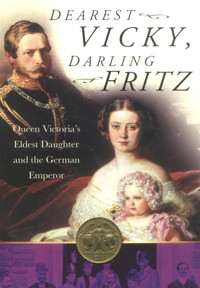
This work tells the love story of the royal couple against the changing background of 19th-century Germany. It looks at the differing political sympathies of the couple, revealed through letters, and re-examines the prevailing view that the domineering Vicky never bothered to conceal her distaste for everything Prussian and flaunting her sense of British superiority. In many ways ahead of her time, she was something of a pioneer feminist, refusing to accept the oft-accepted maxim that women were second-class citizens. Insufficient consideration has been given to her health and the possibility that her judgement and reason may sometimes have been affected, albeit mildly, by the family's inheritance of porphyria that led to the 'madness' of her great-grandfather George III.
Sie lesen das E-Book in den Legimi-Apps auf:
Seitenzahl: 536
Veröffentlichungsjahr: 2002
Das E-Book (TTS) können Sie hören im Abo „Legimi Premium” in Legimi-Apps auf:
Ähnliche



DEAREST VICKY, DARLING FRITZ
The Tragic Love Story of Queen Victoria’s Eldest Daughter and the German Emperor
JOHN VANDER KISTE
First published in 2001
The History Press
The Mill, Brimscombe Port
Stroud, Gloucestershire, GL5 2QG
www.thehistorypress.co.uk
This ebook edition first published in 2013
All rights reserved
© John Van der Kiste, 2001, 2013
The right of John Van der Kiste to be identified as the Author of this work has been asserted in accordance with the Copyrights, Designs and Patents Act 1988.
This ebook is copyright material and must not be copied, reproduced, transferred, distributed, leased, licensed or publicly performed or used in any way except as specifically permitted in writing by the publishers, as allowed under the terms and conditions under which it was purchased or as strictly permitted by applicable copyright law. Any unauthorised distribution or use of this text may be a direct infringement of the author’s and publisher’s rights, and those responsible may be liable in law accordingly.
EPUBISBN 978 0 7524 9926 0
Original typesetting by The History Press
Contents
Sources and Acknowledgements
Genealogical Tables
Introduction
ONE
‘She seemed almost too perfect’
TWO
‘Two young, innocent things’
THREE
‘You belong to your country’
FOUR
‘Youth is hasty with words’
FIVE
‘An era of reaction will ensue’
SIX
‘Malice is rampant’
SEVEN
‘He complains about his wasted life’
EIGHT
‘The fear of what might happen’
NINE
‘A mere passing shadow’
TEN
‘My life is left a blank’
Notes
Bibliography
Sources and Acknowledgements
Vicky has attracted several biographers, from the anonymous writer (believed to be Marie Belloc Lowndes) of the authoritative The Empress Frederick: a Memoir (1913), her friend Princess Catherine Radziwill (1934), and a rather emotional, unsympathetic account by E.E.P. Tisdall (1940), to more recent studies by Richard Barkeley (1956), Egon Conte Caesar Corti (1957), Daphne Bennett (1971), Andrew Sinclair (1981) and Hannah Pakula (1996).
Fritz has fared less well. Within three years there were two biographies, a short volume by Rennell Rodd (1888) and a more extensive one by Lucy Taylor (1891). Apart from a few titles published only in Germany, there were no works in English between a one-volume English translation of Margaretha von Poschinger’s three-volume life edited by Sidney Whitman (1901) and one by the present author (1981). A more recent study by Patricia Kollander (1995), a political rather than personal life, has necessitated a re-evaluation of his liberal principles, which in her view have been rather exaggerated. To these may be added a dual biography of both published during their lifetime, by Dorothea Roberts (1887), which is naturally incomplete but still useful within its limitations.
These have been supplemented by a valuable series of correspondence and diaries. The Empress’s letters to and from Queen Victoria have been edited successively by Roger Fulford and Agatha Ramm in six volumes, supplementing two earlier works, the controversial, largely political Letters of the Empress Frederick, edited by her godson Sir Frederick Ponsonby (1928) and the more personal The Empress Frederick writes to Sophie, edited by Arthur Gould Lee (1955). Selections from the Emperor’s diaries have been published in English translation, notably his ‘war diary’ kept during the Franco-Prussian campaign, and those describing his travels to the east and to Spain.
I wish to acknowledge the gracious permission of Her Majesty The Queen to publish certain letters of which she owns the copyright, and others which are held in the Royal Archives, Windsor. For permission to publish the latter I wish to acknowledge the gracious permission of Prince Moritz, Landgraf von Hessen, as representative of the owners of copyright in the Empress Frederick’s letters. I am also indebted to the India Office Library, British Museum, for permission to publish extracts from correspondence between the Emperor, Empress, and Count Seckendorff with Baron Napier of Magdala.
I am grateful to the following publishers for permission to quote from printed sources: Cambridge University Press (Young Wilhelm, by John Röhl, © 1998; The Holstein Papers, edited by Norman Rich & M.H. Fisher, © 1955–63); Cassell Ltd (The English Empress, Conte Egon Caesar Corti, © 1957); and Greenwood Press (Frederick III, Germany’s liberal Emperor, by Patricia Kollander, © 1995).
As ever I am eternally grateful to various friends for their moral support, advice and loan of various materials while writing this book, especially Karen Roth, Sue Woolmans, Theo Aronson, Dale Headington, and Robin Piguet; to the staff of Kensington and Chelsea Public Libraries, for ready access to their reserve collection; to my editors, Jaqueline Mitchell and Paul Ingrams. Last but not least, my mother, Kate Van der Kiste, has as always been a tower of strength in discussions on the subject and in reading through the draft manuscript.
THE HOUSEOF HOHENZOLLERN
THE HOUSEOF SAXE-COBURG GOTHA
Introduction
On 25 January 1858 ‘Vicky’, Princess Royal, eldest daughter of Queen Victoria and Albert, Prince Consort, of England married ‘Fritz’, Prince Friedrich Wilhelm, second in succession to the throne of Prussia. London sparkled with illuminations in her public buildings and firework displays in her grand parks. The festivities spread far beyond the centre of the capital as the whole nation went en fête for ‘England’s Daughter’ and her husband, with gifts and public dinners for the needy in cities up and down the country.
Having made their responses ‘very plainly’, in Queen Victoria’s words, at the altar in the chapel of St James’s, Vicky and Fritz walked hand in hand to the vestry to join the rest of the family for the signing of the marriage register, full of confidence and beaming at the assembled guests. Before the wedding breakfast they stepped out on to the balcony at Buckingham Palace, to be cheered by the crowds in Pall Mall who had braved the winter cold for a glimpse of the Royal couple. They may have been overwhelmed by this reception, conscious of the fact that they were carrying the hopes of a generation; but they were deliriously happy nonetheless. When bride and groom reached Windsor later that day they were met by yet more fireworks, a guard of honour, and a crowd of boys from Eton College who pulled their carriage from the railway station uphill to the castle. It was a heady start to one of the great love matches of its time.
Historians and biographers have never doubted that it was, in personal terms, an extremely successful marriage. Thirteen years later, a political union was achieved; but it was neither the united constitutional or liberal power that they and their elders had envisaged. Within less than five years of the wedding, two events occurred which were to shake the destiny of the young couple to its very core: firstly, the unexpected death of their mentor, Vicky’s father, Prince Albert; and secondly, the appointment of Count Otto von Bismarck as Minister-President of Prussia. Ultimately, Vicky and Fritz were to be eclipsed by the ambitions of their eldest son, Wilhelm, and by the eventual failure of the hoped-for alliance which would later disintegrate into the carnage and confusion of the First World War.
Personal factors apart, the marriage had begun with high hopes. It was a truly grand dynastic alliance between the Hohenzollerns of Prussia and Queen Victoria’s family of Saxe-Coburg and Gotha, later the House of Windsor, intended to bring to fruition the vision of Prince Albert and his mentors, King Leopold of the Belgians and Baron Christian von Stockmar, of a united, liberal and constitutional Germany. This was to be led by Prussia, with King Friedrich Wilhelm and his consort, a ‘second’ Queen Victoria, at the helm. At the same time as it was intended to fulfil this high-minded ambition, however, theirs was undeniably a genuine love match. For, in the annals of nineteenth century history, Vicky and Fritz were almost uniquely well-suited. She was a charming, bubbly, naïve child of seventeen; he a handsome, chivalrous, yet somewhat withdrawn and self-effacing young man of twenty-six. They had been besotted with one another since their betrothal a little over two years before, and were to remain passionately in love for thirty more years.
Most royal matrimonial unions of the age were marriages of convenience for which the parents, usually in consultation with their senior ministers and ambassadors at court, arranged betrothals between more-or-less eligible parties for reasons of state, sometimes when the princes and princesses concerned were little more than children. Certainly, they may never even have met. If such a marriage turned out to be a personal success, as it did in the case of King William IV and the much younger Queen Adelaide of England, all well and good. In many cases, for example that of Fritz’s ill-matched parents, Wilhelm and Augusta, husband and wife were totally incompatible and remained thus for almost sixty years during which they lived more happily apart.
Sadly, Vicky and Fritz’s eldest son and heir Willy, later Kaiser Wilhelm II, did not personify the peaceful or liberal instincts of his parents, but came under the darker influence of his own ‘mentor’, the nationalist hard-liner, Bismarck. It was one of the tragedies of modern history that this enlightened couple were denied the chance to play the role for which they had been so well prepared, of helping to create the political climate for a more liberal united Germany, which would take its place as one of the leading nations of Europe in an era of unprecedented peace and stability.
On 25 January 1858, it had all seemed so well within their grasp. But, by the time Fritz ascended the throne a little over thirty years later as Emperor, he was already mortally ill. Ironically, the man who had struggled all his life to find a voice in the affairs of his nation died voiceless, robbed of speech by cancer of the larynx. His reign lasted a mere three months, whereupon such political importance as his wife ever possessed ceased abruptly; and, for her remaining thirteen years, she was reluctantly tolerated and often abused by a son under whose rule she found no political satisfaction and only a degree of personal contentment.
Was Vicky a courageous, grossly maligned woman determined to do the best for her adopted Prussia – and later Germany – without regard to the personal consequences for herself; or was she the tactless, domineering Englishwoman, a pampered Princess who remained a slavish disciple of her long-dead father, refusing to accept that there was any other way than the English one? Was Fritz an enlightened Prince who realized that the political mood in Germany was changing, and that the royal house had to change with it; or was he a dreamy, weak-willed depressive who allowed his wife to dominate him? As The Times of London had noted presciently when discussing their betrothal back in 1855, these two complex, ultimately tragic characters surely deserved ‘a better fate’.
ONE
‘She seemed almost too perfect’
On 18 October 1831, Prince Friedrich Wilhelm Niklaus Karl of Prussia was born at the Neue Palais, Potsdam, the first child and only son of Prince Wilhelm and Princess Augusta. Within the family he was always known as Fritz, and more formally as Prince Friedrich, until the age of eight. At his birth he was third in succession to the throne.
Prince Wilhelm, second son of Crown Prince Friedrich Wilhelm and his wife, the former Princess Louise of Mecklenburg-Strelitz, was born on 22 March 1797. Almost eight months later, on 16 November, his grandfather King Friedrich Wilhelm II died after a reign of eleven years. According to his great-great-grandson, the last King of Prussia and German Emperor, he had been ‘indolent, good-humoured, vain, a server of women, incapable of wide vision and lofty flights of mind’.1 The Crown Prince succeeded him as King Friedrich Wilhelm III and reigned for forty-two years.
As the marriage of the King’s eldest son and namesake to Elizabeth of Bavaria was childless, it was Wilhelm’s responsibility to marry and produce an heir. Much to the misfortune of all involved, the only woman whom he ever really loved was Elise Radziwill, a member of the Polish nobility who were considered inferior in rank to the Hohenzollerns of Prussia. He wished to marry her, and in order to facilitate betrothal it was suggested that his brother-in-law, Tsar Nicholas I of Russia, who had married his sister Charlotte, should be asked to adopt Elise as his daughter. Nothing came of this, or of a scheme for one of the other Hohenzollern princes to do likewise. In his heart no princess could ever take the place of his beloved Elise, who died in 1834 of consumption, or a broken heart, as contemporary gossips would have it. All the same, he was ordered to look to the other reigning families of Germany for a more eligible bride.
On 11 June 1829 he married Augusta of Saxe-Weimar Eisenach, one of the most politically advanced states in the German Confederation. She deserved better than this dour, reactionary Prussian soldier prince, who was fourteen years her senior. A vivacious young woman in whom her tutor the poet Goethe had inculcated a keen appreciation of literature, she was a free-thinker with liberal sympathies and a sense of religious toleration at odds with the bigotry, anti-Semitism, anti-Catholicism and generally narrow outlook of the philistine Berlin court. Many a true word is spoken in jest, and her brother-in-law Crown Prince Friedrich Wilhelm said it all when he commented wryly that if he and his brothers had been born sons of a petty official he would have become an architect, Wilhelm a sergeant-major, Karl would have gone to prison, and Albrecht would have been a ne’er-do-well.2
In nearly sixty years of marriage Wilhelm and Augusta would eventually develop a grudging mutual respect, but they were happier under separate roofs. It did not take her long to find he was seeking his pleasures elsewhere, and she naïvely appealed to her father-inlaw who told her patronizingly that if she expected a model of virtue in her husband, she should not have married a Hohenzollern.3 This loveless union turned her into a disagreeable woman with what Catherine Radziwill, Elise’s distant relative, called ‘an almost insane need of flattery’, noting that ‘only those who told her that she was perfection itself ever obtained her favour or enjoyed her confidence.’4 Nevertheless conjugal relations had to be maintained long enough for husband and wife to do their duty to the state, and two years after the wedding Fritz was born. Seven years later, with the birth of a daughter Louise on 3 December 1838, the family was complete.
Wilhelm was an unimaginative, remote father who took little interest in his son. Fritz was brought up by nurses and governesses until he was seven, when Colonel von Unruh, his father’s aide-decamp, was appointed his military governor while Friedrich Godet, a Swiss theologian, and Dr Ernst Curtius, a professor of classics, became his tutors. Learning was considered less important than introducing the boy to military routine, which included drill, the study of artillery, and practical aspects such as shoeing, harnessing, grooming cavalry horses, and cleaning their tack. His father insisted that he should grow up to be a good soldier, turning out punctually and smartly on parade regardless of the weather. One wet day a palace servant watched him on his exercises while soaked to the skin, and dashed out to the parade ground with an umbrella to hold over him. The little prince refused to take advantage of such shelter, asking the well-intentioned man indignantly if he had ‘ever seen a Prussian helmet under a thing like that?’5
Off the parade ground, Godet and Curtius supervised his learning languages, music, dancing, gymnastics, book-binding, carpentry, and the rudiments of typesetting, and when he was twelve the proprietor of a Berlin printing firm presented him with a small hand-printing press. Though he neither liked nor understood mathematics and science he acquired a taste for reading, and spent much of his spare time in the royal library. As a boy he rarely attended the theatre or concert hall. His father declared that music gave him a headache, and he once walked out of a Wagner opera to go on manoeuvres.
On 7 June 1840 King Friedrich Wilhelm III died. His eldest son, now King Friedrich Wilhelm IV, a bald, ugly man with a high-pitched voice and a taste for the bottle, was a contradictory character who wanted to be remembered as a progressive monarch. His accession was marked with an amnesty for political prisoners, concessions to the Roman Catholic church, and a relaxation in press censorship. He enjoyed planning and building castles in mock-Renaissance style, and he was one of the few Hohenzollerns who really appreciated the fine arts. Nonetheless his horror of the French revolution had given him an almost medieval view of his position, and the idea of becoming a constitutional monarch in the British sense was anathema to him. Politically he was a reactionary at heart, agreeing with his contemporaries that only soldiers were any help against democrats. His brother Wilhelm, now heir apparent, was styled Prince of Prussia, and at the age of eight Fritz, henceforth known formally as Prince Friedrich Wilhelm, became heir presumptive.
Three days after the accession of King Friedrich Wilhelm IV, Queen Victoria and Prince Albert of England were leaving Buckingham Palace for a drive up Constitution Hill in an open carriage, when a youth fired his pistol at them and narrowly missed. Thankfully they were unhurt, for the Queen was some three months pregnant with her first child. On 21 November she went into labour, and when the doctor announced almost apologetically that the baby was a princess, she answered defiantly that ‘the next will be a Prince’.6 Referred to as ‘the child’ until her christening in February 1841, the infant was named Victoria Adelaide Mary Louisa, and styled Princess Royal as the sovereign’s eldest daughter. Called Puss or Pussy at first by her parents, she later became Vicky and remained thus en famille for the rest of her life.
Prince Albert was delighted with her winning ways and agile mind, and she always remained his favourite child. The Queen’s elder halfsister Feodora of Hohenlohe-Langenburg also idolised her. On a visit to their uncle King Leopold of the Belgians and his family at Brussels, she could not help comparing three-year-old Vicky favourably with her second cousin and contemporary, Charlotte, who was a few months older and ‘a great beauty but I must say that she does not outshine dear Puss in my eyes, she may be more beautiful, but she has not that vivacity and animation in her countenance and manners which make her so irresistible in my eyes, she is a treasure!’7
The proud father never appreciated that the constant praise he gave and the self-confidence which he was at pains to inculcate in Vicky, added to the opportunities he took of showing her off to relations, nursemaids and courtiers, risked creating in her a sense of superiority and the belief that she was never wrong. Queen Victoria, who was not particularly maternal by nature and always ready to criticize her offspring, had earlier made a subconscious effort to counteract this unalloyed adulation when writing to King Leopold of their eldest child, who at little more than a year of age was ‘quite a dear little companion’, but ‘sadly backward’. The woman soon to be appointed senior governess, Sarah, Baroness Lyttelton, might find her young charge mischievous and liable to answer back, but never backward. Even before her seventh birthday, she noted, the Princess ‘might pass (if not seen, but only overheard) for a lady of seventeen in whichever of her three languages she chose to entertain the company’.8
From an early age she learnt French verses by heart and enjoyed working them into normal conversation. When she was three, Queen Victoria wrote to King Leopold of ‘our fat Vic or Pussette’ learning lines by Lamartine with her governess Mademoiselle Charrier, ending with ‘le tableau se déroule à mes pieds’.* Riding on her pony, looking at the cows and sheep, she turned to the governess, gestured with her hand, and said: ‘Voilà le tableau se déroule à mes pieds’. ‘Is this not extraordinary for a little child of three years old? It is more like what a person of twenty would say. You have no notion what a knowing, and I am sorry to say sly, little rogue she is, and so obstinate.’9
Vicky had inherited her mother’s obstinacy, and also tended to behave like a little autocrat, again following the Queen’s example. When a junior governess on a carriage drive refused to stop and get out to pick her a sprig of heather, she muttered indignantly that of course the governess could not, then she glanced at two young ladies-in-waiting, ‘but those girls might get out and fetch me some.’ Easily bored with routine, and often frustrated, she often gave her mother cause to complain of her ‘difficult and rebellious’ character. Scolded for misbehaving by Lady Lyttelton, whom she called ‘Laddle’, she answered nonchalantly, ‘I am very sorry, Laddle, but I mean to be just as naughty next time.’10
For the first few years of Queen Victoria’s marriage the main royal residences were Buckingham Palace, where Vicky was born, and Windsor Castle. During her childhood they acquired two rural retreats further afield. At Osborne on the Isle of Wight, an existing mansion was demolished and rebuilt to Albert’s directions as a home far away from London where the children could be brought up as simply as possible. The mild climate, the sea where they learnt to swim, the gardens where they had their own tools, and grounds for riding made it an island paradise for them all. They had their own playhouse, a Swiss Cottage in the garden, where Vicky and her sisters learned to cook and bake cakes. A few years later Albert purchased another estate at Balmoral, in the heart of a wooded valley in the Scottish Highlands, where they built another imposing mansion which they visited every year. In the surrounding countryside they could enjoy pony expeditions and picnics, deerstalking, shooting, fishing by day, and Scottish dancing to the sound of bagpipes in the evening.
From childhood the handsome, red-haired Fritz was generous, unselfish, even-tempered, and like his father he was quiet and serious-minded. After his eighth birthday party when the guests had all gone, Unruh found him deep in concentration at his desk and left him alone, returning later to discover him asleep with his head on his hands. A servant carried the boy to bed and on looking at what lay on the desk, the tutor saw a list of presents that Fritz planned to buy for other people, using money given him by his uncle, ‘with reference to the estimated merits of each case, as well as their separate circumstances and conditions.’11 Even though he knew Fritz so well, he was most impressed by his pupil’s kindness of heart.
On another occasion Fritz had a trivial argument with his father, and wanted an impartial opinion as to which of them was wrong. Unruh was asked to arbitrate, and after listening carefully to both sides of the dispute said he believed the Prince of Prussia was in the wrong and his son in the right. Everyone, he continued, was liable to err, and the tutor wanted to tell him not to boast about it, but was forestalled when the boy threw himself on the floor, sobbing, ‘Now everything is lost!’ He had desperately hoped that his father would have been judged right, and was not comforted until Wilhelm took him in his arms and told him gently, ‘You are wrong, Fritz, but you are also right, and so you shall carry your point.’12
Another time Fritz complained to Unruh about one of his teachers, who had puzzled him by referring to the fact that one day he would be King. Pressing the teacher for an explanation, the man told him that on the death of His Majesty, the Prince of Prussia would be King, and in due course he too would die. Here Fritz angrily interrupted him; ‘I know nothing about this; I have never thought of it, and I do not wish my father’s death to be referred to.’13 On 18 October 1841, his tenth birthday, in accordance with family tradition he received his commission as Second Lieutenant in the First Infantry Regiment of Guards, and was invested with the Order of the Black Eagle.
While his tutors found him kind and obedient, they thought he was not particularly intelligent. Augusta was disappointed if not surprised to find her son apparently growing up as a typical Prussian prince, with no early evidence of interest in her progressive political views, but instead a typical Hohenzollern sense of devotion to the army and Prussian monarchy inherited from the father whom he admired but feared. Though it was an age when sons were expected to be in awe of their fathers, Augusta once told a friend that she was alarmed to see how much her son was ‘agitated and nervous’ in his father’s presence.14
In the spring of 1848 Germany, like much of Europe, was shaken by unrest; street fighting broke out in Berlin, and the temporarily unnerved King promised immediate reforms in consultation with the Landtag (Prussian Parliament). Fritz and Louise could see shots being fired between guards and revolutionaries from the palace, and with a sense of shame on behalf of his family the Prince of sixteen also watched the King being forced by demonstrators to salute the bodies of dead revolutionaries in the palace square at Berlin. After a few days Augusta decided that the capital was no place for her children and she took them to Babelsberg, their summer retreat three miles from Potsdam. Here Otto von Bismarck, one of the most reactionary members of the United Diet in Germany, approached Augusta with a plan to persuade the King to abdicate, ask Wilhelm to renounce his right to the succession and place Friedrich, young, innocent, untarnished by any connection with the past, and therefore more acceptable to the rebels than any other Hohenzollern, on the throne. It had been suggested by Karl, the King’s arch-conservative younger brother, who intended that he himself should be the power behind the throne. By coincidence a similar manoeuvre later that year brought the young Habsburg Franz Josef to the imperial Austrian throne in succession to his uncle, the epileptic Emperor Ferdinand. However Augusta’s loyalty to her husband and brother-in-law, or more possibly the desire to see herself as a Queen Consort in waiting, rather than as Queen Mother, overruled her. She refused to contemplate the idea, and never forgave Bismarck.
Meanwhile mobs demanded the blood of Prince Wilhelm, regarded by the Prussian conservatives as their champion at court, after he had summoned troops into the Berlin streets to put down rioting, thus earning himself the epithet of ‘the Grapeshot Prince’. Significantly his was the only royal palace in Berlin to be attacked by revolutionaries, who painted slogans on the walls and smashed the windows. The King sent him a letter advising him ‘to repair to the friendly Court of England’,15 and he trimmed his whiskers with a pair of scissors in order to avoid recognition. Making for the safety of the Prussian Embassy at Carlton House Terrace in London, he was invited to Windsor by Prince Albert who lectured him on his schemes for a united liberal Germany, and the lessons that could be learnt from England’s acceptance of parliamentary government without any adverse effect on national loyalty to the crown. Wilhelm listened in silence, more out of good manners than agreement. Interpreting his acquiescence partly as depression and partly agreement, Albert wrote approvingly to King Leopold that Germany could ‘ill spare people like him.’16 While he was in exile his name was removed from the church prayers until reinstated by order of the government. In May he left England to return home, and was appointed commander of forces in Prussia and Hesse who were charged with putting down the last remnants of rebellion, ordering summary executions with a vengeance that shocked the other German states and secured the order of Pour le Mérite from the King.
Fritz regarded the popular agitation for constitutional reform with distaste, and was shocked to learn that the King had ridden through the streets of Berlin wearing a revolutionary tricolour armband, the symbol of revolutionaries calling for German unification. He told his cousin Friedrich Karl that he would never fall so low; ‘I intend to keep my Prussian cockade on my cap and will not wear the German one.’ Those weeks of March, April and May 1848, he noted in his diary, were ‘the most tragic spring of my life’, and democratic reformers were ‘the unruly mob’ who had ‘trampled the majesty of the crown under their feet.’17
In adolescence Fritz gradually came to see the virtues of his mother’s more liberal political views, as well as noting the lessons of the previous year. At a banquet at Potsdam in May 1849 he was seated next to the conservative Leopold von Gerlach, the King’s Adjutant-General. The latter said he envied the prince his youth, as he would doubtless ‘survive the end of the absurd constitutionalism.’ Fritz shocked him by replying that he believed some form of representation of the people would become a necessity.18 There had to be a parliament, he believed, implying that the integrity of such an assembly provided by the monarchy had to be respected.19
In the summer of 1849, after Unruh’s retirement, he began fulltime military service with his regiment and was promoted to the rank of First Lieutenant; that autumn he commanded the regiment for the first time during seasonal routine manoeuvres. In October he celebrated his eighteenth birthday in the traditional Hohenzollern manner with a reception attended by family and various officials including Prussian state ministers, military commanders, and deputations from town magistrates, all in full dress. He received their congratulations, the Mayor of Berlin, Herr Naumyn, read out addresses from the town officials, and made several short speeches of thanks in return.
Three weeks later he made a break with tradition by becoming the first Hohenzollern prince to receive a university education. Until then military training had been considered adequate for the heirs to the Prussian throne and their kin, but Augusta had used her influence to have her nephew Friedrich Karl, son of the scheming Prince Karl, enrolled at the University of Bonn. In doing so she set a precedent for sending her son there; and in November 1849 he settled in Bonn, on the first floor of the university building, the former Elector’s castle, to study literature, history and law. In his third term he wrote a long essay on his educational experiences, acknowledging that ‘no true picture of the life and doings of man’ could be gleaned at court; one had to meet and exchange views regularly with people from all social classes. ‘At Court one is surrounded by people who invariably meet royalty with politeness, with the observance of ancient traditional forms, and only too frequently with deceitful flatteries, so that habit gradually leads one to think of life in no other way, and to estimate all men with whom one comes in contact by the same standard.’20 It met with qualified approval from his mother who remarked with asperity that, while his knowledge of human nature had certainly improved, ‘his intellectual development does not equal that of his peers.’21
Life in the palaces surrounded by fawning courtiers and servants was stifling, and he found it a refreshing change to get together with royal fellow-students and others in his rooms at Bonn for a ‘social round table’. Though he worked hard, studying into the small hours rather than joining in the all-night drinking and singing parties enjoyed by other students, he was never priggish; he mixed freely with his contemporaries and the people of Bonn, and was accepted by them as ‘one of the crowd’. While he kept his distance from political discussions, knowing that in his position it was politic not to take sides, he had a sense of humour and relished a joke as well as anyone. Only those who failed to treat him with respect due to a prince of the blood royal risked incurring his displeasure, for while he had ‘the common touch’, he insisted on the appropriate deference to his rank.
When not at Bonn he was happiest visiting his mother and sister at Koblenz, their rural retreat in West Prussia. Despite the seven years in age between them, the childhood lack of intimacy between Fritz and Louise had lessened by the time of his early manhood. They were a familiar sight together strolling along the banks of the Elbe, shopping in nearby towns, or visiting local fairs, with a small pug dog scampering at their heels.
His English tutor Copland Perry gave him three lessons in English language and literature a week, and was struck by his sincere affection for the country, for the Queen and her family, and also for her political and social way of life. As Fritz had not yet been to England or met Queen Victoria, such Anglophile sentiments were presumably inspired by his mother, who was too impatient or transparent by nature to try and hide her dislike of reactionary Berlin and her preference for English ways from him. At the end of each formal study session, tutor and student amused themselves ‘by writing imaginary letters to ministers and leaders of society’.22 At that time Bonn had a small English-speaking colony which used to celebrate Divine Service each Sunday according to the rites of the Church of England. Fritz and Perry often attended these services, sharing a pew and a copy of the Book of Common Prayer together. Fritz enjoyed the service so much that his tutor allowed him to keep the book, which he carried about with him for years afterwards.
Although it was not yet taken for granted that Prince Friedrich Wilhelm would eventually marry the Princess Royal, some of the elder generation clearly had this very much in mind. The idea may have originally been proposed by King Leopold, who had been instrumental in encouraging the marriage of Victoria and Albert themselves and was always keen to extend Coburg influence, partly for reasons of family ambition and partly as a means of safeguarding and strengthening the guarantee of Belgian independence. He encouraged the Queen to cultivate her friendship with Princess Augusta, though the latter was equally keen to make the most of the friendship with Queen Victoria herself, hoping to convert her son to liberalism and nationalism through a marriage to the eldest daughter of the new generation of Coburgs at Windsor Castle.23 Alternatively the eminence grise might have been Baron Stockmar, King Leopold’s physician and unofficial family counsellor who supported anything that would bring together ‘the two great Protestant dynasties in Europe’24 and who had first spoken of the issue when Vicky was only six. Finally there was Albert himself, who may not have been the architect but was certainly the catalyst in the match between his daughter and the eventual heir to the Prussian throne.
His vision of a progressive Germany, with the Hohenzollerns of Prussia at the helm, living under constitutional law, and allied to England, seemed well within the bounds of possibility. King Friedrich Wilhelm of Prussia had begun to suffer from a series of increasingly debilitating strokes, and he was not expected to live for much longer. As his eldest brother and heir Wilhelm was already in his fifties, his reign was unlikely to be long. He would be succeeded by his only son, now a young man of almost twenty, trained in the liberal tradition by his mother, and open to good English influences. With another Queen Victoria as the consort of King Frederick, the royal houses of Britain and Prussia, and therefore both nations, would be united.
According to another theory, Augusta was anxious to bring such a marriage to fruition as she wanted to forestall her husband’s scheme for their son to wed a Russian Grand Duchess. Political and family ties between Romanovs and Hohenzollerns had been cemented by their membership of the Holy Alliance since 1815, and the King of Prussia’s sister Charlotte’s marriage to Tsar Nicholas I. Not wanting yet another autocratic Russian in the family, Augusta was suspected of using her friendship with Victoria to further the marriage of her only son to Victoria’s eldest daughter. Augusta and Wilhelm had first met the Queen and Albert briefly when the latter couple visited Coburg in 1845, and in September the following year Augusta was invited to stay at Windsor for a week. After her departure the Queen wrote to King Leopold that she found her ‘so clever, so amiable, so well informed, and so good . . . I believe that she is a friend to us and to our family, and I do believe that I have a friend in her, who may be most useful to us.’25
Impressed with her liberal ideas and belief in constitutional government, as well as her criticisms of backward, autocratic Russia and weak France, Albert began to convince himself that this was the person through whom he could bring some influence to bear by furthering the unification of Germany under Prussia.
In the spring of 1851 Queen Victoria and Prince Albert invited Wilhelm, Augusta and their two children to England for the opening of the Great Exhibition in London in May so they could meet Fritz, and introduce him to Vicky. She was a well-educated, well-read child, familiar with the plays of Shakespeare and the histories of Gibbon and Macaulay. Queen Victoria, who was skilled at drawing and painting in watercolour, encouraged her daughter to work with her and the latter soon revealed even greater gifts as an artist. Prince Albert fostered her interest in music, and she loved sitting beside him on the organ stool and listen to him playing, though with her impatience she had to be persuaded to make an effort with the drudgery of endless scales and five-finger exercises.
Fritz was nineteen and Vicky only ten, and it was too early to raise the subject of marriage. Nevertheless, to disguise any suspicions of matchmaking other European monarchs were also invited. Mindful of the upheavals of 1848 and reluctant to leave their kingdoms or empires unless really necessary, they all refused to come. London, a byword for its toleration of political refugees and dethroned exiles, was regarded by other European monarchs as a hotbed of underground socialism and anarchy. The Crystal Palace in Hyde Park, purpose-built for the exhibition, was seen less by observers as the triumph of nineteenth century engineering its creators intended it to be, than a potential disaster. Merchants of doom prophesied that the enormous glass structure would surely collapse from the weight of bird droppings, or else shatter from the salvo of the guns at the opening ceremony.
Even the Prince of Prussia and his family had to be persuaded to attend. A few days before their departure from Germany, King Ernest Augustus of Hanover (Queen Victoria’s sole surviving uncle, though there was no love lost between either) warned King Friedrich Wilhelm IV that London was full of potential republican assassins who would undoubtedly seize the chance to make an attempt on his brother’s life. King Friedrich Wilhelm’s subsequent letter to Albert, asserting that a mob was on its way to London for the very purpose, drew a sarcastic reply assuring him that all guests would receive the same degree of protection as Queen Victoria and Albert himself, as they were presumably also on the list of potential victims. To this there was no answer, the King withdrew his objections, and on 29 April Prince Wilhelm, Princess Augusta and their two children arrived together at Buckingham Palace.
Queen Victoria’s initial verdict in her journal on Fritz was remarkably restrained; ‘The young Prince, who is 19, is not handsome, but has a most amiable, attractive countenance & fine blue eyes.’26
Vicky and Fritz came face to face for the first time in the magnificent setting of the Chinese Drawing Room at Buckingham Palace. She had been allowed to join the adults ostensibly as company for Louise, who was barely two years older than her. True to her upbringing as a good submissive Prussian princess, Louise hardly said a word all the time and looked thoroughly bored. Chattering in fluent German and English with a remarkable lack of self-consciousness, Vicky could hardly have failed to make an impression. She had already had a private visit to the exhibition, and thanks to her father she knew much about the items on display. When the royal party went for a drive to the exhibition she rose to the occasion magnificently and astounded Fritz with her knowledge as she took him on a conducted tour around the Crystal Palace, full of energy despite the heat and dust which gave him a headache, answering the questions he asked in faltering English. She could see that he was rather taken with her, and the added fact that he was puzzled by the exhibits, which gave her a chance to flaunt her superior knowledge, brought out the best in her. Like her father, she could never resist an opportunity to instruct others or give them the benefit of her superior education, a trait which would have seemed priggish in a child with less charm. With a sense of tact well in advance of her tender years, she swiftly led him by the arm to show him something different every time his parents began to argue, in order to spare them embarrassment.
When they were at Crystal Palace the Queen’s mother, the Duchess of Kent, became accidentally separated from their party. At once Fritz was quite concerned, only to find with astonishment that all of them went into peals of laughter at the thought that any harm could possibly come to her in a place like London.27 To the prince who had stood at the palace window in Berlin and seen the first shots fired in the disturbances of 1848, this was a revelation.
Inclined to be shy and tongue-tied with people his own age, Fritz was amazed by this girl who was obviously flattered by his attention, and eagerness to be guided around the exhibition by a child half his age. She too was normally shy in the presence of strangers, but there was no trace of timidity in her manner as she played the part of hostess to him with a poise well beyond her years. She only spoilt things, understandably in view of her age, when her parents told her afterwards that she was too young to be allowed to stay up late and attend the opera. With a display of petulance which showed how much she was her mother’s daughter, she stumped off to bed in a sulk, refusing to say goodnight. Even paragons had their human side.
Over the next two weeks Vicky and Fritz were allowed to spend several hours in each other’s company, something her parents would never have allowed had she been a few years older. During their conversations they learnt much about each other, though Vicky was the more forthcoming. She told him plenty about the family and about England, and when he mentioned that he was attending the university at Bonn where her father had studied, she warmed to him even more.
Any theories in hindsight that Vicky and Fritz fell in love with each other on this first meeting are palpably nonsense. She was still an undeveloped, plump child of only ten, but it was obvious that she made a vivid impression on him. Some thirty years later he told Catherine Radziwill, who had become a close friend of them both, how taken he had been with her from the start. ‘She seemed almost too perfect; so perfect, indeed, that often I caught myself wondering whether she was really a human being.’28
It might be more accurate to say that in 1851 he fell in love with England. He had already learnt something about the country’s renowned technological superiority, respectability, and tolerant political outlook from his tutors at Bonn; but seeing it at first hand was a different matter entirely. Above all, he was totally captivated by the royal family. Queen Victoria was already the mother of seven children (with two more to come) who were affectionate, healthy, well-mannered, and devoted to their parents, and the leader of this group of children was the Princess Royal, full of interest in everything around her, blessed with high spirits and a welldeveloped sense of humour. In the French phrase of the day, she was encouraged to ‘produce herself’ and be seen to her best advantage. To Fritz the contrast between these young hosts at Windsor, and the royal children of German courts, overwhelmed by etiquette and with individuality fiercely suppressed if not drummed out of them altogether by a conventional upbringing, could hardly have been greater. The difference between Windsor and his forbidding home life at Berlin, presided over by a profoundly disunited and unhappy family, was equally pronounced.
As for Vicky, she had led a very sheltered life with only her younger siblings and parents, plus the usual courtiers and servants, for company. Fritz was a handsome, dashing young man with fair, slightly auburn hair and a moustache, holding himself well as befitted a youth with his military upbringing. To her he was more like a distant cousin to whom she naturally looked up, perhaps even regarded as something of a hero. But he had only come to stay with the family for a few days; and when he went back to Prussia, would he remain as such, or would he just be a happy childhood memory?
Within a few days, the Queen was coming to like their young guest more and more. On 8 May she noted: ‘Am extremely pleased with Fritz, who I find so right & liberal minded, quite understanding the poor King’s character & well aware, that when he joins his Regiment at Potsdam, he will be exposed to every kind of intrigue & attempt to imbue him with the old traditionary [sic] doctrines. But he said there was no fear whatever of his listening to, or being influenced by, these people’.29
Fritz stayed briefly with the family at Osborne before returning home, having asked Albert if he would help him with the occasional letter or memorandum in future. This was the man who would henceforth be his mentor, he had decided, rather than the distant military tutor demanding total unquestioning obedience, who happened to be his father. Albert was more than happy to oblige, intent on giving him much the same advice that he had offered his father during his temporary exile, on the merits of constitutionalism and a modern monarchy for the modern age. All that he had seen in England confirmed Fritz in this belief. In contrast to fighting in the streets of Berlin in 1848, English revolutionary fervour had amounted to no more than a few half-hearted Chartist riots and broken windows at Buckingham Palace. Augusta’s visions of liberalism and German unification did not look nearly so remote in the light of Prince Albert’s words on the subject. His mother’s liberal views, he began to find for himself, were being applied successfully in the most powerful industrial country in the world.
After the visit Fritz and Vicky began to correspond regularly, while the Queen had at last gained some insight into the unhappiness of her guests’ family life. She was in a good position to sympathize, for after the marriage of her half-sister Feodora her own childhood had been lonely, dominated by her ambitious widowed mother and a grasping comptroller, with only a middleaged governess for a friend. She begged Augusta to show confidence in her son, so that he would likewise have a little more confidence in himself. She wrote a few weeks later: ‘I am always afraid in his case of the consequences of a moral clash, should his father strongly recommend something and his mother warn him against it. He will wish to please both, and the fear of not succeeding will make him uncertain and hesitating.’30
Soon after his return to Bonn, Fritz was at a dance with several other students. He struck up a conversation with their host, Eberhard von Claer, and told him how much he had loved England. Suddenly becoming very grave, he lowered his voice and said to him, ‘If you will give me your word of honour that you will not repeat anything, I will show you something.’ Claer assured him that His Royal Highness could rely on his discretion. Ensuring that nobody was eavesdropping on them, Fritz pulled out a large gold locket which had been near his heart, pressed the spring, and showed him what was inside – a charming portrait of a young girl, little more than a child. After letting Claer look at it for some time he gazed at it himself clearly moved, kissed it fervently, and placed it again near his heart. He then put his finger to his lips in order to request silence on the matter, and went back to join the other guests.31
For a while his university studies were interrupted by further military activities. He was commissioned to take command of the castle guard at the public unveiling of a statue to Friedrich the Great in Berlin, and then accompanied his father to observe Russian manoeuvres at Warsaw, where he was appointed Commander of a Russian regiment. After spending the autumn on duty with the First Regiment of Infantry Guards, he was promoted to the rank of Captain. In October he went back to Bonn for the final session of his studies, which came to an end in March 1852. On leaving the university he was presented with a testimonial and various gifts, and the other students staged a torchlight procession in his honour.
University life may have been an unusual move for a Hohenzollern prince, but for Fritz there was to be no respite from the Prussian military tradition, and it is unlikely that he would have wished it otherwise. At camp near Potsdam he celebrated his twenty-first birthday with a supper and dance for the officers of his regiment, followed by manoeuvres and the study of theory. In the spring of 1853 he became indisposed with a chill which developed into a severe inflammation of the lungs. On medical advice he went to recuperate at Ems, a holiday and health resort in Hanover, and thence to Switzerland, to spend a few months on the shores of Lake Geneva, within sight of a perpetual mantle of snow on the Alpine slopes, and the picturesque castle of Chillon.
This period of absence and ill-health was to have disagreeable consequences at home. Not a man to be trusted, Prince Karl took it upon himself to suggest that his nephew might be too delicate to ascend the throne; it would surely be more practical, he argued, to have an heir apparent who was ‘healthy and capable of work’, namely his own son Friedrich Karl. Wilhelm and Augusta insisted that the succession could not be tampered with in this way, but this defence of their son could not prevent the gathering of supporters in both camps among the army officers, one party upholding Fritz’s rights, the other those of his cousin. The affair went no further, but Fritz never trusted either his uncle nor his cousin again.
Once he was pronounced fit and well he returned to resume his duties, taking part in an inspection of the Austrian contingent in the German Federal Army at Olmutz with the Tsar and Emperor Franz Josef, who awarded him a Colonelcy-in-Chief of an Austrian regiment. In December 1853 he went on his travels again, visiting classical Italy. Just before Christmas he met Pope Pius IX, who held out his hand for the ring to be kissed; but Fritz, either not realising the significance of the gesture or else deciding that Protestants should do otherwise, grasped it and shook it heartily. On their subsequent meetings the Pope kept both hands carefully behind his back. During the next few months Fritz’s interest in art and archaeology, already fostered by his classics tutor Professor Ernst Curtius, came to life; he was fascinated by Roman ruins, churches, palaces and art treasures, which till then had been little more than names in a book to him. He stayed in Rome until March, visiting Naples, Vesuvius, Pompeii and Sicily among other places, returning to the papal capital for Easter, and attending the Good Friday service in the Sistine Chapel. After leaving Rome for a second time he returned home via Florence and Venice with various treasures, including an exact model of the triumphal arch of Titus made from marble, two vases, and several copperplate engravings of paintings hanging in the Vatican.
Meanwhile Queen Victoria continued her correspondence with Augusta, rarely letting an opportunity slip of singing Vicky’s praises. Her eldest daughter, the Queen wrote of the twelve-year-old child in the spring of 1853, ‘has made much progress with her music, and has a great deal of talent for drawing; she has a genuine love of art and expresses opinions about it like a grown-up person, with rare good sense.’32 The Queen’s own ‘rare good sense’ was questionable in writing with such honesty, for Augusta cannot have been too favourably inclined towards hearing about this old head on young shoulders whom, she knew, was regarded by both mothers as a possible wife for the future King of Prussia. One story which was doubtless kept from Augusta was Vicky’s mischievous effort at coquetry. On a drive she dropped her handkerchief over the side so that one of the equerries could recover it for her. Seeing through her daughter’s motives, Queen Victoria ordered the coachman to stop the carriage and let down the steps, then she told the smirking girl to get out and fetch it herself.33
Theatricals and tableaux vivants were regularly staged by Queen Victoria’s children, partly for the amusement of their parents, household and invited guests, and partly as an extension of their lessons, particularly in French and German. Prince Albert generally supervised their efforts, while the French governess Madame Rolande took an active role as metteur-en-scène. As the eldest child Vicky was always given one of the leading parts. One of their favourite plays was Racine’s Athalie, in which she was cast as the murderous Queen, and their first performance was staged at Windsor on 10 February 1852, the Queen and Albert’s twelfth wedding anniversary. Vicky, her mother wrote, ‘looked very well and spoke and acted her long and difficult part . . . really admirably, with immense expression and dignity and with the true French emphasis’.34 It was such a success that the children staged three more performances in January 1853 with Vicky ‘very grand and tragic’ in her role, especially at ‘the scene of fury, where she rushes out in a rage, extremely well’ at the dress rehearsal and first performance. However the last night was not such a success, with ‘divers mishaps’, especially when she ‘entirely forgot her part.’35
By this time there was a threat to the Anglo-Prussian unity so carefully nurtured by both royal families. It had long been a maxim of European diplomacy that peace would be maintained throughout Europe as long as the four powers, England, France, Austria and Prussia, were broadly united in their foreign policy. But when England and France fell out with Russia over the Turkish question and the Crimean war broke out in March 1854, Prussia stood aloof. Queen Victoria and Prince Albert were extremely disappointed, and the Queen sent Augusta a copy of the formal declaration, a gesture which the Prince of Prussia found rather tactless as he thought it should have been sent to him, adding that ‘We had hoped to proceed hand in hand’.36 King Friedrich Wilhelm IV, inclined to bow towards the demands and views of his more forceful brotherin-law, Tsar Nicholas of Russia, considered the Anglo-French alliance ‘shameful’, and in April he concluded an offensive and defensive alliance with Austria. Henceforth Prussia’s policy during the conflict was to be one of ‘ostentatious neutrality’.37 Wilhelm supported the Anglo-French alliance, believing that if Prussia was to side with both nations, Russia would be more amenable to reason.38 He protested to his brother that ministers and ambassadors sympathetic to both powers were being ostracized and dismissed without consultation, and for his pains he was temporarily relieved of his duties at Berlin and banished to Koblenz.
Queen Victoria had faith that Anglo-Prussian relations would soon mend, while Albert knew that the ‘Prussian marriage’ had to be kept in mind. Prince Friedrich Wilhelm, they believed, would soon ascend the throne, and therefore be in an excellent position to help save the continent of Europe from the twin evils of French intrigue and Russian reaction. Moreover this handsome, intelligent young man would surely be sought by some other European state’s unmarried princesses if they delayed too long.
In the spring of 1855 Napoleon III and Eugenie, Emperor and Empress of the French, came to Windsor for a state visit, largely as a demonstration of solidarity between both countries during the Crimean war. Vicky was very shy of the Emperor on their first meeting, and the Queen noted in her journal, the fourteen-year-old girl ‘with very alarmed eyes making very low curtsies’.39 At a ball later that week she ‘danced with the Emperor, which frightened her very much’,40 but the Empress went out of her way to make friends with her and soon put her at her ease.
A reciprocal visit was paid to Paris four months later, and Vicky and Bertie Prince of Wales, her eldest brother, were allowed to accompany their parents to the Palace of St Cloud. For Vicky it was the height of luxury; at home she had to share a bedroom with her sister Alice, but for a few days in Paris she had her own, amidst pictures and furniture that were the epitome of elegance and sophistication. She was dressed in style as well, for the Emperor knew that beside Empress Eugenie the dowdy Queen and her daughter might make a poor impression. Having found out that the Princess Royal had a lifesize doll, he obtained the measurements and had a number of dresses made and sent to London, addressed to Her Royal Highness’s doll. The subterfuge was seen through and gratefully accepted, and Vicky easily outshone her mother on their arrival in the French capital.
At first the Queen was reluctant to let her attend the great ball in the Palace des Tuileries, but at the Empress’s request the children were allowed to join their hosts at supper. Vicky was equally flattered and embarrassed when the Emperor walked up to her after the meal, bowed, and asked her for a dance. Blushing deeply, she allowed him to escort her through the Salle des Glaces. It was a rite of passage which she would always remember with pleasure if a touch of embarrassment as well.
She was spared a meeting with the Prussian ambassador to Paris, Otto von Bismarck, who was presented to her parents. Queen Victoria greeted him with civility if coldness, while Prince Albert, Bismarck later recalled, gave him the impression of ‘a certain illdisposed curiosity’ when they spoke together. It was the only time both men, who figured so strongly in the ultimate destiny of Vicky’s life, ever came face to face. Albert was well aware of the ambassador’s pro-Russian stance and anti-western Europe influence on the indecisive King Friedrich Wilhelm IV, and must have found it hard to conceal his displeasure.
As Queen Victoria, Prince Albert and their two eldest children returned from Paris to Osborne in the last days of August 1855, the parents reflected on how their eldest child was maturing fast. As they made plans for their journey north to Balmoral, they also considered the next, and most crucial, stage of her future. Within a month, they knew, she would probably have made the most important decision of her life.
*The picture unfolds beneath my feet.




